R E S E A R C H A R T I C L E
Open Access
Tracking antioxidant properties and color
changes in low-sugar bilberry jam as effect of
processing, storage and pectin concentration
Mariana-Atena Poiana
*, Ersilia Alexa and Constantin Mateescu
Abstract
Background:Recently, an increased interest in the identification of valuable possibilities for preserving the antioxidant properties of products obtained by thermal processing of fruits rich in bioactive compounds can be noticed. In this regard, an extensive analysis is necessary in terms of thermal processed products behavior in relation to various factors. The purpose of the present study was to assess the effect which processing and storage at 20°C has on the antioxidant properties and color quality of low-sugar bilberry jam with different low-methoxyl pectin (LMP) concentrations.
Results:For all measured parameters, it should be noted that thermal processing induced significant alterations reported to the values registered for fresh fruit. Most important losses due to thermal processing were recorded for total monomeric anthocyanins (TMA) (81-84%), followed by L-ascorbic acid (L-AsAc) content (53-58%), total
phenolics (TP) content (42-51%) and FRAP (ferric reducing antioxidant power) values (36-47%). Moreover,
depreciation of the investigated compounds occurred during storage at 20°C. Jam storage for 7 months resulted in severe losses in TMA content in the range 58-72% from the value recorded one day after processing. This
coincided with marked increases in polymeric color percent of these products after 7 months of storage. Also, bilberry jam storage for 7 months resulted in a decrease in L-AsAc content of 40-53% from the value recorded one day after processing, 41-57% in TP content and 33-46% from the value recorded one day after processing for FRAP values. By decreasing of LMP concentration in the jam recipe from 1 to 0.3% there has been an increase in losses of investigated compounds.
Conclusion:Overall, the results indicated that bilberry jams can also represent a good source of antioxidant compounds, although compared to the fruit, important losses seem to occur. Practical application of this work is that this kind of information will be very useful in optimizing the jam processing technology and storage conditions, in order to improve the quality of these products.
Keywords:bilberry jam, FRAP, color quality, total phenolic, monomeric anthocyanins, polymeric color
Background
The significance of fruit phenolics as dietary antioxidants has recently been suggested by several research groups. Compared to other fruits, a high antioxidant capacity has been reported for bilberries. These fruits are known to contain a high level of antioxidant compounds [1-3]. Their antioxidant capacity has been attributed to their
high concentration of phenolics, particularly anthocya-nins [4,5]. The antioxidant capacity is most significantly correlated with the contents of total phenolics and antho-cyanins, while L-ascorbic acid makes a small contribution to the total antioxidant capacity [6,7]. Bilberries have a complex mixture of anthocyanins which may fortify blood vessel walls, induced increase in flexibility of the capillaries, improve blood flow and maintain good circu-lation [8-10]. Polyphenolic compounds including antho-cyanins and proanthocyanidins are not completely stable. After harvest these compounds can change during food
* Correspondence: [email protected]
Banat’s University of Agricultural Sciences and Veterinary Medicine, Faculty of Food Processing Technology, Calea Aradului 119, RO 300645, Timisoara, Romania
processing and storage, which may reduce related biolo-gical activity [11-13]. The researches on high antioxidant capacity of bilberries have sparked considerable interest among consumers who want to know how bilberries can contribute to the nutritional quality of their diet [6,14].
Wild bilberry is very important natural resource of Romania. Although most bilberries are marketed fresh, substantial quantities are processed into shelf-life pro-ducts, available to consumers all year round. The most popular product is jam. Taking into account the nutri-tional recommendations and the health benefits, many people prefer the consumption of low-sugar jams. Low-sugar jams were originally developed for diabetics and people with specific health problems. One question that arises is whether the high quality low-sugar jams could represent a good source of bioactive compounds as fresh fruit does. Currently there is a continuing concern in order to improve the retention of bioactive com-pounds in products obtained by thermal processing of fruits rich in anthocyanins [15,16]. Besides their nutri-tional properties, the color of bilberry jam is an impor-tant factor influencing consumer acceptability, thus minimizing anthocyanins losses during processing and storage is in primary concern [4,17]. Anthocyanins con-tent has a critical role in the color quality of many fresh and processed fruits. During processing and storage, degradation and polymerization usually lead to its disco-loration [8,18]. Temperature, oxygen, pH, light illumina-tion, water activity, presence of saccharides and their degradation products and activities of various enzymes are considered to be important factors influencing anthocyanins stability and bioactive compounds content [4,19,20]. Generally, temperature and duration of boiling and pasteurization, jam recipe (sugar, citric acid content and pectin concentration), degree of fruit ripeness as well as storage conditions of products are the most important factors determining the quality of blueberry jam [17,21-23]. Also, processing methods varying in the number of processing steps and techniques, heating temperature, processing period and storage conditions can significantly affect the phenolics content, L-ascorbic acid, antioxidant capacity and color quality of fruit pro-ducts [24,25]. The antioxidant activity in the course of processing may also be affected by the loss of water-soluble antioxidants, such as phenolics, or interactions with non-phenolics compounds [26,27]. However, there are also reports demonstrating non-phenolic food com-ponents to stabilize anthocyanins. Some hydrocolloids, especially pectin, have recently been shown to enhance color stability in a model gel system, where as other hydrocolloids had no or even adverse effects [28]. The effect of the pectin concentration on the jam color has not been extensively studied. Although it has been sug-gested that pectin has a role in the color degradation of
the jam products, this effect is not yet accurately known [29,30]. Unfortunately, limited information is available on how processing and storage of jams with different pectin concentration influence the retention of bilberry antioxidant characteristics and color properties. Since high antioxidant capacity is a desirable characteristic for foods and the color is one of the most important attri-butes, significantly deciding over consumer preference, this study was undertaken to determine the stability of total phenolics, anthocyanins, L-ascorbic acid, antioxi-dant capacity and color indices in low-sugar bilberry jams with different pectin concentrations following pro-cessing and storage at 20°C.
Results and Discussion
Chemical parameters of fresh bilberries used in this study for jam processing were reported in the Table 1. They are very important because it provides information on the magnitude of alterations due to thermal proces-sing of fruit. Low-sugar jams with different LMP con-centration were analyzed one day after processing (0) and during storage at 20°C (after 1, 3, 5 and 7 months) for total monomeric anthocyanins, total phenolics, L-ascorbic acid, color density, polymeric color (%) and FRAP values. To provide a clear view on the changes occurred for investigated parameters as a result of dif-ferent pectin concentration in the jam formulation and storage time, the results obtained in this study were pro-cessed by two-way ANOVA test. Based on information obtained through statistical processing can be pointed the significance of changes in monitored bioactive com-pounds and color parameter of bilberry jam as response to pectin concentration and storage period.
Total anthocyanins content and color
In jams, TMA content per 100 g fresh weight were much lower than in the corresponding fresh fruit. Based on the amount of fruit needed to obtain 100 g jam was determined the theoretical content of TMA from the bilberry jam. Since jams contained about 69 g of fresh fruit per 100 g, it was to be expected that TMA content would be approximately 69% from the value registered
Table 1 Chemical characteristics of fresh bilberries used in this study
Component (Units) Values
Total phenolics (mg gallic acid·100-1g fresh bilberries) 683.88 ± 25.52
Total anthocyanins content (mg·100-1g fresh bilberries) 238.51 ± 18.73
Antioxidant activity (mM Fe2+·100-1g fresh bilberries) 5.53 ± 0.38
L-ascorbic acid (mg·100-1g fresh bilberries) 17.09 ± 1.22
Color density 12.31 ± 0.94
Polymeric color 0.38 ± 0.025
for fresh fruit. The difference between the theoretical content of TMA and the real content of TMA recorded for bilberry jam was caused by thermal processing. It can be seen the massive decrease of TMA content due to thermal processing (Tables 1 and 2). Thus, jam pre-paration caused a decrease of total anthocyanins content by 81-84% of the value registered for the corresponding fresh fruit. This result is in agreement of other studies of bilberries, where the reduction of total anthocyanins after jam processing was 85% [16]. Pinto et al. [31] showed that anthocyanins are very sensitive to tempera-ture, and a combined time/temperature process can greatly reduce the level of pigments in the final product. Anthocyanins losses are probably due to complexation with co-occurring compounds during jam processing. Losses of anthocyanins and/or formation of brown com-pounds in jam during storage have been attributed to many factors such as pH, phenolic compounds, sugars and sugar degradation products, oxygen, ascorbic acid, fruit maturity and thawing time. Other factors may have a significant role in the expression of color in fruit jams by copigmentation or some other physico-chemical pro-cesses [29,32,33]. The losses of monomeric anthocyanins were most likely due to the formation of anthocyanins polymers or condensation reactions among anthocyanins and procyanidins during the jam processing steps and storage period of these [25,34].
The changes of TMA content in bilberry jam as results of pectin concentrations and storage time are shown in Table 2. In respect of the TMA content in jam directly after production, it can be seen that the highest content of monomeric anthocyanins was recorded in jam with 1% LMP (low-methoxyl pectin). With increasing of LMP concentration in jam increases the amount of retained anthocyanins. By increasing of LMP concentration in the formulation from 0.3 to 1% there was an increase in TMA content of 13%. Since pectin is polyuronic acid, their color stabilizing effect may be based on electrostatic interactions between the anthocyanin flavilium cation and the dissociated car-boxylic groups of the pectin. Due to this association, anthocyanins may be prevented from water attack,
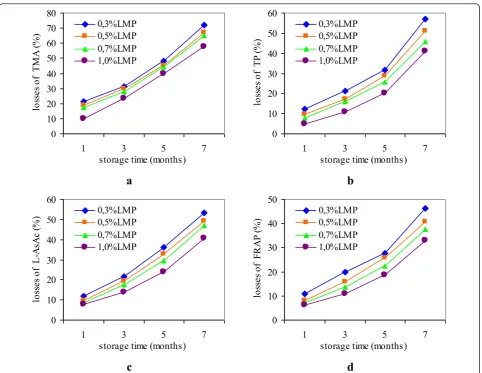
which leads in turn to color stabilization [35]. Prolonged storage may affect hydrolysis of compounds and lead to gradual reduction in anthocyanins content, as observed in our study. The level of monomeric anthocyanins decreases gradually during storage, losing about 23-31% from the value recorded one day after processing at the end of 3 months of storage (Figure 1a). Jam storage at room temperature for 7 months caused further reduc-tion of TMA content by 58-72% from the value recorded one day after processing. These findings of more extensive degradation of monomeric anthocyanins during storage at 20°C for jam with low dose of pectin are consistent with previously reported data [29]. Never-theless, it may be assumed that the oxidative reaction proceeds in jams during storage, even if the jams in our experiment were hot-packed into glass jars. A strong reduction of anthocyanins during storage was also reported for pigments of red raspberry jams [21]. Poly-phenoloxidase, peroxidase, and glycosidase enzymes can have a devastating effect on anthocyanins. Light expo-sure will promote pigment destruction while reduced water activity will enhance stability [4,19].
From the statistical test using two-way ANOVA it could be concluded that the stability of monomeric anthocyanins and the extent of their degradation was markedly affected by storage period and to a lesser extent by the LMP concentration (P < 0.05). It is evi-dently from the Table 2 that storage time has more influence on total monomeric anthocyanins content than the level of LMP. At any level of LMP the decrease of monomeric anthocyanins content with the storage time has statistically significance at P < 0.05. In contrast, for the fresh jam the decrease of monomeric anthocya-nins content with LMP content at P < 0.05 has not any statistical significance.
The effect of processing, LMP concentration and sto-rage for 7 months at 20°C on bilberry jam color was quantified by measuring the following color parameters: color density, polymeric color and polymeric color (%). Polymeric color (%) value is the ratio between polymeric color and color density being used to determine the per-centage of the color that is contributed by polymerized
Table 2 Alterations of total monomeric anthocyanins content in jam as effect of LMP concentration and storage time
Samples Total anthocyanins content (mg·100-1g jam)
storage time (months)
0 1 3 5 7
1.0% LMP 30.74 ± 1.86a, A 27.63 ± 1.54ab, A 23.56 ± 1.93b, A 18.45 ± 1.64c, A 13.04 ± 0.97d, A
0.7% LMP 30.01 ± 1.80a, A 24.77 ± 1.86b, A 21.60 ± 1.65b, A 16.68 ± 1.22c, A 10.46 ± 0.91d, B
0.5% LMP 28.12 ± 1.81a, A 22.75 ± 1.75b, AB 19.80 ± 1.61b, A 15.37 ± 1.13c, A 9.26 ± 0.75d, BC
0.3% LMP 26.63 ± 2.06a, A 20.95 ± 1.50b, AB 18.25 ± 1.45b, AB 13.74 ± 1.27c, AB 7.42 ± 0.58d, C
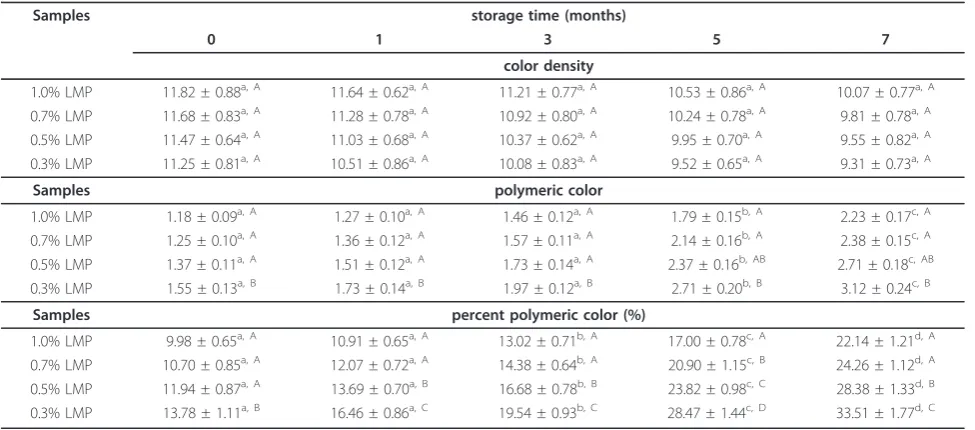
material [36]. Changes in the color parameters as response of LMP concentration and storage period rela-tive to fruit jam after a day of processing were presented in the Table 3. The polymeric color percent increased from 3.09% in fresh fruit to 9.98-13.78% in jam, depend-ing on LMP level, indicatdepend-ing that anthocyanin polymers were formed in response to processing. Increasing of polymeric color values were consistent with losses of TMA content due to processing and corroborates pre-vious studies [18,21,25,26], that reported increased poly-meric values in response to thermal processing of different berries. In addition to the formation of poly-meric pigments, losses of anthocyanins incurred during processing may be associated with enzymatic and ther-mal degradation. Exposure of the berries to elevated temperatures during jam production and pasteurization most likely contributed to losses as well, because antho-cyanins degradation is time and temperature dependent [25,36]. It has been demonstrated that the concentration
of polymeric pigments increases with storage period, and this has an important influence on the color stabi-lity of juices and red wines [4,19,34]. It is remarkable that the rate of color density loss is much slower than the rate of anthocyanins degradation. Even for major losses recorded for TMA only minor changes were found for color density of these products stored at 20°C, proving the stability of the jam color during the long-term storage. This can be explained by the fact that the color assigned of polymeric anthocyanins formed during storage, that are the source of “stable color” [18,19], likely compensated for the loss of color due to signifi-cant degradation of TMA during jam storage.
The effect of pectin level on jam color is still not accurately known. Pectin acts differently on the variety of anthocyanins that exist in berries. In some cases, pec-tin acts as a co-pigment, thus increasing the color [32,33]. It can be seen that decreasing of LMP concen-tration from 1 to 0.3% resulted in an increase of 4% in
0 10 20 30 40 50 60 70 80
1 3 5 7
storage time (months)
lo
sse
s o
f T
M
A
(%
) 0,3%LMP0,5%LMP 0,7%LMP 1,0%LMP
0 10 20 30 40 50 60
1 3 5 7
storage time (months)
lo
sse
s o
f T
P (
%
)
0,3%LMP 0,5%LMP 0,7%LMP 1,0%LMP
a b
0 10 20 30 40 50 60
1 3 5 7
storage time (months)
lo
sse
s o
f L
-A
sA
c (
%
) 0,3%LMP
0,5%LMP 0,7%LMP 1,0%LMP
0 10 20 30 40 50
1 3 5 7
storage time (months)
lo
sse
s o
f F
R
A
P (
%
) 0,3%LMP0,5%LMP 0,7%LMP 1,0%LMP
c
d
polymeric color percent recorded after one day of jam processing. After 7 months of storage the same reduc-tion of LMP concentrareduc-tion determined an increase of approx. 11% in polymeric color percent. For jams with the same dose of pectin, the polymeric color percent increased progressively with extended of storage period. At the end of storage period, the highest value of poly-meric color percent (28-33.5%) were obtained for sam-ples with the lowest LMP doses (0.3-0.5%). In our study, during jam storage, a tendency towards slowing of increase in polymeric color values with increasing of LMP concentration in the jam recipe was remarked. This is due to associantions formed as a results of inter-actions between anthocyanins flavilium cation and the dissociated carboxilic grups of the pectin. It is likely that due to this stabilising effect, anthocyanins may be pre-vented of condensation reactions among anthocyanins and procyanidins. The crosslink formed between antho-cyanins and procyanidins is no more stable than those existing between anthocyanins and pectin.
From the statistical test using two-way ANOVA it may be noted that the LMP dose did not exert a major impact on the polymeric color percent recorded for a jam immediately after processing, but with increasing of storage time its effect became statistically significant (P < 0.05). Color density decreased as effect of thermal processing of bilberry from 12.31 in fresh berries to 11.25-11.82 in jam, in relation to LMP level. It can be observed that the color density of jam undergoes minor changes by increasing the LMP dose from 0.3 to 1%. Following the analysis of color after one day of jam pro-cessing was a slight increase in color density value of
approx. 5% by increasing the LMP level from 0.3 to 1%. This increase becomes 7.5% after 7 of months of jam storage at 20°C. This parameter decreased slightly with increasing of storage time, so that, even after 7 months there were no significant changes in the color density. Thus, on the basis of statistical test using two-way ANOVA it could be concluded that the LMP concentra-tion and storage time induced non-significant changes in color density (Table 3), demonstrating that this para-meter was not only stable in response to processing but were also stable during long-term storage.
Total phenolics content
The impact of thermal processing on the TP content was appreciated in the basis of the values that where recorded in fruit and jam. Also, the effect of LMP con-centration and storage period on the TP content in bil-berry jam was examined and the results are presented in Table 4. It can be observed that, by thermal processing of wild bilberries have occurred major alterations of TP content. Previous studies reported losses in TP content as effect of thermal processing of various berries, but the degree of alteration of total phenolics had different magnitudes [13,16,20].
A significant decrease in TP contents between 42-51% of the value registered directly after processing was observed as a result of processing. The largest loss in TP content was noticed after processing in jam with 0.3% pectin. By increasing the LMP dose from 0.3 to 1% has been an increase in TP content about 16% for bil-berries jam after a day of processing. In addition to the LMP dose used in the jam recipe it was noted that the
Table 3 Changes of jam color as effect of LMP concentration and storage time
Samples storage time (months)
0 1 3 5 7
color density
1.0% LMP 11.82 ± 0.88a, A 11.64 ± 0.62a, A 11.21 ± 0.77a, A 10.53 ± 0.86a, A 10.07 ± 0.77a, A
0.7% LMP 11.68 ± 0.83a, A 11.28 ± 0.78a, A 10.92 ± 0.80a, A 10.24 ± 0.78a, A 9.81 ± 0.78a, A
0.5% LMP 11.47 ± 0.64a, A 11.03 ± 0.68a, A 10.37 ± 0.62a, A 9.95 ± 0.70a, A 9.55 ± 0.82a, A
0.3% LMP 11.25 ± 0.81a, A 10.51 ± 0.86a, A 10.08 ± 0.83a, A 9.52 ± 0.65a, A 9.31 ± 0.73a, A
Samples polymeric color
1.0% LMP 1.18 ± 0.09a, A 1.27 ± 0.10a, A 1.46 ± 0.12a, A 1.79 ± 0.15b, A 2.23 ± 0.17c, A
0.7% LMP 1.25 ± 0.10a, A 1.36 ± 0.12a, A 1.57 ± 0.11a, A 2.14 ± 0.16b, A 2.38 ± 0.15c, A
0.5% LMP 1.37 ± 0.11a, A 1.51 ± 0.12a, A 1.73 ± 0.14a, A 2.37 ± 0.16b, AB 2.71 ± 0.18c, AB
0.3% LMP 1.55 ± 0.13a, B 1.73 ± 0.14a, B 1.97 ± 0.12a, B 2.71 ± 0.20b, B 3.12 ± 0.24c, B
Samples percent polymeric color (%)
1.0% LMP 9.98 ± 0.65a, A 10.91 ± 0.65a, A 13.02 ± 0.71b, A 17.00 ± 0.78c, A 22.14 ± 1.21d, A
0.7% LMP 10.70 ± 0.85a, A 12.07 ± 0.72a, A 14.38 ± 0.64b, A 20.90 ± 1.15c, B 24.26 ± 1.12d, A
0.5% LMP 11.94 ± 0.87a, A 13.69 ± 0.70a, B 16.68 ± 0.78b, B 23.82 ± 0.98c, C 28.38 ± 1.33d, B
0.3% LMP 13.78 ± 1.11a, B 16.46 ± 0.86a, C 19.54 ± 0.93b, C 28.47 ± 1.44c, D 33.51 ± 1.77d, C
storage period affects the TP content, but these changes showed statistical significance (P < 0.05), only after 7 months of storage at 20°C (Table 4). Thus, after one month of storage at 20°C, TP content decreased with 5-12% from the value recorded one day after processing. By extending the storage time to 7 months the losses reaching 41-47% from the value that was recorded after one day of processing (Figure 1b). At the end of the experiment, it was found that in the jams with higher LMP doses (0.7-1%) the polyphenolic compounds are affected to a lesser extent than in the jams obtained with lower doses of pectin. This suggests that total phe-nolics compounds in bilberries jam with high LMP level have a better stability compared to jam with loss doses of pectin.
L-ascorbic acid content
Based on data registered for L-ascorbic acid content in fresh fruit (Table 1) and jam directly after processing (Table 5) and considering the amount of fresh fruit needed to obtain 100 g, could be observed that thermal processing of fruit induced significant alterations in L-AsAc content in agreement with other previous results [12]. Thus, thermal processing of fruit caused a loss of 53-58% from L-AsAc content recorded in fresh fruit. In Table 5 was showed the effect of LMP concentration and storage time at 20°C on L-AsAc content of bilberry jam.
By analyzing these data it can be noted that the decrease of LMP dose in the jam recipe causes a reduc-tion in L-ascorbic acid content. The highest degree of
L-AsAc alteration was recorded in jam obtained with 0.3% pectin. By reducing of LMP level from 1 to 0.5% the recorded loss is around 4.5% from the L-ascorbic acid content and by lowering the LMP dose from 1 to 0.3% the losses were around 11%. Storage at room tem-perature also influenced the amount of L-AsAc and the effect was more expressed in jam with 0.3% LMP than in jams with 0.7-1% LMP. It was found that a storage period of 3 months at 20°C induces loss of L-AsAc con-tent of 14% for jam with 1% LMP and 22% for jam with 0.3% LMP. However, statistical evaluation showed that 3 months of jam storage at room temperature there was no significance difference (p < 0.05) in L-AsAc content regardless of the LMP concentration. Extending the sto-rage period to 7 months resulted in significant altera-tions (p < 0.05) in L-AsAc content, the losses reaching 41-53% from the value recorded one day after proces-sing, (Figure 1c). During storage time, with decreasing of LMP concentration in the bilberry jam occurred sig-nificant loss of L-AsAc content. These observations sug-gest that L-AsAc was more stable in jam with high LMP doses in response of both processing and long-term sto-rage at 20°C.
Antioxidant activity
A comparison of the FRAP values in fresh fruit (Table 1) and jam (Table 6) showed that 36-47% of the corre-sponding fresh fruit antioxidant capacity was lost during jam processing. These results were consistent with data reported previously by Schmidtet al.[13], Savikinet al. [16], Scibiszet al.[17], Howardet al.[20], demonstrating Table 4 Alterations of total phenolics content in jam as effect of LMP concentration and storage
Samples Total phenolics (mg gallic acid·100-1g jam) storage time (months)
0 1 3 5 7
1.0% LMP 275.41 ± 18.73a, A 261.83 ± 13.64a, A 244.80 ± 18.74a, A 219.33 ± 17.0ab, A 163.19 ± 11.89b, A
0.7% LMP 260.11 ± 17.0a, A 239.71 ± 15.33a, A 219.32 ± 15.30ab, A 193.78 ± 15.35b, A 141.09 ± 8.56c,A
0.5% LMP 248.22 ± 13.61a, A 224.43 ± 11.91a, A 205.71 ± 11.92ab, AB 176.81 ± 11.91b, AB 122.43 ± 6.84c,AB
0.3% LMP 231.23 ± 18.71a, A 204.03 ± 17.3a, AB 181.93 ± 13.61ab, AB 158.1 ± 11.94b, AB 98.59 ± 8.51c,AB
Means in a row (a-d across storage time) followed by the same letter are not significantly different (P < 0.05). Means in a column (A-C across LMP concentration) followed by the same letter are not significantly different (P < 0.05).
Table 5 Alterations of L-ascorbic acid content in jam as effect of LMP concentration and storage
Samples L-ascorbic acid (mg·100-1g jam)
storage time (months)
0 1 3 5 7
1.0% LMP 5.51 ± 0.35a, A 5.08 ± 0.22a, A 4.74 ± 0.31ab, A 4.20 ± 0.21b, A 3.27 ± 0.24c,A
0.7% LMP 5.37 ± 0.25a, A 4.91 ± 0.30a, A 4.43 ± 0.36ab, A 3.79 ± 0.28b, A 2.85 ± 0.18c,A
0.5% LMP 5.26 ± 0.35a, A 4.74 ± 0.26a, A 4.24 ± 0.37ab, A 3.53 ± 0.29b, AB 2.66 ± 0.19c,AB
0.3% LMP 4.91 ± 0.37a, A 4.32 ± 0.30a, A 3.85 ± 0.35ab, A 3.15 ± 0.21b, AB 2.30 ± 0.15c,AB
that the antioxidant capacity of different berries signifi-cantly decreased after jam processing. This decrease can be attributed to the destruction of anthocyanins, pheno-lics compounds as well as L-ascorbic acid as a result of thermal treatment. Despite significant losses of anthocya-nins during thermal processing of fruit, the FRAP values recorded for jam were affected to a lesser extent. It was observed that thermal treatment has a lower impact on FRAP recorded in jam with high concentration of pectin. By decreasing the LMP dose in the bilberry jam formula-tion, antioxidant capacity declined (Table 6). Thus, by decreasing of the LMP dose from 1 to 0.3% there is a loss of antioxidant capacity of 17.53% of the values recorded one day after processing. In terms of changes in antioxi-dant capacity in response to storage, it is found that increases of storage time resulted in depreciations of antioxidant activity in the bilberry jam, depending on LMP concentration. The losses recorded in antioxidant activity after 3 month of storage at 20°C were in the range 11-20% relative to the value recorded one day after processing and after 7 months reached 33-46% from the value recorded one day after processing (Figure 1d). However, after 3 months of storage at 20°C there was no statistical significant difference (p < 0.05) in the antioxi-dant activity of investigated jams. Only after 7 months of storage, the alterations of FRAP were statistically signifi-cant (p < 0.05) for all LMP levels. We can say that the depreciation of the antioxidant properties of bilberry jam is accentuated by decreasing of pectin dose in the jam formulation as well as prolonged of storage time at 20°C. In respect of the storage effect, the alterations of FRAP values of jam was significant (p < 0.05), depending on the pectin concentration.
Correlations
A high positive correlation was detected between FRAP values and TP content recorded during the storage per-iod (r > 0.99) (Table 7). FRAP was also highly correlated with TMA content (r > 0.98) and with L-AsAc content (r > 0.99). A positive correlation between TP and TMA (r > 0.97) was observed, which is logical because antho-cyanins are the most important phenolic compounds present in bilberry [4,5].
Prioret al.[6] noted that phytochemicals responsible for the antioxidant activity in berries are most likely to be phenolic acids, anthocyanins, and other flavonoid com-pounds. A significant negative correlation was found between TMA content and polymeric color percent (r > 0.97) indicating that more polymeric products were accu-mulated with total anthocyanin degradation. Also, our results indicate that FRAP values and % polymeric color were negatively correlated (r > 0.96). In fruits such as bil-berries and in correspondent jam, where phenolic compo-nents and, more specifically, anthocyanins, make a significant contribution to total antioxidant activity, simple colorimetric tests such as the Folin-Ciocalteu test [37] for phenolics or the Giusti and Wrolstad anthocyanin test [38] can be useful in estimating changes in antioxidant activity during storage. Although total phenolics and L-ascorbic acid are the major potential candidates as a selection criterion for antioxidant properties of berries jams, antioxidant activity is not limited to these [12,26,27]. Previous results obtained by Tsaiet al.[39], Brownmiller
et al.[25] proved that polymeric anthocyanins show
anti-oxidant activity, which compensates for the loss of a part of antioxidant activity due to monomeric anthocyanins degradation. Also, it has been proven that some degrada-tion products of anthocyanins have the antioxidant activity [40]. Our data suggest that, after 7 months of storage at 20°C, antioxidant activity of fruit jam recorded lower depreciation compared with the content of investigated bioactive compounds. This is confirmed by the fact that a Table 6 Alterations of antioxidant activity in jam as effect of LMP concentration and storage
Samples Antioxidant activity (mM Fe2+·100-1jam) storage time (months)
0 1 3 5 7
1.0% LMP 2.45 ± 0.18a, A 2.30 ± 0.14a, A 2.18 ± 0.16a, A 1.99 ± 0.13ab, A 1.64 ± 0.12b, A
0.7% LMP 2.35 ± 0.17a, A 2.18 ± 0.16a, A 2.03 ± 0.15a, A 1.82 ± 0.09ab, A 1.46 ± 0.09b, A
0.5% LMP 2.14 ± 0.17a, A 1.97 ± 0.14a, A 1.80 ± 0.13a, A 1.59 ± 0.15ab, AB 1.27 ± 0.09b, AB
0.3% LMP 2.02 ± 0.14a, A 1.80 ± 0.12a, Ab 1.62 ± 0.15ab, AB 1.47 ± 0.09b,B 1.08 ± 0.10c, B
Means in a row (a-d across storage time) followed by the same letter are not significantly different (P < 0.05). Means in a column (A-C across LMP concentration) followed by the same letter are not significantly different (P < 0.05).
Table 7 Correlation coefficients obtained by simple regression model applied for investigated parameters
Y = A+B•X correlation coefficient (r) 1%
LMP
0.7% LMP
0.5% LMP
0.3% LMP
FRAP = f(TP) 0.99612 0.99915 0.99905 0.99815
FRAP = f(TMA) 0.98922 0.99379 0.99546 0.99451
FRAP = f(L-AsAc) 0.99983 0.99926 0.99937 0.99399
TP = f(TMA) 0.97696 0.98871 0.99675 0.98994
TMA = f(% polymeric color)
-0.9851 -0,97314 -0,97411 -0,9739
FRAP = f(% polymeric color)
storage period of 7 months does not induce significant changes in FRAP values, while for the other measured parameters such as total phenolics, monomeric anthocya-nins, L-ascorbic acid were noticed significant changes. More studies are required for comprehensive assessment of polymeric anthocyanins contribution to antioxidant activity of bilberry jam in storage.
Conclusions
It could be concluded from the results of this study that thermal processing of wild bilberries into low-sugar jams resulted in significant losses in TMA, TP, L-AsAc content and FRAP values. They also suggest that, TMA are more susceptible than the TP during thermal pro-cessing of bilberry. LMP concentration and storage time affected the antioxidant properties as well as color char-acteristics of bilberry jams. Thus, by increasing of LMP dose in jam recipe from 0.3 to 1% there was an increase in bioactive compounds and FRAP values. In terms of color quality, polymeric color was higher when jams were produced with low pectin concentration. For the same dose of pectin, with increasing of storage period was recorded an increase in depreciation of antioxidant characteristics. The storage of bilberry jam at 20°C for 1-3 months determined mild or moderate alterations of investigates parameters, while 7 months of storage induced statistically significant alterations. The losses of monomeric anthocyanins during storage of processed bilberry jams were accompanied by increased in the polymeric color values, indicating that monomeric anthocyanins were extensively polymerized. The poly-meric color values gradually increased during jam sto-rage, the largest increases occurring at the end of experiment, after 7 months. Despite significant losses of total monomeric anthocyanins, the color density values changed little during jam storage at 20°C, suggesting that polymeric compounds formed compensated the loss of color due to degradation of monomeric antho-cyanins, proving the stability of the jam color during 7 months of storage. Taking into account all these factors, and in spite of the fact that some losses occur in the content of total phenolics, anthocyanins, L-ascorbic acid as well as antioxidant activity, low-sugar bilberry jams are still excellent sources of nutritional substances with antioxidant potential. These products offer an important opportunity to create a healthy, seasonally independent and mixed diet.
Experimental
Berries
Bilberries (Vaccinium myrtillus L.) have been harvested in the summer of 2009 at the fully ripe stage from their natural habitat (mountain region of western Romania,
altitude 1200-1400 m). The berries were stored at 4°C for one day prior to processing.
Jam processing
Low-sugar bilberry jams were prepared in the laboratory, according to a traditional procedure, by boiling in an open kettle under atmospheric pressure, with manual stirring. The final soluble solids content reached upon cooking was 45°Brix. For the jams preparation, fruit (900 g) was blended and then cooked under atmospheric pressure with the addition of sucrose (470 g) Commercial low-methoxyl pec-tin (LM40, Danisco Ingredients, Denmark) was added at four different concentrations, 0.3, 0.5, 0.7 and 1% (m/V) at the final stage of the jam cooking. Citric acid was added towards the end of cooking for adjusting pH values for proper LMP gelatinization (2.8-3.3). Time of thermal pro-cessing was ~ 30 min at 80°C until the final product reached 45°Brix (determined with an Abbe refractometer at 20°C). The jam were filled into hot glass jars, capped and pasteurized at 80°C for 10 min. They were allowed to cool at room temperature and stored in the dark until ana-lysis. Jams were analyzed after a day of processing (0) and after 1, 3, 5 and 7 months of storage at 20°C.
By measure the weight of the jams before and after processing it was obtained the water loss incurred dur-ing cookdur-ing (aproximately 45 g per 1 kg of bilberry jam). Considering water loss recorded during thermal treatment, fresh fruit content per 100 g jam was recalcu-lated (about 69 g per 100 g jam). The amount of fruit needed to obtain 100 g jam provides information about the theoretical content of bioactive compounds from the bilberry jam. The difference between the theoretical content of investigated parameters and the real content recorded for bilberry jam was caused by thermal processing.
Analytical procedures
Chemicals
2,4,6-tripyridyl-s-triazine (TPTZ), gallic acid, Folin&Cio-calteu’s phenol reagent, sodium acetate, FeCl3·H2O, ACS spectrophotometric grade ethanol and other unspecified reagents were purchased from Sigma-Aldrich (Germany).
Preparation of extracts
In order to determine the total monomeric anthocyanins content, color density, polymeric color, total phenolic content, L-ascorbic acid and antioxidant activity, three replicates of fresh fruit and jam extracts were prepared according to Kaltet al.[41].
The extracts for analysis of total phenolics and L-ascorbic acid were obtained by blended samples (~5 g) in hot 95% (v/v) ethanol (10 mL) for 2 min. The solu-tion was filtered. The extracsolu-tion of the residue was repeated twice following above mentioned procedure. Three extracts were combined.
The extracts for antioxidant activity determination were obtained by blended samples (~20 g) in 95% (v/v) ethanol (20 mL) acidified with HCl (0.1%). After 60 min the solution was filtered. The residue was extracted again. The extracts were combined and diluted to volume of 50 mL with ethanol acidified with HCl (0.1%).
Total phenolic assay
The total phenolic content was quantified according to the method of Singletonet al.[37]. Briefly, an aliquot of 12.5μl of extract was mixed with 250 μl of 2% sodium carbonate solution and allowed to react for 5 minutes at room temperature. Then 12.5 μl of Folin-Ciocalteu phe-nol reagent (50%) was added and allowed to stand for 30 minutes at room temperature before the absorbance of the reaction mixture was read at 750 nm using the UV-VIS spectrophotometer (Analytic Jena Specord 205). Calibration was achieved with a gallic acid solution (10-100 mg·L-1). Results were expressed as mg gallic acid equivalent (GAE) per 100 g fresh bilberries, respectively jam (when calculating results of TP for bilberries jam). All determinations were performed in triplicate.
Antioxidant activity (FRAP assay)
The antioxidant activity of fresh berries, as well as of related jams was measured using the ferric reducing antioxidant power (FRAP) assay, a colorimetric test that measures the ability of the tested sample to reduce the ferric 2,4,6-tris(2-pyridyl)-1,3,5-triazine (TPTZ) complex to a blue-colored ferrous form at 37°C in pH 3.6 sodium acetate buffer, thereby changing its absorbance [42,43]. An aliquot of 8.5 μl of extract was added to 275 μl of diluted FRAP reagent and the samples were incubated at 37°C for 30 minutes before measuring the absorbance at 595 nm. A standard curve was prepared using differ-ent concdiffer-entrations (0.05-0.4 mM Fe2+·L-1) of FeS-O4·7H2O. The antioxidant activity based on the ability to reduce ferric ions of the extract was expressed as mM Fe2+equivalents per 100 g fresh bilberries, respec-tively jam. All solutions were used on the day of pre-paration and all determinations were performed in triplicate.
Determination of L-Ascorbic acid
L-Ascorbic acid or vitamin C content was measured by titration with a 2,6-dichlorophenolindophenol sodium salt solution and chloroform was used for intensely colored extracts (AOAC) [44]. Results were expressed in mg L-AsAc equivalent per 100 g fresh bilberries, respec-tively jam.
Total monomeric anthocyanin content, color density and polymeric color measurements
Total monomeric anthocyanin content was performed using a pH differential method [38]. Anthocyanin pig-ments undergo reversible structural transformations with a change in pH manifested by different absorbance spectra. The colored oxonium form predominates at pH 1.0 and the colorless hemiketal form at pH 4.5. An ali-quot of an appropriately diluted extracts was adjusted to pH 1.0 and another aliquot to pH 4.5. The difference in absorbance at 520 nm is proportional to the TMA con-tent. Sample extracts were further diluted 15-fold with 0.025 M potassium chloride buffer (pH = 1.0) or 0.4 M sodium acetate buffer (pH = 4.5). The absorbance of each dilution was measured at 520 and 700 nm against a distilled water blank using a UV-visible spectrophot-ometer (Specord 205 by Analytik Jena) and 1 cm path length glass cells.
The absorbance value (A) calculated according to the equation (1) is proportional to the total monomeric anthocyanin content.
A =(A520nm−A700nm)pH=1.0−(A520nm−A700nm)pH=4.5 (1)
The monomeric anthocyanins content was expressed as mg per 100 g fresh bilberries, respectively jam using a molar extinction coefficient of 26 900 and a molecular weight of 449.2 of the most prevalent anthocyanin (usually cyanidin-3-glucoside). All measurements were done in triplicate.
The percent contribution by polymerized anthocya-nins was evaluated using absorbance values at the speci-fied wavelengths, determined with and without added potassium metabisulfite [38]. All of the measurements were done in triplicate. Sample extracts were diluted with water in order to have an absorbance reading between 0.5 and 1.0 at 520 nm. For analysis, 0.2 mL of 0.90 M potassium metabisulfite were added to 2.8 mL diluted sample (bisulfite bleached sample) and 0.2 mL of distilled water were added to 2.8 mL diluted sample (non bleached, control sample). After equilibrating for 15 min samples were evaluated at l = 700, 520, and 420 nm.
Color density was calculated using the control sample according to the equation (2):
Color dencity =[(A420nm−A700nm)+(A520nm−A700nm)]·dilution factor (2)
Polymeric color was determined using the bisulfite-bleached sample using the equation (3):
Percent polymeric color was calculated using the equation (4):
Polymeric color(%) =polymeric color
color density ·100 (4)
Statistical analysis
Results are presented as means ± standard deviation (SD) of triplicate measurements. Significant statistical differences of investigated parameters were determined by Fisher’s least significant differences (LSD) test at P < 0.05, after analysis of variance (ANOVA) of a two-factor experiment in an factorial designs with four LMP con-centration, five storage period and three replicates as sources of variation. Computations Tukey post-hoc means comparisons and Levene’s test for equal variance was also included. Statistical processing of data was per-formed using the statistical program known as the Sta-tistical Analysis System (SAS, 2001). Correlations between investigated parameters were established by regression analysis.
Abbreviations
LMP: low-methoxyl pectin; TMA: total monomeric anthocyanins; TP: total phenolics; L-AsAc: L-ascorbic acid; FRAP: ferric reducing antioxidant power.
Acknowledgements
This study was supported by S.C. ETCO EUROPE TRADE COMPANY from SEBIS (ARAD), research project no. 637/21.01.2009, Theme:Studies regarding the impact of technological treatments on the antioxidant characteristics of products from berries, Project Manager: Ph.D Assoc. Prof. Mariana-Atena Poiana
Authors’contributions
MAP conceived the research design, performed jam processing, TMA, FRAP and color analysis, results interpretation and manuscript preparation. EA contributed to jam processing, performed extractions, TP and L-AsAc analysis, CM contributed to the color analysis, performed statistical analyses and helped to interpretation of data. All authors read and approved the final version of the manuscript.
Competing interests
The authors declare that they have no competing interests.
Received: 10 November 2011 Accepted: 16 January 2012 Published: 16 January 2012
References
1. Giovanelli G, Buratti S:Comparison of polyphenolic composition and antioxidant activity of wild Italian blueberries and some cultivated varieties.Food Chem2009,112:903-908.
2. Jabłonska-Rys E, Zalewska-Korona M, Kalbarczyk J:Antioxidant capacity, ascorbic acid and phenolics content in wild edible fruits.J Fruit Ornam Plant Res2009,17:115-120.
3. Rababah TM, Mahasneh MA, Kilani I, Yang W, Alhamad MN, Ereifej K, Al-U’datt M:Effect of jam processing and storage on total phenolics, antioxidant activity, and anthocyanins of different fruits.J Sci Food Agric 2011,91:1096-1102.
4. Skrede G, Wrolstad RE, Durst RW:Changes in anthocyanins and polyphenolics during juice processing of highbush blueberries (Vaccinium corymbosumL.).J Food Sci2000, ,65:357-364.
5. Moyer RA, Hummer KE, Finn CE, Frei B, Wrolstad RE:Anthocyanins, phenolics, and antioxidant capacity in diverse small fruits:Vaccinium,
RubusandRibes.J Agric Food Chem2002,50:519-25.
6. Prior RL, Cao G, Martin A, Sofic E, McEwen J, O’Brien C, Lischner N, Ehlenfeldt M, Kalt W, Krewer G, Mainland CM:Antioxidant capacity as influenced by total phenolic and anthocyanin content, maturity, and variety ofVacciniumspecies.J Agr Food Chem1998,46:2686-2693. 7. Proteggente AR, Pannala AS, Paganga G, Van Buren L, Wagner E,
Wiseman S, Van De Put F, Dacombe C, Rice-Evans CA:The antioxidant activity of regularly consumed fruit and vegetables reflects their phenolic and vitamin C composition.Free Radic Res2002,36:217-233. 8. Kalt W, Mc Donald JE, Donnor H:Anthocyanins, phenolics, and
antioxidant capacity of processed lowbush blueberry products.J Food Sci2000,65:390-393.
9. Smith MAL, Marley KA, Seigler D, Singletary KW, Meline B:Bioactive properties of wild blueberry fruits.J Food Sci2000,65:352-356. 10. Zafra-Stone S, Yasmin T, Bagchi M, Chatterjee A, Vinson JA, Bagchi D:Berry
anthocyanins as novel antioxidants in human health and disease prevention.Mol Nutr Food Res2007,51:675-683.
11. Rossi M, Giussani E, Morelli R, Lo Scalzo R, Nani RC, Torreggiani D:Effect of fruit blanching on phenolics and radical scavenging activity of highbush blueberry juice.Food Res Int2003,36:999-1005.
12. Klopotek Y, Otto K, Bohm V:Processing strawberries to different products alters contents of vitamin C, total phenolics, total anthocyanins, and antioxidant capacity.J Agric Food Chem2005,53:5640-5646. 13. Schmidt BM, Erdman JW Jr, Lila MA:Effects of food processing on
blueberry antiproliferation and antioxidant activity.J Food Sci2005,70: S389-394.
14. Szajdek A, Borowska EJ:Bioactive compounds and health-promoting properties of berry fruits: A review.Plant Food Hum Nutr2008,63:147-156. 15. Gimenez J, Kajda P, Margomenou L, Piggott JR, Zabetakis I:A study on the
colour and sensory attributes of high-hydrostatic-pressure jams as compared with traditional jams.J Sci Food Agric2001,81:1228-1234. 16. Savikin K, Zdunic G, Jankovic T, Tasic S, Menkovic N, Stevic T, Dordevic B:
Phenolic content and radical scavenging capacity of berries and related jams from certificated area in Serbia.Plant Foods Hum Nutr2009,
64:212-217.
17. Scibisz I, Mitek M:Effect of processing and storage conditions on phenolic compounds and antioxidant capacity of highbush blueberry jams.Pol J Food Nutr Sci2009,59:45-52.
18. Yuksel S, Koka I:Color stability of blackberry nectars during storage.J Food Technol2008,6:166-169.
19. Wrolstad RE, Durst RW, Lee J:Tracking color and pigment changes in anthocyanin products.Trends Food Sci Tech2005,16:423-428. 20. Howard LR, Castrodale C, Brownmiller C, Mauromoustakos A:Jam
processing and storage effects on blueberry polyphenolics and antioxidant capacity.J Agric Food Chem2010,58:4022-4029. 21. Garcia-Viguera C, Zafrilla P, Artes F, Romero F, Abellan P,
Tomas-Barberan FA:Colour and anthocyanin stability of red raspberry jam.J Sci Food Agric1998,78:565-573.
22. Garcia-Viguera C, Zafrilla P, Romero F, Abellan P, Artes F, Tomas-Barberan FA:Color stability of strawberry jam as affected by cultivar and storage temperature.J Food Sci1999,64:243-247.
23. Kim DO, Padilla-Zakour OI:Jam processing effect on phenolics and antioxidant capacity in anthocyanin-rich fruits: cherry, plum and raspberry.J Food Sci2004, ,69:395-400.
24. Srivastava A, Akoh CC, Yi W, Fischer J, Krewer G:Effect of storage conditions on the biological activity of phenolic compounds of blueberry extract packed in glass bottles.J Agric Food Chem2007,
55:2705-2713.
25. Brownmiller C, Howard LR, Prior RL:Processing and storage effects on monomeric anthocyanins, percent polymeric color, and antioxidant capacity of processed blueberry products.J Food Sci2008,73:H72-79. 26. Ngo T, Wrolstad RE, Zhao Y:Color quality of Oregon strawberries - impact
of genotype, composition and processing.J Food Sci2007,72:C25-32. 27. Bursac Kovacevic D, Levaj B, Dragovic-Uzelac V:Free radical scavenging
activity and phenolic content in strawberry fruit and jam.Agriculturae Conspectus Scientificus2009,74:155-159.
gelatin gels enriched with grape pomace extracts.Eur Food Res Technol 2009,229:949-960.
29. Kopjar M, Pilizota V, Tiban NN, Subaric D, Babic J, Ackar D:Effect of different pectin addition and its concentration on colour and textural properties of raspberry jam.Deutsch Lebensm Runds2007,103:164-168. 30. Kopjar M, Pilizota V, Tiban NN, Subaric D, Babic J, Ackar D, Sajdl M:
Strawberry jams: influence of different pectins on colour and textural properties.Czech J Food Sci2009,27:20-28.
31. Pinto MS, Lajolo FM, Genovese MI:Bioactive compounds and antioxidant capacity of strawberry jams.Plant Foods Hum Nutr2007,62:127-131. 32. Lewis CE, Walker JRL, Lancaster JE:Effect of polysaccharides on the colour
of anthocyanins.Food Chem1995,54:315-319.
33. Kopjar M, Pilizota V, Subaric D, Babic J:Prevention of thermal degradation of red currant juice anthocyanins by phenolic compounds addition.
Croat J Food Sci Technol2009, ,1:24-30.
34. Withy LM, Nguyen TT, Wrolstad RE, Heatherbell DA:Storage changes in anthocyanin content of red raspberry juice concentrate.J Food Sci1993,
58:190-192.
35. Hubbermann EM, Heins A, Stőckmann H, Schwarz K:Influence of acids, salt, sugars and hydrocolloids on the colour stability of anthocyanins rich blackcurrant and elderberry concentrates.Eur Food Res Tech2006,
223:83-90.
36. Rommel A, Wrolstad RE, Heatherbell DA:Blackberry juice and wine: processing and storage effects on anthocyanin composition, color and appearance.J Food Sci1992,57:385-391.
37. Singleton VL, Orthofer R, Lamuela-Raventos RM:Analysis of total phenols and other oxidation substrates and antioxidants by means of Folin-Ciocalteu reagent.Meth Enzymol1999,299:152-178.
38. Giusti MM, Wrolstad RE, Unit F1.2:Characterization and measurement of anthocyanins by UV-visible spectroscopy.InHandbook of food analytical chemistry-pigments, colorants, flavors, texture, and bioactive food components. Edited by: Wrolstad RE. New York: Wiley and Sons; 2005:1-13.
39. Tsai PJ, Huang HP, Huang TC:Relationship between anthocyanin patterns and antioxidant capacity in mulberry wine during storage.J Food Quality 2004,27:497-505.
40. Tsai O, Huang H:Effect of polymerization on the antioxidant capacity of anthocyanins in Roselle.Food Res Intl2004,37:313-318.
41. Kalt W, Forney CF, Martin A, Prior RL:Antioxidant capacity, vitamin C, phenolics and anthocyanins after fresh storage of small fruits.J Agric Food Chem1999,47:4638-4644.
42. Benzie IFF, Strain L:Ferric reducing ability of plasma (FRAP) as a measure of antioxidant power: The FRAP assay.Anal Biochem1996,239:70-76. 43. Stef DS, Gergen I, Trasca TI, Harmanescu M, Stef L, Biron R, Hegedus MG:
Total antioxidant and radical scavenging capacities for different medicinal herbs.Rom Biotech Lett2009,14:4705-4710.
44. AOAC:Vitamin C (ascorbic acid) in vitamin preparations and juices.In Official Methods of Analysis..15 edition. Edited by: Helrich K. AOAC, Inc., Arlington VA; 2000:1058.
doi:10.1186/1752-153X-6-4
Cite this article as:Poianaet al.:Tracking antioxidant properties and color changes in low-sugar bilberry jam as effect of processing, storage and pectin concentration.Chemistry Central Journal20126:4.
Open access provides opportunities to our colleagues in other parts of the globe, by allowing
anyone to view the content free of charge.
Publish with
Chemistry
Central and every
scientist can read your work free of charge
W. Jeffery Hurst, The Hershey Company.
available free of charge to the entire scientific community peer reviewed and published immediately upon acceptance cited in PubMed and archived on PubMed Central yours you keep the copyright
Submit your manuscript here: