ISSN: 2146-4138 www.econjournals.com
Competition and Stability: An Analysis of the Turkish Banking System
Ömer İskenderoğlu
Faculty of Economics and Business Administration Niğde University, Turkey.
Email: [email protected]
Serpil Tomak
Vocational School of Social Sciences, Department of Management and Organization,
Mersin University, Turkey. Email: [email protected]
ABSTRACT: This paper examines the relationship between competition and stability in the Turkish banking sector using quarterly bank level data of 15 private commercial banks (domestic and foreigned-owned) between 2002-2012. There have been many theories stand out on the relationship between competition and stability of the banking sector so far. But theories of the competition-fragility view and competition-stability view are widely accepted theories in the literature. Dynamic panel data approach is employed to test the related tehories. However our findings indicate that the relationship between concentration and competition is not clear enough to emphasize a strict inference.
Keywords: Competition; banking stability; financial system fragility
JEL Classifications: G21; G32
1. Introduction
The financing of the economy as the most important brokerage houses, banks' trading behavior and healthy functioning is important in terms of the economic system. There have been many studies on the relationship between competition and stability of the banking sector in the literature. A case of competition, product and market development in favor of consumers, market players in terms of increased efficiency, is the essence of a free market economy. Unlike the other industries, a high level of competition in banking sector is accepted as dangerous because it leads to instability of financial system. Therefore, there is a concensus in the literature that a certain balance between competition and stability should be established.
As a regulatory and supervisory roles of governments for the purpose of protection financial stability, they occasionally intervene in the banking sector. Within this context, financial authorities need to answer the following questions: Is it necessary to limit competition in order to protect financial stability and competitive forces? or should it be restricted ? and What elements of competitiveness improve the financial stability? Competition policy is generally based on the formation and scope of market power, and the limitation of fraud (Canoy et al., 2001:30). Effective competition policy establishment is important for smooth functioning of other sectors and the development of financial sector. However, given the global dimensions of financial markets, how competition policy is or should be organized is rather a complex issue.
In controlling the possibility of banks' risk levels –controlling excessive risk-taking- and bankruptcy, decision-makers has some instruments: the permitted scope of activities, portfolio constraints, the last credit authority, capital liabilities (adequacy), liquidity and reserve, deposit reserve quantities, high-risk rules, the internal risk management, the industry entry-exit-branching, network, the permitted scope of activities, portfolio constraints, the last credit authority, capital liabilities, liquidity and reserve, deposit reserve quantities. Most of the requlations are carried out in order to protect bank customers. Deposit insurance practices and the obligation of informing the public arrangements are made for this purpose (Vives, 2001:535; Canoy et al,, 2001:46). As new financial products and services emerge in the system, new regulations and adjustment of competition policy are needed (Claessens, 2009:26). Despite a consensus on the relationship between competition and the fragility in literature, there is a strong divergence in the direction of the relationship among them. In this context, three different views stand out in the literature. This paper examines the relationship between competition and stability in the Turkish banking sector within relevant theoretical assumptions. The rest of this paper is structured as follows. Section 2 outlines the litterature review, section 3 gives a brief information about Turkish banking system, section 4 explains the methodology, section 5 shows data and variables, section 6 and section 7 are empirical results and conclusion respectively.
2. Literature Review
Theoretical and empirical models on the relationship between concentration, competition and stability make opposite predictions. Opinions on this issue is discussed in the literature under two topics: competition-fragility approach and competition- stability approach. In these theories competition concept is considered as deposits, assets size of bank balance sheets and the portfolio maximization problem (Beck et al., 2010:17). However, it is not easy to determine the level of trade-offs among competition and stability (or other concerns) in the financial sector. As the determination of the precedents and the degree of competition becomes complicated, competition policy is a complex issue and is not easy to analyze.
According to the competition-fragility view, whereas policies to protect financial stability adversely affect competition among banks, practices to increase competition is detrimental to financial stability. The majority of academic studies adopt this approach. In the traditional charter or franchise value view, more concentrated and less competition level, is considered to be more stable banking systems on account of profits will be the provider of support for the financial fragility and encourage high rate of risk taking (Beck et al., 2010:18). In addition, authorities can audit more efficiently banking sector with a small number of large banks, so that the risk of crisis will decline further. In other words, a high level of competition weakens the market power, a high level of competition weakens the power of the market, decreasing profit margins and as a result, the franchise value of banks is decreasing. In this case, efforts to boost returns leading to banks take more risks.
Increased competition in the banking sector is able to distort the financial stability. For example, intense competition leads banks to undertake –narrowing profit margins - risky activities. High risk, increases the possibilities for bank insolvency and undermines public confidence in the financial system. Contagion effects of the banks failure produce strong negative externality both for the financial sector and for the real sector with a large social cost and moral-hazard problem (Vives,2001:538). Therefore, the case of large-scale banks and mid-level competition is considered as the most important shield for stability in this approach (Canoy et al., 2001:9). As the banks' market power increases, their franchise values also increase. Franchise value is a value that is valid as long as the bank operates. Such banks, because of the opportunity cost of going bankrupt would be very high, comply with “too big to fail” doctrine (Mishkin, 1999), banks are reluctant to get into risky activities; they have low levels of debt or a higher rate of portfolio equity holding to reduce the riskiness of the loan. Keeley (1990) finds a positive relation between levels of concentration and bank stability.
financial stability. In a second-best world, concentration may be socially preferable to perfect competition and perfect stability may be socially undesirable.”
According to competition-stability view; concentrated banking structure and low competition lead to increased financial fragility. Concentrated banking systems, by increasing market power, would allow banks to reflect this to its customers as a higher interest rate. In contrast to the charter-value hypothesis that higher interest rates weaken the power of redemption, the more risky areas of lending to the system by pulling back on credit risk and as a result of increase in the moral hazard and the adverse selection problem. In addition, increased competition causes banks to take more risk. Even though increased the risk level, use of banks own resources or take other risk-mitigating measures still enable the stability of financial system. Boyd and De Nicoló (2005) refers as the market power increases, it would destabilize the system and may distort the financial stability. Boyd and De Nicoló (2005) advocates competition-stability approach and indicate as banking concentration increases, the probability of bankruptcy has increased. They reject the trade-off between competition and concentration. Most of the studies on the economies of developed countries support the competition-stability view [Carletti ve Hartmann (2002); Claessens and Laeven (2004); Boyd, De Nicoló and Jalal (2006); Uhde and Heimeshoff (2009); Schaeck et al., (2009)]. Contrary to competition-fragility
hypothesis, their results support the competition-stability literature. As an alternative approach to these two opposite views, it can be adopted a third approach
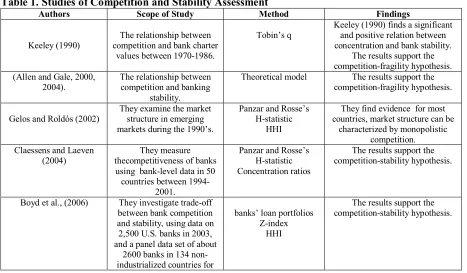
involving the combination of these two approaches. In this approach, the direction of the relationship between competition and bank fragility could differ based on the economic structure and relations. With in this context, it is impossible to make judgements that is always and prevalent everywhere. According to Martinez-Miera and Repullo (2010) whereas risk-shifting effect –identified by Boyd and De Nicoló (2005)- prevalent in monopolistic markets, competitive markets are dominated by the margin effect. Therefore, there has been an established U-shaped relationship between competition and bankruptcy. In risk-shifting effect posed by Boyd and De Nicoló (2005) as a result of more competition leading to less debt level, low level of credit risk and more secure banks. Consequently, low debt levels lead to low income level. Low level of income supports the low debt level losses, but leads to have risky banks. Therefore, economies try to establish a certain balance between competition and stability. However, the scope of arrangements that should be made up for specific situations and markets is rather complex issue. This will be depend on the level at which bank operates and balancing the environmental conditions. A literature survey on competition and stability assessment are listed in table 1.
Table 1. Studies of Competition and Stability Assessment
Authors Scope of Study Method Findings
Keeley (1990)
The relationship between competition and bank charter
values between 1970-1986.
Tobin’s q
Keeley (1990) finds a significant and positive relation between concentration and bank stability.
The results support the competition-fragility hypothesis. (Allen and Gale, 2000,
2004).
The relationship between competition and banking
stability.
Theoretical model The results support the competition-fragility hypothesis.
Gelos and Roldós (2002)
They examine the market structure in emerging markets during the 1990’s.
Panzar and Rosse’s H-statistic
HHI
They find evidence for most countries, market structure can be
characterized by monopolistic competition. Claessens and Laeven
(2004)
They measure thecompetitiveness of banks
using bank-level data in 50 countries between
1994-2001.
Panzar and Rosse’s H-statistic Concentration ratios
The results support the competition-stability hypothesis.
Boyd et al., (2006) They investigate trade-off between bank competition and stability, using data on 2,500 U.S. banks in 2003, and a panel data set of about
2600 banks in 134 non-industrialized countries for
banks’ loan portfolios Z-index
HHI
the period 1993-2004. Beck et al., (2004, 2005,
2010)
They examine bank concentration and the impact
on banking fragility. they take into account systemic banking crises using data on
69 countries between 1980- 1997.
Concentration ratios
The results support the competition-fragility hypothesis.
Ariss (2009)
Banking structures and competitive conditions for
58 Islamic and 192 conventional banks operating in 13 different countries during the period
2000-2006.
Panzar and Rosse’s H-statistic
HHI Lerner Index
They conclude that the global Islamic banking market is both
more concentrated and less competitive compared to the conventional banking segment.
Uhde and Heimeshoff (2009)
They test the banking market concentration effect on financial stability for EU
countries between 1997-2005.
Z-index banks’ loan portfolios
The results support the competition-stability hypothesis.
They find that market concentration has a negative
impact on European banks’ financial soundness.
Berger et al., (2009)
They test risk-taking
behavior of banks using data for 8,235 banks in 23
developed nations. nonperforming loans ratio Z-index HHI Lerner Index
They conclude that “consistent with the competition-fragility view, banks with a higher degree
of market power also have less overall risk exposure. However,
the data also provides some support for one element of the competition-stability view- that market power does increase loan risk in these nations. This risk may
be offset in part by higher equity capital ratios”
Schaeck et al., (2009)
The relationship between competition and banking system fragility is held on
macro perspective.
Panzar and Rosse’s H-statistic
They find evidence on competition-stability view in 38
countries between 1980-2003.
Martinez-Miera and Repullo (2009)
Analyzing trade-off between competition and stability in
banking.
Theoretical model They find U-shaped relationship between competition and the risk
of bank failure.
Angelov and Asadov (2010)
This paper examines the relationship between competition and financial stability for U.S. banking in the period between 1984 and
2004.
Z-index HHI
They find that there is a trade-off between competition and stability
in the U.S. banking sector.
Fungáčová et al., (2010)
Analyzing the bank competition level in Russian
banking sector in the period of 2001-2007.
loans to total assets HHI Lerner Index
The results support the competition-fragility hypothesis.
Deltuvaitė (2010)
The relationship between concentration and stability
for Lithuania banking system between 1987-2007.
Z-index Concentration ratios
The results support the competition-fragility hypothesis
for Lithuania Banks
Anzoategui et al., (2010) This paper examines the extent of bank competition
in the Middle East and Northern Africa region during 1994–2008.
Panzar and Rosse’s H-statistic Lerner Index
They find evidence that banking sector competition in MENA is lower than in most regions of the
developing nations.
Jimenez et al., (2010)
The relationship between bank competition and risk-taking. They examine the
trade-off between competition and bank risk
for spanish banks.
nonperforming loans ratio HHI
Lerner Index
Their findings support the charter-value hypothesis
Because of the paradoxically theoretic predictions and empirical findings, the relationship between bank concentration, competition, and systemic banking crisis is not strong enough. Besides, these three different views are criticized about not taking into account the financial environment in which the bank operates. Different economic developments, distinguishes the bank's policies and practices followed. In terms of productional and allocational efficiency and growth, various aspects of competition must be held in the emerging markets.
3. Turkish Banking Sector
Emerging markets are accepted as not very competitive. Concentration ratios are generally quite high in emerging markets relative to developed nations (Singh, 2002:3). High level of risk and uncertainity, underdeveloped capital markets, the dominant financial position of banks, high risk of being prone to financial crises as compared to developed nations, weak supervisory and regulatory structure characterize the emerging market economies. Bank lending appears to be the basic source of financing. In addition to this, high social cost of financial failure and bankruptcy forced regulatory authorities to follow non-strict policies and rules.
Competitiveness of the banking system in emerging economies compared to developed countries' economies become more important. In such countries, the loans to GDP ratio is very low that they adversely affect competitiveness. An important part of the studies in the literature are studies of developed country markets. There is a few empirical studies on emerging markets. The level and
determinants of competitiveness of the banking system differ in developed and emerging economies (Fungáčová et al., 2010:1). Therefore, the competition policies and rules used for
developed countries can not create a direct indicator for emerging markets.
There are broadly three ownership types in banking; state-owned banks, foreign-owned banks and domestically-owned private banks. After the last November 2000 and February 2001 financial crisis, a large number of the banks were forced to exit the system. Applied to the process of restructuring (The Turkish Banking Restructuring Program-2001), the sector was significantly affected by market structure. Reduction in the number of the banks, as well as the relative shares of banks in different markets have changed. Many had to get out of the bank system. While the number of registered banks was 61 before the crisis period, today 45 banks operate in the system. As a result of structural measures and regulatory reforms taken after the crisis, Turkish banking system today has reached a more robust structure.
The Turkish Banking industry typically demonstrates the dynamics of emerging market economies. Banking sector has a prominent role in the Turkish financial system. Total assets of the banking system account for nearly % 87 of the total assets of the financial sector (except for ISE/Banking Regulation and Supervision Agency-June 2012). Although there has been an increase in the number and size of the non-bank financial institutions, banks has still dominant role in the financial system. In this sense, banks has a special role in overcoming fragility problems and achieving financial stability in Turkey. A literature survey on competition and stability for Turkish banking system are listed in table 2.
Table 2. Competition and Stability Studies for Turkish Banking System Authors Scope of Study Measurement used for
financial fragility and competition
Findings
Yayla (2007)
The relationship between concentration and competition for the Turkish banking system between 1995-2005.
HHI concentration ratios
In this study, concentration shows decreasing trend in the period of 1995-1999 and increasing tendency in 2000-2005.
Abbasoğlu et al. (2007)
The relationship between concentration and competition for the Turkish banking system between 1995-2005.
Panzar and Rosse’s H-statistic
Concentration ratios HHI
Ak Kocabay (2009)
Competition and stability tradeoff hypothesis for Turkish banking system between 1990-2008.
Nonperforming loans ratio Z-index
Concentration ratios Panzar and Rosse’s H-statistic
This study supports both the competition-stability and competition fragility views during the period 1990-2008. the direction of the relation changes for the different measures. Besides, the relationship between competition and stability is not clear.
Tunay (2009) The relationship between competition and financial fragility is examined in three perspective in Turkey during the period 1988-2007.
Nonperforming loans ratio Concentration ratio
Bank asset/Total assets of the system
Foreign bank assets/Total assets of the system
There is a positive relationship between concentration and fragility, but negative
relationship between profitability and fragility.
Yaldız and Bazzana (2010)
The relationship between market power and risk-taking behavior of banks in Turkey was analyzed for the period of 2001-2009.
Nonperforming loans ratio Z-index
Lerner Index
They conclude that there is some evidence for competition-stability view. However, the effect of market power on risk taking behavior is not clear enough.
4. Methodology
To empirically investigate the affects of internal and external factors on bank stability we follow Berger et al. (2009). Since the aim of this paper is to understand whether competition affects bank level financial stability, the general empirical model for this question is:
Financial Stability of Banks = ƒ (Bank Controls, Market Structure, Business Environment) From the all econometric procedures for panel data we selected Arellano-Bond estimation method with instrumental variables for the dynamic panel data which has been developed by Holtz-Eakin, Newey, and Rosen (1988), Arellano and Bond (1991), and Arellano and Bover (1995). This technique is preferred because it controls for the bulk of problems that can appear during estimation:
Quarterly bank balance sheet and income statement data addresses the endogeneity of measures of bank control variables.
There may exist the causal relation between bank control variables thereby these variables may have correlation with composite error term.
Because of dynamic behavior of change in financial stability, we need to include lags of this change into regression and this obviously leads to autocorrelation;
Unobserved specific characteristics (fixed effects) of each bank may be correlated with regressors which cannot done by bank specific dummies due to dynamic structure of relationship.
Arellano-Bond technique was built for large N and small T (N – number of panels, T – number of time periods) and our dataset have this particular characteristic. Arellano and Bover (1995) criticize the Arellano and Bond estimator when time period (T) is very small. In this study T = 39 and N=15, which is enough to avoid such problems.
Arellano and Bond (1991) suggest that consistency and efficiency gains can be obtained by using all available lagged values of the dependent and independent variables as instruments. The first step of applying this methodology is taking the first difference of the original regression equation in order to control for unobserved bank-specific effects. In this case, suggested instruments are lagged observations of the explanatory and lagged dependent variables taken in levels.
5. Data and Variables
This section identifies the sources of data, presents data itself and describes econometric methodology which we use to investigate the effects of internal and external factors on banks financial stability.
5.1. Data
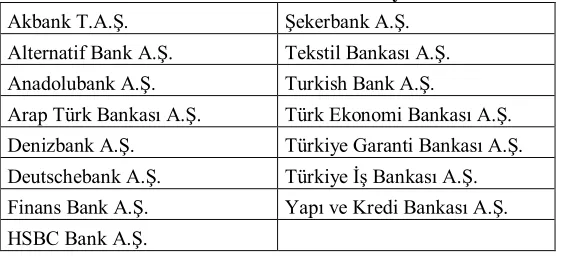
Our main data source for bank specific characteristics is the Banks Association of Turkey (BAT). The reported balance sheet and income statements are used to get relevant data. Sample contains several financial data of 15 Turkish commercial deposit banks spanning from 2002–2012 on a quarterly basis. State owned banks are excluded from the analysis. There are 22 commercial deposit banks (12 of domestic-owned and 10 of foreigned-owned) operating in Turkey on the study period. This study uses 15 of these banks, where 7 banks and are excluded due to lack of data. Table 3 shows the list of banks used in this study.
Table 3. List of the banks used in the study Akbank T.A.Ş. Şekerbank A.Ş. Alternatif Bank A.Ş. Tekstil Bankası A.Ş. Anadolubank A.Ş. Turkish Bank A.Ş.
Arap Türk Bankası A.Ş. Türk Ekonomi Bankası A.Ş. Denizbank A.Ş. Türkiye Garanti Bankası A.Ş. Deutschebank A.Ş. Türkiye İş Bankası A.Ş. Finans Bank A.Ş. Yapı ve Kredi Bankası A.Ş.
HSBC Bank A.Ş.
5.2. Variables
We use Z-index and NPL’s (The ratio of nonperforming loans to total loans) as our main measure for financial stability. Firstly Z-index is an inverse proxy for the firm profitability of failure. It combines profitability, leverage and return volatility in a single measure. It is given by the ratio (Berger et. al., 2008).
Where ROAi is the period – average equity to total assets ratio for bank i, and σROAi is the
standard deviation of return on assets over the period under study. The Z-index increases with higher profitability and capitalization levels and decreases with unstable earnings reflected by a higher standard deviation of return on assets. Besides NPL’s can be defined as ratio of nonperforming loans to total loans. This ratio measures credit quality and loan portfolio risk. Higher the ratio is higher the risk.
As a capital structure ratio, asset composition is being used by fixed assets divided by total assets. This is being used for tangibility. Besides, increase in ratio result in larger borrowing power. Bank size can be calculated by log value of bank level total assets.
The size of banks and the industrial structure of the banking industry depend on a number of factors, including macro-economic conjuncture, market concentration, regulatory capital requirements, guarantee offered by the state to the banking industry in times of crisis.
Deposit ratio is calculated by deposits divided by total assets. This ratio is an indicator for bank liquidity (Saunders and Cornett 2004). Besides, the size of deposits over total assets gives a rough estimate of liquidity risk associated with deposit withdrawal. In as much as the volume of deposits is closely linked to the volume of earning assets, any difference in variability between loans and investments bears directly on the future stability of bank deposits.
In line with earlier empirical studies in banking competition and market concentration as measured by Herfindahl – Hirschman Index (HHI). To avoid autocorrelation each bank should contain different HHI. Thus HHI is used as a combined measure for bot competition and concentration.
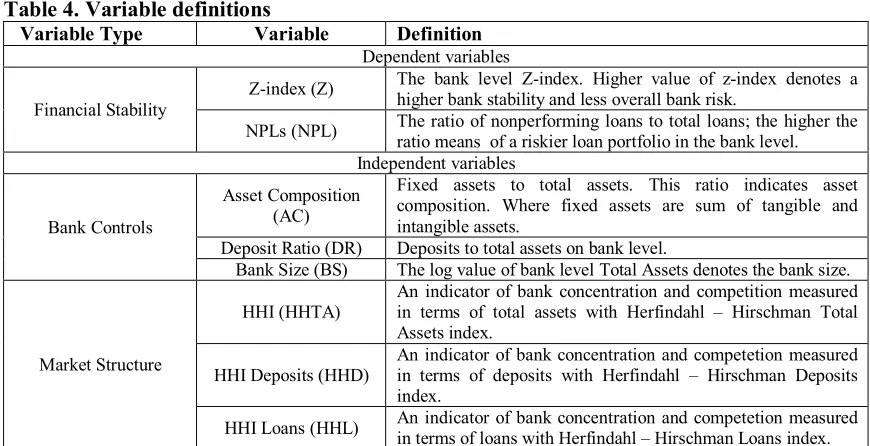
measures of competition The Herfindahl – Hirschman Index is used on total assets, deposits and loans separately. Table 4 shows variable names and definitions of dependent and independent variables.
Table 4. Variable definitions
Variable Type Variable Definition Dependent variables
Financial Stability
Z-index (Z) The bank level Z-index. Higher value of z-index denotes a higher bank stability and less overall bank risk.
NPLs (NPL) The ratio of nonperforming loans to total loans; the higher the ratio means of a riskier loan portfolio in the bank level. Independent variables
Bank Controls
Asset Composition (AC)
Fixed assets to total assets. This ratio indicates asset composition. Where fixed assets are sum of tangible and intangible assets.
Deposit Ratio (DR) Deposits to total assets on bank level.
Bank Size (BS) The log value of bank level Total Assets denotes the bank size.
Market Structure
HHI (HHTA)
An indicator of bank concentration and competition measured in terms of total assets with Herfindahl – Hirschman Total Assets index.
HHI Deposits (HHD)
An indicator of bank concentration and competetion measured in terms of deposits with Herfindahl – Hirschman Deposits index.
HHI Loans (HHL) An indicator of bank concentration and competetion measured in terms of loans with Herfindahl – Hirschman Loans index.
6. Empirical Results
Empirical findings are presented on Table 5, 6, and 7. Table 5 shows the descriptive statistics for all dependent and independent variables used in this study. Table 6 shows cross correlation matrix for variables. Table 7 shows the GMM results. We use two dependent variables as a proxy for financial stability: we measure loan portfolio risk with the ratio of nonperforming loans and overall bank risk with the Z-index, respectively.
Table 5. Descriptive Statistics
BS AC DR HHIAS HHIDEP HHILO LZINDEX NPL ZINDEX
Mean 6.9372 0.0214 0.5892 0.0112 0.0112 0.0103 1.4926 0.0465 35.6064 Median 6.9708 0.0139 0.6094 0.0008 0.0008 0.0010 1.5283 0.0342 33.7495 Maximum 8.2223 0.1335 1.0423 0.0830 0.0813 0.0644 1.9867 0.3714 96.9769 Minimum 5.3827 0.0011 0.0630 1.0700 0.0000 2.2300 0.2387 0.0032 1.7328 Std. Dev. 0.7381 0.0206 0.1263 0.0189 0.0189 0.0159 0.2612 0.04292 16.0012
Observations 546
Table 6. Correlation Matrix
BS AC DR HHIAS HHIDEP HHILO LZINDEX NPL ZINDEX
BS 1.0000
AC -0.1931 1.0000
DR 0.3296 -0.1726 1.0000
HHIAS -0.0191 0.0265 -0.0099 1.0000
HHIDEP -0.0167 0.0245 -0.0092 0.9967 1.0000
HHILO -0.0100 0.0270 0.0061 0.9637 0.9610 1.0000
LZINDEX -0.2472 -0.1027 -0.1337 -0.0273 -0.0278 -0.0316 1.0000
NPL -0.1624 0.4169 -0.1316 0.0772 0.0759 0.0727 -0.2032 1.0000
ZINDEX -0.234848 -0.013532 -0.118538 -0.050732 -0.050919 -0.055590 0.901334 -0.185754 1.0000
concentration. Higher degree of indexes mean higher degree of bank power and a less degree of concentration. We also include bank control variables as bank size (BS), asset composition (AC), and deposit ratio (DR). Our objective is to study the impact of bank structure on financial stability.
Table 7 indicates that asset composition (AC) is the only statistically significant variable in NPL measurements as an dependent variable. Besides (AC) has a positive impact on NPL. The increase in the toxic assets of the bank can be very deductive to understand increase in the fixed assets. Besides confiscated participations with insolvency conditions arising from credit repayments results with an increase in fixed assets as well. Another finding of the GMM analysis on NPL as a dependent variable is HHI’s. It has been found that HHI indexes has no impact on NPL and Z-index. This result support that HHI variables that demonstrate both market concentration and competitiveness has no significant impact on NPL and Z-index. In addition it can be said that the effect of competition and market concentration on risk taking behavior is not clear enough.
GMM results also reveals that bank size (BS) has a negative impact on Z-index. This means that increasing bank size at a certain point results a decreasing financial stability which can be explanied by decreasing returns to scale. As shown in the Table 7, deposit ratio (DR) effects Z-index positively. This result can be explained as a profitable allocation of deposits on relevant credits. Besides more deposit ratio (DR) results with higher Z-index which enhances bank stability.
Table 7. GMM Results
Dependent Variable NPL Dependent Variable Z INDEKS
C -0,028 -0,028 -0,027 1,082* 1,081* 1,075*
DEPVAR (-1) 0,844* 0,844* 0,844* 0,425* 0,425* 0,426*
AC 0,157* 0,158* 0,152* -0,268 -0,266 -0,244
DR 0,011 0,011 0,011 0,190* 0,191* 0,188*
BS 0,003 0,003 0,003 -0,047** -0,469** -0,046**
HHIAS 0,003 0,204
HHIDEP 0,004 -0,226
HHILO -0,011 -0,091
Specification tests
Wald Test
2 3500* 3500* 3495* 121,92* 122,16* 121,21*Sargan Test
2 468,41 468,65 466,88 359,64 360,08 360,62AR(1) -9,762* -9,761* -9,768* -12,526* -12,524* -12,518*
AR(2) 1,734 1,738 1,734 1,661 1,660 1,6526
* p < 0.01, ** p < 0.05
7. Conclusions
Although determining the reasons of a fragile banking system and the role of competition on financial stability are important issues in an economy, there is no consensus about the direction of the relationship between competition and fragility both theoretically and empirically. Moreover, there is no consensus about how to measure stability and competition (Yaldız,2010).
The traditional “competition-fragility” view emphasizes that banks with a higher degree of market power also have less overall risk exposure (Keeley,1990; Beck et al, 2004-2005; Allen and Gale, 2000-2004) . The “competition-stability” view of Boyd and De Nicolo (2005) states that market power
increases banks incline to more riskier loan portfolios (Carletti ve Hartmann,2002; Claessens and
Laeven,2004; Boyd and De Nicolo, 2005; Boyd et al., 2009; Uhde and Heimeshoff, 2009; Schaeck et al., ,2009;Berger et al, 2009).
References
Abbasoğlu, O.F., Aysan, A.F., Gunes, A. (2007). Concentration, Competition, Efficiency and Profitability of the Turkish Banking Sector in the Post-Crises Period”.MPRA Paper, No. 5494:1-23.
Ak Kocabay, S. (2009). Bank Competition and Banking System Stability: Evidence From Turkey. A Thesis Submitted to the Graduate School of Social Sciences of METU, 1-96.
Allen, F., Gale, D. (2000). Financial Contagion. Journal of Political Economy, 108, 1-33.
Allen, F., Gale, D. (2004). Competition and Financial Stability. Journal of Money, Credit, and Banking. 36(3), 453-480.
Anzoategui, D., Soledad, M., Pería, M., Rocha, R. (2010). Bank Competition in the Middle East and Northern Africa Region. Policy Research Working Paper 5363:1-26.
Ariss, R.T. (2009). Market Structure and Competitive Conditions: A comparative analysis of Islamic and conventional banking. Working Paper: 1-32.
Angelov, P., Asadov, F. (2010). Trade-off between Competition and Stability in the U.S. Banking Sector. Working Paper: 1-32.
Arellano, M., Bond, S. (1991). Some tests of specification for panel data: Monte Carlo evidence and an application to employment equations. The Review of Economic Studies, 58, 277–297. Arellano, M. (2003). Panel Data Econometrics, Oxford: Oxford University Press.
Arellano, M., Bover, O. (1995). Another Look at the Instrumental Variable Estimation of Error-Components Models. Journal of Econometrics, 68,29-51.
Baltagi, B. (2001). Econometric Analysis of Panel Data, England: John Wiley and Sons. Beck, T., Demirgüç-Kunt, A., Levine, R. (2004). Bank Concentration, Competition, and Crises: First results. Working Paper: 1-42.
Beck, T., A. Demirgüç-Kunt and R. Levine. 2005. “Bank Concentration and Fragility”. NBER
Working Paper 11500: 1-55.
Beck, T. (2008). Bank Competition and Financial Stability: Friends and Foes”. Working Paper: 1-31. Beck, T., Coyle, D., Dewatripont, M., Freixas, X., Seabright, P. (2010). Bailing out the Banks: Reconciling Stability and Competition- An analysis of state-supported schemes for financial institutions. Centre for Economic Policy Research Working Paper: 1-102.
Berger, A.N., Klapper, L.F., Turk-Ariss, R. (2009). Bank Competition and Financial Stability.
Journal of Financial Service Research, 35(2), 99–118.
Berger, A.N., Klapper, L.F., Turk-Ariss, R. (2008). Bank Competition and Financial Stability. The World Bank, Policy Research Working Paper, WPS4696.
Bond, S. (2002). Dynamic Panel Data Models: A Guide to Micro Data Methods and Practice, Cemmap Working Papers, The Institute for Fiscal Studies Department of Economics, UCL.
Boyd, J.H., Nicoló, G.D. (2005). The Theory of Bank Risk Taking and Competition Revisited.
The Journal of Finance, LX(3), 1329-1343.
Boyd, J.H., De Nicoló, G., Jalal, A.M. (2006). “Bank Risk-Taking And Competition Revisited: New Theory and New Evidence”. IMF Working Paper: 06/297.
Boyd, J.H., De Nicoló, G., Jalal, A.M. (2009). Bank Competition, Risk, and Asset Allocations.
IMF Working Paper: 143:1-35.
Canoy, M., M.V. Dijk, J. Lemmen, R.D. Mooij and J.Weigand. (2001). Competition and Stability in Banking. CPB Document No: 015: 1-161.
Carletti, E., Hartmann, P. (2002). Competition and Stability: What’s Special about Banking? Forthcoming in Monetary History, Exchange Rates and Financial Markets: Essays in Honour of Charles Goodhart, Vol. 2, Ed. by P. Mizen, Cheltenham: Edward Elgar.
Claessens, S., Laeven, L. (2004). What Drives Bank Competition? Some International Evidence. Journal of Money, Credit, and Banking, 36(3), 563-584.
Claessens, S. (2009). Competition in the Financial Sector: Overview of Competition Policies. IMF Working Paper: 1-35.
Deltuvaitė, V. (2010). The Concentration– Stability Relationship in the Banking System: An Empirical Research. Economics and Management. No.15, 900-909.
Gelos, R.G., Roldós, J. (2002). Consolidation and Market Structure in Emerging Markets Banking Systems. Working Paper: 1-28.
Holtz-Eaken, D.W. Newey, Rosen, H.S. (1998). Estimating Vector Autoregressions with Panel Data. Econometrica 56, 1371-1395.
Iskenderoglu, O. (2008). Isletmelerin Buyumesinde Buyuklugun Etkisi: Türkiye İçin Bir İnceleme. Nobel Kitabevi.
Jiménez, G., Lopez, J.A., Salas, J.S. (2010). How Does Competition Impact Bank Risk-taking.
Banco de Espana Working Paper No.1005:1-36.
Keeley, M. C. (1990). Deposit Insurance, Risk, and Market Power in Banking. American Economic Review. 80(5), 1183-1200.
Martinez-Miera, D., Repullo, R. (2009). Does competition reduce the risk of bank failure? Centre for Economic Policy Research Working Paper: DP6669.
Martinez-Miera, D., Repullo, R. (2010). Does Competition Reduce the Risk of Bank Failure? The Review of Financial Studies. 23(10), 3638-3664.
Mishkin, F.S. (1999). Financial consolidation: Dangers and opportunities. Journal of Banking and Finance, 23, 675-691.
Saunders, A., Cornett, M.M. (2004). Financial Markets and Institutions. New Delhi: Tata McGraw Hill Publishing Company Limited.
Singh, A. (2002). Competition and Competition Policy in Emerging Markets: International and Developmental Dimensions. G-24 Discussion Paper Series No.18, 1-26.
Schaeck, K., Cihák, M., Wolfe, S. (2009). Are More Competitive Banking Systems More Stable? Working Paper: 1-43.
Tunay, K.B. (2009). Türk Bankacılık Sektöründe Rekabet and Kırılganlık. Bankacılar Dergisi, 68, 30-49.
Uhde, A.and U. Heimeshoff. 2009. “Consolidation in banking and financial stability in Europe: Empirical evidence”. Institut für Wirtschaftspolitik und Quantitative Working Paper, No.2:1-37. Vives, X. (2001). Competition in the Changing World of Banking. Oxford Review of Economic Policy,
17(4), 535-547.
Yaldız, E., Bazzana, F. (2010). The Effect of Market Power on Bank Risk Taking In Turkey.
Financial Theory and Practice. 34(3), 297-314.
Yaldız, E. (2010). Competition-Fragility or Competition-Stability? Evidence from the Turkish Banking System, Discussion Paper, 1-16.
Yayla, M. (2007). Türk Bankacılık Sektöründe Yoğunlaşma ve Rekabet. BDDK Bankacılık ve Finansal Piyasalar Dergisi. 1(1), 35-59.
Younas, J., Nandwa, B. (2010), Financial Openness and Capital Mobility: A Dynamic Panel Analysis,