Time-Multiplexed Parsing in
Marking-based Network Telemetry
Alon Riesenberg
†, Yonnie Kirzon
†, Michael Bunin
†,
Elad Galili
†, Gidi Navon
•, Tal Mizrahi
††
Technion — Israel Institute of Technology,
•Marvell Semiconductors
Huawei Network.IO Innovation Lab
ABSTRACT
Network telemetry is a key capability for managing the health and efficiency of a large-scale network. Alternate Marking Performance Measurement (AM-PM) is a recently introduced approach that accurately measures the packet loss and delay in a network using a small overhead of one or two bits per data packet. This paper introduces a novel time-multiplexed parsing approach that enables a practical and accurate implementation of AM-PM in network devices, while requiring just a single bit per packet. Experimental results are presented, based on a hardware implementation, and a software P4-based implementation.
CCS CONCEPTS
•Networks→Network protocol design;OAM proto-cols;
1
INTRODUCTION
In the past decade the scale and performance of high-speed networks has increased dramatically, while network op-erators have been constantly striving for flexible, easy-to-manage and automated networks. One of the common threads that run through these different requirements is network telemetry; the ability to accurately measure the performance of the network in real-time.
Network telemetry standards and protocols have been in deployment for over two decades. In the last few years new
Permission to make digital or hard copies of all or part of this work for personal or classroom use is granted without fee provided that copies are not made or distributed for profit or commercial advantage and that copies bear this notice and the full citation on the first page. Copyrights for components of this work owned by others than ACM must be honored. Abstracting with credit is permitted. To copy otherwise, or republish, to post on servers or to redistribute to lists, requires prior specific permission and/or a fee. Request permissions from [email protected].
SYSTOR ’19, June 3–5, 2019, Haifa, Israel
© 2019 Association for Computing Machinery. ACM ISBN 978-1-4503-6749-3/19/06. . . $15.00 https://doi.org/10.1145/3319647.3325837
approaches have been introduced, which piggyback teleme-try information onto data packets, allowing fine-grained per-hop and per-packet measurement. In-situ OAM (IOAM) [4] and In-band Network Telemetry (INT) [11, 12] are two in-band telemetry approaches that have been gaining momen-tum.
Another telemetry method that is being pursued by the Internet Engineering Task Force (IETF) is the Alternate Mark-ing Performance Measurement (AM-PM) method [8], which is a lightweight in-band measurement approach that requires one or two bits per data packet.
AM-PM [8] is a performance measurement method that provides accurate and reliable in-band measurement with a negligible overhead of one or two bits in the header of every data packet. AM-PM is currently under development in the IETF; it was introduced in a recently published RFC [8], and is being considered in the context of various encapsulations, including Geneve, SFC NSH, BIER, MPLS, and QUIC. Notably, AM-PM can also be deployed over IPv4 or IPv6 by using reserved values of fields in the IP header. At least one known deployment [16], in Telecom Italia’s production network, uses reserved values in the IP header for AM-PM.
The main contributions of this work are as follows:
• We introduce a novel time-multiplexed parsing approach that enables the implementation of AM-PM in network devices such as switches, routers, and NICs.
• The abstractions required to implement marking-based telemetry are analyzed from a silicon design perspective, as well as from a data plane programming perspective.
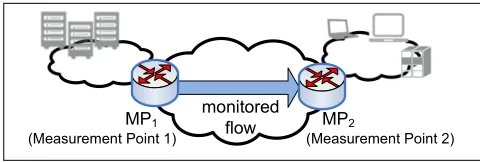
MP1 monitored flow MP2
(Measurement Point 1) (Measurement Point 2)
Two primitive abstractions that are key for implementing marking-based telemetry are presented, and their applica-tion to AM-PM is discussed and demonstrated.
• Experimental results are presented, based on a hardware implementation using a Marvell Prestera switch silicon, and a software implementation in the P4 [3] programming language.
• Our P4-based implementation is publicly available as open source [1].
Due to space limits, some of the detailed analysis is pre-sented in an extended technical report [22].
2
AM-PM IN A NUTSHELL
This section provides a short overview of AM-PM [8, 16]. As illustrated in Fig. 1, AM-PM is used between two or more Measurement Points (MP) in the network. MPs can be hosts, servers, or network devices. The data traffic between the MPs carries one or twomarking bits. This implies that the initiating MP (MP1 in the figure) assigns the value of the marking bit(s), and the terminating MP (MP2) acts upon their value. IfMP2is not the final destination of the packet it clears the value of the marking bits to zero, so as not to affect successive nodes that do not take part in the measurement. The marking bits are used for signaling and coordinat-ing measurement events between the MPs. A measurement event is detected when either a ‘step’ or a ‘pulse’ in the value of the marking bit is detected. If a tunnel encapsulation is used between the MPs, the marking bits are part of the en-capsulation header, and thus the marking bits are removed when the terminating MP strips the encapsulation header from the packet.
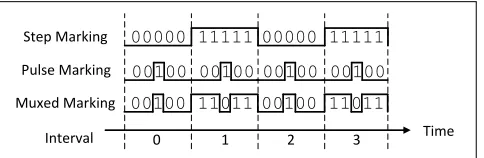
A measurement may be performed among multiple MPs, as further discussed in [9]. For ease of presentation this paper focuses on a point-to-point measurement between two MPs. A marking bit can be used in one of three possible ways, as illustrated in Fig. 2:
Step.The marking bit is assigned a periodically alternating value. Thus, the marking bit divides the traffic into consec-utive blocks of data. A ‘step’ is detected when the value of the marking bit is toggled.
Time
Step Marking 00000 11111 00000 11111
Pulse Marking 00100 00100 00100 00100
Muxed Marking 00100 11011 00100 11011
Interval 0 1 2 3
Figure 2: AM-PM marking bits.
Pulse.The marking bit is assigned a ‘pulse’ value once per time interval. The pulse value indicates to the measurement points that the marked packet is a reference for the mea-surement; for example, the ‘pulse’ packet indicates that all devices should capture the timestamp of this packet.
Multiplexed.This approach [14] combines the step and pulse approaches; the value of the marking bit is toggled periodically, and there is an additional pulse in the middle of each interval. The muxed marking bit can be viewed as the result of an exclusive or (XOR) between a pulse bit and a step bit, thus multiplexing two marking bits onto a single bit.
The simplest variant of AM-PM is called thedouble mark-ing method, in which two marking bits are used: a ‘step’ marking bit is used for Loss Measurement (LM), and a ‘pulse’ bit is used for Delay Measurement (DM). Thestep bitmarks the data packets with one of two ‘colors’, 0 or 1. Each of the MPs maintains two counters,1one per color. At the end of each interval the counter values can be collected by a central Collector2and analyzed. For example, at the end of a ‘0’ in-terval, counter 0 is collected from both MPs, and the packet loss during the interval can be computed by comparing the counter values of the two MPs. Notably, the use of two colors intermittently implies that each counter is exported when it is not currently in use, and thus its value is stable, allowing a consistent snapshot of the counter across the MPs. The
pulse bitis used to indicate specific packets that are used for DM; both MPs measure the timestamp of that packet, and export it to the Collector, which can compute the path delay by comparing the two timestamps.
The main advantage of AM-PM is that it provides accurate loss and delay measurement at the cost of one or two bits per data packet.
3
MARKING-BASED TELEMETRY:
DESIGN AND IMPLEMENTATION
This section introduces a design and implementation of AM-PM. One of the main challenges in the context of implement-ing markimplement-ing-based telemetry is the non-trivial functionality that is required in this telemetry method. As illustrated in Fig. 1,MP1is the node that initiates the measurement. Thus, it assigns the marking bit(s). In order to implement step marking,MP1is required to periodically toggle the marking bit. Pulse marking requiresMP1to select one of the packets in each interval and process it differently than other packets.
1Two counters per flow.
3.1
Primitive Abstractions
We now discuss two primitive abstractions that can be used to implement AM-PM. Fortunately, these two basic abstrac-tions are supported in off-the-shelf network device silicons, as well as in the P4 programming language, thus enabling the implementations described in Section 4.
Time bit as a match criterion.If the time of every packet is measured as the packet is received, then this timestamp can be used as a match criterion in the device’s match-action lookup. Specifically, the timestamp should be used in a ternary lookup, in which all but one of the timestamp bits are masked, defining a match rule that is matched periodically. This is a special case of the approach suggested in [17]. In hardware-based network devices, this requires the ability to include the packet’s timestamp in a ternary match, such as a Ternary Content Addressable Memory (TCAM) lookup. This programming abstraction is provided by P4, as the packet’s ingress time is included in the P4 intrinsic metadata, allowing the timestamp to be used in ternary matches [20, 21].
Stateful behavior.The packet processing decision can be based not only on the packet header, but also on a state. For example, stateful behavior allows distinction between the first packet of an interval, and other packets, thus en-abling pulse marking. Stateful behavior can be implemented in hardware devices by maintaining a per-flow state, and applying an action that is based on this state. P4 supports stateful memories that consist of registers that can be used in the match-action procedure.
3.2
Step Marking Implementation
Step marking requires periodic behavior, such that the value of the marking bit is toggled in every time interval. The time-bit-as-a-match abstraction can be used to implement a periodic time range. For example, assume that the timestamp consists of two fields, aSecondsfield and aSecond Fraction
field. The least significant bit of the Seconds field is by defi-nition toggled every second. Thus, a ternary match rule that considers the least significant bit of the Seconds field and masks the rest of the bits (see Eq. 1) defines a periodic match with an interval of 1 second. Masked bits are denoted by ‘∗’.
(1)
1
* … * * … *
Seconds Fraction
For each packet we denote the value of the time bit cor-responding to the current packet byTimeBit, andMarkBit indicates the value of the marking bit that is assigned to the packet by the initiating MP. These notations will be used throughout the section.
Continuing the example of Eq. 1, the following match-action rules (Table 1) can be used by the initiating MP to
implement step marking for loss measurement. For example, the first rule implies that ifTimeBitis zero, then the marking bit is set to zero, andcounter0 is used for counting.
Match Action
TimeBit =0 MarkBit =0,counter0 TimeBit =1 MarkBit =1,counter1 Table 1: Step marking loss measurement example: the match-action table of theinitiatingMP.
In this case, the match-action lookup at the terminating MP can be implemented by the rules of Table 2.
Match Action
MarkBit =0 counter0
MarkBit =1 counter1
Table 2: Step marking loss measurement example: the match-action table of theterminatingMP.
Generally speaking, time-bit-as-a-match can be used to implement periodic behavior, where the location of the un-masked bit determines the interval length.
3.3
Pulse Marking Implementation
In the pulse marking approach the initiating MP marks a single packet per interval as ‘1’.
Pulse marking can be implemented using the time bit and a register,Reд, which represents the previous value ofTimeBit. Further details are presented in the extended version of this paper [22].
3.4
Time-Multiplexed Parsing
We now introduce a novel time-muxed parsing approach, in which we divide time into slots, and the semantic inter-pretation of the marking bit is a function of the time slot. Our analysis of the time-muxed approach focuses on the muxed marking method, which muxes the step and pulse bits onto a single bit. The advantage of muxed marking is that it requires just a single bit per packet on the wire, while providing the same measurement resolution and accuracy as the double marking approach.
bySeconds[4], which is toggled every 16 seconds. The other bits are masked.
(2)
1
* … * * … *
Seconds Fraction ****
In order to implement muxed marking, we introduce a novel time-multiplexed matching approach. We observe three bits from the timestamp field,Seconds[4 : 2], divid-ing each 16-second interval into four sub-intervals (each sub-interval is illustrated in a different color in Fig. 3).
Time
0
Seconds[4] 1
Seconds[4:2] 000 001 010 011 100 101 110 111
Initiating MP Terminating MP Marking bit
Figure 3: Time-multiplexed parsing: the marking bit has a different interpretation in each time slot.
In a nutshell, the ‘pulse’ bit is invoked byMP1roughly in the middle of the interval, in order to minimize the potential confusion between a step and a pulse. Thus,MP1observes the third quarter of each interval, and triggers a pulse in the first packet of this sub-interval. AtMP2, the second and third quarter of each interval are used for detecting a pulse, whereas the rest of the time is used for detecting steps.
Time-multiplexed matching implicitly assumes that the initiating MP and the terminating MP are phase-synchronized at the slot level. It should be noted that muxed marking could be implemented differently without this as-sumption, by detecting a ‘step’ in the marking bit value without considering the current time.
Further details about multiplexed marking, including a detailed description of the match rules, are presented in the extended version of this paper [22].
4
EVALUATION
We evaluated two implementations; a hardware implemen-tation based on a Marvell switch silicon, and a P4-based software implementation [1]. We present a glimpse at some of the experimental results, showing the high accuracy of the delay measurement. Detailed results are presented in [22].
Due to space limits, some of the experimental results are presented in [22].
4.1
Hardware Implementation
In this experiment we evaluated AM-PM over a hardware switch. We used two development boards of a Marvell Prestera switch device. The two devices were connected
0 200 400 600 800 1000 1200
0 200 400 600 800 1000
M
e
a
su
re
d
D
e
la
y
[
μ
S
e
c]
Expected Delay [μSec]
(a) Delay in the HW implementation: measured vs. expected.
0 1 2 3 4 5 6
0 2 4 6
M
e
a
su
re
d
D
e
la
y
[
se
c]
Configured Delay [sec]
(b) Delay in the SW implementation: measured vs. expected.
Figure 4: Experimental results of delay measurement.
MP1 MP2
Traffic Generator Server
(a) HW experiment setup.
MP1 MP2
S3
H1 H2
Server
(b) SW experiment setup.
Figure 5: Experiment setup.
as illustrated in Fig. 5a. The two switches were used as mea-surement points, and TimeFlip [17] was used in the switches in order to periodically toggle the color with an interval of 1 second. An off-the-shelf traffic generator was used for gen-erating traffic through the two switches. The multiplexed marking method was used to measure loss and delay from MP1toMP2, and the least significant bit of the DSCP field in the IPv4 header was used as the marking bit. The two MPs were synchronized using the Precision Time Protocol (PTP) [10], and periodically exported the counters and times-tamps to a server that plotted the loss and delay.
In this experiment we evaluated the accuracy of loss and delay measurement. In order to create synthetic packet loss inMP1, we varied the traffic rate from the traffic generator toMP1 from 10 Gbps to 15 Gbps, thus creating a tempo-rary overload of 0 to 50%, respectively at the egress port of MP1. We synthetically varied the delay by configuring the queue size inMP1, and thus we were able to synthesize delay between 3 microseconds and 1 millisecond.
0 200 400 600 800 1000 1200
0 200 400 600 800 1000
M e a su re d D e la y [ μ S e c]
Expected Delay [μSec]
(a) Delay: measured vs. expected. 0 1 2 3 4 5 6 7 8 9 10
0 2 4 6 8 10
M e a su re d L o ss [ x 1 0 6p k ts /s e c]
Expected Loss [x106pkts/sec]
(b) Packet loss: measured vs. expected.
Figure 6: Experimental results of a hardware AM-PM implementation.
measurements, and a single packet (less than .0001% error) in some of the measurements. The loss and delay measurement results were as expected, confirming that AM-PM can be implemented accurately over commodity switch silicons.
4.2
P4 Software Implementation
The purpose of this evaluation was to validate the simplic-ity of implementing PM in P4. Two variants of AM-PM were implemented, the double marking method and the multiplexed marking method. The code is publicly available at [1], and was implemented as two P4 applications running over the open source P4 switch from the P4 Consortium [2].
Our implementation includes an extension to the P4 ref-erence switch that includes the time-of-day in the switch’s intrinsic metadata. As discussed above, this extension allows multiple switches to be synchronized to common time inter-vals, enabling a muxed marking implementation along the lines of Section 3.4. It should be noted that it is possible to implement AM-PM without clock synchronization,3and in this case the implementation can be purely in P4, without any changes to the existing P4 reference switch.
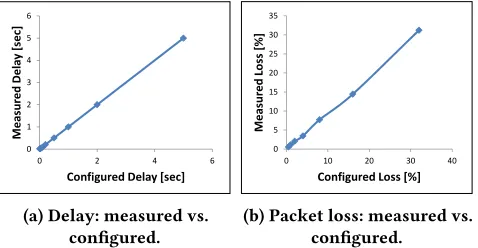
0 1 2 3 4 5 6
0 2 4 6
M e a su re d D e la y [ se c]
Configured Delay [sec]
(a) Delay: measured vs. configured. 0 5 10 15 20 25 30 35
0 10 20 30 40
M e a su re d L o ss [ % ]
Configured Loss [%]
(b) Packet loss: measured vs. configured.
Figure 7: Experimental results of a P4-based AM-PM implementation.
3As further discussed in the extended version of this paper [22].
The experiment was emulated in Mininet using the setup of Fig. 5b. Traffic was sent from hostH1to hostH2through the network, and was forwarded by switchesMP1,S3and MP2. In the Mininet environment all switches use the Linux clock of the machine that hosts Mininet, and thus all switches are synchronized by definition. The two measurement points wereMP1andMP2, and AM-PM was run with an interval of 16 seconds. Results were collected by a third host, labeled ‘Server’ in the figure. Loss and delay were synthetically con-figured in the Mininet environment in order to compare the measured performance and the expected performance.
Results. The experimental results are summarized in Fig. 7, and demonstrate the accuracy of the measurement compared to the anticipated loss and delay that were synthe-sized by Mininet. The delay measurement error was on the order of 1 millisecond compared to the anticipated delay, and the loss measurement error was on the order of 10%. These results are reasonable given the software-based emulation environment that runs on a single machine.
5
RELATED WORK
Performance measurement and monitoring protocols have been in deployment for many years; counters and statistics are often collected from network devices using SNMP [5] or NETCONF [7], and various Operations, Administration and Maintenance (OAM) tools [18] are widely used in carrier networks. The literature is rich with publications about net-work telemetry and timestamping, e.g., [12, 13, 19]. AM-PM was first introduced in [6], and has been under discussion in the IETF for a few years [8]. A tutorial of AM-PM [16] is currently under review. TimeFlip was first introduced in [17], and [15] showed that TimeFlip can be applied to Alternate Marking. The current paper is the first work that analyzes the programming abstractions and implementation considera-tions of marking-based telemetry, and presents experimental results from a P4-based implementation and from a silicon implementation.
6
CONCLUSION
REFERENCES
[1] P4 AM-PM. https://github.com/AlternateMarkingP4/FlaseClase, 2018. [2] P4 Code. https://github.com/p4lang, 2019.
[3] P. Bosshart, D. Daly, G. Gibb, M. Izzard, N. McKeown, J. Rexford, C. Schlesinger, D. Talayco, A. Vahdat, G. Varghese, et al. P4: Pro-gramming protocol-independent packet processors.ACM SIGCOMM Computer Communication Review, 2014.
[4] F. Brockners, S. Bhandari, C. Pignataro, H. Gredler, J. Leddy, S. Youell, T. Mizrahi, D. Mozes, P. Lapukhov, R. Chang, D. Bernier, and J. Lemon. Data Fields for In-situ OAM. draft-ietf-ippm-ioam-data, work in progress, IETF, 2019.
[5] J. Case, M. Fedor, M. Schoffstall, and C. Davin. A simple network management protocol (SNMP). RFC 1157, IETF, 1990.
[6] M. Cociglio, A. Capello, A. Tempia Bonda, and L. Castaldelli. A packet-based method for passive performance monitoring. draft-tempia-opsawg-p3m-00, expired, 2011.
[7] R. Enns, M. Bjorklund, J. Schoenwaelder, and A. Bierman. Network configuration protocol (NETCONF). RFC 6241, IETF, 2011.
[8] G. Fioccola, A. Capello, M. Cociglio, L. Castaldelli, M. Chen, L. Zheng, G. Mirsky, and T. Mizrahi. Alternate Marking method for passive and hybrid performance monitoring. RFC 8321, IETF, 2018.
[9] G. Fioccola, M. Cociglio, A. Sapio, and R. Sisto. Multipoint Alternate Marking method for passive and hybrid performance monitoring. draft-ietf-ippm-multipoint-alt-mark, work in progress, IETF, 2019. [10] IEEE TC 9. 1588 IEEE Standard for a Precision Clock Synchronization
Protocol for Networked Measurement and Control Systems Version 2.
IEEE, 2008.
[11] C. Kim, P. Bhide, E. Doe, H. Holbrook, A. Ghanwani, D. Daly, M. Hira, and B. Davie. In-band network telemetry (INT). 2014 technical speci-fication, P4, 2014.
[12] C. Kim, A. Sivaraman, N. Katta, A. Bas, A. Dixit, and L. J. Wobker. In-band network telemetry via programmable dataplanes. InACM
SIGCOMM Symposium on SDN Research (SOSR), 2015.
[13] R. Mittal, N. Dukkipati, E. Blem, H. Wassel, M. Ghobadi, A. Vahdat, Y. Wang, D. Wetherall, D. Zats, et al. Timely: Rtt-based congestion con-trol for the datacenter. InACM SIGCOMM Computer Communication Review, 2015.
[14] T. Mizrahi, C. Arad, G. Fioccola, M. Cociglio, M. Chen, L. Zheng, and G. Mirsky. Compact Alternate Marking Methods for Passive and Hy-brid Performance Monitoring. draft-mizrahi-ippm-compact-alternate-marking, work in progress, IETF, 2019.
[15] T. Mizrahi and Y. Moses. The case for data plane timestamping in sdn. InIEEE INFOCOM Workshop on Software-Driven Flexible and Agile Networking (SWFAN), 2016.
[16] T. Mizrahi, G. Navon, G. Fioccola, M. Cociglio, M. Chen, and G. Mirsky. AM-PM: Efficient Network Telemetry using Alternate Marking. IEEE Network, accepted, 2019.
[17] T. Mizrahi, O. Rottenstreich, and Y. Moses. TimeFlip: Scheduling net-work updates with timestamp-based TCAM ranges. InIEEE INFOCOM, 2015.
[18] T. Mizrahi, N. Sprecher, E. Bellagamba, and Y. Weingarten. An Overview of Operations, Administration, and Maintenance (OAM) Tools. RFC 7276, IETF, 2014.
[19] S. Narayana, A. Sivaraman, V. Nathan, P. Goyal, V. Arun, M. Alizadeh, V. Jeyakumar, and C. Kim. Language-directed hardware design for network performance monitoring. InACM SIGCOMM, 2017. [20] P4 Consortium. The p4 language specification. P4, 2014.
[21] P4 Consortium. P4 16 Portable Switch Architecture (PSA). P4, 2018. [22] A. Riesenberg, Y. Kirzon, M. Bunin, E. Galili, G. Navon, and T. Mizrahi.