Volume 2, Issue 4, 2015, pp. 113-129 Available online at www.jallr.ir ISSN: 2376-760X
Correspondence: Maryam Bolouri, Email: [email protected] © 2015 Journal of Applied Linguistics and Language Research
Development and Validation of an ELT Based Classroom Management
Questionnaire
Ramin Akbari
Associate professor, Tarbiat Modares University, Iran Maryam Bolouri
MA student of TEFL, Tarbiat Modares University, Iran
Abstract
This study tried to provide an extension of understanding to the classroom management phenomenon for teachers and teacher trainers. Thus through a mixed-method design, the present study intends to investigate, and define different aspects of ELT-based classroom management by employing quantitative and qualitative methods. To reach this aim, in qualitative phase, interviews were done with 16 ELT teachers and experts, and the results were subjected to content analysis. The results of the content analysis were 23 main categories which covered three major themes. In the quantitative phase, the 56-item questionnaire (ELT-CMS), based on the findings of the qualitative phase, were administered. The results of the 267 completed and usable questionnaires were fed into exploratory factor analysis to identify the underlying structure of ELT based classroom management, and into confirmatory factor analysis to check the validity of the model as a good fit for the data. The proposed model of this study consisting of three distinct but related components has been tested and validated. This overarching construct, encompassing language management, structure management and behavior management can be measured through ELT-CMS. The results showed that language management is the most significant factor influencing classroom management in ELT, and has been ignored in the available instruments, which are widely used in ELT field studies. The results of this study have important implications for English Language teacher education and invite EFL teacher educators to put more emphasis on classroom management dimensions in pre-service and in-service training programs.
Keywords: classroom management, ELT teacher, language management, structure management, behavior management
INTRODUCTION
significant role of classroom management. Novice teachers perceive student discipline as their most demanding challenge (Ingersoll & Smith, 2003); moreover, the major cause of teacher burnout and job dissatisfaction is the lack of effective skills in establishing a fruitful environment, motivating learners, absence of proactive strategies and facilitating learning (Evertson & Weinstein, 2006; Gencera & Cakiroglub, 2007). Classroom management has been broadly defined as any action a teacher takes to create an environment that supports and facilitates both academic and social-emotional learning (Evertson & Weinstein, 2006). Brophy, one of the leaders of the classroom management field, defined classroom management as ‘‘the actions taken to create and maintain a learning environment, conductive to attainment of the goals of instruction, arranging the physical environment of the classroom, establishing rules and procedures, maintaining attention to lessons and engagement in academic activities” (cited in Gencera & Cakiroglub, 2007, p. 667).
Notwithstanding the universal recognition of the classroom management significance, it has received scant attention as a topic of empirical research in the ELT literature (Evertson & Weinstein, 2006). The present study, therefore, is aimed at making up for this neglect in ELT by developing an ELT-based classroom management measurement instrument.
Classroom management is one of the most serious challenges students and novice teacher’s face. Research reveals that classroom management is still a major factor in teacher burnout (Durr, 2008) and When foreign language classroom management is added to the issue, the situation becomes even more uncertain (Fowler & Sarapli, 2010). Classroom management in not context-free (Woolfolk Hoy & Weinstein, 2006) and the final behavior of teacher in class management is the function of social pressure and internal drives (Waters, 1998). However there is no consensus regarding the dimensions of this construct.
Due to these blurry boundaries of CM, different disciplines use mostly the Behavior and Instructional Management Scale (BIMS) developed by Martin and Sass (2010). Regarding the different roles of language teachers and disparate natures of teaching and le arning in language classes, developing an ELT-based classroom management is a pressing need in this century. This point is tersely mentioned in Burnett (2011) saying that, the challenges of ELT in the 21st century have never been greater and are more to be discovered. The context specificity of the classroom management makes it of great importance for being looked at from another perspective, which is second language teaching. By this study, it is hoped the research can provide an extension of understanding to the process of classroom management phenomenon in English language teaching for teachers and teacher trainers. To this end the purpose of this study is to present a new measure of the construct and to explore the dimension of this complex construct in English language teaching context. As a result, the following question is addressed:
REVIEW OF LITERATURE
The First impressive publication in this field was done by Bagley in 1907, the book was entitled Classroom Management which is about using incentives to motivate learners, and the most early writings were based on the accumulated experience of master teachers. Empirical research came much later in the middle of the 20th century (Babad, 2009). The major concerns have always been how to deal with the various complexities of the classroom environment, how to control students and minimize disruption, how to lead students to the best academic achievements and psycho-social development. Three main approaches in classroom management
Schools of thoughts per se had their influences on classroom management, in this sense there are three approaches in educational research: 1) behavioral approach 2) process -outcome and 3) ecological approach. Landrum and Kauffman (2006) contend that the behavioral perspective of teaching and management has lost its place in the educational practice. Even in its peak years, behaviorism was controversial and heavily criticized regarding its mechanistic nature and robot-like quality of the elicited behaviors (Pourmohamadi, 2013).
Process-outcome approach refers to the research that investigates the relationship between classroom processes (teacher actions) and the outcome (student achievement and behavior) (Gettinger & Kohler, 2006). In an earlier study Kounin (1970; cited in Gettinger & Kohler, 2006) identified teacher behaviors (process) that were influential on keeping students on-task (outcome). These teacher variables were: with-it-ness that is awareness of what is happening in the classroom and quick “desist” of inappropriate behavior; Overlapping which is attending to multiple issues at a time; smoothness and momentum that refer to a smooth and brisk-paced lesson that student deviant behavior will not stop it; and group alerting that means keeping students attentive. Process-outcome research has shown that “effective teaching is related to a teacher’s ability to use appropriate management strategies while also providing high-quality instruction” (Munk & Repp, 1994; cited in Gettinger & Kohler, 2006, p. 79).
The main idea in the ecological approach is that the characteristics of the context will influence the actions and behavior of its participants. From this viewpoint Doyle (2006) has pointed out some important features of classroom which affect the teachers’ actions to maintain order in the classroom and reach the educational goals. These features are multidimensionality (of classroom events, tasks and relations), simultaneity, immediacy and “rapid pace of classroom events” (p. 98), unpredictability, publicness (the teacher is witnessed by many students) and history (the accumulation of common rules and routines).
for their learning, and the teachers become facilitators rather than transmitters. The emphasis shifted from obedience and compliance to more direction and self-regulation. Finally, CM shifted from intervention to prevention.
Theoretical framework of classroom management
Theoretical frameworks refer to the organized knowledge bases that inform teacher practices and the classroom management models that teachers adopt. While classroom management is concerned with creating engaging learning environments and socializing students (Brophy, 1996), most of these theories view classroom management simplistically as discipline and control and conceptualize teachers’ management orientations along a continuum from controlling to humanistic and democratic.
Drawing from Skinner’s and Rogers’ theories on learning, behaviorist-humanist framework has two extreme views on discipline. Skinner’s (1986) behavioral theories see learning as the result of applying contingent reinforcement and consequences, while Rogers (1977) on the other hand believes that human beings possess an inner capability to self-discipline. In this view teachers as facilitators try to empower students (cited in Pourmohamadi, 2013).
Wolfgang and Glickman (1980; Glickman & Tamashiro, 1980) identify three schools of thought along a continuum of control. At one end there are interventionists who support a carrot-and-stick approach and believe that the teacher has to control and modify student behavior mostly by a system of rewards and punishment. At the other end there are non-interventionists who believe that students have the power to resolve their problems and teachers should not impose their rules. Between these two points there are interactionalists who believe in shared responsibility and reciprocal relationships to solve the problems. Students and teachers have equal control and power to make choice and take the responsibility of their behavior.
Classroom management in ELT
Gebhart (2006) points out that the goal of classroom management is to create a classroom atmosphere conductive to interacting in English in meaningful ways in order to provide students with progress. One of the principles of classroom management, centers on the issue of how to teach under “adverse circumstances” under which lies a number of management concerns such as teaching large classes, teaching multiple proficiency levels in the same class, compromising with the institution, and discipline and cheating (Brown, 2001).
An English language teacher, unlike the non-ELT teacher, must be equipped with not only the knowledge of the subject but also with multiple teaching strategies, evaluation techniques, patience, and classroom management skills (Deita, Unknown). Underwood (1987) listed some basic techniques and approaches that focus on the organizational aspects of teaching English successfully such as: 1) Know yourself, 2) Know your students, 3) Develop an encouraging class atmosphere, 4) Build an ideal classroom, 5) Be prepared, and 6) Plan lesson routines.
One very important skill needed on behalf of English teachers is “pedagogical reasoning skill”. According to Shulman (1987), this ability is as a process of transformation in which the teacher turns the subject matter of instruction into forms which are pedagogically powerful and are appropriate to the level and ability of the students (cited in Richards. 2011). Experienced teachers use these skills every day when they plan their lessons, when they decide how to adapt lessons from their course book, and when they search the Internet and other sources for materials and content which they can use in their classes. This fundamental dimension of teaching is acquired through experience, through accessing content knowledge (Shulman, 1987).
Language-specific competencies that a language teacher needs in order to teach effectively include: to comprehend texts accurately, to provide good language models, to maintain the fluent use of the target language in the classroom, to give explanations and instructions in the target language, to provide examples of words and grammatical structures and give accurate explanations, to use appropriate classroom language, to select target-language resources, to monitor his or her own speech and writing for accuracy, to give correct feedback on learner language, to provide input at an appropriate level of difficulty, to provide language-enrichment experiences for learners (Richards, 2011).
THE STUDY
In this part the methodological considerations of the study will be presented in two separate sections: quantitative and qualitative parts.
Qualitative section
Participants
The participants of the qualitative phase were selected based on a criterion-oriented selection method, rather than a random one. In this method, according to LeCompete and Preissle (1993), the researcher seeks participants who fulfill the criteria essential to the purpose of the study. In addition, it was quite necessary for the researcher to choose participants who contribute tangible and well-organized answers to the questions (Kairuz, Crump, & O’Brein, 2007). A total of sixteen Participants, including eight teachers, four supervisors, four teacher trainers, and two experts in education from different language institutes/universities in Tehran and three other cities participated in the qualitative phase of this study.
Instrumentation
All the participants were asked a set of questions dealing with the nature of classroom management. The purpose of this stage was to seek their attitudes regarding the different aspects of classroom management in ELT context. Several interview questions (28 questions) were formulated based on the literature about different aspects of classroom management issues relevant to most of the teachers in this field. These questions were ordered from general ones about classroom management definition and challenges to more specific questions regarding skills teaching and error correction.
Procedure
Interviews were conducted by the researcher through face-to-face communication at participants’ places or through phone. All the participants were informed about the purpose of the study prior to conducting the interviews. Each interview lasted approximately fifteen to thirty minutes and was audio-taped with the permission of the participants, later on transcribed and filed separately.
Data collection
of the researcher. Through a process of selective reduction of the transcriptions, what the researcher came up with was a certain number of meaningful units of info rmation which constitute the representative list of the important contents covered in the text. These meaningful units were rephrased as simple notions, known as categories. According to Kairuz, Crump, & O’Brein (2007), “a category is a descriptive level of the content and is therefore an expression of manifest content of the data” (p. 372). Categories were grouped based on their underlying meanings so as to find some common relationships among them and, therefore, to form common “themes”.
Following the above-mentioned steps and processes, the researcher came up with 3 major themes, 23 main categories which surfaced from the transcribed data regarding classroom management in ELT context. The results were checked and validated by the researcher and a third party reviewer. In fact, the results of this phase yielded some categories which were not mentioned in the available widely used classroom management inventory (BIMS) by Martin and Sass (2010). Therefore the results of the content analysis of the transcribed data helped the researcher in constructing the probable sub-categories, which were administered in the quantitative part of the study.
Quantitative section
After obtaining the results of the content analysis and comparing them with the supportive literature, the researcher went through designing an item pool, taking stock of three major themes, and all categories relevant to English language teaching. The researcher came up with 69 items which presented the sub-categories of classroom management. Having gone through an analytical look, the researcher eliminated those items that overlapped or were mere repetitions of one another and reduced the first draft to 53 items.
The quantitative phase of the study was composed of two separate parts: pilot study and instrument validation.
Pilot study
In the first phase of the pilot study, 53 items consisting of main categories of English teaching classroom management were reviewed by 27 experts in education, as well as supervisors and teacher trainers, to receive additional opinions on the make-up of the items and to make use of ‘experts’ judgment’ for item redundancy, clarity and readability (Dornyei, 2003).
“I divide the board and keep it organized”. Some minor alterations in the wording of a few items, and splitting the long statements into smaller ones, added the number of the items and the almost final ELT-CMS included 56 items 9.
Sixty copies of the near-final questionnaire were administered and pilot tested on agroup of ELT teachers. Results of the pilot study were fed into SPSS 18 to check the reliability of the instrument using Cronbach’s Alpha.
Validation
Participants
The participants in the second phase of the study consisted of a total of 267 respondents, mostly females (79.4%). Participants ranged in age from 18 t0 54 with an average age of 30.12 years (SD=6.07). The participant pool was composed of teachers from various cities of Iran. Years of experience ranged from 1 to 15 with a mean of 5.73 (SD = 3.41). The majority of participants worked as practicing teachers (84.3) with only 9% as supervisors and a few (6.7) as teacher trainers.
Instrumentation
The participants of the study filled out the 56-item questionnaire which was developed based on the results of the content analysis and the supportive literature, and revised after the pilot study. Items of the questionnaire were written in statement format. The researcher chose a 5-point Likert scale ranging from ‘‘Never true about me’’ to ‘‘Always true about me’’ to assess English language teachers’ classroom management.
Procedure
A total of 300 questionnaires were administered through face-to-face contact and more than 200 via Emails. From among this number, a total of 215 questionnaires were returned to the researcher with a response rate of 71%. Out of these 215 questionnaires, 15 ones were discarded. Some questionnaires were not filled out completely; some were filled haphazardly and lacked internal consistency. Among the sent emails, 68 were returned and responded to completely. Thus, all in all, 267 questionnaires proved useful for the purpose of data analysis.
Data analysis
RESULTS AND DISCUSSION
ELT-CMS was distributed and responded in two phases to measure the internal consistency firstly and factorial validity secondly. In the pilot phase of the study, 60 copies of the questionnaire were taken by 60 participants. The reliability of the instrument was calculated using Cronbach’s Alpha and was 0.81, which is a high reliability index (Table 1).
The ultimate goal of factor analysis is the identification of any underlying relationship among a set of measured variables. It involves two main stages: Exploratory Factor Analysis (EFA) and Confirmatory Factor Analysis (CFA). The former is used when a research study is aimed at the development of a scale, which is a collection of questions utilized in the measurement of a particular research topic. EFA is used in research studies where there is no prior hypothesis regarding the patterns, or factors, of the measured variables (Pallant, 2011) and, therefore, it serves to identify the latent constructs underlying the set of the measured variables. The goal of CFA is to see whether there exists a fit between the measures and a hypothetical model of measurements, which is normally based on previous research or certain theories.
The data obtained from the 267 copies of the questionnaire were fed into SPSS version 18 to check them for the instrument’s internal consistency. The reliability was calculated using Cronbach’s Alpha and the reliability index for the 56-quesionnaire was 0.89, which is a very high reliability index (Table 1). To find the correlations among the items of the questionnaire, and to label the extracted factors, the researcher subjected the data from the 267 questionnaires to factor Analysis with Varimax rotation using a Principal Component Analysis.
Table 1. Reliability Statistics
Cronbach's Alpha Cronbach's Alpha Based on Standardized Items N of Items
.813 .914 56
Table 2. Total variance explained
Component Initial Eigenvalues Extraction Sums of Squared Loadings Total Variance % of Cumulative % Total Variance % of Cumulative %
1 11.565 20.652 20.652 11.565 20.652 20.652
2 3.583 6.398 27.050 3.583 6.398 27.050
3 2.457 4.387 31.437 2.457 4.387 31.437
4 2.322 4.147 35.584 2.322 4.147 35.584
5 1.997 3.566 39.194 1.997 3.566 39.194
6 1.948 3.478 42.627 1.948 3.478 42.627
7 1.829 3.266 45.893 1.829 3.266 45.893
8 1.666 2.975 48.869 1.666 2.975 48.869
9 1.517 2.708 51.577 1.517 2.708 51.577
10 1.430 2.553 54.130 1.430 2.553 54.130
11 1.309 2.337 56.467 1.309 2.337 56.467
12 1.293 2.310 58.776 1.293 2.310 58.776
13 1.238 2.211 60.988 1.238 2.211 60.988
14 1.188 2.122 63.110 1.188 2.122 63.110
15 1.134 2.024 65.134 1.134 2.024 65.134
16 1.089 1.945 67.079 1.089 1.945 67.079
17 1.047 1.870 68.949 1.047 1.870 68.949
The Kaiser-Meyer-Olkin (KMO) measure of sampling adequacy obtained for this set of items on was 0.77, indicating that the present set of data is eligible for a Factor Analysis (normally, if the KMO is less than .5, then a factor analysis is not a good idea. However, a minimum value of KMO for a good factor analysis which is suggested by Tabachnick & Fidell (2007) is 0.6). Another statistical measure which helps to assess the factorability of data is Bartlett’s test of sphericity that should be significant (p < .05). In this study the KMO value is .77 and Bartlett’s test is significant (p = .001), therefore factor analysis is appropriate. Table 3 shows the internal consistency of each part separately and then the total reliability of the questionnaire is calculated.
Table 3. Reliability of the questionnaire
Variable Cronbach’s Alpha Factor 1 0.68
Factor2 0.75 Factor 3 0.68
Total 0.89
The minimum loading for keeping any item was set 0.3. 44 items out of 56 fulfilled this criterion. Considering the results of exploratory factor analysis, 14 items loaded on factor1, 21 items on factor 2 and 12 items on factor 3.
management ; Fator2) structure management and; Factor3) behavior management. Each component will be explained thoroughly later in this section.
As for cross-loadings of items on more than one factor, instead of eliminating them from the model, we consulted domain experts and assigned such items to the factors that looked logically more relevant; one of the objectives in this phase was to maintain as many items of the instrument that could survive the exploratory phase as possible for the confirmatory stage of the study.
A number of items failed to reach the acceptable loading value on their given factors, in this sense, items 1, 18, 19, 35, 38, 42, 45, 46, and 53 were discarded from the subsequent analyses. Item 6, “I choose the best techniques for error correction.”, however with eigenvalues of 0.28 was kept. The researcher decided to keep it, on account of the fact that error correction is the inevitable dimension of English teaching and effective strategies can lead to high degree of learners’ achievement.
Nevertheless, issues regarding its inclusion in or exclusion from the final instrument are still open to discussion and argumentation.
Having scrutinized the 9 discarded items in terms of their concepts and management issues, the researcher came to believe that although they influenced teachers’ actions and decisions in class and had a knock-on effect on teachers’ managerial behaviors, in the same vein there was not a strong and direct relationship between them and in some cases, namely item 18, 35, 45, 46, and 53, were mere repetition of others with different wordings. Hence 9 items in this stage were discarded and 45 items were subjected to factor analysis which accounts for 67.81% of total variance.
In Table 4 the reliability coefficient of each factor after deleting these 9 items are explained. There was an increase in the Cronbach coefficient of each factor; therefore deleting these items was an effective measure to increase the consistency of the overall scale.
Table 4. The reliability coefficient of the revised ELT-CMS
Variable Cronbach’s Alpha Factor 1 0.7
Factor 2 0.83 Factor 3 0.78
Total 0.89
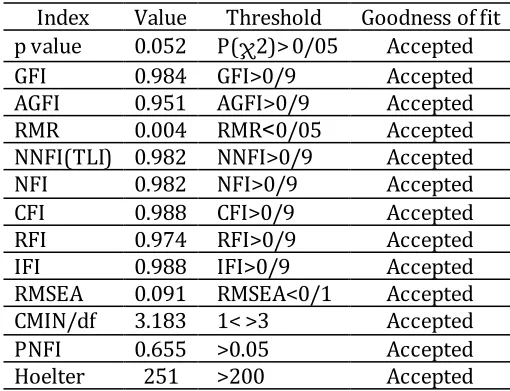
management that can be tested; hence The ELT-CMS was administered to the sample and the obtained data were analyzed using Confirmatory Factor Analysis. This included the most commonly used indices for empirical examination of model fit and research studies normally report five of such indices to confirm the goodness of the model fit.
In addition to the Normed Chi-square (CMIN/DF), CFI (Comparative Fit Index) and GFI (Goodness-of-Fit Index) that are usually reported in CFA-AMOS studies, the RMSEA (Root Mean Square Error of Approximation); and PNFI (Parsimonious Normed Fit Index) are the two other indicators of a model fit. The recommended values of these indices are reported in the literature (Arbuckle, 2009). The fit indices (CFI=0.988; CFI=0.984) and the Normed Chi-square (CMIN/DF=3.18) fell below the suggested threshold point. Overall, the ELT-CMS shows a good and high model fit, confirming the three model structures behind the instrument (Table 5).
Examining Table 5, it appears that CFI and GFI are greater than the 0.90 cutoff point, however bearing in mind the point that, the closer the value to 1, the better fitness, this scale still shows a good fit. Inspecting the CMIN/DF and other Goodness-of-Fit Indices showed a significantly fit model with CMIN/DF=3.183, CFI=0.988., GFI=0.984 and RMEAS=0.09. The internal consistency of the total scale was found to be 0.89. As the p -values and other parameters show, all 45 items of ELT-CMS are kept in the final version and survived this analysis.
Table 5. Fitness indices
Goodness of fit Threshold
Value Index
Accepted P(ჯ2)> 0/05
0.052 p value Accepted GFI>0/9 0.980 GFI Accepted AGFI>0/9 0.951 AGFI Accepted RMR>0/05 0.000 RMR Accepted NNFI>0/9 0.982 NNFI(TLI) Accepted NFI>0/9 0.982 NFI Accepted CFI>0/9 0.988 CFI Accepted RFI>0/9 0.970 RFI Accepted IFI>0/9 0.988 IFI Accepted RMSEA<0/1 0.091 RMSEA Accepted 1< >3 3.183 CMIN/df Accepted >0.05 0.655 PNFI Accepted >200 251 Hoelter
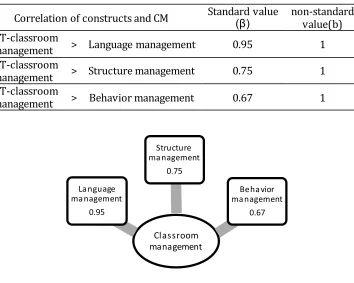
Table 6. The relation of CM and factors
non-standard value(b) Standard value
( β ) Correlation of constructs and CM
1 0.95
Language management >
ELT-classroom management
1 0.75
Structure management >
ELT-classroom management
1 0.67
Behavior management >
ELT-classroom management
Figure1. Amos model modification and the factors indices DISCUSSION
The results obtained in the qualitative and the quantitative phases of the present research are generally satisfactory and in line with the purposes of the study. The obtained model through the phases of the study is very useful with regard to the results of the quantitative stage. Based on the results of the exploratory stage, we now know that classroom management in ELT can be conceived of as having at least three distinct, though related factors which underlie the construct of classroom management in ELT. Additionally, based on the findings of the confirmatory stage, which further extended and verified the developed model, the current make-up of the model and its parameters well fit the data gathered from the questionnaires. In brief, a model which exceeds minimum acceptance cut-off values for the indices can be regarded as a valid tool.
This proposed model can provide the required underpinning to measure CM in English language teaching. Having obtained the strong Amos confirmation, the researcher attempted to elaborate on the three factors, using both the supportive literature and the study’s findings. It is also noteworthy that language management has been defined differently in teacher’s cognition due to its different concerns and the other two factors were strikingly similar to the instructional and behavior management components of Martin and Sass’s model (2010). This can be explained based on the common concerns of CM in general education and specifically in language teaching. The followings are the three overarching component of the ELT classroom management construct:
Classroom management La nguage
ma nagement 0.95
Structure ma nagement
0.75
Beha vior ma nagement
1) Language management: language is both the medium and the content of instruction in ELT classes (Mullock, 2006); hence it is the teachers’ concern to a great extent, paying attention to various aspects of teachers' knowledge and beliefs, ranging from grammar instruction, second language writing to teachers’ opinions about teaching (Borg, 1999; Burns, 1992; Tsui, 1996; Smith, 1996; Cabaroglu & Robert, 2000; cited in Akbari & Moradkhani, 2012). As Gatbonton (1999) states, this construct is concerned with language input learners are exposed to as well as their output. In this sense, this component includes teachers’ attempts aimed at second language development and provides the productive strategies and techniques for second language learners through timely error correction, the use of mnemonic devices, the strategic techniques for skills development, and other issues which aid learners to get their messages across. However language management has been defined broadly and imprecisely until now and according to Mullock (2006) it subsumes all the aspects of input and output; this attempts can be a positive first step in ELT. 2) Structure management: As Martin and Sass (2010) state, instructional
management addresses “instructional aims and methodologies” and includes aspects such as monitoring seatwork, structuring daily routines” as well as lesson planning, teacher’s lecture and grouping patterns. It considers teacher’s concerns with the learners’ needs, interests and backgrounds and the use of effective instructional techniques in order to establish a conductive environment to learning.
It was mentioned in Martin and Sass as Instructional management (IM); however, the researcher believes that structure management can adequately address the CM related issues. What distinguishes a lesson from other kinds of speech event with regard to setting, participants and activities is its structure, in other words, how it begins, proceed and concludes (Richards, 1990), he further defines the pattern of structure as “the result of teacher’s attempts to manage the instructional process” (p. 1) so as to optimize the learning. Therefore structure is a broader term than instruction and entails every aspect of language teaching. According to Rosenshine and Stevens (1986), effective structuring of lessons include purposeful beginning, understandable material presentation, clear and detailed instruction and explanation, systematic feedback and corrections, timely monitoring and explicit instruction and practice for seatwork. Richards(1994) summarized these elements and refers to them as “structuring” which encompasses: Opening, Sequencing that is “how a lesson is divided into segments and how the segments related to each other” (p. 2), Pacing which about the achievement of a sense of movement and Closure.
These elements were attempted to be covered in ELT-CMS and successfully survived factor analysis.
3) Behavior management: it includes “preplanned efforts to prevent misbehaviors as well as the teacher’s response to it” (Martin & Sass, 2010, p. 1126). This component is about being mindful of students’ behaviors and responses, and also includes teachers’ comments on their physical behavior (Gatbonton, 1999) and is similar to, but different from discipline. One very important facet of this construct is the “affective” (ibid) dimension which deals with teachers’ feeling and concerns about the class environment, in other words, to what extent the students are motivated, encouraged, and comfortable.
In the BIMS, this construct encompassed students behavioral issues exclusively (mostly physical and disruptive behavior) and there was no place for teachers’ feeling and concerns.
Emmer, Evertson and Anderson (1980) state the way classroom rules are formulated and implemented is the main difference between effective and ineffective classroom management; however, rules are of little help if students are not motivated and encouraged. Therefore what is noteworthy is that these three constructs are discrete yet related. In other words, taking stock of the affective dimension of CM can provide the necessary environment to implement productive structure management techniques and in the same vein, create a fruitful climate of English learning for learners. In this sense the researcher regards CM as the prerequisite of effective teaching, “scaffolding” for an English class that enables teachers to peg pedagogically valued activities, strategies, and techniques to the CM scaffolding.
CONCLUSION
viewed as the perennial concern of almost all the institutes yet. Regarding its implications for educational organizations, the ELT-based classroom management instrument can guide them with their teacher development programs as it can be used as a way of assessing their practicing teachers’ approaches and locating sources of problem and dissatisfaction within their systems as well.
REFERENCES
Akbari, R., & Moradkhani, S. (2012). Is a Degree Relevant? A Comparison of Pedagogical Thought Units of Teachers with. Australian Journal of Teacher Education, 77-93. Akbari, R., & Tajik, L. (2009). Teachers’ Pedagogic Knowledge Base: a Comparison
between Experienced and Less Experienced Practitioners. Australian Journal of Teacher Education, 59-73.
Akbari, R., Behzadpoor, F., & Dadvand, B. (2001). Development of English language teaching reflection inventory. System, 211-227.
Babad, E. (2009). The social psychology of the classroom. New York and London: Routledge.
Brophy, J. (1996). Teaching problem students. New York: Guilford Press
Brown, D. H. (2001). Teaching by principles: An interactive approach to language pedagogy (2nd ed). New York: Longman.
Deita, C. (n.d.). Classroom management: the key to strategic approach in second language teaching, retrieved from http:// www.rcu.ac.th
Dornyei, Z. (2003). Questionnaires in Second Language Research: Construction, Administration, and Processing. New Jersey: Lawrence Erlbaum Associates, Inc, Publishers.
Doyle, W. (2006). Ecological approaches to classroom management. In C.M. Evertson & C.S. Weinstein (Eds.), Handbook of classroom management: Research, practice, and contemporary issues (pp. 97–126). Mahwah: Lawrence Erlbaum Associates.
Durr, A.J. (2008). Identifying Teacher Capacities That May Buffer Against Teacher Burnout. Dissertation submitted to the Graduate School of The Ohio State University, Columbus, OH. Retrieved from http://etd.ohiolink.edu/send-pdf.cgi/Durr Anthony John.pdf OSU/227554195.
Emmer, E. T., Evertson, C. M., & Anderson, L. M. (1980). Effective classroom management at the beginning of the school year. The Elementary School Journal, 80(5), 219-231. Evertson, C. M., & Weinstein, C. S. (2006). Classroom management as a field of inquiry. In C. M. Everson, & C. S. Weinstein, Handbook of classroom management: Research, Practice, and Contemporary issues (pp. 3-16). Mahwah NJ: Lawrence Erlbaum Associates.
Gebhart. J. (2006). Teaching English as a foreign or second language. Ann Arbor: University of Michigan.
Gencera, A. S., & Cakiroglub, J. (2007). Turkish pre-service science teacher's efficacy beliefs regarding science teaching and their beliefs about classroom management. Teaching and Teacher Education, 23, 664-675.
Handbook of classroom management: Research, practice, and contemporary issues (pp. 73–95). Mahwah, NJ: Lawrence Erlbaum Associates.
Glickman, C., & Tamashiro, R. (1980). Clarifying teachers’ beliefs about discipline. Educational Leadership, 37(6), 459–464.
Harmer. J. (2007). The practice of English Language Teaching (4th ed). Pearson: Longman. Ingersoll, R. M., & Smith, T. M. (2003). The wrong solution to the teacher shortage.
Education Leadership, 8, 30-33.
Kairuz, T., Crump, K., & O'brein, A. (2007). Tools for data collection and analysis. The Pharmaceutical Journal, 278, 371-373.
LeCompetee, M., & Preissle, J. (1993). Ethnography and Qualitative Design in Education Research. San Diego, CA: Academic Press.
Martin, N. K., & Sass, D. A. (2010). Construct validation of the behavior and instructional management scale. Teaching and Teacher Education , 26, 1124-1135.
Mullock, B. (2006). The pedagogical knowledge base of four TESOL teachers. The Modern Language Journal 90, 48-66
Pallant, J. (2011). SPSS survival manual: A step by step guide to data analysis using SPSS (4th edition ed.). Crows Nest Austrailia: Allen & Unwin.
Pourmohammadi, F. (2013). An Investigation of the Classroom Management Style of Iranian EFL and non-EFL Teachers in Public Schools and Private Institutes. Tehran: Master Thesis Tarbiat Modares University.
Richards, J. C. (2011). Competence and Performance in Language Teaching. New York: Cambridge University Press.
Richards, J. C., & Lockhart, C. (1994). Reflective Teaching in Second Language Classrooms. Cambridge: Cambridge University Press.
Rosenshine, B., & Stevens, R. (1986). Teaching functions. In M. C. Wittrock (Ed.), Handbook of research on teaching, 3rd ed. pp. 376-391. New York: Macmillan. Sasson, D. (2007). The teacher as a classroom manager: How to use classroom management
activities and techniques. Retrieved from
http://www.classroom-organization.suite101.com/article.cfm/the teacher as a classroom manager Shulman, L. S. (1987). Knowledge growth in teaching. Educational Researcher. 15, 4–21. Underwood, M.(1987). Effective class management. New York: Longman.
Waters, A. (1998). Managing monkeys in the ELT classroom. ELT journal, 52 (1), 11-18. Wolfgang, C., & Glickman, C. (1980). Solving discipline problems. Boston: Allyn & Bacon. Woolfilk, H. A., & Weinstein, C. S. (2006). Student and Teacher perspectives on classroom
management. In C. M. Evertson, & C. S. Weinstein, Handbook of classroom management: Research, practice, and contemporary issues (pp. 181-219). Mahwah NJ: Lawrence Erlbaum Associates.