Support for seamless data exchanges between web services
through information mapping analysis using kernel methods
Buhwan Jeong, Daewon Lee, Jaewook Lee
*, Hyunbo Cho
Department of Industrial and Management Engineering, Pohang University of Science and Technology (POSTECH), San 31, Hyoja, Pohang 790-784, South Korea
Abstract
A challenging issue to web services interoperability is seamless data exchanges between web services to be composed. A solution to this problem is to establish semantic mappings from an information item to another. To do that, we present an approximate information mapping analysis. We propose a kernel-based structural similarity measure for XML documents. Simulation results with industrial XML data show that the proposed kernel-based measure outperforms other existing methods.
Ó2007 Elsevier Ltd. All rights reserved.
Keywords: Data exchange; Information mapping; Kernel method; Schema matching; Structural similarity; Web service
1. Introduction
Web services, which are self-described and self-con-tained software components over the Internet and use stan-dardized XML messages to exchange data among them, have certainly become the key enabler to develop, inte-grate, and deploy enterprise applications. More adoptions of web services accordingly result in more interactions and data exchanges among services. Moreover, an applica-tion service is often made up of several component services to accomplish a complex task, thereby resulting in more data exchanges among these component services. Both data exchanges between services and within a service potentially cause interoperability problems such as syntax mismatches and semantics conflicts. Hence, assurance of interoperable data exchanges is a prerequisite to successful service composition and deployment.
The present paper proposes an information mapping analysis, which maps an information item in source data to one or more items in destination data. A mapping is established by the degree of similarity between compared
information items. For that purpose, we propose a ker-nel-based similarity measure that exploits XML data by structure. We conduct preliminary simulations with indus-trial XML data for performance evaluation.
The rest of the paper is organized as follows: Section 2 briefly introduces the web service composition problem and then describes the information mapping analysis. Sec-tion3 proposes the kernel-based similarity measure. Preli-minary simulations are conducted in Section 4, and, consequently, Section5gives the conclusion remarks.
2. Problem statement
2.1. Web service composition
Web services are coupled via message (or data) exchanges. In other words, to use a service, an application sends a request message to it and, as a result, receives a response message from it. Such interactions are present both between application services and between component services. Here, we concentrate on interactions between component services, which are scaled up interactions between application services. Service composition is deal-ing with such interactions between component services (Younas, Awan, & Duce, 2006).
0957-4174/$ - see front matterÓ2007 Elsevier Ltd. All rights reserved. doi:10.1016/j.eswa.2007.10.021
*
Corresponding author.
E-mail address:[email protected](J. Lee).
www.elsevier.com/locate/eswa
Expert Systems with Applications 36 (2009) 358–365
Service composition organizes and executes several rele-vant services to accomplish a complex task, when no single service offers that functionality and/or when a single service has very low quality (e.g., expensive to invoke, time-con-suming, less available). A typical approach is to use pro-cesses that effectively integrate distributed, heterogeneous, and autonomous services (Zeng, Benatallah, Dumas, Kala-gnanam, & Sheng, 2003). In this approach, interaction log-ics (e.g., control flow, data flow, and transactional dependencies) among services are expressed by a process model. An AND/OR graph, for example, captures sub-tasks in nodes and invocation precedence orders in directed arcs. For a composition model, we need to discover and assign appropriate component service(s) to each task node. At this discovery time as well as that composition time, data interoperability between services must be assured. At a certain moment, in other words, output data from ser-vices invoked already must include all the necessary infor-mation items of input data for the next service to be invoked. To this end, the information mapping analysis is necessary.
2.2. Information mapping analysis
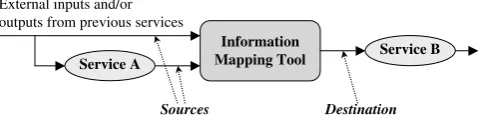
Unless we use identical data in an agreed-upon manner, mismatches in representations and meanings are inevitable during data transfer from a service to another. Such mis-matches depreciate the quality and performance of a com-posite service, thereby demoting the adoption of such a service. For this reason, assurance of seamless data trans-fers is a prerequisite to composing open services provided by anonymous developers. The seamless data transfer is assured when all necessary information is ready for service invocation. In other words, sources are sufficient for and correctly mapped to a destination inFig. 1. In the figure, an information mapping tool merges, fragments, and trans-forms one or more source data into destination data to be fed into a service to be invoked. The sources come either from external applications or previous services already invoked, or both.
Particularly, we introduce the information mapping analysis (IMA) that checks whether the source data are suf-ficient for the destination data and, if they are, then estab-lishes semantic mappings between them. The information mapping concept first comes from the information map-ping test (Kulvatunyou, Ivezic, & Jones, 2005), which ver-ifies that an application correctly processes and transforms data in a proprietary format into those in the standard
XML format, and vice versa. Here, IMA uses the same data format – XML data. IMA has two folds: schema matching at design and discovery time and instance map-ping at execution time. The former schema matching checks whether the data definitions, in XML Schema, of the destination are covered with those of the sources. A ser-vice provider describes and publishes the I/O message meta-types of its service in XML schema via WSDL (Web Service Description LanguageChristensen, Curbera, Meredith, & Weerawarana, 2001). Then, a service requester subscribes the description and makes its interfaces compat-ible with the message types. Therefore, this schema match-ing occurs at composition and/or discovery time. On the other hand, the latter instance mapping actually transforms information items, in XML instances, of the source mes-sages into corresponding ones of the destination message. Hence, the instance mapping is necessary when invoking and integrating services. It is noted that the rest of the paper leaves issues about using ontology for information mapping and transformation. An ontology may explicitly state the relations from source information items to desti-nation items, e.g., the elementSiteis equivalent to the ele-mentFacility, or the elementMaxQuantityis a sub-type of the element Quantity. In other words, the paper uses approximate matching between schemas or between instances.
Simply, IMA compares every pair of information items, each from the sources and the destination, and selects the most plausible mapping(s). This is an approximate match-ing, in that the most similar pair of information items is mapped. Measuring similarity of an information pair is the core of IMA, and will be detailed in the next section. Here, we deal with practical issues arising in IMA. The first issue is the relation between sources and a destination, which is beyond the degree of their similarity. The sources must be sufficient for the destination. In other words, the sources must contain all the information items required by the destination. The first case that is ideal is that a source is identical to the destination – exact match. The second case is that a source or several sources collectively cover the destination – general match. In this case, since the sources have more information or different structures from the destination, the information mapping tool merges, segments, and re-organizes the sources to be iden-tical to the destination. The third case is that the sources provide the destination with insufficient information – par-tial match, thereby requiring additional inputs from exter-nal applications.
The second issue is about information essentiality. For a specific information item I, if a source defines it as an optional item, the item may not appear in an instance doc-ument. On the other hand, suppose that the destination defines the same item I as mandatory. In this case, even though they are an exact match in the schema level, they can be a partial match in the instance level due to absence of the item Iin the source instance. Therefore, a seamless data exchange is granted after such an information essenti-Information
Mapping Tool Service A
Service B External inputs and/or
outputs from previous services
Sources Destination
ality condition is met. A minimal interoperability condition between services is that all the mandatory items in the des-tination are also defined as mandatory in the sources. To sum up, IMA maps information items when they have identical essentiality as well as the same definition and structure. The next section will detail measurement of sim-ilarity between structured data.
3. Kernel-based structural similarity measure
This section entails a comprehensive review on the mea-surement of similarity for XML documents by structure, and proposes a novel structural similarity measure using kernel methods. We also give a brief introduction to kernel methods for they are the core enabler of the proposed measure.
3.1. Similarity measures for XML documents
An XML document is distinguished by its modular tree structure. In the literature, the tree structure provides the underpinning idea to propose a similarity measure for XML documents. Here are typical tree-based similarity measures for XML documents. The most intuitive measure is to compute the portion of common nodes in two docu-ments, in terms of Jaccard coefficient. An advanced one is to compute the portion of common paths. Such node/ path matching approaches appear in Amer-Yahia, Kou-das, and Marian (2005), Buttler (2004), Costa, Manco, Ortale, and Tagarelli (2004), Lee, Lee, and Kim (2001, 2002), Theobald, Schenkel, and Weikum (2003). The sec-ond approaches compute the total operation costs to make a tree identical to the other one. This is often called as tree edit distance (TED), and examples include (Dalamagas, Cheng, Winkel, & Sellis, 2003; Lian, Cheung, Mamoulis, & Yiu, 2004; Nierman & Jagadish, 2002; Yang, Kalnis, & Tung, 2005). In addition, minor approaches also appear such as (Yang, Ceung, & Chen, 2005) that extends a vector space model; (Bhavsar, Boley, & Yang, 2003) that uses weighted node matching; and (Flesca, Manco, Masciari, Pontieri, & Pugliese, 2005) that uses the Fourier transfor-mation. Note that even though we put similar approaches together, each approach uses slightly different representa-tions and/or algorithms to measure similarity.
3.2. Kernel methods for structured data
Kernel methods have been successfully applied to vari-ous real-world problems such as pattern recognition, bio-/chem-informatics, stock market analysis, natural lan-guage processing, computer vision and control, etc., (Lee & Lee, 2005; Scho¨lkopf & Smola, 2001). They convert a linear algorithm into a non-linear one by mapping the ori-ginal samples into ones in a higher-dimensional Hilbert space H so that a linear model in the new space H is equivalent to a non-linear model in the original space X. However, the transformation often leads the methods to
a catastrophe due to highly intensive computational bur-dens and memory problems (Muller, Mika, Ratsch, Tsuda, & Scho¨lkopf, 2001). Fortunately, this problem can be eas-ily solved by using so-called kernel trick, which is origi-nated from an idea that when an algorithm solely depends on the inner product between vectors, the scalar product can be implicitly computed inH, without explic-itly using or even knowing the mapping. That is, we just deal with a kernel functionK:XX!R, not a mapping U:X!H, as UðxÞ UðyÞ ¼Kðx;yÞ. The kernel trick is valid to non-vectorial data as well (Lee & Lee, 2006, 2007a, 2007b). Particularly, the following subsections com-prehensively detail some kernel methods for manipulating textual data.
3.2.1. Vector space model
A traditional way to deal with textual data is a vector space model (VSM) or bag-of-words approach. With a long history (since 1970s), VSM is used as a state-of-the-art tool for ranking relevances of documents in the infor-mation retrieval field. It transforms a document into a numerical vector, each element of which is an indicator of presence or absence of a certain word in the document. Accordingly, a boolean VSM has only ones or zeros, while a real-valued VSM is filled with each term’s appearance fre-quency in a set of documents. ‘Term Frefre-quency–Inverse Document Frequency (TF–IDF)’ weighting (Kobayashi & Aono, 2003; Saracoglu, Tutuncu, & Allahverdi, 2007) is widely used, in which the weight of theith term in the jth document, denoted as wij, is defined by wij¼TFijIDFi¼TFijlogðn=DFiÞ, where TFij is
defined as the number of occurrences of theith term within thejth document, andDFiis the number of documents (out
ofn) in which the term appears.
The similarity between two VSMs, denoted byv1andv2, is simply calculated as the cosine of the angleh defined by them as a distance metric, i.e., dðv1;v2Þ ¼cosh¼ VTv1Vv2=kVv1k2kVv2k2. This cosine similarity is a better dis-tance metric than the Euclidean disdis-tance for information retrieval (Kobayashi & Aono, 2003). However, real-world data are so massive that the similarity measurement method requires too much computations and comparisons for real-time outputs. To overcome this problem, LSA (or LSI, Latent Semantic Analysis/Indexing) (Landauer, Foltz, & Laham, 1998) was proposed that is a fully automatic sta-tistical technique for extracting and inferring relations of expected contextual usage of words in passages of discourse.
3.2.2. String kernels
paperandarticle. Clearly the common subsequences are ‘a’, ‘e’, ‘r’, ‘ae’ and ‘ar’, each of which is represented in an exponential decay penalty – ‘a’: ðk1k1Þ, ‘e’: ðk1k1Þ, ‘r’: ðk1k1Þ, ‘ae’: ðk3k7Þ, and ‘ar’: ðk4k2Þ, that is, ðk1;k1;k1;k3;k4Þvs. ðk1;k1;k1;k7;k2Þ – after applying pen-alties based on the gaps in the occurrence of a subsequence (i.e., the total length of a subsequence in the two strings) with a constant decay factork61. The kernel function is then simply the sum over these penalties, i.e., Kðpaper;articleÞ ¼ k1k1þk1k1þk1k1þk1k1þk3
k7¼k10þk6þ3k2. A formal definition of the basic string kernel, a.k.a., string subsequence kernel (SSK), is provided as follows:
Definition 1 (String Subsequence Kernel (Lodhi, Saunders, Shawe-Taylor, Cristianini, & Watkins, 2002)). Let R be a finite alphabet. A string is a finite sequence of characters fromR, including the empty sequence. For string sandt, we denote byjsjthe length of the string s¼s1. . .sjsj, and with stthe string obtained by concatenating the strings s andt. The strings½i:jis the substringsi. . .sjofs. We say that u is a subsequence of s, if there exist indices i¼ ði1;. . .;ijujÞ, with 16i1<. . .<ijuj6jsj, such that
uj¼sij, for j¼1;. . .;juj, or u¼s½i for short. The length lðiÞof the subsequence insisijuji1þ1. We denote byRn
the set of all finite strings of lengthn, and byR the set of all strings, i.e.,R¼S1n¼0Rn. We now define feature spaces Fn¼RR
n
. The feature mapping/for a stringsis given by defining theu coordinate/uðsÞfor eachu2R
n
. We define /uðsÞ ¼
P i:u¼s½ik
lðiÞ
, for some k61. These features mea-sure the number of occurrences of subsequences in the string s weighting them according to their length. Hence, the inner product of the feature vectors for two stringsand t gives a sum over all common subsequences weighted according to their frequency of occurrence and lengths
Knðs;tÞ ¼
X
u2Rn
h/uðsÞ /uðtÞi ¼X
u2Rn
X
i:u¼s½i
X
j:u¼t½j
klðiÞþlðjÞ: ð1Þ
Since a direct computation of these features would involve
OðjRjnÞ time and space, a recursive computation in
OðnjsjjtjÞ is provided in Lodhi et al. (2002). The Kðs;tÞ, i.e., the inner product of the feature vectors, is the similar-ity between the string sandt (Vert, Tsuda, & Scho¨lkopf, 2004).
Alternatives to SSK have been used inLeslie, Eskin, and Noble (2002) Paass, Leopold, Larson, Kindermann, and Eickeler (2002)where only contiguous substrings of a given string are considered. A string is then represented by the number of times each unique substring of (up to)nsymbols occurs in the sequence. This representation is known as the spectrum of a string or its n-gram representation. Exten-sions of those basic string kernels are found inCancedda, Gaussier, Goutte, and Renders (2003) Saunders, Tschach, and Shawe-Taylor (2002) where the characters replaced with words or syllables – word-sequence kernel – as well as soft matching is allowed. These extensions yield a
signif-icant improvement in computation efficiency for large documents.
3.2.3. Tree kernels
Real-world data are often more structured such as in forms of labeled ordered trees than sequential strings. The key idea to capture such structural information about the trees in the kernel function is to consider all sub-trees occurring in a parse tree, i.e., parse tree kernel (Collins & Duffy, 2002). Here, a subtree is defined as a connected sub-graph of a tree such that either all children or no child of a vertex is in the subgraph. The parse tree kernel for two trees T1 and T2 is defined as KðT1;T2Þ ¼PihiðTiÞhiðT2Þ, where hiðTÞ is the number of times theith subtree occurs
in tree T. In addition, for sets of vertices V1 and V2 of the trees T1 and T2, let Sðv1;v2Þ with vk 2Vk; k¼1;2
be the number of subtrees rooted at vertexv1 andv2 that are isomorphic. Then, the kernel can be computed as KðT1;T2Þ ¼Pv12V1;v22V2Sðv1;v2Þ. This computation has
time complexity OðjV1jjV2jÞ. A recent tree kernel is an extension to string kernels, in which a sequence of node labels in the order of a depth-first traversal is constructed and each node label is identified as a symbol ( Vishwana-than & Smola, 2003). The original tree ought to be ordered.
3.2.4.k-Weighting
One of the most critical factors to determine the kernels’ performance is the choice of the decay factor (i.e., k), regardless the use of the exponential function. Compared with the original string kernel using an identicalkfor every character, Saunders et al. (2002)introduces a different k -weighting strategy that assigns a different weight (kc) to
each character (c2R). In addition, Cancedda et al. (2003) applied the same concept to the word-level. For example, the subsequence ‘cat’ from a string ‘cart’ would receive the weighting kckakrkt. Therefore, the weighted
string kernelKw of two strings sandtis defined as
Kw nðs;tÞ ¼
X
u2Rn
h/wuðsÞ /wuðtÞi
¼X
u2Rn
X
i:u¼s½i
X
j:u¼t½j
Yijij
k¼i1
Yjjjj
l¼j1
kskktl: ð2Þ
The evaluation ofKw can be computed in a similar way to that of the original string kernel (Saunders et al., 2002). The use of different decay factors is one way of incorporat-ing prior knowledge into the strincorporat-ing kernel.
3.3. Proposed structural similarity
similarity. The key idea is a combination approach of translation of an XML DOM tree into a normalized string (Vishwanathan & Smola, 2003), followed by an application of a word-sequence kernel to the normalized strings (Cancedda et al., 2003).
3.3.1. Interface representation
Before describing the interface tree, we introduce some assumptions and notations. An XML document (X) is equivalently represented in a DOM tree (D), in which a node (ni) represents either an element (ei) or an attribute
(ai), therefore the label of a node is assigned by that of
the element or attribute, and no other auxiliary informa-tion, e.g., content (i.e., text value of an element or attri-bute), instruction comment, or annotation, is expressed. The exclusion of contents is because more semantics which an XML document (not an HTML document) ultimately intends to capture are encapsulated in elements rather than the contents (Lee et al., 2001), as well as the paper concen-trates only on the structural similarity. For generality, we assume that the element nodes to be compared are inner nodes, such that they have a parent node and one or more child nodes. If a node has no parent node, then it becomes the root node (i.e., an XML document itself, n1). On the other hand, a node becomes a leaf node when no child node is attached. In addition, attribute nodes are ignored except those belonging to the element node of interest.
An interface representation contains three types of information about a node: self-description of the node (i.e., node label and its attributes), its context information by its ancestor nodes (i.e., a path from the root node to its parent node), and its semantics1 by its descendant nodes (i.e., a sub-tree whose root is the concerned node and no attribute node is allowed). Therefore, the information required is represented in a tuple I¼ ðA;T;DÞ, where A is a sequence of ancestor node labels;T is the node label and a list of its attribute labels; andDis a sequence of its descendant node labels in the order of a depth-first tra-versal. Note that the third field is applied the same treat-ment used by the tree kernel ofVishwanathan and Smola (2003). The root (or a leaf) node has no data in the first (third) field, i.e., A¼ ; (or D¼ ;). More specifically, the tuple is serialized to a sequence of words in the order, and then we get a long string. The reason behind this inter-pretation is that the context of a node is defined by its ancestor nodes, i.e., A, while its precise semantics is real-ized in its descendant nodes, i.e.,D.
Before using this string, we need a normalization process that makes the string have only words in their basic form (e.g., ‘Id’ ! ‘Identifier’). The normalization recursively consists of (1) tokenization, which separates a compound word into atomic dictionary words; (2) lemmatization, which analyzes these words morphologically in order to
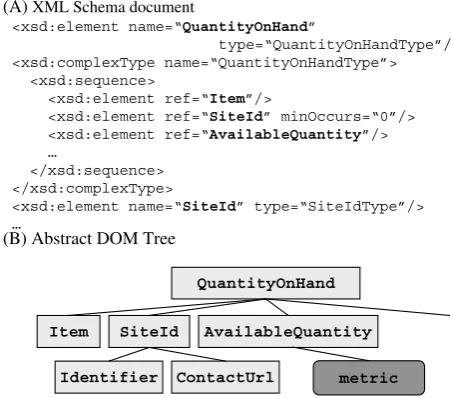
find all their possible basic forms; (3) elimination, which discards meaningless stop words such as article, preposi-tion, and conjunction; and (4) stemming; which finds a stem form of a given inflected word (Jeong, 2006; Shvaiko & Euzenat, 2005). Accordingly, the final interface represen-tation is a normalized string, i.e., a sequence of basic formed words. Take a simple example as shown inFig. 2. The root nodeQuanityOnHand, for example, is serialized into {QuanityOnHand, Item, SiteId, Identifier, ContactUrl, AvailableQuantity,. . .}, and further normalized into { Qua-nity, Hand, Item, Site,. . .}.QuantityOnHand, for example, is separated into {Quantity, On, Hand} and thenOnis elim-inated. In the same way, the nodeAvailableQuantityis rep-resented as {Quantity, Hand, Available, Quantity, metric}.
3.3.2. Similarity measurement
Now, we are ready to compute structural similarity only by applying kernels to the transformed interface represen-tations (i.e., normalized strings). One intuitive and tradi-tional way is to construct a VSM/LSA matrix from the strings and then to compute the cosine similarity. However, this computation ignores the effect of the word order in the normalized strings as well as is biased to the selection of index words. Instead, we address a kernel-based approach (i.e., a word-sequence kernel Cancedda et al., 2003) that reads two strings as sequences of words, generates two fea-ture vectors, and then calculates their inner producth;i, i.e., a kernel function in Eq. (1). The final inner product is the similarity between two XML documents (Vert et al., 2004). The new similarity measure incorporates the order of words as well as the frequency of each word.
With Eq.(2), an extension occurs at assignment of dif-ferent weights (i.e., decay factor, k) to different nodes. The use of different weights (to different words) is new in tree kernels to our knowledge although it is not new in string kernels (Cancedda et al., 2003; Saunders et al.,
1 The leaf (or lower) nodes represent the atomic data that an XML
document ultimately describes (Madhavan, Bernstein, & Rahm, 2001).
(A) XML Schema document
<xsd:element name=“QuantityOnHand”
type=“QuantityOnHandType”/> <xsd:complexType name=“QuantityOnHandType”>
<xsd:sequence>
<xsd:element ref=“Item”/>
<xsd:element ref=“SiteId” minOccurs=“0”/>
<xsd:element ref=“AvailableQuantity”/>
…
</xsd:sequence> </xsd:complexType>
<xsd:element name=“SiteId” type=“SiteIdType”/>
…
QuantityOnHand
AvailableQuantity Item SiteId
(B) Abstract DOM Tree
Identifier ContactUrl metric
2002). Various factors can affect the determination of a decay factorknfor a nodensuch as the depth of the node,
the number of its child nodes, its context (i.e., ancestor nodes), and the lexical semantics of its label (e.g., synonym) (Zhang, Li, Cao, & Zhu, 2003). Among them, the context information is already captured in the interface representa-tion and the lexical semantics is treated as soft matching in Cancedda et al. (2003) and Saunders et al. (2002). Here, we adopt a depth-dependent decay factor kn¼depthk0ðnÞr, where
depthðnÞ is the depth of the node n, (depthðrootÞ ¼1), andrP1 is a relevant factor. Since, as shown in the exam-ple below, the size of inputs (i.e., length of strings) is usu-ally not a constant, the kernel value is sometimes normalized in [0, 1] by applying Kbðs;tÞ ¼ ffiffiffiffiffiffiffiffiffiffiffiffiffiffiffiffiffiKKðs;tÞ
ðs;sÞKðt;tÞ
p ,
b
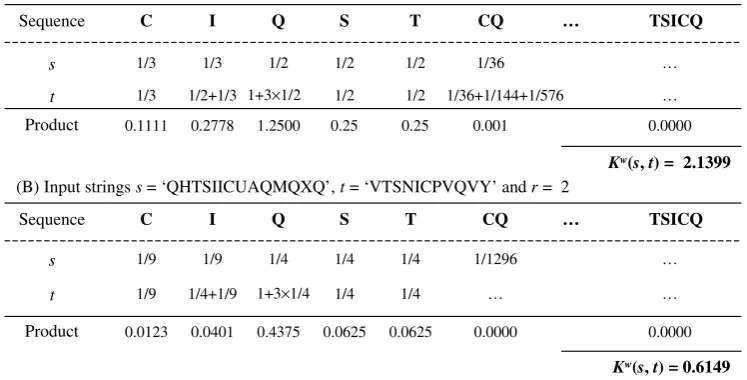
Kðs;tÞ ¼1 if and only if stringssandtare identical. Fig. 3illustrates an example to compute the structural similarity between the node QuantityOnHand in Fig. 2 and a similar node Inventory, which is represented as {Inventory, Item, Site, Name, Identifier, Contact, Point, Inventory, Quantity, Inventory, Capacity}. For simplicity, we use following symbols to each word in the normalized documents: A(vailable), C(ontact), H(and), I(dentifier), L(ocator), M(inimum), N(ame), P(oint), Q(uantity), R(esource), S(ite), T(Item), U(niversal), V(Inventory), X(Maximum), and Y(Capacity). After serialization and normalization, we get the string ‘QHTSIICUR-LAQMQXQ’ for the QuanityOnHand node and ‘VTSNICPVQVY’ for the Inventory node. The common subsequences are fC;Ið2Þ;Qð4Þ;S;T;CQð3Þ;ICð2Þ;. . .; TSICQð6Þg. Note that numbers in parentheses indicate the number of possible occurrences. Accordingly, as detailed inFig. 3, their similarity is easily computed via Eq.(2) as Kw’2:1399 and Kw ’0:6149 with respect to r= 1 and
2, and k0¼1, whereas computed via Eq. (1) with with k¼0:5 yieldsK ¼2:3699.
4. Experimental analysis
To evaluate the proposed method, we performed an experiment with XML schema documents from OAGIS.2 The OAGIS BOD (Business Object Document) schemas are open and standard specifications for supporting inter-operable data exchange by providing enterprise/domain-neutral data structures and definitions. The particular use of OAGIS BODs is very relevant to this research because they are used as the standard data exchange definitions among B2B web services. We designed three types of exper-iments. The first design is just to show that the proposed method is well suited to human judgment, while the second one is to verify the proposed similarity measures well dis-criminate valuable information from irrelevant informa-tion in the perspective of informainforma-tion retrieval. And, the third experiment shows the proposed kernel-based similar-ity measure is well suited to an application of XML docu-ments clustering.
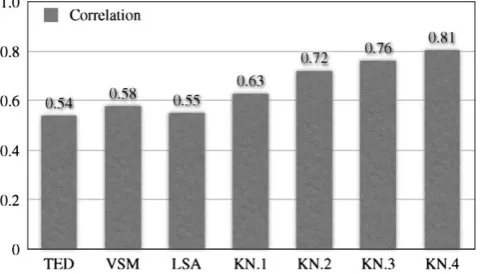
For the first experiment, we randomly select 200 pairs of CC’s (Core Components)3 and then four human experts verify every pair to assign their degree of relatedness. The averaged scores over the four operators are used to com-pare the performance of the proposed methods. We imple-mented five algorithms – TED (Tree Edit Distance); VSMs by means of cosine similarity, and LSA; kernels both with fixed penalty (i.e., kn¼c) and with variant penalty (i.e., kn¼fðk0;depthðnÞ;rÞ). The experiment result is depicted in Fig. 4in terms of correlation with the operators’ score. ‘KN.1’ and ‘KN.2’ implement the fixed k-weighting with respect tok¼1 and 1=2, while ‘KN.3’ and ‘KN.4’ imple-ment the variant k-weighting with respect to relevant
s
t
Sequence C I Q S
Product
T CQ TSICQ
1/3 1/3 1/2 1/2 1/2 1/36
1/3 1/2+1/3 1+3×1/2 1/2 1/2 …
…
1/36+1/144+1/576
0.1111 0.2778 1.2500 0.25 0.25 0.001 0.0000
(A) Input stringss= ‘QHTSIICUAQMQXQ’,t= ‘VTSNICPVQVY’ andr= 1
Kw(s,t) = 2.1399
s
t
Sequence C I Q S
Product
T CQ TSICQ
1/9 1/9 1/4 1/4 1/4 1/1296
1/9 1/4+1/9 1+3×1/4 1/4 1/4 …
…
…
0.0123 0.0401 0.4375 0.0625 0.0625 0.0000 0.0000
(B) Input stringss= ‘QHTSIICUAQMQXQ’,t= ‘VTSNICPVQVY’ andr= 2
Kw(s,t) = 0.6149 …
…
Fig. 3. Exemplary structural similarity computation using the proposed tree kernel with relevant factorr= 1 (A) andr= 2 (B).
2 http://www.openapplications.org.
factors r¼1 and 2. As shown in the figure, the kernel methods (including VSMs) outperform TED, the state-of-the-art structural similarity measure. Moreover, the kernel methods that preserve the word order give better perfor-mance than VSMs do.
The second experiment is a mapping test that evaluates whether mappings established by an algorithm is correct or not compared with true mappings. We configured four experiment sets, each of which consists of two data sets having 10 CC’s and 20 CC’s. Between the two data sets, an algorithm (and human operators as well for evaluation) select plausible mappings (the number of mapping is less than 10). Then, we evaluate how many mappings by an algorithm are the same ones in true mappings by human operators. For this experiment, we adopt standard perfor-mance metrics, i.e., Precision, Recall, and F-Measure, widely used in the information retrieval field. Let Abe a
set of alignments mapped by an algorithm, and T be a set of true mappings by human experts. Then the metrics are defined as follows:
Precision¼jA T
Tj jAj
Recall¼jA T
Tj jTj
F-Measure¼2PrecisionRecall ðPrecisionþRecallÞ :
The experiment results are depicted inFig. 5and show that our proposed kernel method for structured data (i.e., KN:i)
give better performance than the traditional TED and VSMs do as does for the first experiment.
The third experiment is XML document clustering. For this experiment, we prepared 118 CC’s roughly belonging to six groups – time and date, contact information, refer-ence, business role, location, and order reference. We used k-medoids clustering because we have a pair-wise similarity table only. We evaluate if the clustering algorithm identifies six clusters well and if samples in each cluster are from the same group. The clustering results are summarized in Table 1, from which we can conclude that the proposed kernel method more precisely and accurately groups samples.
5. Conclusion
The interoperable data exchanges among services to be composed are a prerequisite to successful web services com-position. A couple of services to be connected must meet their exchange data definitions at a design time and have to be capable of mapping data at a run-time. To this end, we proposed an information mapping analysis that establishes semantic mappings based on an approximate analysis. As part of the analysis, we proposed a novel ker-nel-based measure to compute structural similarity between tree-structured XML documents. In particular, after a comprehensive review of kernel methods, we presented an interface representation of XML documents to be fed into the kernel computation and also introduced a depth-ori-ented penalty assessment. The results on experimental sim-ulations show that the proposed kernel-based measurement of structural similarity outperforms the conventional VSMs as well as the tree edit distance method. Studies are still needed in the direction of consolidating the infor-mation mapping analysis such as semantics-based reasoning.
Fig. 4. Correlation between human judgment and various structural similarity measures – TED (Tree Edit Distance), VSM with cosine of the angle cosh, VSM with LSA, and Kernel-based measures (i.e., k¼1,k¼0:5,k0¼1&r¼1, andk0¼1&r¼2).
Fig. 5. Precision, Recall and F-measure.
Table 1 Clustering results
Method TED VSM LSA KN.1 KN.2 KN.3 KN.4
NoCa 4 4.8 4.3 5.1 5 5.3 5.2
NoDb(%) 23.3 (19.7) 15.2 (12.9) 24 (20.3) 8.7 (7.4) 7.8 (6.7) 11.8 (10.0) 6.9 (5.85)
a NoC indicates the average number of clusters.
Acknowledgement
This work was supported by the Korea Research Foun-dation under the Grant Number KRF-2006-311-D00956.
References
Amer-Yahia, S., Koudas, N., & Marian, A. (2005). Structure and content scoring for XML. InProceedings of the 31st VLDB conference. Bhavsar, V., Boley, H., & Yang, L. (2003). A weighted-tree similarity
algorithm for multi-agent systems in e-business environments. In Proceedings of the business agents and the semantic web (BASeWEB) workshop.
Buttler, D. (2004). A short survey of document structure similarity algorithms. In Proceedings of the 5th international conference on internet computing (IC2004).
Cancedda, N., Gaussier, E., Goutte, C., & Renders, J. (2003). Word-sequence kernels.Journal of Machine Learning Research, 3, 1059–1082. Christensen, E., Curbera, F., Meredith, G., & Weerawarana, S. (2001). Web Service Description Language (WSDL) 1.1(Mar. 2001).<http:// www.w3.org/TR/wsdl>.
Collins, M., & Duffy, N. (2002). Convolution kernels for natural language. In T. Dietterich, S. Becker, & Z. Ghahramani (Eds.).Advances in neural information processing systems(Vol. 14). Cambridge, MA: MIT Press.
Costa, G., Manco, G., Ortale, R., & Tagarelli, A. (2004). A tree-based approach to clustering XML documents by structure. Knowledge Discovery in Databases: PKDD 2004 (LNAI 3202), 137–148. Dalamagas, T., Cheng, T., Winkel, K., & Sellis, T. (2003).Clustering XML
documents by structure. Tech. Rep. TR-2003-6, National Technical University of Athens.
Flesca, S., Manco, G., Masciari, E., Pontieri, L., & Pugliese, A. (2005). Fast detection of XML structural similarity. IEEE Transactions on Knowledge and Data Engineering, 17(2), 160–175.
Jeong, B. (2006).Machine learning-based semantic similarity measures to assist discovery and reuse of data exchange XML schemas. Ph.D. thesis, Department of Industrial and Management Engineering, Pohang University of Science and Technology.
Kobayashi, M., & Aono, M. (2003).Vector space models for search and cluster mining. Springer-Verlag, NY, pp. 103–122.
Kulvatunyou, B., Ivezic, N., & Jones, A. (2005). Content-level confor-mance testing: An information mapping case study. Testing of Communicating Systems LNCS, 3502, 349–364.
Landauer, T., Foltz, P., & Laham, D. (1998). An introduction to latent semantic analysis.Discourse Processes, 25, 259–284.
Lee, J., & Lee, D. (2006). Dynamic characterization of cluster structures for robust and inductive support vector clustering.IEEE Transactions on Pattern Analysis and Machine Intelligence, 28(11).
Lee, J., Lee, K., & Kim, W. (2001). Preparations for semantics-based XML mining. InProceedings of IEEE international conference on data mining (ICDM2001)(pp. 345–352).
Lee, M., Yang, L., Hsu, W., & Yang, X. (2002). XClust: Clustering XML schemas for effective integration. InProceedings of the conference on information and knowledge management (CIKM’02).
Lee, J., & Lee, D. (2005). An improved cluster labeling method for support vector clustering.IEEE Transactions on Pattern Analysis and Machine Intelligence, 27(3), 461–464.
Lee, D., & Lee, J. (2007a). Domain described support vector classifier for multi-classification problems.Pattern Recognition, 40, 41–51.
Lee, D., & Lee, J. (2007b). Equilibrium-based support vector machine for semi-supervised classification.IEEE Transactions on Neural Networks, 18(2), 578–583.
Leslie, C., Eskin, E., & Noble, W. (2002). The spectrum kernels: A string kernel for SVM protein classification. In Proceedings of the Pacific symposium on biocomputating(pp. 564–575).
Lian, W., Cheung, D., Mamoulis, N., & Yiu, S. (2004). An efficient and scalable algorithm for clustering XML documents by structure.IEEE Transactions on Knowledge and Data Engineering, 16(1), 82–96. Lodhi, H., Saunders, C., Shawe-Taylor, J., Cristianini, N., & Watkins, C.
(2002). Text classification using string kernels. Journal of Machine Learning Research, 2, 419–444.
Madhavan, J., Bernstein, P., & Rahm, E. (2001). Generic schema matching with cupid. In Proceedings of the 27th VLDB conference (pp. 49–58).
Muller, K., Mika, S., Ratsch, G., Tsuda, K., & Scho¨lkopf, B. (2001). An introduction to kernel-based learning algorithms.IEEE Transactions on Neural Networks, 12(2), 181–201.
Nierman, A., & Jagadish, H. (2002). Evaluating structural similarity in XML documents. InProceedings of the 5th international workshop on the web and database (WebDB2002).
Paass, G., Leopold, E., Larson, M., Kindermann, J., & Eickeler, S. (2002). SVM classification using sequences of phonemes and syllables. In Proceedings of the 6th European conference on principles of data mining and knowledge discovery(pp. 373–384). Springer-Verlag.
Saracoglu, R., Tutuncu, K., & Allahverdi, N. (2007). A fuzzy clustering approach for finding similar documents using a novel similarity measure.Expert Systems with Applications, 33(3), 600–605.
Saunders, C., Tschach, H., & Shawe-Taylor, J. (2002). Syllables and other string kernel extensions. In Proceedings of the 19th international conference on machine learning (ICML’02).
Scho¨lkopf, B., & Smola, A. (2001).Learning with kernels: Support vector machines, regularization, optimization, and beyond. Cambridge, MA: MIT Press.
Shvaiko, P., & Euzenat, J. (2005). A survey of scham-based matching. Journal of Data Semantics IV, 3730, 14–171.
Theobald, M., Schenkel, R., & Weikum, G. (2003). Exploiting structure, annotation, and ontological knowledge for automatic classification of XML data. In Proceedings of international workshop on the web and databases (WebDB).
Vert, J., Tsuda, K., & Scho¨lkopf, B. (2004).A primer on kernel methods. Cambridge, MA: MIT Press (pp. 35–70).
Vishwanathan, S., & Smola, A. (2003). Fast kernels for string and tree matching. In S. Becker, S. Thrun, & K. Obermayer (Eds.).Advances in neural information processing systems(Vol. 15). MIT Press.
Yang, R., Kalnis, P., & Tung, A. (2005). Similarity evaluation on tree-structured data. In Proceedings of ACM SIGMOD/PODS 2005 conference.
Yang, J., Ceung, W., & Chen, X. (2005). Learning the kernel matrix for XML document clustering. InProceedings of 2005 IEEE international conference on e-technology, e-commerce and e-service(pp. 353–358). Younas, M., Awan, I., & Duce, D. (2006). An efficient composition of web
services with active network support. Expert Systems with Applica-tions, 31(4), 859–869.
Zeng, L., Benatallah, B., Dumas, M., Kalagnanam, J., & Sheng, Q. (2003). Quality driven web services composition. InProceedings of the 12th international world wide web conference (WWW2003)(pp. 411–421). Zhang, Z., Li, R., Cao, S., & Zhu, Y. (2003). Similarity metric for XML