Integral Root Labeling of Graphs
1V.L. Stella Arputha Mary & 2N. Nanthini
1Department of Mathematics, St. Mary’s College (Autonomous), Thoothukudi-628001. 2M.phil Scholar, St. Mary’s College (Autonomous), Thoothukudi-628001.
ABSTRACT
Let 𝐺 = 𝑉, 𝐸 be a graph with 𝑝 vertices and 𝑞 edges. Let 𝑓: 𝑉 → 1,2, … 𝑞 + 1 is called an Integral Root labeling if it is possible to label all the vertices 𝑣 ∈ 𝑉 with distinct elements from 1,2, … 𝑞 + 1 such that it induces an edge labeling 𝑓+: 𝐸 → 1,2, … 𝑞 defined as
𝑓+(𝑢𝑣) = (𝑓 𝑢 )2+(𝑓 𝑣 )2+𝑓 𝑢 𝑓(𝑣)
3 is distinct for all 𝑢𝑣 ∈ 𝐸. (i.e.) The distinct vertex labeling induces a distinct
edge labeling on the graph. The graph which admits Integral Root labeling is called an Integral Root Graph. In this paper, we introduce Integral Root labeling and investigate Integral Root labeling of Path, Comb, Ladder, Triangular Snake and Quadrilateral Snake.
KEY WORDS
Integral Root labeling, Integral Root graph, Path, Comb, Ladder, Triangular Snake, and Quadrilateral Snake.
INTRODUCTION
By a graph G= (V (G), E (G)) we mean a finite undirected graph without loops or parallel edges. For all detailed survey of graph labeling we refer to Gallian[1]. For all other standard terminology and notations we follow Harary[2]. A graph labeling is an assignment of integers to the vertices or edges or both subject to certain conditions.
In this paper we investigate the Integral Root labeling of Path, Comb, Ladder, Triangular Snake, and Quadrilateral Snake.
2. BASIC DEFINITIONS
Definition: 2.1
A walk in which 𝑢1, 𝑢2, … 𝑢𝑛 are distinct is called a path. A path on 𝑛 vertices is denoted by 𝑃𝑛 . Definition: 2.2
A Closed Path is called a Cycle. A cycle on n vertices is denoted by 𝐶𝑛. Definition: 2.3
The graph obtained by joining a single pendent edge to each vertex of a path is called a Comb. Definition: 2.4
The Cartesian product of two graphs 𝐺1=(𝑉1,𝐸1) and 𝐺2=(𝑉2,𝐸2) is a graph 𝐺=(𝑉,𝐸) with 𝑉=𝑉1×𝑉2 and two vertices 𝑢=(𝑢1𝑢2) and 𝑣=(𝑣1𝑣2) are adjacent in 𝐺1×𝐺2 whenever (𝑢1=𝑣1and 𝑢2 is adjacent to 𝑣2) or (𝑢2=𝑣2and 𝑢1 is adjacent to 𝑣1) .It is denoted by 𝐺1×𝐺2.
Definition: 2.5
The Corona of two graphs 𝐺1 and 𝐺2 is the graph 𝐺=𝐺1⨀𝐺2 formed by taking one copy of 𝐺1 and |(𝐺1)| copies of 𝐺2
where the ith vertex of 𝐺1 is adjacent to every vertex in the ith copy of 𝐺2.
Definition: 2.6
The product graph 𝑃2× 𝑃𝑛 is called a ladder and it is denoted by 𝐿𝑛.
Example:
Definition: 2.7
A Triangular Snake 𝑻𝒏 is obtained from a path u1, u2, … unby joining uiand ui+1 to a new vertex vi for 1 ≤ i ≤
n − 1.That is every edge of a path is replaced by a triangle C3.
Example:
Triangular Snake 𝑇4 is given below
Definition: 2.8
A Quadrilateral Snake 𝑸𝒏is obtained from a path 𝑢1, 𝑢2, … 𝑢𝑛by joining 𝑢𝑖 and 𝑢𝑖+1 to two new vertices 𝑣𝑖 and
𝑤𝑖 respectively and then joining 𝑣𝑖 and 𝑤𝑖. That is every edge of a path is replaced by a cycle 𝐶4.
Example:
Quadrilateral Snake 𝑄4 is given below
3. MAIN RESULTS Definition: 3.1
𝑢1 𝑢2 𝑢3 𝑢4
𝑣1 𝑤1 𝑣2 𝑤2 𝑣3 𝑤3
𝑢1 𝑢2 𝑢3 𝑢4
𝑣1 𝑣2 𝑣3
𝑣1 𝑣2 𝑣3 𝑣4
𝑢1 𝑢
Let 𝐺 = 𝑉, 𝐸 be a graph with 𝑝 vertices and 𝑞 edges. Let 𝑓: 𝑉 → 1,2, … 𝑞 + 1 is called an Integral Root labeling if it is possible to label all the vertices 𝑣 ∈ 𝑉 with distinct elements from 1,2, … 𝑞 + 1 such that it induces an edge labeling 𝑓+: 𝐸 → 1,2, … 𝑞 defined as
𝑓+(𝑢𝑣) = (𝑓 𝑢 )2+(𝑓 𝑣 )2+𝑓 𝑢 𝑓(𝑣)
3 is distinct for all 𝑢𝑣 ∈ 𝐸. (i.e.) The distinct vertex labeling induces a distinct
edge labeling on the graph. The graph which admits Integral Root labeling is called an Integral Root Graph. Theorem: 3.2
Anypath 𝑃𝑛 is an Integral Root graph. Proof:
Let G be a path graph 𝑃𝑛.
Let 𝑢1, 𝑢2, … . 𝑢𝑛 be the vertices of path 𝑃𝑛and 𝑒1, 𝑒2, … . 𝑒𝑛−1 be the edges of path 𝑃𝑛
The path 𝑃𝑛 consists of 𝑛 vertices and 𝑛 − 1 edges.
Define 𝑓: 𝑉 𝑃𝑛 → 1,2, … . 𝑞 + 1 by𝑓 𝑢𝑖 = 𝑖 ; 1 ≤ 𝑖 ≤ 𝑛.
Then we find the edge labels 𝑓+ 𝑒 = 𝑢𝑖𝑢𝑖+1 = 𝑖
2+𝑖 𝑖+1 + 𝑖+1 2
3 ; 1 ≤ 𝑖 ≤ 𝑛 − 1
= 𝑖2+𝑖2+𝑖+𝑖32+1+2𝑖 = 3𝑖2+3𝑖+13 = 𝑖 are distinct. Hence 𝑃𝑛 is an Integral Root graph.
Example: 3.3
The Integral Root labeling of 𝑃6is given below
Figure: 1 Theorem: 3.4
Any Comb 𝑃𝑛ʘ𝒌𝟏 is an Integral Root graphs. 𝑛 ≥ 2 Proof:
Let 𝐺 be a comb graph 𝑃𝑛ʘ𝒌𝟏.
Let 𝑢1, 𝑢2, … . 𝑢𝑛, 𝑣1, 𝑣2, … 𝑣𝑛 be the vertices of comb.
The comb has 2𝑛 − 1 edges.
Define a function 𝑓: 𝑉 𝑃𝑛ʘ𝒌𝟏 → 1,2, … . 𝑞 + 1 by
𝑓 𝑢𝑖 = 2𝑖 − 1 ; 1 ≤ 𝑖 ≤ 𝑛,
𝑓 𝑣𝑖 = 2𝑖 ; 1 ≤ 𝑖 ≤ 𝑛.
Then we find the edge labels 𝑓+ 𝑒 = 𝑢
𝑖𝑢𝑖+1 = 2𝑖; 1 ≤ 𝑖 ≤ 𝑛 − 1 ;
𝑓+ 𝑒 = 𝑢
𝑖𝑣𝑖 = 2𝑖 + 1; 1 ≤ 𝑖 ≤ 𝑛 − 1 are distinct.
Hence 𝑃𝑛ʘ𝒌𝟏 is an Integral Root graph. Example: 3.5
The Integral Root labeling of 𝑃7ʘ𝒌𝟏 is given below.
3 4
3 1
1
2 4 5 6
2
Figure: 2 Theorem: 3.6
Any Ladder 𝐿𝑛 is an Integral Root graph. Proof:
Let 𝐺 be a Ladder graph 𝐿𝑛.
Let u1,u2, … .un,v1,v2, …vn be the vertices of ladder.
Define a function 𝑓: 𝑉 𝐿𝑛 → 1,2, … . 𝑞 + 1 as
𝑓 𝑢𝑖 = 3𝑖 − 2 ; 1 ≤ 𝑖 ≤ 𝑛,
𝑓 𝑣𝑖 = 3𝑖 − 1 ; 1 ≤ 𝑖 ≤ 𝑛.
Then we find the edge labels 𝑓+ 𝑢
𝑖𝑢𝑖+1 =3𝑖 − 1 ; 1 ≤ 𝑖 ≤ 𝑛 − 1,
𝑓+ 𝑢
𝑖𝑣𝑖 =3𝑖 − 2; 1 ≤ 𝑖 ≤ 𝑛 − 1,
𝑓+ 𝑣
𝑖𝑣𝑖+1 =3𝑖 ; 1 ≤ 𝑖 ≤ 𝑛 − 1 are distinct.
Hence 𝐿𝑛 is an Integral Root graph. Example: 3.7
The Integral Root labeling of 𝐿6 is given below
Figure: 3 Theorem: 3.8
Any Triangular Snake 𝑇𝑛 is an Integral Root graph. Proof:
Let 𝐺 be a triangular snake 𝑇𝑛.
Define a function 𝑓: 𝑉 𝑇𝑛 → 1,2, … , 𝑞 + 1 by
𝑓 𝑢𝑖 =3𝑖 − 2; 1 ≤ 𝑖 ≤ 𝑛,
2 5 8 11 14 17
1 2
12 4
3
5
6 7
9 8
10
11
13
15 14
16
1 4 7 10 13 16
1
2
3 5 7 9 11 13
10 12
8 6
4
3
1 5 7 9 11 13
8
𝑓 𝑣𝑖 =3𝑖 − 1; 1 ≤ 𝑖 ≤ 𝑛 − 1.
Then we find the edge labels 𝑓+ 𝑢
𝑖𝑢𝑖+1 =3𝑖 − 1; 1 ≤ 𝑖 ≤ 𝑛 − 1,
𝑓+ 𝑣
𝑖𝑢𝑖+1 =3𝑖; 1 ≤ 𝑖 ≤ 𝑛 − 1 ,
𝑓+ 𝑢
𝑖𝑣𝑖 =3𝑖 − 2; 1 ≤ 𝑖 ≤ 𝑛 − 1 are distinct.
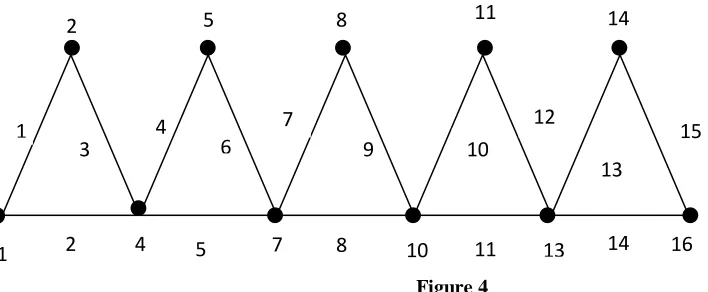
Hence 𝑇𝑛is an Integral Root graph. Example: 3.9
The Integral Root labeling of 𝑇6 is given below
Figure 4 Theorem: 3.10
Any Quadrilateral Snake 𝑄𝑛 is an Integral Root graph. Proof:
Let 𝐺 be a Quadrilateral Snake 𝑄𝑛.
Define a function 𝑓: 𝑉 𝑄𝑛 → 1,2, … . 𝑞 + 1 by
𝑓 𝑢𝑖 =4𝑖 −3; 1 ≤ 𝑖 ≤ 𝑛,
𝑓 𝑣𝑖 =4𝑖 − 2; 1 ≤ 𝑖 ≤ 𝑛 − 1,
𝑓 𝑤𝑖 =4𝑖 − 1; 1 ≤ 𝑖 ≤ 𝑛 − 1.
Then the edge labels 𝑓+ 𝑢
𝑖𝑣𝑖 =4𝑖 −3; 1≤ 𝑖 ≤ 𝑛 −1,
𝑓+ 𝑢
𝑖𝑢𝑖+1 =4𝑖 −1; 1≤ 𝑖 ≤ 𝑛 −1,
𝑓+ 𝑢
𝑖+1𝑤𝑖 =4𝑖; 1≤ 𝑖 ≤ 𝑛 −1,
𝑓+ 𝑣
𝑖𝑤𝑖 =4𝑖–2; 1≤ 𝑖 ≤ 𝑛 −1 are distinct.
Hence 𝑄𝑛 is an Integral Root graph. Example: 3.11
The Integral Root labeling of 𝑄5is given below.
Figure: 5 10
17 15
11 3
16
1 5 9
14 10
4 1
2
5 8 12
6
13 7
13 9
2 3 6 7 11 14 15
1 10 16
2
4 7 13
2 8 11
4
3 6 9
12
1 7 15
13 10
14 5
Theorem: 3.12
Any cycle 𝐶𝑛 is not a Integral Root graph 𝑛 ≥ 3. Proof:
Let 𝐺 be a graph of cycle 𝐶𝑛 .
Let 𝑢1, 𝑢2, … . 𝑢𝑛 be the vertices of cycle 𝐶𝑛 and 𝑒1, 𝑒2, … . 𝑒𝑛−1 be the edges of cycle 𝐶𝑛.
The cycle 𝐶𝑛 consists of 𝑛 vertices and 𝑛 − 1 edges.
Define 𝑓: 𝑉 𝐶𝑛 → 1,2, … . 𝑞 + 1 by
𝑓 𝑢𝑖 = 𝑖 ; 1 ≤ 𝑖 ≤ 𝑛
Then we find the edge labels 𝑓+ 𝑒 = 𝑢
𝑖𝑢𝑖+1 = 𝑖; 1 ≤ 𝑖 ≤ 𝑛 − 1 are distinct., and 𝑓(𝑢𝑛𝑢1) is not distinct.
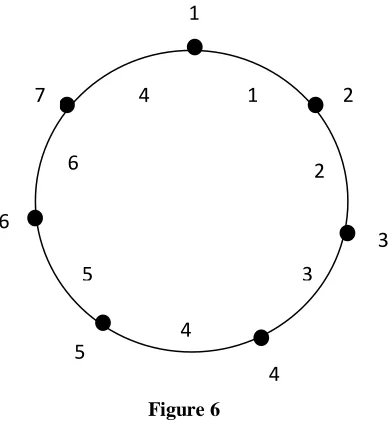
Hence 𝐶𝑛 is not a Root graph. Example: 3.13
Cycle 𝐶7 is not Integral Root Labeling of graph is given below
Figure 6
REFERENCES
[1] J.A.Gallian, 2010, “A dynamic Survey of graph labeling,” The electronic Journal of Combinatories17#DS6. [2] F.Harary, 1988, “Graph Theory,” Narosa Publishing House Reading, New Delhi.
[3] S.Sandhya, S. Somasundaram, S. Anusa, “Root Square Mean labeling of graphs,” International Journal of Contemporary Mathematical Science, Vol.9, 2014, no.667-676.
[4] S. S. Sandhya, E. Ebin Raja Merly and S. D. Deepa, “Heronian Mean Labeling of Graphs” , communicated to International journal of Mathematical Form.
[5] V.L. Stella Arputha Mary S. Navaneetha Krishnan and A. Nagarajan “ Z4p Magic labeling on some special graphs”, International journal of Mathematics and Soft Computing Vol. 3, No: 3 (2013) (61-70).
[6] V.L. Stella Arputha Mary S. Navaneetha Krishnan and A. Nagarajan “ Z4p Magic labeling for some more special graphs”, International journal of Physical Sciences, Ultra Scientist Vol. 25, No: 3 (2013) (319-326).
1
2
3
4 5
6
7 1
2
3
4 5
6