Volume 3, Issue 3, March 2014
Page 518
Abstract
Due to the potential features of extending the boundaries of the communication and network system, optical networking is always under high demand of the customers. Although the technology has witnessed various successful applications and services, still it encounters some of the technical issues which have been on the constant attention from past decade among the research community. Therefore, the proposed system has discussed a model termed as ECON that attempts to enhance the OSNR using the potential features of ROADM. The algorithm is simulated in Matlab and multiple numbers of optical channels are evaluated to find the effectiveness of the model. For better precision, a constraint OSNR optimization issue is considered in the study where the prime intention is to enhance the throughput of the network. Compared with a standard and significant existing model, the proposed model is found to outperform it.
Keywords: Optical Network, Reconfigurable Optical Add-Drop Multiplexer, Optical Signal-to-Noise Ratio.
1.
I
NTRODUCTIONIn order to cater up the demands of high speed and maximum bandwidth utilization, optical communication system has successfully established its identity of modernized communication and networking system [1]. Such type of network has the full fledge capability to support the potential requirements of the existing as well as the upcoming futuristic technologies. For the purpose of accommodating the large variations of applications, networking infrastructure are rising promptly keeping a pace with the modern networking system. For an example, in optical network, Dense Wavelength Division Multiplexing [2] deploys novel switching architectures thereby giving the network a cut edge application compatibility and supportability. With the growing usage of optical network, availability of various hardware devices and software techniques are not that challenging aspect presently. The widespread deployment of optical communication systems and networks introduces many challenges and opportunities, which this special issue aims to address. At present, WDM is preferred over other multiplexing technologies [3] since all of the end-user equipment need to operate only at the peak electronic processing speed where as in TDM and CDM, some part of an end user's network bandwidth can be divided into multiple non-overlapping frequency or wavelength channels. Each WDM channel may be operated at any speed, e.g., peak electronic speed of a few gigabits per second (Gbps). Currently, commercially available optical fibers can support over a hundred wavelength channels, each of which can have a transmission speed of over a gigabit per second (e.g., OC-48, OC-192, and OC-768 [4] in the near future). Optical TDM and CDM are somewhat futuristic technologies today. Under (optical) TDM, each end-user should be able to synchronize to within one time slot. The optical TDM bit rate is the aggregate rate over all TDM channels in the system, while the optical CDM chip rate may be much higher than each user’s data rate. As a result, both the TDM bit rate and the CDM chip rate may be much higher than electronic processing speed, i.e., some part of an end user’s network interface must operate at a rate higher than electronic speed. Thus, TDM and CDM are relatively less attractive than WDM [5], since WDM - unlike TDM or CDM-has no such requirement. Specifically, WDM is the recent favorite multiplexing technology for long - haul communications in optical communication networks since all of the end-user equipment needs to operate only at the bit rate of a WDM channel, which can be chosen arbitrarily, e.g., peak electronic processing speed. Hence, the major carriers today all devote significant effort to developing and applying WDM technologies in their businesses. Research is ongoing to introduce more intelligence in the control plane of the optical transport systems, which will make them more survivable, flexible, controllable and open for traffic engineering. Some of the essential desirable attributes of optical transport networks include real-time provisioning of lightpaths, enhanced network survivability, interoperability functionality between vendor-specific optical sub-networks, and enabling operational protection and restoration capabilities. The research efforts now are focusing on the efficient internetworking of higher layers, primarily IP with WDM layer. The paper discusses about the issues along with the dedicated effort to introduce the new technique termed as ECON, which uses the potential features of ROADM to enhance the OSNR. Section 2 discusses about the theoretical outline of the study followed by Section 3 that discusses about prior research work. Section 4 discusses about the problem identification followed by elaboration of ECON in section 5. Section 6 highlights the design consideration of ECON while research methodology of the study is discussed in Section 7. Section 8 discusses about the algorithms that were implemented to get the result discussed in Section 9. Section-10 gives some of the concluding remarks of the ECON model discussed.
Enhanced Constraint-based Optical Network
for Improving OSNR using ROADM
Kavitha G.R.1, Dr. Indumathi T.S.2
Volume 3, Issue 3, March 2014
Page 519
2.
O
PTICALN
ETWORKThe area of optical network can be precisely illustrated as a networking mechanism that uses fiber optical as a transmission media, where the data packets are carried in the depiction of light pulses from one to another point [6]. In this system, the light particle formulates a type of electromagnetic borne signal that is aimed to borne significant information. Multiple operations are involved in the communication system of optical network: i) producing the light signal using transmitter of specific type, ii) transmitting the light signal along the optical medium, iii) guaranteeing the non-distorted features of the light signal with uniform signal strength, iv) attaining the light signal on the other end, v) conversion of the light signal to electrical signal on the receiver end. In transparent networks, traffic is carried over all-optical connections, called lightpaths. A lightpath originates at an E/O transmitter in the ingress node, where it is said to be added. It occupies a wavelength channel in each traversed link, and terminates at an O/E receiver in the egress node, where it is said to be dropped. The lightpaths are optically switched at the intermediate nodes, and with respect to those nodes, are commonly referred as express lightpaths.
Wavelength Division Multiplexing: WDM is analogous to Frequency Division Multiplexing (FDM) in Radio Frequency (RF) and satellite communications but at much higher frequencies. The two main categories of WDM in use today are Coarse WDM (CWDM) or Dense WDM1 (DWDM). The classification depends on the frequency spacing between individual channels [7].
Non-linearities: Optical fiber nonlinearities cause optical pulses to alter each other or themselves, and have the effect of reducing the Optical Signal to Noise Ratio (OSNR) at the receiver. Two main categories exist: those which result from refractive index variations in fiber when it is exposed to different intensities of light such as Self Phase Modulation (SPM), Cross Phase Modulation (XPM) and Four Wave Mixing (FWM), and those which result from stimulated scattering such as Stimulated Raman Scattering (SRS) and Stimulated Brillouin Scattering (SBS) [8][9].
ROADM: ROADMs [10] are often talked about in terms of degrees of switching. The degree is other name for referring to a switching direction, associated to a transmission fiber pair which connects the node with its neighboring nodes. First generation of ROADMs was restricted to nodes of degree two, situated as switching equipment in bidirectional rings.
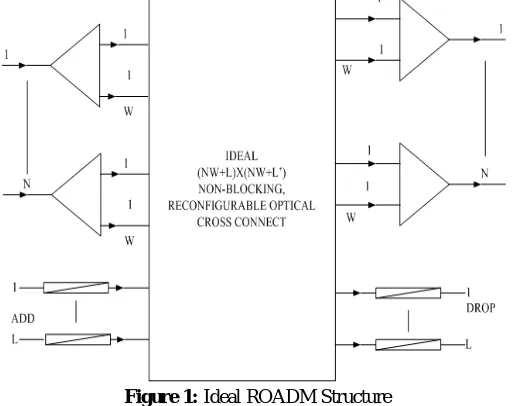
Figure 1: Ideal ROADM Structure
Volume 3, Issue 3, March 2014
Page 520
planning, and degrades the capacity of the network. It is possible to build ROADM architectures with lower blocking by increasing the equipment cost. In the limit, contentionless nodes are those directionless ROADMs in which the contention limitation is totally eliminated, or eliminated in the practice. Figure 1 helps us to illustrate the role of an ideal ROADM, for a node with N input and output fibers, W wavelengths per fiber, and L and L’ add and drop ports respectively. The switching functionality would be ideally implemented by a fully reconfigurable non-blocking (NW+L) × (NW+L’) optical switch. However, such an optical structure is currently far from being feasible from the technical point of view, nor even profitable. Thus, as in other switching technologies, the history of ROADM architecture design is the history of how to build sufficiently large and versatile reconfigurable architectures, making use of the components available.3.
R
ELATEDW
ORKThis section discusses some of the significant literatures that have attempted to enhance the OSNR as a throughput parameter of optical network. Lee et al. [11] demonstrated a simple technique that can be used for monitoring the OSNRs of WDM signals automatically. This technique, based on the polarization-nulling method, was implemented by using a rotating quarter-wave plate and a rotating linear polarizer. The main impairment of this technique was found to be its sensitivity to the nonlinear birefringence and PMD.
B-Meflah et al. [12] used two electro optical modulators to dramatically reduce the number of high-speed components that are required in a multichannel monitoring system. It is suitable for applications in dynamically reconfigurable networks where the monitoring and reconfiguration timescales must be compatible. Pavel et al. [13] developed a framework for OSNR optimization in optical networks via a game theory approach. The optical OSNR model leads to a system matrix with a more general structure than in wireless networks. Under some reasonable assumptions on the utility function, they obtained uniqueness conditions and explicit expression for Nash equilibrium. Baekelandt et al. [14] presented an examination of linear in-band crosstalk in high split long reach wavelength/time-division-multiplexing passive optical networks. In this manuscript, an empirical schema is derived for estimating the optical signal-to-noise ratio values in terms of penalties owing due to in-band communication in multiple point-to-point networks.
Cheung et al. [15] discussed the mechanism of nullifying the effect of polarization using an off-center narrow-band filtering for attaining new polarization-mode dispersion using insensitive in-band optical signal-to-noise ratio monitoring scheme. Pavel [16] addresses the problem of enhancing optical signal to noise ratio (OSNR) in optical communication networks. The OSNR optimization problem is formulated as an m-player no cooperative game, based on a network OSNR model, developed for a general multi-link configuration. Pavel [17] considered a game theory framework for power control in optical networks. Channel optical signal-to-noise ratio (OSNR) optimization is formulated as an -player no cooperative game, based on a general network OSNR model. Their work provides a starting point for future contributions in the area of optical network control.
Khan et al. [18] experimentally demonstrate an asynchronous half-symbol delay-tap sampling technique for in-band optical signal-to-noise ratio (OSNR) monitoring in return-to-zero differential quadrature phase-shift-keying systems. Kim et al. [19] shown that OFDM signal quality is sensitive to the quality of the optical multicarrier generator. With an optimized design, they have found that a PM laser with a spectrum optically flattened by one transmission loss filter can be used to obtain 7 or 11 carriers for WDM remoting of antenna arrays.
D-Legrand et al. [20] elaborately discussed about optical measurements. The transfer of pump noise by four-wave mixing was clearly demonstrated. A numerical model was developed to simulate the transfer of pump noise and validated by these measurements. Using this model, they determine, for practical systems, a minimum required pump optical signal-to-noise ratio of 65 dB.
Chitgarha et al. [21] demonstrated an optical-signal-to-noise-ratio (OSNR) monitoring scheme by deploying Mach-Zehnder delay-line-interferometer with less than 0.5 dB error for signals with up to 23 dB actual OSNR. They have also shown usability of this scheme by varying different parameters and have determined design guidelines to achieve a desired level of accuracy.
Kim et al. [22] evaluated the performance of an OSNR monitor based on the polarization-nulling technique in a 120-km long aerial fiber link. Despite of the fast and slow fluctuations in state of polarization in aerial fiber, OSNR was measured within an accuracy of better than ±1 dB.
Menif et al. [23] presented a novel equalizing method that combines pre-emphasis with equal amplifier inversion to achieve perfect output OSNR equalization at the end of the EDFA chain, without resorting to any optical equalizing filter. Finally, they examine the performance of the equalizing method when the input WDM channels carry burst-mode packetized data traffic with high variability in the burst duration.
Pan et al. [24] discussed issues pertaining to constrained optical signal-to-noise ratio (OSNR) enhancement problem in the viewpoint of system performance. Rahman et al. [25] studied, the maximum distance is taken up to five meters and the signal degradation is small. Although the signal strength decreases linearly with the length of the fiber as the noise increases, the demultiplexer works efficiently for short haul communication system.
Volume 3, Issue 3, March 2014
Page 521
multi-input and multi-output (MIMO) state-space model. They use classical linear system theory to explain the controllability of the pricing and the observability of the power states.L. Pavel [27] developed a hierarchical iterative OSNR technique using game theory. The system formulates a Nash game between the channels with channel utility related to maximizing channel optical signal-to-noise ratio (OSNR). The outcome of the system shows better accomplishment of OSNR.
4.
P
ROBLEMI
DENTIFICATIONIn the area of optical network, the multiple channel systems are represented by the wavelength division multiplexing that compromises of various origin of nodes multiples in wavelength domain and transmitted over the same channel. Evolution of control theory on optical network using optimization principle surfaces from uniformly designed point-to-point links to reconfigurable networks. Usually bit error rate is used to measure the performance of any channel from physical transmission level that is highly dependent on dispersion and non-linear effect. A noise is referred as a signal over the same optical link in multiple optical channel system. Presence of such noise invokes performance declination of the system as well as services being rendered over the optical fiber. Hence, it is very much critical that such noise level to be reduced as much as possible and signal contents are increased. A better quality of OSNR at receiver end always calls for controlling the input power per channel at transmitter end. When all the individual wavelength multiplexed channels in a link share the optical fiber, the cumulative input power at the transmitter end has to be less than the non-linear threshold. This is also termed as link capacity constraint.
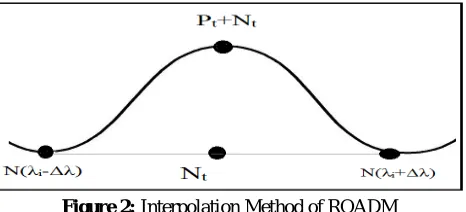
Figure 2: Interpolation Method of ROADM
While implementing ROADM, the OSNR value is found to be the most precise parameter to furnish the correlation of all the cumulative noise effects as well as enhances the performance of the system in a very short interval of period. As per suggestion of IEC 61280-2-9 [28], OSNR is usually evaluated using interpolation technique. Interpolation technique is designed on the consideration that noise level is usually flat between and under adjacent peaks. Using optical switching mechanism, noise level between the adjacent peaks can be determined by the precise use of cursors on the trace. The interpolation technique is applied on noise value under the peak (Figure 2). Hence, OSNR is evaluated by estimating difference between peak power and noise under the peak.
However, in ROADM based network, the distinctive shape of noise is never maintained. When the optical channels are being filtered by the multiplexer and demultiplexer of ROADM, the optical signal noise under that channel peak is being carved. Hence, interpolation technique doesn’t emphasize on the current value of noise on the outgoing channel results in error-prone OSNR computation. Hence, implementing ROADM and ensuring OSNR optimization is the prime problem identified for the study. Therefore, the study proposes a technique that uses ROADM considering the system constraint of noise and power inside channel limits for the purpose of enhancing the OSNR in optical network.
5.
E
NHANCEDC
ONSTRAINT-
BASEDO
PTICALN
ETWORKVolume 3, Issue 3, March 2014
Page 522
Figure 3: Schematic Architecture of the Proposed Model6.
ECON
C
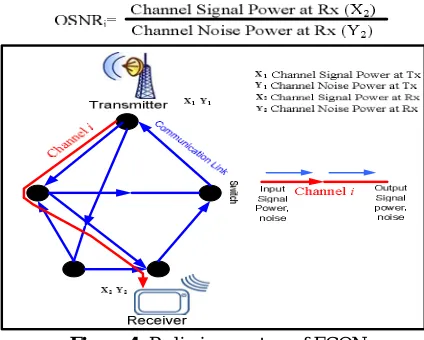
ONSIDERATIONThe proposed model ECON is designed using mathematical approach considering the variables of optical network into consideration. Consider a sample optical network with links of optical fibres connecting switches be represented as LON = {1, 2… L}. It is considered that the optical switches permit the communication channel of optical network to be added, or dropped or may be routed. The system is designed in a manner that it also provides better flexibility of channel power adjustment. A communication link l
LON is consisting of specific number of amplified spans optically Nspan, where each Nspan includes optical fiber followed by an amplifier. The preliminary set up design of the ECON is as shown in Figure 4. The system considers a set of channels C= {1, 2… c} that is equivalent to the set of the wavelength and is forwarded across the optical network by using intensity modulation and wavelength multiplexing. The system represents set of channel Cl transmitted over communication link l
LON and set of links from associated Tx to the corresponding Rx that that channel i uses as Ri (i
C). The system also denotes X1,Y1,X2,and Y2 as channel signal power at transmitter, channel noise power at transmitter, channel signal power at receiver, and channel noise power at receiver respectively. Consider x=[x1... xc]T represents the vector form. Therefore, the optical signal-to-noise ratio for any channel i
C can be exhibited as,Figure 4: Preliminary set up of ECON
The above equation acts as a prime key factor for modelling the proposed model. The system also comprises of amplified span s on communication link l that posses optical fibers with loss coefficient LON(loss) that is highly independent from any wavelength and an amplifier gain G. The ECON considers introducing amplified spontaneous emission (ASE) noise
denoted by σl,s,i. It is to be noted that both the gain and ASE is highly dependent on wavelength. Consider X2(l,s,i) and Y2(l,s,i) represents the channel signal and noise power respectively at the receiver considering span s on communication link l. Therefore, when the span s=0, we have,
X1(l,i)=X2(l,0,i) ,Y1(l,i)=Y2(l,0,i)
The channel signal and noise power at the receiver end (output) of the communication link l is denoted by X2(l,i) and Y2(l,i) respectively and are considered to be the same as the channel signal and noise power at the receiver (output) end of span S as,
Volume 3, Issue 3, March 2014
Page 523
Similar principle is also applicable in the input end. The system considers that the spans on each communication link l have uniform length and all amplifiers are controlled in automatic power control (APC) mode with the same cumulative power target X2 and thereby have the same gain spectral shape. One of the advantage of the retaining the constant cumulative power or a uniform cumulative launching power after each span is the compensation of the fluctuations in the power loss in fiber span across the communication link. An interesting fact observed here is that if the cumulative targeted power is selected to be less than the thresholds for non-linear effects, the system can possible achieve optimal gain distribution across the communication link after every span.7.
D
ESIGNM
ETHODOLOGYThe ECON model is designed on a single point-to-point WDM link where a set of C channels are transmitted in this link. The link is also considered to consist of N cascaded amplified spans is as shown in Figure 5.
1 , 1 P
2 , 2 P
m Pm,
1 0
, 1n u
2 0
, 2n u
m
n um 0
,
Figure 5: A single point-to-point WDM link of ECON
The system uses the evaluation of the OSNR considering system matrix (more elaborated in implementation section). The model is designed considering the OSNR constraint (i.e. OSNRi should be greater than or equal to desired OSNR value.). Similarly, total power constraint is formulated as channel signal power of ith channel should be less than or equal to Total channel signal power at receiver end. Referring to equation 8 of work done by Pan et al [24], the system considers two matrixes T and b. Consideration of majority of the mathematic parameters OSNRi (eq-1), system matrix (eq.2), and condition of constraints (eq.9) are considered from the study discussed by Pan et al [24]. Further, we introduce the ROADM concept for enhancing the OSNR as enhancement of [24].Therefore, using the ECON model uses the potential features of ROADM, optical signal-to-noise ratio values is the best possible factor to justify the depiction of all the cumulative noise impacts and renders an indirection benefits to the overall system performance in minimal instance of time period. Using the model the ROADM contributes to remove the intermediate regeneration points and unnecessary optical electronic-optical (O-E-O) contents over the optical network. This fact thereby yields to minimize the cost of installation with non-trivial optical network management with challenging real-time task provisioning. It should also be noted that implementing ROADM and harnessing the potential services of ROADM computational is a quite challenging task and may accompany various constraints. Therefore, the study considers OSNR and power constraints to make the study more mathematically sound.
Figure 6 helps us to illustrate the majority of the ROADM architectures are based on the broadcast-and-select (B&S) approach to implement the switching functionality. The optical splitter and combiner and the optical multiplexers and de-multiplexers are passive devices. Fixed and tunable transceivers, wavelength selective switches (WSS) and photonic cross-connects (PXC) are active devices. The WSS is a reconfigurable device which is able to switch any wavelength channel at any of its input ports, to any of its output ports, and vice-versa. In ROADMs, part of the optical switching functionality is implemented by means of active optical devices, under the control of a coupled control and management plane. As a result, a subset of the lightpath reconfigurations can be completed in the order of seconds, without an on-site visit of a technician.
Volume 3, Issue 3, March 2014
Page 524
In this, the study considers a total of 10 channels. As in the normal MUX case, 1st 6 channels are considered with data for transmission. Assuming that any of the other channel data(randomly selecting any channel) should be transmitted without any delay, at that time power constraint (total power should not exceeds the total carrying power of fiber) has to be checked. If it met, that channel will be added as in ROADM. Else any of the channels will be dropped, in that place the required channel will be sent. While performing evaluation, a constant focus was on the constraint, where optimization algorithm was used to adjust all the channel power. Experimentation was carried out in multiple numbers of channels, where the ROADM was used to constantly monitor the progress of OSNR.8.
I
MPLEMENTATIONThe proposed system ECON is implemented on normal 32 bit Windows platform with 1.84 GHz (min) processor and Matlab being the development environment. All the simulation parameters like channel signal power and channel signal noise for both transmitter and receiver module is considered along with other optical network parameters like channel, link, space loss coefficient, and amplifier gain etc. Usual simulation environment of optical network is designed considering the significance of ROADM in the proposed implementation. The implementation of the proposed system using ROADM is as follows,
Algorithm-1: Enhancing OSNR ROADM Input: NumCH, Nspan, Ptotal, Pi, ni, Po
Output: OSNROPT START
1. Initialize Number of channel, NumCH=10 //{1,2,…….., n} 2. Initialize Number of Spans, Nspan=1
3. Assign a matrix for targeted OSNR
4. Assign Total Power Carrying Capacity of a channel Ptotal 5. For i=1: NumCH
6. Attenuate the channel noise 7. End
8. Check Total Power constraint
9. if (Ptotal >Sum(Individual channel power) )
10. ADD/DROP channels according to traffic and requirements 11. End
12. Compute the Gain of all channels.
12. Evaluate Amplified Spontaneous Emission Noise
B hf G n
ASEi 2 sp( i1) i
13. Calculate System Matrix and OSNR
total
P ASE G
G si
N s s i s j j i , 1 , ) ( ) (
Where s is the number of span
ch N j j j i o i i i p n p OSNR ,14. Optimize the OSNR for each channel using ROADM optimization algorithm END
The above mentioned equations are responsible for implementation of ROADM for improving the OSNR of considered optical network. The system reconfigures the network for enhancing the traffic performance. Moreover, the equations have the potential features of adding and dropping the channel according to the traffic requirement as well as network priority. Using the above technique, the channel capacity can be effectively improved. The system basically automates the scheduling of optical capacity in the network that efficiently manages the operational cost and time needed to schedule the channel capacity.
Algorithm-2: Final OSNR Computation Input: Target OSNR (γ), System matrix (
) Output: OSNROPTSTART
1. Initialize desired channels OSNR γ
2. If (Ptotal >Sum (Individual channel power) )
3. Evaluate associated log function of individual channel
CH i i i i i
i i Num
OSNR a
P
Volume 3, Issue 3, March 2014
Page 525
4. Estimate the cost of each channel
i i i i ii p p p
C ln
5. Determine the T and B matrix.
6. Estimate the barrier function λ i
6, 0 max
100 i i
i
i x bx
Where xi=rowi (T 1
) pi 7. Compute vector si
i
ii t row T
s 1
8. Estimate the input power Pi
t k
C
p
t
s
t
p t i i
i i
i
9. Calculate OSNR using estimated input power 10. Iterate till it reaches desired OSNR
11. End END
The above equations are designed for the purpose of computing the final OSNR value after implementing ROADM. It considers target OSNR and system matrix as its input while after processing it yields optimized OSNR. The system attempts to optimize the input channel signal power every time in order to get the desired target OSNR. For effective outcome, the algorithm performs iterations in order to monitor the each channel signal power outcome matching the desired input power. The system considers different channels travelling different path and the previous equations essentially filters the channel noise power between the communication channels as a part of routing.
9.
R
ESULT DISCUSSIONFor the purpose of benchmarking our study, the accomplished result is compared with the similar study done by Pan et al [24]. The study [24] has formulated a system optimization problem for accomplishing better throughput in terms of OSNR for every individual channel along with satisfying the cumulative power constraint. The author has transformed the original problem to a relaxed system problem deploying barrier function and used distributed iterative algorithms. The significant effects of the parameters are evaluated using game theory on OSNR. Hence, the proposed model ECON uses ROADM for enhancing the OSNR while prior Pan et al. approach [24] doesn’t use ROADM. The result attempts to investigate that whether there is a significant effect on ROADM in enhancing the OSNR.
2 2.5 3 3.5 4 4.5 5 5.5 6
22 22.5 23 23.5 24 24.5 25 25.5 26 26.5
equalization algorithm OSNR
Time
d
B
Channel-1 Channel-2 Channel-3 Channel-4 Channel-5 Channel-6
Figure 7: Equalization Technique of Pan yet al [24]
Volume 3, Issue 3, March 2014
Page 526
Figure 7 represents the equalization techniques of normal MUX, where it can be seen that using 10 channels the system has attempted to optimize the OSNR of all the considered channels. However, the outcome was found with linear valuesof OSNR which is detrimental for performance in optical network. The prime purpose of Figure 8 was to exhibit the nature of outcome in existing MUX. Hence, using the same normal MUX with same 10 channels and
integrating with an efficient algorithm for distributive improvement of OSNR, the outcome as shown in Figure 8 is arrived.
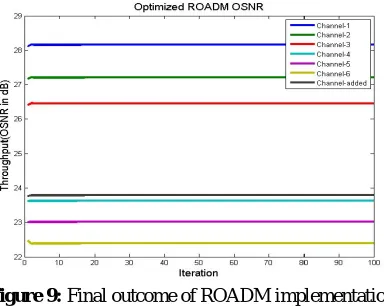
Figure 9: Final outcome of ROADM implementation
Figure 9 discusses about the final outcome after introducing ROADM in the proposed study, where it can be seen that out of 10 channels, 3 channels (channel-7, channel-8, and channel-9) were dropped while 1 channel is added. Any channel with higher priority is transmitted over the lower priority channels so that the required data will be transmitted to the user quickly. Therefore, it increases packet delivery ratio and thereby increases system performance.
Figure 10: Performance Comparative Analysis of ECON
Figure 10, shows the comparative performance analysis of the proposed ECON with the study of Pan et al [24]. In the figure it can be seen that the ECON has outperformed the prior work with respect to OSNR. Hence, in a nutshell, it can be said that by introducing ROADM in the proposed model, the scope of optimization has increased which is found missing in Pan et al work [24].
10.
C
ONCLUSIONThe proposed system ECON analyzed about ROADM based model that has the capability to enhance the OSNR of the optical channels. A new mechanism is adopted by chalking out a mathematical model using a single point-to-point link. The constraint based optimization principle and its respective modelling shows that it is quite possible to enhance the OSNR using ROADM for many number of channels. Prior systems has experimented till 6 channels while our system is being evaluated over 10 channels posing that adding or dropping number of channels using ROADM can actually enhanced better service quality and system performance in optical network.
References
[1] Govind P. Agrawal, Fiber-Optic Communication Systems, John Wiley & Sons, 23-Feb-2012 - Science - 600 pages. [2] http://www.cisco.com/en/US/tech/tk482/tk184/tsd_technology_support_protocol_home.html
[3] R. K. Wade, Wavelength division multiplexing/demultiplexing devices using polymer lenses, US Patent, US 6298182 B1, 2001
Volume 3, Issue 3, March 2014
Page 527
[5] M. Krishna Sivalingam, Suresh Subramaniam, Optical WDM Networks: Principles and Practice, Springer,31-Mar-2000 - Computers - 352 pages
[6] en.wikipedia.org/wiki/Fiber-optic_communication
[7] G. Ramesh, S. Sundara Vadivelu, Jose Anand, A Survey on Wavelength Division Multiplexing (WDM) Networks, ICTACT Journal Of Communication Technology, Issue: 01, March 2010,
[8] G.P. Agrawal, Nonlinear Effects in Optical Fiber, University of Rochester, 2006
[9] R.U.Kale, P.M. Ingale, R. T. Murade, “Comparison of SRS & SBS (Non Linear Scattering) In Optical Fiber”, International Journal of Recent Technology & Engineering(IJRTE),ISSN:2277-3878,Volume-2,Issue-1,March 2013 [10]S. Perrin, The Need for next-Generation ROADM Networks, Whitepaper of HEAVY READING, 2010
[11]J. H. Lee, D. K. Jung, C. H. Kim, Y. C. Chung, “OSNR Monitoring Technique Using Polarization-Nulling Method”, IEEE Photonics Technology Letters, Vol. 13, No. 1, 2001
[12]L. B.-Meflah, S. Savory, B.Thomsen, J.Mitchell,P. Bayvel, “In-Band OSNR Monitoring Using Spectral Analysis After Frequency Down-Conversion”, IEEE Photonics Technology Letters, Vol. 19, No. 2, 2007
[13]L.Pavel, “A Noncooperative Game Approach to OSNR Optimization in Optical Networks”, IEEE Transactions On Automatic Control, Vol. 51, No. 5, 2006
[14]Bart Baekelandt, C. Mélange, J. Bauwelinck, P. Ossieur, T. D. Ridder, X.-Z. Qiu,J. Vandewege, “OSNR Penalty Imposed by Linear In-Band Crosstalk Caused by Interburst Residual Power in Multipoint-To-Point Networks” , IEEE Photonics Technology Letters, Vol. 20, No. 8, 2008
[15]M-H. Cheung, L-K. Chen, C-K. Chan, “PMD-Insensitive OSNR Monitoring Based on Polarization-Nulling With Off-Center Narrow-Band Filtering”, IEEE Photonics Technology Letters, VOL. 16, NO. 11, 2004
[16]L. Pavel, “Power Control for OSNR Optimization in Optical Networks: A Noncooperative Game Approach”, 43rd IEEE Conference on Decision and Control, 2004
[17]L. Pavel, “A Noncooperative Game Approach to OSNR Optimization in Optical Networks”, IEEE Transactions On Automatic Control, VOL. 51, NO. 5, 2006
[18]F. N. Khan, A.P.T.Lau, Z. Li, C. Lu, P. K. A. Wai, “OSNR Monitoring for RZ-DQPSK Systems Using Half-Symbol Delay-Tap Sampling Technique”, IEEE Photonics Technology Letters, vol. 22, NO. 11, 2010
[19]Y. Kim, M. E. Mousa Pasandi, S. Doucet, L. A. Rusch, S. LaRochelle, “ OSNR requirements for Optical Multicarrier Generator for Short Range Radio-Over-Fiber Systems”, Conference on Lasers and Electro-Optics. Optical Society of America, 2009
[20]A. D-Legrand, C. Simonneau, D. Bayart, A. Mussot, T. Sylvestre, E. Lantz, H. Maillotte, “Impact of Pump OSNR on Noise Figure for Fiber-Optical Parametric Amplifiers”,IEEE Photonics Technology Letters, Vol. 17, No. 6, 2005 [21]M. R. Chitgarha, S. Khaleghi, W. Daab, M. Ziyadi, A. Mohajerin-Ariaei, D. Rogawski1, M. Tur, J. D. Touch, V.
Vusirikala, W. Zhao, A. E. Willner, “Demonstration of WDM OSNR Performance Monitoring and Operating Guidelines for Pol-Muxed 200-Gbit/s 16-QAM and 100-Gbit/s QPSK Data Channels”, Optical Fiber Communication Conference and Exposition and the National Fiber Optic Engineers Conference (OFC/NFOEC), pp.1,3, 17-2,1 2013 [22]C. H. Kim, Y. B. Lee, S. K. Ji, S. D. Choi, M. W. Park, M. S. Kim, S. P. Hamn, S. K. Shin, I. B. Kim, H. C. Ji, J. H.
Lee, Y. C. Chung, “Performance of OSNR Monitor based on Polarization-Nulling Technique in Aerial Fiber Link”, Optical Fiber Communication Conference. Optical Society of America, 2004
[23]M. Menif, A. Bononi, L. A. Rusch, M. Karasek, “A New Method to Equalize Static and Dynamic OSNR in Cascades of EDFAs without In-Line Optical Filters”, International Conference on Applications of Photonic Technology (Photonics North), SPIE, Vol.4087, pp. 335-42, 2000
[24]Y.Pan, T.Alpcan, L.Pavel, “A System Performance Approach to OSNR Optimization in Optical Networks”, Communications, IEEE Transactions, Vol. 58(4), pp. 1193-1200, 2010
[25]M.S. A.-Rahman, L. S. Supian, H.G. Safnal, M. H. Harun, K. Jumari, “Osnr Performance on Hand-Made Demultiplexer Using Thin-Film Filter and Splitter in Wdm-Pof Network Design for Short-Haul Communication System Applications”, World Applied Sciences Journal, Vol. 20 (6), pp. 801-805, 2012
[26]Q. Zhu, L. Pavel, “State-space Approach to Pricing Design in OSNR Nash Game”, Proceedings of the 17th World Congress The International Federation of Automatic Control Seoul, 2008
[27]L. Pavel, “Hierarchical Iterative Algorithm for a Coupled Constrained OSNR Nash Game”, In Global Telecommunications Conference, GLOBECOM'06. IEEE, pp. 1-6, 2006

![Figure 7: Equalization Technique of Pan yet al [24]](https://thumb-us.123doks.com/thumbv2/123dok_us/9762362.1961197/8.612.216.414.423.732/figure-equalization-technique-pan-al.webp)