The Thirty-Third AAAI Conference on Artificial Intelligence (AAAI-19)
Learning to Embed Sentences Using Attentive Recursive Trees
Jiaxin Shi,
1Lei Hou,
1∗Juanzi Li,
1Zhiyuan Liu,
1Hanwang Zhang
21Tsinghua University
2Nanyang Technological University
[email protected],{houlei,lijuanzi,liuzy}@tsinghua.edu.cn, [email protected]
Abstract
Sentence embedding is an effective feature representation for most deep learning-based NLP tasks. One prevailing line of methods is using recursive latent tree-structured networks to embed sentences with task-specific structures. However, ex-isting models have no explicit mechanism to emphasize task-informative words in the tree structure. To this end, we pro-pose an Attentive Recursive Tree model (AR-Tree), where the words are dynamically located according to their impor-tance in the task. Specifically, we construct the latent tree for a sentence in a proposed important-first strategy, and place more attentive words nearer to the root; thus, AR-Tree can inherently emphasize important words during the bottom-up composition of the sentence embedding. We propose an end-to-end reinforced training strategy for AR-Tree, which is demonstrated to consistently outperform, or be at least com-parable to, the state-of-the-art sentence embedding methods on three sentence understanding tasks.
Introduction
Along with the success of representation learning (e.g., word2vec (Mikolov et al. 2013)), sentence embedding, which maps sentences into dense real-valued vectors that represent their semantics, has received much attention. It is playing a critical role in many applications such as sentiment analysis (Socher et al. 2013), question answering (Wang and Nyberg 2015) and entailment recognition (Bowman et al. 2015).
There are three predominant approaches for construct-ing sentence embeddconstruct-ings. (1) Recurrent neural networks (RNNs) encode sentences word by word in sequential or-der (Dai and Le 2015; Hill, Cho, and Korhonen 2016). (2) Convolutional neural networks (CNNs) produce sen-tence embeddings in a bottom-up manner, moving from lo-cal n-grams to the global sentence as the receptive fields enlarge (Blunsom, Grefenstette, and Kalchbrenner 2014; Hu et al. 2014). However, the above two approaches can-not well encode linguistic composition of natural languages to some extent. (3) The last approach, on which this paper focuses, exploits tree-structured recursive neural networks (TreeRNNs) (Socher et al. 2011; 2013) to embed a sentence
∗
Corresponding author.
Copyright c2019, Association for the Advancement of Artificial
Intelligence (www.aaai.org). All rights reserved.
interesting
movie
The
is
to me
very .
interesting is
movie The
very
to me .
(a) (b)
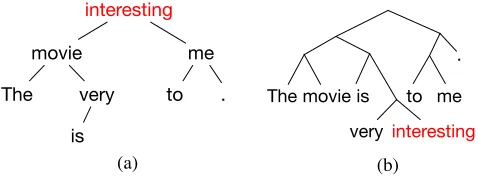
Figure 1: Two recursive trees for sentenceThe movie is very
interesting to me.in the sentiment analysis task. Our
AR-Tree (a) is constructed by recursively selecting the most
in-formative word,e.g.,interesting. However, other latent trees
(b) are built by composing adjacent pairs,e.g.,very
interest-ingcaptured by (Choi, Yoo, and goo Lee 2017), which lacks
the potential to emphasize words.
along its parsing tree. Tree-structured Long Short-Term Memory (Tree-LSTM) (Tai, Socher, and Manning 2015; Zhu, Sobihani, and Guo 2015) is one of the most renowned variants of TreeRNNs that is shown to be effective in learning task-specific sentence embeddings (Bowman et al. 2016).
Tree-LSTM models are motivated by the intuition that in human languages there are complicated hierarchical struc-tures which contain rich semantics. Latent tree models (Yo-gatama et al. 2016; Maillard, Clark, and Yo(Yo-gatama 2017; Choi, Yoo, and goo Lee 2017; Williams, Drozdov, and Bowman 2017) can learn the optimal hierarchical structure, which may vary from tasks to tasks, without explicit struc-ture annotations. The training signals to parse and embed sentences are both from certain downstream tasks. Existing models place all words in leaves equally and build the tree structure and the sentence embedding by composing adja-cent node pairs bottom up (e.g., Figure 1b). This mechanism prevents the sentence embedding from focusing on the most informative words, resulting in a performance limitation on certain tasks (Shi et al. 2018).
that contains one word in each leaf and non-leaf node, simi-lar to the dependency parsing tree (Nivre 2003) but our AR-Tree does not depend on manual rules. To utilize the sequen-tial information, we expect the tree’s in-order traversal pre-serves the word sequence, so that we can easily recover the original word sequence and obtain context of a word from its subtrees. As shown in Figure 1a, the key advantage of an AR-Tree is that those task-important words will be placed at those nodes near the root and will be naturally emphasized in tree-based embedding. This is attributed to our proposed top-down attention-first parsing strategy, inspired by easy-first parsing (Goldberg and Elhadad 2010). Specifically, we introduce a trainable scoring function to measure the word attention in a sentence with respect to a task. We greedily
select the word with the highest score (e.g.,interesting) as
the root node and then recursively parse the remaining two
subsequences (e.g.,The movie isandto me.) to obtain two
children of the parent node. After the tree construction, we embed the sentence using a modified Tree-LSTM unit (Tai, Socher, and Manning 2015; Zhu, Sobihani, and Guo 2015)
in a bottom-up manner,i.e., the resultant embedding is
ob-tained at the root node and is then applied in a downstream application. As the Tree-LSTM computes node vectors in-crementally from leaf nodes to the root node, our model nat-urally pays more attention to those shallower words, i.e., task-informative words, meanwhile remaining advantages of the recursive semantic composition (Socher et al. 2013; Zhu, Sobihani, and Guo 2015).
Training AR-Tree is challenging due to the non-differentiability caused by the dynamic decision-making procedure. To this end, we develop a novel end-to-end train-ing strategy based on REINFORCE algorithm (Williams 1992). To make REINFORCE work for the structure infer-ence, we equip it with a weighted reward which is sensitive to the tree structures and a macro normalization strategy for the policy gradients.
We evaluate our model on three benchmarking tasks: tex-tual entailment, sentiment classification, and author pro-filing. We show that AR-Tree outperforms previous Tree-LSTM models and is comparable to other state-of-the-art sentence embedding models. Further qualitative analyses demonstrate that AR-Tree learns reasonable task-specific at-tention structures.
To sum up, the contributions of our work are as follows:
• We propose Attentive Recursive Tree (AR-Tree), a
Tree-LSTM based sentence embedding model, which can parse the latent tree structure dynamically and emphasize infor-mative words inherently.
• We design a novel REINFORCE algorithm for the
train-ing of discrete tree parstrain-ing.
• We demonstrate that AR-Tree outperforms previous
Tree-LSTM models and is comparable to other state-of-the-art sentence embedding models in three benchmarks.
Related Work
Latent Tree-Based Sentence Embedding.(Bowman et al.
2016) build trees and compose semantics via a generic
shift-reduce parser, whose training relies on ground-truth pars-ing trees. In this paper, we are interested in latent trees that dynamically parse a sentence without syntax supervision. Combination of latent tree learning with TreeRNNs has been shown as an effective approach for sentence embedding as it jointly optimizes the sentence compositions and a task-specific objective. For example, (Yogatama et al. 2016) use reinforcement learning to train a shift-reduce parser without any ground-truth.
Maillard, Clark, and Yogatama use a CYK chart parser (Cocke 1970; Younger 1967; Kasami 1965) instead of the shift-reduce parser and make it fully differentiable with the help of the softmax annealing technique. How-ever, their model suffers from both time and space issues
as the chart parser requiresO(n3)time and space
complex-ity. (Choi, Yoo, and goo Lee 2017) propose an easy-first parsing strategy, which scores each adjacent node pair us-ing a query vector and greedily combines the best pair into one parent node at each step. They use Straight-Through Gumbel-Softmax estimator (Jang, Gu, and Poole 2016) to compute parent embedding in a hard categorical gating way and enable the end-to-end training. (Williams, Drozdov, and Bowman 2017) compare above-mentioned models on sev-eral datasets and demonstrate that (Choi, Yoo, and goo Lee 2017) achieve the best performance.
Attention-Based Sentence Embedding.Attention-based
methods can be divided into two categories: inter-attention (dos Santos et al. 2016; Munkhdalai and Yu 2017b), which requires a pair of sentences to attend with each other, and intra-attention (Arora, Liang, and Ma 2016; Lin et al. 2017), which does not require extra inputs except the sentence; thus the latter is more flexible than the former. (Kim et al. 2017) incorporate structural distributions into at-tention networks using graphical models instead of recursive trees. Note that existing latent tree-based models treat all in-put words equally as leaf nodes and ignore the fact that dif-ferent words make varying degrees of contributions to the sentence semantics, which is nevertheless the fundamental motivation of attention mechanism. To our best knowledge, AR-Tree is the first model that generates attentive tree struc-tures and allows the TreeRNNs to focus on more informative words for sentence embeddings.
Attentive Recursive Tree
We represent an input sentence S of N words as
{x1,x2,· · ·,xN}, wherexiis aDx-dimensional word
em-bedding vector. For each sentence, we build anAttentive
Re-cursive Tree (AR-Tree) where the root and nodes are
de-noted byRandT, respectively. Each nodet ∈ T contains
one word denoted ast.index(t.index = imeans thei-th
word of input sentence) and has two children denoted by
t.lef t ∈ T andt.right ∈ T (nilfor missing cases). Fol-lowing previous work (Choi, Yoo, and goo Lee 2017), we discuss binary trees in this paper and leave the n-ary case for future work. To keep the important sequential information,
we guarantee that thein-ordertraversal ofTcorresponds to
S(i.e., all nodes int’s left subtree must contain an index less
that words with more task-specific information are closer to the root.
To achieve the property, we devise a scoring function to measure the degree of importance of words, and recursively select the word with the maximum score in a top-down man-ner. To obtain the sentence embedding, we apply a modified
Tree-LSTM to embed the nodes bottom-up,i.e., from leaf
to root. The resultant sentence embedding is fed into down-stream tasks.
Top-Down AR-Tree Construction
We feed the input sentence into a bidirectional LSTM and obtain a context-aware hidden vector for each word:
− →
hi,−→ci =
−−−−→
LSTM(xi,
−−→
hi−1,−−→ci−1),
←−
hi,←c−i =
←−−−−
LSTM(xi,
←−−
hi+1,←−−ci+1),
hi= [
− →
hi;
←−
hi],
ci= [−→ci;←c−i],
(1)
where h,c denote the hidden states and the cell states
respectively. We utilize h for scoring and let S =
{h1,h2,· · · ,hN}. Based on these context-aware word
em-beddings, we design a trainable scoring function to reflect the importance of each word:
Score(hi) =MLP(hi;θ), (2)
where MLP can be any multi-layer perceptron
parameter-ized byθ. In particular, we use a 2-layer MLP with 128
hid-den units and ReLU activation. Traditional tf-idf is a simple and intuitive method to reflect the degree of importance of words, however, it is not designed for specific tasks. We will use it as a baseline.
Algorithm 1Recursive AR-Tree construction
Input:Sentence hidden vectorsS={h1,h2,· · · ,hN},
be-ginning indexband ending indexe
Output:root nodeRS[b:e]of sequenceS[b:e]
procedureBUILD(S, b, e)
R←nil
ife=bthen
R←new Node
R.index←b
R.lef t, R.right←nil, nil
else ife > bthen
R←new Node
R.index←argmaxe
i=bScore(hi)
R.lef t←BUILD(S, b, R.index−1)
R.right←BUILD(S, R.index+ 1, e) end if
returnR
end procedure
We use a recursive top-down attention-first strategy to
construct AR-Tree. Given an input sentenceSand the scores
for all the words, we select the word with the maximum
score as the root R and recursively deal with the
remain-ing two subsequences (before and after the selected word)
to obtain its two children. Algorithm 1 gives the
proce-dure of constructing AR-Tree for sequence S[b : e] =
{hb,hb+1,· · · ,he}. We can obtain the whole sentence’s
AR-Tree by callingR=BUILD(S,1, N)and obtainT by
the traversal of all nodes. In the parsed AR-Tree, each node is most informative among its rooted subtree. Note that we do not use any extra information during the construction, thus AR-Tree is generic for any sentence embedding task.
Bottom-Up Tree-LSTM Embedding
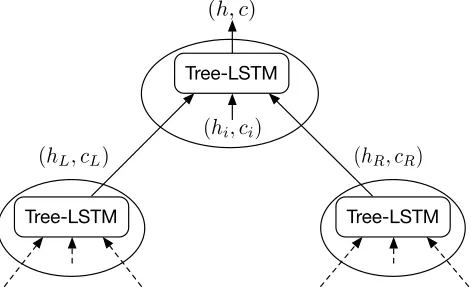
After the AR-Tree construction, we use Tree-LSTM (Tai, Socher, and Manning 2015; Zhu, Sobihani, and Guo 2015),
which introducescell stateinto TreeRNNs to achieve better
information flow, as the composition function to compute parent representation from its children and corresponding word in a bottom-up manner (i.e., Figure 2). Because the original word sequence is kept in the in-order traversal of the AR-Tree, Tree-LSTM units can utilize both the sequen-tial and the structural information to compose semantics.
(
<latexit sha1_base64="66lXwE8expd9eMApWnI/czKQN2c=">AAAB8XicbVBNT8JAEN3iF+IX6tFLI5hgYkjLRb0RvXjggIkVktI022ULG7a7ze7UhBB+hhcParz6b7z5b1ygBwVfMsnLezOZmRelnGlwnG+rsLa+sblV3C7t7O7tH5QPjx61zBShHpFcqm6ENeVMUA8YcNpNFcVJxGknGt3O/M4TVZpJ8QDjlAYJHggWM4LBSH61NgxbFyRsnVfDcsWpO3PYq8TNSQXlaIflr15fkiyhAgjHWvuuk0IwwQoY4XRa6mWappiM8ID6hgqcUB1M5idP7TOj9O1YKlMC7Ln6e2KCE63HSWQ6EwxDvezNxP88P4P4KpgwkWZABVksijNug7Rn/9t9pigBPjYEE8XMrTYZYoUJmJRKJgR3+eVV4jXq13XnvlFp3uRpFNEJOkU15KJL1ER3qI08RJBEz+gVvVlgvVjv1seitWDlM8foD6zPH4Axj58=</latexit><latexit sha1_base64="66lXwE8expd9eMApWnI/czKQN2c=">AAAB8XicbVBNT8JAEN3iF+IX6tFLI5hgYkjLRb0RvXjggIkVktI022ULG7a7ze7UhBB+hhcParz6b7z5b1ygBwVfMsnLezOZmRelnGlwnG+rsLa+sblV3C7t7O7tH5QPjx61zBShHpFcqm6ENeVMUA8YcNpNFcVJxGknGt3O/M4TVZpJ8QDjlAYJHggWM4LBSH61NgxbFyRsnVfDcsWpO3PYq8TNSQXlaIflr15fkiyhAgjHWvuuk0IwwQoY4XRa6mWappiM8ID6hgqcUB1M5idP7TOj9O1YKlMC7Ln6e2KCE63HSWQ6EwxDvezNxP88P4P4KpgwkWZABVksijNug7Rn/9t9pigBPjYEE8XMrTYZYoUJmJRKJgR3+eVV4jXq13XnvlFp3uRpFNEJOkU15KJL1ER3qI08RJBEz+gVvVlgvVjv1seitWDlM8foD6zPH4Axj58=</latexit><latexit sha1_base64="66lXwE8expd9eMApWnI/czKQN2c=">AAAB8XicbVBNT8JAEN3iF+IX6tFLI5hgYkjLRb0RvXjggIkVktI022ULG7a7ze7UhBB+hhcParz6b7z5b1ygBwVfMsnLezOZmRelnGlwnG+rsLa+sblV3C7t7O7tH5QPjx61zBShHpFcqm6ENeVMUA8YcNpNFcVJxGknGt3O/M4TVZpJ8QDjlAYJHggWM4LBSH61NgxbFyRsnVfDcsWpO3PYq8TNSQXlaIflr15fkiyhAgjHWvuuk0IwwQoY4XRa6mWappiM8ID6hgqcUB1M5idP7TOj9O1YKlMC7Ln6e2KCE63HSWQ6EwxDvezNxP88P4P4KpgwkWZABVksijNug7Rn/9t9pigBPjYEE8XMrTYZYoUJmJRKJgR3+eVV4jXq13XnvlFp3uRpFNEJOkU15KJL1ER3qI08RJBEz+gVvVlgvVjv1seitWDlM8foD6zPH4Axj58=</latexit>h
L, c
L)
(
<latexit sha1_base64="6RyLEemjhvJ0r8cncVrmOZCzM+s=">AAAB8XicbVBNT8JAEJ3iF+IX6tFLI5hgYkjLRb0RvXhEYoWkNM122cKG7W6zuzUhhJ/hxYMar/4bb/4bF+hBwZdM8vLeTGbmRSmjSjvOt1VYW9/Y3Cpul3Z29/YPyodHj0pkEhMPCyZkN0KKMMqJp6lmpJtKgpKIkU40up35nSciFRX8QY9TEiRowGlMMdJG8qu1Ydi+wGH7vBqWK07dmcNeJW5OKpCjFZa/en2Bs4RwjRlSynedVAcTJDXFjExLvUyRFOERGhDfUI4SooLJ/OSpfWaUvh0LaYpre67+npigRKlxEpnOBOmhWvZm4n+en+n4KphQnmaacLxYFGfM1sKe/W/3qSRYs7EhCEtqbrXxEEmEtUmpZEJwl19eJV6jfl137huV5k2eRhFO4BRq4MIlNOEOWuABBgHP8ApvlrZerHfrY9FasPKZY/gD6/MHkoWPqw==</latexit><latexit sha1_base64="6RyLEemjhvJ0r8cncVrmOZCzM+s=">AAAB8XicbVBNT8JAEJ3iF+IX6tFLI5hgYkjLRb0RvXhEYoWkNM122cKG7W6zuzUhhJ/hxYMar/4bb/4bF+hBwZdM8vLeTGbmRSmjSjvOt1VYW9/Y3Cpul3Z29/YPyodHj0pkEhMPCyZkN0KKMMqJp6lmpJtKgpKIkU40up35nSciFRX8QY9TEiRowGlMMdJG8qu1Ydi+wGH7vBqWK07dmcNeJW5OKpCjFZa/en2Bs4RwjRlSynedVAcTJDXFjExLvUyRFOERGhDfUI4SooLJ/OSpfWaUvh0LaYpre67+npigRKlxEpnOBOmhWvZm4n+en+n4KphQnmaacLxYFGfM1sKe/W/3qSRYs7EhCEtqbrXxEEmEtUmpZEJwl19eJV6jfl137huV5k2eRhFO4BRq4MIlNOEOWuABBgHP8ApvlrZerHfrY9FasPKZY/gD6/MHkoWPqw==</latexit><latexit sha1_base64="6RyLEemjhvJ0r8cncVrmOZCzM+s=">AAAB8XicbVBNT8JAEJ3iF+IX6tFLI5hgYkjLRb0RvXhEYoWkNM122cKG7W6zuzUhhJ/hxYMar/4bb/4bF+hBwZdM8vLeTGbmRSmjSjvOt1VYW9/Y3Cpul3Z29/YPyodHj0pkEhMPCyZkN0KKMMqJp6lmpJtKgpKIkU40up35nSciFRX8QY9TEiRowGlMMdJG8qu1Ydi+wGH7vBqWK07dmcNeJW5OKpCjFZa/en2Bs4RwjRlSynedVAcTJDXFjExLvUyRFOERGhDfUI4SooLJ/OSpfWaUvh0LaYpre67+npigRKlxEpnOBOmhWvZm4n+en+n4KphQnmaacLxYFGfM1sKe/W/3qSRYs7EhCEtqbrXxEEmEtUmpZEJwl19eJV6jfl137huV5k2eRhFO4BRq4MIlNOEOWuABBgHP8ApvlrZerHfrY9FasPKZY/gD6/MHkoWPqw==</latexit>h
R, c
R)
(
<latexit sha1_base64="F8bYAnhCLiN+xRE/RtqnJEaS5Ic=">AAAB8XicbVBNS8NAEN3Ur1q/qh69LLZCBSlJL+qt6MVjBWMLaQib7aZdusmG3YlQQn+GFw8qXv033vw3btsctPXBwOO9GWbmhangGmz72yqtrW9sbpW3Kzu7e/sH1cOjRy0zRZlLpZCqFxLNBE+YCxwE66WKkTgUrBuOb2d+94kpzWXyAJOU+TEZJjzilICRvHpjFPALGvDzelCt2U17DrxKnILUUIFOUP3qDyTNYpYAFURrz7FT8HOigFPBppV+pllK6JgMmWdoQmKm/Xx+8hSfGWWAI6lMJYDn6u+JnMRaT+LQdMYERnrZm4n/eV4G0ZWf8yTNgCV0sSjKBAaJZ//jAVeMgpgYQqji5lZMR0QRCialignBWX55lbit5nXTvm/V2jdFGmV0gk5RAznoErXRHeogF1Ek0TN6RW8WWC/Wu/WxaC1Zxcwx+gPr8wfYx4/Z</latexit><latexit sha1_base64="F8bYAnhCLiN+xRE/RtqnJEaS5Ic=">AAAB8XicbVBNS8NAEN3Ur1q/qh69LLZCBSlJL+qt6MVjBWMLaQib7aZdusmG3YlQQn+GFw8qXv033vw3btsctPXBwOO9GWbmhangGmz72yqtrW9sbpW3Kzu7e/sH1cOjRy0zRZlLpZCqFxLNBE+YCxwE66WKkTgUrBuOb2d+94kpzWXyAJOU+TEZJjzilICRvHpjFPALGvDzelCt2U17DrxKnILUUIFOUP3qDyTNYpYAFURrz7FT8HOigFPBppV+pllK6JgMmWdoQmKm/Xx+8hSfGWWAI6lMJYDn6u+JnMRaT+LQdMYERnrZm4n/eV4G0ZWf8yTNgCV0sSjKBAaJZ//jAVeMgpgYQqji5lZMR0QRCialignBWX55lbit5nXTvm/V2jdFGmV0gk5RAznoErXRHeogF1Ek0TN6RW8WWC/Wu/WxaC1Zxcwx+gPr8wfYx4/Z</latexit><latexit sha1_base64="F8bYAnhCLiN+xRE/RtqnJEaS5Ic=">AAAB8XicbVBNS8NAEN3Ur1q/qh69LLZCBSlJL+qt6MVjBWMLaQib7aZdusmG3YlQQn+GFw8qXv033vw3btsctPXBwOO9GWbmhangGmz72yqtrW9sbpW3Kzu7e/sH1cOjRy0zRZlLpZCqFxLNBE+YCxwE66WKkTgUrBuOb2d+94kpzWXyAJOU+TEZJjzilICRvHpjFPALGvDzelCt2U17DrxKnILUUIFOUP3qDyTNYpYAFURrz7FT8HOigFPBppV+pllK6JgMmWdoQmKm/Xx+8hSfGWWAI6lMJYDn6u+JnMRaT+LQdMYERnrZm4n/eV4G0ZWf8yTNgCV0sSjKBAaJZ//jAVeMgpgYQqji5lZMR0QRCialignBWX55lbit5nXTvm/V2jdFGmV0gk5RAznoErXRHeogF1Ek0TN6RW8WWC/Wu/WxaC1Zxcwx+gPr8wfYx4/Z</latexit>h
i, c
i)
(
h, c
)
<latexit sha1_base64="AK9r5gltqa9U0iXglBDoM54kXkc=">AAAB7XicbVBNTwIxEJ3iF+IX6tFLI5hgYsguF/VG9OIRE1dIYEO6pQsN3e6m7ZqQDT/Ciwc1Xv0/3vw3FtiDgi+Z5OW9mczMCxLBtXGcb1RYW9/Y3Cpul3Z29/YPyodHjzpOFWUejUWsOgHRTHDJPMONYJ1EMRIFgrWD8e3Mbz8xpXksH8wkYX5EhpKHnBJjpXa1Nrqg59V+ueLUnTnwKnFzUoEcrX75qzeIaRoxaaggWnddJzF+RpThVLBpqZdqlhA6JkPWtVSSiGk/m587xWdWGeAwVrakwXP190RGIq0nUWA7I2JGetmbif953dSEV37GZZIaJuliUZgKbGI8+x0PuGLUiIklhCpub8V0RBShxiZUsiG4yy+vEq9Rv647941K8yZPowgncAo1cOESmnAHLfCAwhie4RXeUIJe0Dv6WLQWUD5zDH+APn8A3TaOIQ==</latexit>
<latexit sha1_base64="AK9r5gltqa9U0iXglBDoM54kXkc=">AAAB7XicbVBNTwIxEJ3iF+IX6tFLI5hgYsguF/VG9OIRE1dIYEO6pQsN3e6m7ZqQDT/Ciwc1Xv0/3vw3FtiDgi+Z5OW9mczMCxLBtXGcb1RYW9/Y3Cpul3Z29/YPyodHjzpOFWUejUWsOgHRTHDJPMONYJ1EMRIFgrWD8e3Mbz8xpXksH8wkYX5EhpKHnBJjpXa1Nrqg59V+ueLUnTnwKnFzUoEcrX75qzeIaRoxaaggWnddJzF+RpThVLBpqZdqlhA6JkPWtVSSiGk/m587xWdWGeAwVrakwXP190RGIq0nUWA7I2JGetmbif953dSEV37GZZIaJuliUZgKbGI8+x0PuGLUiIklhCpub8V0RBShxiZUsiG4yy+vEq9Rv647941K8yZPowgncAo1cOESmnAHLfCAwhie4RXeUIJe0Dv6WLQWUD5zDH+APn8A3TaOIQ==</latexit>
<latexit sha1_base64="AK9r5gltqa9U0iXglBDoM54kXkc=">AAAB7XicbVBNTwIxEJ3iF+IX6tFLI5hgYsguF/VG9OIRE1dIYEO6pQsN3e6m7ZqQDT/Ciwc1Xv0/3vw3FtiDgi+Z5OW9mczMCxLBtXGcb1RYW9/Y3Cpul3Z29/YPyodHjzpOFWUejUWsOgHRTHDJPMONYJ1EMRIFgrWD8e3Mbz8xpXksH8wkYX5EhpKHnBJjpXa1Nrqg59V+ueLUnTnwKnFzUoEcrX75qzeIaRoxaaggWnddJzF+RpThVLBpqZdqlhA6JkPWtVSSiGk/m587xWdWGeAwVrakwXP190RGIq0nUWA7I2JGetmbif953dSEV37GZZIaJuliUZgKbGI8+x0PuGLUiIklhCpub8V0RBShxiZUsiG4yy+vEq9Rv647941K8yZPowgncAo1cOESmnAHLfCAwhie4RXeUIJe0Dv6WLQWUD5zDH+APn8A3TaOIQ==</latexit>
Tree-LSTM
Tree-LSTM Tree-LSTM
Figure 2: Our Tree-LSTM unit composes semantics of left
child (hL,cL), right child (hR,cR) and current word (hi,ci)
to obtain the node embedding (h,c).
The complete Tree-LSTM composition function in our model is as follows:
i fL
fR
fi
o g
=
σ σ σ σ σ tanh
Wc "h
L
hR
hi #
+bc
,
c=fLcL+fRcR+fici+ig,
h=otanh(c),
(3)
where(hL,cL),(hR,cR)and(hi,ci)come from left child,
right child, and bidirectional LSTM, respectively. For those nodes missing some inputs, such as the leaf nodes or nodes with only one child, we fill the missing inputs with zeros.
Finally, we usehof the rootRas the embedding of the
sentenceSand feed it into downstream tasks. The sentence
End-to-end Training Using REINFORCE
Our overall training lossLcombines the loss of the
down-stream taskLtask(e.g., the cross-entropy loss for
classifica-tion tasks), the tree construcclassifica-tion lossLtree = −J(θ)
(dis-cussed soon), and an L2 regularization term on all trainable
parametersφ:
L=Ltask+αLtree+λ||φ||22, (4)
whereαandλare trade-off hyperparameters.
We train the model only according to the downstream task and do not incorporate any structure supervision or pre-trained parser, leading to non-differentiability as the AR-Tree construction is a discrete decision-making
pro-cess. Specifically, the scoring functionScore(h)cannot be
learned in an end-to-end manner when optimizingLtask.
In-spired by (Yogatama et al. 2016), we employ reinforcement
learning, whose objective corresponds toLtree, to train the
scoring function.
We consider the construction of AR-Tree as a recursive decision-making process where each action selects a word
for a node. For nodet ∈ T, we define thestate st as its
corresponding sequenceS[bt :et], wherebtandet
respec-tively represent the index of beginning and ending position. Theaction spaceAtis{bt, bt+ 1,· · · , et}. We feed scores
of candidate words into a softmax layer as ourpolicy
net-work, which outputs a probability distribution over the
ac-tion space:
π(at=i|st;θ) =
exp(Score(hi;θ))
Pet
j=btexp(Score(hj;θ))
, (5)
wherei∈ At. Different from Algorithm 1 which is greedy
and deterministic, at training, we construct AR-Trees
ran-domly in terms ofπ, to explore more structures and bring
greater gain in the long run. After theactionatis sampled
based onπ(at|st;θ), the sequence is split intoS[bt:at−1]
andS[at+ 1 :et], which are used respectively as two
chil-dren’s states.
As for therewardrt, we consider the performance metric
on a downstream task. For simplicity, we discuss a classi-fication task in this paper and leave further explorations in
future work. After the whole treeT is recursively sampled
based onπ, we can obtain the sentence embedding following
Section , feed it into the downstream classifier and obtain a predicted label. The sampled tree is considered good if the prediction is correct, and bad if the prediction is wrong. A
simple rewarding strategy is to givert= 1for alltin a good
tree, andrt=−1for alltin a bad tree.
However, we consider that an early decision from a longer sequence has a greater impact on the tree structure (e.g., the selection of root is more important than leaves). So we
mul-tiply the reward value by|At|,i.e.,rt = |At|for alltin a
good tree andrt=−|At|for alltin a bad tree.
We use REINFORCE (Williams 1992), a widely-used policy gradient method in reinforcement learning, to learn parameters of the policy network. The goal of the learning algorithm is to maximize the expected long-term reward:
J(θ) =Eπ(at|st;θ)rt. (6)
Following (Sutton et al. 2000), the gradient w.r.t. the param-eters of policy network can be derived as:
∇θJ(θ) =Eπ[rt∇θlogπ(at|st;θ)]. (7)
It is prohibitively expensive to calculate the accurate
∇θJ(θ)by iterating over all possible trees. Following (Yu et
al. 2017), we apply Monte Carlo search to estimate the
ex-pectation. Specifically, we sampleM trees for sentenceS,
denoted asT1,· · ·, TM, each containingN nodes. Then we
can simplify∇θJ(θ)by averaging rewards among all these
M ×Nnodes (micro average):
∇θJ(θ) =
1 M N
M
X
k=1 X
t∈Tk
rt∇θlogπ(at|st;θ). (8)
However, we observed that frequent words (e.g.,the, is)
were assigned high scores if we used Formula 8 to train
θ. We think the reason is that the scoring function takes
one single word embedding as input, meaning that frequent words will contribute more to its training gradient if rewards are averaged among all tree nodes, which is harmful to the score estimation of low-frequency words.
To eliminate the influence caused by the word frequency,
we integrateB input sentences as a mini-batch, sampleM
trees for each of them, and normalize the gradient in word-level (macro average) rather than node-word-level:
∇θJ(θ) = 1
|W|
X
w∈W
1
|Tw|
X
t∈Tw
rt∇θlogπ(at|st;θ), (9)
whereW represents all words of the mini-batch,Tw
rep-resents all nodes whose selected word is win allB ×M
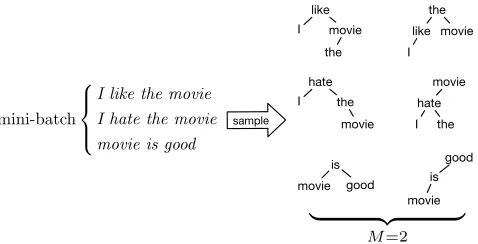
sampled trees. Figure 3 gives an example.
sample like I
the movie
the like I
movie
hate I
movie the
movie hate I the
is
movie good is movie
good mini-batch
8 > < > :
I like the movie I hate the movie movie is good
|
{z
}
M=2
Figure 3: Sampled results of a mini-batch. We have three
sentences in a mini-batch (B = 3) and for each sentence
we sample two trees (M = 2). Totally we get six sampled
trees. Micro average is to average gradients over all nodes of these six trees. Macro average is to first average gradients over nodes of the same word (e.g., average over 6 nodes
con-tainingmovieto get the gradient ofmovie), and then average
gradients of these words to obtain the final training signals.
Experiments
Experiment Dx Dh Dc Finetune Dropout Bn Batch size M Optimizer
SNLI-100D 100 100 200 √ 0.1 √ 128 2 Adam (Kingma and Ba 2014)
SNLI-300D 300 300 1024 0.1 √ 128 2 Adam
SST-2 300 300 300 √ 0.5 32 3 Adadelta (Zeiler 2012)
SST-5 300 300 1024 √ 0.5 64 3 Adadelta
Age prediction 300 600 2000 √ 0.3 50 3 Adam
Table 1: Experimental settings. Dropout: dropout probability. Bn: whether using batch normalization.
Model # params. Acc. (%)
100D Latent Syntax Tree-LSTM (Yogatama et al. 2016) 500k 80.5
100D CYK Tree-LSTM (Maillard, Clark, and Yogatama 2017) 231k 81.6
100D Gumbel Tree-LSTM (Choi, Yoo, and goo Lee 2017) 262k 82.6
100D Tf-idf Tree-LSTM (Ours) 343k 82.3
100D AR-Tree (Ours) 356k 82.8
300D SPINN (Bowman et al. 2016) 3.7m 83.2
300D NSE (Munkhdalai and Yu 2017a) 6.3m 84.8
300D NTI-SLSTM-LSTM (Munkhdalai and Yu 2017b) 4.0m 83.4
300D Gumbel Tree-LSTM (Choi, Yoo, and goo Lee 2017) 2.9m 85.0
300D Self-Attentive (Lin et al. 2017) 4.1m 84.4
300D Tf-idf Tree-LSTM (Ours) 3.5m 84.5
300D AR-Tree (Ours) 3.6m 85.5
600D Gated-Attention BiLSTM (Chen et al. 2017) 11.6m 85.5
300D Decomposable attention (Parikh et al. 2016) 582k 86.8
300D NTI-SLSTM-LSTM global attention (Munkhdalai and Yu 2017b) 3.2m 87.3
300D Structured Attention (Kim et al. 2017) 2.4m 86.8
Table 2: Test accuracy and the number of parameters (excluding word embeddings) on the SNLI dataset. The above two sections list results of Tree-LSTM and other baseline models grouped by the dimension. The bottom section contains state-of-the-art inter-attention models on SNLI dataset.
We setα= 0.1,λ= 1e−5in Eq. 4 through all
exper-iments. For fair comparisons, we followed the experimental settings in (Choi, Yoo, and goo Lee 2017) on language in-ference and sentence sentiment analysis. For the author pro-filing task whose dataset is provided by (Lin et al. 2017), we followed their settings by contacting the authors. We con-sidered their model, which is self-attentive but without tree structures, as a baseline, to show the effect of latent trees. We
conductedTf-idf Tree-LSTMexperiment, which replaces the
scoring function with tf-idf value while retaining all other settings, as one of our baselines. For all experiments, we saved the model that performed best on the validation set as our final model and evaluated it on the test set. The
im-plementation is made publicly available.1
Natural Language Inference
The natural language inference is a task of predicting the semantic relationship between two sentences, a premise, and a hypothesis. We evaluated our model using the Stan-ford Natural Language Inference corpus (SNLI; (Bowman et al. 2015)), which aims to predict whether two
sen-tences areentailment,contradiction, orneutral. SNLI
con-sists of 549,367/9,842/9,824 premise-hypothesis pairs for train/validation/test sets respectively.
Following (Bowman et al. 2016; Mou et al. 2016), we ran AR-Tree separately on two input sentences to obtain their
embeddingshpre andhhyp. Then we constructed a feature
1
https://github.com/shijx12/AR-Tree
vectorvfor the pair by the following equation:
v=
hpre
hhyp
|hpre−hhyp|
hprehhyp
, (10)
and fed the feature into a neural network,i.e., a multi-layer
perceptron (MLP) which has aDc-dimentional hidden layer
withReLUactivation function and asoftmaxlayer.
We conducted SNLI experiments with two settings: 100D (Dx = 100) and 300D (Dx = 300). In both experiments,
we initialized the word embedding matrix with GloVe pre-trained vectors (Pennington, Socher, and Manning 2014), added a dropout (Srivastava et al. 2014) after the word em-bedding layer and added batch normalization layers (Ioffe and Szegedy 2015) followed by dropout to the input and the output of the MLP. Details can be found in Table 1. The training on an NVIDIA GTX1080 Ti needs about 30 hours, slower than Gumbel Tree-LSTM (Choi, Yoo, and goo Lee 2017) because our tree construction is implemented for ev-ery single sentence instead of the whole batch.
Model SST-2 (%) SST-5 (%)
LSTM (Tai, Socher, and Manning 2015) 84.9 46.4
Bidirectional LSTM (Tai, Socher, and Manning 2015) 87.5 49.1
RNTN (Socher et al. 2013) 85.4 45.7
DMN (Kumar et al. 2016) 88.6 52.1
NSE (Munkhdalai and Yu 2017a) 89.7 52.8
BCN+Char+CoVe (McCann et al. 2017) 90.3 53.7
byte-mLSTM (Radford, Jozefowicz, and Sutskever 2017) 91.8 52.9
Constituency Tree-LSTM (Tai, Socher, and Manning 2015) 88.0 51.0
Latent Syntax Tree-LSTM (Yogatama et al. 2016) 86.5
-NTI-SLSTM-LSTM (Munkhdalai and Yu 2017b) 89.3 53.1
Gumble Tree-LSTM (Choi, Yoo, and goo Lee 2017) 90.1 52.5
Tf-idf Tree-LSTM (Ours) 88.9 51.3
AR-Tree (Ours) 90.4 52.7
Table 3: Results of SST experiments. The bottom section contains results of Tree-LSTM models and the top section contains other baseline and state-of-the-art models.
model, by 1.1%, demonstrating its effectiveness.
Sentiment Analysis
We used Stanford Sentiment Treebank (SST) (Socher et al. 2013) to evaluate the performance of our model. The sen-tences in SST dataset are parsed into binary trees with the Stanford parser, and each subtree corresponding to a phrase is annotated with a sentiment score. It includes two subtasks: SST-5, classifying each phrase into 5 classes, and SST-2, preserving only 2 classes.
Following (Choi, Yoo, and goo Lee 2017), we used all phrases for training but only the entire sentences for
evalua-tion. We used an MLP with aDc-dimensional hidden layer
as the classifier. For both SST-2 and SST-5, we initialized the word embeddings with GloVe 300D pre-trained vectors, and added dropout to the word embedding layer and the in-put and the outin-put of the MLP. Table 1 lists the parameter details.
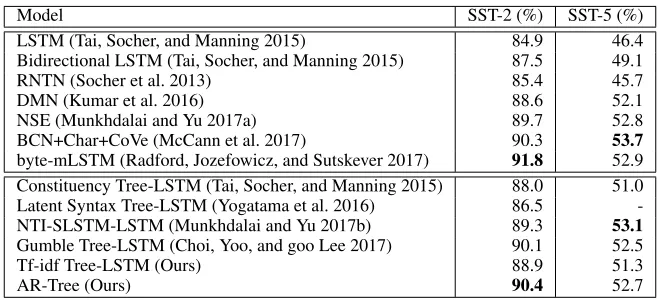
Table 3 shows the results of SST experiments. Our model on SST-2 outperforms all Tree-LSTM models and other state-of-the-art models except Byte-mLSTM (Rad-ford, Jozefowicz, and Sutskever 2017), a byte-level language model trained on a very large corpus. (McCann et al. 2017) obtains the highest performance on SST-5 due to the help of pretraining and character n-gram embeddings. Without the help of character-level information, our model can still get comparable results on SST-5.
Author Profiling
The Author Profiling dataset consists of Twitter tweets and some annotations about age and gender of the user writ-ing the tweet. Followwrit-ing (Lin et al. 2017) we used English tweets as input to predict the age range of the user,
includ-ing 5 classes: 18-24, 25-34, 35-49, 50-64 and 65+. Theage
predictiondataset consists of 68,485/4,000/4,000 tweets for
train/validation/test sets.
We applied GloVe and dropout as in the SST experiments. Table 1 describes detailed settings, which are the same as (Lin et al. 2017)’s published implementation except for the optimizer (they use SGD but we find Adam converges bet-ter).
Model Acc. (%)
BiLSTM+MaxPooling (Lin et al. 2017) 77.40
CNN+MaxPooling (Lin et al. 2017) 78.15
Gumble Tree-LSTM (Choi, Yoo, and goo Lee 2017) 80.23
Self-Attentive (Lin et al. 2017) 80.45
Tf-idf Tree-LSTM (Ours) 80.20
AR-Tree (Ours) 80.85
Table 4: Results of age prediction experiments.
Results of the age prediction experiments are shown in Table 4. We can see that our model outperforms all other baseline models. Compared to self-attentive model, our AR-Tree model obtains higher performance in the same experi-mental settings, indicating that latent structures are helpful to sentence understanding.
Qualitative Analysis
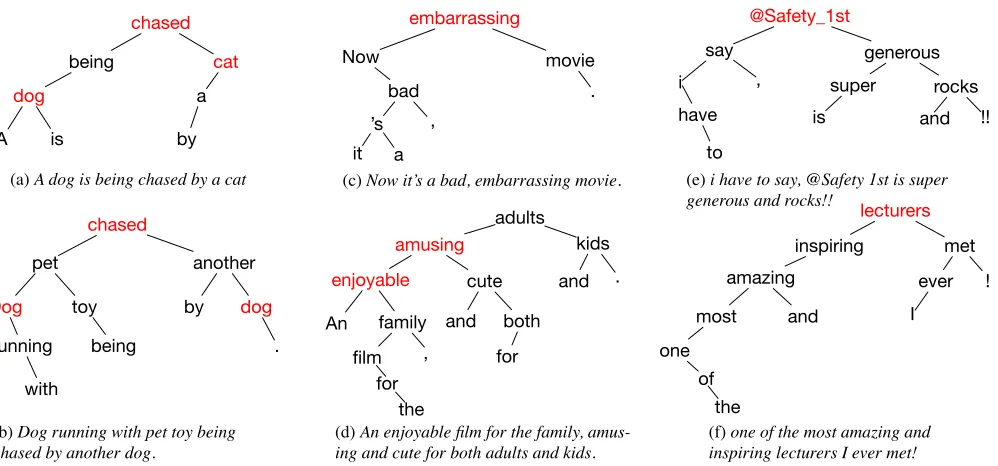
We conducted experiments to observe structures of the learned trees. We select 2 sentences from the test set of three experiment datasets respectively and show their atten-tive trees in Figure 4.
The left column is a sentence pair with relationship
con-tradictionfrom SNLI. Figure 4a and 4b both focus on the
predicate wordchasedfirstly, then focus on its subject and
object respectively. The middle column is from SST-2, the sentiment analysis dataset. Both Figure 4c and 4d focus on
emotional adjectives such asembarrassing,amusingand
en-joyable. The right column is from the age prediction dataset, predicting the author’s age based on the tweet. Figure 4e
at-tends to@Safety 1st, a baby production, indicating that the
author is probably a young parent. Figure 4f focuses on
lec-turerswhich suggests that the author is likely to be a college
student.
Furthermore, we applied parsers trained on different tasks to the same sentence, and show results in Figure 5. The
parser of SNLI focuses onpartially(Figure 5a), as SNLI is
an inference dataset and pays more attention to words which may be different in two sentences to reflect the contradiction
relationship (e.g.,partiallyv.s.totally). The parser of
A dog
is being
chased
by a
cat
Dog
running
with pet
toy
being chased
by another
dog
.
(a) A dog is being chased by a cat
(b) Dog running with pet toy being chased by another dog.
embarrassing
Now bad ’s it a
,
movie .
An enjoyable
film for
the family , amusing
cute
and both
for adults
kids
and . i have
to say
,
@Safety_1st
is super
generous
and rocks
!!
one of
the most
amazing
and inspiring
lecturers
met ever I
!
(c) Now it’s a bad, embarrassing movie.
(d) An enjoyable film for the family, amus- ing and cute for both adults and kids.
(e) i have to say, @Safety 1st is super generous and rocks!!
(f) one of the most amazing and inspiring lecturers I ever met!
Figure 4: Examples of our produced attentive trees. The caption of each subfigure is the input sentence. The left, middle and right columns are from SNLI, SST-2 and age prediction respectively. We can see that our AR-Tree can place task-informative words at shallow nodes.
Though unfinished
partially
remarkable appealing
academic and
,
his
papers
are
Though
unfinished
partially
remarkable
appealing academic
and
, his
papers
are
Though unfinished
partially
remarkable appealing academic
and ,
his
papers
are
(a) SNLI (b) SST-2 (c) age prediction
Figure 5: Different structures from different trained parsers for the same sentenceThough unfinished partially, his academic
papers are remarkable and appealing. We can see that words are emphasized adaptively based on the target task.
words (Figure 5b) as we have expected. In the parsed
re-sults of age prediction,academicandpapersare emphasized
(Figure 5c) because they are more likely to be discussed by college students, and are more informative to the age predic-tion task than other words.
Our model is able to pay attention to task-specific critical words for different tasks and learn interpretable structures, which is beneficial to the sentence understanding.
Conclusions and Future Work
We propose Attentive Recursive Tree (AR-Tree), a novel yet generic latent Tree-LSTM sentence embedding model, learning to learn task-specific structural embedding guided by word attention. Results on three different datasets demon-strate that AR-Tree learns reasonable attentive tree struc-tures and outperforms previous Tree-LSTM models.
Moving forward, we are going to design a batch-mode
tree construction algorithm,e.g., asynchronous parallel
re-cursive tree construction, to make the full exploitation of dis-tributed and parallel computing power. Therefore, we may able to learn an AR-Forest to embed paragraphs.
Acknowledgments
The work is supported by National Key Research and Devel-opment Program of China (2017YFB1002101), NSFC key project (U1736204, 61533018), and THUNUS NExT Co-Lab.
References
Blunsom, P.; Grefenstette, E.; and Kalchbrenner, N. 2014. A
convolutional neural network for modelling sentences. InACL.
Bowman, S. R.; Angeli, G.; Potts, C.; and Manning, C. D. 2015. A large annotated corpus for learning natural language
infer-ence. InEMNLP.
Bowman, S. R.; Gauthier, J.; Rastogi, A.; Gupta, R.; Manning, C. D.; and Potts, C. 2016. A fast unified model for parsing and
sentence understanding. InACL.
Chen, Q.; Zhu, X.; Ling, Z.-H.; Wei, S.; Jiang, H.; and Inkpen, D. 2017. Recurrent neural network-based sentence encoder
with gated attention for natural language inference. InRepEval.
Choi, J.; Yoo, K. M.; and goo Lee, S. 2017. Learning to
com-pose task-specific tree structures. InAAAI.
Cocke, J. 1970. Programming languages and their compilers: Preliminary notes.
Dai, A. M., and Le, Q. V. 2015. Semi-supervised sequence
learning. InNIPS.
dos Santos, C. N.; Tan, M.; Xiang, B.; and Zhou, B. 2016.
Attentive pooling networks.CoRR, abs/1602.03609.
Goldberg, Y., and Elhadad, M. 2010. An efficient algorithm for
easy-first non-directional dependency parsing. InNAACL.
Hill, F.; Cho, K.; and Korhonen, A. 2016. Learning distributed
representations of sentences from unlabelled data. InNAACL.
Hu, B.; Lu, Z.; Li, H.; and Chen, Q. 2014. Convolutional neural network architectures for matching natural language sentences.
InNIPS.
Ioffe, S., and Szegedy, C. 2015. Batch normalization: Acceler-ating deep network training by reducing internal covariate shift.
InICML.
Jang, E.; Gu, S.; and Poole, B. 2016. Categorical
reparameteri-zation with gumbel-softmax.arXiv preprint arXiv:1611.01144.
Kasami, T. 1965. An efficient recognition and syntaxanalysis algorithm for context-free languages. Technical report. Kim, Y.; Denton, C.; Hoang, L.; and Rush, A. M. 2017.
Struc-tured attention networks. arXiv preprint arXiv:1702.00887.
Kingma, D., and Ba, J. 2014. Adam: A method for stochastic
optimization.arXiv preprint arXiv:1412.6980.
Kumar, A.; Irsoy, O.; Ondruska, P.; Iyyer, M.; Bradbury, J.; Gul-rajani, I.; Zhong, V.; Paulus, R.; and Socher, R. 2016. Ask me anything: Dynamic memory networks for natural language
pro-cessing. InICML.
Lin, Z.; Feng, M.; Santos, C. N. d.; Yu, M.; Xiang, B.; Zhou, B.; and Bengio, Y. 2017. A structured self-attentive sentence
embedding.arXiv preprint arXiv:1703.03130.
Maillard, J.; Clark, S.; and Yogatama, D. 2017. Jointly learning sentence embeddings and syntax with unsupervised tree-lstms. arXiv preprint arXiv:1705.09189.
McCann, B.; Bradbury, J.; Xiong, C.; and Socher, R. 2017.
Learned in translation: Contextualized word vectors. InNIPS.
Mikolov, T.; Sutskever, I.; Chen, K.; Corrado, G. S.; and Dean, J. 2013. Distributed representations of words and phrases and
their compositionality. InNIPS.
Mou, L.; Men, R.; Li, G.; Xu, Y.; Zhang, L.; Yan, R.; and Jin, Z. 2016. Natural language inference by tree-based convolution
and heuristic matching. InACL.
Munkhdalai, T., and Yu, H. 2017a. Neural semantic encoders.
InACL.
Munkhdalai, T., and Yu, H. 2017b. Neural tree indexers for text
understanding. InACL.
Nivre, J. 2003. An efficient algorithm for projective
depen-dency parsing. InProceedings of the 8th International
Work-shop on Parsing Technologies (IWPT.
Parikh, A.; T¨ackstr¨om, O.; Das, D.; and Uszkoreit, J. 2016. A decomposable attention model for natural language inference.
InEMNLP.
Pennington, J.; Socher, R.; and Manning, C. 2014. Glove:
Global vectors for word representation. InEMNLP.
Radford, A.; Jozefowicz, R.; and Sutskever, I. 2017. Learning
to generate reviews and discovering sentiment. arXiv preprint
arXiv:1704.01444.
Shi, H.; Zhou, H.; Chen, J.; and Li, L. 2018. On tree-based
neural sentence modeling. InProceedings of the 2018
Confer-ence on Empirical Methods in Natural Language Processing, 4631–4641.
Socher, R.; Pennington, J.; Huang, E. H.; Ng, A. Y.; and Man-ning, C. D. 2011. Semi-supervised recursive autoencoders for
predicting sentiment distributions. InEMNLP.
Socher, R.; Perelygin, A.; Wu, J.; Chuang, J.; Manning, C. D.; Ng, A.; and Potts, C. 2013. Recursive deep models for semantic
compositionality over a sentiment treebank. InEMNLP.
Srivastava, N.; Hinton, G. E.; Krizhevsky, A.; Sutskever, I.; and Salakhutdinov, R. 2014. Dropout: a simple way to prevent
neural networks from overfitting.JMLR.
Sutton, R. S.; McAllester, D. A.; Singh, S. P.; and Mansour, Y. 2000. Policy gradient methods for reinforcement learning with
function approximation. InNIPS.
Tai, K. S.; Socher, R.; and Manning, C. D. 2015. Improved semantic representations from tree-structured long short-term
memory networks. InACL.
Wang, D., and Nyberg, E. 2015. A long short-term memory model for answer sentence selection in question answering. In ACL.
Williams, A.; Drozdov, A.; and Bowman, S. R. 2017. Learning
to parse from a semantic objective: It works. is it syntax?arXiv
preprint arXiv:1709.01121.
Williams, R. J. 1992. Simple statistical gradient-following
algorithms for connectionist reinforcement learning. Machine
learning.
Yogatama, D.; Blunsom, P.; Dyer, C.; Grefenstette, E.; and Ling, W. 2016. Learning to compose words into sentences
with reinforcement learning.arXiv preprint arXiv:1611.09100.
Younger, D. H. 1967. Recognition and parsing of context-free
languages in time n3. Information and control.
Yu, L.; Zhang, W.; Wang, J.; and Yu, Y. 2017. Seqgan:
Se-quence generative adversarial nets with policy gradient. In
AAAI.
Zeiler, M. D. 2012. Adadelta: an adaptive learning rate method. arXiv preprint arXiv:1212.5701.
Zhu, X.; Sobihani, P.; and Guo, H. 2015. Long short-term