
Volume 3, Issue 5, May 2014
Page 384
Abstract
Wireless Sensor networks have wide range applications using different routing protocols to route the data towards the sink. However, these protocols being too simple are prone to various attacks. LEACH is a highly secure protocol with dynamic selection of Cluster Heads based on Received Signal Strength. But as with other protocols, LEACH is prone to HELLO Flood Attack when the adversary becomes the Cluster Head and sensors being computation and energy constrained cryptographic approaches to prevent this attack are not too helpful. Some non-cryptographic methods to detect the HELLO Flood attack also exist but they are not too efficient as they result in large test packet overhead. In this paper an efficient non-cryptographic method for the detection and prevention of HELLO Flood attack in LEACH protocol is proposed which results in early detection with lesser energy and communication overhead.
Keywords: Security, WSN, LEACH, HELLO Flood attack, Cluster Head, Adversary.
1.
I
NTRODUCTIONWireless Sensor networks have unique characteristics and face security challenges as defined below:
1.1 SECURITY ISSUES IN WSN:
1. Data Confidentiality: Ensuring that only the authorized sensor nodes can access the content of the messages. 2. Data Authentication: Ensuring that the data is originated from a valid source [3].
3. Data Integrity: Ensuring that any received data has not been altered or manipulated in transit by unauthorized parties. 4. Availability: Ensuring that services offered by whole WSN or by a single sensor node must be available whenever required.
5. Data Freshness: Ensuring that no old messages have been replayed in the network [10].
6.Authorization: Ensure that only authorized sensors can provide information to network services or applications. 7. Non-repudiation: It denotes that a node cannot deny sending a message it has previously sent [7].
8. Forward and Backward Secrecy: These should be considered when new sensors are deployed and old sensors leave the network due to some failure. Forward Secrecy means a sensor should not be able to read any messages after it leaves the network. Backward Secrecy means a joining node should not be able to read any message that has been previously transmitted [12].
1.2 LEACH PROTOCOL
Heinzelman, et.al [5] introduced a dynamic, hierarchical clustering protocol for sensor networks, called LEACH (Low Energy Adaptive Clustering Hierarchy). LEACH forms small clusters of some sensor nodes of which one is the cluster head and others are the cluster members. The cluster members send their sensed data to the cluster head and cluster head in turn send this data to the sink by aggregating all the received data from its cluster members, in order to reduce the redundancy. In LEACH the cluster head nodes are periodically re-elected so that the same node is not repeatedly used for the high energy task of the cluster head. However, the chosen cluster heads do not ensure the coverage of all the sensors in the field which is the primary disadvantage of LEACH Protocol. TDMA/CDMA MAC is used to reduce inter-cluster and intra-cluster collisions or interference. This protocol is used where a constant monitoring by the sensor nodes are required as data collection is centralized (at the base station) and is performed periodically[10].
1.2.1Operation of LEACH
LEACH operations can be divided into two phases:- 1. Setup phase
2. Steady phase
In the setup phase, the clusters are formed and a cluster-head (CH) is chosen for each cluster while other nodes in the cluster are considered as the cluster members. While in the steady phase, data is sensed and sent to the central base station. The steady phase is longer than the setup phase. This is done in order to minimize the overhead cost [17].
Detection of Malicious Cluster Head causing
Hello Flood Attack in LEACH Protocol in
Wireless Sensor Networks
Satwinder Kaur Saini1, Mansi Gupta2
1
Department of Computer Science Engineering, PIT (PTU main Campus), Kapurthala, India
2
Volume 3, Issue 5, May 2014
Page 385
Figure 1 LEACH Protocol Phases [6]1.2.2 Attacks possible on LEACH
LEACH protocol is a secure protocol as compared to the more conventional multi-hop protocols. In the conventional multi-hop protocols, the nodes around the base station are more attractive to compromise as they are the major points of aggregation and forwarders of all packets to the base station. Whereas, in LEACH, the Cluster Heads are the only node that directly communicate with the base station. The location of these Cluster Heads can be anywhere in the network irrespective of the base station. And more over the CHs are periodically randomly changed. So spotting these CHs is very difficult for the adversary.
However, as it is a cluster-based protocol, depending solely on the Cluster Heads for aggregation of data and its routing, attacks involving the Cluster Heads are the most harmful. If any adversary nodes become a CH, then it can facilitate attacks like Sybil attack, HELLO flood attack and selective forwarding [11].
1.3 HELLO FLOOD ATTACK
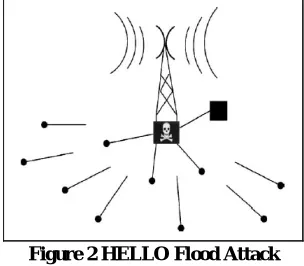
An attacker uses high-powered transmitter to trick a large area of nodes into believing they are neighbours of that transmitting node. If the attacker intentionally broadcasts a false superior route to the base station, all of these nodes will choose to transmit through the attacking node, despite many being out of radio range in reality [16] [18]. The intruder can broadcast a powerful advertisement to all the nodes in the network and hence, every node is likely to choose the adversary as the cluster-head. The adversary can then selectively forward information to the base-station or modify or dump it [1] [2] [11].
Figure 2 HELLO Flood Attack
2.
LITERATURE
REVIEW
Extensive study of work done in the field of detection of HELLO flood attack in LEACH protocol in WSNs is done and can be categorized into two groups: Cryptographic approaches & non-cryptographic approaches. These are described as follows:
Table 5 Cryptographic Approaches
S.No Paper Title Year Author Approach Advantages Disadvantages
1 Secure routing in wireless sensor networks: attacks and
countermeasures.[ 8]
2003 Chris Karlof, David Wagner
Sharing a secret key between any two nodes. Key generated during communication.
Only reachable nodes can decrypt.
Spoofing makes the approach worthless.
2 Defense against lap-top class attacker in wireless sensor network.[4]
2006 Md. Abdul Hamid, Md. Mamun-Or-Rashid and Choong Seon Hong
Secret key for each different route to a base station. Multiple base stations with each covering and keeping track of secrets of some nodes.
High secrecy preventing the adversary from attacking the network.
Computation overhead is high during route setup.
Volume 3, Issue 5, May 2014
Page 386
Random Key
Distribution
Solution for
Securing Clustered Sensor
Networks.[11]
Oliveira, Hao C. Wong, M. Bern, Ricardo Dahab and A. A. F. Loureiro
distribution approach,
Symmetric key cryptography and dynamic cluster formation.
communicatio n authenticity, confidentiality, freshness and integrity.
attack possible
4 An Efficiency
Security Model of Routing Protocol in Wireless Sensor Networks.[7]
2008 Jing Chen, Huanguo Zhang and Junhui Hu
Public Key cryptography.
Resists outside attackers
Cannot prevent inside attacks and computation overhead is high
5 Performance Evaluation of LEACH Protocol
in Wireless
Network.[9]
2012 M.Shankar, Dr.M.Sridarand Dr.M.Rajani
Random pair wise key distribution Resists spoofing, sinkhole, wormhole, selective forwarding and many other attacks.
Random key pre distribution scheme is used thus efficient key management mechanisms are required.
Table 6 Non-Cryptographic Approaches
S.No Paper Title Year Author Approach Advantages Disadvantages
1 Malicious node
detection in
wireless sensor networks. [13]
2004 Waldir Ribeiro Pires J´unior, Thiago H. de Paula Figueiredo, Hao Chi Wong and Antonio A.F. Loureiro
Signal strength and geographical information based approach. Each node monitors all the heard transmissions and maintains a local reputation table for the heard nodes.
Both outside and inside attacks can be detected.
Spoofing of identity by the adversary may result in false detection.
Information dissemination by each node is adds
to the
communication overhead. 2 Signal Strength
based HELLO
Flood Attack
Detection and Prevention in Wireless Sensor Networks. [16]
2013 Virendra Pal Singh, Aishwarya S. Anand Ukey and Sweta Jain
Signal strength based
approach.COmpar ison of RSS with pre-calculated threshold Simple Approach with less computation overhead
TEST packet communication overhead is high.
3 Detection of
HELLO Flood
Attack on LEACH Protocol[19]
2014 Shikha Magotra and Krishan Kumar
Geographical information based approach. Co-ordinate approach with distance calculation.
Simple approach with lesser
detection time
TEST packet communication overhead.
3.
P
ROPOSEDM
ETHODOLOGYThe Proposed approach is based on the Received Signal Strength (RSS) and the geographical information of the motes deployed in the sensing region of interest. In the proposed approach random GUIDE nodes are chosen, as these are randomly chosen their distribution cannot be guaranteed to be uniform over the sensing region. These GUIDE nodes are chosen randomly in each round as the Cluster Heads depending upon the desired Guide node percentage. The GUIDE nodes are responsible for the work of detection of malicious Cluster Head and malicious node information dissemination as well. Larger is the Guide node percentage, more are the chances of early detection; However higher Guide node percentage will also result in more energy consumption.
3.1 TERMINOLOGY
Volume 3, Issue 5, May 2014
Page 387
CH: Cluster Head N: Normal Node
Pthresh: Pre defined Received Power Threshold G: GUIDE Node
pg: Percentage of GUIDE Nodes countGs: Counter for GUIDE Nodes
ADV.Power: Power of the Advertisement message sent by the elected CHs range_normal: range of normal sensor node
dist: distance between the GUIDE node and the ADV sending CH node detect: counter for detection of malicious node
3.2 ALGORITHM FOR PROPOSED APPROACH:
The algorithm for the proposed GUIDE Approach is given below:
Step 1. Creation of GUIDE nodes
for(i=1;i<=n;i++)
{ random =choose a random number;
if(S(i).E>0&& S(i)∉ CH&&random<=(pg/(1-pg*mod(r,round(1/pg))))) { node.type=’G’;
countGs++;
Transmit GUIDE Signal (x,y,random). } }
Step 2.Detection by the GUIDE nodes
for(i=0;i<=countGs;i++)
{ if(ADV.Power>=PThresh || dist>=range_normal) { detect++;
Malicious CH detected;
Store the detected Malicious CH co-ordinates. } }
Step 3. Information Dissemination
if(detect>0)
{ Detecting GUIDE node: Transmits ALERT message with Malicious CH co-ordinates. Other GUIDE nodes: Retransmit ALERT message. }
Step 4. CH Association (for N nodes)
for(i=0;i<=n;i++)
{ Choose CH such that co-ordinates are not same as those in received ALERT message and maximum Power CH is chosen as minimum distance CH. }
4.
RESULTS
4.1 SIMULATION SCENARIO USING MATLAB
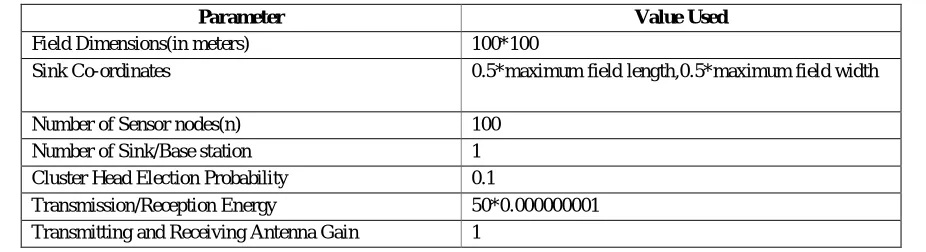
The proposed algorithm has been implemented using MATLAB simulator. HELLO Flood attack has been simulated by choosing desired percentage of random attackers (here 0.01) in the network with high transmission power as compared to normal sensor nodes in the network. A sink is placed at a fixed position in the field and sensors are placed randomly in the field. The field dimensions are 100 x 100. Other simulation parameters are defined below along with their values used.
Table 7 Parameters used in the simulation Scenario with values
Parameter Value Used
Field Dimensions(in meters) 100*100
Sink Co-ordinates 0.5*maximum field length,0.5*maximum field width
Number of Sensor nodes(n) 100 Number of Sink/Base station 1 Cluster Head Election Probability 0.1
Volume 3, Issue 5, May 2014
Page 388
Transmitting and Receiving Antenna Heights(in meters)
1.5
Radio Range of normal sensor nodes(in meters) Diameter of sensing field*sqrt (log (n) /n) [20]
Radio Range of Attacker(in meters) 80
Path Loss 1
Percentage of attackers 0.01
Maximum number of rounds 100
Percentage of Guide nodes 0.1 Distance threshold between two guide nodes 15
Figure 3 Simulation of Proposed Approach
o : Normal node
* : Cluster Head
+ : Attacker
x : Sink
* : Guide Node
The proposed approach results are compared to two existing approaches that are, Received Signal Strength (RSS) based Approach and non-cryptographic approach presented in reference []. The performance metrics used for comparison are detection Time, Detection Energy and Communication Overhead. Each of these metrics is explained below along with the results obtained in comparison to previously existing approaches.
4.2 PERFORMANCE RESULTS
The performance of the proposed approach has been compared to two existing approaches in terms of performance metrics like detection time, energy required for detection and communication overhead. The comparison is described below:
4.2.1Detection Time: It is the time the network takes to detect the malicious cluster Head node or the adversary in each round in LEACH Protocol. Results are shown below:
4.2.2
Table 8 Comparison based on the detection Time (in Seconds)
LEACH Round RSS Based Approach Approach in ref [19] Proposed GUIDE Approach
round=20 4.64 1.11 0.443
round=40 5.93 1.40 0.382
round=60 5.73 1.39 0.149
round=80 7.42 1.09 0.421
Volume 3, Issue 5, May 2014
Page 389
Figure 4 Comparison based on Detection Time (in Seconds)4.2.2 Detection Energy: it is defined as the amount of energy dissipated by the network nodes for the detection of the attacking node per round in LEACH Protocol. Results are given below:
Table 9 Comparison based on Detection Energy required (in milliJoules)
LEACH Round RSS Based Approach Approach in ref [19] Proposed GUIDE Approach
round=20 9.27 2.37 1.6
round=40 10.47 2.57 1.4
round=60 11.43 2.9 2
round=80 11.37 2.11 2
round=100 10.37 2.37 1
Figure 5 Comparison based on Detection Energy (in milli Joules)
4.2.3 Communication Overhead: It is defined as the overhead incurred by the network in terms of additional packets for the purpose of successful detection of Attacker node in the network. Results are shown below:
Table 10: Comparison based on Communication Overhead
LEACH Round RSS Based Approach Approach in ref [19] Proposed GUIDE Approach
round=20 37 14 8
round=40 28 12 7
round=60 20 13 10
round=80 28 14 10
round=100 26 11 5
Volume 3, Issue 5, May 2014
Page 390
The above analysis clearly shows that the proposed approach gives better results in terms of performance metrics defined above. Thus, the HELLO Flood attack can be detected with lesser detection time, lesser energy and lesser computation overhead with the proposed GUIDE approach in comparison to the previously existing approaches.
5. CONCLUSION
LEACH protocol is difficult for an adversary to attack except the case when the adversary node become a Cluster Head, it makes it easy for the attacker to launch a HELLO flood attack by simply broadcasting a powerful advertisement to all the nodes deployed in the sensing field. In this paper, a new non-cryptographic approach to detect and prevent HELLO Flood attack in LEACH protocol in WSN is proposed. The results of the proposed approach have been compared with the existing approaches and the comparison proves that the proposed approach is more effective with less detection time, energy and computational overhead. The proposed approach improves the network performance by early detection of adversary and preventing the nodes from associating with such a malicious Cluster Head.
6. FUTURE SCOPE
The proposed approach in LEACH protocol works well with detection of the adversary and prevention from associating any normal node to such node as cluster member. However the proposed work does not include any plan for the isolation of the attacker nodes in the network. In future, work can be enhanced to isolate such nodes from the rest of the network for the smooth functioning of the network. Furthermore, the simulated scenario defines a homogeneous network whereas real life environment is heterogeneous. So in future, work can be done for the same. Also the guide nodes are not uniformly placed in the field so their connectivity and even distribution in the network cannot be guaranteed. The work can be enhanced in future to ensure the even distribution of guide nodes in the sensing region.
REFERENCES
[1] Anand, D.G.; Chandrakanth, H.G.; Giriprasad, M.N.; “Security Threats & Issues in Wireless Sensor Networks,” International Journal of Engineering Research and Applications (IJERA), ISSN: 2248-9622, vol. 2, Issue 1, pp.911-916, Jan-Feb 2012.
[2] Chaudhari, H.C.; Kadam, L.U.; “Wireless Sensor Networks: Security, Attacks and Challenges,” International Journal of Networking, vol. 1, Issue 1, pp-04-16, 2011.
[3] Chee-Yee Chong; Kumar, S.P., "Sensor networks: evolution, opportunities, and challenges," Proceedings of the IEEE, vol.91, no.8, pp.1247,1256, Aug. 2003.
[4] Hamid, A.; Mamun-Or-Rashid; Choong-seon Hong, "Defense against lap-top class attacker in wireless sensor network," Advanced Communication Technology, 2006. ICACT 2006. The 8th International Conference , vol.1, no., pp.5 pp.,318, 20-22 Feb. 2006.
[5] Heinzelman, W.R.; Chandrakasan, A.; Balakrishnan, H.; "Energy-efficient communication protocol for wireless microsensor networks," System Sciences, 2000. Proceedings of the 33rd Annual Hawaii International Conference on, vol. 2, pp.10 pp., 4-7 Jan. 2000.
[6] Heinzelman, W.B.; Chandrakasan, A.P.; Balakrishnan, H.; "An application-specific protocol architecture for wireless microsensor networks," Wireless Communications, IEEE Transactions on, vol.1, no.4, pp.660, 670, Oct 2002.
[7] Jing Chen; Huanguo Zhang; Junhui Hu, "An Efficiency Security Model of Routing Protocol in Wireless Sensor Networks," Modeling & Simulation, 2008. AICMS 08. Second Asia International Conference on, vol., no., pp.59, 64, 13-15 May 2008.
[8] Karlof, C.; Wagner, D., "Secure routing in wireless sensor networks: attacks and countermeasures," Sensor Network Protocols and Applications, 2003. Proceedings of the First IEEE.2003 IEEE International Workshop on, vol., no., pp.113, 127, 11 May 2003.
[9] M.Shankar; M.Sridar; M.Rajani; “Performance Evaluation of LEACH Protocol in Wireless Network,” International Journal of Scientific & Engineering Research, vol 3, Issue 1, January-2012.
[10] Modares, H.; Salleh, R.; Moravejosharieh, A.; "Overview of Security Issues in Wireless Sensor Networks," Computational Intelligence, Modelling and Simulation (CIMSiM), 2011 Third International Conference on, vol., no., pp.308, 311, 20-22 Sept. 2011.
[11] Oliveira, L.B.; Wong, H.C.; Bern, M.; Dahab, R.; Alfredo Ferreira Loureiro, Antonio; "SecLEACH - A Random Key Distribution Solution for Securing Clustered Sensor Networks," Network Computing and Applications, 2006. NCA 2006. Fifth IEEE International Symposium on, vol., no., pp.145, 154, 24-26 July 2006.
[12] Pathan, A.K.; Hyung-Woo Lee; Choong-seon Hong; "Security in wireless sensor networks: issues and challenges," Advanced Communication Technology, 2006. ICACT 2006. The 8th International Conference, vol.2, no., pp.6 pp., 1048, 20-22 Feb. 2006.
Volume 3, Issue 5, May 2014
Page 391
[14] Suraj Sharma; Sanjay K. Jena; “A survey on secure hierarchical routing protocols in wireless sensor networks,”ICCCS ’11 Proceedings of the 2011 International Conference on Communication, Computing & Security, pp.146, 151,2011.
[15] Uddin, M.Y.S.; Akbar, M.M.; "Addressing Techniques in Wireless Sensor Networks: A Short Survey," Electrical and Computer Engineering, 2006. ICEC '06. International Conference on, vol., no., pp.581, 584, 19-21 Dec. 2006.
[16] Virendra Pal; Aishwarya S.; Sweta Jain; “Signal Strength based HELLO Flood Attack Detection and Prevention in Wireless Sensor Networks,” International Journal of Computer Applications (0975 – 8887) vol. 62– No.15, January 2013.
[17] Yassein, M.B.; Al-zou’bi, A.; Khamayseh, Y.; Mardini, W.; “Improvement on LEACH protocol of Wireless Sensor Network,” International Journal of Digital Content Technology and its Applications, vol. 3, issue 2, June 2009.
[18] Yong Wang; Attebury, G.; Ramamurthy, B., "A survey of security issues in wireless sensor networks," Communications Surveys & Tutorials, IEEE, vol.8, no.2, pp.2, 23, Second Quarter 2006.
[19]Magotra, S.; Kumar, K., "Detection of HELLO flood attack on LEACH protocol," Advance Computing Conference (IACC), 2014 IEEE International , vol., no., pp.193,198, 21-22 Feb. 2014.
[20]Simek M., Moravek P. and Silva J., “Wireless Sensor Networking in Matlab: Step-by-Step”, January 2010.
AUTHORS
Satwinder Kaur Saini received B.Tech degree in Computer Science Engineering from Sant Baba Bhag Singh Institute Of Technology in 2012. She is now pursuing M.Tech degree in Computer Science (Networking Systems) from Ambika Paul Institute of Technology (Punjab Technical University, Main Campus), Kapurthala, Punjab, India.

![Table 8 Comparison based on the detection Time (in Seconds) RSS Based Approach Approach in ref [19] Proposed GUIDE](https://thumb-us.123doks.com/thumbv2/123dok_us/9768841.1962057/5.612.132.535.73.447/table-comparison-detection-seconds-based-approach-approach-proposed.webp)
![Table 9 LEACH Round Comparison based on Detection Energy required (in milliJoules) RSS Based Approach Approach in ref [19] Proposed GUIDE](https://thumb-us.123doks.com/thumbv2/123dok_us/9768841.1962057/6.612.99.528.249.471/comparison-detection-energy-required-millijoules-approach-approach-proposed.webp)
