Vol. 17, No. 2, 2018, 203-210
ISSN: 2279-087X (P), 2279-0888(online) Published on 5 June 2018
www.researchmathsci.org
DOI: http://dx.doi.org/10.22457/apam.v17n2a6
203
Annals of
Second Order Hybrid Fuzzy Fractional Differential
Equations by Runge Kutta 6
thOrder Fehlberg Method
M. Saradha
Department of Mathematics, MVJ College of Engineering Bangalore, Karnataka, India
Email: [email protected]
Received 9 April 2018; accepted 4 June 2018
Abstract. In this paper we study numerical methods for second order hybrid fuzzy fractional differential equations. We solve the hybrid fuzzy fractional differential equations with a fuzzy initial condition by using variational iteration method. We consider a second order differential equation with fractional values and we compared the results with their exact solutions in order to demonstrate the validity and applicability of the method. We further give the definition of the Degree of Sub element hood of hybrid fuzzy fractional differential equations with examples.
Keywords: Hybrid fuzzy fractional differential equations, degree of sub element hood
AMS Mathematics Subject Classification (2010): 65L40, 65L70
1. Introduction
With the rapid development of linear and nonlinear science, many different methods such as the variational iteration method (VIM) [1] were proposed to solve fuzzy differential equations. Fuzzy initial value problems for fractional differential equations have been considered by some authors recently [2,3]. As another development, hybrid systems are dynamical systems that progress continuously in time but have formatting changes called modes at a sequence of discrete times. Some recent papers about hybrid systems include [4,7]. When the continuous time dynamics of a hybrid system comes from fuzzy fractional differential equations the system is called a hybrid fuzzy fractional differential system or a hybrid fuzzy fractional differential equation.
204
2.1. Preliminaries
In this section the most basic notations used in hybrid fuzzy fractional differential equations are introduced.
Let us consider the following fractional differential equation:
)), ( ), ( , ( )
( k k
a
cD x t f t x t
λ
xβ = [ , ]
1
+
∈ tk tk
t (1) where, 0
We can also represent a fuzzy numbers x E by a pair of functions
β
a
cD x (t) =
β
a cD
= [cDaβx(t),cDaβx(t) ]
Using a representation of fuzzy numbers we may represent x E by a pair of functions such that:
1. is bounded, left continuous and non decreasing, 2. is bounded, left continuous and non increasing and
3. ,
Therefore, we may replace (1) by an equivalent system equation (2):
k k k
k k a
cD x(t)= f(t,x,
λ
(x )≡F (t,x,x),x(t )=xβ
cDaβx(t)= f(t,x,
λ
k(xk)≡Gk(t,x,x),x(tk)=xk (2) This possesses a unique solution , which is a fuzzy function. That is for each t, the pair [ is a fuzzy number, where are respectively the solutions of the parametric form given by Equation (3):) ( ) ; ( )), ; ( ), ; ( , ( )
(t F t x t r x t r x t r x r
x
Da k k k
c = =
β
cDa x(t)=Gk(t,x(t;r),x(t;r)),x(tk;r)=xk(r)
β (3)
for r [0, 1]
3. The sixth order Runge Kutta Fehlberg method with harmonic mean
For a second order hybrid fuzzy fractional differential equation we develop the sixth order Runge Kutta Fehlberg method with harmonic mean when f and λk in (1) can be obtained via the Zadeh extension principle from:
f [R+ X R X R, R] and λk C [R,R]
The Sixth Order Runge Kutta Fehlberg method for (1) is given by: (Yk(t;r),Yk(t;r)≡(xk(t;r),xk(t;r)), (yk(t;r),yk(t;r))
Second Order Hybrid Fuzzy Fractional Differential Equations by Runge Kutta 6 Order Fehlberg Method
205
,
)]} ( ), ( [ )], ( ), ( {[
)]} ( ), ( [ )], ( ), ( {[ \
)) ( , , (
min )) ( ); ( ; (
, ,
, ,
, ,
, ,
,
, ,
, 1
∈ ∈ =
r z r z r y r y u
r z r z r y r y u
u u t f h r
z r y t k
n k n k n
k n k k
n k n k n
k n k
k k n k k
n k n k n k
λ
,
)]} ( ), ( [ )], ( ), ( {[
)]} ( ), ( [ )], ( ), ( {[ \
)) ( , , (
min )) ( ); ( ; (
, ,
, ,
, ,
, ,
,
, ,
, 1
∈ ∈ =
r z r z r y r y u
r z r z r y r y u
u u t f h r
z r y t l
n k n k n
k n k k
n k n k n
k n k
k k n k k
n k n k n k
λ
,
)]} ( ), ( [ )], ( ), ( {[
)]} ( ), ( [ )], ( ), ( {[ \
)) ( , , (
max )) ( ); ( ; (
, ,
, ,
, ,
, ,
,
, ,
, 1
∈ ∈ =
r z r z r y r y u
r z r z r y r y u
u u t f h r
z r y t k
n k n k n
k n k k
n k n k n
k n k
k k n k k
n k n k n k
λ
,
)]} ( ), ( [ )], ( ), ( {[
)]} ( ), ( [ )], ( ), ( {[ \
)) ( , , (
max )) ( ); ( ; (
, ,
, ,
, ,
, ,
,
, ,
, 1
∈ ∈ =
r z r z r y r y u
r z r z r y r y u
u u t f h r
z r y t l
n k n k n
k n k k
n k n k n
k n k
k k n k k
n k n k n k
λ
,
)] ( ), ( [
) , (
) , ( \
)) ( , ), ( 2 1 (
min )) ( ); ( ; (
0 , 0 ,
, ,
, , ,
, ,
, 2
1 1
∈
Φ Φ ∈
+
=
r y r y u
y t
y t u
u u h t
f h
r z r y t k
k k
k
n k n k k
n k n k k
k k k n
k k
n k n k n k
λ
Like we can arrange
)) ( ); ( ;
( , , ,
2 t y r z r
l kn kn kn ,k2(tk,n;yk,n(r);zk,n(r)),l2(tk,n;yk,n(r);zk,n(r))
)) ( ); ( ;
( , , ,
3 t y r z r
k kn kn kn ,l3(tk,n;yk,n(r);zk,n(r)),k3(tk,n;yk,n(r);zk,n(r)),
)) ( ); ( ;
( , , ,
3 t y r z r
l kn kn kn ,k4(tk,n;yk,n(r);zk,n(r)),l4(tk,n;yk,n(r);zk,n(r)),
)) ( ); ( ;
( , , ,
4 t y r z r
k kn kn kn ,l4(tk,n;yk,n(r);zk,n(r)), k5(tk,n;yk,n(r);zk,n(r)),
)) ( ); ( ;
( , , ,
5 t y r z r
Second Order Hybrid Fuzzy Fractional Differential Equations by Runge Kutta 6 Order Fehlberg Method 207
)))
(
),
(
,
(
*
845
)
(
),
(
,
(
*
29440
)
(
),
(
,
(
*
32832
)
(
),
(
,
(
*
8341
(
*
*
)
4104
/
1
(
)
(
)),
(
),
(
,
(
*
845
)
(
),
(
,
(
*
29440
)
(
),
(
,
(
*
32832
)
(
),
(
,
(
*
8341
(
*
*
)
4104
/
1
(
)
(
,
(
))
(
),
(
,
(
, , , 4 , , , 3 , , , 2 , , , 1 , , , , 4 , , , 3 , , , 2 , , , 1 , , , , , 4r
z
r
y
t
l
r
z
r
y
t
l
r
z
r
y
t
l
r
z
r
y
t
l
h
r
z
r
z
r
y
t
k
r
z
r
y
t
k
r
z
r
y
t
k
r
z
r
y
t
k
h
r
y
h
t
f
r
z
r
y
t
n k n k n k n k n k n k n k n k n k n k n k n k n k n k n k n k n k n k n k n k n k n k n k n k n k n k n k n k n k n k k−
+
−
+
−
+
−
+
+
=
Φ
)))
(
),
(
,
(
*
)
40
/
11
(
)
(
),
(
,
(
*
)
4104
/
1859
(
)
(
),
(
,
(
*
)
2565
/
3544
(
)
(
),
(
,
(
*
2
)
(
),
(
,
(
*
)
27
/
8
(
(
*
)
(
)),
(
),
(
,
(
*
)
40
/
11
(
)
(
),
(
,
(
*
)
4104
/
1859
(
)
(
),
(
,
(
*
)
2565
/
3544
(
)
(
),
(
,
(
*
2
)
(
),
(
,
(
*
)
27
/
8
(
(
*
)
(
,
)
5
.
0
(
(
))
(
),
(
,
(
, , , 5 , , , 4 , , , 3 , , , 2 , , , 1 , , , , 5 , , , 4 , , , 3 , , , 2 , , , 1 , , , , , 5r
z
r
y
t
l
r
z
r
y
t
l
r
z
r
y
t
l
r
z
r
y
t
l
r
z
r
y
t
l
h
r
z
r
z
r
y
t
k
r
z
r
y
t
k
r
z
r
y
t
k
r
z
r
y
t
k
r
z
r
y
t
k
h
r
y
h
t
f
r
z
r
y
t
n k n k n k n k n k n k n k n k n k n k n k n k n k n k n k n k n k n k n k n k n k n k n k n k n k n k n k n k n k n k n k n k n k n k n k n k k−
+
−
+
−
+
−
+
−
+
−
+
+
=
Φ
)))
(
),
(
,
(
*
)
40
/
11
(
)
(
),
(
,
(
*
)
4104
/
1859
(
)
(
),
(
,
(
*
)
2565
/
3544
(
)
(
),
(
,
(
*
2
)
(
),
(
,
(
*
)
27
/
8
(
(
*
)
(
)),
(
),
(
,
(
*
)
40
/
11
(
)
(
),
(
,
(
*
)
4104
/
1859
(
)
(
),
(
,
(
*
)
2565
/
3544
(
)
(
),
(
,
(
*
2
)
(
),
(
,
(
*
)
27
/
8
(
(
*
)
(
,
)
5
.
0
(
(
))
(
),
(
,
(
, , , 5 , , , 4 , , , 3 , , , 2 , , , 1 , , , , 5 , , , 4 , , , 3 , , , 2 , , , 1 , , , , , 5r
z
r
y
t
l
r
z
r
y
t
l
r
z
r
y
t
l
r
z
r
y
t
l
r
z
r
y
t
l
h
r
z
r
z
r
y
t
k
r
z
r
y
t
k
r
z
r
y
t
k
r
z
r
y
t
k
r
z
r
y
t
k
h
r
y
h
t
f
r
z
r
y
t
n k n k n k n k n k n k n k n k n k n k n k n k n k n k n k n k n k n k n k n k n k n k n k n k n k n k n k n k n k n k n k n k n k n k n k n k k−
+
−
+
−
+
−
+
−
+
−
+
+
=
Φ
Next we define:
)] ( ), ( ), ( ), ( [ , , , , ,
, y r y r z r z r t
S kn kn kn
208
)]
(
),
(
),
(
),
(
[
, , ,, ,
,
y
r
y
r
z
r
z
r
t
T
kn kn knn k n k
k =
{
))} ( ), ( ; ( ) 11 / 12 (
) ( ), ( ; ( ) 10 / 9 ( )) ( ), ( ; ( ) 11286 / 28561 (
)) ( ), ( ; ( ) 2565 / 6656 ( )) ( ), ( ; ( ) 27 / 16 ( 5
, ,
, 6
, ,
, 5 ,
, , 4
, ,
, 3 ,
, , 1
r z r y t k
r z r y t k r
z r y t k
r z r y t k r
z r y t k h
n k n k n k
n k n k n k n
k n k n k
n k n k n k n
k n k n k
+
− +
+
The exact solution at tk,n+1is given by:
+ =
+ =
+ +
)]. ( ), ( ), ( ), ( [
) ( )
(
)], ( ), ( ), ( ), ( [
) ( )
(
, ,
, ,
, , ,
1 ,
, ,
, ,
, , ,
1 .
r z r z r y r y t T r Y r G
r z r z r y r y t S r Y r F
n k n k n k n k n k k n
k n
k
n k n k n k n k n k k n
k n
k
(5)
3.1. Degree of sub element hood
Let X be a Universal, U be a set of parameters and let (Fk,n+1) and (Gk,n+1) are two fuzzy elements of X. Then the degree of sub element hood denoted by
S S S
S(
1 ,n+ k
F , Gk,n+1) is defined as,
S
SS
S(
1 ,n+ k
F ,Gk,n+1) =
Where and
SSSS(
1 ,n+ k
G ,Fk,n+1) = .
4. Numerical example
In this section, we present the example for solving hybrid fuzzy fractional differential equations.
Consider the following second order hybrid fuzzy fractional differential equation:
cDaβ X (t) =Z and cDaβZ (t) = XZ2-Y2 (6) X (0) = X0,
where β∈(0,1] and t > 0 and X0 is any triangular fuzzy number.
This problem is a generalization of the following hybrid fuzzy fractional differential equation:
cDaβ x (t) = z(t) = &
β
a cD z(t) =
2
- 2 (7)
x (t) = x0,
where β∈(0,1], t > 0,
α
is the step size and x0 is a real number.Second Order Hybrid Fuzzy Fractional Differential Equations by Runge Kutta 6 Order Fehlberg Method
209
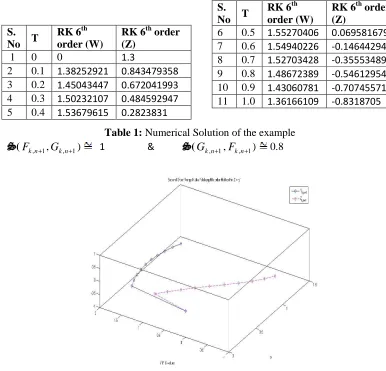
generalized the error of the hybrid fractional fuzzy differential equation, also we illustrated the figure and in the table for this generalization by using Matlab.
S. No T
RK 6th order (W)
RK 6th order (Z)
1 0 0 1.3
2 0.1 1.38252921 0.843479358 3 0.2 1.45043447 0.672041993 4 0.3 1.50232107 0.484592947 5 0.4 1.53679615 0.2823831
S. No T
RK 6th order (W)
RK 6th order (Z)
6 0.5 1.55270406 0.069581679 7 0.6 1.54940226 -0.14644294 8 0.7 1.52703428 -0.35553489 9 0.8 1.48672389 -0.54612954 10 0.9 1.43060781 -0.70745571 11 1.0 1.36166109 -0.8318705
Table 1: Numerical Solution of the example
S S S
S(
1 ,n+ k
F ,Gk,n+1) 1 & SSSS(
1 ,n+ k
G ,Fk,n+1) 0.8
Figure 1: Graphical representation of the example 5. Conclusion
In this paper, we have studied a hybrid fuzzy fractional differential equation. Final results showed that the solution of hybrid fuzzy fractional differential equations approaches the solution of hybrid fuzzy differential equations as the fractional order approaches the integer order. The results of the study reveal that the proposed method with fuzzy fractional derivatives is efficient, accurate, and convenient for solving the hybrid fuzzy fractional differential equations.
210
1. S.Arshad and V.Lupulescu, Fractional differential equation with the fuzzy initial condition, Electron. J. Differ. Equ., 34 (2011) 1-8.
2. R.P.Agarwal, V.Lakshmikanthama and J.J.Nieto, On the concept of solution for fractional differential equations with uncertainty, Nonlinear Anal., 72 (2010) 2859-2862.
3. E.Khodadadi and E.Çelik, The variational iteration method for fuzzy fractional differential equations with uncertainty, Fixed Point Theory and Applications 2013, 2013:13
4. K.Miller and B.Ross, An introduction to the fractional calculus and fractional
differential equations, Wiley, New York, 1993.
5. M.Z.Ahmad and M.K.Hasan, Numerical methods for fuzzy initial value problems under different types of interpretation: a comparison study, in Informatics
Engineering and Information Science, vol. 252 of Communications in Computer and Information Science, pp. 275–288, Springer, Berlin, Germany, 2011.
6. S.Pederson and M.Sambandham, Numerical solution to hybrid fuzzy systems,
Mathematical and Computer Modelling, 45 (2007) 1133–1144.
7. S.Ruban Raj and M.Saradha, Solving hybrid fuzzy fractional differential equation by Runge Kutta forth order method, International Journal of Science and Research, 4(2) (2015) 96-98.
8. S.Ruban Raj and M.Saradha, Solving second order hybrid fuzzy fractional differential equation by Runge Kutta forth order method, International Journal of
Science and Research, 4(1) ( 2015) 2148-2153.