w w w . i j m r e t . o r g I S S N : 2 4 5 6 - 5 6 2 8 Page 7
Profit Optimization VIA Process Enhancement through A.I.
Controllers
Mr. Patrick Robert Cheron& Dr. Syed Adeel Ahmed
University of New Orleans, New Orleans, LA 70148, USA. Xavier University of Louisiana, New Orleans, LA 70125, USA.
Abstract In today’s market businesses are always trying to find ways to keep up with the escalating economic
model of supply and demand. To do this, they either need to improve on their product to make sales higher or find ways to cut down on the money and material used to make that product. This could be accomplished by savings millions, if not billions, using total quality management and artificially intelligent controllers. Even with the ever-growing popularity of total quality management, and the introduction of it in to some of the bigger corporations, not all businesses have adopted its methods. In 2005 it was said that only around 5% - 25% of all petroleum companies worldwide implemented some form of quality management. However, today it is recorded that around 40% of all oil and gas companies do implement some sort of quality management. For years companies have been investing money into the research and development of Artificial Intelligence (A.I.) and attempting to implement this technology into their processes and distribution methods. A few companies who have been successful with this undertaking are companies like Spotify, Facebook and Netflix. These companies use a series of complex algorithms and artificial intelligence to learn your preferences, so whatever your preferences are, those can be the first things seen on your newsfeed when you log in. Hypothetically, it is possible that the petroleum companies could also use this sort of technology to regulate and maintain their processes during the refinement stages, making the overall efficiency of the process/production increase. If an A.I. could manage production processors that could automatically time and adjust parameters for flow, pressure, liquid levels, temperature, and chemical compositions; then, time, man-power, and materials used could be cut down, and production increased.
Keywords Artificial Intelligence, Oil & Gas, Quality Management, Control Modes, Control Loops, PID Loops
I. Introduction
In the last fifty years the way business has been conducted and the technology that used to do that business have both been growing exponentially with an ever-growing market demand. Due to this ever-growing demand, a large majority of big businesses have adapted some sort of total quality management application within their company. There have been many articles warning companies of the dangers of not having some type of quality management in place. One such article written by CEBOS [5] states that, “Businesses that want to grow in size and market share need a quality management system to remain economically relevant in the future.” They also stated that, “Without such a program, progress will be hit-and-miss, and the entire potential of the organization will never be attained.” So, it is to no surprise that the petroleum companies, like many of the other larger businesses, are starting to hop on board with the idea of quality management. It has already been proved that quality management can improve a
w w w . i j m r e t . o r g I S S N : 2 4 5 6 - 5 6 2 8 Page 8
play. Which can end up either costing the company more money by using more supplies than needed, or by having a longer process time. Introducing an A.I. into this scenario could reduce human error and improve the process simultaneously by correcting the operating parameters in real time as variables and chemical compositions change.
II. Controls and A.I.
According to the Gas Processors Suppliers Association (GPSA) Engineering Data Book Volume 1 [1], “Controller tuning has been referred to as the most important, least understood, and most poorly practiced aspect of process control.” Control tuning occurs whenever a process variable is different from the setpoint variable. When this occurs, as seen in figure 1, the measure variable is manipulated by the controller to bring the measured variable back to the setpoint variable.
Figure 1: Manipulation of Setpoint Variables The four basic forms of control modes used in most processes today consist of two-position, proportional, integral, and derivative controllers. The proportional, integral, and derivative controllers can be used in various combinations with each other when the cycling nature of the two-position control cannot be tolerated. However, there are advantages as well as disadvantages when using the latter three control modes.
2.1 Proportional Mode (P)
This type of control mode is considered the simplest of the three control modes we will be discussing. Its advantages are that it is simple and inexpensive, plus it does not introduce any extra time lags into the system. The proportional mode is expressed as:
𝐶𝑂 = 𝐾𝑃 𝑃𝑉 − 𝑆𝑃 + 𝑀𝑂 (1)
Where MO represents the controller output while set on manual, (PV – SP) the error signal, and KP the
gain constant. The major downfall is that this type of controller mode does not cope well with load changes in the process. Whenever there is a process load change, and the original manual output cannot maintain the controlled process variable at the setpoint, offset will occur in the system. Offset is the deviation from the controlled variable from the
setpoint. To battle these offsets in the system, you can add an integral to the proportional mode.
2.2 Proportional Plus Integral Plus
Derivative Mode (PID)
The PI controllers, proportional modes plus integral modes, make up about 70% - 90% of controllers used in a typical plant. The bonus of combining the integral mode with the proportional mode is that when offset occurs the integral will cause the control element to move with speed proportional to the offset until the offset is cancelled out. The PI mode is expressed as:
𝐶𝑂 = 𝐾𝑃 [ 𝑃𝑉 − 𝑆𝑃 + 1
𝑇𝑖 𝑃𝑉 − 𝑆𝑃 𝑑𝑡] + 𝑀𝑂
(2)
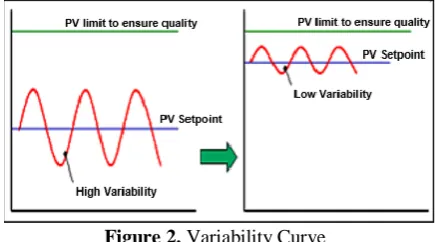
The main problem with PI mode controllers is that if the integral is to large then the reset rate will be longer due to the offset going past the setpoint value, adding time lag to the system. This will make the variability larger, thus taking it longer for the process to zero-out and stabilize as seen in figure 2 in the next column. Engineers and technicians soon learned that to speed up and counter these long-time delays in the responses a derivative
Figure 2. Variability Curve
needed to be added to act as a brake, so the output didn’t overshoot the setpoint value. This is how the derivative mode came into play. The downside to using a derivative mode is that by nature derivatives are sensitive to signal noise, which can cause excessive wear and tear on the control valve, and thus need enough signal filtering to be used and maintained. By combining all three modes you get a PID controller mode expressed as:
𝐶𝑂 = 𝐾𝑛 𝐾𝑝 𝑃𝑉 − 𝑆𝑃 − 1 𝑇𝑖
(𝑃𝑉 − 𝑆𝑃)
+ 𝑇𝑑
𝑑 𝑃𝑉 − 𝑆𝑃
𝑑𝑡
+ 𝑀𝑂 (3)
w w w . i j m r e t . o r g I S S N : 2 4 5 6 - 5 6 2 8 Page 9
the system parameters cannot be precisely estimated or achieved, then the desired process outcome might not be achieved. Another downfall is that the integral and derivative must be readjusted whenever there are disruptions from the operating environment such as temperature changes, flow changes, weather, power surges, and so on. There are two major causes of deficient performance when it comes to controller loops. The first is due to excessive time delay between the actuation of the element and the resulting change in the controlled variable, and second, is some variation in loop gain due to changes in the process conditions. All in all, the process will be efficient and work perfectly if there are no upsets are changes to the working system. Once a change is detected time lag will occur and process time will be lost until the parameters are adjusted and the system is corrected. The problem is no one knows there is a change in the system until the alarm notifies the controller of the situation. This is where the help of Artificial Intelligence technology could come into play. If the A.I. can sense the change in the system in real time, then the A.I. could adjust the integral and the derivative to compensate for the best approach needed.
2.3 Artificial Intelligence (A.I.)
The field of artificial intelligence research has been heavily invested into on and off ever since the early days of its founding at Dartmouth college in the summer of 1956. It wouldn’t be until the beginning of the 21’st century that machine learning would be successfully applied to problems within industry. Deep learning, big data, and artificial general intelligence are the three core zones being developed for business practices. According to the Harvard Business Review, there are many advantages as well as disadvantages when dealing with artificial intelligence. Some of the advantages include the ability to automate job functions to improve efficiency for manufacturing, improve business processes in transportation and logistical supply chains, predict performance and behavior, increased revenue, pattern recognition mentioned
w w w . i j m r e t . o r g I S S N : 2 4 5 6 - 5 6 2 8 Page 10 Figure 3:Financial Impact of A.I. on Businesses
III. Cost Analysis
With the latest downturn in the petroleum industry, and their hand being forced by low prices for end products, the companies who have invested in innovative technologies to improve efficiency, reduce costs, and minimize any unplanned downtime shall be the ones who emerge stronger than ever afterwards.
3.1 Financial Savings
The potential financial return a company can save by integrating an A.I. controller should be enough for any company to give it a second thought. Carlos Uribe-Gomez, Netflix’s VP of Product Innovation, and its Chief Product Officer Neil Hunt, published a paper saying that Netflix’s A.I. algorithms save them $1 billion every year by impacting their churn rate. They also go on to say that, “Retention rates are already high enough that it takes a very meaningful improvement to make a retention difference of even 0.1%”.
Netflix’s technology and development budget has increased slightly faster than its overall revenue. Last year it was reported that the company’s budget increased 38% to $651 million, roughly about 10% of their revenue; however, only a small part of their development budget goes to their A.I. recommendation engine, so if the claim of $1 billion in savings is accurate then Netflix is seeing a significant return from its A.I. research.
What does this mean for the petroleum companies
though? By 2020 it is estimated that the A.I. market will be worth over $5 billion. It is also believed that, even though its adoption is slow compared to other sectors, the oil and gas division will be one of its major benefactors. Drilling is not only highly expensive, but it is also an extremely risky investment. For these reasons companies are always trying to find ways to improve on their product and process time. By implementing an A.I. controller you can ensure a process in a refinery will be repeatable in a consistent fashion and improve the success rate across various stages of production. This could save oil companies millions of dollars per day by eliminating non-productive times and reducing risks.
3.2 Social Obligations
w w w . i j m r e t . o r g I S S N : 2 4 5 6 - 5 6 2 8 w w w . i j m r e t . o r g I S S N : 2 4 5 6 - 5 6 2 8 Page 11 Page 11
who work in or around the refineries and rigs would have extra security and peace of mind knowing that the company they work for is looking out not only for the environment and surrounding communities, but also for their wellbeing.
IV. Discussion
What does all this really mean though? It means that by integrating an A.I. into a controller it has the potential to enhance human worker capabilities by freeing them up for greater strategic thinking and enabling smarter decision-making. It also means that by enabling an A.I. integrated controller you can save your company money by cutting costs due to non-productive process time and potential liabilities due to loss of human life, product, and environmental disasters.
V. Conclusion
Artificial intelligence has already found many applications in the business and manufacturing areas, but its potential for growth is still vast and numerous. In processes, deadtime results in a loss of operating time, which in return leads to a loss of profit. By implementing some form of artificial intelligence in the controller to read, analyze, and adjust to real-time changes in the process system, this deadtime can be cut down, and system efficiency can be increased, leading to increased production, profit, and company prestige. The recent research and documentation from companies that have implemented A.I. into its business practices proves that artificial intelligence technology has provided growth and financial gain for those companies. Further research and improvement in an A.I. controller could excel the technology towards the benefit of engineering and scientific sectors, while potentially savings a company billions of dollars.
References
[1] Gas Processors Suppliers Association. Engineering Data Book Volume 1 Sections 1-16, Gas Processors Association, USA, 1987
[2] John M. Campbell, Robert A. Hubbard, Robert N. Maddox. Gas Conditioning and Processing: Volume 1 The Basic Principles, sixth edition, Campbell Petroleum Series, USA, 1988
[3] Paul Mampilly. Paul Mampilly’s Profits Unlimited, www.banyanhill.com, USA,
2018
[4] Matt Slowikowski. How Artificial Intelligence Could Help Transform the Oil Industry, available online at:
https://oilprice.com/Energy/Energy- General/How-Artificial-Intelligence-Could-Help-Transform-The-Oil-Industry.html
[5] CEBOS blog. CEBOS a division of QAD, online at https://www.cebos.com/blog/the-
top-risks-of-not-having-a-quality-management-system/
[6] PAControl. Instrumentation and Control: Process Control Fundamentals, available
online at:
https://oilprice.com/Energy/Energy- General/How-Artificial-Intelligence-Could-Help-Transform-The-Oil-Industry.html
[7] Bright Hub Project Management. Companies That Benefited From TQM, available online at: https://www.brighthubpm.com/methods- strategies/99895-companies-that-benefited-from-tqm/
[8] IQS. Quality Management for Oil & Gas, available online at: https://www.iqs.com/oil-gas/
[9] International Organization for Standardization. Quality management system for the oil and natural gas industry, available online at: https://www.iso.org/news/2003/11/Ref879.h tml
[10] North Bridge Consultants. Impact of Artificial Intelligence, available online at: http://www.northbridgeconsultants.com/new sletters/summer2017/impact_of_artificial_in telligence.php
[11] Accenture. How A.I. Boosts Industry Profits and Innovation, available online at: https://www.accenture.com/us-en/insight-ai-industry-growth
[12] OGM. Artificial Intelligence in Upstream Oil and Gas, available online at: http://www.oilgasmonitor.com/artificial-intelligence-upstream-oil-gas/
https://www.techemergence.com/artificial-w https://www.techemergence.com/artificial-w https://www.techemergence.com/artificial-w . i j m r e t . o r g I S S N : 2 4 5 6 - 5 6 2 8 w w w . i j m r e t . o r g I S S N : 2 4 5 6 - 5 6 2 8 Page 12 Page 12
intelligence-in-oil-and-gas/
[14] Wikipedia. History of Artificial Intelligence, available online at:https://en.wikipedia.org/wiki/History_of_ artificial_intelligence
[15] Datamation.Artificial Intelligence Impacts Business: the AI-Business Revolution, available online at:
https://www.datamation.com/big- data/artificial-intelligence-impacts-business-the-ai-business-revolution.html
[16] Gillian Mohney. ABC News. Oil Rig Explosion Kills 4 in Gulf of Mexico, No Spill Reported, available online at:https://abcnews.go.com/International/oil- rig-explosion-kills-gulf-mexico-spill-reported/story?id=30052063
[17] Fox News 9. Explosion at Superior, Wisconsin oil refinery: Multiple injuries, evacuations ordered, available online at: http://www.fox9.com/news/explosion-at- superior-wisconsin-oil-refinery-multiple-injuries
[18] Elizabeth Dunbar. MPR News. Five lessons of loss and resilience after Superior refinery fire, available online at: https://www.mprnews.org/story/2018/06/04/ five-lessons-of-loss-resilience-after-superior-refinery-fire-explosion
[19] Alan Taylor. The Atlantic. Bhopal: The World's Worst Industrial Disaster, 30 Years Later, available online at: https://www.theatlantic.com/photo/2014/12/ bhopal-the-worlds-worst-industrial-disaster-30-years-later/100864/
[20] Dan Hebert, PE, and Alex Misiti. Engineering 360.The Growing Role of Artificial Intelligence in Oil and Gas, available online at: https://insights.globalspec.com/article/2772/t he-growing-role-of-artificial-intelligence-in-oil-and-gas
[21] Value Global.How AI Is Transforming the Oil & Gas Industry, available online at: http://www.valueglobal.net/how-ai-is-transforming-the-oil-gas-industry
[22] Dr. Arun Kumar Ranganathan. Infosys. Artificial Intelligence in Upstream Oil and Gas, June 24, 2016
[23] Adam Levy. The Motley Fool. How Netflix’s
AI Saves It $1 Billion Every Year, June 19, 2016
Mr.Patrick Robert Cheron, B.S.M.E., University of New Orleans, 2000 Lakeshore Dr., New Orleans, LA 70148. He is a three-time published author and current student at the University of New Orleans seeking his M.B.A and master’s degree
in Engineering Management. E-mail:
[email protected] or [email protected]
Syed Adeel Ahmed, Ph.D., Xavier University of Louisiana, 1 Drexel Dr., New Orleans, LA 70125. He is an Assistant Professor of Management at Xavier University of Louisiana, E-mail: