Assessment of Different Routing Protocols in
MANET (Mobile-Ad Hoc Network)
Mrs. Swetha M. S Dr. Thungamani M
Assistant Professor Assistant Professor
Department of Information Science And Engineering Department of Computer Science & Engineering BMS Institute of Technology & Management, Yelahanka,
Bangalore -560064, Karnataka
COH UHS Campus GKVK BANGALORE 560065, Karnataka
Mr. Ritesh Kumar Student
Department of Information Science And Engineering
BMS Institute of Technology & Management, Yelahanka, Bangalore -560064, Karnataka
Abstract
In recent years, a vast investigation has been seen going on in the field of Mobile Ad Hoc Networks (MANET). Due to inadequate assets in MANET, to plan an effective and trustworthy routing policy is still a challenge. An intelligent routing strategy is required to efficiently use the limited resources. Also the procedures designed for old-style wired networks such as link-state or distance vector, does not scale well in wireless atmosphere. Routing in MANET is an inspiring task and has received an incredible amount of devotion from researchers around the world. To speechless this problem a number of routing protocols have been established and the number is still growing day by day. It is quite challenging to control which protocols may accomplish well under a number of dissimilar network situations such as network size and topology etc. In this paper we provide an indication of a wide range of the current routing protocols with a specific focus on their appearances and functionality. Also, the assessment is provided based on the routing policies and information used to make routing verdicts. The presentation of all the routing protocols is also discussed. Further this study will help the researchers to get an indication of the existing protocols and recommend which protocols may perform better with respect to changeable network scenarios.
Keywords: Routing, Protocols, AODV, Cluster
_______________________________________________________________________________________________________
I. INTRODUCTION
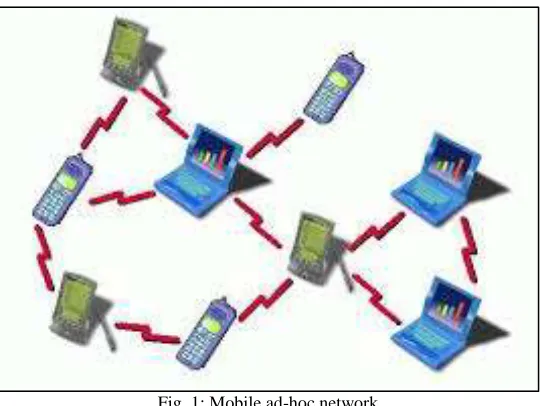
A Mobile ad hoc network is a set of wireless movable CPUs (or nodes) in which nodes team up by accelerating packets for each other to allow them to interconnect external range of shortest wireless communication. Ad hoc networks need no central management or fixed network setup such as base stations or access points. A MANET is an independent group of mobile users that interconnect over equitably slow wireless links. The network topology may vary quickly and changeably over time, because the nodes are movable. Such a network may function in a unconnected fashion, or may be associated to the greater Internet.
MANETs retain certain appearances like Bandwidth-constrained, variable capacity links, Energy constrained Operation, Limited Physical Security, Dynamic network topology, Infrequent routing updates.
II. ROUTING IN MANET
Fig. 1: Mobile ad-hoc network
III. CLASSIFICATION OF ROUTING PROTOCOL
We will discuss the categorization of existing wireless ad hoc routing protocols, their distinctive features & types. The Routing Protocols for ad hoc wireless networks can be separated into three class based on the routing content update performance. They could be Unstable (On-demand), Proactive (Table-driven) or Hybrid. The table-driven ad hoc routing approaching is similar to the connectionless approach of transmitting packets, with no respect to when and how frequently such routes are desirable. When a node using an on-demand protocol desires a route to a new destination, it will have to wait until such a route can be discovered. On the other hand, because routing information is constantly propagated and maintained in table-driven routing protocols, a route to every other node in the ad hoc network is always available, regardless of whether or not it is needed.
Fig. 2: classification of routing protocol
Proactive Protocols
These protocols always keep up-to-date content of path from each node to every other node in the network. These protocols endlessly learn the topology of the network by dealing topological content among the web nodes. Thus, when there is a need for a path to a goal, such route information is available immediately. Dissimilar protocols keep pathway of different routing state information. These protocols need each node to retain one or more tables to store up to date routing message and to transmit word throughout the network. Some examples of table driven ad hoc routing protocols contain Dynamic Destination Sequenced Distance-Vector Routing Protocol (DSDV), Optimized Link State Routing Protocol (OLSR) and Wireless Routing Protocol (WRP).
Destination-Sequenced Distance-Vector
Optimized Link State Protocol
Clausen and Jacquet projected the Optimized Link State Protocol, a point-to-point proactive protocol that state an efficient link state packet transmitting mechanism called multi-point relaying it optimizes the pure link state routing protocol. Improvement are done in two ways: by decreasing the size of the control packets and by reducing the number of links used for transmitting the link state packets. Here each node keep the topology information about the network by sporadically exchanging link-state messages among the other nodes.
Optimized Link State Protocol
Clausen and Jacquet projected the Optimized Link State Protocol, a point-to-point proactive protocol that utilize an cost-efficient link state packet forwarding mechanism called multi point relaying. It optimizes the pure link state routing protocol. Optimizations are done in two ways: by reducing the property of the control packets and by reducing the number of links used for transmitting the link state packets. Here each node keep the topology info about the network by sporadically dealing link-state messages among the other nodes.
The Wireless Routing Protocol,
The Wireless Routing Protocol, as estimated by Murthy and Garcia-Luna-Aceves, is a table-based protocol related to DSDV that receives the properties of Bellman-International Journal of Content. The main goal is retaining routing message among each nodes in the network respect the shortest distance to all destination. Wireless routing protocols (WRP) is a loop open routing protocol. WRP is a path-finding algorithm with the omission of avoiding the count-to-infinity difficulty by forcing all node to execute uniformness checks of predecessor information reported by each its neighbors.
STAR
The STAR protocol is also supported on the link state algorithm. Each router keeps a source tree, which is a set of links include the preferable paths to destinations. This protocol has significantly decreased the measure of routing
overhead disseminated into the network by using a least elevated routing approach (LORA), to exchange routing information. The optimal routing (ORA) approach obtains the shortest path to the destination while LORA decrease the packet expense.
The Cluster head Gateway Switch Routing
The Cluster head Gateway Switch Routing protocol differs from another protocols as it exercise hierarchical network topology, rather of a flat topology. As projected by Chiang, it organizes nodes into clusters, which arrange among the members of all cluster entrusted to a special node called cluster head. Least Cluster Change (LCC) algorithm [21] is applied to dynamically choose a node as the cluster head. Each node must keep a cluster member table where it maintain the destination cluster head for each movable node in the network. These cluster member tables are send by each node sporadically via DSDV algorithm.
Reactive Protocols
The reactive or on-demand routing protocols are maintained on Query-Reply topology in which they do not try to constantly keep the up-to-date topology of the linkage. When a route is anticipated, a method is appealed to find a route to the destination node. The major objective of on demand or reactive routing protocols is to reduce the network traffic overhead. These routing protocols are based on some type of "query-reply" dialog. They do not try to constantly maintain the up-to-date topology of the network. Rather, when the essential arises, a reactive protocol invokes a procedure to find a route to the destination; such a procedure involves some sort of flooding the network with the route query.
AODV
AODV is a widely accepted on-demand routing protocol in ad hoc networks formed by C. E. Perkins and E. M. Royer. Ad hoc On-demand Distance Vector (AODV) is an accumulation of both DSR and DSDV. It follows the basic on-demand execution of Route Discovery and Route Maintenance from DSR, plus the usage of hop-by-hop routing, sequence numbers, and periodic beacons from DSDV. It uses end sequence numbers to ensure loop freedom at all times and by deflecting the Bellman-Ford “count-to- infinity” problem offers fast convergence when the ad hoc network topology modification. AODV discovers routes only when required and hence is reactive in nature.
TORA
The Temporally-Ordered Routing Algorithm (TRA) was formulated by Park and Corson. Temporarily sequential routing algorithm (TORA) is highly adjustive, loop-free, distributed routing algorithm founded on the concept of link reverse. It uses directed acyclic graphs (DAG) to define the routes either as upstream or downstream. This graph enables TORA to provide better route aid for networks with dense, large population of nodes. However to deliver this feature TORA necessities synchronization of the nodes which confines the application of the protocol. TORA is a fairly complex protocol but what makes it distinctive and prominent is its main feature of propagation of control messages only around the point of failure when a link failure occurs.
DSR
DSR is an on-demand protocol deliberated by D. B. Johnson, Maltz and Broch to control the bandwidth expended by control packets in ad hoc wireless networks by rejecting the periodic table update messages essential in the proactive routing protocols. The distinctive feature of Dynamic Source Routing (DSR) is the use of source routing. DSR is a reactive protocol i.e. it doesn’t use periodic updates. It calculates the routes when necessary and then maintains them.
LAR
restricting the flooding to a certain area. LAR is a reactive protocol which is based on the DSR. This Routing Protocol uses location information to diminish routing overhead of the mobile ad-hoc network. In the LAR routing procedure, RouteRequest and RouteReply packets resembles DSR and AODV are being proposed.
CBRP
Cluster Based Routing Protocol (CBRP), different from on-demand routing protocols, the nodes are systematized in a hierarchy. The nodes in CBRP are gathered into clusters. Every cluster has a cluster-head, which manages the data transmission within the cluster and to other clusters. The advantage of CBRP is that only cluster heads exchange routing information, therefore the number of control overhead transmitted through the network is far less than the traditional flooding methods. The protocol undergoes from temporary routing loops.
IV. HYBRID ROUTING PROTOCOLS
These protocols try to integrate various aspects of proactive and reactive routing protocols. They are generally used to provide hierarchical routing in general can be either flat or hierarchical. The trouble of all hybridrouting protocols is how to unify the network according to network parameters. The common disadvantage of hybrid routing protocols is that the nodes that have high level topological information maintains more routing information, which leads to more memory and power consumption. Some examples of Hybrid Routing Protocols include ZRP and ZHLS
ZRP
Haas and Pearlman projected Zone Routing Protocol. ZRP is a hybrid routing protocol for mobile ad hoc networks which confines the nodes into sub-networks (zones). It includes the merits of on-demand and proactive routing protocols. Within each zone, proactive routing is altered to speed up communication between neighbors. The inter-zone communication uses on-demand routing to decrease unnecessary communication.
ZHLS
ZHLS is based on hierarchical structure in which the network is separated into non-overlapping regions. According to Joa and Lu, each node is allocated one unique node ID and a zone ID, which are calculated using geographicalinformation. Hence the network surveys a two-level topology structure: node level and zone level. Respectively, there are two types of link state updates: the node level LSP (Link State Packet) and the zone level LSP. A node level LSP comprises the node IDs of its neighbors in the same zone and the zone IDs of all other zones. A node sporadically broadcast its node level LSP to all other nodes in the same zone. Therefore, through periodic node level LSP interactions, all nodes in a zone keep similar node level link state information.
V. SIMULATION AND RESULT
Part of the work is simulated via Network Simulator (NS) 2.35. NS-2 has as its major goal to support study in networking at many institutions undertaking networking exploration. New procedures can be established and movement patterns can be considered in NS-2.
In our case we use simulated traffic to arrive at our data sets, which we then divide into three subsections. The first subsection is the training set, which is used for training and appraising the ANN parameters. The second subset is the authentication set. In this phase we make use of the parameters got in phase one as the intrusion detection assessment data set .The model form of the dataset included 6000 records. A subset of the data that contained the desired attack types and a sensible amount of customary proceedings were selected physically. The last dataset used in this study involved 2500 records. MLP-NN is used to train the detection and grouping engine.
1) The various routing protocol in manet has been studied in detail.
2) Manet applications, advantages and issues associated with it is been discussed in detail.
VI. CONCLUSION
In this paper, we have presented and deliberated the arrangement of routing protocols in mobile ad hoc networks and provided relationships between them. The protocols are divided into three main categories: (i) source-initiated (reactive or on-demand), (ii) table-driven (pro-active), (iii) hybrid protocols. For each of these classes, we studied and linked several illustrative protocols. While there are still many defies facing Mobile ad hoc networks associated to routing and security. Each routing protocol has distinctive features. Based on network environments, we have to pick the suitable routing protocol. The examination of the different proposals has verified that the inherent characteristics of ad hoc networks, such as nonexistence of infrastructure and quickly varying topologies, present additional problems to the already complex problem of protected routing.
VII.FUTURE WORK
Mobile Ad hoc networking is a roasting concept in private communications Worldwide study is going on in this zone and many concerns still have to be lectured. We concentrated on ideas like unipath and multipath routing protocols with respect to their presentation in the mobile Ad hoc network. Multipath routing is a footstep towards attaining a network with better Quality of Service. However there are many more problems associated to routing that could be exposed to further research studies. The current research effort can be prolonged to plan and grow new routing protocols to meet the following extra necessary features.
1) Robust Scenario- A routing protocol must work with vigorous scenarios where movement is high, nodes are compact, area is large and the extent of traffic is more.
2) Probabilistic Route Maintenance- A more research in the field like probabilistic route maintenance is required to identify the probability of route failure before the occurrences of route failures.
3) Quality of service (QoS) - Ad hoc routing protocols must meet the anticipated supplies of QoS to accomplish lower end-to-end delay, high throughput improved delivery ratio, reduced routing overhead and more energy effectiveness.
REFERENCES
[1] Swetha M S, Chandana B N, Deepika M, A Survey on Homomorphic Data Concealment and Reliability in Multi Cloud Computing.In the proceedings of International Journal of Innovative Research in Computer and Communication Engineering, Vol. 5, Issue 2, February 2017
[2] Swetha M S,Dr.Thungamani M,Ankita Mishra, Enhancement of Performance Analysis in Anonymity MANET through Trust-Aware Routing Protocol.In the proceedings of International Journal of Advance Research in Computer Science and Management Studies, Volume 5, Issue 5, May 2017
[3] Swetha M.S, Dr. Thungamani M , Pooja Reddy, Richa Singh, A Survey on Privacy-Preserving and Authenticated Routing in Mistrustful Mobile Ad-Hoc Networks.In the proceedings of International Journal of Innovative Research in Computer and Communication Engineering Vol. 4, Issue 4, April 2016 [4] Mrs.Swetha M S, Dr.Thungamani M, Enhanced Anonymity in Hierarchical Routing Protocol for MANETs. 978-1-5386-4304-4/18/$31.00 ©2018 IEEE. [5] Mr. Muneshwara M.S, Mrs.Swetha M.S, Dr. Thungamani M and Dr. Anil G.N, Digital Genomics to Build a Smart Franchise in Real Time Applications.In
proceedings of 2017 International Conference on circuits Power and Computing Technologies [ICCPCT].
[8] C.E. Perkins and P. Bhagwat, Highly Dynamic Destination-Sequenced Distance-Vector Routing (DSDV) for Mobile Computers. [9] C.-C. Chiang, Routing in Clustered Multihop, Mobile Wireless Networks with Fading Channel.
[10] S. Murthy and J.J. Garcia-Luna-Aceves, An Efficient Routing Protocol for Wireless Networks
[11] Tsu-Wei Chen and Mario Gerla, Global State Routing: A New Routing Scheme for Ad-hoc Wireless Networks. [12] Tsu-Wei Chen and Mario Gerla, Global State Routing: A New Routing Scheme for Ad-hoc Wireless Networks.
[13] Swetha M S, Chandana B N, Deepika M, A Survey on Homomorphic Data Concealment and Reliability in Multi Cloud Computing.In the proceedings of International Journal of Innovative Research in Computer and Communication Engineering, Vol. 5, Issue 2, February 2017.
[14] Swetha M.S, Dr. Thungamani M , Pooja Reddy, Richa Singh, A Survey on Privacy-Preserving and Authenticated Routing in Mistrustful Mobile Ad-Hoc Networks.In the proceedings of International Journal of Innovative Research in Computer and Communication Engineering Vol. 4, Issue 4, April 2016 [15] Swetha M S,Dr.Thungamani M, Ankita Mishra, Enhancement of Performance Analysis in Anonymity MANET through Trust-Aware Routing Protocol.In
the proceedings of International Journal of Advance Research in Computer Science and Management Studies, Volume 5, Issue 5, May 2017. [16] Y. Liu and Y. R. Yang. Reputation propagation and agreement in mobile ad-hoc networks. In Proc. Of IEEE Wireless Communication and Networking [17] S. Marti, T. Giuli, K. Lai, and M. Baker. Mitigating routing misbehaviour in mobile ad hoc networks. In Proceedings of the Sixth Annual International