The Open Journal of Occupational Therapy
The Open Journal of Occupational Therapy
Volume 5
Issue 4 Fall 2017 Article 8
October 2017
Art in Occupational Therapy Education: An Exploratory
Art in Occupational Therapy Education: An Exploratory
Mixed-Methods Study of an Arts-Based Module
Methods Study of an Arts-Based Module
Susan Coppola
University of North Carolina at Chapel Hill - USA, [email protected]
Adrienne F. Miao
University of North Carolina at Chapel Hill - USA, [email protected]
Carolyn Allmendinger
University of North Carolina at Chapel Hill - USA, [email protected]
Wanqing Zhang
University of North Carolina at Chapel Hill - USA, [email protected]
Follow this and additional works at: https://scholarworks.wmich.edu/ojot
Part of the Occupational Therapy Commons
Recommended Citation Recommended Citation
Coppola, S., Miao, A. F., Allmendinger, C., & Zhang, W. (2017). Art in Occupational Therapy Education: An Exploratory Mixed-Methods Study of an Arts-Based Module. The Open Journal of Occupational Therapy, 5(4). https://doi.org/10.15453/2168-6408.1320
This document has been accepted for inclusion in The Open Journal of Occupational Therapy by the editors. Free, open access is provided by ScholarWorks at WMU. For more information, please contact
Art in Occupational Therapy Education: An Exploratory Mixed-Methods Study of Art in Occupational Therapy Education: An Exploratory Mixed-Methods Study of an Arts-Based Module
an Arts-Based Module
Abstract Abstract
Art-based learning experiences have demonstrated a range of benefits, including improved observation skills and perspective taking. This article describes the effects of an art-based module in an entry-level curriculum for occupational therapy (OT) students. An exploratory pilot study investigated the feasibility of a group-administered visual art-based module for 20 first-year OT graduate students. Outcomes were evaluated using a mixed-methods approach that combined pre-post quantitative results from survey questionnaires and qualitative reflective essays. Pre- and post-surveys revealed significant changes in the students’ perception regarding the benefits of art in OT curricula. The students’ reflective essays on their learning described art-based sessions as: (a) opportunities to practice perspective shifting, (b) tapping into emotion, (c) exemplars of the therapeutic encounter, (d) integrative and “out of the box,” and (e) impacting student roles and the classroom environment. Findings support art-based pedagogies to complement coursework to build an understanding of clients, creative thinking, and valued learning experiences. Learning partnerships between occupational therapy faculty, art museum educators, and artists can offer fruitful interdisciplinary learning experiences.
Keywords Keywords
art, arts and crafts, humanities, occupational therapy education
Cover Page Footnote Cover Page Footnote
The Institutional Review Board (IRB) for the University of North Carolina at Chapel Hill approved the study. Students completed the IRB approved informed consent process. There were no external funds to
support this study. Preliminary data from this study was presented at the American Occupational Therapy Association 2015 Annual Conference. We thank the students who participated in this study. We also thank artists Gloria Lightsey-Lewis and Alice McCall Smith for the valuable learning experiences given to the occupational therapy students.
Credentials Display
Susan Coppola, MS, OTR/L, BCG, FAOTA; Carolyn Allmendinger, PhD; Wanqing Zhang, PhD; Adrienne Miao, MS, OTR/L
Copyright transfer agreements are not obtained by The Open Journal of Occupational Therapy (OJOT). Reprint permission for this Topics in Education should be obtained from the
corresponding author(s). Click here to view our open access statement regarding user rights and distribution of this Topics in Education.
DOI: 10.15453/2168-6408.1320
Literature Review
The term art has many meanings. Most simply, art is “something that is created with imagination and skill and that is beautiful or that expresses important ideas or feelings” (Art, n.d.). Concepts in the category of art include skill, creativity, beauty, and feeling. Art has important meanings in occupational therapy (OT). One is the
therapeutic use of art- and craft-making
occupations. Another is the art of OT practice.
This background will briefly describe these first two meanings and then focus on the use of art in OT education.
An important backdrop for exploring art in OT is the profession’s history. When the profession began a century ago, the act of “doing” arts and crafts was central to practice and education (Levine, 1987; Peloquin, 1996a, Peloquin, 1996b; Quiroga, 1995). The profession took inspiration from leaders such as Mary Reilly, who wrote “man, through the use of his hands as they are energized by mind and will, can influence the state of his own health” (1962, p. 2). Later, OT adopted a medical lens on occupation and intentionally distanced itself from arts and crafts to legitimize the science of practice in the context of reductionist paradigms (Levine, 1987). The interventions of many practitioners shifted the focus to remediating impairments in
body structures and functions and skills training for basic activities of daily living (Shannon, 1977). An effort to appear high-tech in this era has contributed further to the demise of arts and crafts in practice (Harris, 2007). As arts and crafts receded as therapeutic occupations, particularly in medical model settings, they disappeared from curriculum
standards (Bathje, 2012). There are few examples of the use of art in any form in entry-level OT education today.
Another factor in this discussion of art is OT’s identity as an art and as a science (Rogers, 1983; Wood, 1995; Yerxa & Sharrott, 1986; Zemke, 2004). Rogers (1983) wrote that the “artistry of clinical reasoning is exhibited in the craftsmanship
with which the therapist executes the series of steps that culminates in a clinical reasoning decision” (p.
615). Peloquin (1989) describes the art of OT as also the “capacity to establish rapport, to empathize, and to guide others to know and make use of their potential” (p. 221). Yet, the art of OT has been
dropped from the American Occupational Therapy Association’s official definition(Peloquin, 1989). While scholars have used the term artistry in their descriptions of best practice (Rogers, 1983; Wood, 1996, 2004), a stronger influence has been the science-driven culture and reimbursement policy in the United States (Howard, 1991). Given the profession’s devalued historical stereotype of
simply teaching basket weaving, there are status and financial risks for identifying essential parts of practice that are not informed by science (Levine, 1987; Shannon, 1977).
In OT education, art may be a useful pedagogy with which to teach important tenets of
practice (Peloquin, 1996a,1996b). As a
biopsychosocial profession, OT requires a deep understanding of the values and beliefs of our clients, beyond simply “doing” occupation, to build partnerships with them in practice. Moreover, competence in the profession rests on the ability to consider varying perspectives on situations, and
importantly, to grasp the client’s way of seeing things (Mattingly & Fleming, 1994). This
capability requires that practitioners reflect on the nature and limitations of their own perspectives (Schön, 1983). Social science knowledge cannot sufficiently prepare a practitioner to enter the life-world of clients who have faced dashed hopes, traumatic losses, fear, and even catastrophe (Cassel,
1976; Mattingly & Fleming, 1994). Visual arts offer nonverbal ways of communicating
information about the human condition that may offer insights about values, beliefs, and the lived experiences of clients that constitute the meanings of occupation.
At many universities, health disciplines called “medical humanities” and “health
humanities” have emerged. For example, visual
arts in professional education is used to develop clinical skills, including observation skills, critical thinking, perspective taking, and rapport building (Casey, 2009; Cassel, 1976; Charon, 2010; Gaufberg & Williams, 2011; Ousager &
Johannessen, 2010; Schaff, Isken, & Tager, 2011). This interest was spurred by studies indicating a decline in medical students’ empathy during medical school (Hojat et al., 2009; Roberts & Noble, 2015). It has been suggested that learning through medical humanities improves patient care,
as well as self-understanding and stress relief for physicians in training (Gaufberg & Williams, 2011; Hammer et al., 2011; Ousager & Johannessen, 2010; Perry, Maffulli, Willson, & Morrissey, 2011; Roberts & Noble, 2015). Museum-based
experiences involving medical students and people with dementia have been employed to develop
understanding and rapport (Roberts & Noble, 2015). Arts and humanities have also been used for
interprofessional education experiences to build empathy, compassion, ethics, and skills for teamwork (Smith, Molineux, Rowe, & Larkinson, 2006).
Art-based education aligns with pedagogies used in OT that stress active learning, modeling of
learning experiences, and integrating affective and cognitive learning (Peloquin, 1996b; Schaber et al.,
2012; Schaber, 2014). Pedagogies not only convey information, but also teach how to approach new learning and what is important in the culture of the profession. Educational approaches also
communicate the teachers’ values and thinking about what is important in human transactions (Hooper, 2008). In accordance with this, the authors acknowledge that we value occupational therapists who navigate dimensions of human occupations and experiences that are not readily understood on the surface or through current social science.
Research in OT education is in its early phases of development, and therefore remains largely theoretical and descriptive (Hooper, King, Wood, Bilics, & Gupta, 2013). The small amount of literature about art in OT focuses on the use of arts, crafts, and creative occupations in practice
(Perruzza & Kinsella, 2010).
Over the past 20 years, students in the University of North Carolina at Chapel Hill (UNC) master’s of occupational therapy program have read narratives and heard from guest speakers who use art occupations therapeutically while living with a disability. The speakers’ interpretations of the
2 https://scholarworks.wmich.edu/ojot/vol5/iss4/8
value and meaning of artworks provide rich insights into inner selves, as well as the significance of aesthetics, context, and possibilities. These learning experiences of interaction with speakers are based on Deweyan pedagogy that incorporates active experience, inquiry, and social processes to promote habits of inquiry that integrate cognitive and
affective domains (Dewey, 1938).
Two years prior to this study, an experience led by an educator at the Ackland Art Museum on
the UNC campus was added to the course. Many students described it as a profound learning experience. Their responses echoed emerging evidence about the benefits of museum-based learning experiences for medical students, nurses, and OT students (Camic, Tischler, & Pearman, 2014; Cohen et al., 2006). These experiences have demonstrated a range of benefits, including
increased observation skills and perspective-taking ability (MacDonnell & Macdonald, 2012). OT students’ favorable responses to these experiences and the emerging evidence in literature inspired us to more systematically investigate art-based experiences in OT education (Fraser & al Sayah, 2011).
We sought to explore OT students’ learning experiences from a 6-hr visual art module. The visual art module was part of a four-credit course
for first-year master’s level graduate students. Our rationale for using a mixed-methods approach incorporating quantitative surveys and a qualitative essay was to achieve a more comprehensive
description of the students’ views of the benefits of art in OT curricula. The aim of the quantitative component was to examine the change in the
students’ perceptions of art in their learning
experience before and after the art-based education intervention. It was hypothesized that the students’ perceptions regarding the benefits of art in OT education would improve after the intervention. The qualitative research question was: What can students’ reflections from three sessions of
art-based learning tell us about art in OT education?
Method
This exploratory pilot study investigated the
feasibility of a single-arm, group-administered, three-session visual art teaching module for 20 first-year master’s students in OT. Using a before and after survey and a qualitative analysis of end-of-session reflective essays, intervention outcomes were evaluated using a mixed-methods approach. Visual Art Module
The visual art module was part of an OT entry-level course titled Biomedical and
Phenomenological Aspects of Illness and Disability. It occurred in the first unit, Multiple Perspectives on Illness and Disability, and was comprised of three sessions lasting 2 hr each. The first of three
activities was a visit to the Ackland Art Museum on the UNC campus. During the 2-hr class session at the museum, the students participated in group discussions about four works of art, facilitated by author CA. The four works of art included: a
seventeenth-century Dutch scene of an expansive church interior and people in it; a
nineteenth-century French painting of Cleopatra contemplating suicide; a fifteenth-century Italian altarpiece from a Catholic church depicting Mary, Jesus, and four saints; and a fifteenth-century monumental Thai sculpture of Buddha. Taken together, they
presented varied styles, subjects, moods, materials, and time periods.
The students spent approximately the same amount of time discussing each of the four works of art. In each case, the discussion focused on the same series of questions that asked them to (a) note the work of art’s visual characteristics, working as a
group to produce a careful and thorough inventory;
and (b) based on those visual characteristics and again working as a group, articulate an analysis of
what they saw and postulate possible meanings. Author Carolyn Allmendinger then provided factual and contextual information about the works of art to answer the students’ questions and to support or, if
needed, contest their interpretations. Finally, the students were prompted to reflect on their own participation—whether they volunteered
information readily, for example, or hesitated to speak up—and what types of visual characteristics they noticed early or later in the process.
The educator, author Carolyn Allmendinger, prompted the students to consider the difference between what they observe and what they infer; the varied perspectives that other students had on the same painting or sculpture; the effect of the artist’s intention on the work’s meaning; multiple meanings
of the same scene, act, or object; and the importance of context to understand the work of art. This
experience was designed to examine how
experiences in many contexts, including encounters with fine art, can hone students’ skills with
observing, interpreting, and considering differing perspectives on the same work.
The second and third learning sessions for this module were with two women with disabilities
who engage in art-making occupations. Although neither identifies primarily as an artist, they have agreed to the use of this identity for this project. One of the artists, who has multiple sclerosis and depression, works with clay to express her personal aesthetic, explore and overcome fears, and find joy through creative and emergent processes of working with clay. She was trained as an occupational
therapist in another country and has not practiced in 20 years. The second artist is educated as a
chaplain. She creates mandalas each day as a meaningful occupation to self-assess her well-being as part of her self-health care routine. The process and product of making mandalas enables her to monitor, anticipate, reflect on, and overcome her challenges from bipolar disorder.
The second and third sessions each had three parts. They began with the artist’s personal
narrative, in particular, her social and occupational history into which chronic health conditions entered and changed that narrative. Then using photos and actual objects, the artists offered insights about how their art enables them to live well with a disability. In the final portion of each session, the artists led the students in working with clay and making mandalas to experience art making as both self-assessment and as a therapeutic occupation. The artists discussed what they experience when their
creation does (and does not) express their ideas, how the work emerges in ways that surprise them, and the discoveries they have made about
themselves through art occupations. The artists solicited conversation about the personal experiences of the students in the art-making
activity as part of an unfolding learning process that
4 https://scholarworks.wmich.edu/ojot/vol5/iss4/8
was infused with emotional content. Themes from the museum visit arose naturally, such as
discoveries about differing meanings, points of view, intentions, and contexts for art making.
Pre and Postmodule Surveys
A premodule survey was administered to twenty students on the first day of the class. Eleven survey questions using a Likert scale captured the students’ perspectives toward the learning model of
visual art in OT education. The survey was
re-administered at the end of the art-based sessions. Reflective Essays
At the conclusion of the unit titled Multiple Perspectives on Illness and Disability, which included the art-based learning sessions, the students were asked to write a three- to five-page reflective essay that addressed (a) course content on living with chronic conditions and disabilities, (b) use of visual art in learning, and (c) personal growth as learners. In other words, the students were asked to address the content, pedagogical methods, and perceived personal learning outcomes associated with the unit. The reflective essay was a pass/fail assignment for which the students gained full credit by simply completing the assignment. We asked permission to analyze the essays after the students had received credit.
Data Analysis
The results of the premodule and
postmodule surveys from the seventeen students who gave permission for their results to be used in the study were analyzed using SAS version 9.3. The quantitative responses were analyzed using paired t-tests to compare mean scores on the two administrations of the survey. Two-sided
significance tests were set at 0.05. To our
knowledge, there has been no previous research in this area to indicate whether a small, moderate, or large effect size was likely. Since this was an exploratory pilot study, we applied a large effect size (0.8). Our power analysis yielded a greater than 80% power to detect such an effect for a sample size of seventeen in a pre-post design.
Qualitative data analysis of the students’ reflective essays followed an inductive thematic
approach adapted from Braun and Clarke (2006) and used coding strategies described by Saldaña (2015). Two coders, one occupational therapist and one museum educator (AM and CA), began
building familiarity and understanding by independently re-reading the data and posing questions, such as “What is the student learning?” and “What terms do they use to describe the experience?” Multiple cycles of coding were
undertaken to synthesize the data and search for themes, including first cycle descriptive, in vivo, and process coding and second cycle affective coding, including emotions coding and values coding. The coders came to consensus on major themes and collaboratively worked through additional data visualization and condensation processes. The coders examined relationships among the data by comparing participant accounts
and narrative arcs, as well as re-contextualizing the data by applying the findings to goals of OT education.
Results
Pre and Postmodule Survey Results
Nineteen first-year OT graduate students completed the premodule surveys (response rate of
95%) and seventeen of them completed the post-art module surveys (response rate of 85%). The mean age of the participating students was 27.5 years of age (ranged from 22 to 39 years of age). The two completed premodule surveys without matching postsurveys were excluded in the analysis.
In response to the questions about their previous experiences of visual arts, seven students
(41%) indicated they were “not at all or only
slightly involved with visual art,” while 10 students
(59%) indicated they were “moderately to very involved with visual art” for the premodule survey.
For the postmodule survey, five students (29%) indicated “not at all or only slightly involved with
visual art,” while 12 students (71%) indicated “moderately to very involved with visual art.”
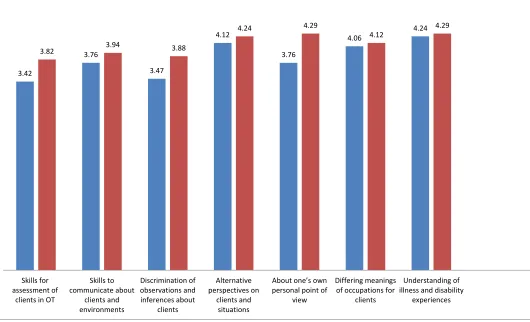
Seventeen students provided answers to the seven prompts about their perceptions of whether visual arts should be used in OT curricula for critical thinking for both pre and postmodules. The students were asked to “select the response that best represents how you feel about whether visual arts should be used in OT curricula to teach (a) skills for assessment of clients in OT; (b) skills to
communicate about clients and environments; (c) discrimination of observations and inferences about clients; and (d) alternative perspectives on clients and situations, about one’s own personal point of
view, differing meanings of occupations for clients, and understanding of illness and disability
experiences.”
The seven questions were placed on a 5-point rating scale ranging from strongly disagree
(1) to strongly agree (5). For the premodule, the overall mean score of the students’ perceptions
about whether visual arts should be used in OT curricula to teach students for critical thinking was 26.8 (standard deviation [SD] = 3.9), while the postmodule mean was 28.6 (SD = 3.4). Although the difference between the premodule and
postmodule responses was small, it is notable that the mean score for Question 5 (about one’s own personal point of view) increased from 3.76 to 4.29
(see Figure 1).
Seventeen students provided answers to the
three questions about their perspectives about whether visual arts should be used in OT curricula for experiences for both pre- and post-art sessions. As summarized in Table 1, the premodule mean score of the students’ perceptions about whether OT class sessions should be used to make and discuss making art was 2.94 (SD = 0.97), while the
postmodule mean was 4.29 (SD = 0.85) (p < 0.05). The mean score on the question about making art for a deeper understanding of creativity, self, and imagination was also significantly increased after completing art sessions (p < 0.05). For the question about whether it makes sense to discuss art in OT coursework, the postmodule mean score of 1.65 was significantly lower than the premodule mean of 2.18 (p < 0.05) (see Table 1). This prompt was stated in the negative, and thus the decrease from pre to postmodule scores reflected a significant increase in
their support for art in their education. In the premodule survey, the students generally agreed or strongly agreed that because few future clients would be artists, art-based education experiences did not make much sense. However, this opinion of the value of arts-based education significantly changed after the module.
6 https://scholarworks.wmich.edu/ojot/vol5/iss4/8
Figure 1. Pre and post-art module score differences on art for critical thinking.
Table 1
Pre- and Post-art Module Score Differences on Art as Experience
Pre-art (N = 17)
Post-art (N = 17)
Differences (N = 17)
Items
Mean (SD)
Mean (SD)
1. OT class sessions should be used to make and discuss making art. 2.94(0.97) 4.29(0.85) 1.3529a 2. OT students should experience making art for a deeper understanding
of creativity, self, and imagination.
3.41(1.06) 4.47(0.51) 1.0588a
3. Because few of my future clients will be artists, it does not make sense to discuss art in OT coursework.
2.18(0.88) 1.65(0.61) -0.5294a
Note: 5-point rating scale ranging from (1) strongly disagree to (5) strongly agree a
p < 0.05
3.42
3.76
3.47
4.12
3.76
4.06
4.24
3.82 3.94 3.88
4.24 4.29
4.12
4.29
Skills for assessment of
clients in OT
Skills to communicate about
clients and environments
Discrimination of observations and inferences about
clients
Alternative perspectives on
clients and situations
About one’s own personal point of
view
Differing meanings of occupations for
clients
Understanding of illness and disability
experiences
Figure 1. Pre- and post- Art Module Score Differences on Art for Critical
Thinking
pre-survey mean scores post-survey mean scores
Qualitative Results in Student Reflections
Five central themes arose in the student reflections: (a) art-based sessions are opportunities to practice perspective shifting, (b) art-based sessions tap into emotion, (c) art-based sessions are exemplars of the therapeutic encounter, (d) art-based sessions are integrative and “out of the box,” and (e) art-based sessions impact student roles and
the classroom environment.
Art-based sessions are opportunities to
practice perspective shifting. Several of the students noted that they initially felt skeptical about the art-based learning sessions. They questioned the relevance of the experiences. One student predicted that the museum visit would merely serve as a reminder to be observant. The students were surprised, however, by how engaging and
memorable the sessions were. Viewing works of art prompted many discussions of how context
influences interpretation. The students appreciated having the time and space to consider the varying contexts in which the art was produced and viewed by its original audiences, and how changing social, historical, and even spiritual climates might impact how an audience received and understood works of art. The students began to question their first impressions and to think more carefully about perception and interpretation. They described
seeing parallels between the way works of art and clients tell stories—with special attention to the importance of looking beyond a client’s body or
physical components and of considering the emotional and spiritual aspects of his or her situation. They acknowledged the significance of perspective shifting to think about how a client
might make sense of his or her experiences in the context of personal history or a life story. One of the students who was initially suspicious of the museum visit later wrote about how valuable she thought it was to reevaluate her thinking, and how she envisioned continuing self-reflective processes as essential components of her future therapy career.
This experience drove home the importance of perspective and communication and
showed me just how difficult it is to create the shared understanding that is so vital to a successful medical team and therapeutic relationship. I think it also made me realize how much detail you can see if you simply take the time to look. For many of the paintings, I thought I had gotten the ‘gist’ of
the painting after a brief minute or two of looking. But being encouraged to look further and spend time with the painting revealed many important details that ended up being central, or at least significant, to the painting’s meaning. I hope I will
remember to take time with my future clients, making certain to pay attention to all the details of the evaluation and treatment process in order to capitalize on details I may have otherwise missed.
This student expressed surprise that there was more to be seen by looking longer, more carefully, or from various vantage points. Many of the students expressed that the art-based learning sessions experientially demonstrated that they could improve their observation skills with training and practice. Several wrote about the museum visit as a
8 https://scholarworks.wmich.edu/ojot/vol5/iss4/8
social experience that highlighted the importance of multiple perspectives and different but also valid interpretations of the same information. Some of the students described frustration that there was no ultimate authority figure and no single answer, and that the artists were not present to answer questions. As one wrote, it caused the students to pause and consider how a medical team communicates and
shares information in the effort to create a shared understanding in a clinical context. The students
explained that learning in a social context was valuable and allowed them to reflect on the different life histories and perspectives that their peers
brought to the conversation.
The students also reflected on how their own assumptions and knowledge base impacted their interpretive processes. Viewing or making art in a group with their peers allowed the students to see the range of reactions the class had to the same piece. Some of the students were less familiar with representations of famous people or religious iconography and were surprised when other students interpreted those pieces more readily. Other students pointed out things that they had not previously been able to see.
As I move forward from this unit, I feel even more strongly that humility is one of the most important qualities in an effective
occupational therapist. Having the self-awareness to understand our own tendencies to want to quickly arrive a ‘big picture’ and
to create our own stories, allows us to know when to humbly step back from our
narrative creation and listen to others, allowing their story to unfold.
The students acknowledged that in their future OT careers they would end up facing
unknowns; they commented that taking the time to learn more about a client’s story and history would
enhance their understanding of a clinical situation. One student wrote about the process of stepping back and taking a reflective pause to consider the co-constructive nature of therapeutic relationships.
In general, they reflected that therapists should be as skillful in listening as in instructing. A therapist
who can listen to alternative narratives is able to collaborate with, rather than attempt to dictate on, a client’s trajectory.
Art-based sessions tap into emotion. The students felt that the art-based learning sessions were accessible in different ways than the standard lecture or discussion-based class sessions.
The inclusion of art highlighted a way to understand some things that cannot be put into words. Both creating art and perceiving others’ art can be a highly emotional and
evocative process, sometimes conjuring feelings that are subconscious or too complex to organize into verbal form. Emotions that are overwhelming or difficult to articulate can be transferred to a picture, colors, or shapes.
This student explained how the process of
viewing and making art tapped into a level of emotion and creativity that is often challenging to access consciously. Many students wrote about the arts’ ability to communicate through visual rather
than verbal means, sometimes allowing entry into difficult or uncomfortable topics.
Art-based sessions are exemplars of the
therapeutic encounter. The students related the art-making sessions to the concept of a therapeutic encounter, in which the guest artist facilitated the students’ experiences of doing.
It was really important to also grasp the role of the facilitator in the art sessions. Had the facilitator been less passionate or simply
bland, the activities would have been equally bland. The words chosen and even
things like tone and pace led to a productive and useful session.
The students felt these sessions helped them develop a better understanding of OTs as facilitators of therapy sessions. The students said they learned key components for successful OT interventions by experiencing how the guest artist facilitators
presented the art-making activities and the safe space that they created for the students to
experience experimentation, trial, and error. As one student commented:
They had a way of leading their sessions that made art accessible to everyone. By
emphasizing the process and being comfortable with varied outcomes, [the guest artists] facilitated successful and inspiring sessions.
The students thought that the art facilitation
helped model the therapeutic process, and that the art activities themselves were meaningful tools they would keep in mind for possible interventions. They felt they gained a better appreciation for the importance of creating physical and emotional space for clients to express their feelings and experiences. Many of the students wrote that they
had gained increased confidence about their future roles as OT practitioners to create these spaces.
Art-based sessions promote learning that
is “out of the box” and integrative. The art-based learning sessions helped students think about integrating different, sometimes unexpected, types of knowledge and information, taking students “out of the box,” a term they used in their reflections. As
one student explained:
I experience the world more intuitively than
intellectually. In spite of that, I initially undervalued the strengths in that type of understanding. [This module] has helped me to see the importance of unquantifiable information that doesn’t fit neatly in a box.
The art-based learning also helped the students develop comfort with OT as a discipline that, in some views, operates “out of the box” by validating their perspective of OT as holistic, humanistic, and able to bridge medical science and lived experience. The students wrote about developing a better sense of what was distinctive about the OT field, as well as what connects it with other disciplines. The students expressed excitement at more clearly seeing parallels between the arts and humanities and developing a more nuanced appreciation of the complexity of the human experience. Viewing art, they wrote, made them think about topics such as
body language and power structures and how they can envision applying this type of information into their approach to working with future clients.
I was also not expecting the way in which the narratives, the art experiences, the more academic and theoretical talks, and the poetry would work together to create a
10 https://scholarworks.wmich.edu/ojot/vol5/iss4/8
unified academic experience for me as a student. I am more used to academic experiences that do not embrace
subjectivity, and may even claim objectivity. I am used to embracing the
phenomenological experience as more worthy of study and contemplation in my personal life. I enjoyed embracing
subjectivity and the necessity of
understanding different phenomenological
experiences in an academic setting, and placing those understandings alongside biological or medical explanations as different and equally valuable ways of knowing and thinking—not just feeling. This more complicated way of knowing and thinking rings true and necessary for me in light of my understanding of what it means to be a competent professional in a human services field.
As this student described, viewing illness and disability as lived experiences helped him or her to contextualize a biomedical understanding. The students felt that the art-based learning reinforced their own ideas of the importance of understanding humans as feeling beings, offsetting the potential of biomedical perspectives to minimize emotional experience in favor of other forms of
data. The students articulated the need to seek balance between art and science, between biomedical and phenomenological sources of information, and between client and therapist knowledge.
The themes noted above were surprisingly consistent in the students’ reflective essays.
Although a few students acknowledged that not all clients might desire to participate in art-based occupations as therapeutic intervention, none of the students felt that art-based learning sessions had been unhelpful to their education. A few of the students commented that they had begun to incorporate more art-making into their own daily lives. The students felt the sessions were a valuable
part of the course and should be continued. Art-based sessions affect student roles
and the classroom environment. The students discussed the art activities’ effect on the classroom
environment. Some of the students relaxed in new ways and become absorbed in the process of creating art, which in turn allowed them to listen and respond to one another in new ways.
The process of creating space through art was very meaningful to me because of the different perspective it gave me on the artistic process. During the class sessions, I allowed myself to just enjoy the experience of creating. I liked watching the clay walls become smooth and even under my hands, and I enjoyed listening to the discussion take place. It gave me space to think about the classroom in a much different way than I typically do. As I listened to my classmates discuss what it meant [to] them, I viewed
them not just as classmates but as people with their own histories. We were
collectively in a process of discovery, not just about ourselves but about each other. It was a place set apart and it allowed space to simply enjoy the process of learning.
The students noted appreciatively one effect of having their hands occupied: They were able to engage with one another without being expected to make eye contact or to display full attention through other typical behaviors. A student said he often finds sitting through classes somewhat tedious, but found himself better able to attend to the class discussion as he moved and manipulated materials.
Another student mentioned that the hands-on work with materials increased her confidence when
handling materials while she went on a Level I fieldwork mid-semester and assisted with bandaging, compression garments, and making splints.
The students also noted the interactive, hands-on nature of the art-based learning sessions. Learning about concepts experientially, they said, felt different and augmented how they tended to think about ideas abstractly. They appreciated the novelty and fun of the sessions and felt that they represented some of the most memorable moments in the course. Overwhelmingly the students wrote about how valuable they found the art-based sessions and how much they contributed to their learning. Again, they favored continuing the art-based learning sessions in future classes as a natural complement to other forms of learning in the
curriculum.
Discussion
The integrated quantitative and qualitative findings of this study support the use of art-based pedagogies to complement coursework. The aim of the quantitative component was to examine the change in the students’ perceptions of art in OT learning experiences before and after a three-session
art-based educational intervention. It was hypothesized that the students’ perceptions
regarding the benefits of art in OT education would improve after intervention. Indeed, on the survey, a significant change was found in the students’ perceptions of art-based class sessions as positive experiences.
The favorable responses from the students
about the value of arts in OT education are supported in theoretical and anecdotal literature
about art in OT education (Peloquin, 1996b). This result supported our quantitative hypothesis, and the qualitative analysis of the reflective essays
strengthened this finding about the value of arts in OT education. Analysis of the student essays, which comprised the qualitative arm of this study, revealed what they learned from the art-based module. In particular, the qualitative portion of this study explored: What can students’ reflections from three sessions of art-based learning tell us about art in OT education?
The students’ reflective essays conveyed that the art-based education (a) was an important opportunity to practice perspective shifting, (b) tapped into emotions, (c) exemplified the
therapeutic encounter, (d) promoted learning that is “out of the box” and integrative, and (e) impacted
student roles and the classroom environment.
Our findings align with literature about these themes of art-based learning in health professions. Art-based learning in health professions has been used to generate an understanding of differing perspectives(Casey, 2009; Cassel, 1976; Fraser & al Sayah, 2011; Gaufberg & Batalden, 2007; MacDonnell &
12 https://scholarworks.wmich.edu/ojot/vol5/iss4/8
Macdonald, 2012; Naghshineh et al., 2008;
Peloquin, 1996a). The ability to shift perspectives is a fundamental skill that underpins OT principles of client-centered services. In a landmark study of OT clinical reasoning, Mattingly and Fleming (1994) wrote: “The meaning that the patient makes of an illness enters directly into the therapeutic process. The therapists thus find themselves constantly
confronted with the interpretive task of translating between their way of seeing and the patient’s” (p.
75). In delivery of care to people with complex occupational needs, there are typically multiple perspectives to be understood and incorporated into intervention, including those of family members and caregivers (Lawlor, 2003; Mattingly, 2010). The student essays revealed they experienced and they valued having practice with perceiving, shifting, and even adopting multiple perspectives.
That students described art as tapping into emotions was expected given the types of
discussions during the art-based sessions. It may go without saying that art is a form of expression that can fill a void in our ability to use words to
communicate feelings, experiences, and connections to each other. John Dewey, in his book, Art and Experience, posited “works of art are the only media of complete and unhindered communication between man and man that can occur in a world full
of gulfs and walls that limit community of experience” (Dewey, 1934/2005). Art-based
methods have been described as safe ways to access and discuss complex emotions for medical students by putting the focus on “the third thing,” the art
object, rather than oneself (Gaufberg & Batalden, 2007). Quite possibly the use of art gave
permission to pay attention to and consider aspects of human experience that are not language based. Peloquin (1996b) argued for “art to enhance confluent learning,” integrating affective and cognitive experience because students who “ready themselves for any humanistic practice must learn to understand—that is, to think about and feel themselves into—the experiences of others” (p.
148). The students’ access to their own emotions during the art experiences in our study may relate to
the literature supporting the use of art to build empathy in health care provider education (Casey, 2009; Cassel, 1976; Charon, 2010; Fraser & al Sayah, 2011; Gaufberg & Williams, 2011; George, Yang, Stuckey, & Whitehead, 2012; Peloquin, 1996a; Perry et al., 2011; Roberts & Noble, 2015; Schaff et al., 2011).
The students reflected on their art-based experiences as instructive as exemplars for therapy sessions they will conduct in the future. Likely, the students enjoyed and felt well facilitated in the art-based experience, and therefore they wished to be able to replicate key features that they themselves found particularly therapeutic. We acknowledge that the favorable comments by the students may have been based also on the teaching skills of the museum educator, former occupational therapist, and chaplain who had honed their skills over past
sessions of teaching. While the students
appreciated the facilitation, they conveyed that there is something inherent in the art-based learning beyond how well the activities were facilitated. Although the study did not focus on teaching
students to use art therapeutically with clients, some
students expressed increased interest in the use of art as a therapeutic occupation in practice.
The arts-based learning experience that they described as “out of the box” appeared to affirm the students’ desires to relate their beliefs about
themselves as whole people into their views of their clients. The students may have already been
acculturated to delegitimize subjective and affective
aspects of human experience, or be discreet about divulging their significance, a behavior coined as
the “underground practice” (Mattingly & Fleming, 1994). Art-based learning seemed to give them permission to think about both the heart and the mind of practice, and to realize therapists can actually integrate biomedical and phenomenological ways of knowing (Turpin, 2007). Moreover, for some, the art-based unit kindled passions about becoming occupational therapists who can engage with clients through profound experiences and extreme challenges. It endorsed the use of creative thinking to assist clients to overcome occupational challenges.
Art-based learning created a classroom environment in which the students were able to engage in ways that facilitated their learning. The students favorably viewed the pedagogy of active learning that incorporated physical engagement with materials, walks through museum spaces,
engaged inquiry, peer learning, affective and intellectual integration, and reflection on learning. In progressive education pedagogy, these are conditions that optimize learning (Dewey, 1938). Active and relational approaches to learning also align with pedagogies described as germane to OT (Schaber et al., 2012).
The students reported that art-based learning experiences offered accessible and valued
opportunities to develop their abilities to understand others’ perspectives, access emotions, think
creatively, and bridge ways of knowing. This perspective contrasts with the decline in the profession’s identity as an art and as a science and
its use of art in practice and education. At the end
of the module, the students expressed a view of art-making as a useful therapeutic tool that has a place
in OT education and practice. Their comments aligned with OT scholars who have endorsed art-based learning but have not yet influenced current definitions of practice and education standards. The qualitative findings support use of active learning, inquiry, and social processes that are central principles of Deweyan pedagogy that has been applied in OT education (Coppola, 2013; Dewey, 1938).
Taken together, the qualitative and
quantitative findings collectively affirm the notion that art-viewing and art-making activities served as a useful and valuable pedagogical method for building the clinical reasoning skills of first-year OT students. The statistical analysis serves as additional triangulation of the qualitative findings, and the qualitative findings helped to deepen our understanding of the survey results. The benefit of
a mixed-methods approach in this context was that the students completed brief pre and posttests that enabled them to quickly self-assess changes in their learning, as well as provide useful feedback to the course instructors. The reflective essay assignment was already built into the syllabus. Securing permission to analyze the written reflections
14 https://scholarworks.wmich.edu/ojot/vol5/iss4/8
allowed the researchers to further develop their understanding of how and why the unit was meaningful.
OT education programs may consider the benefits of learning partnerships with art museums. These partnerships align with trends in which universities are seeking to build interdisciplinary experiences for engaging arts, humanities, and
health professions. At the same time, museums are developing creative programming to serve
communities and students. This confluence of interests poses opportunities to investigate the nature and effects of these educational experiences. Our students’ responses and our interdisciplinary
collaborative learning through this research project reveal potential for such partnerships to grow to benefit students, faculty, clients, and communities.
It was the intent of this study to contribute to education research about using art in OT education, rather than to teach students to use art as therapeutic occupations. It is beyond the scope of this study to explore whether students’ experiences of art
influence their use of art in interventions for future clients. The main implication of this pilot study was to inform future research about art-based educational methods. To our knowledge, a study of this kind has not been previously undertaken. The favorable responses of the students who responded
to the surveys and submitted their essay for analysis indicate that art-based OT education may be worthy of future larger studies of art in OT education. Limitations
This study used a small sample size of 20 OT students in an educational program in the southeastern United States. Seventeen students
completed the anonymous pre and postexperience surveys, and 15 of those completed the narrative questions at the end of the postexperience survey. The reasons for not completing surveys are
unknown and may have biased results toward favorable views of the art-based experience. The students may have felt the need to write favorably about the experience as part of a course assignment,
despite the fact that the essay was ungraded. The design did not allow us to distinguish the key
aspects of the intervention that most impacted student learning. Although conclusions are limited by the small sample size and some environmental and specific personal factors, such as cultural background, this pilot study contributes to our understanding of art as a useful therapeutic tool in OT education.
Future Study
Further studies are needed to confirm and expand the present findings for other contexts, on a larger scale, and potentially with multiple sites and various forms of art. Those studies could identify key ingredients of the experience, the optimal amount of time in the module, and which students appear to benefit most from these experiences. In other studies of this nature, there will be variations in the learning experience provided by local artists and art educators. Our central finding is that
art-based experiences are feasible and important aspects of pedagogy for preparing occupational therapists. For OT to fully embrace its ethos as an art and as a science, the profession needs to
continue to investigate and advance pedagogies that help students learn the art of practice.
Susan Coppola, MS, OTR/L, BCG, FAOTA; Division of Occupational Science and Occupational Therapy, University of North Carolina at Chapel Hill
Carolyn Allmendinger, PhD; Ackland Art Museum, University of North Carolina at Chapel Hill
Wanqing Zhang, PhD; Department of Allied Health Sciences, University of North Carolina at Chapel Hill
Adrienne Miao, MS, OTR/L; Division of Occupational Science and Occupational Therapy, University of North Carolina at Chapel Hill
References
Art. (n.d.). In Merriam-Webster’s online dictionary. Retrieved from
http://www.merriam-webster.com/dictionary/art Bathje, M. (2012). Art in occupational therapy: An
introduction to occupation and the artist. The Open Journal of Occupational Therapy, 1(1), Article 8. http://dx.doi.org/10.15453/2168-6408.1034 Braun, V., & Clarke, V. (2006). Using thematic analysis in
psychology. Qualitative Research in Psychology,
3(2), 77-101.
http://dx.doi.org/10.1191/1478088706qp063oa Camic, P. M., Tischler, V., & Pearman, C. H. (2014). Viewing
and making art together: A multi-session art-gallery-based intervention for people with dementia and their carers. Aging & Mental Health, 18(2), 161-168. http://dx.doi.org/10.1080/13607863.2013.818101 Casey, B. (2009). Arts-based inquiry in nursing education.
Contemporary Nurse, 32(1-2), 69-82. http://dx.doi.org/10.5172/conu.32.1-2.69
Cassel, E. J. (1976). The healer's art: A new approach to the doctor-patient relationship. New York, NY: Lippincott.
Charon, R. (2010). Commentary: Calculating the contributions of humanities to medical practice-motives, methods, and metrics. Academic Medicine: Journal of the Association of American Medical Colleges, 85(6), 935-937.
http://dx.doi.org/10.1097/ACM.0b013e3181dc1ead Cohen, G. D., Perlstein, S., Chapline, J., Kelly, J., Firth, K.
M., & Simmens, S. (2006). The impact of professionally conducted cultural programs on the physical health, mental health, and social functioning of older adults. The Gerontologist, 46(6), 726-734. Retrieved from
http://www.ncbi.nlm.nih.gov/pubmed/17169928 Coppola, S. (2013). Deweyan educational philosophy in
occupation-centered curricula. In M. Cutchin, & V. A. Dickie (Eds.), Transactional perspectives on
occupation (pp. 199-213). Dordrecht, Netherlands: Springer.
Dewey, J. (1938). Education and experience. New York: Macmillan.
Dewey, J. (2005). Art as experience. London: Penguin (Original work published 1934).
Fraser, K. D., & al Sayah, F. (2011). Arts-based methods in health research: A systematic review of the literature.
Arts & Health, 3(2), 110-145.
http://dx.doi.org/10.1080/17533015.2011.561357 Gaufberg, E., & Batalden, M. (2007). The third thing in
medical education. The Clinical Teacher, 4(2), 78-81.
http://dx.doi.org/ 10.1111/j.1743-498X.2007.00151.x
Gaufberg, E., & Williams, R. (2011). Reflection in a museum setting: The personal responses tour. Journal of Graduate Medical Education, 3(4), 546-549. http://dx.doi.org/10.4300/JGME-D-11-00036.1 George, D. R., Yang, C., Stuckey, H. L., & Whitehead, M. M.
(2012). Evaluating an arts-based intervention to improve medical student attitudes toward persons with dementia using the dementia attitudes scale.
Journal of the American Geriatrics Society, 60(8), 1583-1585 http://dx.doi.org/10.1111/j.1532-5415.2012.04070.x
Hammer, R. R., Rian, J. D., Gregory, J. K., Bostwick, J. M., Barrett Birk, C., Chalfant, L., . . . Hall-Flavin, D. K. (2011). Telling the patient’s story: Using theatre training to improve case presentation skills. Medical Humanities, 37(1), 18-22.
http://dx.doi.org/10.1136/jmh.2010.006429 Harris, E. (2007). The meanings of craft to an occupational
therapist. Australian Occupational Therapy Journal,
55(2), 133-142. http://dx.doi.org/10.1111/j.1440-1630.2007.00700.x
Hojat, M., Vergare, M. J., Maxwell, K., Brainard, G., Herrine, S. K., Isenberg, G. A., . . . Gonnella, J. S. (2009). The devil is in the third year: A longitudinal study of erosion of empathy in medical school. Academic Medicine: Journal of the Association of American Medical Colleges, 84(9), 1182-1191.
http://dx.doi.org/10.1097/ACM.0b013e3181b17e55 Hooper, B. (2008). Stories we teach by: Intersections among
faculty biography, student formation, and instructional processes. American Journal of Occupational Therapy, 62(2), 228-241. http://dx.doi.org/10.5014/ajot.62.2.228 Hooper, B., King, R., Wood, W., Bilics, A., & Gupta, J.
(2013). An international systematic mapping review of educational approaches and teaching methods in occupational therapy. The British Journal of Occupational Therapy, 76(1), 9-22.
http://dx.doi.org/10.4276/030802213X135764692546 12
16 https://scholarworks.wmich.edu/ojot/vol5/iss4/8
Lawlor, M. C. (2003). Gazing anew: The shift from a clinical gaze to an ethnographic lens. American Journal of Occupational Therapy, 57(1), 29-39.
http://dx.doi.org/10.5014/ajot.57.1.29
Levine, R. E. (1987). The influence of the arts-and-crafts movement on the professional status of occupational therapy. American Journal of Occupational Therapy,
41(4), 248-254.
http://dx.doi.org/10.5014/ajot.41.4.248
MacDonnell, J. A., & Macdonald, G. J. (2012). Arts-based critical inquiry in nursing and interdisciplinary professional education: Guided imagery, images, narratives, and poetry. Journal of Transformative Education, 9(4), 203-221.
http://dx.doi.org/10.1177/1541344612441083 Mattingly, C. (2010). The paradox of hope: Journeys through
a clinical borderland. Berkeley: University of California Press.
Mattingly, C., & Fleming, M. H. (1994). Clinical reasoning: Forms of inquiry in a therapeutic practice.
Philadelphia, PA: F. A. Davis Press.
Naghshineh, S., Hafler, J. P., Miller, A. R., Blanco, M. A., Lipsitz, S. R., Dubroff, R. P., . . . Katz, J. T. (2008). Formal art observation training improves medical students’ visual diagnostic skills. Journal of General Internal Medicine, 23(7), 991-997.
http://dx.doi.org/10.1007/s11606-008-0667-0 Ousager, J., & Johannessen, H. (2010). Humanities in
undergraduate medical education: A literature review. Academic Medicine: Journal of the Association of American Medical Colleges, 85(6), 988-998.
http://dx.doi.org/10.1097/acm.0b013e3181dd226b Peloquin, S. M. (1989). Sustaining the art of practice in
occupational therapy. American Journal of Occupational Therapy, 43(4), 219-226. http://dx.doi.org/10.5014/ajot.43.4.219
Peloquin, S. M. (1996a). Art: An occupation with promise for developing empathy. American Journal of
Occupational Therapy, 50(8), 655-661. http://dx.doi.org/10.5014/ajot.50.8.655
Peloquin, S. M. (1996b). Using the arts to enhance confluent learning. American Journal of Occupational Therapy,
50(2), 148-151.
http://dx.doi.org/10.5014/ajot.50.2.148 Perruzza, N., & Kinsella, E. A. (2010). Creative arts
occupations in therapeutic practice: A review of the literature. British Journal of Occupational Therapy,
73(6), 261-268.
http://dx.doi.org/10.4276/030802210x127599254689 43
Perry, M., Maffulli, N., Willson, S., & Morrissey, D. (2011). The effectiveness of arts‐based interventions in medical education: A literature review. Medical
Education, 45(2), 141-148.
http://dx.doi.org/10.1111/j.1365-2923.2010.03848.x Quiroga, V. A. M. (1995). Occupational therapy: The first 30
years 1900 to 1930. Bethesda, MD: American Occupational Therapy Association
Reilly, M. (1962). Occupational therapy can be one of the great ideas of 20th century medicine. Eleanor Clarke Slagle Lecture. American Journal of Occupational Therapy, 16(1), 87-105. Retrieved from
https://reillym.wikispaces.com/file/view/maryreillysl agel.pdf
Roberts, H. J., & Noble, J. M. (2015). Education research: Changing medical student perceptions of dementia: An arts-centered experience. Neurology, 85(8), 739-741.
http://dx.doi.org/10.1212/WNL.0000000000001867 Rogers, J. C. (1983). Clinical reasoning: The ethics, science,
and art. Eleanor Clarke Slagle Lecture. American Journal of Occupational Therapy, 37(9), 601-616. http://dx.doi.org/10.5014/ajot.37.9.601
Saldaña, J. (2015). The coding manual for qualitative researchers. Thousand Oaks, CA: Sage. Schaber, P. (2014). Keynote address: Searching for and
identifying signature pedagogies in occupational therapy education. American Journal of
Occupational Therapy, 68(Suppl 2), S40-S44. http://dx.doi.org/10.5014/ajot.2014.685s08 Schaber, P., Marsh, L., & Wilcox, K. J. (2012). Relational
learning and active engagement in occupational therapy professional education.In N. L. Chick, A. Haynie, R. A. R. Gurung (Eds.), Exploring more signature pedagogies: Approaches to teaching and disciplinary habits of mind (pp. 188-202). Sterling, VA: Stylus Publishing.
Schaff, P. B., Isken, S., & Tager, R. M. (2011). From contemporary art to core clinical skills: Observation, interpretation, and meaning-making in a complex environment. Academic Medicine: Journal of the Association of American Medical Colleges, 86(10), 1272-1276.
http://dx.doi.org/10.1097/ACM.0b013e31822c161d Schön, D. A. (1983). The reflective practitioner: How
professionals think in action. New York: Basic Books.
Shannon, P. D. (1977). The derailment of occupational therapy. American Journal of Occupational Therapy,
31(4), 229-234. Retrieved from
https://www.researchgate.net/publication/22814207_ The_derailment_of_occupational_therapy
Smith, S., Molineux, M., Rowe, N., & Larkinson, L. (2006). Integrating medical humanities into physiotherapy and occupational therapy education. International Journal of Therapy and Rehabilitation, 13(9), 421-427. http://dx.doi.org/10.12968/ijtr.2006.13.9.21787
Turpin, M. (2007). Recovery of our phenomenological knowledge in occupational therapy. The American Journal of Occupational Therapy, 61(4), 469-473. http://dx.doi.org/10.5014/ajot.61.4.469
Wood, W. (1995). Weaving the warp and weft of occupational therapy: An art and science for all times. American Journal of Occupational Therapy, 49(1), 44-52. http://dx.doi.org/10.5014/ajot.49.1.44
Wood, W. (1996). Legitimizing occupational therapy’s knowledge. American Journal of Occupational Therapy, 50(8), 626-634.
http://dx.doi.org/10.5014/ajot.50.8.626 Wood, W. (2004). The heart, mind, and soul of
professionalism in occupational therapy. American Journal of Occupational Therapy, 58(3), 249-57. http://dx.doi.org/10.5014/ajot.58.3.249
Yerxa, E. J., & Sharrott, G. (1986). Liberal arts: The foundation for occupational therapy education.
American Journal of Occupational Therapy, 40(3), 153-159. http://dx.doi.org/10.5014/ajot.40.3.153 Zemke, R. (2004). Time, space, and the kaleidoscopes of
occupation. American Journal of Occupational Therapy, 58(6), 608-620.
http://dx.doi.org/10.5014/ajot.58.6.608
18 https://scholarworks.wmich.edu/ojot/vol5/iss4/8