Wireless Intelligent Ark
Siddharth Mody Kunal Mittal
Student Student
D.J. Sanghvi College of Engineering D.J. Sanghvi College of Engineering
Bansari Mehta Sunil Karamchandani
Student Assistant Professor
D.J. Sanghvi College of Engineering D.J. Sanghvi College of Engineering
Abstract
The proposed Wireless Intelligent Ark, a robotic arm mechanism aims to provide innovative services relating to different aquatic problems by cleaning of the solid refuse. The development of this ark also furnishes the idea of measuring various parameters like decline in pH value of water, temperature changes, salinity and chlorine level. With all this it achieves collision avoidance resulting into a better informed, safer and more co-ordinate device while maneuvering thereby making it a smarter transport network.
Keywords: Servo Mechanism, Video Streaming, Lidar, Humidity, Salinity,Temperature
_________________________________________________________________________________________________________
I.
I
NTRODUCTIONThe core objective of this project is to develop a wireless system for a number of applications like surveillance, access areas like narrow tunnels, blocked pipelines, mines and enemy zones, cargo handling applications, for military and intelligence use and for exploration and research purposes without risking a life by the use of technology in a feasible and cost effective way. Watercraft is one such evolving technology involving a wireless communication for better results and efficiency. It uses Wi-Fi 802.11G standard for its control signals through TCP/IP protocol, which has flow control. This enables uninterrupted and reliable transmission of control signal to the Watercraft. Wi-Fi support high data rates which enables good quality uninterrupted video transmission from the watercraft to the computer. Camera rotation is done by mounting an IP-camera over a geared motor controlled through a bridge circuit.
II.
P
ROPOSED SYSTEM DESIGNAnalyzing all current scenarios our paper focuses on an intelligent watercraft which is wirelessly controllable via any laptop. It transmits live video wirelessly to the controlling laptop, it can tidy up the water surface which comes in its path way and can also provide optical display of the various parameters of water by employing a sensing technology. It uses Wi-Fi 802.11G standard for its control signals through TCP/IP protocol, which has flow control. This enables uninterrupted and reliable transmission of control signal to the watercraft (Thunder ARK). Camera used for surveillance is an IP-camera, mounted on top over a geared motor, controlled through a bridge circuit [5].
This ark can thus collect and clean up the entire area employing less time and in a sagacious way.
Server Development A.
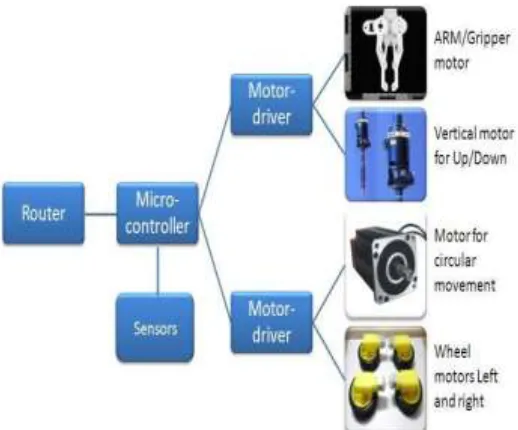
The server development means that router needs to be used as a server which handles the wireless signals transmitted to it from a computer. For this purpose a code in C is written in correspondence to the GUI coded values into the router. This C code is converted into an installable format for router (Linux based format .ipkg) [2]. Router working as a server will continuously receive signal stream and when it receives a control command it communicates with the microcontroller.
Computer Interface B.
The computer interface is designed in Visual Basic 6.0. It uses TCP/IP communication to transmit control signals to the router. UDP is not implemented because it doesn’t have a flow control and also that TCP is a standard protocol for Wi-Fi. VB has a built-in component or an ActiveX called Winsock which enables communicate through LAN using TCP/IP protocol.
Controller C.
As for reliability purposes a 3.3 V coming from router is converted to 12 V which needs to be converted back, so max232 is used with the microcontroller and a male DB9 connector is also added.
Video Streaming Function D.
Video streaming is a function which enables controlling of this watercraft from far distant places possible. For this an IP camera is employed using the same Wi-Fi link between the computer and the router (present on the boat). This camera also enables the user to monitor the video even on internet.
Fig.1: Concept Structure
The camera is fastened by its configuration, whereas body of the camera is removed as it is to be rotated also [4]. Table 1. IP Sensor Specifications
Video
MJPEG Compression Format
JPEG for Still Image supported
Remote management Web based
Connectivity Wired (10/100 fast
Ethernet)
IPv4, TCP, UDP, DHCP
Networking protocols client, DNS client,
HTTP, FTP
The biggest advantage of using a camera is to avoid the usage of high-end ultra-sonic sensors for collision avoidance thereby making this project less complicated and sumptuous
III.
R
OBOTIC ARM DESIGNThe servo control robotic arm was developed and designed in the research and development laboratory of D.J. Sanghvi College of Engineering. One gantry and one end effector motor is used. Gantry motor provides vertical and horizontal axis motion whereas end effector is used to pick and place the refuse. The arm is fabricated using sheet metal which is coated with a primer to avoid corrosion of metal. The end effector uses a hardened rubber surface to provide proper grip for picking of any type of refuse, such as, plastic bags, thermocol, flowers, garlands and other type of floating garbage.
Figure 2: Schematic of Robotic Arm
Microcontroller A.
PORT 0 (P0.0-P0.7) of the micro controller is connected to the motor driver circuit while PORT 3 (P3.0-P3.3) is connected to four sensors for parameter measurement. Pin no. 9 is RESET pin, which is connected to the reset circuit. Pin no. 9 and 10 of ADC are serial data line (SDA) and serial clock line (SCL) respectively. Both are connected to a positive supply through a pull-up resistor. These pins are connected to the P1.6 & P1.7 of the micro controller.
Driver circuit B.
The L293 and L293D are quadruple high-current drivers. The L293 is designed to provide bidirectional drive currents of up to 1A at voltages from 4.5 V to 36 V. The L293D is designed to provide bidirectional drive currents of up to 600mA at voltages from 4.5 V to 36 V. Both devices are designed to drive inductive loads such as relays, solenoids, dc and bipolar stepping motors, as well as other high-current/high-voltage loads in positive supply applications. All inputs are TTL compatible. Each output is a complete totem pole drive circuit, with a darlington transistor sink and a pseudo-darlington source. Drivers are enabled in pairs. When the enable input is high, the associated driver is enabled and the corresponding output is active and in phase with the input. When the enable input is low, those drivers are disabled and their outputs are off and in the high-impedance state. With the proper data inputs, each pair of drivers forms a full-H (or bridge) reversible drive suitable for solenoid or motor applications. A Vcc1 terminal, separate from Vcc2, is provided for the logic inputs to minimize device power dissipation.
IV.
O
PERATIONThe operation of the intelligent ark is a mechatronic design where a servo mechanism deploys an ambidextrous arm which is wirelessly controlled using control signals from the microcontroller.
Servo Mechanism A.
The main purpose of this watercraft is the working of a robot-arm system for carrying out pliable pick and place behaviour using visual perception for cleaning of solid refuse. Object manipulation from visual data involves determining the pose of the object with respect to the manipulator [1].
Mechanical Design 1)
This pick and place mechanism has two main mechanical components (a) Robotic arm and end-effectors.
(b) Gantry for moving the arm. The working of the arm is as follows:
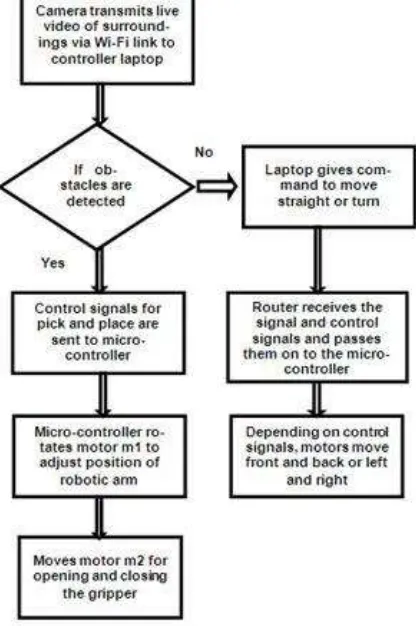
(a) Initially arm is at the rest position, i.e. state when no object is placed. As soon as object is seen using the camera it is placed at the picking platform by the signal sent to the microcontroller via router using a laptop.
(b) For this operation two motors are used gantry motor (M1) and that for end effecter (M2) [3].
(d) As it reaches there, M1 stops and now motor M2 is started in say clockwise direction to hold the object by closing jaw. This motor also, is on for particular fixed time instant.
(e) As M2 gets off, motor M1 is moved again in opposite (here anticlockwise) direction till the time it reaches the placing platform.
(f) As it reaches placing platform, the motor M1 stops and M2 is switched ON in opposite (here anticlockwise) direction till it exempts object properly on desired place.
(g)
If after this no object is detected, the arm is in rest position. Otherwise if another object is detected, the algorithm is repeated from c [6].Figure 3: Flow Chart for control of Robotic Arm
Secondary Operation B.
Along with the cleaning of water the use of sensors at the hull of the watercraft provides few additional features as follows:
LIDARS 1)
The power of the back scattered light that is received by the telescopes on the ground is measured as (1).
where, K - system constant, G(R) - range-dependent measurement geometry, β(R) - back scatter coefficient, T(R) - transmission term.
a) Bathymetric LIDAR –
This LIDAR, which is used forbathymetric studies, generates a blue-green signal and a infrared signal concurrently. The near-infrared signal does not penetrate the water and is directly reflected by the sea surface and recorded by the sensor. The blue-green signal, in contrast, penetrates the water, is reflected by the bottom and reaches the sensor at a later time. The difference in time is a direct function of the water depth [7].
b) Fluorescence LIDAR-
This LIDAR records the emittedfluorescent light induced by the interaction of the LIDAR transmitted blue- green light with the target. The fluorescence of the target is often unique and therefore provides a means of recognition. This instrument has been used to distinguish and quantify chlorophyll in water and also to identify and measure the thickness of marine oil slicks [7].
Salinity detection 2)
The measurement of salinity from remotely sensed data is obtained with the use of microwave sensors to an accuracy of one part per thousand. The microwave properties of the sea surface are a function of its physical and chemical state. The emissivity of sea water is dependent on salinity. Changes in salinity cause significant changes in the emissive brightness temperature of water for frequencies less than 5 GHz. Hence the salinity of sea water can be determined remotely by measuring accurately the emissive brightness temperature. The precision afforded by this technique may be adequate for mapping the spread of fresh water at a river mouth or for studying estuaries and near shore waters [7].
V.
P
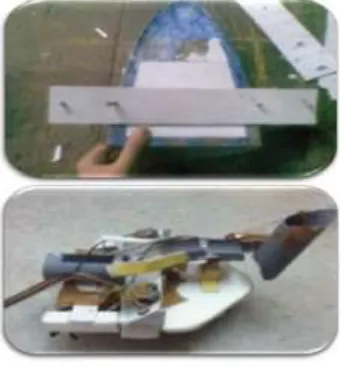
ROTOTYPE AND FEATURESThe fabrication and the design of the robotic arm was implemented at the research and development laboratory of D.J. Sanghvi College of Engineering
Figure 5: Prototype
Wi-Fi link (802.11G).
GUI designed in visual basic 6.0
360 degree Rotating IP Camera for capturing 3-Dimentional view.
Increasable range proportional to access pointsVI.
A
PPLICATION AND FUTURE ENHANCEMENTSAccess points A.
By the use of access points the range of this boat can be increased up to any desired level proportional to the access point and this will make it a very suitable choice for the purpose of research and exploration.
DS-5X Multi parameter water quality sensor B.
By the use of this single sensor, we can measure in total 10 parameters simultaneously as follows:
Temperature, depth, conductivity, salinity, total dissolved gases, dissolved oxygen, pH value, chlorophyll content, presence of blue green algae, ammonium chloride content etc.
VII.
C
ONCLUSIONThus the ark proves to be an excellent and cost efficient solution for the various activities like waste disposal for water bodies as well as to explore unreachable and dangerous destinations for research and development purpose. More often researchers, explorers, soldiers and other people come across places which cannot be accessed due to our physical limitations or unknown conditions. Therefore a watercraft which can be controlled wirelessly along with various supporting features can provide a good level of accessibility in risk involving areas.
R
EFERENCES[1] Rong-Jyue Wang, Jun-Wei Zhang, Jia-Ming Xu, Hsin-Yu
Liu, “The multiple-function intelligent robotic arms”, pp. 1995 – 2000, 20-24 Aug. 2009.
[2] N.I. Sarkar, Scholar of Computer & Information Science,Craig T.M, “Wireless communication and networking fundamentals using Wi-Fi projects” Auckland University of Technology, New Zealand, Vol. 49, pp. 98-104, Feb. 2006.
[3] A.J. Sbnchez, University Politecnica de Valencia Martinez, J.M. “Robot-arm pick and place behavior programming system using visual perception.” Conference Publications, vol 4, pp. 507 – 510.
[4] V. Lippiello, B. Siciliano, Villani, “Robust visual tracking using a fixed multi-camera system”, vol. 3, pp. 3333–3338, 14-19 Sept. 2003. [5] K.S. Narendra, S.T. Venkataraman, “Adaptation and learning in robotics and automation”, Centre for Syst. Sci.,
Yale Univ., New Haven, CT, USA, vol. 2, pp. 1244 – 1251, 21-27 May 1995.
[6] F. Daerden, D. Lefeber, B. Verrelst, R.Van Ham, “Pleated pneumatic artificial muscles: actuators for automation and robotics”, Dept. of Mech. Eng., Vrije Univ., Brussels, Belgium, vol.2, pp. 738-743, 2001.
![Fig.1: Concept Structure The camera is fastened by its configuration, whereas body of the camera is removed as it is to be rotated also [4]](https://thumb-us.123doks.com/thumbv2/123dok_us/8870981.1813905/2.612.75.538.144.380/concept-structure-camera-fastened-configuration-camera-removed-rotated.webp)