Journal of Management and Innovation, 3(1), Spring 2017
Copyright Creative Commons 3.0
On the Enablement, Deployment and Management of
the Breakout Workforce
by
Miriam Masullo
University of Maryland
Christina Harnett
Johns Hopkins University
Antonio Ruiz
Leidos and Science Applications International Corporation
Linda Tsantis
Johns Hopkins University
Timothy Schoeb
Abstract
75 to 150 word abstract outlining the article and providing the reader insight into
why the article might be valuable to the reader. Radical changes in the way
Information Age technologies help to create new business models have initiated an
Age of Content launched by what should be described as breakouter leadership
capable of launching a massive breakout workforce. The roles that education,
knowledge and skills development will play in preparing the follower breakout
workforce as it may evolve into the future are examined from an interdisciplinary
perspective. The connections between relevant neuroscience and leadership theory
are discussed as are the role of business management practices the impact of
Journal of Management and Innovation, 3(1), Spring 2017
Copyright Creative Commons 3.0
List of terms and definitions
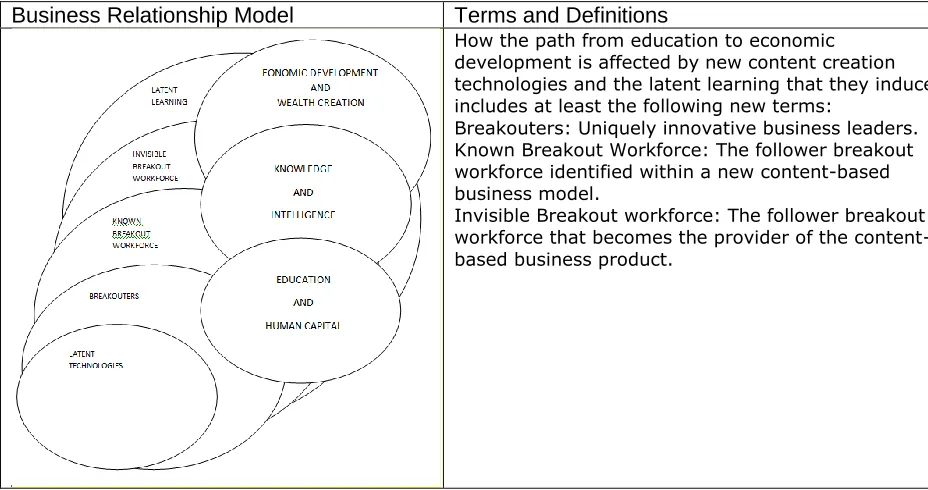
The diagram below offers a perspective for how interdisciplinary forces relate and
interact to affect learning and economic development in what can be described as the Age
of Content, where content as a product of knowledge and information is commercialized
in new ways through new business models. The underlying concept alludes to how
content is leveraged for the intellectual capital it generates by leveraging a huge and
elusive workforce described within the context of existing and new terminology.
Business Relationship Model
Terms and Definitions
How the path from education to economic development is affected by new content creation technologies and the latent learning that they induce includes at least the following new terms:
Breakouters: Uniquely innovative business leaders. Known Breakout Workforce: The follower breakout workforce identified within a new content-based business model.
Invisible Breakout workforce: The follower breakout workforce that becomes the provider of the content-based business product.
Fig. 1 List of terms and definitions within the context of a new content-based business models.
Introduction
Radical innovation achievements by college dropouts, from technologies that changed the world to industries that created new global markets, herald the age of a breakout workforce. This new kind of radical entrepreneurship is enabling a workforce of the future capable of altering industry strategies, government initiatives and academic programs. Recognizing and understanding how the confluence of these forces spontaneously generates followers is of great importance to the enablement of this new kind of workforce motivated by radical innovation, and the promise of great business success and wealth creation.
Journal of Management and Innovation, 3(1), Spring 2017
Copyright Creative Commons 3.0
academic programs and/or employment responsibilities. These visionaries abandoned academic goals, career paths, or both, for a vision birthed by their own intuitive beliefs.
There are strong psychological, social and physiological principles that bind members to their groups and anchor them to group rules, norms, and expectation. The traditional workplace with its rules for daily life should be a mecca of security for most employees meeting psychological and social needs. The workplace is stable, predictable, and collaborative. However, visionary pioneers are people unencumbered by classic, decision-making, “group-think” dynamics as identified by Janis (1972), and undaunted by institutional deindividuation. Moreover, they are undeterred by our natural evolutionary instinct to remain “with the herd” (McDougall, 1908) as well as the fundamental need to belong (Maslow, 1968); Brewer (1991) notes that humans are highly adapted for group membership and not well-designed for survival outside of it. In addition, there appears to be a neural basis for the “pain of exclusion” that is beyond the psychological realm of ostracism; rejection “hurts” from both psychological and physical perspectives (Eisenberger, Lieberman, & Williams, 2003; Kross et al. 2011). According to Baumeister and Leary (1995), “the need to belong is a powerful, fundamental, and extremely pervasive motivation” (p. 497) with people forming strong bonds with others that are relatively resistant to dissolution. Moreover, such relationships are accompanied by related emotional sequelae and cognitive processes.
In the work environment, this need for belongingness binds us to the rules and policies of the organization and to fellow employees as “members of the team”. Through social self-analysis, people determine various aspects of their identities using both intrapersonal and interpersonal comparisons (Alicke, Guenther, C. & Zell, 2012). Thus, we might conclude that there would be a natural resistance to changing group affiliations and having to redefine some aspects of personal identity. That is exactly what makes breakouters stand apart from most employees; they move against natural constraints in favor of a lack of constraints, or at least, the perception of “more freedom.”
Breakouters also challenge neuroscience findings that tell us that we tend to go in-sync with the neural states and perspectives of others (Goleman, 2006), especially with those with whom we spend the most time such as fellow employees. At odds with this neural wi-fi, breakouters move away from the “norms” and create a “private space” wherein they see their own design of “the future” progressively realized as they attract like-minded “followers”. Followers who also have the capability to move beyond the existing culture as “software of the mind” (Hofstede, 1991) to reinvent their own version of the future are also given their own spaces. Breakouters seem to have experienced an epiphany that evolved from finding “the Element…the meeting point
between natural aptitude and personal passion” and from discovering “their most authentic selves, a sense of self-revelation, of defining who they really are and what they’re really meant to be doing with their lives,” (Robinson, K., Aronica, L., 2009). And that seems to apply to those who follow them even without any direct interaction with the visionaries.
To understand them we have to ask:
Who are these people? Independent thinkers? Societal revelers?
What motivates them? Insight? Curiosity? What tools do they use? Divergent thinking? Self-engineering?
How do they make it happen? Through solution-focus? With radically different business plans?
What do they seek? Wealth? Cognitive freedom? Followers?
Journal of Management and Innovation, 3(1), Spring 2017
Copyright Creative Commons 3.0
Breakout leaders are able to create economies where none existed of a scale large enough to support the size of their visions and make them happen. Most significantly, they make them happen by enabling a new kind of workforce, the kind they need to not just employ but also deploy as a massive body of workers in a totality not well understood by them or their followers, but seen destined to achieve both their goals. That aspect of such radical business development processes is also true of innovators who did not “dropout” but turned their visions into reality even with academic credential in hand and even when gainfully employed in their professions. The Innovative leader creates the vision, the culture and the workforce to synergize change and to break the limits of conventional work-place philosophy and managed vision. That break out of form in leadership and its followers seems to be what fuels radically successful industries. Do they hire the needed workforce or does it coalesce as an army of followers?
There is an unrecognized new kind of economic development at play caused by the (so
perceived) dropout culture of success inherent in radical entrepreneurship that is not limited to the so-called disruptive technologies. It incorporates the innovation that created those disruptive technologies and new kinds of leadership that make them happen. What earned these new leaders the title of “dropouts” is simply one quality they all had in common: the inability to postpone their vision. Such leaders saw in technology and in the harnessing of content the tools to realize their vision at a critical point in time when that became possible. It is significant to note that their dropout and breakout timelines were decided upon too prematurely for comfort in traditional business tied to corporate strategies, which impeded realization of their vision. Thus, state and time, in industry, become irrelevant to their vision. In some cases the given industry did not even exist, so state and time became irrelevant, but new technology and new knowledge were not, those were real and available making their vision doable. Radical innovation happens at those points in time because while most industry leaders think in a two-dimensional frame of time and space, breakouters have the ability to ignore those constraints. Thus, they were able to conceive solutions in a three-dimensional time and space and the future state of industry. They simply pushed the boundaries of technology and industry to create content-based a radically new form of economic development.
Every artist is in some measure an innovator; for his own age he is a romanticist. But the romanticist of one age becomes the classic for the next; and his performance in its turn gives laws to his successor. Carleton Noyes (1907, p.79)
Economic development from the capitalization of breakouters
Journal of Management and Innovation, 3(1), Spring 2017
Copyright Creative Commons 3.0
The complex synergy required for these new kind business models to emerge builds upon Information Age infrastructure, but the success of these new radically innovative industries depends on much more than the enabling technologies that created the Information Age. It includes resulting latent learning caused by a new age of technology development for content creation and content manipulation. The engineers of success, that new and invisible workforce deployed to create content, considered less entitled to the resulting new kind of wealth creation, that workforce worked almost entirely on one thing: the very the creation of the content that built those industries. That workforce was supported only by an independent workforce of Web developers, shipping services, marketers, journalists, product creators and even educators who are prominent knowledge augmenters in the space. All these workers, invisible and independent, participate in new wealth creation, but they marginally benefit from it.
That new kind of workforce is made up of googlers, bloggers, tweeters, facebookers, linkediners and others; who are all invisible workers from the perspective of remuneration. They are part of the same breakout workforce launched by the new industries, but sharing little of the wealth generated by their contributions as communities of workers in those industries. The vast majority of the overall breakout workforce plays an often unplanned, mostly ad-hoc role in radical
innovation; they are workers attracted to the activities of the space and they work pro-bono. Those who are part of the invisible breakout workforce, voluntarily and for no remuneration are cast as “dwellers” in the spaces, but these are not just there, they are there working in those spaces to generate revenue by virtue of their presence in the spaces and their contributions of content. They generate revenue in ways not associated with contractual arrangements,
employment and salaries. They are intensely leveraged, unrecognized content providers, sales agents and market promoters.
Perhaps the best way to illustrate how radical industry and the breakout workforce have changed what we knew about business models and profits is by describing a subtle example: Craigslist.
With more than 200 million user postings in only 100 topical forums, it generates 50 billion page views per month, more than 60 million each month in the US alone. It receives more than one million new job listings each month and over 80 million classified ads each month (including reposts and renewals), in Catalan, Danish, Dutch, English, Filipino, French, German, Italian, Norwegian, Portuguese, Spanish, Swedish and Turkish, (Craigslist, 2017). And, although its CEO states “Craigslist's a private company and we never comment on financial matters,” the financial
literature estimates its value at over five billion dollars, (Quora, 2017, Blodget, 2008). With only 50 full time employees (Linkedin. 2017) each would be valued at $100,000,000.
The more mature Google is worth $834,000,000,000 and has 56,604 employees each valued $14,733,941. The fact that Craigslist is non-profit highlights the possibilities at hand for radical industries, taking into consideration the value of each worker and the maturity of the industry. What an employee is worth to a corporation is traditionally calculated using complex
methodologies, complex because they require identification and evaluation of various sets of variables, most often logical costs such as recruiting costs, salary training, benefits, social security and other evolving expenses mandated by law, in addition to physical costs like utilities, maintenance, rent or mortgage costs, insurance, (Davis, M., 2011). And today we should add the costs of digital services, including access to infrastructures like WiFi, Cloud, transactional
platforms and end-user devices.
Journal of Management and Innovation, 3(1), Spring 2017
Copyright Creative Commons 3.0
investments and IPO valuations. But, what if we also consider the impact of the breakout
workforce as leveling factor? What are those companies worth then? What happens if part of the breakout workforce goes away, specifically the invisible part of the breakout workforce? Can that happen? Yes, very easily, thanks to our system of free enterprise and competition.
The kinds of numbers that the simple Valuation - VL, per Worker - WR, formula reveal are very telling of what an invisible workforce can contribute to Value Creation – VC, and Economic Development - ED, in the Age of Content, and exactly what is really needed to create that valuable content, exactly those kinds of workers, that kind of free work. When we examine the possibility of using the simplicity of the same types of equations using the terms VL / WR = VC equation we are able to see a completely different picture:
Airbnb: VL ($60,000,000,000) / WR (130) = VC ($461,538,461) Uber: VL ($51,000,000,000) / WR (6,700) = VC ($7,611,940) Microsoft: VL ($497,500,000,000) / WR (91,000) = VC ($5,467,032) IBM: VL ($173,490,000,000) / WR (386,558) = VC ($448,807) Ford: VL ($50,560,000,000) / WR (201,000) = VC ($251,542)
A more extensive study may reveal that what is rising to the surface of value creation are companies that were able to leverage and deploy all aspects of the breakout workforce, companies that become very valuable in somewhat of a reversal of the accepted Fortune 500 filtering parameters for valuation.
From formula to perspective
A formula for evaluating the relative value of each invisible worker in the breakout workforce for each market segment would require data to gain understanding of the contributions to the enterprise that each invisible worker makes and understanding of the variables involved. When content creation becomes a significant aspect of the intellectual capital of an enterprise, and when it is being generated by an invisible source of human capital, its value becomes unimaginably intangible.
While the numbers are real, the formula and understanding the way in which to put those numbers into an economic development perspective will require much more study.
Are those things that energize manufacturing, industrialization and economic development evolving in unexpected ways? Perhaps disappearing?
Is the Age of Content redefining manufacturing, industrialization, economic development and wealth creation? What about training?
What is the ED value for each breakout workforce? Is it education or is it simply free labor?
Journal of Management and Innovation, 3(1), Spring 2017
Copyright Creative Commons 3.0
Purveyors of knowledge derived from content which is obtained for the free, and the voluntary presence of workers in virtual spaces, gathered by these new radically innovative corporations, when compared to the industries that provide services and tangible goods, present yet another business consideration: Who profits? To answer that question we have to examine how are radically innovative corporations that leverage the Age of Content built.
Three layers of the breakout workforce have been identified:
1. The breakout workforce, those employed by new corporations that depend on for wealth creation.
2. The independent breakout workforce, those self-employed or employed by corporations that becomes peripheral contributors to wealth creation by radically innovative
corporations, and only modestly benefit from them.
3. The invisible breakout workforce that sustains a presence in virtual spaces and creates the content leveraged by radically innovative corporations, but benefits little or not at all.
Three layers of remuneration can be loosely identified in this order:
a) to the radically innovative corporations,
b) to the investors, underwriters and stock holders,
c) to the breakout workforce as defined in 1 and 2 above.
Worker employment versus workforce deployment
Google explains it: “There’s no one kind of Googler, so we’re always looking for people who can bring new perspectives and life experiences to our teams. If you’re looking for a place that values your curiosity, passion, and desire to learn, if you’re seeking colleagues who are big thinkers eager to take on fresh challenges as a team, then you’re a future Googler, ” (Google., 2017).
There’s truly “no one kind of Googler” because the keyword in that workforce is “team.” We are arguably all “googlers,” or at least we identify personally with that term, but we are not all
employed by Google. However, all googlers are deployed by Google. How is a “googler” defined? The way an IBMer is? An IBMer employed by IBM, a Googler is presumably employed by
Google, but there is one difference between the terms. An IBMer has identifiable skills that IBM needs, skills specifically described in job descriptions, and they perform specific jobs for
scheduled wages. Curiosity, passion and desire to learn can easily describe most googlers who are not employees of Google but users of the resource. Even if we are not able to join “the” Google team as an employed colleague to take on fresh challenges, we are taking on the
challenge of producing new content in the form of queries, driven by curiosity, passion and desire to learn. Consequently, we are part of “the team.” When we google, we create content that Google can analyze and knowledge that Google obtains, uses and profits from. So, the “user googler” is fundamentally a pro-bono Google worker contributing to the success of Google as an invisible member of Google’s broader team: a member of the Google’s breakout workforce.
Journal of Management and Innovation, 3(1), Spring 2017
Copyright Creative Commons 3.0
SME’s. Today, courseware is often enhanced with Power Point presentations that can be easily modified to include state-of-the-art and current events material. New technology tools provide specially designed opportunities to enhance the traditional added content like presentations, diagrams and projects plan tools, with audio and video components embraced by most educators to provide more meaningful experiences for students, but these additives as incorporate by the LMS’s remain couched in ambiguous, accidental language of best practices, with new
consequential meaning and limitations. Who owns the content? Who is responsible for its positions? Who evaluates it and validates it? Still, copyrights and content ownership are not as disputable in academia as they are in industry, and academic freedom offers some latitude where points of view are concerned.
The universal implications of content creation through unspecified working arrangements are mind-boggling. Technology and telecommunications vendors as well as service providers know it and want to increase their stakes in this trend through acquisitions of content-providing sources and the systematic ownership of content produced by work for hire sources and work elicited through end-user interfaces, all very real work done without the full protection of copyright laws and the rewards of contractual royalties. New digital economies have created these kinds of business opportunities, for some, not necessarily the actual workers. Invisible workers are particularly useful in digital economies because they produce not only free content but also provide free information that can be mined for knowledge that can yield intelligence. In general, not even contracts are needed, a simple disclaimer allows an enterprise to control large segments of the breakout work force and own the products of their elicited labor: their content and the knowledge they wish to voluntarily share through blogs, tweets and digital habits. This is made clear by the fact that the invisible workforce is deployed by technology trends not Human Resources organizations, but very clearly they are valuable human capital with unwritten job descriptions, and no rights to their contributed content and their gifts of knowledge.
Such profound changes in how industry can be made to work, in the now very real Age of Content, are not part of a master Systems Engineering Management Plan - SEMP, Project Management Plan – PMP, or even a simple business plan, they occur serendipitously. These new workers are the pseudoworkers and latent learners of a content commercialization industry. These workers accrue knowledge, learn alone, train themselves and they are passionate about participating in these (industry) spaces they belong to. Thus, they exhibit the hallmarks of the pioneering spirit that we know to have created nations. We may not recognize it as such, but we have all joined one or more virtual spaces becoming part of the invisible side of the breakout workforce. And as such, we are not manufacturing anything and we are not actually contributing to any form of industrialization, irrelevant concepts for those spaces, we are contributing to our own commercialization, the commercialization of the self.
Innumerable activities, company initiatives and academic programs are found on the Web, too many to cite and too many to categorize by merit, all focusing on traditional entrepreneurship and training to spark innovation. Yet, we have seen that the most successful innovators rejected training and dropped-out of college, those who graduated did not receive training different from the vast majority of other graduates who did not become radicalinnovators. It is not clear how to train for innovation in general, because the future of innovation is unpredictable by definition. A more approachable goal is to try to understand how to participate in radically innovative industries in a more equitable and profitable way in a climate of profits no longer defined by the measured difference between revenue and cost.
Journal of Management and Innovation, 3(1), Spring 2017
Copyright Creative Commons 3.0
How large institutions in industry, government and academia, deal with innovation can be described as traditional and systematic, business as usual, and in general rooted in long-established processes. All things considered, executives, program managers and academic leaders continue to stick to guidelines and policies; they don’t make it a habit to break them. For example, promotions in industry typically come from within, and hiring is done to meet planned needs carefully assessed and documented in job descriptions. Academia is typically much more rigid, hiring according to serious credentials that help meet accreditation guidelines and funded initiatives. In both cases, how individuals move through the ladders of these institutions can be affected by internal politics and control of opportunities by and for a selected few. The spread of the for-profit academic culture, where faculty may come to feel that a student is more of a client than an accountable learner, complicates matters for traditional academia attempting to embrace the benefits of online programs. Conflicting business philosophies along with increasing demands for ownership of an individual’s contribution of content and intellectual property is moving content creation towards total corporatization without compensatory rewards, and that will inhibit
innovation with diminishing motivation.
What does this all do for radical innovation, the kind that generates new industries, new economies and new wealth, the kind of innovation that changes the way we all function in the world? How can the enablement of the breakout workforce move forward through education-based knowledge creation? How can the deployment of the breakout workforce become
energized by compensatory wealth creation? The point of policies, rules and regulations is not to allow breakouts, rather to inhibit their emergence and quell beginning rebellions in their infancy. Should we consider the potential of doing the opposite based on what we now know about drop-outs? Which kinds of disruptive technologies are capable of supporting radically different business models that propel the creation of radically new wealth economies to flourish worldwide? We have the technology to enable and deploy a massive and productive breakout workforce worldwide. Can we, therefore, support with technology massive, compensatory economic development and wealth creation?
Elements of the breakout workforce
Who makes up the breakout workforce? Those who followed these highly successful innovators and entrepreneurs may also be dropouts taking greater risks and changing their lives more drastically. They are also more likely to have left an established industry unaware that they were becoming part of a special kind of workforce that would put it all on the line to follow a vision that they may or may not be able to clearly see. It is likely that the vision was not enough to sway this new workforce, but the infrastructure behind it may have been the decisive, enabling factor. It is difficult to question the future of Uber when its valuation has been estimated to be as high as $68 billion, (Sorkin, A., 2016). Whether that is an exact figure or not the questions that it raises range from what does that do for competing entrepreneurial ventures to how was a massive workforce of drivers deployed worldwide literally in real-time. How much specific prior experience or training in the business area at hand present in this breakout workforce? Where did the Information Technology – IT, training to execute the job come from? How did these workers come to be able to operate the laptop and cell phone as part of their job? Who trained them? How did the online culture and the power of latent learning leveraged?
Journal of Management and Innovation, 3(1), Spring 2017
Copyright Creative Commons 3.0
enthusiasm, commitment and ability to adapt to change that identifies the breakout workforce. We are not going to get these breakout workers from the personnel files of traditional big business, but from the opportunity building industries created by visionary breakout leaders. Such confluence of events was demonstrated in the case with Uber. The case of Uber suggests that such a massive, spontaneous and profitable workforce can bring about employment opportunity and economic development.
From leadership theory models to industry-follower theory models
Can Leadership Theory help us to understand the kinds of visionary leaders that can trigger deployment of a breakout workforce? Contingency Theory connects leadership with both needed elements: situations and followers (Contingency Theory, 2016). But, interaction with followers is not a necessary precondition to support the emergence of a visionary or innovative leader or to trigger the deployment of a resulting workforce. Visionaries and innovators are by definition alone in their beliefs, monopolizing their own visions, armed with the conviction that “it” will happen and that people will catch on, that people will do this, work on this. How people do catch on is through latent learning, because they think of themselves as belonging, as users: the googlers,
facebookers, ebayers and Uber drivers, already prepared to do what is required of them. They are all members of the breakout workforce that supplies the content, virtual storefronts,
independent sources of goods and tools that fuel these industries. They supply a large part of the needed deployment resources for free: laptops, cell phones, power, work space, cars, and above all their skills and knowledge from accrued and latent learning.
Since break-out leaders do not communicate with these kinds of industry-building followers, variants of the Leader-Follower Theory also do not fit well because the two elements that are need, effective communication and relationship-building, are also not provided by the leader for this order of magnitude workforce acclimation (Price, M.E., Van Vugt, M., 2014). The concept of a voluntary workforce that acclimates itself spontaneously and independently provide time and resources in order to share in a very small portion of the wealth creation generated by the leader industry is not yet well understood, perhaps because it is a phenomenon of workforce dynamics in the Age of Content. These new leaders transfer their leadership presence to the leader industry itself that they create. Communications and relationships are functions of technology not
recruiters or salesmen. The concept ofneural wi-fi from neuroscience becomes directly applicable to leadership theory in this case and may explain what potentially might cause a person to resist directly following a “break-out” leader.
Each breakout industry case is different and by studying each case we may be able to find some commonality in the kinds of leadership qualities that followers find worth believing and investing in. Timeframes from conception to promise and fund raising needs are discrete, quantifiable parameters that can be used to determine the promise factor of an innovative vision. The self-creation of new wealth that results from these types of radical innovation can then be factored in the valuation of actual success including such timeframes as time to IPO, assets growth and the evolving make-up and size of a breakout workforce. Ultimately, the breakout workforce is more profoundly built upon the human feasibility factor. A question that each potential worker who wants to be gainfully employed and is willing to become a voluntary participant of the breakout workforce, is simply: Can I be part of it, now? Those who want to become part of the gainfully employed breakout workforce need to answer an additional question: Do I have what is takes, now? When we answer those questions with a yes is when latent learning, skill sets and
experience become relevant dimensions of radical industries, (What is latent Learning? 2017).
Journal of Management and Innovation, 3(1), Spring 2017
Copyright Creative Commons 3.0
Individualized mentoring is the epitome of learner-centric education: one mentor, one student, one learning goal at a time, at the precise time when needed. We idealize educational systems that provide student-centric learning and low student to teacher ratios. Yet the money we spend per student in education seems to have little impact on our own economic development, (The Associated Press, 2013). Some of the very same nations that take away jobs from American workers are doing the opposite, (The Guardian. 2015). There is no clear explanation for why education spending and literacy are not having greater impact on job creation in America.
Education in the classic sense is needed for the accrual of knowledge by the individual, but there’s a limit to what can be done with accrued knowledge to raise standards of living and support industrialization. Renowned political scientist and scholar, Myron Weiner, believed in education first by need, industry second by default (Weiner, M., 1991). This is crude at best, a summary of his esteemed social philosophy. Many of us have dedicated our entire professional lives working to help energize economic development through education at a global level, yet modern industry has changed the game, for long we have been dealing with a different definition of industry. Wealth creation has been taken by long existing industries to places where education is not the key to economic development, but rather unskilled labor is. We have yet to define skilled and unskilled labor in terms of multiple intelligences as we keep ignoring it, (Armstrong, T., 2017) and what we have attempted to do with education in terms work skills development is not what helped create the breakout workforce.
New breakout industries and new trends coming from existing tech giants require overnight armies of skilled and unskilled workers, and we do not have strategies in place for recruiting by the thousands based on abilities that come from inherent intelligences. We need to put in place a system for mass assimilation of latent workplace skills that are perhaps driven by unidentified intelligences that such potential workers have. Our recruiting strategies are the bottleneck of the problem. They work well for finding the right executive, engineer, scientist, but not to deploy a gainfully employed workforce overnight. Our recruiting strategies extend to human resources organizations and job descriptions but they are not good enough to fill assembly lines of workers to assist robots or for supplying end-users of knowledge like doctors, lawyers, engineers and teachers, with skills to work with the emerging intelligent tools of their trades. Training is
becoming obsolete while skills osmosis, as a form of latent learning is the norm for all we learn to do in those situations. We should find ways to embrace those options.
Maybe it is all a question of using technology to identify talent needed to build skills, (Masullo, M., 1998). Maybe it is a question of how we build knowledge through technology. Maybe training should start after mass identification of needed skills-sets based on the identification of talent and accrued knowledge; and, the emerging technology trends that will shape industry. The breakout workforce is effective, when it is enabled not trained, when deployed not hired. We need new strategies to enable the breakout worker for gainful deployment in the new kinds of economic development opportunity that radical innovation is only starting to bring about.
From managing to monitoring the breakout workforce
Journal of Management and Innovation, 3(1), Spring 2017
Copyright Creative Commons 3.0
contributing to produce revenue that is shared in the “parent industry” space, such as ecommerce or social media. Whether operating as separate businesses or as an individual player, such as a content developer, their contributions to the radical industry they are involved with are significant. YouTube and Google Play are estimated to contribute 15% of Google’s revenue (Edwards, J., 2015); while “PC search ads, mobile search ads and YouTube ads contribute approximately 57%
to the firm’s (Alphabet) value,” (Trefis Team, 2016).
What roles did opportunity management, resource planning and engagement management played in establishing or redeploying those peripheral industries as virtual “industry verticals”? Not likely the traditional roles. What roles did Human Resources and Personnel departments played in the management of the invisible aspect of the breakout workforce that generate the resulting revenue opportunities? Possibly none... What about customer relationship
management? Who is the customer and who is the service provider? Who is responsible for the customer, the breakout industry or the invisible breakout worker? Are business service providers rethinking use of their enterprise resource planning and project management tools? How are financials supposed to be accurately estimated, profitability predicted and investment recommendations made in a climate of complex virtual interactions? Can we depend on the existence of these interactions from day to day? Can we estimate their performance quarter to quarter? Do we have methodologies for answering these questions in our business management textbooks? Will these questions change with the next radical industry and breakout workforce?
Summary and Conclusion
While quality education, medical research, space exploration and national security merit our attention and dedicated research, one area that we cannot allow ourselves to be complacent with is Business Management. Almost universally, business as usual does not exist in the Age of Content, and business generates wealth, and education drives economic development to support business. What business has come to mean in a world of virtual spaces, new ways to view human capital and uncontrolled harnessing of freely created content, is yet unknown, and how to educate for economic development and wealth creation is also yet unknown. Broadly
interdisciplinary research is needed to examine all the issues in context with content-based industries and the emergence of new instances of the breakout workforce. This exploration of the issues involved considers only a few traditional concepts from education, neuroscience, computer science and business management that should be reexamined to:
1. Redefine the concept of the successful dropout in terms of visionary breakouters:
industry revolutionaries and inspired thinkers so that we can encourage more of them.
2. Reconsider extensions of existing leadership theory models that may be applicable to
radical entrepreneurship and the existence of the breakout workforce.
3. Reexamine the roles of learning and skills development in how creating a breakout
workforce is made capable of spontaneously driving wealth creation.
4. Rethink the role of management practices and tools as marginally applicable to new
workforce creation patterns including how the invisible breakout workforce is being
leveraged.
5. Argue for a re-conceptualization of an inclusively profitable content-based business
Journal of Management and Innovation, 3(1), Spring 2017
Copyright Creative Commons 3.0
References
Alicke, M. D., Guenther, C. L., & Zell, E. ( 2012). Social self-analysis: Constructing and
maintaining personal identity. In M. R. Leary & J. P. Tangney (Eds.) Handbook of Self and Identity (2nd ed., pp. 291-308). New York: The Guilford Press.
Armstrong, T. (2017). Multiple Intelligences. Retrieved from URL
http://www.institute4learning.com/resources/articles/multiple-intelligences
Baumeister, R. F., & Leary, M.R. (1995). The need to belong: Desire for interpersonal
attachments as a fundamental human motivation. Psychological Bulletin, 117(3), 497-529.
Benna, S. (2015). These 16 insanely successful college dropouts show you don't need a degree.
Retrieved from URL
http://www.businessinsider.com/16-insanely-successful-college-dropouts-2015-6
Brewer, M. B. (1991). The social self: On being the same and different at the same time.
Personality and Social Psychology Bulletin, 17(5), 475-482.
Blodget, H. (2008). Craigslist Valuation: $80 Million in 2008 Revenue, Worth $5 Billion. Retrieved from URL
http://www.businessinsider.com/2008/4/craigslist-valuation-80-million-in-2008-revenue-worth-5-billion
Chen, L. (2015). The Most Valuable Employees: Snapchat Doubles Facebook. Retrieved from URL
https://www.forbes.com/sites/liyanchen/2015/08/11/the-most-valuable-employees-snapchat-doubles-facebook/#164a97395f5b
Journal of Management and Innovation, 3(1), Spring 2017
Copyright Creative Commons 3.0
Craigslist. (2017). Craigslist. Retrieved from URL https://www.craigslist.org Davis, M. (2011). What’s your employee value? Retrieved from URL http://www.investopedia.com/financial-edge/1011/whats-youremployee-value.aspx
Edwards, J. (2015). We finally got some really good data on just how much money Google makes from URL YouTube and Google Play. Retrieved from URL
http://www.businessinsider.com/stats-on-googles-revenues-from-youtube-and-google-play-2015-7
Eisenberger, N. I., Lieberman, M. D., & Williams, K. D. (2003). Does rejection hurt? An fMRI
study of social exclusion. Science, 302, 290-292.
Google.(2017). How We Hire. Retrieved from URL https://careers.google.com/how-we-hire Hofstede, G. (1991). Cultures and organizations: Software of the mind. London, England:
McGraw-Hill.
Janis, I. (1972). Victims of groupthink. Boston: Houghton-Mifflin.
Kross, E., Berman, M. G., Mischel, W., Smith, E. E., Wager, T. D. (2011). Social rejection shares
somatosensory representations with physical pain. Proceedings of the National Academy of Sciences,108 (15), 6270-6275.
Lenhart, A., Shermak, J. ( 2005). Selling items online. Pew Research Center.
Journal of Management and Innovation, 3(1), Spring 2017
Copyright Creative Commons 3.0
Masullo, M. (1998). Discovering The Academic Potential Of Our Children. Retrieved from URL http://www.invivovision.com/library/R-9810.pdf
McDougall, W. (1908). An introduction to social psychology. London: Methuen.
Noyes, C. (1907). The gate of appreciation: Studies in the relation of art to life. New York: Houghton, Mifflin and Co.
Price, M.E., Van Vugt, M. (2014). The evolution of leader–follower reciprocity: the theory of service-for-prestige. Retrieved from URL
https://www.ncbi.nlm.nih.gov/pmc/articles/PMC4045238
Quora. (2017). Retrieved from URL https://www.quora.com/How-much-is-Craigslist-worth
Robinson, K., Aronica, L. (2009). The element: how finding your passion changes everything.
New York, Viking.
Sorkin, A. (2016). Why Uber keeps raising billion. Retrieved from URL
https://www.nytimes.com/2016/06/21/business/.../why-uber-keeps-raising-billions.html
The employee Association. (2017). Profit per Employee.Retrieved from URL ttps://www.employersassoc.com/profitperee
The Associated Press. (2013). U.S. education spending tops global list. Retrieved from URL http://www.cbsnews.com/news/us-education-spending-tops-global-list-study-shows
The Guardian. (2015). One in four young people in developing countries unable to read, says UN.
Retrieved from URL
Journal of Management and Innovation, 3(1), Spring 2017
Copyright Creative Commons 3.0
Trefis Team. (2016). Alphabet Earnings: Mobile and YouTube boosts Google revenues as other bets still bleed cash. Retrieved from URL
http://www.forbes.com/sites/greatspeculations/2016/10/28/alphabet-earnings-mobile-and-youtube-boosts-google-revenues-as-other-bets-still-bleed-cash/#58c3fc2a5d32
Weiner, M. (1991). The child and the state in India: Child labor and education policy in comparative perspective. Princeton, N.J.: Princeton U.P.
What is latent Learning? (2017). Retrieved from URL
https://www.reference.com/world-view/latent-learning-5ff30f6f5e4cbd82
Authors
Christina Harnett, Ph.D., MBA - Christina is a Licensed Psychologist and Associate Professor of Counseling and Human Development at Johns Hopkins University School of Education.
Miriam Masullo, Ph.D., M.Ph., MS - Miriam has over forty years of combined industry experienced in telecommunications and computer science research. She is an adjunct professor at the
University of the University of Maryland University College.
Antonio Ruiz, Ph.D. - Antonio has more than twenty-five years of experience as technical contributor, senior manager, and executive in systems engineering of complex systems, solutions, products, and R&D. He is Chief Systems Engineer, Leidos and Science Applications International Corporation.
Timothy Schoeb, MBA - Timothy has over 30 years of experience in both the commercial and government job sectors. His commercial experience is with both established and startup companies.
Journal of Management and Innovation, 3(1), Spring 2017