doi:10.15171/rdme.2015.032 http://journals.tbzmed.ac.ir/rdme
Effects of a “Brief Stress Management Training Program” from Medical
Students’ Viewpoints: A Qualitative Study
Sepideh Herizchi1, Jaafar Sadegh Tabrizi2,Fatemeh Ranjbar3*
1Department of Psychiatry, Faculty of Medicine, Tabriz University of Medical Sciences, Tabriz, Iran
2Health Services Management Research Center, Tabriz University of Medical Sciences, Tabriz, Iran
3Research Center of Psychiatry and Behavioral Sciences, Tabriz University of Medical Sciences, Tabriz, Iran
*Corresponding author: Fatemeh Ranjbar, Email:[email protected]
© 2015 The Authors. This is an Open Access article distributed under the terms of the Creative Commons Attribution License (http://creativecommons.org/licenses/by/4.0), which permits unrestricted use, distribution, and reproduction in any medium, as long as the original authors and source are cited. No permission is required from the authors or the publishers.
Article History: Received: 3 Dec 2015 Accepted: 10 Jan 2016 ePublished: 1 Feb 2016
Keywords: Qualitative study, Stress Management Training,
Medical students
Introduction: Medical students undergo many stressors during various stages of medical
education and must learn to cope with their new situation. Some studies have reported that stress management training methods have significant effects on decreasing stress in medical students. The aim of this study was to evaluate the efficacy of a “Stress Management Training Session” from medical students’ viewpoints.
Methods: This study design employed a qualitative phenomenological research method. Using a goal-directed sampling method, medical students in the psychiatry ward during 3 months, participated in a “Stress Management Training Session”. In this section, the nature of stress and some simple techniques for stress management were taught practically. After 1 month, participants cooperated in 3 focus group discussions. In the FGDs students explained their experiences in the stress management session and its effectiveness. After recording and writing discussions, subjects’ content was analyzed.
Results: In total, 6 themes and 2:10 subthemes materialized from data analysis. In the students’ opinions, learning and using stress management techniques had good effects on their stress, sleep and headaches. Although some students didn’t notice to the efficacy on concentration, others believed stress management techniques were useful for learning and concentration.
Conclusion: Based on the medical students’ opinions, learning and using stress management techniques had good effects on their stress, sleep and headaches and may improve concentration and learning quality.
Abstract Article info
Article Type: Original Research
Citation: Herizchi S, Tabrizi JS, Ranjbar F. Effects of a “Brief Stress Management Training Program” from Medical Students’ Viewpoints: A Qualitative Study. Res Dev Med Educ 2015;4(2):183-188. doi:10.15171/rdme.2015.032
Introduction
Every situation in which a person needs to adapt can cause stress. Perceived stress in the same situation may differ in different persons because of their distinctive views and use of fight or flight strategies. Medical students' experience several stressors during various stages of medical education and must learn to cope with new situations. New personal and professional life styles, new responsibilities and educational curriculum, sleep deprivation, lack of facilities and social support are some stressors described for medical student.1 In clinical stages, students experience relationships with patients and their pain and sadness may cause higher stress.2 Medical education lasts several years. This is another source of stress for medical students.3
The wide range of stressors medical students experience may result in very serious outcomes, high expectations of perfection, interpersonal problems or even suicide.4 Reported results by both developed countries like Canada and the US and developing countries like Nepal are really surprising; burn out syndrome is seen in nearly 50% of medical students.5,6,7 Lisa Kuhn reported high stress in final years and residency.1 Student use different strategies to adapt with stress. For rescuing of high stress, students might do risky behaviors like drinking or drug abuse. Like studies by Babalola in Nigeria, Damiral in Turkey and Hull SK in Ohio, USA.8,9,10
spend more time for personal and social life.11 A cross-sectional study by Gharavi in Iran suggested stress management training for medical students because of high levels of stress.12 In a review article by Shiralkar, stress management methods like meditation and mindfulness had significant effects on decreasing stress in medical students.13 Another review article by Alzahem studied effects of stress management training on dentistry students and the results were similar.14 A study by Park J in South Korea found that stress is related to depression and learning motivation and teaching coping stress techniques can improve motivation for learning in medical students.15 Several studies in different universities in the world have reported the positive effect of stress management programs on the wellbeing of medical students and have suggested requiring these programs in medical education curriculum.16-27
In some universities “life skills training” is routine and there are some structured websites for this aim.28
But also very few studies have considered the own medical students' ideas about this programs. Unfortunately in Iran “life skills” like “stress management” are not teaching in the ordinary curriculum of medical education. However Iranian medical students are not different from the others. Therefore they also experience high amount of stress and also may use non healthy behaviors for confronting stress, although there is not complete information about it. Considering these, a cost benefit program of “stress management training” seems necessary. This program should be accessible, available, useful and desirable in medical students' ideas. Usually medical students are in hurry and full filled time! In this reason, current study aimed to assay the efficacy of a very brief stress management training program in educators' opinions.
Materials and Methods
This study was designed in a qualitative phenomenological research method. The goal of qualitative phenomenological research is to describe an "alive experience" of a phenomenon.29 According to Willis’s opinion, phenomenological research in its base, is a description of biological perception that gives the phenomena a different humanistic quality.30 Therefore, this can be an appropriate method for deliberation of humanistic experiences from events or an instructional method and educational course.31 Using a goal-directed sampling method, medical students in the psychiatry ward during 3 months of May, June and July 2014, were selected. They participated in a training session tutored by the researcher. In this session, the nature of stress, frequent somatic and psychological symptoms, some useful and simple techniques of stress management were taught. Also, techniques of meditation and progressive muscle relaxation were shown practically. In order to avoid bias in students’ experiences, researcher did not give any comments about the positive effects of stress management techniques and the main research question was unclear for them. Overall time for every session was nearly 60 minutes. All groups were asked to
take part in focus group discussions [FGD] after 1 month. For participants' convenience, these FGDs were provided in their present clinical wards. All FGDs were starting with an open-answer question, “What was your experience of stress management training session”? How did you evaluate efficacy of it? When participants did not clarify much about the effects of program, the researcher was asking about doing the stress management techniques and efficacy of them on copping daily stress, quality of learning and con centration or any other experiences. Every FGD lasted almost 30 minutes. All dialogues and discussions were recorded as an mp3 file by 2 psychiatry residents. After every FGD contents of mp3 files were written in A4 papers. However, during FGDs the researcher herself was writing highlighted points. The researcher ensured all participants of the security of data before every FGD. All participants were interested in cooperating with this research.
After training 3 groups and 3FGDs, initial reviewing the gathered data of FGDs showed that fresh data was not seen at the last session content. In other words data was repetitive and saturated. As a result, sampling and training other groups should stop.32 Program evaluation results were strongly positive. In qualitative phenomenological researches, data analysis is done in "Content Analysis Method". According to the usual method of content analysis, interpretation were starting with several free readings. These initial readings were aimed at the study topic without any intention of categorization. But other readings were done for coding and categorizing data. In the first analysis 20 coded items were find among contents of FGDs. But with more times interpreting and analyzing contents, finally items decreased to 6 themes.
Results
50 medical students took part in educational program. However, in total 40 medical students, 24 female and 16 male, participated FGDs. The mean age of students was 23.5 ± 0.7
According was said former, finally 6 themes and 10 Sub them and Categories materialized from data analysis, as tables 1 to 6.
In students’ overall perception, stress management techniques were helpful for sleep quality and comfortably going sleep.
Generally, according to students' interpretations, stress management techniques were more effective on the mild to moderate stressors, but not on the severe stressors. In their opinion they need more practice and training sessions. We concluded that, students used learned stress management techniques for healing different types of headaches, although this usage were not presented for them in the training session.
Categories Examples
1.Good effect of intermittent cold and warm bath on sleep I tried intermittent cold and warm bath. Especially after warm bath I slept easily. It was very nice and comfortably and I had no bad dreams.
2.Good effect of Muscle Relaxation on sleep I did Muscle Relaxation for my sleep. It lasted about 30 minutes and then I fell!
3.Not effect of Muscle Relaxation on sleep I did Muscle Relaxation, it had good effect on my stress and concentration, but not abut sleep problem. Table 1. Categories and issues for theme “Efficacy on Sleep”
Categories Examples
1. Good effect of stress management techniques session on copping stress
I felt very relaxed and my stress got considerably better by only one session of stress management learning.
My stress got better in my perception.
2. Good effect of stress management techniques session on mild to moderate stress
Stress management techniques affected mild to moderate stresses were better with, but they did not have specific effect on major stresses.
3. Good effect of stress management
training on the others! My sister had an important exam and she was under severe stress I helped her do Muscle Relaxation, and she felt better. Table 2. Categories and issues for theme “Efficacy on Stress”
According to students’ experiences, the use of stress management techniques can get rid of fatigue and help them regain energy.
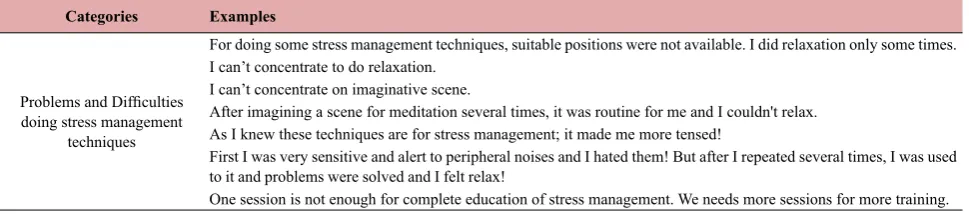
In students’ opinions about problems with stress management techniques, at the first times they couldn't do relaxation in the noisy places and finding silent place was difficult! However, after practicing more, they had got positive results. In their opinions, the training classes should be repeated for greater efficacy.
Discussion
As said in the introduction, medical students undergo several stressors during various stages of medical education, and they must learn to cope with their new situation. New personal and professional life styles, new responsibilities and educational curriculum, sleep deprivation, lack of facilities and social support are some stressors described for medical students.1 Many studies has been referenced with many other researches. Like the study by Susan Michie in
Categories Examples
1. Recovery effect on headache I had headache; after practicing these techniques, I felt better.
2. Healing Migraine headache My friend was suffering a severe Migraine headache. I trained her Muscle Relaxation. Her headache got much better.
Table 3. Categories and issues for theme “Efficacy on Headache”
Categories Examples
1. Good Effect on learning and concentration
I did these techniques sometimes. In my opinion it was very good for my concentration.
Sometimes I was very tired and I should study for exam; I did relaxation and meditation. My concentration got very better and I could study well.
Despite I didn't see them useful on my sleep, but my stress got better and also my concentration. I did relaxation before sleep. After awaking, I felt my concentration and learning got better.
After studying I was very tired. I did some of these techniques and after that, I refreshed my energy and could continue to study.
2. Not being careful about efficacy
My feeling and perception after doing these techniques were good; however I was not careful of efficacy on learning or concentration.
It was good; but I didn’t care and understand this effect!
1994. She performed a short training program for medical students in the first year of clinical educational stages in London. Her stress management training was provided in 3 weekly sessions lasting 2 hours. Medical students reported this program was very useful and, during the next year, in comparison with the control group, their performance was considerably improved. This assay showed long-time efficacy of stress management training. However, in the current study only one session was carried out. Although students reported improvement in their functioning in this short time period, the long-time efficacy of stress management training was not evaluated. Also, results of the current study are similar to a review study performed by Shiralkar in the US that confirmed efficacy of stress management techniques such as meditation, self-hypnosis, healthy funny habits and mindfulness in decreasing stress in medical students.13 In present study, meditation and muscle relaxation was taught practically to students. Another assay studied the amount of cortisol metabolites in the saliva of students during exam time. Students who learned stress management had lower cortisol levels in their saliva in comparison with others in the control group.3 In the present study, the somatic effects of stress management training was not the objective, but students find it useful and used these techniques to refresh and heal headaches for themselves or the others. One study by Yazdani et al. assessed the degree of anxiety and depression before and after a stress management workshop in the students of midwifery and nursery in Isfahan, Iran. According to compare questionnaires they had improvements in anxiety and depression scales in contrast to the control group.21 In the recent study, depression and anxiety were not assessed before intervention and we used qualitative methods instead of a questionnaire. However, the results of both studies shows the same results. Shirbeim's research showed improvement in somatic and anxiety syndromes in a group of students who were educated about stress management in comparison to a control group.18
Although the structures of these studies are not similar, the results are not different. Improvement in energy and headaches was resulted in participants' opinion in present
Categories Examples
1. Efficacy on “Fatigue and Energy”
If we do these techniques when we are tired after daily activities, it is very good. When I did these techniques, I felt fresher especially early in the morning. When I felt fatigued after studying, doing these techniques made me energetic. Table 5. Categories and issues for theme “efficacy of stress management techniques training on “Fatigue and Energy”.
Categories Examples
Problems and Difficulties doing stress management
techniques
For doing some stress management techniques, suitable positions were not available. I did relaxation only some times. I can’t concentrate to do relaxation.
I can’t concentrate on imaginative scene.
After imagining a scene for meditation several times, it was routine for me and I couldn't relax. As I knew these techniques are for stress management; it made me more tensed!
First I was very sensitive and alert to peripheral noises and I hated them! But after I repeated several times, I was used to it and problems were solved and I felt relax!
One session is not enough for complete education of stress management. We needs more sessions for more training. Table 6. Categories and issues for theme “Problems and Difficulties for using stress management techniques”.
study, too. Hirakata et al. found advantages of stress management training in changing problematic coping strategies and decreasing passive behaviors in Japanese students. This research confirms our study.19 At Oklahoma University Redwood and Polack offered stress management training to first-year medical students by the second-year students in small groups.20
The results were considerable and suggest the option of using peer education could be a beneficial method of stress management training for medical students. In present study, training was done by researcher, a psychiatrist. Research by Muhammad Saiful in Malaysia performed a similar program in 8 sessions and also confirmed the recent study.24 A review study suggests establishing Mental Health Improvement Programs in the ordinary academic education curriculums.5
Assessment tools in many studies in the literature were questionnaires. Often questionnaires cannot show all aspects of human experiences and ideas, and some viewpoints might be neglected. The current study attempted to evaluate the efficacy of stress management training based on medical students’ personal opinions and experiences. It also studied problems with carrying out stress management strategies using a qualitative study method. In our research we could not find any similar studies.
In addition, many studies had carried out stress management training programs in several sessions, with at least a minimum of 3. However, in the present study only one session was performed in the students’ current clinical ward. Although students were offered similar programs, for medical students who have little free time having training in their clinical ward is an advantage. On the other hand, in the research, anxiety and depression were evaluated more often and learning quality and concentration were less noticed. In the students’ ideas stress management can improve even learning quality and concentration. In this viewpoint, the recent study seems unique.
Limitations in study
current study were considerable, certainly performing more sessions and more practice will be more effective. In addition, the long-time effects of this program were not assessed. For this purpose another prospective cohort study should be designed.
Conclusion
In the medical students' opinion learning and using stress management techniques had good effects on their stress, sleep and headaches and may improve concentration and learning quality.
Comments and Suggestions
Medical students experience several stressors during various stages of their medical education. They are future physicians and also future "community health undertakers.” They spend a long time of their life learning. They cannot have good performance when they do not have good mental and physical health. They are also young, a risky group in the general population. Medical students' quality of lives should be noticed more. Authors suggest courses for "stress management and other life skills" in different stages.
Competing Interests
There is no conflict of interest in this research.
Ethical issues
There was not any Ethical Issue for this research.
References
1. Kuhn L, Kranz P, Koo F, Cossio G, Lund NL. Assessment of Stress in Physician Assistant Students. Journal of Instructional Psychology 2005; 32(2):167-177.
2. Kazmi R, Amjad S, Khan D. Occupational stress and its effect on job performance. A case study of medical house officers of district Abbottabad. J Ayub Med Coll Abbottabad 2008;20(3):135-139.
3. MacLaughlin BW, Wang D, Noone AM, Liu N, Harazduk N, Lumpkin M, Haramati A, et al. Stress Biomarkers in Medical Students Participating in a Mind Body Medicine Skills Program. Evidence-Based Complementary and Alternative Medicine 2011; 2011:1- 8. doi:10.1093/ecam/ neq039
4. Shapiro SH, Astin JA, Bishop SR, Cordova M. Mindfulness-Based Stress Reduction for Health Care Professionals: Results from a Randomized. Int J Stress Manag 2005;12(2):164–176. doi: 10.1037/1072-5245.12.2.164
5. Dyrbye LN, Thomas MR, Shanafelt TD. Systematic review of depression, anxiety, and other indicators of psychological distress among U.S. and Canadian medical students. Acad Med 2006;81(4):354-373.
doi:10.1097/00001888-200604000-00009
6. Cherkil S, Gardens SJ, Soman DK. Coping styles and its association with sources of stress in undergraduate medical students. Indian J Psychol Med 2013;35(4):389-393. doi:10.4103/0253-7176.122235
7. Sreeramareddy CT, Shankar PR, Binu VS, Mukhopadhyay C, Ray B, Menezes RG. Psychological morbidity, sources of stress and coping strategies among undergraduate
medical students of Nepal. BMC Med Educ 2007;7:26.
doi:10.1186/1472-6920-7-26
8. Babalola E, Akinhanmi A, Ogunwale A. Who guards the guards: drug use pattern among medical students in a nigerian university. Ann Med Health Sci Res 2014;4(3):397-403. doi:10.4103/2141-9248.133467
9. Akvardar Y, Demiral Y, Ergor G, Ergor A.. Substance use among medical students and physicians in a medical school in Turkey. Soc Psychiatry Psychiatr Epidemiol 2004;39(6):502-506. doi:10.1007/s00127-004-0765-1
10. Hull SK, DiLalla LF, Dorsey JK. Prevalence of health-related behaviors among physicians and medical trainees. Acad Psychiatry 2008;32(1):31-8. doi:10.1176/appi. ap.32.1.31
11. Kjeldstadli K, Tyssen R, Finset A, Hem E, Gude T, Gronvold NT, Ekeberg O, Vaglum P. Life satisfaction and resilience in medical school--a six-year longitudinal, nationwide and comparative study. BMC Med Educ 2006;6:48. doi:10.1186/1472-6920-6-48
12. Marjani A, Gharavi AM, Jahanshahi M, Vahidirad A, Alizadeh F. Stress among medical students of Gorgan (South East of Caspian Sea), Iran. Kathmandu Univ Med J (KUMJ) 2008;6(23):421-425. doi:10.3126/kumj. v6i3.1726
13. Shiralkar MT, Harris TB, Eddins-Folensbee FF, Coverdale JH. A systematic review of stress-management programs for medical students. Acad Psychiatry 2013;37(3):158-164. doi:10.1176/appi.ap.12010003
14. Alzahem AM, Van der Molen HT, Alaujan AH, De Boer BJ. Stress management in dental students: a systematic review. Adv Med Educ Pract 2014;5:167–176. doi:10.2147/
AMEP.S46211
15. Park J, Chung S, An H, Park S, Lee C, Kim SY, Lee JD, Kim KS. A structural model of stress, motivation, and academic performance in medical students. Psychiatry Investig 2012;9(2):143-149. doi:10.4306/pi.2012.9.2.143
16. Dunn LB, Iglewicz A, Moutier C. A conceptual model of medical student well-being: promoting resilience and preventing burnout. Acad Psychiatry 2008;32(1):44-53.
doi:10.1176/appi.ap.32.1.44
17. Hassed C, de Lisle S, Sullivan G, Pier C. Enhancing the health of medical students: outcomes of an integrated mindfulness and lifestyle program. Adv Health Sci Educ Theory Pract 2009;4(3):387-398. doi: 10.1007/s10459-008-9125-3
18. Shirbeim Z, Soudani M, Shafee Abadi A. Efficacy of stress management training on decreasing students' anxiety and somatic syndrome. Women Research Journal (Motaleat e Zanan) 2009;7(3):139-163. [In Persian].
19. Hirokawa K, Yagi A, Miyata Y. An Examination of the Effects of Stress Management Training for Japanese College Students of Social Work. Int J Stress Manag 2002;9(2):113-123. doi:10.1023/A:1014906820573
20. Redwood SK, Pollak MH. Student-led stress management program for first-year medical students. Teach Learn Med 2007;19(1):42-46. doi:10.1080/10401330709336622
22. Conley CS, Durlak JA, Dickson DA. An evaluative review of outcome research on universal mental health promotion and prevention programs for higher education students. J Am Coll Health 2013;61(5):286-301. doi:10.10 80/07448481.2013.802237
23. van der Riet P, Rossiter R, Kirby D, Dluzewska T, Harmon C. Piloting a stress management and mindfulness program for undergraduate nursing students: Student feedback and lessons learned. Nurse Educ Today 2015;35(1):44-49.
doi:10.1016/j.nedt.2014.05.003
24. Saiful M, Yusoff B. Effects of A Brief Stress Reduction Intervention On Medical Students’ Depression, Anxiety And Stress Level During Stressful Period. Asean Journal of Psychiatry 2011;12(1):477-500.
25. Bughi SA, Sumcad J, Bughi S. Effect of Brief Behavioral Intervention Program in Managing Stress in Medical Students from Two Southern California Universities. Medical Education Online 2006;11:17. doi:10.3402/meo. v11i.4593
26. Moffat KJ, McConnachie A, Ross S, Morrison JM. First year medical student stress and coping in a problem-based learning medical curriculum. Medical Education 2004;38(5):482-491. doi: 10.1046/j.1365-2929.2004.01814.x
27. Shaikh BT, Kahloon A, Kazmi M, Khalid H, Nawaz K, Khan N, Khan S. Students, stress and coping strategies: a case of Pakistani medical school. Educ Health (Abingdon) 2004;17(3):346-353. doi:10.1080/13576280400002585
28. Mary White. Stress Management for Medical Student [Online]. Available from: http://stress.lovetoknow.com/
Stress_Management_Medical_Students
29. Iman MT. Paradigmatic foundations of qualitative and quantitative research methods in social sciences. Ghom, Iran: Pazhuheshgahe Hoze Va Daneshgah;2009. [In Persian].
30. Donoghue T, Punch K. Qualitative Educational Research in Action, Doing and Reflecting. New York and London: Rout ledge Falmer;2003.
31. Catherine MC. Castellan. Quantitative and Qualitative Research: A View for Clarity. Quantitative and Qualitative Research: A View for Clarity 2010;2(2):1-14. doi:10.5296/ ije.v2i2.446