Using fMRI to Explore the Influence of Road Network
Patterns on Geospatial Cognition
Bing Liu
a,b, Weihua Dong
b, *, Lin Zhu
b, Huiping Liu
b, Liqiu Meng
aa Chair of Cartography, Technical University of Munich, 80333 Munich, Germany; Bing Liu, [email protected], Liuqiu Meng, [email protected]
b Beijing Key Laboratory for Remote Sensing of Environment and Digital Cities, Research Center of Geospatial Cognition and Visual Analytics and Faculty of Geographical Science, Beijing Normal University, Beijing 100875, China; Weihua Dong, [email protected], Lin Zhu, [email protected], Huiping Liu, [email protected]
* Corresponding author: [email protected]
Abstract: Road networks play an important role in our daily life. People strongly interact with roads in commuting and tourism. The road network patterns influence human cognition, behaviour and the road safety. However, how the influence takes places remains unclear. In this paper, we experiment with fMRI (functional Magnetic Resonance Imaging) to explore the influence of regular and irregular road networks on spatial cognition. Nine subjects were asked to accomplish orientation and shortest-route-selection tasks in both a regular and an irregular road network using street view. SPM (Statistical Parametric Mapping) was used to analyse the brain activities in the process. The results of orientation tasks show more activation in the middle frontal gyrus, relating to cognition, the superior frontal gyrus, relating to voluntary movement and eye movement, and the medial frontal gyrus, relating to executive process in irregular road network. The results indicate that the orientation task in an irregular road network is more demanding and requires more information. For shortest route selection tasks in both road networks, no common active brain areas among different subjects were found. This indicates that the associated cognition process is hardly influenced by road network patterns. In summary, orientation tasks are harder for subjects in irregular road networks, while the cognition difficulty is almost the same for shortest-route-selection tasks in regular and irregular road networks. Besides, subjects tend to use egocentric frame of reference more and switch between ego- and allocentric frame of reference more frequently in irregular road networks.
Keywords: Road network patterns, spatial cognition, fMRI, spatial orientation
1.
Introduction
Roads are important in people’s daily life, whether commuting or tourism, as they are essential to the movement between any two places. Previous studies have found that road network patterns can influence people’s cognition (Byrne 1979, Green 1994), behaviour (Fitzpatrick, Carlson et al. 2001, Hochmair and Karlsson 2004) and traffic safety (Haynes, Lake et al. 2008, Hamdar, Qin et al. 2016). However, what results in such differences are not clear. In this study, we aim to explore how the road networks influence the cognition process in wayfinding.
During the last decades, functional magnetic resonance imaging (fMRI) has attracted researchers’ interests in spatial cognition. The current widely used technology is blood-oxygen-level dependent fMRI (BOLD fMRI), which measures the blood oxygen level in brain. When a certain brain area is in use, blood flow to this area would increase, then the oxygen-rich blood overcome consumption of oxygen and results in an increase of blood oxygen level. This can further changes the magnetic field and thus be detected by machine. Previous spatial studies based on fMRI are mainly done by psychologists, who
usually cared more about orientation, picture recognition and other cognition issues in small scale. However, these small-scale abilities have no strong relationship with environmental spatial ability (Hegarty, Richardson et al. 2002, Wakabayashi and Ishikawa 2011) and it is till recently that researchers start applying fMRI on geospatial ability and cognition study.
Furthermore, some evidence show that cingulate gyrus, parahippocampal gyrus, superial temporal gyrus and middle temporal gyrus play important roles in navigation related tasks (Lawrence 2011, Schinazi, Nardi et al. 2013, Howard, Javadi et al. 2014, Spiers and Barry 2015, Boccia, Guariglia et al. 2016). Therefore, we focus on the function of frontal and temporal lobes in this study.
2.
Method
2.1 Experiment design
In this study, we aim to explore the influence of regular and irregular road networks on spatial cognition based on fMRI experiment. Regular road networks are those with orthogonal intersections and straight segments, and irregular road networks are roads with non-orthogonal intersections or curved segments. We instructed all subjects to perform orientation (ORI) and shortest-route-selection (SRS) tasks, which are very common in daily life and can reflect people's sense of distance and direction, in both networks.
The experiment was conducted in two days. On Day 1, the subjects were asked to use street view maps to familiarize themselves with a regular and an irregular road network. On Day 2, they needed to complete a set of ORI and SRS tasks based on the road networks they learned the day before, while being scanned in a magnetic resonance imaging machine.
2.2 Subjects
Nine right-handed students (5 males and 4 females; age = 26.8±3.6 years) from universities in Beijing participated in the experiment. All subjects had normal or corrected-to-normal vision, without having or having had neurological or psychiatric disorders. The experiment data of 2 male subjects were excluded in the analyses due to movement. The study was approved by the Institutional Review Board of Beijing Normal University, and all subjects signed the written informed consent.
2.3 Apparatus
FMRI scanning was conducted at the BNU Imaging Center for Brain Research, Beijing, China, on a Siemens 3T scanner (MAGENTOM Trio, a Tim system) with a 12-channel phased-array head coil. Whole brain structural T1-weighted scan were acquired with a 3D magnetization-prepared rapid acquisition gradient-echo pulse sequence (MP-RAGE, TR = 2530 ms, TE = 3.45 ms, flip angle = 7°, slice thickness = 1 mm, matrix size = 256×256, voxel size = 1.0×1.0×1.0 mm, sagittal orientation).
2.4 Materials
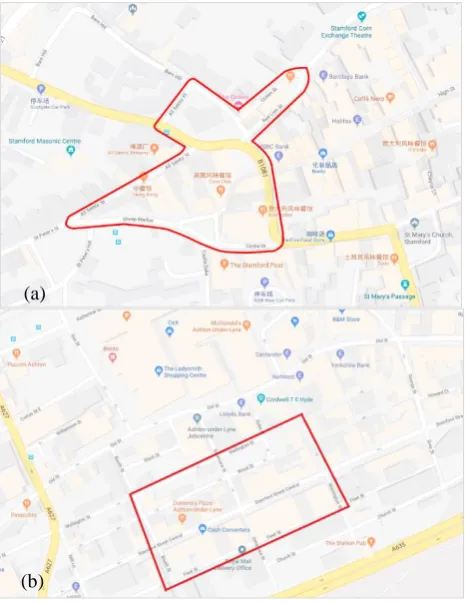
Considering the fact that pedestrians, weather and traffic conditions will influence the subjects’ memory of the road network (Fotios, Uttley et al. 2015), we used street views from Google Maps as experiment material in this study. A part of business areas in Stamford, Lincolnshire and Ashton-under-Lyne, Greater Manchester served as the study area for irregular road networks and regular road networks, respectively (Figure 1). On Day 1, we asked the subjects to learn and remember the road networks using Google Maps while road labels and compass were shown
and other widgets were hidden using Google Maps API (https://developers.google.com/maps/documentation/java script/tutorial). On Day 2, the materials used in the ORI and SRS tasks were screenshots of Street View (1024 * 640), in which the road signs were removed, leaving only the compass.
Figure 1 Experiment area (from Google Maps, (a) for irregular road network and (b) for regular road network).
2.5 Procedure
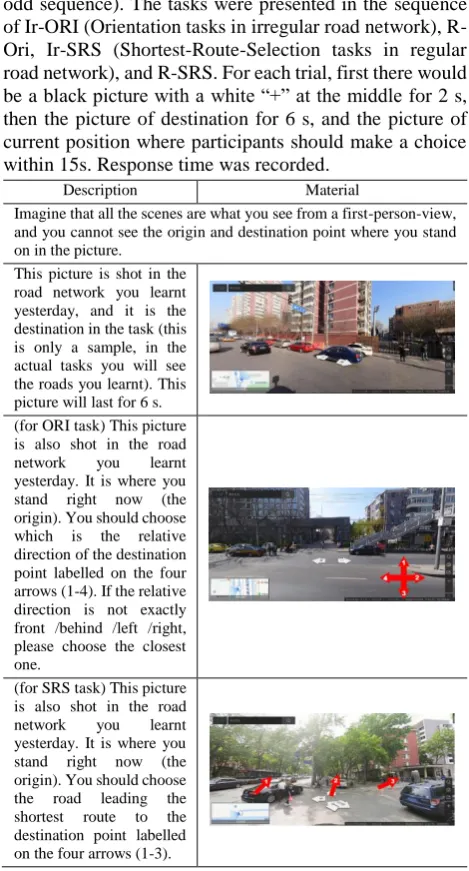
On Day 1, we first obtained written informed consents from each subject and explained the ORI and SRS tasks to them using the street view from Baidu Maps of the area near Beijing Normal University (Table 1), which was familiar to them. After knowing how to move in Google Street View freely by mouse or keyboard, subjects were guided to “walk” along the boundaries of the irregular road network in street view and asked to remember the specified area by traveling in it. Finally, we provided 10-12 screenshots of street view and required subjects to judge whether the screenshots were from the road network they had learned within 5 s for each. If the accuracy was above 90%, the same procedure would begin for the regular road network. Otherwise, the subjects needed to continue “walking” in the area.
One Day 2, first we confirmed with the subjects about the safety regulations again. Then they were explained the task instructions (Table 1) and required to answer some example questions to prove they understood the tasks correctly. During the task phase, no further instruction would be provided unless the task section changes (i.e. from ORI to SRS). Event-related design was used in the fMRI experiment, including anatomical MRI scan, resting state fMRI scan and 4 task fMRI scans (10 trials for each
(a)
task scan). The process of the scan was as follow: T1 anatomical scan with 10 min, resting state scan with duration 200TR (400 s), task fMRI scan with duration 4*116 TR (4*232 s, TR = 2000 ms, TE = 30 ms, flip angle = 90°, FOV = 220 mm, resolution = 64, matrix size = 384×384, voxel size = 3.125×3.125×3.5 mm, interleaved odd sequence). The tasks were presented in the sequence of Ir-ORI (Orientation tasks in irregular road network), R-Ori, Ir-SRS (Shortest-Route-Selection tasks in regular road network), and R-SRS. For each trial, first there would be a black picture with a white “+” at the middle for 2 s, then the picture of destination for 6 s, and the picture of current position where participants should make a choice within 15s. Response time was recorded.
Description Material
Imagine that all the scenes are what you see from a first-person-view, and you cannot see the origin and destination point where you stand on in the picture.
This picture is shot in the road network you learnt yesterday, and it is the destination in the task (this is only a sample, in the actual tasks you will see the roads you learnt). This picture will last for 6 s. (for ORI task) This picture is also shot in the road network you learnt yesterday. It is where you stand right now (the origin). You should choose which is the relative direction of the destination point labelled on the four arrows (1-4). If the relative direction is not exactly front /behind /left /right, please choose the closest one.
(for SRS task) This picture is also shot in the road network you learnt yesterday. It is where you stand right now (the origin). You should choose the road leading the shortest route to the destination point labelled on the four arrows (1-3).
Table 1. Task description
2.6 Data Analysis
The raw scanned images acquired was first converted from DICOM format to .inn format by MRIConvert (https://lcni.uoregon.edu/downloads/mriconvert). Then we analyzed the functional imaging data using the SPM8 software package (Statistical Parametric Mapping, Department of Cognitive Neurology, London) and visualized the analysis results with xjView toolbox (http://www.alivelearn.net/xjview). The processing steps include slice timing correction, realignment, coregister and normalization. The middle slices were used as reference in time slicing. Functional volumes with movements exceeding 2 mm in translation errors or 2 in rotation errors (in any direction) were excluded. The high-resolution
structural images were then coregistered with the mean BOLD image obtained during motion correction. Finally, the coregistered BOLD images were spatially normalized into standard Montreal Neurological Institute (MNI) space.
The single-subject analysis was used using fMRI First level analysis in SPM. We used the t-contrasts method to compare the active brain function area under the same task with different road networks (uncorrected p<0.01, cluster size>10), taking the 4 tasks as 4 conditions, the response time of each task as the parametric modulations and the head motion parameter as the multiple regression parameter.
We admit that there were some flaws in the experiment, as the different kinds of tasks should have been in the same run so that the interval time could have been better controlled. In this experiment, there might be some uncovered active brain areas due to these separated runs, however, the results we got from this experiment should be the most significant difference and still worth being reported here.
3.
Results and Discussion
3.1 Orientation task
Table 2 shows the active brain areas in Orientation task (irregular road networks – regular road networks, only show + values). Compared with the orientation tasks in regular road networks, those in irregular road networks evoked more active response mainly in middle frontal gyrus, superior frontal gyrus and medial frontal gyrus. Middle frontal gyrus is part of high cognition network, relates to working memory, attention and planning. Superior frontal gyrus is related to voluntary movement and eye movement. Medial frontal gyrus is about decision- making. Specifically, Subject A showed stronger activation in precentral gyrus, which is also related to voluntary movement; Subject E shows stronger response in cingulate gyrus and inferior parietal lobule, which relates to switch between egocentric and allocentric perspective and egocentric perspective itself, respectively. Frontal lobe plays an important role in human navigation. Boccia, Guariglia et al. (2016) found that at the beginning of route learning, frontal gyrus’ activation was strong, but it would decrease as the subjects get familiar with the study area, which indicates that activation of frontal lobe is related to familiarity of route. In this study, it indicates that subjects are more familiar with the regular road compared with irregular ones.
The results indicate that in orientation tasks, subjects had worse memory about irregular roads. The orientation tasks in irregular roads required more concentration with a higher workload, and possibly evoked more memories about switch of view during learning.
Orientatio
n Irregular-Regular
Subject
Peak MNI Coordination
Peak Value
Peak MNI Coordination Area
Subject A
58 -2 46 4.0546 Precentral Gyrus
Subject B
26 10 52 4.0066 Middle Frontal Gyrus
-22 10 56 4.1213 Superior Frontal Gyrus
-20 18 60 3.9072 Middle Frontal Gyrus
Subject C
-10 34 -22 4.0659 Rectal Gyrus
-36 64 6 4.0857 Middle Frontal Gyrus
Subject D 32 66 8 4.0194
Superior Frontal Gyrus
Subject E
-6 48 -10 3.898 Medial Frontal Gyrus 4 56 4 4.234 Medial Frontal Gyrus
-10 46 8 4.7715 Medial Frontal Gyrus
-26 52 16 3.92 Middle Frontal Gyrus
26 58 26 3.8386 Middle Frontal Gyrus -8 22 32 4.2863 Cingulate Gyrus
-56
-38 38 4.149
Inferior Parietal Lobule
6 24 60 4.7982 Superior Frontal Gyrus
Table 2. Active brain areas in orientation tasks (irregular - regular)
Table 3 shows the active brain areas of regular road networks – irregular road networks (only + values are shown) and no unified active brain area was found. This shows that the detected active brain area might not be related to the task or indicates special strategies in performing the tasks. For example, Subject C’s superior temporal gyrus, which is related to process of verbal information, showed stronger activation in regular roads. This subject could have a special verbal memory about this road network during Day 1’s learning, as the subjects were not asked to maintain absolutely quiet in the learning. Also, it could be the subject is imaging him/herself walking in that area in an egocentric perspective and updating his/her current location, according to Lawrence’s finding based on visually impaired subjects.
Orienta
tion Regular - Irregular
Subject Peak MNI Coordination Peak Value Peak MNI Coordination Area Subject A 66
-22 -6 4.441
Middle Temporal Gyrus
18 40 22 3.7768 Medial Frontal Gyrus
Subject C
44 6
-20 4.1786
Superior Temporal Gyrus
48 0
-10 3.656
Superior Temporal Gyrus
Subject E
-24 58 -2 3.8924
Superior Frontal Gyrus
46 34 26 3.9042 Middle Frontal Gyrus
36
-58 32 3.7423 Sub-Gyral
46
-50 48 4.014
Inferior Parietal Lobule
-22 56
-42 4.4466 *
38 48
-36 3.8916
* Blank means undefined area, the followings are the same.
Table 3. Active brain areas in orientation tasks (regular - irregular)
3.2 Shortest-Route-Selection task
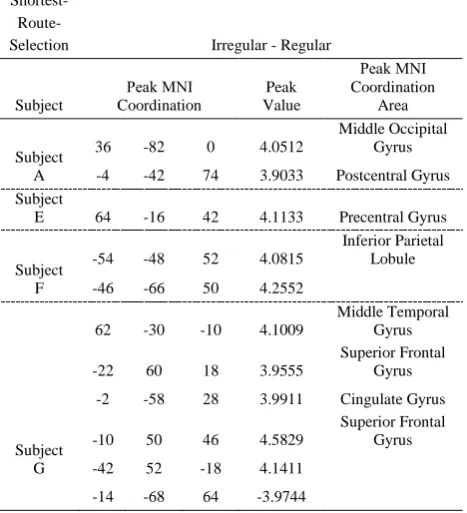
As Table 4, which shows the results in Shortest-Route-Selection tasks of irregular road networks – regular road networks (only show + values), shows that there are no unified brain areas that are more active in tasks in irregular road networks. This indicates that subjects had different strategies. However, different brain areas can indicate similar cognition process. Subject A showed more activation in middle occipital gyrus and Subject G showed more activation in superior frontal gyrus. While these two brain areas locate in different lobes, they are both related to visual information, i.e. visual cognition and eye movement control, respectively. This indicates that visual attention to be more complex in irregular road networks. Also, according to Boccia’s summary (Boccia, Nemmi et al. 2014), middle occipital gyrus is more active in learning new roads. Therefore, Subject A might have a better memory about regular roads. Also, Subject E showed stronger activation in precentral gyrus, which is related to mental orientation. Similar to Orientation tasks, there were also subjects showing stronger activation in cingulate gyrus (Subject G) and inferior parietal lobule (Subject F), which indicates in irregular road networks, subjects tend to apply an egocentric perspective of view and switch more frequently between ego- and allocentric perspective.
Shortest- Route-
Selection Irregular - Regular
Subject Peak MNI Coordination Peak Value Peak MNI Coordination Area Subject A
36 -82 0 4.0512
Middle Occipital Gyrus
-4 -42 74 3.9033 Postcentral Gyrus Subject
E 64 -16 42 4.1133 Precentral Gyrus
Subject F
-54 -48 52 4.0815
Inferior Parietal Lobule
-46 -66 50 4.2552
Subject G
62 -30 -10 4.1009
Middle Temporal Gyrus
-22 60 18 3.9555
Superior Frontal Gyrus
-2 -58 28 3.9911 Cingulate Gyrus
-10 50 46 4.5829
Superior Frontal Gyrus
-42 52 -18 4.1411
-14 -68 64 -3.9744
Table 4. Active brain areas in shortest-route-selection tasks (irregular - regular)
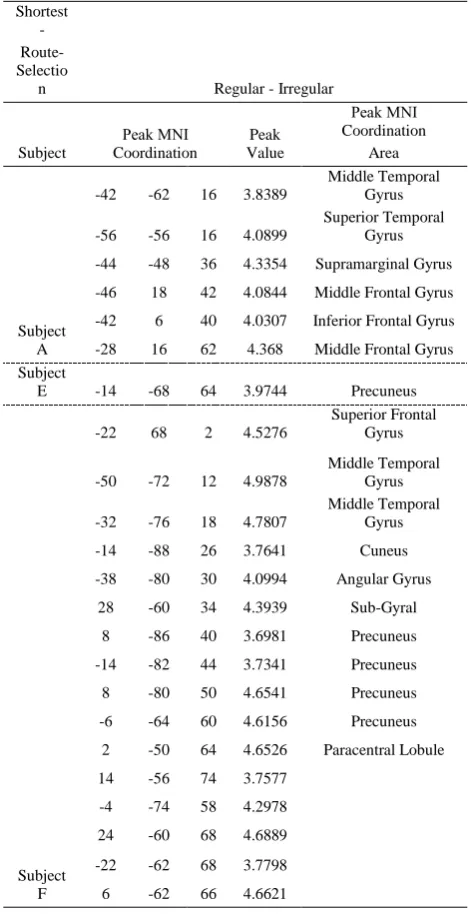
and plot memory, respectively. These subjects might have a better memory and maintain better sense of direction in regular road networks.
Shortest - Route-Selectio
n Regular - Irregular
Subject
Peak MNI Coordination
Peak Value
Peak MNI Coordination
Area
Subject A
-42 -62 16 3.8389
Middle Temporal Gyrus
-56 -56 16 4.0899
Superior Temporal Gyrus
-44 -48 36 4.3354 Supramarginal Gyrus
-46 18 42 4.0844 Middle Frontal Gyrus
-42 6 40 4.0307 Inferior Frontal Gyrus
-28 16 62 4.368 Middle Frontal Gyrus Subject
E -14 -68 64 3.9744 Precuneus
Subject F
-22 68 2 4.5276
Superior Frontal Gyrus
-50 -72 12 4.9878
Middle Temporal Gyrus
-32 -76 18 4.7807
Middle Temporal Gyrus
-14 -88 26 3.7641 Cuneus
-38 -80 30 4.0994 Angular Gyrus
28 -60 34 4.3939 Sub-Gyral
8 -86 40 3.6981 Precuneus
-14 -82 44 3.7341 Precuneus
8 -80 50 4.6541 Precuneus
-6 -64 60 4.6156 Precuneus
2 -50 64 4.6526 Paracentral Lobule
14 -56 74 3.7577
-4 -74 58 4.2978
24 -60 68 4.6889
-22 -62 68 3.7798
6 -62 66 4.6621
Table 5. Active brain areas in shortest-route-selection tasks (regular - irregular)
4.
Overall Discussion
In this empirical study, we applied fMRI-based experiment to find out the influence of irregular and regular road networks on geospatial cognition during orientation and shortest-route-selection tasks. The results show that the orientation task in irregular road networks requires more attention and might be demanding because more activations of the subjects were observed in middle frontal gyrus, superior frontal gyrus and medial frontal gyrus. For the shortest-route-selection task, some subjects showed better sense of distance and pictorial spatial memory, but there was no united active brain area. In both kinds of tasks, there were some subjects showing stronger activation in cingulate gyrus and inferior parietal lobule in irregular road networks compared with in regular ones,
which means in irregular road networks subjects are more likely to use egocentric framework and the switch more frequently between ego- and allocentric perspective. This study that may cover some difference and influence, this research work can serve as a starting point to explore more detailed influences caused by various road networks in combination with other variates, such as relative density and general orientation.
5.
Acknowledgements
This research is supported by the National Natural Science Foundation of China (NSFC, Grant No. 41871366), and China Scholarship Council (Grant No. 201806040219).
6.
References
Boccia, M., C. Guariglia, U. Sabatini and F. Nemmi (2016). "Navigating toward a novel environment from a route or survey perspective: neural correlates and context-dependent connectivity." Brain Structure and Function
221(4): 2005-2021.
Boccia, M., F. Nemmi and C. Guariglia (2014). "Neuropsychology of Environmental Navigation in Humans: Review and Meta-Analysis of fMRI Studies in Healthy Participants." Neuropsychology Review 24(2): 236-251.
Byrne, R. W. (1979). "Memory for Urban Geography." Quarterly Journal of Experimental Psychology 31(1): 147-154.
Fitzpatrick, K., P. Carlson, M. Brewer and M. Wooldridge (2001). "Design factors that affect driver speed on suburban streets." Transportation Research Record: Journal of the Transportation Research Board(1751): 18-25.
Fotios, S., J. Uttley, C. Cheal and N. Hara (2015). "Using eye-tracking to identify pedestrians’ critical visual tasks, Part 1. Dual task approach." 47(2): 133-148.
Green, P. (1994). "Driver workload as a function of road geometry: A pilot experiment."
Griffin, A. and A. Robinson (2010). Comparing color and leader line approaches for highlighting in geovisualization. Proc. GIScience.
Hamdar, S. H., L. Qin and A. Talebpour (2016). "Weather and road geometry impact on longitudinal driving behavior: Exploratory analysis using an empirically supported acceleration modeling framework." Transportation Research Part C: Emerging Technologies
67: 193-213.
Haynes, R., I. R. Lake, S. Kingham, C. E. Sabel, J. Pearce and R. Barnett (2008). "The influence of road curvature on fatal crashes in New Zealand." Accident Analysis & Prevention 40(3): 843-850.
Hegarty, M., A. E. Richardson, D. R. Montello, K. Lovelace and I. Subbiah (2002). "Development of a self-report measure of environmental spatial ability." Intelligence 30(5): 425-447.
Howard, Lorelei R., Amir H. Javadi, Y. Yu, Ravi D. Mill, Laura C. Morrison, R. Knight, Michelle M. Loftus, L. Staskute and Hugo J. Spiers (2014). "The Hippocampus and Entorhinal Cortex Encode the Path and Euclidean Distances to Goals during Navigation." Current Biology
24(12): 1331-1340.
Lawrence, M. M. (2011). Behavioral and neurological studies in tactile map reading and training by persons who are blind or visually impaired, University of Oregon. Lobben, A., M. Lawrence and J. M. Olson (2009). "fMRI and human subjects research in cartography." Cartographica: The International Journal for Geographic Information and Geovisualization 44(3): 159-169. Lobben, A. K., J. M. Olson and J. Huang (2005). Using fMRI in cartographic research. Proceedings of the 22nd International Cartographic Conference.
Montello, D. R. (2009). "Cognitive Research in GIScience: Recent Achievements and Future Prospects." Geography Compass 3(5): 1824-1840.
Schinazi, V. R., D. Nardi, N. S. Newcombe, T. F. Shipley and R. A. Epstein (2013). "Hippocampal size predicts rapid learning of a cognitive map in humans." Hippocampus 23(6): 515-528.
Spiers, H. J. and C. Barry (2015). "Neural systems supporting navigation." Current Opinion in Behavioral Sciences 1: 47-55.