PhD Dissertation
DISI - University of Trento
International Doctorate School in Information and Communication Technologies
L
ARGE
S
CALE
A
GGREGATED
S
ENTIMENT
A
NALYTICS
Mikalai Tsytsarau
Advisor:
Prof. Themis Palpanas
Universit`a degli Studi di Trento
Abstract
In the past years we have witnessed Sentiment Analytics becoming increasingly popular topic in Information Retrieval, which has established itself as a promising direction of research. With the rapid growth of the user-generated content represented in blogs, forums, social networks and micro-blogs, it became a useful tool for social studies, market analysis and reputation man-agement, since it made possible capturing sentiments and opinions at a large scale and with the ever-growing precision. Sentiment Analytics came a long way from product review mining to full-fledged multi-dimensional analysis of social sentiment, exposing people attitude towards any topic aggregated along different dimensions, such as time and demographics.
The novelty of our work is that it approaches Sentiment Analytics from the perspective of Data Mining, addressing some important problems which fall out of the scope of Opinion Mining. We develop a framework for Large Scale Aggregated Sentiment Analytics, which allows to capture and quantify important changes in aggregated sentiments or in their dynam-ics, evaluate demographical aspects of these changes, and explain the underlying events and mechanisms which drive them. The first component of our framework is Contradiction Anal-ysis, which studies diverse opinions and their interaction, and allows tracking the quality of aggregated sentiment or detecting interesting sentiment differences. Targeting large scale ap-plications, we develop a sentiment contradiction measure based on the statistical properties of sentiment and allowing efficient computation from aggregated sentiments. Another important component of our framework addresses the problem of monitoring and explaining temporal sentiment variations. Along this direction, we propose novel time series correlation methods tailored specifically for large scale analysis of sentiments aggregated over users demographics. Our methods help to identify interesting correlation patterns between demographic groups and thus better understand the demographical aspect of sentiment dynamics. We bring another in-teresting dimension to the problem of sentiment evolution by studying the joint dynamics of sentiments and news, uncovering the importance of news events and assessing their impact on sentiments. We propose a novel and universal way of modeling different media and their dy-namics, which aims to describe the information propagation in news- and social media. Finally, we propose and evaluate an updateable method of sentiment aggregation and retrieval, which preserves important properties of aggregated sentiments and also supports scalability and per-formance requirements of our applications.
Keywords
Acknowledgements
It is commonly acknowledged that novelty, usefulness and timeliness are the most valued factors of any research. It takes a deep experience to understand the novelty of a problem, a good imagination to see its usefulness and an incredible intuition to predict when it becomes necessary. But above all, it takes a good luck for all these qualities to meet in one person. In this regard I was very lucky to meet my advisor, Themis Palpanas, who first envisioned the idea of diverse sentiment aggregation, and then helped to develop it into a full-fledged analysis of aggregated sentiment. I am especially honored being his first doctoral student, and I would like to thank him for a careful guidance and wise management, and also for a great attention to my scientific endeavors.
My research took off from the problem of sentiment contradiction analysis and evolved to include the problems of demographical and dynamical analysis of aggregated sentiments, inspired by collaborations with the leading researchers in this area. It was my pleasure to work on the demographical sentiments problem with Sihem Amer-Yahia, who suggested many interesting ideas and motivated my research a lot. I am especially grateful for her confidence in usefulness of this research and in our methods. The analysis of sentiments dynamics took a start from the collaboration with Malu Castellanos and Meichun Hsu, and also led to a patent application with Umeshwar Dayal. I would like to thank them for very useful discussions that helped to shape this part of my work and understand its value. Finally, my thanks are due for Aris Gionis and Francesco Bonchi, whom I worked with on the diversity of itemsets. All these collaborations gave me an invaluable experience and I hope that they will continue in the future. I would also like to thank my friends and colleagues for all their numerous comments and suggestions, that helped to improve my dissertation: Maksim Khadkevich, Siarhei Bykau, Yury Audzevich, Evgeny Stepanov, and everyone I know. My special thanks are to the members of dbTrento group, who were eagerly interested in my work and asked hard questions during our seminars and meetings: Yannis Velegrakis, Oleksiy Chayka, Alice Marascu, Katya Mirylenka, Davide, Dimitra, Kostas, Matteo, Michele and Pavlos.
Contents
1 Introduction 1
1.1 Thesis Context and Problems . . . 2
1.2 Thesis Structure and Solutions . . . 3
1.3 Innovative Aspects . . . 4
1.4 Related Publications . . . 5
2 Background 7 2.1 Introduction . . . 7
2.2 Subjectivity Analysis . . . 10
2.2.1 Problems and Goals . . . 10
2.2.2 Terminology and Definitions . . . 10
2.3 Opinion Mining . . . 13
2.3.1 Problems in Opinion Mining . . . 13
2.3.2 Development of Opinion Mining . . . 14
2.3.3 Opinion Mining in Microblogs . . . 20
2.4 Opinion Aggregation . . . 22
2.4.1 Problems in Opinion Aggregation . . . 23
2.4.2 Development of Opinion Aggregation . . . 24
2.4.3 Opinion Aggregation and Spam . . . 26
2.5 Contradiction Analysis . . . 28
2.5.1 Problems in Contradiction Analysis . . . 28
2.5.2 Development of Contradiction Analysis . . . 29
2.6 Topic and Opinion Dynamics . . . 34
2.6.1 Topic Identification . . . 34
2.6.2 Topic Dynamics . . . 36
2.7 Discussion . . . 36
2.7.1 Analysis of Trends . . . 37
2.7.2 Comparison of Methods . . . 39
3 Problem Formulation 43
3.1 Introduction . . . 43
3.2 Problems . . . 44
3.2.1 Contradiction Analysis . . . 45
3.2.2 Demographics Analysis . . . 46
3.2.3 Dynamics Analysis . . . 47
4 Sentiment Aggregation 49 4.1 Introduction . . . 49
4.2 Aggregation . . . 50
4.3 Problems . . . 53
4.4 CTree . . . 55
4.5 DTree . . . 58
4.6 Performance Evaluation . . . 61
5 Contradiction Analysis 67 5.1 Introduction . . . 68
5.2 Problem Definition . . . 69
5.3 Contradiction Detection . . . 72
5.3.1 Preprocessing . . . 72
5.3.2 Contradictory Distributions . . . 73
5.3.3 Modeling Contradictions . . . 75
5.3.4 Detecting Contradictions . . . 78
5.4 Experimental Evaluation . . . 81
5.4.1 Datasets . . . 82
5.4.2 Accuracy . . . 83
5.4.3 Correctness . . . 85
5.4.4 Usefulness . . . 87
5.5 Conclusions . . . 91
6 Demographics Analysis 93 6.1 Introduction . . . 93
6.2 Problem Definition . . . 96
6.3 Sentiment Correlation . . . 100
6.4 Method and Algorithms . . . 102
6.4.1 Computing Correlations . . . 102
6.4.2 Pruning Correlations . . . 105
6.5 Experimental Evaluation . . . 110
6.5.1 Datasets . . . 111
6.5.2 Methodology . . . 113
6.5.3 Accuracy . . . 113
6.5.4 Performance . . . 117
6.5.5 Usefulness . . . 118
6.6 Conclusions . . . 119
7 Dynamics Analysis 123 7.1 Introduction . . . 123
7.1.1 Motivating Scenarios and Examples . . . 125
7.1.2 Contributions . . . 126
7.2 Problem Definition . . . 127
7.3 Background and Related Work . . . 130
7.3.1 Models of News Dynamics . . . 130
7.4 Method . . . 134
7.4.1 Correlating News and Sentiments . . . 136
7.4.2 Detecting Impacting Events . . . 137
7.4.3 Annotating Events . . . 144
7.5 Experimental Evaluation . . . 146
7.6 Conclusion . . . 155
8 Conclusions and Future Work 157
Bibliography 159
List of Tables
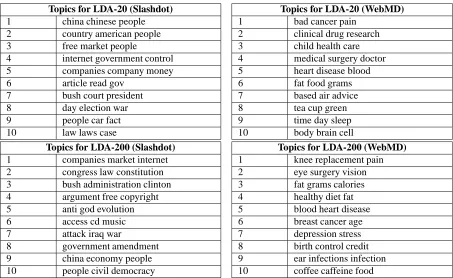
2.1 Top ten topics identified for Slashdot and WebMD datasets. . . 36
4.1 Capacity of a 4K disk page for different data. . . 57
5.1 Performance evaluation of synchronous contradiction detection. . . 83
5.2 Examples of contradicting posts. . . 88
5.3 Performance of contradiction detection aided by our approach versus a baseline. 90 6.1 Positive and negative sentiment correlations identified in MovieLens dataset. . . 122
7.1 Notations used in this section. . . 127
7.2 Estimated decay parameters. . . 147
7.3 Sentiment correlation statistics for selected time series from Twitter. . . 154
1 An overview of the most popular sentiment extraction methods. . . 170
2 Precision of sentiment extraction for different implementations. . . 172
3 An overview of the most popular opinion mining datasets. . . 172
4 Attributes of database storage Cdb. . . 173
List of Figures
2.1 An example of Google and Bing review aggregations. . . 22
2.2 An example architecture of product review aggregation. . . 23
2.3 An example of geographical sentiment aggregation from [153]. . . 25
2.4 Opinion timeline visualization from [19]. . . 29
2.5 Contradiction timeline visualization from [133]. . . 32
2.6 Blogosphere topic convergence from [140]. . . 33
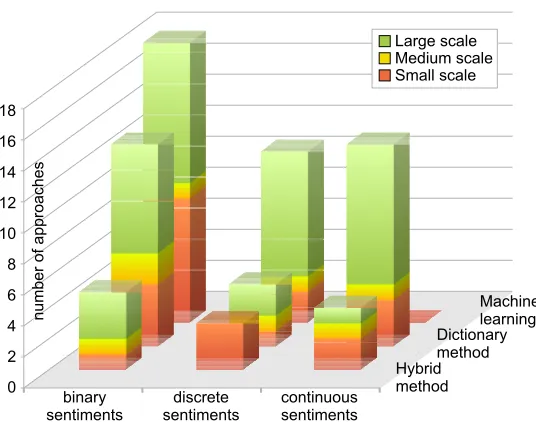
2.7 Number and scalability of methods over sentiment representation and algorithms. 38 2.8 Number of algorithms with different scalability levels over the last years. . . . 39
2.9 Percentage of algorithms targeting different domains over the last years. . . 39
3.1 Compositional diagram of the proposed framework. . . 44
4.1 A time series from Twitter with various aggregations. . . 51
4.2 The weight function approximating the significance of aggregates. . . 52
4.3 Logical structure of CTree. . . 55
4.4 Physical structure of CTree nodes. . . 57
4.5 Update diagram for different CTree implementations. . . 58
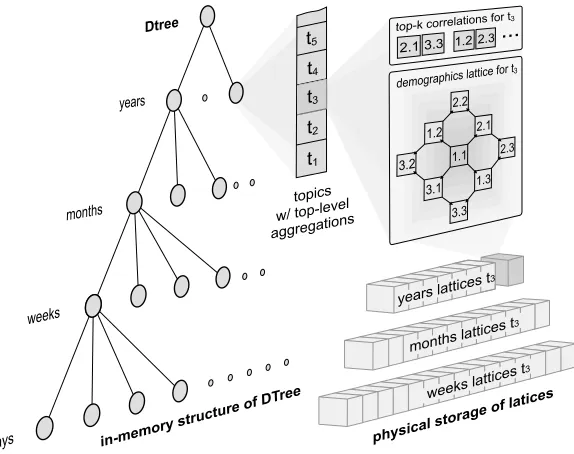
4.6 Logical structure of DTree. . . 60
4.7 Physical structure of DTree nodes. . . 61
4.8 Performance of DTree versus memory cache size. . . 64
4.9 Single-topic vs all-topics queries scalability. . . 65
4.10 Update time vs number of topics. . . 66
4.11 CTree top-k queries performance. . . 66
5.1 Schema of contradiction analysis. . . 72
5.2 Typical sentiment distributions. . . 74
5.3 Possible sentiment distributions. . . 76
5.4 Sentiment data with artificial contradictions. . . 79
5.5 The effect of neutral sentiments on Formula 5.10. . . 80
5.6 Accuracy of asynchronous contradiction detection with or without regression. . 85
5.7 Average and smooth sentiments for “Internet government control”. . . 86
6.1 Two demographics hierarchies forming a lattice. . . 97
6.2 Examples of different correlation types. . . 101
6.3 Performance of hard pruning. . . 106
6.4 Performance of soft pruning. . . 106
6.5 DBSCAN parameters space and optimization. . . 109
6.6 Generating biased sentiment time series. . . 111
6.7 Accuracy of baseline correlations vs aggregation. . . 114
6.8 Precision and recall of baseline correlations. . . 114
6.9 Compression error for top-k correlations. . . 116
6.10 Accuracy of top-k correlations, 10 days aggregation. . . 116
6.11 Performance of baseline methods. . . 117
6.12 Performance of pruned methods. . . 117
6.13 Positive sentiment correlations in MovieLens. . . 120
6.14 Negative sentiment correlations in MovieLens. . . 121
7.1 The search interest for the topic “iPod”, outbursting during Christmas sales. . . 124
7.2 The effect of trend subtraction on Search Interest. . . 125
7.3 The effect of deconvolution on News Frequency. . . 126
7.4 An example of correlation between sentiment and news volume. . . 128
7.5 Classes of event importance from [73]. . . 131
7.6 Classes of event dynamics from [29]. . . 131
7.7 A diagram of the sentiment shift prediction. . . 135
7.8 Correlated bursts of n(t)and s+(t)from Twitter. . . 137
7.9 Media response functions and their frequency domain response. . . 139
7.10 Rectangular event importance shapes and their convolution. . . 140
7.11 Triangular event importance shapes and their convolution. . . 141
7.12 Event importance time series obtained by deconvolution. . . 142
7.13 The search interest for the topic “iPod”, featuring exponential decay. . . 146
7.14 Decay parameters estimation using exponential regression. . . 146
7.15 Optimized decay parameters. . . 147
7.16 Time series and the predicted volume from [75]. . . 148
7.17 A time series approximation by hyperbolic deconvolution. . . 148
7.18 Error distribution for meme and deconvolution models (hyperbolic). . . 149
7.19 Error distribution of deconvolution models for Meme dataset. . . 150
7.20 Error distribution of deconvolution models for Twitter dataset. . . 151
7.21 Error distribution of deconvolution models for Google dataset. . . 152
7.22 Search interest time series from Google. . . 152
Chapter 1
Introduction
During the recent years we have been witnessing the Internet becoming an open platform, where people can express their opinions and can be heard. There are many services that allow people to publish information and opinions, such as blogs, wikis, forums, social networks and others. They all represent a rich source of opinionated information on different topics, which can be analyzed and exploited in various applications and contexts. It is therefore not surprising that we witness an increasing interest in the processing and analysis of unstructured data, with a special focus on Web text data. The wealth of information on the Web makes this endeavor not only rewarding in terms of newly produced knowledge, but also necessary, in order to exploit all this available information.
Sentiment Analysis can be used to learn about a customer’s attitude to a product or its features, or to reveal people’s reaction to some event or their political preferences. Opinions expressed by users are an important factor taken into consideration by product vendors, policy makers and stock analysts. The analysis of sentiments brings significant economic effects to various businesses and therefore we also observe a booming of services that analyze public sentiment on-demand. We believe that the interest in mining Web data would only continue to grow, as new sources of such data emerge and attract more attention from businesses and researchers alike.
1.1. THESIS CONTEXT AND PROBLEMS CHAPTER 1. INTRODUCTION
1.1
Thesis Context and Problems
People provide a huge amount of personal experiences and opinions towards different topics in the Web: In reviews, they express their opinions and experiences with a specific product or service. In blog postings, a mixture of information, arguments, and opinions can be found. Fo-rum postings can be seen as online discussions and exchange platform of arguments. Microblog messages bear a reaction of people towards various events and personal experiences. All these expressed opinions are interesting for different applications. Consider the following scenarios:
1. Given a specific medical treatment, a physician might be interested in positive and neg-ative experiences or opinions with respect to this treatment. But, not only a quantitneg-ative im-pression is useful to him, also how the opinion changed over time and which arguments were used in favor or against a specific treatment. Another example of contrasting sentiments comes from political topics, which are extensively discussed in the Web. Being aware of the opinions expressed towards these topics might be crucial to come up with the correct prediction of the impact and support for certain policies or decisions.
2. In some cases we want to detect where opinion of a group of people deviates from the general population or from that of another group with different demographical attributes. For instance, when computer scientists like sci-fi movies more than people working in Finance. An-other type of biases that we are interested in considers behavioral differences of demographical groups, e.g. when people living in Italy think differently about their local events compared to people from Europe in general.
3. Changes in community’s opinion are usually driven by new evidence or by impacting events coming from news sources. However, these are often not mentioned explicitly in texts, and to recognize the cause of sentiment changes we want to navigate to a correlated news trend and analyze the volume of news around a sentiment change. Then, by observing the dynamics of social media and their delayed reaction, we want to predict these changes as soon as we are able to recognize the establishing news trend.
Evidently, such problems require analyzing significant amounts of data to produce a de-sired output, and special methods that can exploit this volume to improve the resolution and representativeness of sentiment analysis. Conventional sentiment aggregation methods may be inefficient for large scale analytics, especially when subsequent time intervals contain different amount of sentiments and when a simple average of diverse sentiment values is taken. The information about real sentiment values can even be lost, when aggregating opposite values.
CHAPTER 1. INTRODUCTION 1.2. THESIS STRUCTURE AND SOLUTIONS
1.2
Thesis Structure and Solutions
The objective of our research is to exploit the current work on sentiment analysis and opinion mining, and extend the state of the art in detecting, explaining and predicting sentiment con-tradictions. Our additional goal is to provide efficient and scalable sentiment aggregation and storage methods which serve as a basis for the proposed solutions.
This thesis is structured as follows. In Chapter 2 we discuss the related work in Subjec-tivity Analysis, various trends and directions of research in this area, and identify different problems, which help establishing the scope and aims of the present work. In Chapter 3 we give an overview the particular problems we address and their interaction within the proposed framework. We also outline the most important methods, necessary for tackling the identified problems, and analyze their requirements. Following this, Chapter 4 presents our approach for sentiment aggregation and storage, which supports the outlined requirements and serves as a basis for the solutions we list below.
In Chapter 5, we are focusing on the novel problem of Contradiction Analysis, which aims at finding sentiment-based contradictions and opinion shifts at a large scale. First, we give a thorough definition of contradictions, backed up by the analysis of related literature. Second, we evaluate typical sentiment distributions and the human perception of their diversity based on user experiments. Third, we introduce a novel measure of contradiction, which is based on our observations. We study its properties related to our definitions and real data. Finally, we propose a scalable and accurate method for identifying contradictions at different time scales and evaluate its performance using synthetic and real-world datasets, as well as a user-study.
Chapter 6 discusses Demographics Analysis of extracted contradictions and concentrates on the detection of correlated user behavior. We propose a scalable approach for correlation detection among various demographic groups, which is suitable for the analysis of their biases and behavioral similarity. The novelty of our method is that it achieves very high efficiency by compressing the top-k correlations, without significantly affecting the quality of the results. We test our approach on both synthetic and real datasets, proving its efficiency and effectiveness.
In Chapter 7, we formulate a problem of identifying news events that cause dramatic changes of sentiments and their Dynamics Analysis. We propose a novel framework for a complex news- and social media modeling, which is capable of detecting interesting features of events by observing a time series of news articles publications, search interest or social response, and then correlating these data with time series of sentiment changes detected by various interestingness functions. We also study the differences in response dynamics between various media.
1.3. INNOVATIVE ASPECTS CHAPTER 1. INTRODUCTION
1.3
Innovative Aspects
This work addresses a novel large-scale sentiment analytics problem, focusing on the efficient aggregation of sentiments, detection and explanation of sentiment contradictions and opinion shifts, and computation of significant sentiment correlations for different demographic groups within dynamically determined time intervals. The main contributions of this work can be summarized as follows.
• We describe a novel data structure, which enables sentiment analytics approaches to scale to very large data collections by a careful indexing of time and demographics into hier-archies. It is incrementally maintained in an online environment, and can outperform a relational DBMS implementation by up to 3 orders of magnitude. Moreover, our storage maintains the statistical aggregates of sentiments, sufficient to extract the most important sentiment metrics and assess their significance. In order to enhance the performance of our algorithms, we also describe analytical results that allow to prune the search space, while maintaining quality guarantees on results.
• We formally define the problem of contradiction detection, and further describe two vari-ations of the problem, namely, synchronous and asynchronous contradictions. We present an approach for sentiment contradiction detection, which is using a novel contradiction measure based on mean and variance of sentiment distribution. We also develop sev-eral other measures of aggregated sentiment, which capture the desired behavior. Our approach is uniquely designed to withstand noise and irregularity of online sentiment, thanks to regression analysis and smart thresholding.
• We study various correlation measures and describe their semantics within the scope of sentiment data. Based on a sentiment correlation of demographic groups, and their hier-archical relations, we define the concept of demographics maximality, which is especially useful for automated analysis of meaningful correlations on a large scale. Specific to demographics sentiments and maximality formulation, we describe efficient correlation pruning methods. Furthermore, we introduce two novel methods for correlation compres-sion, which allow for the efficient implementation of our algorithms.
CHAPTER 1. INTRODUCTION 1.4. RELATED PUBLICATIONS
• We conduct an extensive set of experiments on several synthetic and real datasets to val-idate our problems, and evaluate the performance of our solutions. The experiments demonstrate that contradictions and correlated demographic groups can be identified very efficiently with the help of our specialized indexing storage and effective pruning. Finally, our evaluation provides insights on contradictions for a range of popular topics, and inter-esting correlations among real demographic groups, which can be of particular interest to social scientists and social recommender applications.
1.4
Related Publications
[ – ] Tsytsarau M, Palpanas T (2013) Mining Sentiment-based Contradictions at Web scale. InfSys, Information Systems, Elsevier (pending)
[136] Tsytsarau M, Amer-Yahia S, Palpanas T (2013) Efficient Sentiment Correlation for Large-scale Demographics. In: ACM SIGMOD Conference, New York, USA, June 22-27, 2013 [135] Tsytsarau M, Palpanas T, Castellanos M, Hsu M, Dayal U (2012) Identifying News Events That Cause A Shift In Sentiment. US Patent HP-82962988 (pending)
[130] Tsytsarau M, Palpanas T (2011a) Survey on mining subjective data on the web. DMKD, Data Mining and Knowledge Discovery, Special Issue on 10 Years of Mining the Web, pp 1-37, DOI: http://dx.doi.org/10.1007/s10618-011-0238-6, iSSN 1384-5810
[134] Tsytsarau M, Palpanas T, Denecke K (2011) Scalable detection of sentiment-based con-tradictions. In: First International Workshop on Knowledge Diversity on the Web, Colocated with WWW 2011, Hyderabad, India, March 28-31, 2011
[131] Tsytsarau M, Palpanas T (2011b) Towards a framework for detecting and managing opin-ion contradictopin-ions. In: ICDM Workshops, pp 1219–1222
[133] Tsytsarau M, Palpanas T, Denecke K (2010) Scalable discovery of contradictions on the web. In: Proceedings of the 19th International Conference on World Wide Web, WWW 2010, Raleigh, USA, April 26-30, 2010
[132] Tsytsarau M, Palpanas T, Denecke K, Brosowski M (2009) Scalable Discovery of Con-tradicting Opinions in Weblogs. Tech. Rep. DISI-09-038, DISI, University of Trento
Chapter 2
Background
The purpose of our background study is to highlight the development of the field with a focus on the recent years, examine the main trends that have appeared in the study of the field and their evolution over time, report in a systematic way the performance results of competing algorithms and the characteristics of the available datasets, and discuss some of the emergent topics and open research directions in the area of Subjectivity Analysis.
2.1
Introduction
Since the World Wide Web first appeared two decades ago, it has changed the way we manage and interact with information. It has now become possible to gather the information of our preference from multiple specialized sources and read it straight from our computer screen. But even more importantly, it has changed the way we share information. The audience (i.e., the receivers of the information) does not only consume the available content, but in turn, actively annotates this content, and generates new pieces of information. In this way, the entire com-munity becomes a writer, in addition to being a reader. Today people not only comment on the existing information, bookmark pages, and provide ratings, but they also share their ideas, news and knowledge with the community at large.
There exist many mediums, where people can express themselves on the web. Blogs, wikis, forums and social networks are examples of such mediums, where users can post information, give opinions and get feedback from other users. In their own right, they collectively represent a rich source of information on different aspects of life, but more importantly so on a myriad of different topics, ranging from politics and health to product reviews and traveling. The in-creasing popularity of personal publishing services of different kinds suggests that opinionative information will become an important aspect of the textual data on the web.
2.1. INTRODUCTION CHAPTER 2. BACKGROUND
To achieve this, subjectivity filtering is applied [116], in order to remove texts that may provide a biased point of view. These texts can be distinguished by analyzing sentiments expressed by the authors, or by discovering explicit marks of contradiction with other texts [37]. This dimension of web search emphasizes the importance of analyzing subjective data.
We now turn our attention to the following interesting question: whether the subjective data that exist on the web carry useful information. Information can be thought of as data that reduce our uncertainty about some subject. According to this view, the diversity and pluralism of information on different topics can have a rather negative role. It is well understood, that true knowledge is being described by facts, rather than subjective opinions. However, this diversity in opinions, when analyzed, may deliver new information and contribute to the overall knowledge of a subject matter. This is especially true when the object of our study is the attitude of people. In this case, opinionative data can be useful in order to uncover the distribution of sentiments across time, or different groups of people.
It is now becoming evident that the views expressed on the web can be influential to readers in forming their opinions on some topic [57]. Similarly, the opinions expressed by users are an important factor taken into consideration by product vendors [61, 56, 17] and policy mak-ers [97]. There exists evidence that this process has significant economic effects [4, 5, 21]. Moreover, the opinions aggregated at a large scale may reflect political preferences [137] and even improve stock market prediction [13]. These arguments are illustrated in the following examples.
Example 1. Today we can see a growing number of blogs focused on various aspects of
politics. They cover the entire spectrum of interested parties: from simple citizens expressing their opinions on everyday issues, to politicians using this medium in order to communicate their ideas (as was best exemplified during the last USA presidential elections), and from jour-nalists criticizing the government to the government itself. It is to the benefit of all the parties mentioned above to follow the opinions that are expressed on a variety of topics, and to be able to identify how these opinions or public sentiments change and evolve across time.
Example 2. Imagine a potential buyer of a digital camera, who is not familiar with the details
of this technology. In this case, reading the camera specifications can be an arduous task. In contrast, the opinion of the community that shares the same interests with the buyer, can be very informative. Therefore, a system that accumulates feedback and opinions originating from multiple sources, effectively aggregates this information, and presents the result to the user, can be both helpful and influential.
In this study, we introduce readers to the problems of Opinion Mining and Opinion
Aggre-gation, which have been rapidly developing over the last decade, as well as with a rather new
CHAPTER 2. BACKGROUND 2.1. INTRODUCTION
provide discussions on what the form of the problem that all papers in each one of these areas solve is, and, where applicable, we also include a mathematical formulation.
To the best of our knowledge, only a few systematic surveys were published in this area, which nevertheless played an important role of establishing it as an independent field of re-search. Out of them we may name the works of Pang and Lee [107] and [125], observing the area from perspectives of machine learning and review mining respectively, as well as the recent work by Liu Bing [82], systemizing existing methods and problems.
Our current study has notable differences to the ones mentioned above, with respect to both new content, and also to the way that some common references are being treated. We provide a more balanced view on Subjectivity Analysis from perspectives of its historic development and evolution of methods. Our special attention is devoted to the interaction between different problems in this area and to a variety of methods applied to tackle with them. We emphasize on the differences between these methods and try to outline their scope and applicability for solving the current as well as the emergent problems. Furthermore, we present novel comparative information (in the form of graphs and tables) on the algorithms in this area, related to the techniques they use, their performance, as well as to the datasets used for their experimental evaluation. Moreover, we include a considerable amount of new information - starting from the newly appeared literature on the topic and our evaluation of existing papers from the different perspectives, to a discussion of absolutely novel trends - Opinion Mining in Microblogs and Opinion Quality and Spam. This information helps the reader form an overall picture for the general area of Subjectivity Analysis: where the past efforts have concentrated on, which the most popular methods and techniques are, and what the current trends are.
In contrast with the first work, we build up our discussion around a classification of the pa-pers into four different approaches (machine learning, dictionary based, statistical, and seman-tic), also providing formal problem statements and method explanations wherever they were available for each of them. The approaches discussed are evaluated from different aspects, revealing their properties and applicability to Subjectivity Analysis. Similarly, the section on Opinion Aggregation mainly addresses the issues different to the work by [125]: we consider the recent advances, a general workflow, the problems and nuances of the area, rather than its particular methods. The work of Bing Liu [82], which appeared during the preparation of this work, also puts a considerable effort in systemizing the existing methods and providing their theoretical underpinnings. In our survey, we rather aimed at describing the evolution of these methods throughout the past decade and understanding the reasons of their popularity.
2.2. SUBJECTIVITY ANALYSIS CHAPTER 2. BACKGROUND
2.2
Subjectivity Analysis
Subjectivity Analysis involves various methods and techniques that originate from Information Retrieval (IR), Artificial Intelligence and Natural Language Processing (NLP). This confluence of different approaches is explained by the nature of the data being processed (free-form texts) and application requirements (scalability, online operation). Therefore, Subjectivity Analysis shares much of its terminology and problem definitions with the domains mentioned above. In the following paragraphs, we discuss in more detail the literature on the problems of Opinion
Mining and Opinion Aggregation. We review the recent developments in these areas, and then
present the field of Contradiction Analysis, which has recently started to attract interest.
2.2.1 Problems and Goals
The Subjectivity Analysis domain is still in the process of being shaped, and its problem state-ments touch upon different domains. Being originally studied in different communities, the problems of Opinion Mining and Sentiment Analysis have slightly different notions. Opinion Mining originates from the IR community, and aims at extracting and further processing users’ opinions about products, movies, or other entities. Sentiment Analysis, on the other hand, was initially formulated as the NLP task of retrieval of sentiments expressed in texts. Neverthe-less, these two problems are similar in their essence, and fall under the scope of Subjectivity Analysis. For the rest of this document, we will use both these terms interchangeably.
At a first level of approximation, the various Subjectivity Analysis techniques can be de-scribed as being composed of the following three steps:
1. identify; 2. classify; 3. aggregate.
These steps also implicitly list the most important problems in Subjectivity Analysis. For ex-ample, a typical opinion mining process involves the first two steps, and results in producing sentiment values for texts. In opinion aggregation, the third step is involved as well, in order to aggregate these sentiments. Note that even though this aggregation can be considered as a post-processing step, it is no less important than the previous steps. Indeed, the analyst is often times more interested in determining the common features and interesting patterns that emerge through sentiments from many different data sources, rather than in the opinions of particular authors.
2.2.2 Terminology and Definitions
CHAPTER 2. BACKGROUND 2.2. SUBJECTIVITY ANALYSIS
Opinion Mining operates at the level of documents, that is, pieces of text of varying sizes and formats, e.g., web pages, blog posts, comments, or product reviews.
Definition 1 (Document) D is a piece of text in natural language.
We assume that each document discusses at least one topic, and not all topics discussed in the same document have to be related to each other.
Definition 2 (Topic) T is a named entity, event, or concept that is mentioned in a document D. Examples of such topics are product features, famous persons, news events, happenings, or any other concept s that may attract our interest. What we are interested in is analyzing these topics in connection to any subjective claims that accompany them. Therefore, for each of the topics discussed in a document, we wish to identify the author’s opinion towards it.
Definition 3 (Sentiment) S is the author’s attitude, opinion, or emotion expressed on topic T . Sentiments are expressed in natural language, but as we will see below, they can in some cases be translated to a numerical or other scale, which facilitates further processing and analysis.
There are a number of differences in meaning between emotions, sentiments and opinions. The most notable one is that opinion is a transitional concept, which always reflects our attitude towards something. On the other hand, sentiments are different from opinions in that they reflect our feeling or emotion, not always directed towards something. Further still, our emotions may reflect our attitudes.
Generally speaking, the palette of human emotions is so vast, that it is hard to select even the basic ones. Most of the authors in the NLP community agree on the classification proposed by Paul Ekman and his colleagues [35], which mentions six basic emotions: anger, disgust,
fear, joy, sadness, surprise. Although this classification is consistent in itself, it needs to be
further extended by antonyms in order to allow capturing positive and negative shifts in opin-ion. Accordingly, Jianwei Zhang et al. [153] propose to group the basic emotions along four dimensions: Joy ⇔ Sadness, Acceptance ⇔ Disgust, Anticipation ⇔ Surprise, and Fear⇔ Anger. However, such a division requires a rather complex processing and analysis of the
in-put data, which is not always feasible. Therefore, the majority of the authors accept a simpler representation of sentiments according to their polarity [107]:
Definition 4 (Sentiment Polarity) The polarity of a sentiment is the point on the evaluation
scale that corresponds to our positive or negative evaluation of the meaning of this sentiment.
2.2. SUBJECTIVITY ANALYSIS CHAPTER 2. BACKGROUND
De Marneffe et al. [89] introduce a classification of contradictions consisting of seven types that are distinguished by the features that contribute to a contradiction (e.g., antonymy, negation, numeric mismatches). Antonymy are words that have opposite meanings, i.e., “hot - cold” or “light - dark”. Antonymy can give rise to a contradiction when people use these words to describe some topic. Negation imposes a strict and explicit contradiction, e.g., “I love you - I love you not”. Numeric mismatches form another type of contradiction, which may be caused by erroneous data: “the solar system has 8 planets - there are 9 planets orbiting the sun”. Their work defines contradictions as a situation where “two sentences are extremely unlikely to be true when considered together”. In other words, contradictions may be defined as a form of textual entailment, when two sentences express mutually exclusive information on the same subject [53].
The works discussed above rely on human-perceivable definitions of contradiction that sum-marize our expectations about which features contribute to a contradiction. Opposite sentiments are also very common sources of contradictions. However, they may be described in different terms compared to the textual entailment problem. Consider the following example: “I like this book - This reading makes me sick”. Both sentences convey a contradiction on opinions expressed about a book, yet they may appear together if they belong to different authors. There-fore, we may relax the ’exclusivity’ constraint of textual entailment and propose the following definition:
Definition 5 (Contradiction) There is a contradiction on a topic T in a document collection D, between two sets of documents,D1,D2⊂ D | D1TD2= /0, when the information conveyed
about T is considerably more different betweenD1andD2than within each one of them.
In the above definition, we purposely not specify exactly what it means for a sentiment value to be very different from another one. This definition captures the essence of contradictions, without trying to impose any of the different interpretations of what might cause a contradiction to arise. For example, if we assume that opinion polarity is the relevant information, then a contradiction would mean that two groups of documents express contrasting opinions on some topic. In Section 2.5 we discuss some of the papers for contrasting opinion summarization, which rely on this principle.
CHAPTER 2. BACKGROUND 2.3. OPINION MINING
2.3
Opinion Mining
Opinion Mining is the problem of identifying the expressed opinion on a particular subject and
evaluating the polarity of this opinion (e.g., whether the expressed opinion is positive or neg-ative). Opinion Mining forms the basis upon which other tasks under Subjectivity Analysis can be built. It provides an in-depth view of the emotions expressed in text, and enables the further processing of the data, in order to aggregate the opinions, or identify contradicting opin-ions. Evidently, the quality of the results of Opinion Mining is crucial for the success of all subsequent tasks, making it an important and challenging problem.
2.3.1 Problems in Opinion Mining
In the area of Opinion Mining, studies usually follow a workflow consisting of two steps:
iden-tify (topics, opinionative sentences), and classify (sentences, documents).
In the first step, we need to identify the topics mentioned in the input data, and also asso-ciate with each topic the corresponding opinionative sentences. During this step, we may also try to distinguish between opinionative and non-opinionative phrases (i.e., perform
subjectiv-ity identification). This additional task is useful, because not all phrases that contain sentiment
words are, in fact, opinionative. The reverse claim is also true: some of the opinionative phrases do not contain positively (or negatively) charged words. Therefore, performing this identifica-tion task can be an effective addiidentifica-tion to the classificaidentifica-tion step in order to improve precision [146, 32, 105, 116, 145, 147]. Furthermore, retrieval of opinionative documents evolved into a separate task with many specific algorithms, like in [152, 70, 154, 54].
During the second step, the problem of sentiment classification is most often a binary clas-sification problem, distinguishing between positive and negative texts. Nevertheless, additional classes can also be introduced, in order to make the analysis more robust and increase the qual-ity (i.e., granularqual-ity) of results. For example, some of the works include the neutral or irrelevant sentiment categories, which mean that there is no sentiment. By doing this, we can avoid the subjectivity identification task mentioned above, and have the classifier distinguish between opinionative and non-opinionative phrases. There is evidence that this approach has a positive effect on the precision of the final results [68]. Previous work [155] has also tried to improve sentiment classification by running this task separately for each of the topic’s features (deter-mined by an ontology) and averaging the output. Though, this step is generally considered as separate from topic identification [107].
In summary, we could argue that Opinion Mining can be viewed as a classification problem, distinguishing between several classes of sentiments (most often, positive, negative and
neu-tral). This division is applicable to some extent even to the methods that produce sentiments on
2.3. OPINION MINING CHAPTER 2. BACKGROUND
2.3.2 Development of Opinion Mining
Opinion Mining has been studied for a long time. Yet, the research in this area acceler-ated with the introduction of Machine Learning methods and the use of annotacceler-ated datasets [95, 108, 151, 32]. The evaluations found in [151, 71, 32, 3] demonstrate that opinion data obtained from the web, are represented primarily in discrete or categorical form. This happens mainly because ratings and opinion labels are represented by a limited number of categories on the web. Such availability of categorical training data favors the use of machine learning for such tasks as rating inference or review mining, and made machine learning tools the de-fault choice for solving the Opinion Mining problem. A side effect of the domination of these tools is that the sentiment classification task is mostly considered as a binary- or three-class classification problem, distinguishing among positive, negative, or neutral texts. However, it is not clear whether this approach is the winner. On the contrary, recent studies demonstrate the benefits of employing more complex (detailed) sentiment classifications [127], that provide sentiment values on a continuous scale. Moreover, it is not always possible to use supervised machine learning methods. For example, when there are no annotated training data (like in blog opinion retrieval), other types of approaches, like Dictionary, Statistical, and Semantic become an interesting alternative.
The Machine Learning Approach is a sophisticated solution to the classification problem that can be generally described as a two-step process: 1) learn the model from a corpus of training data (supervised, unsupervised), and 2) classify the unseen data based on the trained model.
Below, we provide a formal statement for the (supervised) learning step, adapted to our ter-minology. We assume training data are documents represented in a space,D, whose dimensions are document features (e.g., frequency of words, bi-grams, etc.). Furthermore, these documents have been assigned a sentiment label from a spaceS:
Given training data{(Di∈D,Si∈S)}, find g :D→S, g(Di) =arg max S
f(Di,Si) (2.1)
The above formulation says that given a set of training pairs, we want to find a function g that maps documents to sentiment labels, according to the best prediction of some scoring function
f . This function takes as input documents and sentiment labels and gives a sentiment label
prob-ability prediction (using either conditional or joint probprob-ability). Without loss of generality, the learning process can be considered as an estimation of the scoring function. Examples of such scoring functions are feature vectors inD, computed relative to class separating hyperplanes, or functions based on decision trees.
CHAPTER 2. BACKGROUND 2.3. OPINION MINING
is obtained, which may be either annotated with sentiment labels (supervised learning), or not (unsupervised learning). Second, each document is represented as a vector of features. We describe examples of such representations further in the text. Third, a classifier is trained to distinguish among sentiment labels by analyzing the relevant features. Finally, this classifier is used to predict sentiments for new documents.
The current popularity of the machine learning approach for opinion mining originates from the work “Thumbs up?” by Pang and Lee [108]. The authors proposed and evaluated three supervised classification methods: Naive Bayes (NB), Maximum Entropy (ME) and Support Vector Machines (SVM). According to their evaluation, SVM showed the best performance, while NB was the least precise out of the three (though, the differences among them were small). Nevertheless, all the algorithms clearly surpassed the random choice baseline, exhibiting an average precision of around 80%. Dave et al. [32] further extended the work of Pang and Lee, emphasizing feature selection. They also used Laplacian smoothing for NB, which increased its accuracy to 87% (for a particular dataset). However, the SVM classifier has achieved similar results, performing below NB only when using unigram features (refer also to Table 2). Pang and Lee [105] also used subjectivity identification as a preprocessing step in order to improve the precision of NB.
The sentiment analysis task is very similar to the rating inference task, in which the class labels are scalar ratings, such as 1 to 5 “stars”, representing the polarity of an opinion. The need to provide a finer resolution of sentiments, without affecting the classification accuracy, required different multi-class categorization methods compared to traditional SVM. Although the SVM method has proved its efficiency for binary classification, the new problem demanded more sophisticated solutions.
2.3. OPINION MINING CHAPTER 2. BACKGROUND
similar documents using a distance measure computed directly from document features. These assumptions are similar to metric labeling, except that they are used a-priori, thus, allowing to use even unlabeled data for training. Although their approach exhibited better performance than SVR, the authors mention that it is sensitive to the choice of the similarity measure, and not able to benefit from the use of additional labeled data.
In the studies discussed above, rating inference tasks have been considered at the document level, thus showing an ’average’ precision on heterogeneous reviews, which mention multiple aspects of the product with different sentiments expressed on each one. This brings up the problem of contextual sentiment classification, which requires algorithms not only operating at the sentence level, but also involving the context of each sentence in their analysis [147]. Extending on [106], Shimada and Endo [118] proposed to analyze ratings on the product-feature level, naming their work “Seeing Several Stars”. They have demonstrated that SVR, despite being less precise than SVM, produces output labels that are closer to the actual ones. This evidence also supports the claim in [106] that with the use of a “gradual” function in SVR “similar items necessarily receive similar labels”.
Topic-dependent sentiment analysis on a sub-document level is also becoming a standard tool for opinion extraction. O’Hare et al. [101] present an approach to topic-dependent senti-ment analysis in financial blogs. In particular, positive and negative opinions expressed towards companies and their stock are distinguish by a machine learning approach (Naive Bayes, SVM). Based on topic terms, their approach first identifies text paragraphs dealing with a specific topic. Sentiment analysis is then performed on sub-document level.
Apart from the choice of algorithms and data selection, the performance of machine learning approaches is heavily dependent on feature selection. The most straightforward (yet, in some cases very effective) way is to encode each feature in the set by its presence or absence in the document. In the case of word features, this would produce a simple binary vector representa-tion of a document. Extending this representarepresenta-tion, we can instead use relative frequencies of words’ occurrence [118]. Though, not all words are equally representative and, therefore, use-ful for subjectivity analysis. This provides an opportunity to make the learning process more efficient by reducing the dimensionality of D (refer to Formula 2.1). Osherenko et al. [102] demonstrate that it is possible to use just a small set of the most affective words as features, almost without any degradation in the classifier’s performance. Interestingly, the direct use of sentiment values from such dictionaries, instead of binary feature presence values, has shown little to no increase of precision. Therefore, studies usually use frequencies of words instead. For example, Devitt and Ahmad [34] identify sentiment-bearing words in a document by using SentiWordNet, but then use just their frequencies of occurrence for the classification task. This approach is also popular with dictionary methods, which we describe below.
CHAPTER 2. BACKGROUND 2.3. OPINION MINING
mining as well. For instance, Zhang et al. [154] describe an approach that uses an SVM trained on a set of topic-specific articles obtained from Wikipedia (objective documents) and review sites (subjective documents) to perform subjectivity identification. Another example is the use of machine learning to classify opinion spam [62, 78].
The Dictionary Approach relies on a pre-constructed dictionaries that contain opinion polarities of words. When it is necessary to process a continuous flow of texts coming at a high rate (which is the case for web-scale analysis), simple implementations of this approach can calculate sentiments with the very high performance while keeping their accuracy still usable for aggregated analytics.
The most popular dictionaries today are the General Inquirer1, the Dictionary of Affect of Language2, the WordNet-Affect3, or the SentiWordNet [39]. For instance, SentiWordNet has been created automatically by means of a combination of linguistic and statistic classifiers and provides a triple of polarity scores (positivity, negativity and objectivity) for each set of synonyms from WordNet. Existing works exploit these resources mainly for identification of opinionative words, although some recent studies showed that it is possible to use polarity scores directly, providing a sentiment value on a continuous scale [40, 132, 94].
Most of the dictionary methods compute expression sentiments using simple rule-based al-gorithms and then aggregate polarity values for a sentence or a document by averaging the polarities of individual words, without considering sentence’s syntactic structure or discourse [156]. We now describe a formula that defines the most basic case of document opinion assign-ment using a dictionary:
S(D) =∑w∈DSw·weight(w)·modi f ier(w)
∑weight(w) (2.2)
In the above equation, Sw represents the dictionary sentiment for a document word w, which
is being aggregated with respect to some weighting function weight() and modifier operator
modi f ier()(which handles negation, intensity words, and other cases affecting a-priori senti-ment). Weighting functions may be defined statically for each sentence, or computed dynami-cally, with respect to positions of topic words. Usually weighting functions represent a window around the topic word, thus, taking into account the sentiments of the words that are immediate neighbors of the topic word in the document. For example, a weighting function can have the value of 1 for two or three words surrounding the topic word, and 0 elsewhere. The weighting of phrase words (reranking) can also be performed by machine learning methods [64], providing
1http://www.wjh.harvard.edu/~inquirer/ 2http://www.hdcus.com/
2.3. OPINION MINING CHAPTER 2. BACKGROUND
yet another hybrid method in addition to using sentiment polarity features in machine learning classifier.
A more sophisticated processing of texts typically involves NLP methods, which we believe to provide the most accurate sentiment values, subject to using a context-dependent dictionary. For instance, the Sentiment Analyzer introduced by Yi et al. [151] the Linguistic Approach by Thet et. al [127], or Live Customer Intelligence by Castellanos et al. [17], extract sentiments precisely for some target topics using advanced methods that exploit domain-specific features, as well as opinion sentence patterns, Part-Of-Speech tags and syntactic parsing. [127] uses a linguistic approach for analyzing sentiments of movie reviews along a scale of -1 and 1 on clause-level. The prior sentiment scores of the words derived from SentiWordNet and used by rules to determine a contextual sentiment score for each clause utilizing grammatical dependen-cies of words. Different rules are specified for the various parts of a sentence (subject, object, predicate, verb phrase).
We note that relying on the polarity values assigned by a dictionary is not always feasible, as the dictionary may not be suited for use on particular datasets (e.g., may not include some domain-specific lexicons). Furthermore, dictionary methods are usually not able to adapt po-larity values to particular contexts. It turns out that words can change their popo-larity when used in different contexts [40]. Consider the adjectives “cold” (generally regarded as negative), and “warm” (regarded as positive). When these adjectives are used in the phrases “cold wine” and “warm beer”, their polarities change to positive and negative, respectively. Such changes mostly occur with the words with ambiguous meaning or with adjectives, which are usually not present in general (cross-domain) sentiment dictionaries. Nevertheless, sentiment lexicons can be extended or adapted to specific domains to improve the recall of sentiment extraction. For instance, [17] determine aspect-dependent sentiment words by noting their presence within aspect-related clauses and then optimizing their polarity score through a robust regularization framework [87]. In contrast to the dictionary approach, machine learning methods naturally adapt to the corpus they are trained on.
CHAPTER 2. BACKGROUND 2.3. OPINION MINING
positive (negative) texts, then it has a positive (negative) polarity. Equal frequencies indicate neutral words. It is also interesting to mention, that applications working with the Chinese language are able to recognize polarity even for unseen words, due to the fact that phonetic characters determine the word’s sense [70, 71]. In this case, we can analyze frequencies of sin-gle characters rather than words. Although computationally efficient, the basic method requires a large annotated corpus, which becomes a limiting factor.
The state of the art methods are based on the observation that similar opinion words fre-quently appear together in a corpus. Correspondingly, if two words frefre-quently appear together within the same context, they are likely to share the same polarity. Therefore the polarity of an unknown word can be determined by calculating the relative frequency of co-occurrence with another word, which invariantly preserves its polarity (an example of such a word is “good”). To achieve this, Peter Turney [139, 138] proposed to use the Point-wise Mutual Information (PMI) criterion for statistical dependence [25], replacing probability values with the frequencies of term occurrence F(x)and co-occurrence F(x near y):
PMI(x,y) =log2F(x near y)
F(x)F(y) ; (2.3)
Sentiment polarity (expressed by PMI-IR) for word x is then calculated as the difference be-tween PMI values computed against two opposing lists of words: positive words, pWords, such as “excellent”, and negative words, nWords, such as “poor”:
PMI-IR(x) =
∑
p∈pWords
PMI(x,p)−
∑
n∈nWords
PMI(x,n) (2.4)
Along with the formulas above, Turney et al. proposed to obtain the co-occurrence frequen-cies F by relying on the statistics of the AltaVista web search engine. Extending on this work, Chaovalit et al. [18] used Google’s search engine to determine the co-occurrence of words, increasing the precision. Read et al. [115] further extended this approach, employing Seman-tic Spaces and Distributional Similarity as alternative weakly-supervised methods. A detailed study on constructing dictionaries of this kind was made by Taboada et al. [123], mentioning some problems that occur due to the unavailability of the “near” modifier or non-persistence of the search engine’s output. On the other hand, search engines allow retrieving the co-occurrence scores (thus, polarities) not only for words, but also for phrases, which is a useful feature.
2.3. OPINION MINING CHAPTER 2. BACKGROUND
Finally, the opinion relevance score is combined with the topic relevance score, providing a ranking of opinionative documents on that topic.
The Semantic Approach provides sentiment values directly (like the Statistical Approach), except that it relies on different principles for computing the similarity between words. The underlying principle of all approaches in this category is that semantically close words should receive similar sentiment values.
WordNet [42] provides different kinds of semantic relationships between words, which may be used to calculate sentiment polarities. The possibility to disambiguate senses of words using WordNet can serve as a way to include the context of these words into the opinion analysis task. Similar to statistical methods, two sets of seed words with positive and negative sentiments are used as a starting point for bootstrapping the construction of a dictionary.
Kamps et al. [65] proposed to use the relative shortest path distance of the “synonym” re-lation, demonstrating a good degree of agreement (70%) with an annotated dictionary. Another popular way of using WordNet is to obtain a list of sentiment words by iteratively expanding the initial set with synonyms and antonyms [67, 58]. The sentiment polarity for an unknown word is determined by the relative count of positive and negative synonyms of this word [67]. Otherwise, unknown words may also be discarded [58]. However, it is important to know that since the synonym’s relevance decreases with the length of the path between the synonym and the original word, so should the polarity value, too. Additionally, the polarity of a word is often averaged over all possible paths to it. Though, as was pointed out by Godbole et al. [51], we should only consider paths that go through the words of the same polarity as initial.
2.3.3 Opinion Mining in Microblogs
In the above paragraphs, we mostly considered static approaches to the problem of Opinion Mining, where the classifier’s model does not change after being constructed. However, there exists another class of applications, such as those analyzing messages in microblogging, which require adaptability of the model to changing data during the analysis.
The most prominent example of microblogging platforms, which allows for real-time anal-ysis, is Twitter. Its vast user community, all-around presence and informal style of conversation make Twitter a rich source of up-to-date information on different events and a good indicator of users’ moods. Recently, it was demonstrated that sentiments from Twitter messages correlate with political preferences [137, 81], and even improve stock market prediction [13].
senti-CHAPTER 2. BACKGROUND 2.3. OPINION MINING
ment extraction is the general tendency to mention only one topic and a wide usage of hashtag annotations. However, a fairly short size of messages and the proliferation of internet slang require adaptations of existing sentiment extraction models.
Pak and Paroubek [104] performed statistical analysis of linguistic features of Twitter mes-sages and report interesting patterns which may help distinguish among sentiment classes. They demonstrate that an NB classifier, based on negation extended bi-gram features, achieves good accuracy (albeit, at the expense of low recall) and can be useful to information retrieval appli-cations. Bermingham and Smeaton [7] compared the performance of SVM and Multinomial Naive Bayes (MNB) classifiers on microblog data and reviews, and demonstrated that in most cases these classifiers yield better results on short-length, opinion-rich microblog messages.
However, sometimes the content of short text messages is not sufficient to extract their sen-timents reliably. Hu et al. [60] describe a method of sentiment analysis for microblog messages that leverages on users social network in addition to conventional text mining features. In par-ticular, the authors extend a Linear Regression learning method with a sparse regularization component to include optimization factors based on the consistency of sentiments from the same user (sentiment consistency) and from connected users (emotional contagion). Moreover, the proposed method requires smaller amounts of annotated data and overcomes the problem of noisy and sparse training data through the regularization based on the aforementioned socio-logical theories.
Lin et al. [81] evaluate political sentiments in Twitter during US presidential elections, focusing on aggregated sentiments of pre-selected (partisan) groups of users, who are likely to share the same background or biases. They consider that sentiments in social media are mainly reflecting the reaction towards various events rather than the overall attitude, and should be mined to extract behavioral patterns instead of inferring background preferences.
2.4. OPINION AGGREGATION CHAPTER 2. BACKGROUND
2.4
Opinion Aggregation
The analysis of opinions at a large scale is impractical without automatic aggregation and sum-marization. In this case, we are interested in identifying opinions at a higher level than that of an individual: we would like to identify the average or prevalent opinion of a group of people about some topic, and track its evolution over time.
What distinguishes Opinion Aggregation from other tasks, is the necessity to provide sum-maries along several features, aggregated over one or more dimensions. Therefore, feature extraction and aggregation appear as the key problems here, and we are going to concentrate our attention on these tasks.
The problem of mining product reviews has attracted particular attention in the research community [95, 32, 83, 15]. This problem imposes certain challenges related to the extraction of representative features and the calculation of the average sentiment or rating. The final goal though, is to determine the overall opinion of the community on some specific product, rather than the individual user opinion on that product.
Figure 2.1: An example of Google and Bing review aggregations (actual images and text were arranged for better representation).
CHAPTER 2. BACKGROUND 2.4. OPINION AGGREGATION
Figure 2.2: An example architecture of product review aggregation.
2.4.1 Problems in Opinion Aggregation
Review mining is the main application domain for opinion aggregation. Therefore, the problems that have been studied in relation to opinion aggregation are mainly formulated around the aggregation of product reviews. They include the processes of collecting, mining and reasoning on customer feedback data, represented in the form of textual reviews [125].
Figure 2.2 illustrates the review mining process. The process starts with the identification of opinionative phrases, which may additionally involve a collection of phrase patterns, or compar-ative sentences (in this case, sentiments are expressed by means of comparison of an object to another similar object) [82]. Identified phrases are then passed on to the feature extraction step, which may exploit a product taxonomy database [15] in order to improve the results. Features and opinionative phrases are used in the sentiment classification step, which outputs sentiment polarities to be aggregated over frequent features at the opinion aggregation step. This process can be iterative, using the identified features in order to improve the phrase extraction step.
Although Opinion Aggregation is a separate task having its own problems, practical ap-plications also involve information retrieval and sentiment analysis techniques during the data pre-processing. Thus, the Opinion Aggregation techniques have been developing in close con-nection to other methods, and were subsequently revisited when improved sentiment analysis and feature extraction methods were introduced. Generally speaking, Opinion Aggregation methods are quite modular and may be used with different Opinion Mining algorithms. For example, Carenini et al. [15] describe a system that relies on sentiment extraction only as a preprocessing task, concentrating their attention on the aggregation of user reviews.
formu-2.4. OPINION AGGREGATION CHAPTER 2. BACKGROUND
lated as the problem of determining a set of product features (each labeled with a corresponding sentiment), satisfying certain criteria:
{(f,µS)} |rep(f,D)>ρf, µS=agg(S,f), satisfying con(S) (2.5)
Where f is a product feature that is important for the description of the product in D, ac-cording to some representativeness measure rep(), and µS is the sentiment for f , computed
over D according to some aggregating function agg(). During this procedure, we may only consider features with a representativeness measure over some thresholdρf, and corresponding
sentiments that satisfy some constraints, expressed by con(S). Examples of such constraints are imposing a limit on the sentiment’s absolute value (e.g., consider only moderate opinions), or the timestamp (e.g., consider only recent opinions).
We note that Opinion Aggregation is different from Opinion Summarization [129, 66, 112], which is the problem of producing a shortened version of the corresponding text. These prob-lems are complementary to each other in a way that while Opinion Aggregation extracts average sentiments for topic features, the task of Opinion Summarization is to provide exempts from text, bearing or corresponding to these sentiments. In this study we focus on the former since it involves aggregated sentiment.
2.4.2 Development of Opinion Aggregation
A typical method for opinion aggregation was proposed by Hu et al. [58]. They describe a system that aims at discovering words, phrases, and sentiments that best characterize some product. At a high level, their solution follows the steps we listed in the previous section. We note though, that not all studies follow this pattern. For example, Morinaga et al. [95] reversed the ordering of steps 1 and 2, and the experiments revealed that their system achieves a similar performance. By running opinion classification prior to identification of features, we effectively apply some kind of filtering on features: we remove those that were not mentioned in an opinionative phrase (since these are features that are irrelevant for our analysis).
CHAPTER 2. BACKGROUND 2.4. OPINION AGGREGATION
Figure 2.3: An example of geographical sentiment aggregation from [153].
system that identifies features by using information retrieval methods. They use TF-IDF scores per paragraph and per document, and a dictionary to determine polarity. The intuition here is that relevant features appear frequently in few of the paragraphs of many documents, or in many of the paragraphs of few documents. This technique is also efficient for eliminating the irrelevant features described above.
2.4. OPINION AGGREGATION CHAPTER 2. BACKGROUND
2.4.3 Opinion Aggregation and Spam
Aggregation of opinions usually involves a large number of texts, and because of this it has some advantages of scale: resistance to random errors in sentiment identification, more re-liable feature identification, possibility to learn or adapt to data. However, it also has some vulnerabilities, such as: loss of deviations in data, accumulation of constant errors in sentiment identification, possibility to manipulate aggregate values by introducing artificially correlated data. This makes opinion quality assessment and spam detection being necessary steps during Opinion Aggregation.
With the rapid growth of web sites featuring product ratings and their increasing impact on users’ opinions and/or buying decisions, it comes as no surprise that we observe a significant interest to this area from commercial organizations [56]. These organizations include product manufacturers, marketing and advertising agencies. Opinion Aggregation plays an important role in this field, because it has the potential to capture the opinions of the community. How-ever, it also has some weak points, such as the smoothing of the variances in opinions and the possibility to manipulate the aggregate values by introducing artificially constructed data. This makes opinion quality assessment and spam detection useful pre-processing steps for Opinion Aggregation.
The first problem, opinion quality assessment, aims at determining the quality of opinions expressed in a review. [86] describe an opinion quality classifier relying not only on the review’s textual features, but on the re
![Figure 2.3: An example of geographical sentiment aggregation from [153].](https://thumb-us.123doks.com/thumbv2/123dok_us/591156.2058358/39.595.76.525.145.346/figure-example-geographical-sentiment-aggregation.webp)
![Figure 2.4: Opinion timeline visualization from [19].](https://thumb-us.123doks.com/thumbv2/123dok_us/591156.2058358/43.595.115.481.128.245/figure-opinion-timeline-visualization-from.webp)
![Figure 2.5: Contradiction timeline visualization from [133].](https://thumb-us.123doks.com/thumbv2/123dok_us/591156.2058358/46.595.113.482.126.260/figure-contradiction-timeline-visualization-from.webp)
![Figure 2.6: Blogosphere topic convergence from [140].](https://thumb-us.123doks.com/thumbv2/123dok_us/591156.2058358/47.595.119.483.127.251/figure-blogosphere-topic-convergence-from.webp)