A Hybrid Range-Free Algorithm Using Dynamic
Communication Range for Wireless Sensor Networks
https://doi.org/10.3991/ijoe.v16i08.14379
Fengrong Han (), Izzeldin Ibrahim Mohamed Abdelaziz, Xinni Liu, Kamarul Hawari Ghazali
University Malaysia Pahang, Pekan, Malaysia
Hao Wang
University Malaysia Pahang, Gambang, Malaysia
Abstract—Location plays a backbone role in networks, since it will great influence basic wireless sensor networks (WSNs) architecture. Distance-Vector Hop (DV-Hop) is a representative range-free localization algorithm, which is widely utilized to locate node position in location-based application. However, with poor localization accuracy, it cannot satisfy precise location-based applica-tion requirement. Consequently, we proposed a hybrid range-free algorithm de-pends on dynamic communication range to address low localization accuracy problem, named as DCDV-Hop. Firstly, we applied statistical methods to ana-lyze the relationship between location error and hop count under different communication ranges. Thereafter, we employed centroid algorithm to calculate target node coordinate based on hop threshold. Finally, a weighted least square is applied to locate remaining target nodes. We conducted considerable experi-ments, the results demonstrated that our proposed algorithm DCDV-Hop can ef-fectively reduce accumulate localization error and improve localization accura-cy of target nodes, with stable performance. Moreover, maximum localization accuracy reached up to 90.94% and localization error reduced more than 50%, compared with DV-Hop algorithm.
Keywords—WSNs, Range-free localization, DV-Hop, Communication range, Anchor node.
1
Introduction
world to monitoring center or user. If perception data without position information, it will be lost meaning, specifically for precise location-based applications. Therefore, localization technique has developed into one of the most fundamental issues for WSNs [2, 3].
According to whether position is known or not, sensors nodes are divided into two categories, one is called as beacon node or anchor node, the other one is called as target nodes or unknown nodes. Anchor node is with fixed location, that manually deployed or attached with navigation equipment, like GPS. Cost of anchor noes is larger than normal nodes due to attached navigation equipment, and so the number of anchor node utilized in sensor network is small. Target node is randomly distributed in monitor area by many deploy methods, such as aircraft scatter [3]. In wireless sen-sor network, target nodes relied on anchor nodes to locate their position, when target nodes received location information form more than three anchor nodes, its coordinate can be estimated by using trilateration, multilateral measurement etc. [4].
Currently, proposed localization schemes are broadly divided into range-based and range-free positioning algorithms based on whether attached Global Positioning Sys-tem (GPS) chips on sensor to range angle and distance for location positioning. Range-based scheme estimated target sensor location based on perceived distance or angle, it can obtain high localization accuracy. However, it not only required complex hardware circuits but also consumed high energy. That is mainly including Angle of Arrival (AOA) [5], Time of Arrival (TOA) [6], Time Difference of Arrival (TDOA) [6] and Received Signal Strength Indicator (RSSI) [7].
Due to limited battery and overhead energy, range-free localization scheme is more practical and popular for its simplicity. Currently, range-free algorithm mainly includ-ed Centroid [8], Amorphous [9], multidimensional scaling (MDS) [10], DV-Hop (Distance-Vector-Hop) [11], and Approximate Point in Triangle (APIT) [12] etc. DV-Hop is one of classical range-free algorithms, it estimated distance between anchor and target node based on hop counts. DV-Hop can obtain high located ratio even in low network density. However, due to average hop size is utilized instead of linear distance, its localization accuracy is easily affected by network topology and some nodes got high localization error.
Aimed at enhancing localization accuracy for DV-Hop algorithm, we proposed a hybrid range-free algorithm based on weighted dynamic communication range for WSNs to address poor location accuracy problem. Firstly, we applied statistical meth-ods to analyze the relationship between location error and hop count under different communication ranges. Then, we employed dynamic communication range based on hop counts to narrow hop size error. Finally, improved centroid algorithm and weighted least squares are adopted to estimate target node coordinate according to hop threshold.
2
Related Works
Multiple scholars have proposed corresponding improved localization algorithms from various aspects to overcome shortcomings of DV-Hop. Shi et al [13] employed RSSI technology to calculate hop counts between anchor nodes. Quasi-Newton opti-mization method is applied to estimate location coordinate of target node in third phase. However, it will increase hardware cost since introduced RSSI. Minimum hop count is optimized by employed RSSI technology in reference [14]. In addition, aver-age hop size is controlled by anchor node proportion. Wu et al. introduced a new localization method based on distance-assisted (LDA) in paper [15], which introduced curving fitting method in third phase to calculate location coordinate. Simulation results presented good performance in accuracy. Two corrections are weighed for average hop size in reference [16]. It is given higher weighted coefficient for one hop count of target node. Li et al. designed a newly 3D location algorithm in paper [17]. Firstly, average hop distance is calculation by weighted coefficient. The anchor node is selected based on topology. A weighted centroid algorithm is utilized to estimate the coordinate of target node, which greatly reduced computational complexity and localization error. A modified hop size is presented in reference [18], which is based on actual distance between anchor nodes. In addition, max received value of anchor node is utilized to instead of the first received one.
Zheng et al. proposed an improved localization (DV-SCA) [19]. Firstly, average hop distance is correct by actual distance of anchor node. Then, optimal anchor nodes are selected by APIT algorithm, which depended on whether unknown node is in acute triangle or not. If increased anchor node ratio, it can get a higher positioning accuracy. However, that increased hardware cost. To reduce cost, an empirical pa-rameter as threshold value is set in paper [20]. The concept of proportional papa-rameter is introduced to narrow average hop size in paper [21]. Simulation results shown that localization accuracy improved 10.2%, comparing with traditional DV-Hop. CAO et al. [22] proposed a novel DV-Hop algorithm, named as (DANS IDV-Hop). A dynam-ic anchor node set is utilized to select suitable anchor nodes for target node, whdynam-ich transformed location issue to be combinational optimization problem. Then, binary particle swarm optimization is employed to structure dynamic anchor node set. Lastly, continuous particle swarm optimization is proposed to further correct target node position. However, DANS IDV-Hop increased location time for iteration times. A PSO-QNN model is proposed by Liu et al [23] in DV-Hop which combined particle swarm optimization and quantum neural network. Levenberg Marquardt method is applied in third phase of DV-Hop to instead of least squares in paper [24]. A hybrid based on RSSI and PSO algorithm is proposed in [25], however, it increased compu-tational complexity.
3
DV-Hop Algorithm and Error Analysis
3.1 DV-Hop algorithm model
The DV-Hop localization algorithm is developed by Dragos Niculescu et al. for distributed networks. The localization process consisted of 3 basic steps.
Step 1: Estimate minimum hop counts between nodes: All anchor nodes send packet information with position and hop count data to neighbour node, after com-municable node received data, if precious hop count is larger, data hop count plus 1. Then, forward to target node that has not obtained data packet, until whole network got minimum hops between nodes.
Here, Fig. 1 is an illustration of DV-Hop algorithm, A1, A2 and A3are anchor nodes, and the rest nodes are target nodes. It is assumed target node Ti is the one that needed to be located. From the first step, we can get minimum hop A1 to A2, A2to A3 and A1 to A3 is 2, 5 and 7, respectively. The minimum hop Tito A1, A2 and A3 is 4, 2 and 3, re-spectively.
Fig. 1. An illustration of DV-Hop
Step2: Estimate average hop size: All anchor nodes obtained minimum hop value and node location information after Step 1. It adopted Equation (1) to calculate aver-age hop size.
𝐴𝑣𝑔𝐻𝑜𝑝𝑆𝑖𝑧𝑒𝑖=
𝛴ⅈ≠𝑗𝑚√(𝑥ⅈ−𝑥𝑗)2+(𝑦ⅈ−𝑦𝑗)2
𝛴ⅈ≠𝑗𝑚𝐻ⅈ𝑗 (1)
Where, (xi, yi) and (xj, yj) are the coordinate of anchor node i and j, respectively. Hij is hop counts between anchor node i and j. AvgHopSizei denoted average hop size of anchor node i.
Taken Fig.1 as an example, average hop size of A1, A2 and A3can be calculated as following.
Equation (2) is employed to calculate estimate distance dit between anchor node i and target node t.
𝑑𝑖𝑡= 𝐴𝑣𝑔𝐻𝑜𝑝𝑆𝑖𝑧𝑒𝑖× 𝐻𝑖𝑡 (2)
Here, we still employed Fig. 1 as an instance. Since minimum hop of Tito A1, A2 and A3 are 4, 2 and 3, respectively, so it chose AvgHopSize_A2 as target hop size to estimate the distance Tito A1, A2 and A3, it can be obtained by Equation (2).
d_A1_Ti = 17.14 ×4 = 68.56 d_ A2_Ti = 17.14 ×2 = 32.48 d_ A3_Ti = 17.14 ×3 = 51.42
Step 3: Estimate target node coordinate: When target node got at least three es-timated distance form anchor nodes, coordinates of target node can be eses-timated by maximum likelihood method or multilateral measurement method.
Let (xt, yt) be coordinate of target node t, and dit is distance between target node t and anchor node Ai, i∈ {1, 2, 3…n}, dit can be obtained based on Equation (2).
(𝑥𝑡− 𝑥1)2+ (𝑦𝑡− 𝑦1)2= 𝑑1𝑡2 (𝑥𝑡− 𝑥2)2+ (𝑦𝑡− 𝑦2)2= 𝑑2𝑡2
. .
(𝑥𝑡− 𝑥𝑛)2+ (𝑦𝑡− 𝑦𝑛)2= 𝑑𝑛𝑡2
(3)
Equation (3) can be formulated into AX=B, see as follow.
𝐴 = −2 ×
[
𝑥1− 𝑥𝑛 𝑦1− 𝑦𝑛
𝑥2− 𝑥𝑛 𝑦2− 𝑦𝑛
. .
𝑥𝑛−1− 𝑥𝑛 𝑦𝑛−1− 𝑦𝑛]
(4)
𝑋 = [𝑥𝑦𝑢𝑢] (5)
𝐵 =
[
𝑑12− 𝑑𝑛2− 𝑥12+ 𝑥𝑛2− 𝑦12+ 𝑦𝑛2 𝑑22− 𝑑𝑛2− 𝑥22+ 𝑥𝑛2− 𝑦22+ 𝑦𝑛2
. .
𝑑𝑛−12 − 𝑑𝑛2− 𝑥𝑛−12 + 𝑥𝑛2− 𝑦𝑛−12 + 𝑦𝑛2]
(6)
The coordinate (xt, yt) of target node can be estimated by Equation (7).
𝑋 = (𝐴𝑇𝐴)−1𝐴𝑇𝐵 (7)
3.2 Localization error analysis
anchor node cannot fully represent the whole entire network. Especially, in multi-hop networks, since estimated distance between target node anchor node is not straight line, which will accumulate hop size error in lower density area. Hence, network con-nectivity and hop size between anchor nodes are two essential factors in DV-Hop localization algorithm. Moreover, communication range of anchor node is greatly affected average hop size and hop count between nodes.
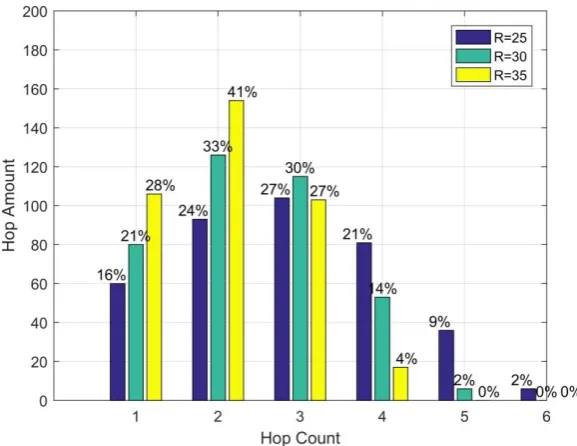
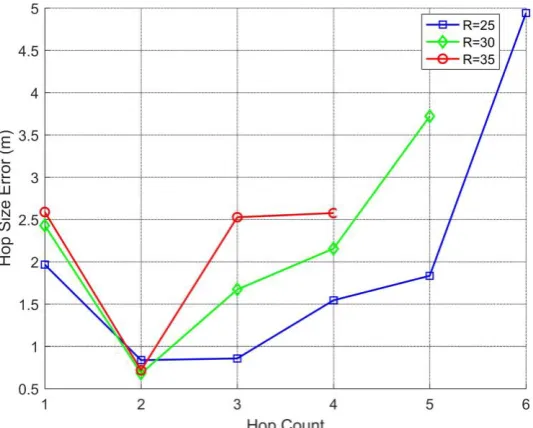
In order to investigate the relationship of location error between communication radius and hop count, following experiment has conducted in this article. In this ex-periment, there are 100 anchor nodes random distributed in 100m ×100m area, includ-ing 20 anchor nodes, communication range is 25m, 30m and 35m, respectively. The relationship between hop count and localization error of DV-Hop algorithm under different communication range is illustrated in Fig.2 and Fig.3.
Fig. 2. Hop count under communication range=25m, 30m, 35m
It is observed from Fig. 2 that hop count shown normal distribution trends under different communication ranges. The maximum hop count is 6, 5 and 4, under com-munication range 25m, 30m and 35m, respectively. Hop count 1, 4, 5 and 6 present decline trends with increasing communication range. Hop count value 2 is always the largest amount under communication range 30m and 35m, respectively. Hop count value 2 is the greatest amount under communication range 25m.
essential to correct hop count based on communication range, since it will greatly be affected hop count amount. So, if got relatively accurate hop distance, it will undoubt-edly improve the localization accuracy of all target nodes. We introduced dynamic communication ranges to each anchor node, one is the same network communication range R, the other is R/2. The hop count is no longer an integer number after intro-duced communication range R/2, which will greatly reduce hop size error of anchor nodes with one hop count.
Fig. 3. Hop size error under communication range=25m, 30m, 35m
3.3 Verification based on dynamic communication ranges
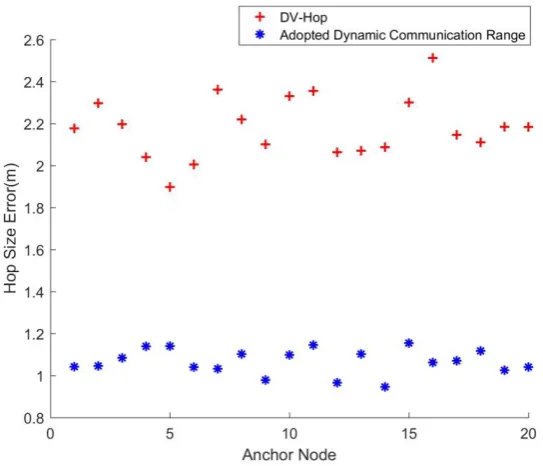
Fig. 4. Hop size error of anchor nodes
It is shown in Fig.4 that hop size error is around 1m after applied dynamic commu-nication range. And it is worth to point that hop size error is smooth with little fluc-tuation, that means, estimate distance error is small. However, hop size error of previ-ous DV-Hop is around 2.2m, exceeded two times larger than employed dynamic communication range. Furthermore, hop size error is not stable, with larger fluctua-tion. In addition, the minimum hop size error of former DV-Hop is extremely bigger than introduced dynamic communication range, even compared with maximum error. Consequently, the verification confirmed feasibility of this method by introduced dynamic communication
4
Proposed Algorithm (DCDV-Hop)
4.1 Hop counts correction
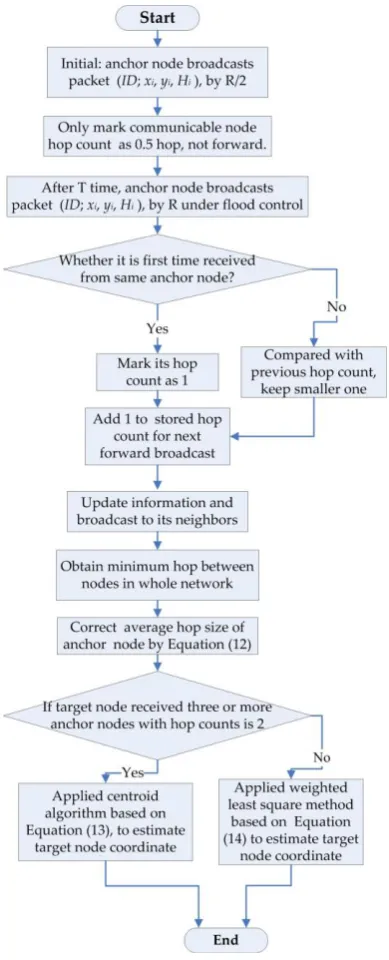
It is assumed that target communication range is settled, but anchor node has two communication ranges, R and R/2. The implementation steps are listed as follows.
Step 2:After T times, anchor node broadcasts its information packet to the whole network for the second time with communication radius R.
Step 3:If it is the first time of node received information packet from an anchor node, its hop count will be assigned to 1. Otherwise, compared it with previous hop count, keep smaller one. Add 1 to the stored hop count for continuing broadcasting.
As we all known, forward information will consume a large amount of communi-cation energy during every flood. Due to each node has limited energy, hence, only second broadcast by flooding control. The first broadcast only sends information packet to communicable neighbor node. Since, the first broadcast with communica-tion radius of 0.5R, so, the minimum hop count is no longer integer.
4.2 Average hop size correction
It is can be obtained estimated distance between anchor node i and j using Equation (2). The error between actual distance and estimate distance denoted as Ei, which can obtain by Equation (10).
𝐸𝑖= 1
𝑁−1∑ (√(𝑥𝑖− 𝑥𝑗)
2
+ (𝑦𝑖− 𝑦𝑗)2− 𝐴𝑣𝑔𝐻𝑜𝑝𝑆𝑖𝑧𝑒𝑖× 𝐻𝑖𝑗)
𝑖≠𝑗 (8)
Based on minimum mean-square error, let Equation (8) transformed into Equation (9).
𝑓 = 1
𝑁−1∑ (√(𝑥𝑖− 𝑥𝑗) 2
+ (𝑦𝑖− 𝑦𝑗) 2
− 𝐴𝑣𝑔𝐻𝑜𝑝𝑆𝑖𝑧𝑒𝑖× 𝐻𝑖𝑗)2
𝑖≠𝑗 (9)
According to first derivative, let 𝜕𝑓 𝜕𝐴𝑣𝑔𝐻𝑜𝑝𝑆𝑖𝑧𝑒 𝑖
⁄ = 0 , we can get new equation to calculate average hop size.
𝐴𝑣𝑔𝐻𝑜𝑝𝑆𝑖𝑧𝑒𝑖𝑁𝑒𝑤=
∑ⅈ≠𝑗(𝐻ⅈ𝑗√(𝑥ⅈ−𝑥𝑗)2+(𝑦ⅈ−𝑦𝑗)2)
∑ⅈ≠𝑗𝐻ⅈ𝑗2 (10)
4.3 Target node localization
Let denoted actual coordinate of target node Xt, as (xt, yt), distance between each anchor node Ak (k=1,2,3…, N), is dtk, which can be calculated by Equation (2).
1. Estimate target node coordinate based on hop threshold: It is observed from Fig. 2, the minimum hop size error is at hop count 2. It means less localization er-ror. If target node received the number of anchor nodes (m) with two hop counts that equal or more than three, these anchor nodes are randomly combined into 𝐶𝑚3
𝑋𝑡𝑒= ( ∑𝐶𝑚𝑡=13 𝑥𝑡′
𝐶𝑚3 ,
∑𝐶𝑚𝑡=13 𝑦𝑡′
𝐶𝑚3 ) (11)
2. Estimate target node coordinate based on weighted least squares: Yan et al [26]. proposed an optimal weighted least square for irregular network. Based on this idea, we introduced it to regular network, employed a weighted coefficient ma-trix W, see as following.
𝑊 =
[
𝑊1 0 0 0
0 𝑊2 0 0
. . . .
. . . .
0 0 0 𝑊𝑘]
(12)
Where, 𝑊𝑘= 1 𝐻 𝑘3
⁄ , 𝐻𝑘3 is the minimum number hop count between target node X and anchor node A. Hence, Equation (9) can be transformed into Equation (13).
𝑋 = (𝐴𝑇𝑊𝑇𝑊𝐴)−1𝐴𝑇𝑊𝑇𝑊𝐵 (13)
The flow chart of our proposed algorithm DCDV-Hop is illustrated in Fig. 5.
5
Experimental Results and Discussion
Fig. 6. A classic instance of distributed node Table 1. The parameters setting for simulations
Parameters Value
Network area 100m ×100m
Total nodes 50-300
Anchor nodes 10-40
Communication range 20m-36m
5.1 Performance evaluation criteria
3. Localization error (LE): Localization error (LE) is the error between real and es-timated coordinates of target node, which is denoted by Equation (16).
𝐿𝐸 = √(𝑥𝑎− 𝑥𝑒)2+ (𝑦𝑎− 𝑦𝑒)2 (14)
4. Average Localization Error (ALE): Average Localization Error (ALE) is aver-age error of all target nodes.
𝐴𝐿𝐸 =∑
𝑛
𝑡,𝑎=1√(𝑥𝑎−𝑥𝑒)2+(𝑦𝑎−𝑦𝑒)2
𝑛 (15)
5. Localization Accuracy (LA): Localization accuracy (LA) is defined as following.
𝐿𝐴 = (1 −∑
𝑛
𝑢,𝑎=1√(𝑥𝑎−𝑥𝑒)2+(𝑦𝑎−𝑦𝑒)2
𝑛∗𝑅 ) ∗ 100% (16)
5.2 Experiment results
Experiments for all algorithms are conducted for 200 times for each result due to random deployment of nodes, adopted average value to evaluate the performance. We employed average LE, ALE and LA to evaluate the performance of our presented algorithm (DCDV-Hop).
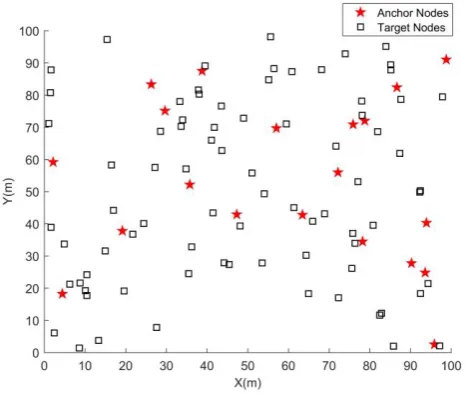
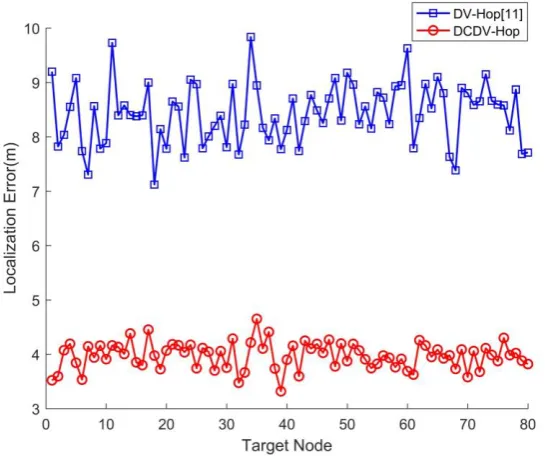
1. Localization error for each target node: In this experiment, it is assumed that 100 senor nodes, involved 20 anchor nodes are randomly deployed in 100m×100m area. The sensor communication range is 20m. The LE for each unknown node is illustrated in Fig. 7 and Fig. 8.
Table 2. The localization error for each target node
Localization Algorithm Max. LE(m) Avg. LE(m) Min. LE(m) Std.LE(m)
DV-Hop 9.8358 8.4301 7.1207 0.5589
DCDV-Hop 4.6500 3.9713 3.3182 0.1994
The maximum LE, average LE, minimum LE and standard deviation of LE is illus-trated in Table 2. It is observed form Table 2, the minimum LE of our proposed algo-rithm (DCHop) is less than 3.5m, with 53.40% decreased compared with DV-Hop algorithm, which stranded for it has a better performance. The max. LE and avg. LE are reduced 52.56% and 52.89%, respectively. Moreover, standard deviation LE of DCDV-Hop is almost 3 times less than DV-Hop, that indicated DCDV-Hop is more stable.
It is illustrated in Fig. 7 that the line of estimate and actual coordinate for most tar-get nodes is extremely short. It means that estimate coordinate of tartar-get node close to actual coordinate. There are only 12 target nodes cannot be located during 200 times, it stands for that located ratio is nearly 100%.
Fig. 8. The localization error for each target node
It can be seen from Fig. 8, the LE of basic DV-Hop algorithm is round 7-10m and our proposed algorithm (Hop) is round 3-4m. Based on this figure, DCDV-Hop has a superior performance. The localization error of our proposed algorithm (DCDV-Hop) decreased about 55%, compared with DV-Hop algorithm.
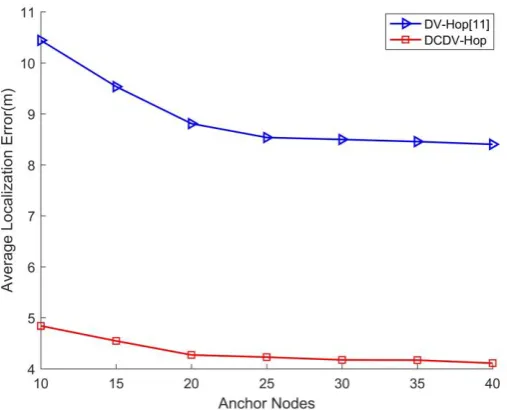
Fig. 9. The ALE under various anchor nodes
It can be seen form Fig.9 that the ALE of our proposed algorithm (DCDV-Hop) is less than 5, it reduced more 55%, compared with DV-Hop. Moreover, the ALE is improved as the number of anchor nodes increases, whether it is a traditional algo-rithm DV-Hop or DCDV-Hop. When the proportion of anchor nodes increased from 10% to 20% in the network, the ALE curves of two algorithms have significantly decreased. The ALE curves of the two algorithms decrease slowly, when the propor-tion of anchor nodes increases from 20% to 40%. When anchor nodes ratio is larger than 20%, as anchor nodes density increased, the ALE of both algorithms tended to stabilize, and anchor node density no longer has large effect on ALE.
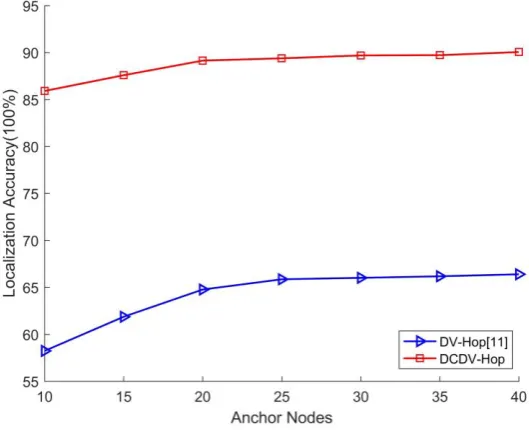
Fig. 10.The LA under various anchor nodes
Table 3. The comparison of ALE and LA for various anchor nodes
Algorithm Min.ALE(m) Avg.ALE(m) Max.LA (100%) Avg.LA (100%)
DV-Hop 8.53 9.03 65.89 63.86
DCDV-Hop 4.21 4.41 90.06 88.37
It is observed form Table 3, our proposed algorithm has a superior performance, with lower localization error and high localization accuracy. Besides, the ALE of DCDV-Hop is round 4.5m, but ALE of DV-Hop is large than 8.5m. Furthermore, enhanced minimum ALE and average ALE of DCDV-Hop is reduced 50.64% and 51.16%, compared with basic DV-Hop, respectively. The average LA of proposed DCDV-Hop is more than 88%, that means it with higher localization accuracy, but average LA of DV-Hop is less than 64%. The maximum LA and average LA of DCDV-Hop is increased 24.17% and 24.51%, compared with DV-Hop, respectively.
Table 4. The comparison of ALE and LA for various communication ranges
Algorithm Min.ALE(m) Avg.ALE (m) Max.LA (100%) Avg.LA (100%)
DV-Hop 7.21 8.39 69.34 63.98
DCDV-Hop 3.55 5.09 90.94 89.31
It is presented that in Table 4 our proposed algorithm has outstanding performance, with lower localization error and high localization accuracy. Besides, the ALA of DCDV-Hop is 5m, however, the ALE of DV-Hop is large than 7.2m. In addition, the enhanced minimum ALE and average ALE of DCDV-Hop is reduced 50.76% and 39.33%, compared with basic DV-Hop, respectively. The average LA of proposed DCDV-Hop is more than 88%, that means it with higher localization accuracy, yet, maximum LA of DV-Hop is less than 70%. The maximum LA and average LA of DCDV-Hop is increased 21.60% and 25.33%, compared with DV-Hop, respectively.
Fig. 11.The ALE under various communication ranges
Fig. 12.The LA under various communication ranges
The LA is illustrated Fig.12. The both algorithms demonstrates upward trend with communication range increasing. The LA of our proposed DCDV-Hop is large than 85%, however, the maximum LA is less than 70%, which presents DCDV-Hop supe-rior outstand than DV-Hop. The LA of DCDV-Hop is increased more than 30%, compared with DV-Hop.
6
Conclusion
7
Acknowledgement
This research work was supported by Universiti Malaysia Pahang Postgraduate Re-search Grants, grant number is PGRS1903143.
8
References
[1]Akyildiz, I.F., Su, W., Sankarasubramaniam, Y., and Cayirci, E.J.I.C.m., 'A Survey on Sensor Networks', 2002, 40, (8), pp. 102-114. https://doi.org/10.1109/mcom.2002. 1024422
[2]Chowdhury, T.J., Elkin, C., Devabhaktuni, V., Rawat, D.B., and Oluoch, J.J.C.N., 'Ad-vances on Localization Techniques for Wireless Sensor Networks: A Survey', 2016, 110, pp. 284-305. https://doi.org/10.1016/j.comnet.2016.10.006
[3]Suo, H., Wan, J., Huang, L., and Zou, C., 'Issues and Challenges of Wireless Sensor Net-works Localization in Emerging Applications', in, 2012 International Conference on Com-puter Science and Electronics Engineering, (IEEE, 2012). https://doi.org/10.1109/ iccsee.2012.44
[4]Laoudias, C., Moreira, A., Kim, S., Lee, S., Wirola, L., Fischione, C.J.I.C.S., and Tutori-als, 'A Survey of Enabling Technologies for Network Localization, Tracking, and Naviga-tion', 2018, 20, (4), pp. 3607-3644. https://doi.org/10.1109/comst.2018.2855063
[5]Manickam, M., Selvaraj, S.J.I.S., Measurement, and Technology, 'Range-Based Localisa-tion of a Wireless Sensor Network Using Jaya Algorithm', 2019. https://doi.org/10. 1049/iet-smt.2018.5225
[6]Harter, A., Hopper, A., Steggles, P., Ward, A., and Webster, P.J.W.N., 'The Anatomy of a Context-Aware Application', 2002, 8, (2/3), pp. 187-197.
[7]Girod, L., Bychkovskiy, V., Elson, J., and Estrin, D., 'Locating Tiny Sensors in Time and Space: A Case Study', in, Proceedings. IEEE International Conference on Computer De-sign: VLSI in Computers and Processors, (IEEE, 2002). https://doi.org/10.1109/iccd. 2002.1106773
[8]Bulusu, N., Heidemann, J., and Estrin, D.J.I.p.c., 'Gps-Less Low-Cost Outdoor Localiza-tion for Very Small Devices', 2000, 7, (5), pp. 28-34. https://doi.org/10.1109/98.878 533
[9]Zhao, L.-z., Wen, X.-b., and Li, D., 'Amorphous Localization Algorithm Based on Bp Arti-ficial Neural Network', 2014.
[10]Kulkarni, V.R., Desai, V., and Kulkarni, R.V.J.W.N., 'A Comparative Investigation of De-terministic and Metaheuristic Algorithms for Node Localization in Wireless Sensor Net-works', 2019, 25, (5), pp. 2789-2803. https://doi.org/10.1007/s11276-019-01994-9 [11]Niculescu, D. and Nath, B.J.T.S., 'Dv Based Positioning in Ad Hoc Networks', 2003, 22,
(1-4), pp. 267-280.
[12]He, T., Huang, C., Blum, B.M., Stankovic, J.A., and Abdelzaher, T., 'Range-Free Localiza-tion Schemes for Large Scale Sensor Networks', in, Proceedings of the 9th annual interna-tional conference on Mobile computing and networking, (ACM, 2003). https://doi.org/10.1145/938985.938995
[14]Huang, C., Mao, Y., ' Exploration of a New Location Algorithm for Wireless Sensor Net-work', 2018, 14 (06), pp.191-202
[15]Wu, J., 'The Research and Optimization of Ad-Hoc Network Localization Algorithm Based on the Distance-Assisted', in, 2016 18th International Conference on Advanced Communication Technology (ICACT), (IEEE). https://doi.org/10.1109/icact.2016. 7423446
[16]Hu, D., Liu, G., and Li, H., 'Study on Wireless Sensor Networks Localization Algorithm Based on Dv-Hop', in, 2016 2nd Workshop on Advanced Research and Technology in In-dustry Applications (WARTIA-16), (Atlantis Press, 2016). https://doi.org/10.2991/wartia-16.2016.194
[17]Li, Y.-H., Wu, S.-H., and Wu, H.-T., 'A Design of Wireless Sensor Network Node Loca-tion Algorithm', in, 2016 InternaLoca-tional Conference on Computer and InformaLoca-tion Technol-ogy Applications, (Atlantis Press, 2016). https://doi.org/10.2991/iccita-16.2016.18 [18]Salama, M. and Kandil, M., 'An Improved Dv-Hop Localization Algorithm Based on
Mod-ified Hop-Size', in, 2016 World Symposium on Computer Applications & Research (WSCAR), (IEEE, 2016). https://doi.org/10.1109/wscar.2016.11
[19]Zheng, J.-g., Chen, L., and Xia, X.-h., 'The Localization Algorithm Based on Improved Dv-Hop Algorithm', in, 2nd International Conference on Electronics, Network and Com-puter Engineering (ICENCE 2016), (Atlantis Press, 2016). https://doi.org/10.2991/icence-16.2016.83
[20]Tomic, S. and Mezei, I.J.T.S., 'Improvements of Dv-Hop Localization Algorithm for Wire-less Sensor Networks', 2016, 61, (1), pp. 93-106. https://doi.org/10.1007/s11235-015-0014-9
[21]Xiong, N.N., Wu, W., Wu, C., and Cheng, H.J.J.o.I.T., 'An Improved Node Localization Algorithm Based on Positioning Accurately in Wsn', 2019, 20, (5), pp. 1323-1332. [22]Cao, Y. and Wang, Z.J.I.A., 'Improved Dv-Hop Localization Algorithm Based on
Dynam-ic Anchor Node Set for Wireless Sensor Networks', 2019, 7, pp. 124876-124890. https://doi.org/10.1109/access.2019.2938558
[23]Liu, Y, Yu, X, Hao, Y', Wireless Sensor Node Localization Algorithm Based on Particle Swarm Optimization and Quantum Neural Network', 2018, 14 (10), pp.230-240. https://doi.org/10.3991/ijoe.v14i10.9314
[24]Qiao, X., Yang, H., Wang Z..', Iterative L-M Algorithm in WSN – Utilizing Modifying Average Hopping Distances ', 2017, 13 (10), pp.4-20. https://doi.org/10.3991/ijoe. v13i10.7006
[25]Zheng, J, Wang, G, Chen, Y, Huang D, Yuan H, ' On the Localization Algorithm of Wire-less Sensor Network and Its Application ', 2017, 13 (3), pp.40-51.
[26]Yan, X, Sun, L, Zhou, J, and Song, A.J.E.L, 'Dv-Hop Localisation Algorithm Based on Optimal Weighted Least Square in Irregular Areas', 2018, 54, (21), pp. 1243-1245. https://doi.org/10.1049/el.2018.6512
9
Authors
Fengrong Han is currently pursuing PHD degree program in faculty of electrical and electronics engineering, University Malaysia Pahang, Malaysia. E-mail: [email protected]
Xinni Liu is currently pursuing PHD degree program in faculty of electrical and electronics engineering, University Malaysia Pahang, Malaysia. E-mail: [email protected]
Kamarul Hawari Ghazali is a Professor of faculty of electrical and electronics engineering at University Malaysia Pahang, Malaysia. He is a senior member IEEE and a member of IEEE communications society chapter. E-mail: [email protected]
Hao Wang is currently pursuing PHD degree program in Faculty of Manufacturing and Mechatronic Engineering Technology, University Malaysia Pahang. E-mail: [email protected]