An Internet of Things System Based on
Device-to-Device Communication Technology
and Radio-Frequency Identification
https://doi.org/10.3991/ijoe.v14i10.9302Cheng Huang(*), Yongbo Lv Beijing Jiaotong University, Beijing, China
Abstract—This paper aims to build a mobile communication system suitable for different application scenarios of the Internet of Things (IoT). For this pur-pose, an IoT system was developed based on device-to-device (D2D) communi-cation technology and radio-frequency identificommuni-cation (RFID). The D2D-RFID-based IoT system combines the merits of mobile communication (e.g. 4G) and the RFID. The analysis shows that the proposed system boasts good mobility, stable transmission, short time delay, fixed IP, and no need of a central server. The research findings have a great application potential in different IoT scenar-ios.
Keywords—device-to-device (D2D), radio-frequency identification (RFID), internet of Things (IoT)
1
Introduction
The Internet of Things (IoT) is a technology of the future. It can connect all things [1], create intelligent equipment, and generate a massive amount of valuable data. In the IoT era, network access will not be limited to personal computers or mobile phones, but extended to almost everything, ranging from refrigerator, air-conditioner to smart toilet.
However, the connection speed of the IoT is restricted by the wireless communica-tion technology. At present, the IoT is mainly accessed via Wi-Fi or 4G. With a fixed range of communication, the Wi-Fi fails to support mobile communications; the 4G is designed to connect mobile phone users of the Internet, rather than accommodate the IoT applications. Neither of the two technologies can actually stimulate the develop-ment of the IoT.
2
Technical Background
As an important component of the IoT, the RFID is a wireless communication tech-nology that recognizes an object through radio signals instead of actual contact. The D2D is also a key element of the IoT. This communication technology mainly acceler-ates the interaction between things. It should be noted that the D2D operation relies on the 5G system.
The 5G is a landmark communication standard for the development of the IoT [2]. Before the birth of 5G, the IoT functions are severely limited in that the 4G does not support the connection to enough devices, and that the Wi-Fi does not have central control or mobile handover capability. The application of the IoT is fully considered in the design of 5G. This new generation standard 1000 times the number of connections of 4G and reduces the communication delay, without sacrificing the advantages of 4G (e.g. central control and mobility).
2.1 RFID
Currently, the RFID serves as a target recognition method like barcode and two-dimensional barcode [3~5]. The RFID suits the IoT well because it requires no direct contact with the target, works for a long time without replacing the power supply, and uses small and durable tags. Therefore, this technique has been applied in vehicle charg-ing, document recognition and item tracking. On the downside, the strength of the RFID lies in the recognition of items, rather than the big data communication and processing or the security authentication [6, 7]. This is because most RFID devices, originally de-signed for item recognition, have no power supply or sufficient processing/storage ca-pacity.
2.2 D2D
The D2D communication is an important feature of the 5G [8, 9]. Unlike traditional mobile communication, the D2D devices communicate directly with each other and the data need not to pass through the core network. In this way, the communication quality is improved at the cost of the communication range of short distance devices [10]. Note that short distance wireless communication is commonplace in the IoT.
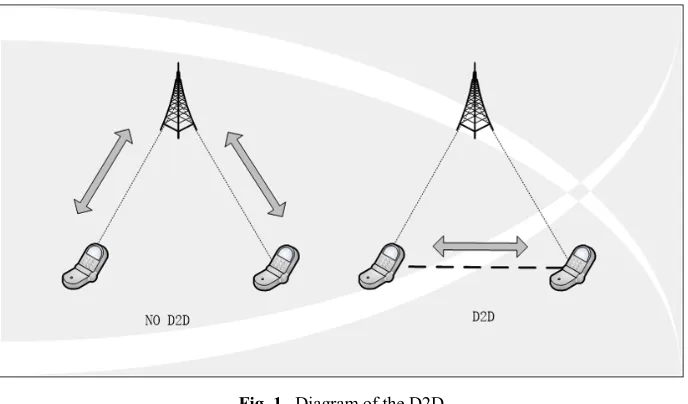
Fig. 1. Diagram of the D2D
According to the diagram in Figure 1, the D2D allows a device to directly send data to a nearby device, instead of the transfer by the mobile network. The direct transmis-sion reduces the pressure on the central network and the network time delay.
Using wireless communication methods, the IoT applications can only be imple-mented individually in the effective distance of wireless communication, which varies from tens of metres to several hundred metres. The D2D, through direct communica-tion, greatly enhances the communication ability and quality of IoT applications within the distance.
3
Design of RFID-D2D-Based IoT
The development of the D2D makes it possible to further improve the original IoT system. Here, the improvement is realized through integration of the technical features of the D2D and the RFID.
3.1 System design
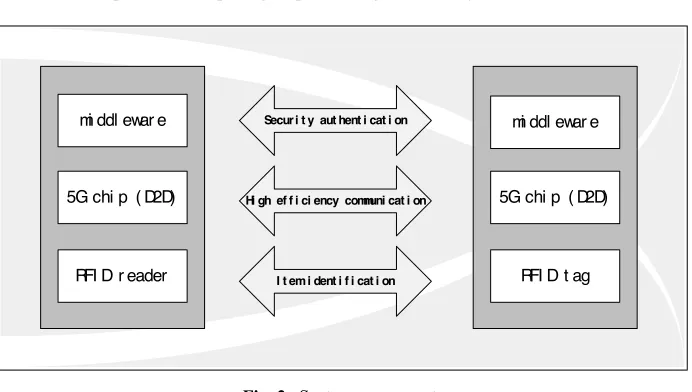
As shown in Figure 2, the RFID-D2D-based IoT consists of four modules: an item perception module, a data transmission module, an authentication module and a service processing module. In the system, the item perception and recognition are realized us-ing the RFID; then, the items are connected via the D2D to ensure high-quality com-munication; the security authentication is performed on a middleware; finally, the ser-vice of the upper layer application is processed by the serser-vice processing module.
1.The RFID does well in identifying items that are close to each other. In a close dis-tance, it is easy to set up seamless connections with the D2D.
2.The RFID is a completely independent technique that helps an application recognize items in any format. By contrast, the mobile communication is not suitable for ap-plication or capable of item identification, although it carries the information for the core network to identify the terminal.
3.With an electric tag or a reader, the RFID is an essential part of smart devices, in addition to the CPU for computing and the chip for communication. Each of these parts answers the intended purpose, forming a simple and reliable whole. Compared with hardware, the Authentication is particularly suitable for software, as RFID does not have to perform computing or processing for security authentication.
Fig. 2. System components
The above figure shows that the RFID is responsible for recognizing and perceiving the underlying items, the D2D for communicating the data efficiently, and the middle-ware for authentication through open SSL.
3.2 RFID module design
In the RFID-D2D-based IoT system, the RFID module does not have a strong pro-cessing ability. The only function of this module is short-distance recognition by elec-tronic tags powered by a passive supply. The security authentication and data storage duties are transferred to the middleware of the upper layer software. In this way, the RFID module is simplified and blessed with a big storage space, and reliable perfor-mance.
RFI D r eader 5G chi p ( D2D)
mi ddl ewar e
RFI D t ag 5G chi p ( D2D)
mi ddl ewar e
I t em i dent i f i cat i on Hi gh ef f i ci ency communi cat i on
3.3 D2D module design
The D2D module has a D2D chip for mobile communication. Without any modifi-cation, this chip can establish D2D connections whenever data communication is needed. However, the D2D module must be able to broadcast the received address to the nearby terminals, i.e. all the connectable devices. This is because RFID tags are often not bound to the layer 2 or layer 3 address of the other party, which should be connected to after acquiring the RFID tag information of the peer end. The broadcasting ability eliminates the need to record the correspondence between the RFID tags of the two parties and the layer 2 or layer 3 address through the central server, thereby reduc-ing the number of central nodes and acceleratreduc-ing the establishment of connection. After receiving the broadcast, the peer end will check if its own RFID is requested, and, if yes, respond with its own IP address.
3.4 Authentication module design
The authentication module mainly relies on a middleware that performs CA certifi-cate-based security authentication using the OpenSSL library. The middleware boasts excellent authentication performance, thanks to its low cost, high flexibility, and good CPU processing ability for chips with mobile communication functions. The RFID was not adopted for this module because its encryption algorithms are expensive and hard-ware-oriented. Below is a brief description of the principle of CA certification.
The CA certificate is a security technology that uses asymmetric encryption algo-rithms to perform identity authentication. In general, each certificate has a private key and a public key. The former should be kept private, while the latter can be disclosed to others. With the public key, a person can decrypt the encrypted information sent by the private key. As the only holder of the private key, the sender of the information has a reliable identity. Of course, the actual situation is much more complex than the above principle. Sometimes, some people may make their own certificates. To prevent this, the certificate must be issued by a reliable third-party.
3.5 System operation process
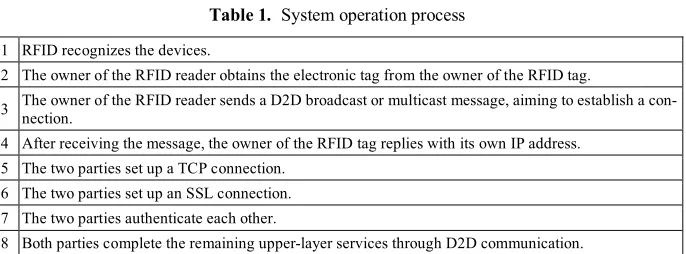
Table 1. System operation process 1 RFID recognizes the devices.
2 The owner of the RFID reader obtains the electronic tag from the owner of the RFID tag.
3 The owner of the RFID reader sends a D2D broadcast or multicast message, aiming to establish a con-nection. 4 After receiving the message, the owner of the RFID tag replies with its own IP address.
5 The two parties set up a TCP connection. 6 The two parties set up an SSL connection. 7 The two parties authenticate each other.
Note: The “upper-layer services” refers to the application services to be transmitted after the IoT, namely, the data collected by the current device.
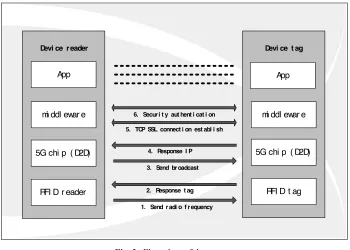
Table 1 gives a clear map of the relationship between the various modules of the system and its process. As described earlier, the owner of the RFID reader first emits a radio frequency signal; after receiving the signal, and the passive RFID tag of the owner of the RFID tag replies with its own tag; after that, the owner of the RFID reader sends a D2D broadcast to obtain the layer 2 and layer 3 addresses of the other party; then, TCP and SSL connections are gradually established. In total, there are 7 interactions, and fewer if both systems support TCP fast start-up optimization. Next, the two parties perform the authentication through the CA certificate. Finally, the upper application services run on the IoT system.
Here, the D2D information is not broadcasted continuously so that the two parties can obtain each other’s information without using the RFID module. The reason goes as follows: The D2D, not designed for item recognition, may consume a huge amount of 5G resources and battery power if the communication chip works continuously. By contrast, the RFID is designed for item recognition and the owner of the RFID tag con-sumes no power. That is why the D2D and the RFID are integrated in this research.
Fig. 3. Flow chart of the system
Note: Device reader is the owner of the RFID reader; Device tag is the owner of the RFID tag.
RFI D r eader 5G chi p ( D2D)
mi ddl ewar e
RFI D t ag 5G chi p ( D2D)
mi ddl ewar e
App App
Devi ce reader Devi ce t ag
1. Send radi o f requency 2. Response t ag 3. Send broadcast 4. Response I P 5. TCP SSL connect i on est abl i sh
4
Analysis on the RFID-D2D-based IoT
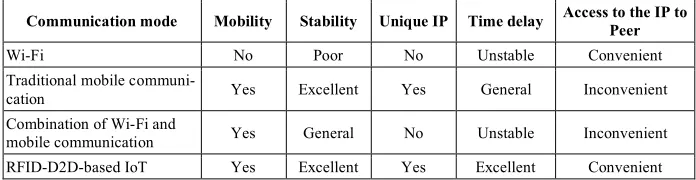
The proposed RFID-D2D-based IoT has the following advantages over the main-stream IoT systems.
1.Good mobility: Many IoT systems are based on Wi-Fi connections. They have no mobility and only works in a very small range. The connections are lost once the object is out of the range. Compared to these systems, the proposed IoT can auto-matically switch from the D2D mode to the normal transmission mode and complete the handover between different base stations.
2.Stable transmission: The D2D, as a technical standard of 5G, is managed by a wire-less resource management unit. Since all wirewire-less resources are allocated by the base station, the proposed IoT does not have the unstable communication state as Wi-Fi. When there are a few users, Wi-Fi outperforms the proposed IoT because it has no central node to control wireless resource allocation. However, when there are many users, the terminals of Wi-Fi will compete for wireless resources, leading to unstable transmission and up to ten milliseconds-long delay. [11]
3.Unique IP: Considering both short- and long-distance transmission modes, the pro-posed IoT can assign a fixed IP to each device, which is not possible for the combi-nation of Wi-Fi and mobile communication. The unique IP prevents reconnection of the TCP and improves the communication stability. This feature is very important. Without this feature, the low-starting TCP may be too slow to reach a stable sending speed.
4.Short delay: Because the D2D communication mode does not need to pass through the core network, the proposed IoT enjoys a shorter communication delay than tra-ditional mobile communication network. The short delay reduces the core through-put, which in turn enhances the network performance.
5.Simplicity: The adoption of D2D broadcasting eliminates the need for a third-party server to open a barrier in which neither side knows the other’s IP address.
Table 2. Comparison between IoT connection technologies
Communication mode Mobility Stability Unique IP Time delay Access to the IP to Peer
Wi-Fi No Poor No Unstable Convenient
Traditional mobile
communi-cation Yes Excellent Yes General Inconvenient
Combination of Wi-Fi and
mobile communication Yes General No Unstable Inconvenient
RFID-D2D-based IoT Yes Excellent Yes Excellent Convenient
5
Conclusions
This paper designs a promising RFID-D2D-based IoT system which adopts both RFID and D2D technologies, integrates middleware functions, and realizes excellent performance. The proposed system combines the merits of mobility and short-distance communication and avoids their disadvantages. It is suitable for scenarios where the device has a certain processing capability, but not for connecting items that have no communication chip and processing capability. With the development of IoT applica-tions and mobile communication techniques, it is believed that more research areas will be opened up in the fields of the IoT and IoT and mobile communication in the future.
6
References
[1]Gubbi, J., Buyya, R., Marusic, S., Palaniswami, M. (2013). Internet of things (iot): a vi-sion, architectural elements, and future directions. Future Generation Computer Sys-tems, 29(7), 1645-1660. https://doi.org/10.1016/j.future.2013.01.010
[2]Osseiran, A., Boccardi, F., Braun, V., Kusume, K. (2014). Scenarios for 5g mobile and wire-less communications: the vision of the metis project. Communications Magazine IEEE, 52(5), 26-35. https://doi.org/10.1109/MCOM.2014.6815890
[3]Ferrer, G., Dew, N., Apte, U. (2010). When is rfid right for your service? International Jour-nal of Production Economics, 124(2), 414-425. https://doi.org/10.1016/j.ijpe.2009.12.004
[4]Want, R. (2006). An introduction to rfid technology. IEEE Pervasive Computing, 5(1), 25-33. https://doi.org/10.1109/MPRV.2006.2
[5]Orndorff, C., Dai, W. (2016). Numerical hyperthermia simulation for a 3-d triple-layered skin structure with embedded vascular countercurrent network and nanoparti-cles. Interna-tional Journal of Heat & Technology, 34(Special Issue 1), S179-S184.
https://doi.org/10.18280/ijht.34S124
[6]Feldhofer, M., Dominikus, S., Wolkerstorfer, J. (2004). Strong authentication for rfid sys-tems using the aes algorithm. Ches, 3156, 357-370. https://doi.org/10.1007/978-3-540-28632-5_26
[7]Finkenzeller, K. (2003). Rfid handbook: fundamentals and applications in contactless smart cards and identification / k. finkenzeller. Wiley & Sons(5). https://doi.org/10.1002/0470868 023.ch9
[8]Hakola, S., Chen, T., Lehtomaki, J., Koskela, T. (2010). Device-To-Device (D2D) Commu-nication in Cellular Network - Performance Analysis of Optimum and Practi-cal Communi-cation Mode Selection. 29.16:1-6. https://doi.org/10.1109/WCNC.2010.5506133
[9]Sakr, A.H., Hossain, E. (2014). Cognitive and energy harvesting-based d2d communi-cation in cellular networks: stochastic geometry modeling and analysis. IEEE Trans-actions on Communications, 63(5), 1867-1880. https://doi.org/10.1109/TCOMM.2015.2411266
[10]Liu, Z., Peng, T., Xiang, S., Wang, W. (2012). Mode selection for Device-to-Device (D2D) communication under LTE-Advanced networks. IEEE International Confer-ence on Com-munications (pp.5563-5567). IEEE. https://doi.org/10.1109/ICC.2012.6364738
7
Authors
Huang Cheng is a doctoral student, computer engineering. He studies in School of Traffic and Transportation Beijing Jiaotong University, No.3 Shangyuancun Haidian District Beijing 100044 P. R. China.
Lv Yongbo is a system scientist, engineering educator, and Professor of Beijing Jiaotong University. She studies in School of Traffic and Transportation Beijing Jiao-tong University, No.3 Shangyuancun Haidian District Beijing 100044 P. R. China.