Path Planning for Batch Picking of Warehousing and
Logistics Robots Based on Modified A* Algorithm
https://doi.org/10.3991/ijoe.v14i11.9527
Li-Mei Duan
Kunming Metallurgy College, Yunnan Kunming, China [email protected]
Abstract—To make the picking path planning of warehousing and logistics robot in warehouse more efficient and real-time, a path planning for batch picking of warehousing and logistics robots based on the modified A* algorithm was put forward. First of all, the path planning of the single robot batch picking was re-alized. Then, the time cost was introduced to further improve the A* algorithm to realize the batch picking path planning of the multi-warehouse logistics robots. Finally, according to the algorithm proposed, .Net visual programming technol-ogy was applied to build a complete warehouse logistics robot picking path plan-ning simulation system to verify the effectiveness of the algorithm proposed. The research results showed that the algorithm proposed could meet the needs of ef-ficient and real-time path planning in the process of completing batch picking tasks. To sum up, it lays a solid foundation for the realization of intelligent and fully automated warehouse management.
Keywords—warehousing and logistics robot, A* algorithm, path planning, batch picking
1
Introduction
Intelligent warehouse is a new automated warehouse built on the basis of artificial intelligence (AI) technology. It has the characteristics of high automation, low labour cost and high efficiency. The warehouse logistics robot plays a key role in the process of building an intelligent warehouse. As everyone knows, the picking is very critical to the operation of most of the warehouse, which accounted for about 55% of the ware-house operation cost [1]. It also directly determines the downstream customer service experience. Therefore, to solve the problem of how to realize the further improvement has very important realistic significance to the picking efficiency by logistics robot, but the key to solve the problem lies in the efficient path planning in view of logistics robot picking in different situations.
improve warehousing and logistics robots to warehouse environment adapting ability lay a solid the basis for realizing intelligent warehouse, automatic management [2].
2
State of the art
Warehousing and logistics robot is a new type of moving robot applied in the field of warehousing and logistics technology. It can independently accomplish the tasks of goods location, cargo transportation and even goods picking in warehouses, and it is the leading role of future intelligent warehouse. At present, foreign warehousing and logistics robots are mainly divided into two categories. One is the Kiva robot system represented by Amazon Company and the other is two kinds of robots with goods taking and delivering function represented by Fetch Company. Domestic storage and logistics robot technology research started relatively late, but the speed of development is faster. At present, the "Cao Cao" robot, similar to Fetch Company's delivery robot developed by Alibaba, has been applied to the warehouse of Alibaba, which mainly has the func-tion of independently locating goods and transporting goods. The main drawback of this type of robot is that the picking process of the goods should be aided by the robot, and it cannot reduce the human cost well [3]. The path planning algorithm studied in this paper is mainly for this type of robot or the robot that will be able to pick up goods and transport goods in the future.
At present, there are relatively few professional and systematic researches on the picking path planning of warehousing and logistics robots at home and abroad. Most of the literatures are about the path planning of moving robots and the planning of artificial picking paths. The centralized multi-robot path planning method is more suitable for the known conditions of the global environment. The distributed multi-robot path plan-ning method is more suitable for the known conditions of the local environment [4]. Considering that the working environment of multi warehouse logistics robot is fixed and generally does not change significantly, the centralized approach is applied to the path planning of multi-warehouse logistics robot.
3
Methodology
3.1 Warehouse environment modelling and picking task description
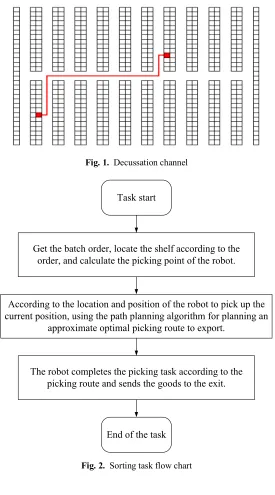
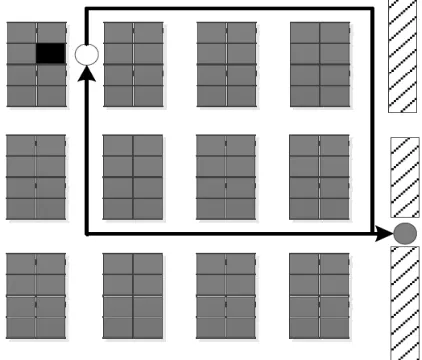
The layout of the warehouse channel in this paper is a decussation channel with multi-lateral channels, as shown in Figure 1. Multi-lateral channel can effectively re-duce the traffic jam of multi-warehouse logistics robot.
warehouse model established in this article, the task flow of the sorting operation is roughly as shown in Figure 2.
Fig. 1. Decussation channel
Fig. 2. Sorting task flow chart
Get the batch order, locate the shelf according to the order, and calculate the picking point of the robot.
According to the location and position of the robot to pick up the current position, using the path planning algorithm for planning an
approximate optimal picking route to export.
The robot completes the picking task according to the picking route and sends the goods to the exit.
Task start
3.2 Single picking path planning for warehousing and logistics robots
The path planning of a single mobile robot is to solve an optimal path from the start-ing point to the end point. Aimstart-ing at sstart-ingle warehouse logistics robot sstart-ingle order path planning algorithm design, we only consider time complexity, space complexity, mov-ing rule, path length and movmov-ing time. In terms of a path plannmov-ing algorithm for ware-housing logistics robot by single selection, the A* algorithm is used in this paper. Be-cause the A* algorithm has a small time complexity and space complexity. It also has a strong adaptability and it can meet the need for multi-robot scheduling [5].
The A* algorithm is a heuristic search algorithm, which uses the valuation function to find the optimal path from the starting point to the end point. The general form of the valuation function is:
(1) g(n) represents the actual distance from the starting point startNode to the current node n, and h(n) refers to the estimated distance between the current node n and the end point endNode. When h(n)≤h*(n) and it has the optimal distance from the current node n to the end point endNode, it can ensure the A* algorithm to get the optimal path [6].
According to the moving rules of warehousing and logistics robot, we should choose four-neighbourhood searching in search mode, and at the same time, we should use Manhattan distance for unconstrained distance estimation function, and its formula can be expressed as:
(2) In addition, due to the different time consumptions and energy consumptions of the warehousing logistics robot, we should add the steering cost ε0 to h(n), so the form of heuristic function is:
(3) ε0 represents the turning cost and the value is:
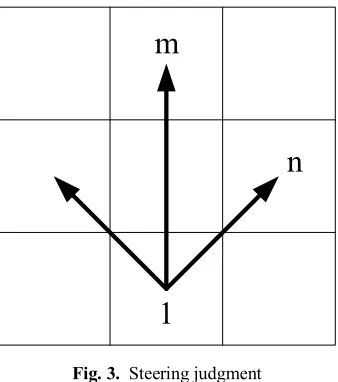
(4) The dis(l, n) represents the Euclidean distance of the precursor node 1 between the current node n and the node m with the smallest f value, which is mainly used to judge the robot rotation. When dis(l, n) =2 (Figure 3), the robot turns 90 degrees and then the turning price is ε0=1; when dis(l,n)=2, the robot does not turn, then the turning price is ε0=0; when dis(l,n)=0, it shows that the robot may conduct a 180 degree turn. This case will only appear when the robot needs to return to the original starting point after it
( )
=
( ) ( )
+
f n
g n h n
( )
(
)
(
)
'
=
-
.
+
-
.y
h n abs nx endNode x abs nx endNode
( )
=
'
( )
+
e
0h n
h n
( )
( )
( )
0,
2
0
1
,
2
2
,
0,
e
=
ì
ï
=
í
=
ï
=
=
î
dis l n
dis l n
reaches the picking point of pickNode and completes the picking task [7]. It is important to note that every time we use A* algorithm to plan the pickNode path of picking point, we need to remember the precursor node of picking point pickNode to determine the posture and position of the robot.
Fig. 3. Steering judgment
In this paper, the priority queue based on two-fork heap is used to manage the OPEN table. The time complexity of each optimization, insertion and deletion operation is O(logn). Therefore, the overall time complexity of A* algorithm is O(nlogn). The pri-ority queue source used in this article is found on the NuGet platform. NuGet is an open source project under the.NET platform, which is an extension of VisualStudio [8]. In the process of using VisualStudio to write this program, the open source priority queue program found in Nuget is added to the project and can be directly quoted in the project.
3.3 Batch selection path planning for warehousing and logistics robots
In order to solve the problem of batch picking path planning for warehousing and logistics robots, a suitable mathematical model should be established firstly. Under the premise of considering the distance between point and point as the Manhattan distance, according to whether the starting point of robot is at the outlet, the problem of batch picking path planning can be divided into two types. One is that when the starting point of the robot is at the exit, the problem can be regarded as a classic TSP problem. The other is that when the starting point is not at the exit but in other positions, the problem can be considered as the open loop TSP problem with fixed starting and end point (hereinafter referred to as ST-TSP) [9]. The mathematical model of the classic TSP problem can be described as the formula:
n
m
(5) In view of the TS-TSP problem, s is recorded as the starting point of the robot, and e is the end of the robot, which meets the flowing formula.
(6) In order to solve the TSP problem, we use the nearest neighbour algorithm in the genetic algorithm to generate the initial population. Combined with the characteristics of the batch picking task and the variable order number, we propose a new adaptive parameter design plan based on the size of the problem scale α.
First of all, on the whole, when the problem scale is small, the quality of the initial population is generally higher, the greater crossover probability δ and smaller mutation probability φ can be used to get the optimal solution as far as possible; when the prob-lem scale α is large and the initial population is of poor quality, we can use the smaller crossover probability and greater mutation probability φ to protect the gene structure as far as possible, guarantee the quality of the solution and avoid local optimum. At the same time, in the iterative process, by considering the number of iterations η and the fitness value f changes, we further improve the solution quality and convergence speed [10].
The range of cross probability δ value in this paper is 0.80-0.95, δmax=0.95 and δ values are shown as follows.
(7)
(8) Similarly, the value of mutation probability φ is taken, which is generally small. In this paper, the range of the value of φ is taken in 0.01-0.05, where φmax=0.05, and the formula of the φ value is shown below [11].
( )
(
1) (
1)
1
1
min
b b,
b+ b,
b
-=
=
å
+
i i k
k i
Z P
d v v
d v v
( )
(
1) (
1)
(
)
1
1
min
b b,
b+,
b,
b
-=
=
å
k i i+
+
ki
Z P
d v v
d s v
d e v
min
0.90
2
20
0.85
20
30
0.80
30
a
d
a
a
£ £
ì
ï
=
í
< £
ï
<
î
(
)
(
max)
max max min
max
max
'
2
2
,
,
i i if
f
f
f
f
f
f
f
h
d
d
d
h
d
d
ì
æ
-
ö
ï
-
-
ç
+
÷
ï
ç
÷
=
í
è
-
ø
³
ï
ï
<
(9)
(10) There are six main steps in the implementation of the batch selection path planning algorithm. Firstly, input the problem scale α, population size β, the maximum crossover probability δmax, the maximum variation probability φmax, and the maximum number of iterations η. Then, output the picking path P. The first step is to make use of the nearest neighbour algorithm to produce the initial population with scale of β. The sec-ond step is to calculate the fitness fi of the individual (the reciprocal of the path length), the average fitness and the maximum fitness fmax. The third step is to calculate the cumulative probability λ of the individual in the population and the selected probability λi and choose individual to generate new population by means of roulette. The formulas (7) and (8) are used to determine the cross probability δ, and generate a new individual. The mutation probability is determined by the formulas (9) and (10), and the mutant individual is produced. The fourth step is to decide whether it satisfies the iteration termination condition. If satisfies, end the loop and save the order L of access node, and move to the fifth step; otherwise it will go to the second step. The sixth step is to use the improved A* algorithm to give the path of adjacent nodes in L and merge into the complete path P and output [12].
3.4 Batch picking path planning for multi warehouse logistics robot
In this paper, the minimum time cost is chosen as the optimization goal of the batch picking path planning model of multi warehouse logistics robot. The time spent for picking a single robot is mainly composed of the time of robot picking up the goods (PT), the time of robot moving (RT) and the waiting time (WT) of the robot [13]. On the basis of single robot batch picking mathematical model, we can get the mathemati-cal model of multiple warehouse logistics robot batch picking path planning based on the appropriate modification and the model is shown in the following formula.
(11) min
0.01
2
20
0.03
20
30
0.05
30
a
j
a
a
£ £
ì
ï
=
í
< £
ï
<
î
(
)
(
max)
max max min
max
max '
2 2 ,
, i i i f f f f f f f f
h
j
j
j
h
j
j
ì æ - ö
ï - - ç + ÷
ï ç ÷
=í è - ø ³
ï
ï <
î
f
( )
(
1) (
1)
1
1
min
k i,
i,
ki
T P
bd v v
b b+d v v
b bt RRT WT
-=
æ
ö
=
ç
+
÷
*
+
+
(12) When multiple warehousing and logistics robots batch pick in warehouse, the path of robots may be in conflict. When the conflict of multiple robots is more, it is easy to cause channel blockage, which affects the efficiency of robot executing batch picking task [14].
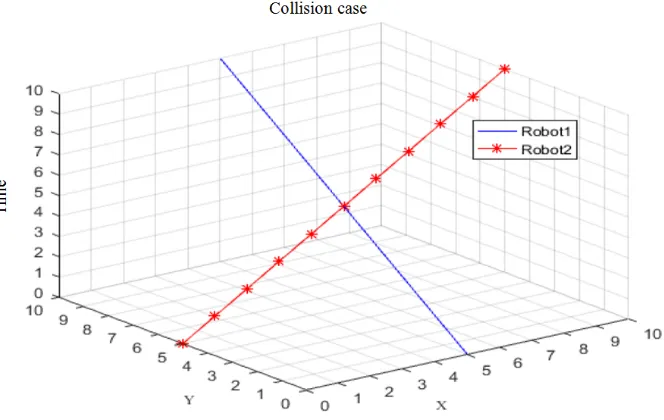
From Figure 4, we can see that when robot 1 and robot 2 arrive the same point with the same distance at the same time with the same speed, there will inevitably be a con-flict of paths, that is, two robots will appear at the same position at the same time.
Fig. 4. The situation of path conflict
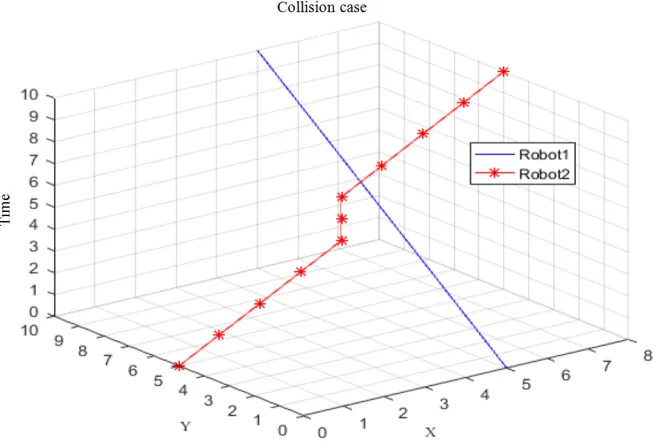
For obstacle avoidance planning, we first of all need to determine the priority of two robots with path conflict, and the one low priority needs to adjust the temporal and spatial information of the path. Secondly, the adjustment of time and space information of the robot with low priority should be based on the type of conflict to determine [15]. The strategy adopted in this paper allows the robot to enter the channel to wait and give the corresponding conflict resolution strategy according to the specific type of conflict. The result of the obstacle avoidance is shown in Figure 5.
( )
(
1)
( )
1(
)
1
1
min
k i,
i,
,
ki
T P
bd v v
b b+d s v
bd e v
bt RRT WT
-=
æ
ö
=
ç
+
+
÷
*
+
+
Fig. 5. Path conflict resolution
4
Results and discussion
4.1 Algorithm implementation of warehouse logistics robot based on single picking path planning
Fig. 6. Implementation effect of traditional single picking path planning algorithm
Fig. 7. Implementation effect of improved single picking path planning algorithm
4.2 Comparison of batch picking path planning algorithms for warehouse logistics robots
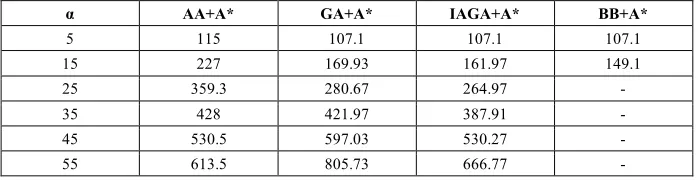
The alleyway algorithm (AA), GA algorithm (traditional genetic algorithm), IAGA algorithm (improved adaptive genetic algorithm) and branch and bound method (BB) are combined with A* algorithm, respectively, and the average path length of the algo-rithm is compared. Alleyway algoalgo-rithm is a path picking planning method for lateral multi - channel and picking points. The principle is that the robot starts from a point (usually at the entrance) and enters the picking alleyway, completes the sorting of goods in the picking channel and then directly turns to the next alleyway needing to conduct the picking, and finally returns to the starting point. Branch and bound algorithm is a traditional algorithm to solve the TSP problem. The solution is the best solution, but the algorithm has high time complexity and space complexity. When the scale is large, it is difficult for the computer to get effective results.
Each problem scale has 10 different picking point distributions, 10 experiments are conducted in each case, and the experimental results are shown in Table 1. It can be seen from Table 1 that, when the problem scale is small, the average path length of IAGA+A* algorithm is similar to that of GA+A* and BB+A* algorithm, significantly less than that of AA+A*; when the scale of the problem is in the middle, the average path length of IAGA+A* algorithm is smaller compared with that of AA+A* algorithm and GA+A* algorithm, while the BB+A* algorithm has been unable to obtain the cal-culation results; when the scale of the problem is large, the average path length of IAGA+A* algorithm is similar to or greater than that of AA+A* algorithm, but signif-icantly less than that of GA+A* algorithm. Generally speaking, the IAGA+A* algo-rithm can well adapt to the path planning of small and medium scale problems. When the size of the problem is over 45, it is suitable for path planning by channel join algo-rithm. In addition, during the experiment, the IAGA+A* algorithm does not run more than 0.15 seconds each time.
Table 1. Genetic algorithm parameters
α AA+A* GA+A* IAGA+A* BB+A*
5 115 107.1 107.1 107.1 15 227 169.93 161.97 149.1 25 359.3 280.67 264.97 - 35 428 421.97 387.91 - 45 530.5 597.03 530.27 - 55 613.5 805.73 666.77 -
4.3 Comparison of batch picking path planning for multi warehouse logistics robot
In this paper, the designed simulation system is used to verify the solution of the multi warehouse logistics robot scheduling. The experiment is mainly to compare the active obstacle avoidance and passive obstacle avoidance by using the current algo-rithm. Active obstacle avoidance is to choose the optimal path from the global compre-hensive time cost. Passive obstacle avoidance only considers the shortest path, and the strategy is only waiting in terms of the path conflict. During the experiment, the scale of the robot M∈{5,10,15,20,25,30}, the size of each robot uses the same order, and 10
experiments are carried out. Finally, from three aspects of the average path length, av-erage conflict node number and avav-erage picking time, active avoidance and passive avoidance strategies are analyzed and compared.
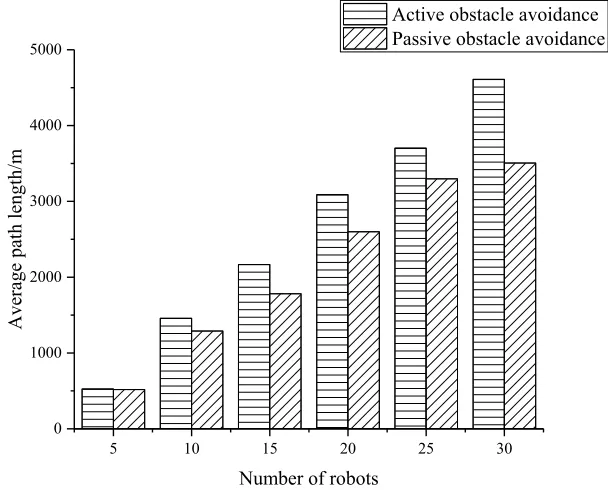
From the comparison of the average path length, as shown in Figure 8, the overall path length of active avoidance all more than the passive avoidance and with the in-crease in the number of robot, the gap between the two is expanding, which is mainly because that the active avoidance strategy will choose a relatively long path length. But the path with low comprehensive cost and the increasing number of robots will result in the increase of conflict nodes. In addition, the instability of the genetic algorithm can cause the fluctuation of the selection path length.
Fig. 8. Comparison of average path length
5 10 15 20 25 30
0 1000 2000 3000 4000 5000
Average
path length/m
Number of robots
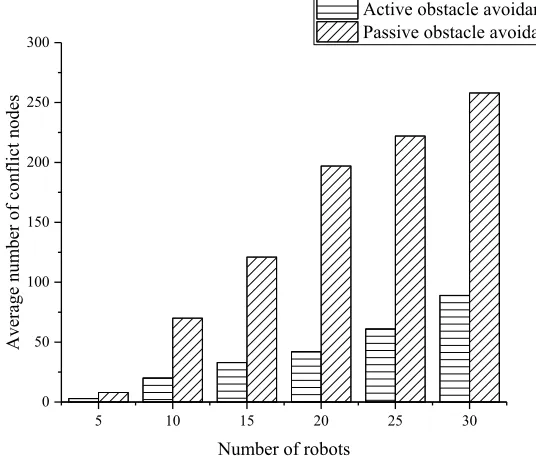
From the comparison of the average number of nodes of the conflict, as shown in Figure 9, with the increase of the number of robots in scale, the number of average conflict nodes in the active and passive avoidance increases. However, the average number of conflict nodes of active avoidance is significantly less than the number of nodes in the passive avoidance, and with the increasing number of robot scale, the gap between the two is gradually widening. This fully demonstrates the effectiveness of the proposed strategy to solve the path conflict of multi-robot.
Fig. 9. Comparison of average number of conflict nodes
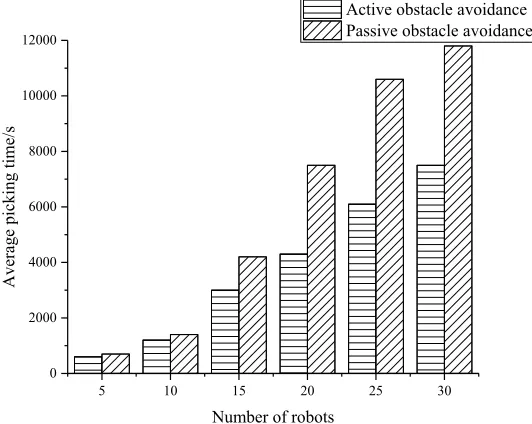
From the comparison of average picking time, as shown in Figure 10, with the in-crease of robot number, the average picking time of active obstacle avoidance and av-erage obstacle avoidance is increasing and the gap is gradually widening. When the number of robots is small, the difference between average picking time and passive obstacle avoidance is not significant. This is mainly due to the fewer number of nodes in the path conflict when the number of robots is small, so the time saved by obstacle avoidance strategy is relatively short. Besides, the active obstacle avoidance strategy may choose a longer path than the passive obstacle avoidance strategy, which also re-duces the time saved by the active obstacle avoidance strategy to a certain extent.
5 10 15 20 25 30 0
50 100 150 200 250 300
Average
number of confli
ct nodes
Number of robots
Fig. 10.Comparison of average picking time
Overall, the average path length has poor effect on active avoidance strategy than passive avoidance strategy, while the average number of conflict nodes and the average conflict picking time obtain good results and the effect becomes more obvious with the expansion of problem scale, which fully demonstrates the effectiveness of the proposed strategy.
4.4 Realization of the simulation system of path planning for warehousing and logistics robot
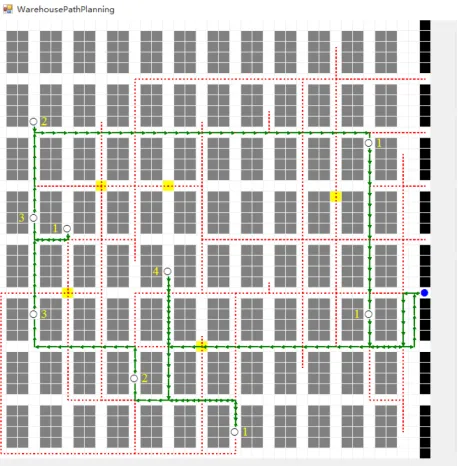
In order to verify the reliability of the proposed warehouse logistics robot picking path planning algorithm, we use the C# programming language to build a visual simu-lation system in the simusimu-lation tool Visualstudio2015, and the system operation flow chart is shown in Figure 11. The user interface of the visual experimental platform is Windows form based on the.NET framework. This simulation system is mainly used to verify single batch warehouse logistics robot batch picking path planning algorithm and multiple warehouse logistics robot batch picking path planning algorithm. The imple-mentation of the system is shown in Figure 12.
5 10 15 20 25 30
0 2000 4000 6000 8000 10000 12000
Average
picking time/s
Number of robots
Fig. 11.System operation flow chart
Fig. 12.Schematic diagram of simulation system running
5
Conclusion
This paper made a systematic study on the routing planning of the storage and logis-tics robot. Firstly, a path planning method for single warehouse logislogis-tics robot single
Necessary input
Algorithm selection
Order generation
Path search Task start
picking - A* algorithm was given. And then the characteristics of logistics robot batch picking path planning were studied, as the TSP problem and the corresponding mathe-matical model was established. The improved adaptive genetic algorithm was used to get the picking access sequence and experimental simulation was conducted. In view of the possible various path conflicts in the multi-warehouse logistics robot, the method of obstacle avoidance was proposed. Finally, the simulation system of the path planning of the warehousing logistics robot was realized. The research results showed that the proposed logistics robot batch picking path planning based on modified A* algorithm could well meet the needs of the robot for efficient real-time path planning in the pro-cess to complete the batch picking tasks. It lays a solid foundation for the realization of intelligent warehouse and full automation management.
6
References
[1] Gao, W.F., Liu, S.Y., & Huang, L.L. (2013). A novel artificial bee colony algorithm based on modified search equation and orthogonal learning: IEEE Transactions on Cybernetics, 43 (3) : 1011. https://doi.org/10.1109/TSMCB.2012.2222373
[2] Yılmaz, S., & Küçüksille, E.U. (2015). A new modification approach on bat algorithm for solving optimization problems: Applied Soft Computing, 28 (5) : 259-275.
https://doi.org/10.1016/j.asoc.2014.11.029
[3] Gonglin, Y., & Maojun, Z. (2013). A Modified Hestenes-Stiefel Conjugate Gradient Algo-rithm for Large-Scale Optimization: Numerical Functional Analysis & Optimiza-tion, 34 (8) : 914-937. https://doi.org/10.1080/01630563.2013.777350
[4] Chang, C.F., Lin, T.Y., & Tai, C.L., et al. (2013). Advanced Information of Parity Bits for Decoding Short Linear Block Codes Using the A* Algorithm: IEEE Transactions on Com-munications, 61 (4) : 1201-1211. https://doi.org/10.1109/TCOMM.2013.020813.120216
[5] Nascimento, T.P.D., Costa, P., & Costa, P.G., et al. (2013). A set of novel modifications to improve algorithms from the A* family applied in mobile robotics: Journal of the Brazilian Computer Society, 19 (2) : 167-179. https://doi.org/10.1007/s13173-012-0091-5
[6] Takeshi, N. (2013). Modification of ABC Algorithm for Adaptation to Time-Varying Func-tions: Electronics & Communications in Japan, 96 (11): 44-53. https://doi.org/10.1002/ ecj.11479
[7] Adnanshiltagh, N., & Dalawr Jalal, L. (2014). A Comparative Study: Modified Parti-cle Swarm Optimization and Modified Genetic Algorithm for Global Mobile Robot Navigation: International Journal of Computer Applications, 89 (9) : 32-46.
[8] Mezura-Montes, E., Portilla-Flores, E.A., & Herna Ndez-Ocaa, B. (2014). Optimum synthe-sis of a four-bar mechanism using the modified bacterial foraging algorithm: In-ternational Journal of Systems Science, 45 (5) : 1080-1100.
[9] Zhan, W., Wang, W., & Chen, N., et al. (2015). Path planning strategies for UAV based on improved A* algorithm: Geomatics & Information Science of Wuhan University, 40 (3) : 315-320.
[10] Mahajan, M., & Preet Singh, T. (2014). The Modified Gaussian Function based RED (MGF-RED) Algorithm for Congestion Avoidance in Mobile Ad Hoc Networks: In-ternational Journal of Computer Applications, 91 (6) : 39-44.
[11] Liu, T., Xie, J.B., & Yan, W., et al. (2013). An algorithm for finger-vein segmentation based on modified repeated line tracking: Journal of Photographic Science , 61 (6) : 491-502.
[12]Zhou, D., & Zhou, H. (2015). A modified strategy of fuzzy clustering algorithm for im-age segmentation: Soft Computing, 19 (11) : 3261-3272. https://doi.org/10.1007/s00500-014-1481-8
[13]Azizi, R., Sedghi, H., & Shoja, H., et al. (2015). A Novel Energy Aware Node Cluster-ing Algorithm for Wireless Sensor Networks Using a Modified Artificial Fish Swarm Algo-rithm: International Journal of Computer Networks & Communications, 7 (3) : 13.
https://doi.org/10.5121/ijcnc.2015.7307
[14]Roberts, M.K., & Jayabalan, R. (2015). A Modified Optimally Quantized Offset Min-Sum Decoding Algorithm for Low-Complexity LDPC Decoder: Wireless Personal Communica-tions, 80 (2) : 561-570. https://doi.org/10.1007/s11277-014-2026-2
[15]Defoort, M., & Djemaï, M. (2013). A Lyapunov-based design of a modified super-twisting algorithm for the Heisenberg system: Ima Journal of Mathematical Control & Information, 30 (2) : 185-204. https://doi.org/10.1093/imamci/dns020
7
Author
Li-Mei Duan is with the Kunming Metallurgy College, Yunnan Kunming, China ([email protected]).