A Model and Indicator of Aggregate Need Satisfaction
for Capped Objectives and Weighting Schemes
for Situations of Scarcity
Anders Herlitz1,2•David Horan3
Accepted: 23 May 2016
Springer Science+Business Media Dordrecht 2016
Abstract Normative criteria for evaluations of economic and social outcomes are often formulated in terms of social welfare functions which are essentially and importantly non-satiable. However, there are good reasons to consider certain normative criteria and many policy objectives to becapped, i.e. bounded, and thus satiable provided sufficient resources are made available for their satisfaction. Inspired by the Foster–Greer–Thorbecke class of indicators, this paper uses an interdisciplinary approach to develop a model for assessing outcomes in terms of capped objectives based on an understanding of individual shortfalls from the objective, denotedneeds. We present an indicator to measure need satisfaction in a population of individuals with heterogeneous needs and highlight an aggregation problem under scarcity. For such situations, we develop three ways in which the indicator can be weighted that reflect respectively concerns over the frequency, depth and severity of the need shortfalls and show that normative evaluations based on these weighting schemes can conflict, yielding mutually inconsistent outcome rankings. The indicator can be adapted to measure a wide variety of phenomena, e.g. health needs, education shortfalls, deprivation, etc., and it is suited for targeting exercises and other policy implementations. In particular, it allows for exogenous weighting schemes, i.e. weights that can incorporate non-shortfall characteristics relevant for the evaluation, e.g. age, gender, ethnicity, etc. The indicator thus enables new ways for researchers to promote and study satiable objectives in a wide
& Anders Herlitz
& David Horan [email protected]
1 Department of Philosophy, Linguistics and Theory of Science, University of Gothenburg,
Gothenburg, Sweden
2
Department of Philosophy, Rutgers, The State University of New Jersey, New Brunswick, New Jersey, USA
3
School of Politics and International Relations, and the UCD Geary Institute for Public Policy, University College Dublin, Dublin, Ireland
variety of contexts relevant to economic and social policy, e.g. human development pro-grams, poverty reduction, healthcare policies, etc.
Keywords Capped objectivesSocial choicePriority weightsAggregationScarcity
1 Introduction
In contrast to popular normative criteria that assess the extent to which an insatiable objective has been met (e.g. social welfare maximization, utility maximization, Rawlsian maximin, economic growth), many policy objectives for economic, social and environ-mental problems are capped. These caps are typically, either explicitly or implicitly, formulated in terms of target levels for achievements in some relevant population. For example, development goals such as elimination of extreme poverty, universal primary education, ending hunger, malaria eradication, gender equality, climate change mitigation are characterized by the fact that once a certain target level has been attained, increases beyond that level do not contribute to the overall goodness or choice-worthiness of the situation in terms of the objective, i.e. the objective is bounded. While capped objectives have been examined in the more specific context of poverty research, and whereas it has been acknowledged that they are prevalent in a vast number of other areas (e.g. Bognar and Hirose2014; Foster et al.2010; Herlitz and Horan2016a; Horan2012; Temkin2012), little attention has been given to the general features of capped objectives and questions con-cerning how to assess outcomes in situations of scarcity, i.e. when only partial satisfaction of the objective is feasible. This paper introduces a general model and indicator for aggregating individual shortfalls from target levels that allows us to better understand problems associated with prioritizations when objectives are capped and the importance of establishing appropriate weighting schemes in circumstances of scarcity.
unless a specific weighting scheme that specifies the priority order of the shortfalls is appended to the indicator.
In particular under scarcity, advocates of capped objectives must address the question of whether it is better to (1) reduce the frequency or multitude of individuals in the population with need shortfalls (individuals in need); (2) reduce the average need shortfall in the population, irrespective of the distribution of shortfalls across the population; (3) reduce the severity of the individual need shortfalls in the population, suppressing smaller shortfalls and emphasizing larger shortfalls; or (4) incorporate some shortfall-independent standard(s) in order to set priorities? In this paper, we focus on the first three of these considerations and show that they conflict since (1) prioritizes individuals with smaller shortfalls; (2) requires assigning equal weight to all individuals; and (3) prioritizes indi-viduals with larger shortfalls. Consequently, it is of utmost importance to address the question of what an appropriate weighting scheme is and how weighting schemes shape capped objectives under scarcity. This becomes even more problematic since a weighting scheme can be interpreted as defining the degree of entitlement to a particular good that is ascribed to individuals with shortfalls (cf. Daoud2007; Sen1981).
It is important to note that a particular strength of our suggested model is that it allows one to depart from the, often tacitly assumed and rarely defended, ideas that target levels should necessarily be uniform, and that weighting schemes should be based solely on the shortfall size. Thus far, indicators that measure the extent to which shortfalls are met (cf. Sen1976,1979; Foster et al.1984,2010), and normative criteria that rely on target levels and measurable divergences from these (cf. Broome 2015; Crisp 2003; Juth2015; Sen
1992; Temkin1993), refer touniformtarget levels and weighting schemes derived solely from the properties of the shortfalls, i.e. the target level is assumed to be the same for every individual, and weights that are applied to shortfalls are derived from the size of the shortfalls (e.g. Alkire et al.2015; Crisp2003; Parfit2012). In some cases, using uniform target levels is overly restrictive (e.g. not every sick personcanbe fully cured) or might be undesirable (e.g. perhaps individualsdeserve different things). In other cases, restricting weights to depend only on shortfall sizes may exclude other individual characteristics relevant for the evaluation (e.g. age, gender, income, etc.). In contrast to FGT, our model allows researchers to move beyond these constraints and think about heterogeneous target levels and in particular exogenous weighting schemes. This latter feature is potentially of great importance since exogenous weighting schemes enable evaluations of targeted interventions (e.g. toward minority groups), and the formulation of weighting schemes that are based on how badly off individuals aregenerallyor in other dimensions (e.g. income, health, etc.), and not only with respect to the need shortfall that one measures (cf. Herlitz and Horan2016b).
2 Needs and Need Shortfalls
We have chosen to address capped objectives in terms ofneedsfor two reasons. First, the structure of the concept of need such as it is widely used both in everyday language and in research literature resembles the structure of shortfalls from capped objectives (e.g. Doyal and Gough 1991; Gough 2015). Second, one of the areas in which the problem is most often discussed, and also widely accepted as relevant, is health care rationing where heterogeneous health needs are typically considered highly important for resource allo-cation (e.g. Bognar and Hirose2014; Herlitz and Horan2016a; Juth2015). Developing an indicator of need satisfaction thus at the same time meets a very specific demand from the area of health care rationing, and enables a vast range of applications to fields characterized by shortfalls, heterogeneous targets and capped objectives.
In this paper, we define need in the following way: it denotes a distance between a current levelof an individual and an obtainable, desired level—atarget level—where an individual should be understood as an agent in the population relevant to the decision, which could be a person or a household but also an organization, region or domain (e.g. Alkire2005; Doyal and Gough1991; Wiggins1987,2005). Need is a 3-place relation (Juth
2015). An individual A has a need for B in order to attain C. What A, B and C actually are depends on the context. In the area of health care, where this is often discussed, C is typically attainable good health, B is health care/treatment, and A is someone in ill-health. In relation to income poverty, A is a poor person who has a need for income, B, in order to reach the poverty line C (cf. Foster et al. 1984, 2010; Sen 1979). In relation to CO2 emissions, A is an emitting agent, B is whatever reduces CO2 emissions, and C is the target abatement level. However, when talking about assessments of policy outcomes generally we can also think of A as affected individuals, B as utility and C as a target utility level, a way of thinking familiar primarily from egalitarian and sufficientarian normative theories (e.g. Temkin 1993; Shields 2012). Alternatively, C can be conceptualized in terms of normal or sufficient functioning/capability, B improved functioning/capabilities, and A affected individuals (Alkire2002; Mitchell et al.2015). A, B and C can capture universal needs that all individuals or societies have (or are ascribed). Yet, they can also capture needs that occur only in specific cultures. Need-satisfaction indicators are very flexible measures with broad applicability. When evaluating outcomes, we use the term need shortfallto refer to the magnitude of an individual’s unsatisfied need.
It follows, thus, that a need-satisfaction indicator can easily be adjusted according to different substantial concepts of need in accordance with the particular capped objective one is interested in. The indicator can be used and is relevant in situations in which there is: (i) identifiable, well-defined target levels, and (ii) measurable divergences from these levels. We place no limitations on how to interpret need beyond these. Need shortfallscan correspond to the degree of entitlement to resources, but they do notnecessarily corre-spond to such valid claims on resources. Examples of problem areas that can be con-ceptualized with this framework include: poverty reduction, health care rationing, environmental policymaking and education/training resource allocation.
partial satisfaction of needs is obviously of little value (e.g. if one addresses expensive cancer treatment), then the latter way of measuring needs seems more appropriate. Below, we focus on how to think about situations where partial satisfaction matters, but the indicator can easily be adjusted so that it accounts for only complete need satisfaction, or both.
We assume scalar comparability of needs both between individuals and within lives. In principle, our concept of need allows for scalar comparisons of needs such that also the magnitude of the need differences can be established. These assumptions about both intra-and interpersonal scalar comparability are controversial intra-and perhaps also generally unwarranted (e.g. Hicks and Allen1934; Herlitz2012; Hirose2015; Pareto1974; Rawls
1971; Schumpeter1954). However, although often questioned the assumptions are com-mon in discussions of policy evaluations and social choice. Also measurements of equality such as the Gini coefficient and calculations of total utility rely on assumptions of intra-and interpersonal comparability. This assumption poses limits on when the indicator can be used: it can be applied in circumstances when scalar comparability is assumed to be possible within the population that is studied. The assumptionmightrelate to a normative view. However, there are also situations in which the assumption is made in order to develop decision heuristics, as well as situations in which the assumption is made in order to make approximations of factual state of affairs. Furthermore, this assumption can be made about a specific, confined population (e.g. a religious minority, the population in a certain region), but it can also be made universally.
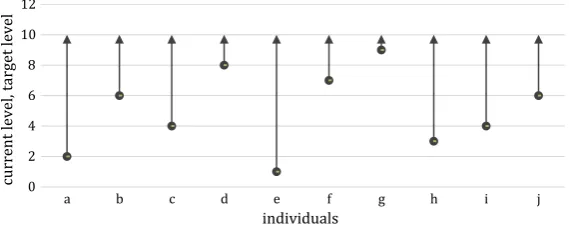
Three broad classes of situations appear in light of our model. The first class of situ-ations is characterized by a common, uniform target level for each member of the popu-lation and individual differences in current levels. In this type of situation, the objective of aggregate need satisfaction involves elevating each individual to the common target. Figure1shows such a situation in which the target level is 10 units for each member of the population.
This class of situations has been studied extensively in the poverty literature. The unit of measurement might, for example, be income and the uniform target the poverty line. Persons in income poverty differ according to their effective income, i.e. real income adjusted for transfers, and the objective of poverty eradication involves increasing the effective incomes of all individuals in poverty up to the poverty line. Within our frame-work, this objective can be interpreted as a form of aggregate need satisfaction, where a need shortfall in this context is the difference between a poor individual’s current income and the poverty line.
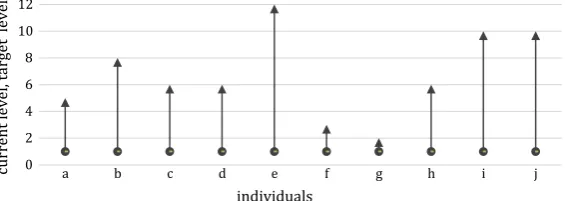
The second class of situations is characterized by a uniform current level for all indi-viduals, and different individual target levels. In this situation, the objective of aggregate need satisfaction requires that each person attain her individual target. Figure2shows a situation where the current level for each individual is 1, and target levels are individuated. One example of when this type of situation arises is in relation to the allocation of scarce resources with the objective of providing schooling for individuals with similar social circumstances but different educational needs.
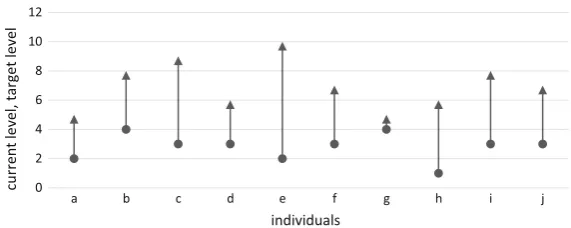
The final class of situations involves heterogeneous current levels and heterogeneous target levels. In this situation, the objective of aggregate need satisfaction requires that each individual is brought from her individuated starting point to her individuated target level. Figure3shows a situation where individuals have different current levels and dif-ferent target levels.
This type of situation arises when individuals have different prospects and also different starting points. One area in which this type of situation is likely to occur is health care, where the target for each individual is to reach the health level that their individual circumstances allow for, and where their initial health levels are different.
There are two distinct ways to think of why need satisfaction matters in light of different interpretations of what theresourcethat is allocated is. On the one hand, satisfying a need can beinstrumentallyvaluable, because it contributes to the attainment of a well-defined objective such as health promotion or poverty reduction. In this case, one uses an in-strumentalinterpretation of what the resource in the model is. Satisfying an individual’s need for medical resources contributes to her attaining good health. Raising a poor indi-vidual’s nominal income contributes to attaining the objective of reducing income poverty. On the other hand, we can think of need satisfaction as a direct measure of how well a well-defined objective has been attained. In such cases resources are equated with thefinalvalue and its unit of measurement. Satisfying an individual’s need for health-improvement is itself part of the objective of health promotion. Satisfying a poor individual’s need for an increase in effective income is itself part of the objective of income poverty reduction. Both the use of final and instrumental resources can be very useful for social choice but it is important to be clear on the differences between them.
Furthermore, if a monotone transformation can be employed to express the relation between individual need shortfalls expressed with an instrumental value and need shortfalls expressed with the final value, then such transformations will preserve rankings of out-comes derived from the indicator of aggregate need satisfaction. It is in such situations irrelevant from a social choice perspective whether the interpretation of the essential resource is equated with an instrumental value or the final value.
However, in many situations, monotone transformations of this type may be impossible. For example, in the area of health care, an individual might have a need for a very large amount of medical resources, a very large instrumental need shortfall, while the amount of health improvement she obtains is relatively small, a relatively small final need shortfall (e.g. a terminally ill patient who can attain very small health benefits at very high costs). Yet, the relation can also be the opposite: an individual might have a need for a very small amount of medical resources, a small instrumental need shortfall, while the amount of health improvement she obtains is very large, a large final need shortfall (e.g. an individual who can be resuscitated by manual CPR).
To summarize: we will use the concept need to denote a shortfall between a current level of an individual and a desired target level. An individual has a need for whatever it is that can close this gap when such a gap exists. Needs are capped, and measured on a continuum. We assume that needs can be scalarly measured both within and between individuals. The magnitude of unsatisfied needs is measured by need shortfalls. Measuring needs is possible when there are (i) identifiable, well-defined target levels, and (ii) mea-surable divergences from these levels.
3 An Indicator of Need Satisfaction for Capped Objectives
In this section, we present an indicator designed to measure aggregate need satisfaction in a population of individuals with different need shortfalls. We then discuss the main prop-erties of the indicator and introduce three different types of weighting schemes relevant in the presence of scarce resources.
3.1 The Model
Suppose N¼ f1;. . .;ng is the population of interest,xi[0 denotes the target level of individuali2N, e.g. the poverty line or resources needed to attain a certain target health level, andxi0 denotes the current level of individuali, e.g. the income of an individual or the health resourcesicurrently receives. The need shortfall of each individual is measured by the difference between the individual’s current and target level, i.e.xixi. Whereas positive values indicate excess need satisfaction, negative values indicate the presence of a need shortfall with the size of the gap measuring the magnitude of the individual’s shortfall.
The following are two empirically relevant special cases of the model. First, if all members of the population have individuated current levels, but the same target level t[0, i.e.xi ¼tfor alli, thenððxi;tÞÞni¼1refers to a situation characterized by a uniform target level and heterogeneous current levels (cf. Fig.1above). Second, if all individuals in the population have individuated target levels, but a common current level, i.e.xi¼cfor all i, thenc;xini¼1 refers to a situation characterized by a uniform current level and heterogeneous target levels (cf. Fig.2above).
3.2 Indicator of Need Satisfaction with Exogenous Weighting Schemes
Following aggregation approaches widely adopted in poverty research, we measure aggregate need satisfaction as a normalized weighted sum of the individual need shortfalls of the population (cf. Sen1976; Foster et al.1984,2010). In particular, like unidimensional poverty indicators such as FGT, the indicator is based on the normalized shortfall of an individual, i.e. xixi
x
i , which is the need shortfall expressed as a share of the individual’s
target level.
In contrast to standard poverty measures, which adopt uniform target levels and shortfall weighting schemes (e.g. Sen 1976; Foster et al.1984,2010; Alkire and Foster
2011), our indicator allows for heterogeneous target levels and exogenous weighting schemes. This latter feature explicitly allows for the possibility that weights are assigned to individual shortfalls with reference to exogenous factors other than the specific need shortfall such as gender, cultural belonging, ethnicity, income/wealth etc. This feature is original to our indicator and it is potentially of great importance as it enables evaluations of targeted interventions (e.g. toward minority groups), but also weighting schemes that are based on how badly off individuals are generally, and not only with respect to the need shortfall that one measures.
Supposexi0 is the weight given to individuali’s normalized need shortfall, with the sum of the weights standardized to equal one, i.e. Pixi¼1. For any standardized weighting scheme x¼ ðxiÞni¼1 and for any outcomex¼ xi;xi
n
i¼1, the value of the
indicator of aggregate need satisfaction, denotedv, is given by
vxð Þ ¼x 1þ Xn
i¼1
ximin 0;xix
i xi
where minfgis the minimum function. The minimum function picks the lowest number in the set f0;xixi
x
i g. This function captures a distinctive feature of capped objectives which
distinguishes it from uncapped objectives such as total utility, weighted utility and Rawlsian approaches, namely that need satisfaction, like poverty eradication, is a bounded objective. In particular, excess need satisfaction adds no extra value to the objective. If for an outcome x, an individual’s target level is exceeded, i.e. xi[xi, all else equal, then
min 0;xixi
x
i n o
¼0, i.e. i’s excess need satisfaction adds no additional value of the indicator.
The indicator takes values between 0 and 1, i.e.vxð Þ 2 ½x 0;1. To see this, on the one
thus min 0;xi
x
i1
n o
¼0 for alli, and consequently the indicator takes its maximum value, i.e. v=1. On the other hand, the objective of aggregate need satisfaction is completely unfulfilled in outcomexif the need ofnoindividual in the population with positive weight is even partially met. In this case, for each individual withxi[0, we have thatxi¼0 and thus min 0;xi
x
i1
n o
¼ 1 for alli, and consequently the indicator takes its lowest value, i.e.v=0.
Importantly, the indicator satisfies the following monotonicity axiom. This axiom ensures that larger values of v indicate greater aggregate need satisfaction within the population.
Monotonicity Axiom: Given other things, a reduction in the need shortfall of an individual strictly increases the need satisfaction indicator provided the individual receives non-zero weight.
More formally, suppose x¼ ðxiÞni¼1 andx0¼ ðx0iÞni¼1 are two outcomes such that x0 is Pareto superior tox, i.e.xix0ifor alliand for at least one individualj,xj\x0j. It can be easily shown that if x is any arbitrary weighting scheme, then vxðxÞ vxðx
0
Þ, and if xj[0 andxj\xj, thenvxð Þx \vxðx
0
Þ. Thus, if an decreases lowers the need shortfall of at least one individual that receives positive weight and does not increase the need shortfall of any other individual then the value of the indicator strictly increases.
3.3 Scarcity, Abundance and Sufficiency
For uncapped objectives such as total utility maximization, available resources are natu-ralized and universalized as scarce due both to the standard non-satiation assumption imposed on utility and the uncapped nature of the objective (e.g. Daoud2011). In contrast, the bounded property of capped objectives allows us to characterize situations involving such objectives according to the availability of resources in terms ofsufficiency,abundance andscarcity(SAS) (cf. Daoud2011). First, available resources, denotedR, are said to be sufficientif there exists a feasible outcome such that the target levels ofallindividuals in the population who receive positive weight are achieved and not exceeded, i.e. given R[0, there exists an outcome x such that vxðxÞ ¼1 and xi¼xi for all i satisfying xi[0, andPixi¼R.
Secondly, available resourcesRare said to beabundantif there exists a feasible out-come such that the target level of at least one individual who receives positive weight is exceeded and the target levels of all other individuals in the population who are assigned positive weight are achieved, i.e. givenR[0, there exists an outcomexsuch thatvxðxÞ ¼
1 withxixi for alliwithxi[0,xj[xj for at least one individualjhavingxj[0, and
P
ixiR. Finally, available resources R are said to bescarceif for all feasible outcomes, there is at least one individual in the population who receives positive weight for whom her target level is not achieved, i.e. givenR[0, we have that vxð Þx \1, for all outcomesx
satisfyingPixiR.
3.4 Scarcity and Shortfall Weighting Schemes
In many situations, the objective of aggregate need satisfaction is likely to be constrained by thescarcityof available resources. Importantly, in situations ofscarcity, this objective is indeterminate until a specific weighting scheme is specified. This constitutes an aggregation problem for proponents of aggregate need satisfaction which in large respects resembles aggregation problems for proponents of equality (e.g. Temkin 1993; Herlitz and Horan
2016b). In particular, advocates of capped objectives must address where it is better to (1) reduce the multitude of individuals in need; (2) reduce the average or depth of shortfall in the population, where need satisfaction has the same impact no matter whether the individual is slightly in need or gravely in need; or (3) reduce the severity of individual need shortfalls, suppressing smaller shortfalls and emphasizing larger ones? In the presence of scarcity, the choice of weighting scheme, which establishes trade-offs between these considerations, must be justified. This is a value judgment. One view is that this choice should be settled with reference to reasonable public acceptance and open to public debate and scrutiny (cf. Foster and Sen1997), but it could also be justified on other grounds.
Below, we introduce three types of weighting schemes that reflect respectively concerns for the frequency, depth and severity of the shortfalls in the population. We first focus on a weighting scheme that weights equally the need shortfalls of all individuals in the popu-lation. We refer to an aggregate need satisfaction indicator with this weighting scheme as the depth indicator. We then examine a weighting scheme in which individuals with relatively smaller need shortfalls receive relatively higher weight. This indicator tends to favor outcomes that minimize the need shortfalls of individuals with relatively smaller shortfalls. We refer to indicators with such weighting schemes as frequency indicators since they place greater emphasis on reducing the multitude of individuals experiencing need shortfall. Finally, we present a weighting scheme in which individuals with relatively larger need shortfalls receive relatively more weight. This indicator typically favors out-comes that reduce the need shortfalls of individual’s with relatively larger shortfalls. We refer to indicators with such weighting schemes as severity indicators since they place greater emphasis on reducing the severity of the need shortfalls of individuals, rather than their multitude.
3.4.1 Depth Indicator
An important feature of indicators based on normalized shortfalls is that in the presence of heterogeneous target levels, the standard equal-weighting scheme xi¼1
n for all i, implicitly gives higher weight to the (absolute) shortfalls of individuals with relatively lower target levels. This target level bias arises becausexi weights the individual’s nor-malized shortfall, i.e.xixi
x
i , and not the individual’s shortfall, i.e.xix
i. Thus, in situations of heterogeneous targets, indicators based on the equal-weighting scheme tend to favor outcomes which, all else equal, reduce the shortfalls of individuals with relatively lower targets and thus relatively smaller shortfalls. If on the other hand, the target level is uniform across the population, as typically arises in poverty measurement (cf. Alkire and Foster 2011), then the standard equal-weighting scheme would weight equally the short-falls of all individuals and could act as an appropriate weighting scheme for the depth indicator when targets are uniform.
weighting scheme is given byxdepthi ¼Pxi jx
j
for alli, wherePjxj is the sum total of the
target levels of the population, which we refer to as thetotal target level. This weighting scheme expresses the individual target level as a fraction of the total target level and it satisfiesPixdepthi ¼1. Incorporating these weights, adepthindicator of aggregate need satisfaction, denotedvdepth, is given by
vdepthð Þ ¼x 1þX
n
i¼1
x i
P
jxj
!
min 0;xix
i xi
Notice that whereas the weight given to an individual’s normalized need shortfall increases with the individual’s target level, the weight given to individuals with different (absolute) need shortfalls are identical. An interesting consequence of this type of weighting scheme is that thedepthneed satisfaction indicator measures essential resource allocation. To see this, suppose the target level of no individual is exceeded, i.e.xixi for all i. Simple manipulations reveal that the depth indicator reduces to vdepthð Þ ¼x
P ixi P
ix
i
which is simply the total current or achieved level expressed as a fraction of the total target level. The depth indicator can thus also be viewed as measuring the depth of need deprivation in the population. In this sense, the indicator is similar to the Poverty Gap Index, P1 or FGT1, which estimates the depth of poverty by considering how far, on
average, the poor are from the poverty line (Foster et al.2010). It however corrects for the implicit bias in FGT1 in the presence of heterogeneous target levels.
The major upshot of thedepthindicator is that it allows us to establish the proportion of needs that are satisfied by a certain intervention. This can be very useful in situations in which some possible and also appealing decisions entail that not all resources go into actually meeting needs. Two examples of such situations can be mentioned. First, there are situations where a decision affects both need satisfaction and some other value such as total utility, and where allocating resources also to individuals who do not need them in our technical sense can increase the second value. The indicator allows us to see that one alternative does relatively better than another in terms of satisfying needs while they might have the opposite relation in terms of the second value. Second, there are situations in which we want to evaluate decisions in terms of how much resources actually satisfy needs, and not just how much resources are allocated to individuals with needs. For example, we might want to measure how much resources go into actually improving health need satisfaction. Since our indicator takes into account the cap on needs, thedepthindicator allows us to measure exactly this.
A significant shortcoming of thedepthneed-satisfaction indicator is that it does not dis-criminate between different needs at all. Everything else equal, an alternative is thus better in terms of thedepthindicator of need satisfaction if it satisfies more needs, regardless of how immediate and how large the needs are. Under empirical circumstances in which it is easier to meet some needs than others, following thedepthindicator of need satisfaction will thus bias decision making toward satisfying the needs that are easiest and cheapest to satisfy. This appears highly undesirable in some situations. For example, in the allocation of scarce health care resources where some health needs are very expensive to meet, but still deservesomepriority.
3.4.2 Frequency Indicator
schemes could be construed. In this paper, we focus on a weighting scheme in which an individual’s weight depends on the difference between her need shortfall and the need shortfall of the worst-off in the population. The larger this difference, the smaller is the individual’s shortfall and the greater the weight her shortfall receives.
Formally, the need shortfall of the worst-off person, denoted gmax, is given by gmax¼maxf0;x
1x1;x2x2;. . .;xnxng, where the maximum function picks the lar-gest number in this set. To avoid assigning zero weight to the worst-off person, we add a parametere0 to the shortfall of the worst-off which will indirectly measure how much weight is given to the shortfall of the worst-off person. We thus definegmax
e ¼gmaxþe.
Supposexfreqi ¼ gmaxe maxf0;xixig
ngmax
e
P jmaxf0;x
jxjgis the weight given to individuali’s shortfall, where
e0. If2¼0, then the worst-off person receives zero weight, whereas if2 [0 the worst-off receives positive weight. The denominator is the sum of the differences between the shortfall of the worst-off plus e and each individual’s shortfall and therefore acts to standardize this weighting scheme, i.e.Pix
freq i ¼1.
Incorporating this weighting scheme, a frequency indicator of aggregate need satis-faction, denotedvfreq, is given by
vfreqðxÞ ¼1þX
n
i¼1
gmax
e max 0;xi xi
ngmax
e P
jmax 0;xj xj
n o 0
@
1
Amin 0;xix
i xi
Under this weighting scheme, individuals with relatively smaller need shortfalls receive relatively greater weight, and thus, this indicator tends to favor outcomes which reduce relatively smaller shortfalls. As a result, it is in light of the frequency indicator typically better to reduce or eradicate the need shortfalls of people with relatively smaller shortfalls rather than to allocate resources to individuals with relatively larger shortfalls, since reducing their need shortfalls contributes less value to the indicator. Importantly for sit-uations of sufficient or abundant resources, the assumptione[0 ensures that any outcome which eradicates the need shortfall of the worst-off contributes a non-zero, albeit small, value to this frequency indicator.
The upshot of this measure is that it provides us with an indicator of aggregate need satisfaction that prioritizes closing gaps horizontally. In situations in which there is a large population with heterogeneous target levels and where we want to prioritize minimizing the amount of individuals in the population with need requirements, this weighting scheme is useful. Furthermore, weighting the indicator of aggregate need satisfaction in this manner provides a safeguard against the possibility that a few individuals with very large needs are prioritized over every other individual.
The shortcoming of this weighting scheme is that it fails to capture some widely held intuitions about prioritizations. Most political-philosophical, general approaches to prior-ity-setting suggest that some priority ought to be given to the worst off, which is the opposite of what this weighting scheme does (cf. criticism against Headcount sufficien-tarianism, Shields2012).
3.4.3 Severity Indicator
Consider now a severity indicator which requires that individuals with relatively larger need shortfalls are explicitly given greater weight. Several different weighting schemes could be used to express this. We focus on the case where the magnitude of an individual’s
need shortfall directly determines the weight. Supposexsev i ¼
maxfx
ixi;0g P
jmaxfx
jxj;0gis the weight
given to individuali’s shortfall, where the denominatorPjmaxfxj xj;0gis the sum total
of the need shortfalls of the population andPixsev
i ¼1. Individuali’s weight is defined as the magnitude of her need shortfall expressed as a fraction of the total need shortfall in the population. Under this weighting scheme, individuals with relatively larger need shortfalls receive relatively greater weight. Incorporating these weights, a severity indicator of aggregate need satisfaction, denotedvsev, is given by
vsevð Þ ¼x 1þX
n
i¼1
max x i xi;0 P
jmax xj xj;0 n o 0
@
1
Amin 0;xix
i xi
Under this weighting scheme, it is typically better to reduce the need shortfalls of individuals with larger shortfalls because need satisfaction for these individuals contributes greater value to the indicator. On the other hand, allocating resources to individuals with relatively smaller need shortfalls gives a lower score to the indicator and thus contributes less to the overall objective of aggregate need satisfaction.
This indicator measures need satisfaction in a way that gives extra weight to need satisfaction of the individuals who are relatively worse off in terms of how much of the essential resource they need. The indicator thus closely resembles the poverty severity index,P2or FGT2, in the more general setting of need deprivation, a measure which puts
more weight the further a poor person’s observed income falls below the poverty line (Foster et al.2010). This is thus an indicator that comes close to measuring the factor that Derek Parfit proposed matters when he introduced the priority view (Parfit1997). Yet, this will also depend on how one interprets the essential resource.
The shortcomings of the measure include that in circumstances where some individuals in the population have very large need shortfalls, the indicator gives a large value to the satisfaction of these individuals’ needs and may thus prioritize the needs of a small number of individuals over a much larger set of individuals with relatively smaller need shortfalls. This may in some cases be very undesirable.
of an instrumental unit of measurement, and where the relation between the instrumental and the final unit of measurement is not monotone, it appears arbitrary to define a weighting scheme with reference to the characteristics of the individual needs such as these are expressed in the instrumental unit of measurement. This appears to be the case in the health care sector where the costs of treatments do not correspond to the benefits that they generate in any clear way. Third, in situations where the indicator measures need satis-faction in terms of an instrumental unit of measurement, and where the relation between the instrumental and the final values ismonotone, it appears plausible that one can define desirable weighting schemes with reference to the characteristics of the individual needs in the population such as these are expressed with the instrumental unit of measurement.
4 Illustrative Example
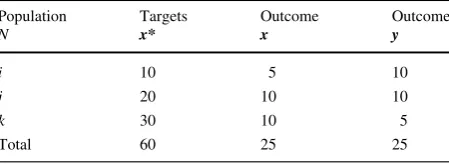
Using a simple example, we now illustrate how frequency, depth and severity indicators can conflict, yielding mutually inconsistent outcome rankings. For reasons of space, we do not use real data for the illustration. Consider a population of three types of individuals with heterogeneous target levels illustrated in Table1.
One can think of this as heterogeneous health needs. We compare two outcomesxandy
characterized by having the same quantity of scarce resources, i.e. R¼25 units of need satisfaction, but different distributions of the resources across individuals. Whereas out-comexis better for the individual with the highest target level, outcomeyis better for the individual with the lowest target level. We now examine how the different weighting schemes presented in the previous section evaluate these outcomes (Table2). For the case of the frequency indicator, we sete¼1.
Table3summarizes the values of the indicators of aggregate need satisfaction for each of the three different weighting schemes.
First, the depth indicator views x and y as equivalent outcomes, i.e. vdepthð Þ ¼x 0:4167¼vdepthðyÞ. Since both outcomes distribute the same amount of resources and thedepthindicator weights each individual’s need shortfall equally,xandy
are equivalent from adepthperspective. Second, thefrequencyindicator ranksyas a better outcome thanx, i.e.vfreqð Þ ¼x 0:494,vfreqð Þ ¼y 0:7946 and thusvfreqð Þx\vfreqð Þy . For this indicator, individuals with relatively smaller need shortfalls receive relatively greater weight, and consequently the indicator typically prefers allocations that favor distributing resources to individuals with smaller need shortfalls. By contrast, the severity indicator ranks x as a better outcome than y, i.e.vsevð Þ ¼x 0:4048, vsevð Þ ¼y 0:2619 and thus vsevð Þx [vsevð Þy . For this indicator, individuals with relatively larger need shortfalls receive relatively greater weight, and consequently it typically gives a higher rank to
Table 1 Target levels and two
feasible outcomes Population Targets Outcome Outcome
N x* x y
i 10 5 10
j 20 10 10
k 30 10 5
outcomes that favor distributing resources to individuals with larger need shortfalls. This indicator thus yields the reverse ranking to the frequency indicator.
We see, thus, that different weighting schemes entail conflicting outcome evaluations (cf. Herlitz and Horan2016b). This means that in so far as no specific weighting scheme is promoted in relation to a capped objective, capped objectives are indeterminate in the case of scarcity. This is an important finding since it shows how more work needs to be done in order to develop appropriate weighting schemes for capped objectives. This can be done in various ways, either with reference to normative political theory, with reference to social preferences, through deliberative-democratic processes or through the use of sensitivity and uncertainty analysis techniques (cf. Saisana et al. 2005; OECD 2008; Marozzi
2014,2015). All of these approaches have their merits, but also their shortcomings. It is beyond the scope of this paper to defend or dismiss any of the approaches to how one should justify weighting schemes for capped objectives.
5 Discussion
In this paper, we presented an indicator that measures the extent to which the aggregate needs(defined as a distance between a current level and a target level) of a population have been satisfied. This indicator can be used to evaluate outcomes when objectives are capped, and allows for both heterogeneous target levels and individuated weights. We have shown that, under conditions of scarcity, capped objectives (e.g. bring people out of poverty, prioritize individuals who fail to reach target level X) will be vague and/or arbitrary until a specific weighting scheme that establishes how to aggregate the need shortfalls in the population has been developed and appended to the indicator.
Establishing an indicator of aggregate need satisfaction allows us to get a better understanding of prioritizations. We developed what we have called frequency, depth and severity weighting schemes and showed that outcome rankings differ depending on which of these weighting schemes one applies. The selection of an appropriate weighting scheme should plausibly be settled on a case-by-case basis, and it is not even obvious that the features of the shortfalls constitute the best ground for weighting schemes, but on a very general level it is important to recognize the problem, and also the fact that Table 2 Depth, frequency and
severity weighting schemes Population Depth Frequency Frequency Severity Severity
N xdepth xfreqðxÞ xfreqðyÞ xsevðxÞ xsevðyÞ
i 0.1667 0.5714 0.6046 0.1429 0
j 0.3333 0.3929 0.3721 0.2857 0.2857
k 0.5 0.0357 0.0233 0.5714 0.7143
Total 1 1 1 1 1
Table 3 Depth, frequency and
severity indicator values Indicator Outcome Outcome
v x y
vdepth 0.4167 0.4167
vfreq 0.494 0.7946
proponents of gap closures owe us an answer to the question of which weighting scheme one should embrace under scarcity. This is a challenge for theories that rely on capped objectives, but seeing the challenge enables us to make significant progress in this area.
One limitation of the indicator in its current form is that the model does not take into account the indirect resources that a policy maker has to mobilize—‘‘the delivery sys-tem’’—in order to fill gaps. This can lead to misdirected targeting. For example, we know that people living in rural areas typically have greater water need shortfalls compared to people living in urban areas. Building and connecting water pumps to remote areas is costly. This means that even if rural people have the greatest water needs and should get water (direct satisfier), the associated costs of building that delivery system (indirect satisfiers) are high. One important direction for future research is thus to incorporate into the model a ‘‘cost parameter’’ that takes into account the difficultly associated with closing different needs shortfalls.
A further limitation of the indicator presented above is that it assumes that partial need satisfaction is valuable. This is clearly a desirable feature for an indicator of aggregate need satisfaction in some situations (e.g. income poverty reduction). However, it is equally clear that there are situations in which this feature is problematic. For example, it is problematic to measure aggregate need satisfaction in this way when the need concerns literacy, or resources that can be used to provide medical treatment with fixed costs. For such situa-tions, one gets a more appropriate indicator by adjusting our indicator so that it measures discrete need satisfaction.
Another limitation of the indicator is that it assumes static needs. This assumption can be dropped, and the indicator adjusted so that it incorporates also needs arising in different time periods and different spatial locations. Such adjustments would be highly useful for studies that concern distributional issues over time and across space, for example problems concerning climate change, sustainable development and intergenerational justice. But it could also account for problems concerning the concept of need itself and be used to advance the study of needs, since it would allow for needs to change over time also for a single individual.
More research is needed to figure out how to account for intuitions about prioritizations based on aggregate need satisfaction. More research is also needed concerning the application of need-based prioritization ideals in more specific fields, such as health care rationing, humanitarian aid and poverty reduction. It is our hope that this paper can contribute to research in these fields.
Acknowledgments This work has been conducted with the support of COFAS Marie Curie fellowship program and the Central Research Fund (Oxford Brookes University). The authors would like to thank Henrik Andersson, Christine Chwaszcza, Pascal Courty, Adel Daoud, Sean Dineen, Charles Gottlieb, Ian Gough, Urban Herlitz, Dennis Patterson, Richard Spady, Rick Van der Ploeg, Christoph Weiss and seminar participants at OPHI, University of Oxford and ZEF, University of Bonn as well as two anonymous reviewers for valuable feedback.
References
Alkire, S. (2002).Valuing freedoms: Sen’s capabilities approach and poverty reduction. Oxford: Oxford University Press.
Alkire, S., & Foster, J. (2011). Counting and multidimensional poverty measurement.Journal of Public Economics, 95(7–8), 476–487.
Alkire, S., Foster, J., Suman, S., Santos, M. E., Roche, J. M., & Ballon, P. (2015).Multidimensional poverty measurement analysis. Oxford: Oxford University Press.
Bognar, G., & Hirose, I. (2014).The ethics of health care rationing. New York: Routledge.
Broome, J. (2015). Equality versus priority: A useful distinction. Economics and Philosophy, 31(2), 219–228.
Crisp, R. (2003). Equality, priority, and compassion.Ethics, 113(4), 745–763.
Daoud, A. (2007). (Quasi)Scarcity and Global Hunger: A sociological critique of the scarcity postulate with an effort to synthesis.Journal of Critical Realism, 6(2), 199–225.
Daoud, A. (2011). Sufficiency, abundance and scarcity: contributions to social and economic theory. Dis-sertation, University of Gothenburg.
Dorsey, D. (2012).The basic minimum: A welfarist approach. Cambridge: Cambridge University Press. Doyal, L., & Gough, I. (1991).A theory of human need. New York: Palgrave Macmillan.
Foster, J., Greer, J., & Thorbecke, E. (1984). A class of decomposable poverty measures.Econometrica, 52(3), 761–766.
Foster, J., Greer, J., & Thorbecke, E. (2010). The Foster–Greer–Thorbecke (FGT) poverty measure: 25 years later.Journal of Economic Inequality, 8(4), 491–524.
Foster, J., & Sen, A. (1997). On economic inequality: After a quarter century. In A. Sen (Ed.),On economic inequality(pp. 109–219). Oxford: Clarendon Press.
Gough, I. (2015). Climate change and sustainable welfare: the centrality of human needs.Cambridge Journal of Economics, doi:10.1093/cje/bev039.
Herlitz, A. (2012). Choice: An essay on pluralism, value conflicts and decision-making. Dissertation, European University Institute.
Herlitz, A., & Horan, D. (2016a). Measuring needs for priority setting in healthcare planning and policy.
Social Science and Medicine, 157, 96–102.
Herlitz, A., & Horan, D. (2016b). Prioritizing the ‘‘worse off’’ under attainability constraints: An indeter-minacy problem for distributive fairness. UCD Geary Institute for Public Policy Discussion Paper Series, Geary WP2016/08.
Hicks, J. R., & Allen, R. G. D. (1934). A reconsideration of the theory of value.Economica, 1(2), 52–76. Hirose, I. (2015).Moral aggregation. Oxford: Oxford University Press.
Horan, D. (2012). Essays on innovation, R&D policy and industrial clusters. Dissertation, European University Institute.
Juth, N. (2015). Challenges for principles of need in health care.Health Care Analysis, 23(1), 73–87. Marozzi, M. (2014). Measuring trust in European Public Institutions.Social Indicators Research, 123(3),
879–895.
Marozzi, M. (2015) Construction, robustness assessment and application of an index of perceived level of socio-economic threat from immigrants: A study of 47 European countries and regions.Social Indi-cators Research, doi:10.1007/s11205-015-1037-z.
Mitchell, P. M., Roberts, T. E., Barton, P. M., & Coast, J. (2015). Assessing sufficient capability: A new approach to economic evaluation.Social Science and Medicine, 139, 71–79.
OECD (2008).Handbook on constructing composite indicators: methodology and user guide, OECD 2008, ISBN 978-92-64-04345-9.
Pareto, V. (1974).Manuale di economia politica con una introduzione alla scienza sociale. Padova: Cedam. Parfit, D. (1997). Equality and priority.Ratio, 10(3), 202–221.
Parfit, D. (2012). Another defence of the priority view.Utilitas, 24(3), 399–440. Rawls, J. (1971).A theory of justice. Cambridge: Harvard University Press.
Saisana, M., Saltelli, A., & Tarantola, S. (2005). Uncertainty and sensitivity analysis techniques as tools for the quality assessment of composite indicators.Journal of the Royal Statistical Society Series A, 168, 307–323.
Schumpeter, J. A. (1954).History of economic analysis. Oxford: Oxford University Press. Sen, A. (1976). Poverty: An ordinal approach to measurement.Econometrica, 44(2), 219–231.
Sen, A. (1979). Issues in the measurement of poverty.Scandinavian Journal of Economics, 81(2), 285–307. Sen, A. (1981).Poverty and famines: An essay on entitlement and deprivation. Oxford: Oxford University
Press.
Sen, A. (1992).Inequality reexamined. Cambridge: Harvard University Press. Shields, L. (2012). The prospects for sufficientarianism.Utilitas, 24(1), 101–117. Temkin, L. (1993).Inequality. Oxford: Oxford University Press.
Wiggins, D. (1987). Claims of need. In D. Wiggins (Ed.),Needs, values, truth(pp. 1–58). Oxford: Oxford University Press.