E X T E N D E D G E N O M E R E P O R T
Open Access
Insights into
Cedecea neteri
strain M006
through complete genome sequence, a
rare bacterium from aquatic environment
Kok-Gan Chan
1,2*and Wen-Si Tan
1Abstract
Cedecea neteri
M006 is a rare bacterium typically found as an environmental isolate from the tropical rainforest
Sungai Tua waterfall (Gombak, Selangor, Malaysia). It is a Gram-reaction-negative, facultative anaerobic, bacillus.
Here, we explore the features of
Cedecea neteri
M006, together with its genome sequence and annotation. The
genome comprised 4,965,436 bp with 4447 protein-coding genes and 103 RNA genes.
Keywords:
Cedecea
, Gram-negative, Facultative anaerobic, Genome
Introduction
The
Cedecea
genus is an extremely rare member of the
Enterobacteriaceae
family [1]. The name
Cedecea
was
proposed in 1980 for a new genus formerly designated
as CDC Enteric Group 15 [1, 2].
Cedecea
is
character-ized by positive lipase activity, resistance to colistin and
cephalothin, and the inability to hydrolyze gelatin or
DNA [3
–
5]. Discovery was from human sources where
its natural environmental habitat remains unknown,
Cedecea
constitutes a rare pathogen of rising importance
[6]. To date, only a few species of
Cedecea
have been
identified:
C. davisae
,
C. lapagei
and
C. neteri
. All three
species exhibit different behaviors in the human body.
C.
davisae
has been reported to be associated with scrotal
abscess [7] and, most recently, to cause bacteraemia in
patients with sigmoid colon cancer [8]. On the other
hand,
C. lapagei
has mostly been reported to be involved
in pneumonia cases [5, 9].
C. neteri
is associated with
bacteremia in heart disease patients [4] and patients with
systemic lupus erythematosus [10].
Strain M006 is a strain of
Cedecea neteri
and is an
aquatic isolate from the Sungai Tua Waterfall, a
Malaysian tropical rainforest waterfall (N 03 19.91
′
E 101
42.15
′
). In this study, we present an overview of the
classification and features of
C. neteri
M006 as well as its
genome sequence and annotation. There are a few
C.
neteri
aquatic isolates deposited in GenBank and
C. neteri
strain M006 was one of the few isolates discovered from a
waterfall which its genome feature has not been reported.
Hence, here we firstly reported the genome information of
C. neteri
M006 isolated from a waterfall environment.
Organisms Information
Classification and features
Strain M006 was categorized as a member of the
genus
Cedecea
by 16S rRNA phylogeny and
pheno-typic characteristics (Table 1). The EzTaxon database
[11] was used as the preliminary 16S rRNA gene
sequence-based identification. Strain M006 was most
closely related to
C. neteri
GTC 1717T (GenBank
accession = AB086230) with a sequence similarity of
99.78%. Subsequent phylogenetic analysis was
per-formed comparing the 16S rRNA gene sequences of
strain M006 and related species (Fig. 1). The
se-quences were aligned and phylogenic trees were built
using neighbor-joining (NJ) and maximum-likelihood
(ML) methods implemented in MEGA version 5 [12].
C. neteri
M006 cells are Gram-negative, bacillus in
shape (0.6-0.7 × 1.3-1.9
μ
m), are facultatively anaerobic
and are motile with 5-9 peritrichous flagella. Colonies
formed on nutrient agar are 1.5 mm in diameter and
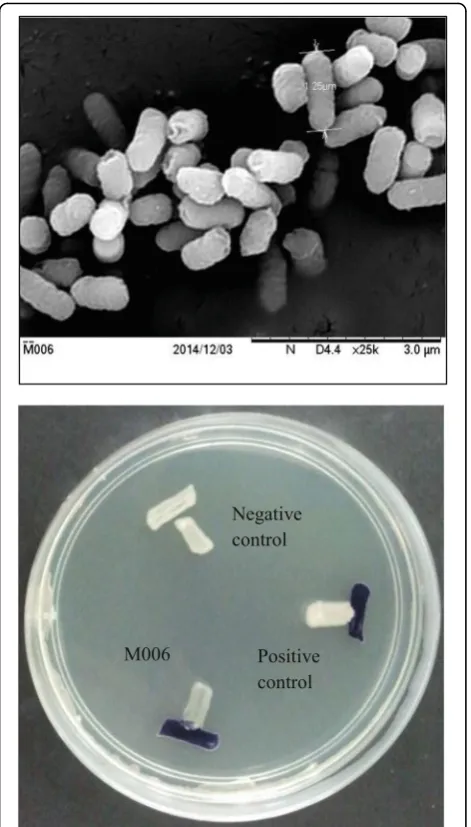
non-pigmented. Scanning electron micrograph pictures of
nu-trient broth grown cultures showed free-floating cells
* Correspondence:[email protected]
1Division of Genetics and Molecular Biology, Institute of Biological Sciences, Faculty of Science, University of Malaya, 50603 Kuala Lumpur, Malaysia 2Vice Chancellor Office, Jiangsu University, Zhenjiang 212013, People’s Republic of China
Table 1
Classification and general features of
Cedecea neteri
M006 according to MIGS recommendations [14]
MIGS ID Property Term Evidence code
Classification Domain Bacteria TAS [22]
PhylumProteobacteria TAS [23,24] ClassGammaproteobacteria TAS [25–27]
Orderunknown TAS [23]
FamilyEnterobacteriaceae TAS [28–30]
GenusCedecea TAS [4]
SpeciesCedecea neteri IDA
Strain: M006
Gram stain negative TAS [4,10]
Cell shape bacillus TAS [4,10]
Motility motile TAS [4]
Sporulation Non-spore forming NAS
Temperature range 4-28 °C IDA
Optimum temperature 28 °C IDA
pH range; Optimum e.g., 5.0-8.0; 7 IDA
Carbon source D-sorbitol, Sucrose, D-xylose, malonate TAS [4]
MIGS-6 Habitat waterfall IDA
MIGS-6.3 Salinity unknown IDA
MIGS-22 Oxygen requirement Facultative anaerobic TAS [4,10]
MIGS-15 Biotic relationship Free-living TAS [4]
MIGS-14 Pathogenicity Non-pathogen IDA
MIGS-4 Geographic location Sungai Tua Waterfall, Malaysia IDA
MIGS-5 Sample collection 2013 IDA
MIGS-4.1 Latitude N 03 19.91′ IDA
MIGS-4.2 Longitude E 101 42.15′ IDA
MIGS-4.4 Altitude 586 m IDA
Evidence codes–IDA: Inferred from Direct Assay; TAS: Traceable Author Statement (i.e., a direct report exists in the literature); NAS: Non-traceable Author Statement (i.e., not directly observed for the living, isolated sample, but based on a generally accepted property for the species, or anecdotal evidence). These evidence codes are from the Gene Ontology project [31]
Fig. 1Phylogenetic tree highlighting the position ofCedecea neteriM006 relative to the type strains of other species within the genus of
Cedecea. The strains and their corresponding GenBank accession numbers of 16S rRNA genes are indicated in parentheses. The sequences were
and clotted cells (Fig. 2). The carbon sources utilized
by
C. neteri
are D-sorbitol, sucrose, D-xylose and
malonate.
C. neteri
is reported to be unable to
utilize dulcitol, adoitol, L-rhamnose, erythritol,
gly-cerol and mucate. The optimal temperature for
strain M006 is 28 °C.
C. neteri
M006 cells are Gram-negative, bacillus in
shape, survive facultative anaerobically and are motile. The
colonies formed on nutrient agar are 1.5 mm in diameter
and are non-pigmented. The colony is whitish in color and
the appearance is round with a smooth edge. Signaling
molecules, known as
N
-acylhomoserine lactone, are
pro-duced for communication purposes in order to regulate
physiological properties. The preliminary screening of strain
M006 using the bacterial biosensor
Chromobacterium
violaceum
(CV026) showed the purple pigmentation
indi-cative the presence of signaling molecules (Fig. 3).
Genome sequencing information
Genome project history
Strain M006 was selected for the sequencing based on
its phylogenetic position and the similarity of its 16S
rRNA to other members of the genus
Cedecea
, The
gen-ome project was deposited in the Gengen-omes On-Line
Database [13] and the genome sequence was deposited
in GenBank (CP009458.1). A summary of the project
Table 2
Genome sequencing project information
MIGS ID Property Term
MIGS 31 Finishing quality Complete
MIGS-28 Libraries used PacBio
MIGS 29 Sequencing platforms PacBio
MIGS 31.2 Fold coverage 74.34×
MIGS 30 Assemblers HGAP V 2.1.1
MIGS 32 Gene calling method IMG-ER
Locus Tag LH23
Genbank ID CP009458
Genbank Date of Release 2014/10/22
GOLD ID Gp0109502
BIOPROJECT PRJNA260769
MIGS 13 Source List Identifier M006
Project relevance Environmental
Fig. 2Scanning electron micrograph ofCedecea neteriM006. Scale bar 3.0μm
and the Minimum Information about a Genome Sequence
(MIGS) [14] are shown in Table 2.
Growth conditions and genomic DNA preparation
Cedecea neteri
M006 was cultured aerobically on
Luria-Bertani (LB) agar medium at 28 °C overnight (16-18 h).
Genomic DNA was extracted using the MasterPure
™
DNA Purification Kit (Epicentre Inc., Madison, WI, USA).
The extracted genomic DNA was examined via a
Fig. 4Graphical circular map of the genome. Starting from the outermost circle and moving inwards, each ring of the circle contains information on a genome: tRNA/rRNA, genes on the reverse and forward strands, GC skew and GC ratio
Table 3
Genome statistics
Attribute Value % of total
Genome size (bp) 4,965,436 100
DNA coding (bp) 4,350,834 87.62
DNA G + C (bp) 2,701,616 54.41
DNA scaffolds 1 100
Total genes 4550 100
Protein coding genes 4447 97.74
RNA genes 103 2.26
rRNA genes 22 0.48
tRNA 80 1.76
Pseudo genes 24 0.53
Genes in paralog clusters 3462 76.09
Genes with function prediction 4091 89.91
Genes assignmed to COGs 3611 79.36
Genes with Pfam peptides 4095 90.00
Genes with signal peptides 466 10.24
Genes with transmembrane helices 1079 23.71
CRISPR repeats 0 0.00
Table 4
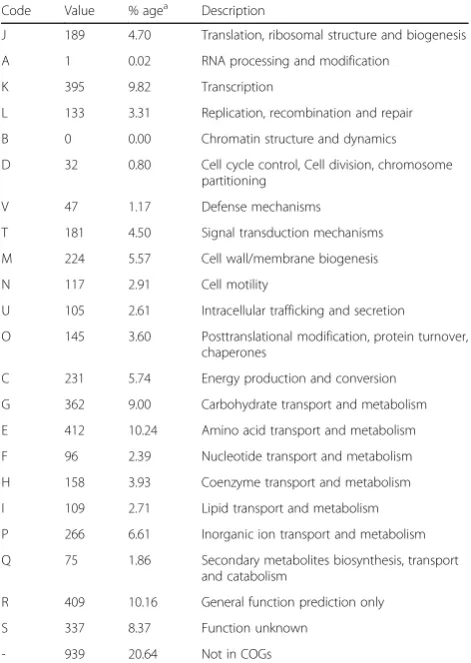
Number of genes associated with general COG
functional categories
Code Value % agea
Description
J 189 4.70 Translation, ribosomal structure and biogenesis
A 1 0.02 RNA processing and modification
K 395 9.82 Transcription
L 133 3.31 Replication, recombination and repair
B 0 0.00 Chromatin structure and dynamics
D 32 0.80 Cell cycle control, Cell division, chromosome partitioning
V 47 1.17 Defense mechanisms
T 181 4.50 Signal transduction mechanisms
M 224 5.57 Cell wall/membrane biogenesis
N 117 2.91 Cell motility
U 105 2.61 Intracellular trafficking and secretion
O 145 3.60 Posttranslational modification, protein turnover, chaperones
C 231 5.74 Energy production and conversion
G 362 9.00 Carbohydrate transport and metabolism
E 412 10.24 Amino acid transport and metabolism
F 96 2.39 Nucleotide transport and metabolism
H 158 3.93 Coenzyme transport and metabolism
I 109 2.71 Lipid transport and metabolism
P 266 6.61 Inorganic ion transport and metabolism
Q 75 1.86 Secondary metabolites biosynthesis, transport and catabolism
R 409 10.16 General function prediction only
S 337 8.37 Function unknown
- 939 20.64 Not in COGs
a
NanoDrop
spectrophotometer
(Thermo
Scientific,
Waltham, MA, USA) and a Qubit 2.0 fluorometer
(Life Technologies, Carlsbad, CA, USA) for its quality.
Genome sequencing and assembly
The genome of strain M006 was sequenced at the
micro-biome lab, High Impact Research, University Malaya, using
a Pacific Biosciences single-molecule real-time (PacBio
SMRT) sequencer. The sequencing was carried out using
P5 chemistry on two SMRT cells with a 20-kb prepared
SMRTbell library [15]. De novo assembly of 41,094 reads
using the hierarchical genome assembly process in the
SMRT version 2.1.1 portal resulted with one contig of
3.96 Mb in size. The sequencing average coverage is
74.34 × and this genome has a GC content of 54.41%.
Genome annotation
After genome assembly, it was analyzed using Rapid
An-notation using Subsystem Technology server databases
(version 2.0) [16], which identified 4423 predicted coding
sequences with a total of 103 RNA genes. The predicted
open reading frames were annotated by searching clusters
of orthologous groups [17] using the Integrated Microbial
Genomes Expert Review [18]. The different groups of
RNAs (rRNA and tRNA) were identified by using
RNAm-mer 1.2 [19] and tRNAscan-SE 1.23 [20] respectively. The
additional gene prediction analysis and functional
annota-tion were performed within IMG-ER platform.
Genome properties
The genome comprised a circular chromosome with a
length of 4,965,436 bp and 54.41% G + C content
(Fig. 4 and Table 3). It is composed of one contig
and of the 4550 predicted genes, 4447 were
protein-coding genes. The properties of and the statistics for
the genome are summarized in Table 3. The
distribu-tion of genes into COG funcdistribu-tional categories is
presented in Table 4.
Insights from the genome sequence
RAST annotation allowed the insight of subsystem
category distribution of
C. neteri
strain M006. This
category enabled the understanding of various
func-tional roles such as protein classes, amino acid
Fig. 5RAST annotation ofC. neteristrain M006. This annotation pipeline allows a view of the subsystem category distribution ofC.
neteristrain M006. Genes responsible for QS activity in this strain can
be found in regulation and cell signaling subsystem (red arrow)
biosynthesis and metabolic pathways. There are 552
subsystems. The most abundant subsystem feature
belonged to carbohydrate metabolism (
n
= 576; out
of
a
total
of
3760
subsystem
feature
counts),
followed by amino acid and derivatives (
n
= 495)
and protein metabolism (
n
= 299) (Fig. 5). One of
the subsystem features grouped as regulation and
cell signaling was focused to allow functional genes
related to quorum sensing (QS) activity to be
searched. The
in-silico
study identified the novel
LuxIR homologue of
C. neteri
, which was later
desig-nated as CneIR. The complete open reading frame of
C. neteri
strain M006
cneI
and
cneR
homologues
were found and are 462 bp and 723 bp, respectively.
The complete genome sequencing allows deeper
understanding of the genetic makeup that may help
in identifying the linkage of pathogenicity and
viru-lence factors with its QS properties [15].
Currently, the availability of genomes of this genus is
low. Only 5 complete genomes of
C. neteri
strains
in-cluding strain M006 and a draft genome of type strain
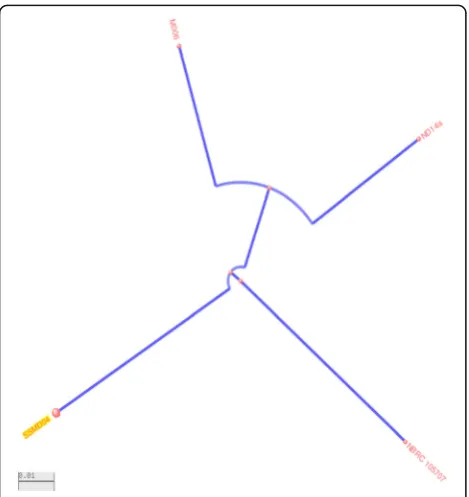
NBRC 105707 are deposited in NCBI. A matrix and
den-drogram were generated based on AAI calculation that
provide estimation of the average amino acid identity
using best hits (one-way AAI) and reciprocal best hits
(two-way AAI) between several genomic datasets of
pro-teins [21],
C. davisae
type strain DSM 4568 was included
in the analyses. From the analyses, we can see closer
protein clustering between strain M004 and strain
ND14a (Fig. 6). Some of the basic comparisons of the
genomes are listed in Table 5.
Conclusion
This study provides phenotypic and genomic insights into
Cedecea neteri
strain M006. It reports the isolation of
C.
neteri
from an aquatic environment for the first time. This
study also revealed of the QS ability of
C. neteri
.
Abbreviations
AHL:N-acylhomoserine lactone; HGAP: hierarchical genome assembly process; LB: Luria-Bertani; ML: Maximum-likelihood; NJ: Neighbor-joining; QS: Quorum sensing; RAST: Rapid Annotation using System Technology
Acknowledgements
This research was supported by the University of Malaya via High Impact Research Grants (UM.C/625/1/HIR/MOHE/CHAN/01, Grant No. A-000001-50001, UM-MOHE
HIR Grant UM.C/625/1/HIR/MOHE/CHAN/14/1, no. H-50001-A000027 and GA001-2016) and University of Malaya IPPP grant No. PG090-2015B awarded to Kok-Gan Chan. The authors thank Dr. Andrew Sanderson (PhD, Nottingham) for proofreading this manuscript.
Authors’contributions
WST carried out the experiment,KGC conceived the idea and supervised the
whole project, all authors wrote and proofread the paper. Both authors read and approved the final manuscript.
Competing interests
The authors declare that they have no competing interests.
Publisher
’
s Note
Springer Nature remains neutral with regard to jurisdictional claims in published maps and institutional affiliations.
Received: 10 April 2017 Accepted: 12 July 2017
References
1. Grimont PAD, Grimont F, Farmer JJ III, Asbury MA.Cedecea davisaegen. nov, sp. nov.Cedecea lapagiesp. nov, newEnterobacteriaceaefrom clinical specimens. Int J. Syst Bacteriol. 1981;31:317–26.
2. Bae BH, Sureka SB, Ajamy JA. Enteric group 15 (Enterobacteriaceae) associated with pneumonia. J Clin Microbiol. 1981;14:774–8. 3. Abate G, Qureshi S, Mazumber SA.Cedecea davisaebacteremia in a
neutropenic patient with acute myeloid leukemia. J Infect. 2011;63:83–5. 4. Farmer JJ III, Sheth NK, Hudzinski JA, Rose HD, Asbury MF. Bacteremia due
toCedecea neterisp. nov. J Clin Microbiol. 1982;16:775–8.
5. Dalamaga M, Karmaniolas K, Arsenis G, Pantelaki M, Daskalopoulou K, Papadavid E, Migdalis I.Cedecea lapageibacteremia following cement-related chemical burn injury. Burns. 2008;34:1205–7.
6. Dalamaga M, Sotiropoulos GP, Vrioni G, Tsakris A.Cedecea: an“unknown” pathogen in the family ofEnterobacteriaceae–its clinical importance, detection and identification methods. Hellenic Microbiological Society. 2014;59:17–28. 7. Bae BH, Sureka SB.Cedecea davisaeisolated from scrotal abscess. J Urol.
1983;130:148–9.
8. Akinosoglou K, Perperis A, Siagris D, Goutou P, Spliopoulou I, Gogos CA, Marangos M. Bacteraemia due toCedecea davisaein a patient with sigmoid colon cancer: a case report and brief review of the literature. Diagn Microbiol Infect Dis. 2012;74:303–6.
9. Yetkin G, Ay S, Kayabas U, Gedik E, Gucluer N, Caliskan A. A pneumonia case caused byCedecea lapagei. Mikrobiyol Bul. 2008;42:681–4.
10. Aguilera A, Pascual J, Loza E, Lopez JL, Garcia G, Liano F, Quereda C, Ortuno J. Bacteraemia withCedecea neteriin a patient with systemic lupus erythematous. Hospital Ramon y Cajal. 1994:179–80.
11. Kim OS, Cho YJ, Lee K, Yoon SH, Kim M, Na H, Park SC, Jeon YS, Lee JH, Yi H, Won S, Chun J. Introducing EzTaxon-e: a prokaryotic 16S rRNA gene sequence database with phylotypes that represent uncultured species. Int J Syst Evol Microbiol. 2012;2:716–21.
12. Tamura K, Peterson D, Peterson N, Stecher G, Nei M, Kumar S. MEGA5: molecular evolutionary genetics analysis using maximum likelihood, evolutionary distance, and maximum parsimony methods. Mol Biol Evol. 2011;28:2731–9.
13. Reddy TBK, Thomas AD, Stamatis D, Bertsch J, Isbandi M, Jansson J, Mallajosyula J, Pagani I, Lobos EA, Hyrpides NC. The Genome OnLine Database (GOLD) v.5: a metadata management system based on a four level (meta)genome project classification. Nucl Acids Res. 2015;43(D1): D1099–106. doi:10.1093/nar/gku950.
14. Field D, Garrity G, Gray T, Morrison N, Selengut J, Sterk P, et al. The minimum information about a genome sequence (MIGS) specification. Nat Biotechnol. 2008;26:541–7.
15. Chan KG, Tan KH, Yin WF, Tan JY. Complete genome sequence ofCedecea
neteristrain SSMD04, a bacterium isolated from pickled mackerel sashimi.
Genome Announcement. 2014;2:1–2.
16. Aziz RK, Bartels D, Best AA, DeJongh M, Disz T, Edwards RA, Formsma K, Gerdes S, Glass EM, Kubal M, Meyer F, Olsen GJ, Olson R, Osterman AL, Overbeek RA, McNeil LK, Paarmann D, Paczian T, Parrello B, Pusch GD, Reich C, Stevens R, Vassieva O, Vonstein V, Wilke A, Zagnitko O. The RAST Server: Rapid annotation using subsystems technology. BMC Genomics. 2008;9:1–15.
Table 5
Comparison of several strains of
C. neteri
Organism/Name Strain Size (Mb) GC% Gene Protein
C. neteri M006 4.97 54.40 4703 4531
ND02 4.31 53.90 4053 3884
ND14b 5.05 56.90 4491 4295
ND14a 4.66 54.80 4426 4215
SSMD04 4.88 55.10 4622 4416
17. Stackerbrandt E, Ebers J. Taxonomic parameters revisited: tarnished gold standards. Microbiol Today. 2006;33:152–5.
18. Markowitz VM, Chen IA, Palaniappan K, Ken C, Szeto E, Pillay M, Ratner A, Huang J, Tanja W, Huntemann M, Anderason I, Billis K, Varghese N, Mavromatis K, Pati A, Ivanova NN, Kyrpides. IMG 4 version of the integrated microbial genomes comparative analysis system. Nucl Acids Res. 2014;42:D560–7.
19. Lagesen K, Hallin P, Rødland EA, Stærfeldt HH, Rognes T, Ussery DW. RNAmmer: consistent and rapid annotation of ribosomal RNA genes. Nucl Acids Res. 2007;35:3100–8.
20. Lowe TM, Eddy SR. tRNAscan-SE: a program for improved detection of transfer RNA genes in genomic sequence. Nucl Acids Res. 1997;25:955–64. 21. Konstantinidis KT, Tiedje JM. Towards a genome-based taxonomy for
prokaryotes. J Bacteriol. 2005;187:6258–64.
22. Woese CR, Kandler O, Wheelis ML. Towards a natural system of organisms: proposal for the domains Archaea, Bacteria, and Eucarya. Proc Natl Acad Sci U S A. 1990;87:4576–9.
23. Garrity GM, Bell JA, Lilburn T. Phylum XIV. Proteobacteria phyl. nov. In: Brenner DJ, Krieg NR, Staley JT, Garrity GM, editors. Bergey's Manual of Systematic Bacteriology, Volume 2 (TheProteobacteria). 2nd ed. New York: part B (The Gammaproteobacteria), Springer; 2005. p. 1.
24. Validation List No. 107. List of new names and new combinations previously effectively, but not validly, published. Int J Syst Evol Microbiol. 2006;56:1–6. 25. Garrity GM, Bell JA, Lilburn T. Class III. Gammaproteobacteria class. nov. In:
Brenner DJ, Krieg NR, Staley JT, Garrity GM, editors. Bergey's Manual of Systematic Bacteriology, Volume 2. 2nd ed. New York: Springer; 2005. p. 1. 26. Validation of publication of new names and new combinations previously
effectively published outside the IJSEM. List no. 106. Int J Syst Evol Microbiol. 2005;55:2235–8.
27. Williams KP, Kelly DP. Proposal for a new class within the phylum
Proteobacteria,Acidithiobacilliaclassis nov., with the type order
Acidithiobacillales,and emended description of the class
Gammaproteobacteria. Int J Syst Evol Microbiol. 2013;63:2901–6.
28. Skerman VBD, McGowan V, Sneath PHA. Approved lists of bacterial names. Int J Syst Bacteriol. 1980;30:225–420.
29. Rahn O. New principles for the classification of bacteria. Zentralbl Bakteriol Parasitenkd Infektionskr Hyg. 1937;96:273–86.
30. Judicial Commission. Conservation of the family nameEnterobacteriaceae, of the name of the type genus, and designation of the type species OPINION NO. 15. Int Bull Bacteriol Nomencl Taxon. 1958;8:73–4.
31. Ashburner M, Ball CA, Blake JA, Botstein D, Butler H, Cherry JM, Davis AP, Dolinski K, Dwight SS, Eppig JT, Harris MA, Hill DP, Issel-Tarvel L, Kasarskis A, Lewis S, Matese JC, Richardson JE, Ringwald M, Rubin GM, Sherlock G. Gene ontology: tool for the unification of biology. The Gene Ontology Consortium. Nat Genet. 2000;25:25–9.
• We accept pre-submission inquiries
• Our selector tool helps you to find the most relevant journal
• We provide round the clock customer support
• Convenient online submission
• Thorough peer review
• Inclusion in PubMed and all major indexing services
• Maximum visibility for your research
Submit your manuscript at www.biomedcentral.com/submit
![Table 1 Classification and general features of Cedecea neteri M006 according to MIGS recommendations [14]](https://thumb-us.123doks.com/thumbv2/123dok_us/651693.2064786/2.595.56.538.578.683/table-classification-general-features-cedecea-neteri-according-recommendations.webp)