School students’ beliefs about abilities
and perspective‑taking over time
Anett Wolgast
*Introduction
Students are not alone at school; they interact with each other and adapt to their peers (e.g., Levesque 1993), relatives (e.g., Lillard 1998), and teachers (e.g., Gehlbach et al. 2016). After transitioning to secondary school, students share a class with other students who are more or less previously unknown. “Social means” of comparison will tend to be more available than “non-social means” (Festinger 1954, p. 118ff.) such as school grades, and students are likely to take into account what other students say or do. In this case, their beliefs about their own abilities would be in part a function of social comparisons.
Abstract
Background: Beliefs about one’s own abilities and perspective-taking are essential for appropriate behavior in professional and social life, cooperative learning, and situa-tions were conflict is occurring. The social comparison theory and previous research suggested positive relations between school students’ beliefs about one’s own abilities and perspective-taking. The hypotheses were: (1) Beliefs about one’s own abilities and perspective-taking are positively related to each other after the transition to secondary school and (2) will fade thereafter.
Methods: The hypotheses were tested using data from two national longitudinal studies. In Study 1, analyses were based on a sample consisting of the same N = 4428 students in fifth, seventh, and ninth grades. Beliefs about one’s own abilities and per-spective-taking were analyzed by one structural equation model considering relevant covariates, namely gender, school achievement, ethnic background, school type, and socioeconomic status. In Study 2, the sample consisted of N = 2105 students who were assessed at the beginning, during, and at the end of fifth grade. Beliefs about one’s own abilities and perspective-taking were analyzed by the same structural equation model as in Study 1 including the same covariates and additional cognitive abilities. Results: Relations only existed from the first to the second measurement point in both studies.
Conclusions: A possible explanation for the changed relationship over time is that the students adjusted to their peers, and likely learned to deal with diverse conflicting situ-ations and to differentiate between academic, social or other abilities over the course of the school year. Perspective-taking items measure coordination between oneself and other people in social interactions and conflicting situations. In the future, such relations could be analyzed using domain-specific perspective-taking items.
Keywords: Academic self-concept, Beliefs about perspective-taking, Structural equation modeling, Adolescents, School students
Open Access
© The Author(s) 2018. This article is distributed under the terms of the Creative Commons Attribution 4.0 International License (http://creat iveco mmons .org/licen ses/by/4.0/), which permits unrestricted use, distribution, and reproduction in any medium, provided you give appropriate credit to the original author(s) and the source, provide a link to the Creative Commons license, and indicate if changes were made.
RESEARCH
School students compare themselves to other students socially and academically. Academic self-concept refers to one’s beliefs about one’s own academic abilities or the cognitive representation of one’s own academic abilities (e.g., Marsh et al. 2014). Strong evidence exists concerning general and domain-specific academic self-concepts (mathe-matics versus language, e.g., Marsh 1986). For example, findings indicate that mathemat-ical and verbal academic self-concepts are strong predictors of later school achievement (Möller et al. 2009).
However, whether academic self-concept supports or hinders social learning and socially appropriate behavior at school is understudied. One foundation for social learn-ing and socially appropriate behavior is the cognitive capacity to engage in perspective-taking (e.g., Piaget 1972). Since Piaget proposed his theory, researchers from different schools of thought have proposed several theoretical and methodological approaches to examining perspective-taking concepts (e.g., Bosacki 2000) and beliefs about one’s own perspective-taking (e.g., Davis 1980, 1983). Two of these approaches are outlined below.
Perspective-taking was conceptualized within the cognitive-developmental frame-work theory of mind (e.g., Baron-Cohen et al. 1985; Bosacki 2000; Wimmer and Perner 1983). Having a theory of mind involves the ability to distinguish between oneself and another individual’s self. Without this basic ability, one would expect that “what I think or believe, other people think or believe as well”. With a theory of mind, one expects dif-ferences between one’s own subjective thoughts or beliefs (e.g., intentions) and another person’s thoughts or beliefs. Thus, having a theory of mind is an essential feature of per-spective-taking as a source of beliefs about one’s own perper-spective-taking.
The theory of mind is often assessed with false-belief tasks (e.g., Wimmer and Perner 1983) or social perspective-taking tasks (e.g., Bosacki 2000). Findings indicate that chil-dren without special needs have already developed a theory of mind at 4 years of age (e.g., Hughes and Ensor 2007). Thus, school students without special needs are able to distinguish between themselves and others’ self. Bloom and German (2000) summarized theory of mind research using false-belief tasks as an approach that focusses on specific situations instead of the tendency to engage in perspective-taking or beliefs about one’s perspective-taking. Theory-of-mind researchers are mainly interested in the develop-ment of conceptual perspective-taking skills (situation-specific attempts to anticipate others’ intentions, e.g., Baron-Cohen et al. 1985). Moreover, researchers have created “overlaps with cognitive empathy and the terms are used interchangeably” (Lawrence et al. 2004, p. 911).
Empathy is defined as a multidimensional concept with two basic dimensions: The emotional dimension of empathy reflects the tendency to engage in emotional reactions and compassionate responses (e.g., Davis 1980). The cognitive dimension of empathy refers to one’s cognitive capacity, including the ability of perspective-taking towards a human (-like) target (e.g., Devoldre et al. 2010). Individuals who demonstrate high levels of beliefs about their own social perspective-taking (measured by a task-related ques-tionnaire) engaged more in understanding a dissimilar target in a scenario-based task than those demonstrating low levels of such beliefs (Chambers and Davis 2012).
2017) used a “perspective-taking” subscale adapted from Davis (1980). Davis’ (1983, p. 113) subscale assesses the “tendency to spontaneously adopt the psychological point of view of others”. It is a self-report measure that assesses one’s beliefs about one’s own perspective-taking. Such beliefs represent a disposition to mentalize or simulate different points of view in social interactions and conflict situations. This conceptu-alization considers perspective-taking as a simulation theory of someone else’s self (e.g., Chambers and Davis 2012). Davis’ perspective-taking subscale has been used in other studies to investigate relations to other constructs (e.g., empathy-quotient validation studies regarding theory of mind, Lawrence et al. 2004; executive functions and mindfulness, Schonert-Reichl et al. 2015).
The relationship between academic self-concept and beliefs about one’s own per-spective-taking is rarely examined, although one might argue that an overarching self-evaluation of one’s abilities shapes one’s self-evaluation of both one’s academic abilities and one’s social abilities. The self-evaluation of academic abilities involves academic self-concept and the self-evaluation of social abilities involves beliefs about one’s perspective-taking in social interactions and conflict situations. Students with an intention to invest in perspective-taking might hold a more valid, realistic aca-demic self-concept that in many cases might be lower than a self-concept generated without such an intention.
Conversely, academic self-concept, as one aspect of understanding oneself, might con-tribute to subsequent beliefs about one’s own perspective-taking or understanding oth-ers in social interactions and conflict situations. The link between self-evaluation and self-understanding or self-reflection is well established, with findings indicating that understanding one’s own self is related to understanding others’ self (see Dimaggio et al. 2008, for a review). In line with this assumption and research, the results of a transversal study (Bosacki 2000) based on theory of mind indicated positive relations between chil-dren’s self-concept at school and their social perspective-taking. Bosacki (2000) assessed self-concept at school using Harter’s (1985) self-perception inventory for children. A longitudinal study (Bosacki 2014, p. 217) including assessments of self-perceptions and “theory of mind understanding (social ambiguous stories)” found positive relationships between self-perceptions and theory of mind understanding in students 8 years of age that had faded 2 years later.
Longitudinal relations between academic self-concept and perspective-taking over 4 years of school would extend existing evidence on theory of mind research with other measures (e.g., Bosacki 2000) and simulation theory or cognitive empathy research (e.g., Chambers and Davis 2012; Davis 1980, 1983). Longitudinal data including beliefs about one’s own perspective-taking are available (see Fischer et al. 2017; and Quellenberg 2009, for scale documentation). The aim of the current studies was therefore to describe longitudinal relations between students’ academic self-concept and beliefs about their own perspective-taking following the transition to secondary school.
Beliefs about oneself in social comparison theory
Festinger (1954) described nine hypotheses about an individual’s abilities and opinions in private or social conditions within his social comparison theory. Later findings sup-ported the social comparison hypothesis (e.g., Marsh et al. 2014; see Wrzus et al. 2013, for a meta-analysis). Research on academic self-concept usually refers to social compari-son theory as the internal–external frames of reference model (e.g., Marsh 1986). This model has frequently been tested with regard to internal frames of reference and math versus language abilities (e.g., see Möller et al. 2009, for a meta-analytic path analysis) or external frames of reference regarding different school types (e.g., Marsh 1987; Marsh et al. 2014). The big-fish-little-pond effect is based in part on social comparison theory and related theoretical perspectives positing that students compare their own academic accomplishments to those of others, and that this serves as one basis for the formation of their academic self-concept (e.g., Marsh et al. 2014). This is particularly relevant in Germany, where students are stratified by ability at an early age (about nine or 10 years of age). Indeed, children at school not only compare their own abilities to others, they compare clothes, bags, and electronic devices. The more children perceive similarities when they compare themselves with other children, the more likely they will find it easy to engage in self-simulation to others (e.g., Chambers and Davis 2012).
Festinger (1954, p. 118) assumed in his Hypothesis II that if “non-social means are not available, people evaluate their opinions and abilities by comparison respectively with the opinions and abilities of others.” Thus, each student might compare his/her state-ments or behavior with others’ statestate-ments or behavior, which might provide cues about others’ abilities as an external frame of reference. The students might evaluate their abil-ities by comparing them to the abilabil-ities of others during in-class activabil-ities: the better one subjectively understands others’ academic statements or questions, the higher one’s academic-self-concept level. Such social comparisons require considering other stu-dents, understanding their opinions, and comprehending their statements or the quality of their responses (e.g., correct or incorrect answers). Considering and understand-ing others even in conflict situations is related to beliefs about one’s own perspective-taking assessed by Davis’ (1980) perspective-perspective-taking subscale (e.g., Nelson et al. 2017). The better one subjectively understands other students in different (conflict) situations, the higher one’s level of belief about one’s own social perspective-taking. Appropriate assumptions about others’ opinions and abilities linked to self-evaluation affect chil-dren’s self-concepts (e.g., Bosacki 2000; Sebastian et al. 2008). Thus, self-concept might not only contribute to beliefs about one’s own perspective-taking, such beliefs might predict later self-concept as well. Accordingly, the interim hypothesis mentioned above has been changed to the assumption of a reciprocal relationship between these two con-structs over time.
Relevant factors for beliefs about oneself
Previous research has indicated that individual differences in academic self-concept and beliefs about one’s own social perspective-taking can be explained by gender, cognitive abilities (e.g., school achievement, fluid reasoning, receptive vocabulary, or reading fluency), ethnic background, type of school, and the socioeconomic status of the student’s family. Gender differences among students with regard to academic self-concept are related to roles and contexts at school (e.g., Wigfield and Eccles 2000). For example, girls reported higher academic self-concept levels in reading than boys (e.g., Jacobs et al. 2002). The difference between girls’ and boys’ academic self-concept levels in reading has been shown to increase over time (e.g., Jacobs et al. 2002), even though overall academic self-concept levels in reading decreased from 1st to 12th grade in both girls and boys (Archambault et al. 2010). Van der Graaff et al. (2014) found that gender correlated with beliefs about one’s own social perspective-taking in both children and adolescents, and that girls’ levels were significantly higher than boys’ levels of such beliefs at six measurement points. The researchers (Van der Graaff et al. 2014) used Davis’ (1980) perspective-taking subscale.
A domain-specific self-concept such as academic self-concept in reading is related to students’ school achievement in that domain (e.g., Marsh 1986). Indicators of school achievement (e.g., Helmke and van Aken 1995; Karbach et al. 2013) are stu-dents’ school grades, e.g., in math class or literature class. Positive relations have been found between opportunities to practice mindfulness attention in combination with beliefs about one’s own perspective-taking and teacher-rated math grades (Schon-ert-Reichl et al. 2015). Fluid reasoning was significantly correlated with students’ self-concept in mathematics but not with their verbal self-concept (e.g., Mustafic et al. 2017). Reading fluency was positively related to students’ reading self-concept (e.g., Kasperski et al. 2016). Verbal abilities in the form of receptive vocabulary (e.g., Bosacki 2000) are correlated with self-concept as measured by Harter’s (1985) aca-demic competence subscale. However, beliefs about one’s own perspective-taking ware barely correlated (females: r= .07, males: r= .15) with receptive vocabulary on the Wechsler adult intelligence scale (Davis 1983, p. 118).
According to the well-known big-fish-little-pond effect (e.g., Marsh 1987), academic self-concept levels are related to external frames of reference such as the type of school. Thus, moderate achievers have higher academic self-concept levels in schools with a vocational rather than an academic curriculum. Coming from a family with a low soci-oeconomic status negatively affected students’ academic self-concept, and academic self-concept, in turn, was positively related to peer-assisted learning (e.g., see Ginsburg-Block et al. 2006 for a meta-analytic review).
Taken together, academic self-concept (e.g., Marsh 1989) and beliefs about one’s own perspective-taking (e.g., Davis 1980) are conceptualized as mental representations of an individual’s abilities (e.g., Bosacki 2000; O`Brien et al. 1992). Festinger’s Hypothesis II (1954, p. 118) assumes that “objective” and “non-social means” of comparing abilities are not available following the transition to secondary school, and that students evalu-ate their abilities vis-à-vis the perceived abilities of others and by understanding other students in conflict situations. Several further relevant factors should be borne in mind, namely gender, school achievement, cognitive ability scores, ethnic background, the type of school, and socioeconomic status. There is a distinct lack of longitudinal evidence on whether students’ academic self-concept and beliefs about their own perspective-taking are related to each other over time at school. Using data from two national longitudinal studies, the hypothesis of reciprocal relations was tested with one latent autoregressive model with cross-lags in Study 1 and Study 2.
Overview of the present research and hypothesis
Festinger (1954, p. 118) assumed “To the extent that objective, non-social means are not available, people evaluate their opinions and abilities by comparison respectively with the opinions and abilities of others.“In accordance with previous research from other schools of thought (e.g., Bosacki 2000; Dimaggio et al. 2008), the aim of Study 1 was to analyze whether relations exist between students’ academic self-concept and beliefs about their own perspective-taking over 4 years of school (controlling for gender, school grades in math class and literature class, ethnic background, type of school, and socio-economic status).
Further findings (e.g., Wolgast and Barnes-Holmes 2018) suggest relations between self-concept in reading and beliefs about one’s own perspective-taking assessed using Davis’ (1980) subscale. The cognitive representation of one’s reading abilities is self-con-cept in reading. The aim of Study 2 was therefore to determine whether reciprocal rela-tions exist between students’ self-concept in reading and their beliefs about their own perspective-taking over 1 year of school, analogously to how Study 1 assessed relations over 4 years of school. Like Study 1, this aim was based on Festinger’s (1954) second hypothesis. In addition to the covariates considered in Study 1, available standardized assessments were included as covariates in Study 2: fluid reasoning (Weiß 2006), recep-tive vocabulary (Weiß 2006), and reading fluency (Auer et al. 2011).
and beliefs about one’s own perspective-taking will exist after the transition to second-ary school, and will fade thereafter.
Taken into account in all statistical analyses were the previously introduced relevant covariates, namely gender, school achievement, ethnic background, type of school, and socioeconomic status in both Study 1 and Study 2, and fluid reasoning, receptive vocabulary and reading fluency in Study 2. Fluid reasoning and reading ability scores were only available in the data used in Study 2. Gender differences have been found (e.g., Jacobs et al. 2002, Van der Graaff et al. 2014) in both types of beliefs about one’s own abilities, and this was taken into consideration by separately analyzing girls’ and boys’ data simultaneously in one structural equation model. As described below, in both stud-ies, the measures were administered in schools over three measurement points (Times 1–3): in Study 1 over the course of 4 years, and in Study 2 over one school year. These longitudinal student samples (Study 1 and Study 2) stemmed from assessments admin-istered in secondary schools as part of two large-scale studies with ethics approval (sci-entific use file; for a full sampling description, see Fischer and Klieme 2013; Study on the Development of All-day Schools—StEG 2013).
The first large-scale study aimed to provide an overview of all-day schools in Germany (broader scope). At Time 1, the sample was representative of German all-day schools. The second large-scale study aimed to provide insights into reading and social learn-ing at all-day schools. The target schools were those with a focus on readlearn-ing and social learning and were drawn from the first study’s representative school sample. Some school-level data from the first large-scale study were used in the analyses of the sec-ond study’s data and were not again asked. Therefore, Study 1 provides a broader view on academic self-concept and belief about one’s own perspective-taking over a longer period of time than Study 2.
Methods Data
In Study 1, analyses were based on a sample consisting of N= 4428 students (n= 2100 female, n= 35 missing values for the variable gender; Mage= 10.90, SDage= .60, one non-response the variable age) from 392 classes at 211 schools. Students’ ethnic background was recorded as migration when at least one parent or the student him- or herself had been born outside Germany (this is in line with the criterion used in the Programme for International Student Assessment; Adams and Wu 2002). This was true of n= 1471 stu-dents (18 non-responses). Thus, the sample includes stustu-dents with heterogeneous ethnic backgrounds.
After elementary school, students in Germany are assigned to different types of schools predominantly on the basis of their achievement in elementary school. In this sam-ple, n= 1145 (26% of N= 4428) students attended an academically-oriented secondary school (Gymnasium), while the other n= 3283 (74%) students attended a secondary school with a more vocational curriculum.
educational level and occupation. This international standard classification of occupa-tions ranges from highly-ranked “physical scientists, technical and related workers” (e.g., “aircraft and ships officers” or medical professionals) to low-ranked “manual workers” (e.g., “street sweeper” or “road construction worker”; Ganzeboom et al. 1992, pp. 33–55). Students’ family socioeconomic status varied by 47 points (16 =minimum, 90 = maxi-mum). Values up to 33 HISEI points made up the lowest quartile, and 23% of students fell within that range. Values over 55 HISEI points made up the highest quartile, and 24% of students fell within that range.
In Study 2, the sample consisted of N= 2105 fifth-grade students (n= 973 female, Mage= 10.37, SDage= .61, 24 non-responses for the variable age) from k= 127 classes at 66 schools. In this sample, n= 637 students attended a Gymnasium; the other n= 1468 students attended secondary schools with a more vocational curriculum. Information on students’ ethnic background (Adams and Wu 2002) and socioeconomic status (Ganze-boom et al. 1992) was gathered at the end of the study via a computerized questionnaire. An ethnic background other than German was reported by n= 762 (36%) students. Type of school and the socioeconomic status of a student’s family were measured using HISEI points as described above.
Procedures
Students participated in Study 1 or 2 with the consent of their parents, the students themselves, their school principals, and the education ministries of the federal states. In Study 1, students filled out a questionnaire including the same measures of academic self-concept and beliefs about one’s own perspective-taking at school at the beginning of fifth grade (Time 1), seventh grade (Time 2) and ninth grade (Time 3).
In Study 2, students’ receptive vocabulary knowledge (Weiß 2006) and reading fluency (Auer et al. 2011) were tested using computer-based test versions at Time 1; afterwards, the students filled out a computer-based questionnaire. One laptop per student was pro-vided to conduct the assessments; for example, 20 laptops were propro-vided a class con-tained 20 students. All students completed the same measures at three measurement points: at the beginning (Time 1), middle (Time 2), and end (Time 3) of fifth grade. The summer break began after Time 3.
Measures
Academic self‑concept (Study 1)
Students’ academic self-concept was measured with four items adapted from a standard-ized assessment (see Quellenberg 2009, for details). Each item was assessed on a 4-point scale (from 1 =not true at all to 4 =absolutely true). The items captured students’ gen-eral academic self-concept. The question was worded as follows:
Do the following statements apply to you? (a) I learn things quickly. (b) I usually know the answer to a question earlier than the others. (c) I get good grades without effort. (d) It is easy for me to solve difficult tasks.
Time 3 served as the outcome variable for testing the hypothesis of reciprocal relations between academic self-concept and perspective-taking over time.
Academic self‑concept in reading (Study 2)
Four items were used to measure academic self-concept in reading (see Fischer et al. 2017, for details), with students’ responses recorded on scales ranging from 1 =not true at all to 4 =absolutely true. Students answered the following question:
What about reading in class? (a) I can comprehend difficult texts. (b) It is easy for me to comprehend new texts. (c) I can handle long texts. (d) If I want to understand a difficult text, I will succeed here too.
In this study, Cronbach’s alpha was α = .81 at Time 1, α = .78 at Time 2, and α = .83 at Time 3, thus demonstrating satisfactory internal consistency. The intraclass correlation was low, meaning that values for students in the same class did not tend to be more simi-lar than those of students in different classes (intraclass correlation ICC = .04). Academic self-concept in reading at Time 3 served as the outcome variable for testing the hypoth-esis of relations between academic self-concept in reading and beliefs about one’s own perspective-taking over time.
Beliefs about one’s own perspective‑taking (Studies 1 and 2)
Davis (1980) proposed items to measure beliefs about one’s own perspective-taking as a disposition. Four items from Davis’ perspective-taking scale were available in this study (Davis 1980; Quellenberg 2009). Students responded to each of the four items using the same scenario—“Imagine yourself in your school”—to encourage them to think about how they usually act in social situations at school. Students’ beliefs about their own social perspective-taking were assessed using their responses to the following question:
What do you do? (a) I sometimes try to understand my friends better by imagining how things look from their perspective; (b) I believe that there are two sides to every question and try to look at them both; (c) Before criticizing somebody, I try to imag-ine what I would think if I were in their place; or (d) I try to look at everybody’s side of a disagreement before I make a decision.
α = .81 at Time 2, and α = .86 at Time 3. Thus, the scale demonstrated satisfactory inter-nal consistency in both studies.
Beliefs about one’s own perspective-taking at Time 3 served as the outcome variable for testing relations between academic self-concept and this belief over time in Studies 1 and 2. Overall, in Study 1, missing values for academic self-concept and beliefs about one’s own perspective-taking across the three measurement points ranged from 0 to 7% (see Quellenberg 2009, for means, standard deviations, and number of missing values by variable). In Study 2, missing values for academic self-concept in reading and beliefs about one’s own perspective-taking across the three measurement points ranged from 0 to 10%. (see Fischer et al. 2017, for means, standard deviations, and number of missing values by variable).
Covariates in studies 1 and 2
Students’ school achievement assessed in math class and literature class ranged from high achievement, coded as 1, to low achievement, coded as 6, at Time 1, Time 2, and Time 3. Students whose ethnic background was not German were coded as 1; ethnically German students were coded as 0. Type of school and the socioeconomic status of a student’s fam-ily were measured using HISEI points as described above.
Additional covariates in Study 2
Students’ school achievement assessed in literature class ranged from high achievement, coded as 1, to low achievement, coded as 6, at Time 1, Time 2, and Time 3. Previous research suggests correlations between beliefs about one’s own perspective-taking and general cognitive abilities (e.g., Schonert-Reichl et al. 2015) as well as verbal abilities (e.g., Gabay et al. 2016). In the current study, general cognitive abilities were assessed via processing capacity tasks (fluid reasoning via matrices; Weiß 2006) and reading fluency via the Salzburger Lese-Screening 5–8 (Auer et al. 2011). Students read syntactically and grammatically simple sentences as quickly as possible and responded to questions pertaining to the sentences (Auer et al. 2011). Further standardized tasks assessed com-prehension of general and advanced German vocabulary (Weiß 2006). The test scores obtained from each of the used tests were scaled using Rasch modeling in accordance with item-response theory, with one difficulty parameter assigned to each test item within a test (one-parameter logistic test model constructed with the ltm package, Riz-opoulos 2006). Table 1 contains product-moment correlation coefficients at Time 1, which demonstrate a correlation between vocabulary knowledge and reading fluency.
Statistical analyses
this two-factor CFA model. In Study 1, this CFA model including constrained factor loadings suggested configural invariance ( CFI = .011; RMSEA = .001; see Additional file 2 for further fit indices and an overview of tested models) across 4 years according to recommended cutoffs for larger group sizes (Rutkowski and Svetina 2014). Thus, the factor structure found in the data from the students in fifth grade was equivalent to the factor structure found in the data from the same students 4 years later in ninth grade.
The two-factor CFA model including constrained factor loadings and intercepts for multi-group analyses suggested scalar invariance across gender ( CFI = .005,
RMSEA = .001, see Additional file 2 for further fit indices of the tested models). Stu-dents’ gender was coded as 0 =girls and 1 =boys. The factor structure and intercepts found for the girls’ data were equivalent to the factor structure and intercepts found for the boys’ data at Time 1, Time 2, and Time 3.
The CFA model was additionally tested across types of school. Constrained factor load-ings and intercepts at Time 1, Time 2, and Time 3 suggested scalar invariance across types of school ( CFI = .005, RMSEA = .001, see Additional file 2 for tested mod-els). School types with a more vocational curriculum were coded as 0; Gymnasium was coded as 1. The factor structure and intercepts found in the data from schools with a vocational curriculum were equivalent to the factor structure and intercepts found in the data from schools with an academic-oriented curriculum. This CFA resulted in χ2 (237) = 762.276, fit indices: root mean square error of approximation (RMSEA) = .027, CI [.025, .029], comparative fit index (CFI) = .983, standardized root mean square resid-ual (SRMR) = .031. These indices indicated that the postulated structure fit the data.
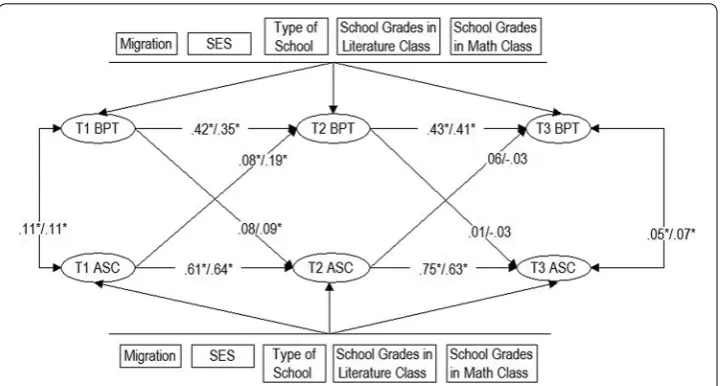
Statistical relations were specified in one structural equation model including latent academic self-concept measured by four items as indicators with four residuals each, as well as latent perspective-taking measured by four items as indicators with four
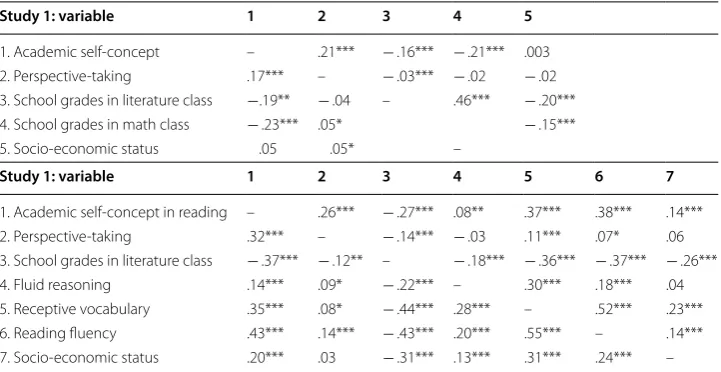
Table 1 Correlations between academic self-concept, perspective-taking, school achievement, cognitive abilities, and socio-economic status at time 1
Academic self‑concept (Quellenberg 2009; Fischer et al. 2017). Belief about one’s own perspective‑taking (Davis 1980). Study 1: Correlation coefficients below the diagonal are for girls in fifth grade (Time 1); values above the diagonal are for boys (Time 1). Variables representing cognitive abilities were not provided in the scientific use file (see Quellenberg 2009, for all large‑scale variables). Study 2: Fluid reasoning and receptive vocabulary (Weiß 2006). Reading fluency (Auer et al. 2011). Values below the diagonal are for girls from the beginning of fifth grade (Time 1); values above the diagonal are correlation coefficients for boys (Time 1). **p < .01, ***p < .001
Study 1: variable 1 2 3 4 5
1. Academic self-concept – .21*** − .16*** − .21*** .003 2. Perspective-taking .17*** – − .03*** − .02 − .02 3. School grades in literature class −.19** − .04 – .46*** − .20*** 4. School grades in math class − .23*** .05* − .15***
5. Socio-economic status .05 .05* –
Study 1: variable 1 2 3 4 5 6 7
residuals each at Time 1, Time 2, and Time 3. The model is depicted in Fig. 1. Stu-dents reported their school grades from elementary school as indicators of their school achievement (e.g., Karbach et al. 2013) at Time 1. Therefore, school grades in math class and in literature class at Time 2 were included as covariates of academic self-concept and perspective-taking only at Time 2 and Time 3.
Particularly in tests of reciprocal effects, it is critical that all variables are repre-sented as latent variables with appropriate controls for typically complex measure-ment error. This is particularly important in cases where internal consistence is not high, when it is not reasonable to assume that the constructs are measured without error. The predictor variables ethnic background, type of school, and family socioeco-nomic status were therefore specified on both latent factors at Time 1, Time 2, and Time 3 (i.e., all measurement points as described by Pekrun et al. 2017).
Auto-regressive paths were specified from latent academic self-concept at Time 1 to Time 2, and from Time 2, in turn, to latent academic self-concept at Time 3, as well as from latent perspective-taking at Time 1 to Time 2, and in turn, from Time 2 to latent perspective-taking at Time 3. Cross-lagged regression paths were specified between these two latent factors from Time 1 to Time 2 and from Time 2 to Time 3 (see Figs. 1 and 2).
Grand mean centering was applied and random intercepts were allowed. The cur-rent study’s research question analyzes the relevance of an individual’s academic self-concept for that individual’s beliefs about his or her own perspective-taking. Therefore, the nested data structure of classes at schools was considered at the indi-vidual level via corrections for nested data (similar to TYPE = COMPLEX in Mplus; see Oberski (2014), for details). The model specification considered girls’ and boys’
data separately, i.e., girls’ data were analyzed without boys’ data and vice versa. Out-come variables were latent academic self-concept and latent perspective-taking at Time 3.
Study 2
Analogously to Study 1, measurement invariance was tested using the data
from Study 2. The CFA suggested (factor loadings constrained, CFI = .008,
RMSEA = .004) configural invariance over time, (factor loadings and intercepts constrained, CFI = .002, RMSEA = .002) scalar invariance across gender, and (factor loadings and intercepts constrained, CFI = .002, RMSEA = .001) scalar invariance across type of school. The CFA indicated that the postulated structure fit the data: χ2 (237) = 801.870, fit indices: RMSEA = .042, CI [.038, .045], CFI = .959, SRMR = .028.
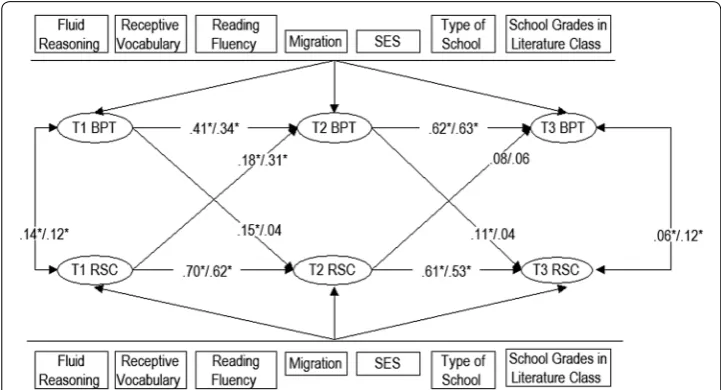
Relations were specified in a manner analogously to Study 1: The structural equa-tion model used in Study 1 was adapted to include academic self-concept in reading and perspective-taking at Time 1, Time 2 and Time 3 in Study 2. The model is depicted in Fig. 2. Seven predictor variables were included in the structural equation mode-ling: school grades in literature class, fluid reasoning measured by matrices, receptive vocabulary (Weiß 2006), and reading fluency (Auer et al. 2011), ethnic background, type of school, and socioeconomic status. The model was constructed with the R pack-age lavaan using WLSMV estimation (Rosseel 2012, 2016). The nested data structure of classes at schools was again considered at the individual level (Oberski 2014).
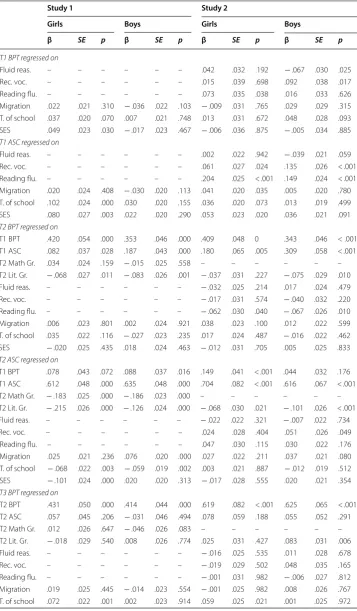
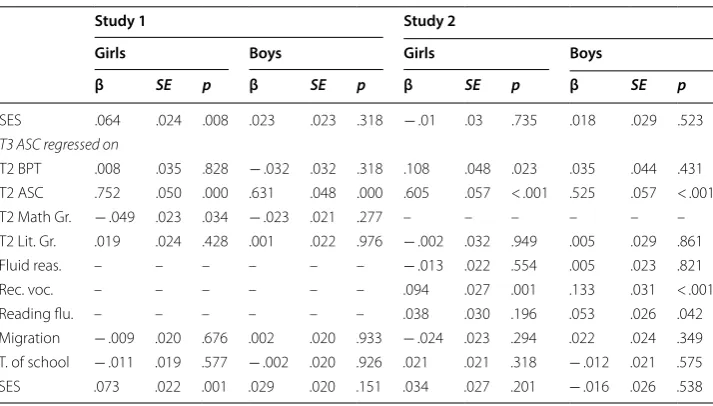
Table 2 Study 1 and Study 2: relations between academic self-concept and belief about one’s own perspective-taking over time
Study 1 Study 2
Girls Boys Girls Boys
β SE p β SE p β SE p β SE p
T1 BPT regressed on
Fluid reas. – – – – – – .042 .032 .192 − .067 .030 .025
Rec. voc. – – – – – – .015 .039 .698 .092 .038 .017
Reading flu. – – – – – – .073 .035 .038 .016 .033 .626
Migration .022 .021 .310 − .036 .022 .103 − .009 .031 .765 .029 .029 .315 T. of school .037 .020 .070 .007 .021 .748 .013 .031 .672 .048 .028 .093 SES .049 .023 .030 − .017 .023 .467 − .006 .036 .875 − .005 .034 .885
T1 ASC regressed on
Fluid reas. – – – – – – .002 .022 .942 − .039 .021 .059 Rec. voc. – – – – – – .061 .027 .024 .135 .026 < .001 Reading flu. – – – – – – .204 .025 < .001 .149 .024 < .001 Migration .020 .024 .408 − .030 .020 .113 .041 .020 .035 .005 .020 .780 T. of school .102 .024 .000 .030 .020 .155 .036 .020 .073 .013 .019 .499 SES .080 .027 .003 .022 .020 .290 .053 .023 .020 .036 .021 .091
T2 BPT regressed on
T1 BPT .420 .054 .000 .353 .046 .000 .409 .048 0 .343 .046 < .001 T1 ASC .082 .037 .028 .187 .043 .000 .180 .065 .005 .309 .058 < .001 T2 Math Gr. .034 .024 .159 − .015 .025 .558 – – – – – – T2 Lit. Gr. − .068 .027 .011 − .083 .026 .001 − .037 .031 .227 − .075 .029 .010 Fluid reas. – – – – – – − .032 .025 .214 .017 .024 .479 Rec. voc. – – – – – – − .017 .031 .574 − .040 .032 .220 Reading flu. – – – – – – − .062 .030 .040 − .067 .026 .010 Migration .006 .023 .801 .002 .024 .921 .038 .023 .100 .012 .022 .599 T. of school .035 .022 .116 − .027 .023 .235 .017 .024 .487 − .016 .022 .462 SES − .020 .025 .435 .018 .024 .463 − .012 .031 .705 .005 .025 .833
T2 ASC regressed on
T1 BPT .078 .043 .072 .088 .037 .016 .149 .041 < .001 .044 .032 .176 T1 ASC .612 .048 .000 .635 .048 .000 .704 .082 < .001 .616 .067 < .001 T2 Math Gr. − .183 .025 .000 − .186 .023 .000 – – – – – – T2 Lit. Gr. − .215 .026 .000 − .126 .024 .000 − .068 .030 .021 − .101 .026 < .001 Fluid reas. – – – – – – − .022 .022 .321 − .007 .022 .734
Rec. voc. – – – – – – .024 .028 .404 .051 .026 .049
Reading flu. – – – – – – .047 .030 .115 .030 .022 .176
Migration .025 .021 .236 .076 .020 .000 .027 .022 .211 .037 .021 .080 T. of school − .068 .022 .003 − .059 .019 .002 .003 .021 .887 − .012 .019 .512 SES − .101 .024 .000 .020 .020 .313 − .017 .028 .555 .020 .021 .354
T3 BPT regressed on
T2 BPT .431 .050 .000 .414 .044 .000 .619 .082 < .001 .625 .065 < .001 T2 ASC .057 .045 .206 − .031 .046 .494 .078 .059 .188 .055 .052 .291 T2 Math Gr. .012 .026 .647 − .046 .026 .083 – – – – – – T2 Lit. Gr. − .018 .029 .540 .008 .026 .774 .025 .031 .427 .083 .031 .006 Fluid reas. – – – – – – − .016 .025 .535 .011 .028 .678
Rec. voc. – – – – – – − .019 .029 .502 .048 .035 .165
Results
Results of the product-moment correlations are depicted in Table 1. In Study 1, the variables academic self-concept and perspective-taking were correlated significantly with each other at Time 1 (see Table 1). This correlation replicates previous find-ings from transversal studies using different methods (Bosacki 2000). The results from the structural equation modeling suggested a good fit between the assumed and real data structure: χ2 (660) = 1916.681, CFI = .958, RMSEA = .037, CI [.036, .039], SRMR = .042. Figure 1 shows the model including the covariates (math grades, litera-ture grades, ethnic background, type of school, socioeconomic status) and the latent factors (without indicators and residuals for reasons of space) and all paths between two factors. Path coefficients and standard errors of the structural equations are depicted in Table 1.
The relations over 4 years of school, controlling for the covariates, were as follows: High academic self-concept levels among boys and girls at Time 1 in fifth grade sig-nificantly predicted high levels of perspective-taking in seventh grade (Time 2) but not from Time 2 to ninth grade (Time 3). High academic self-concept levels among boys in seventh grade (Time 2) did not predict high perspective-taking levels in ninth grade (Time 3; see Fig. 1).
High perspective-taking levels among girls in fifth grade (Time 1) did not signifi-cantly predict high academic self-concept levels in seventh grade (Time 2), nor was an association found from seventh to ninth grade (Time 2 to Time 3). High perspective -taking levels among boys in fifth grade (Time 1) significantly predicted high academic self-concept levels in seventh grade (Time 2), but not from seventh to ninth grade (Time 3; see Fig. 1). This structural equation model explained 51% of the variance in girls’ latent academic self-concept, 37% of the variance in boys’ latent academic Table 2 (continued)
Study 1 Study 2
Girls Boys Girls Boys
β SE p β SE p β SE p β SE p
SES .064 .024 .008 .023 .023 .318 − .01 .03 .735 .018 .029 .523
T3 ASC regressed on
T2 BPT .008 .035 .828 − .032 .032 .318 .108 .048 .023 .035 .044 .431 T2 ASC .752 .050 .000 .631 .048 .000 .605 .057 < .001 .525 .057 < .001 T2 Math Gr. − .049 .023 .034 − .023 .021 .277 – – – – – – T2 Lit. Gr. .019 .024 .428 .001 .022 .976 − .002 .032 .949 .005 .029 .861 Fluid reas. – – – – – – − .013 .022 .554 .005 .023 .821 Rec. voc. – – – – – – .094 .027 .001 .133 .031 < .001
Reading flu. – – – – – – .038 .030 .196 .053 .026 .042
self-concept, 20% of the variance in girls’ latent perspective-taking and 17% of the vari-ance in boys’ latent perspective-taking in ninth grade (Time 3). The covariates contrib-uted to the outcome variables academic self-concept and perspective-taking at Time 3 as follows: Girls with high socioeconomic backgrounds in fifth grade tended to exhibit higher academic-self-concept levels 4 years later than those with low socioeconomic backgrounds. Girls with high socioeconomic backgrounds and girls at a Gymnasium in fifth grade (Time 1) reported that they were more likely to consider others’ social perspectives 4 years later (perspective-taking at Time 3) than those with low socioeco-nomic backgrounds and those who attended a vocational-oriented school type (see Table 2).
In Study 2, the variables academic self-concept in reading and perspective-taking were significantly correlated with one another at Time 1 (see Table 1). This correlation repli-cated the correlations found in the study by Bosacki (2000) and in the present Study 1. The results of the structural equation modeling indicated a good fit between the assumed and real data structure, χ2 (726) = 1604.434; CFI = .955, RMSEA = .034, CI [.032, .036], SRMR = .038. Figure 2 shows the model including the manifestly measured covariates (school grades in literature class, fluid reasoning, receptive vocabulary, reading fluency, ethnic background, type of school, socioeconomic status), the measured latent factors (depicted without indicators and residuals for reasons of space), and all paths between two factors. Path coefficients and standard errors of the structural equations are given in Table 2.
The significantly relations over 1 year of schooling, controlling for the covariates, were as follows: Girls’ and boys’ self-concept in reading at the beginning of fifth grade (Time 1) was positively related to perspective-taking half a year later at Time 2 (see Table 2 and Fig. 2).
Social perspective-taking levels among girls and boys at the beginning of fifth grade (Time 1) were positively related to self-concept in reading half a year later at Time 2. This association could be only found among girls from Time 2 to the end of fifth grade half a year later (Time 3). No relations were found between boys’ self-concept in reading and perspective-taking from Time 2 to the end of fifth grade (Time 3; see Table 2 and Fig. 2). This model explained 35% of the variance in girls’ self-concept in reading, 50% of the var-iance in boys’ self-concept in reading, 33% of the variance in girls’ perspective-taking and 31% of the variance in boys’ perspective-taking at Time 3.
(perspective-taking at Time 3) than those with worse school grades in literature class (see Table 2).
Discussion
The aim of the present two studies was to analyze longitudinal relations between self-concept and beliefs about one’s own perspective-taking among girls and boys following the transition to secondary school. In secondary school, for the first time, “social means” of comparing students’ abilities rather than “objective means” (Festinger 1954, p. 118ff.) are available as an external frame of reference.
Previous research from other schools of thought suggested positive (e.g., Bosacki 2000) and reciprocal (e.g., Dimaggio et al. 2008) relations between children’s cognitive repre-sentations of themselves and their cognitive reprerepre-sentations of others. The first hypoth-esis was (1) the more students think about their academic abilities in comparison to the abilities of their classmates, the more they will believe that they engage in perspective taking, trying to understand their peers in conflict situations as well. The positive rela-tions between students’ self-concept and beliefs about their own perspective-taking sup-port Hypothesis 1 and are in line with previous results, even though Bosacki (2000) used other measures (the self-perception scale by Harter 1985, and a storytelling task).
The results of the current Studies 1 and 2 suggest a substantial degree of rank order instability, particularly in students’ beliefs about their own perspective-taking. The auto-regressive parameters for this belief contradict the hypothesis of a stable disposition (or trait) over time. As expected in Hypothesis (2), reciprocal relationships between aca-demic self-concept and beliefs about one’s own perspective-taking exist after the transi-tion to secondary school, but fade thereafter, with the relatransi-tions fading over the course of time. Bosacki (2014) found a similar fade-out in relations between self-perceptions and understanding others’ minds in children 8–10 years of age in a longitudinal study with two measurement points.
Two possible explanations can be identified for changes in the relationship between academic self-concept and beliefs about one’s own perspective-taking over time. First, the faded relations over two (Bosacki 2014) or four (current Study 1) years of school imply social adjustments, as Festinger (1954) described in his social comparison theory. When students have “objective means” (Festinger 1954, p. 118ff.) of comparing their own abilities and others’ abilities, and they agree with or reject the opinions of other students in class, their academic self-concept will be related to their school achievement. Beliefs about one’s own perspective-taking might be less necessary in this case. As Festinger (1954, p. 120) postulated, “The tendency to compare oneself with some other specific person decreases as the difference between his[/her] opinion or ability and one’s own increases.”
own perspective-taking from Time 1 to Time 2 found in boys (Study 1) and girls (Study 2).
A second explanatory approach is that an increasing number of tasks and time pres-sure at school might constrain perspective-taking in a similar manner as in experimental studies (e.g., Chambers and Davis 2012). If this is the case, the relationship between aca-demic self-concept and beliefs about one’s own perspective-taking would change in line with the current results from Study 1 and Study 2.
In addition, students experience physiological changes from late childhood in fifth grade to adolescence from seventh to ninth grade (e.g., Sebastian et al. 2008). Adoles-cence is known as a time of focusing on oneself rather than considering others (e.g., Sebastian et al. 2008), and might represent a possible underlying developmental process behind the changed relationship between academic self-concept and beliefs about one’s own perspective-taking. The reciprocal relations between academic self-concept and beliefs about one’s own perspective-taking over time found in these studies extend pre-vious research (e.g., Bosacki 2000).
Study 2 allowed us to take a more specific look at the relations between girls’ and boys’ academic self-concept in reading and beliefs about their own perspective-taking across the fifth grade. The results of Study 2 replicated the transversal relationship between aca-demic self-concept and beliefs about one’s own perspective-taking at Time 1 following the transition to secondary school described in Study 1. Reciprocal relations between self-concept in reading and beliefs about one’s own perspective-taking were only found in girls over the first half year of fifth grade (Time 1 to Time 2). Self-concept in reading contributed to boys’ beliefs about their own social perspective-taking (Time 1 to Time 2) but not vice versa. The results are in line with Festinger’s second hypothesis, and suggest that girls and boys adjusted to their peers, and likely learned to deal with diverse con-flict situations and to differentiate between academic abilities and social or other abili-ties over the course of the school year. Social comparisons were also less likely in Study 2 as soon as objective means (such as peers’ school grades) were available as an external frame of reference.
Limitations and practical implications
One limitation of Study 1 is that it measured general academic self-concept instead of a domain-specific academic self-concept. This limitation as well as the fact that academic achievement was measured using school grades resulted from the use of already-avail-able scientific data in Study 1. Academic self-concept is a multidimensional construct (e.g., Davis 1980). It would probably exhibit the highest relationships to the correspond-ing achievement domain, as the results of Study 2 indicated. Similarly, domain-specific beliefs about one’s own social perspective-taking related to peer-assisted learning in lit-erature class might also exhibit higher relationships with self-concept in reading than were found in Study 2.
both school grades and test scores are indicators of cognitive abilities, but have different implications. School grades represent success at school, which reflects both cognitive abilities and further characteristics of students (e.g., gender, Voyer and Voyer 2014; or obesity MacCann and Roberts 2013), whereas test scores represent students’ cognitive abilities at one point of time.
A confounding variable might be social desirability, the tendency of students to answer in a manner that will be viewed favorably by their teachers. Social desirability was a con-cern for the self-report measures used in Study 1 and Study 2, and would be reflected in a similar correlation pattern over Time 1, Time 2, and Time 3. However, the correla-tion pattern changed, as boys’ academic self-concept barely correlated with their beliefs about their own perspective-taking between Time 2 and Time 3.
The results of these studies have practical relevance for schools, for example, with respect to peer-assisted learning and dealing with conflict situations. Whether or not children solve tasks jointly with peers, and whether or not students help or criticize one another, children need perspective-taking to understand each other when working on tasks at school. Students interact with each other and adapt to their peers, relatives and teachers. Understanding others’ reactions or opinions by assuming that these per-sons have their own reaper-sons resulting from their past experiences is a social resource. Attempts to understand another person’s social situation are related with low levels of stereotyping or prejudice (Davis et al. 1996). Students engage in mental representations (mentalizing) with both academic self-concept and perspective-taking (e.g., O`Brien and Albrecht 1992). Frequently deploying mental models in social situations might not only contribute to knowledge about oneself, consideration of others and dealing with conflict situations. Such mental models might also help students understand historical events (e.g., Hartmann and Hasselhorn 2008). Furthermore, it would be worthwhile to inves-tigate whether students apply perspective-taking during in-class activities such as peer learning because children and adolescents need interpersonal understanding to adopt task-related and other thoughts about each other.
Conclusion for future research
The main findings of the two studies presented here indicate changes in the relationship between students’ academic self-concept and beliefs about their own perspective-taking over time. The fragile relationship between these two constructs suggests that students understand social and academic concerns and demands in different ways following the transition to secondary school. According to the internal–external frame-of-reference model (e.g., Möller et al. 2009), internal dimensional comparisons between beliefs about one’s own academic vs. social abilities (e.g., academic self-concept vs. social perspective-taking) could be assessed using adapted measures.
contribute to our understanding of longitudinal relations between academic and social abilities at school following the transition to secondary school.
Additional files
Additional file 1: Figure S1. Statistical model used in confirmatory analyses in Study 1 and Study 2 (s1, s2, and s3 = academic self-concept at Time 1, Time 2, and Time3; p1, p2, and p3 = perspective-taking at Time 1, Time 2, and Time3).
Additional file 2: Table S1. Results of invariance tests in Study 1 and Study 2.
Authors’ contributions
The author read and approved the final manuscript.
Acknowledgements Not applicable. Competing interests
The author declares no competing interests. Availability of data and materials
The data are available as scientific use files on the website of The Institute for Educational Quality Improvement (https :// www.iqb.hu-berli n.de/fdz/studi es/StEG).
Funding
The longitudinal data used in the current studies were collected for two national studies (StEG; StEG-S: 01GTS0311A and B) funded by the German Federal Ministry of Education and Research.
Publisher’s Note
Springer Nature remains neutral with regard to jurisdictional claims in published maps and institutional affiliations.
Received: 16 March 2018 Accepted: 19 October 2018
References
Adams, R., & Wu, M. (2002). PISA 2000 Technical Report. Paris: Organisation for Economic Co-operation and Development (OECD). Retrieved from https ://www.oecd.org/pisa/pisap roduc ts/33688 233.pdf
Archambault, I., Eccles, J. S., & Vida, M. N. (2010). Ability self-concepts and subjective value in literacy. Joint trajectories from Grades 1 through 12. Journal of Educational Psychology,102, 804–816. https ://doi.org/10.1037/a0021 075. Atkins, D., Uskul, A. K., & Cooper, N. R. (2016). Culture shapes empathic responses to physical and social pain. Emotion,16,
587–601. https ://doi.org/10.1037/emo00 00162 .
Auer, M., Gruber, G., Mayringer, H., & Wimmer, H. (2011). Salzburger Lese-Screening für die Klassenstufen 5–8 (SLS 5–8). Bern: Hans Huber.
Baron-Cohen, S., Leslie, A. M., & Frith, U. (1985). Does the autistic child have a ‘theory of mind’? Cognition,21, 37–46. https ://doi.org/10.1016/0010-0277(85)90022 -8.
Bloom, P., German, T. P. (2000). Two reasons to abandon the false belief task as a test of theory of mind. Cognition, 77(1), B25–B31. https ://doi.org/10.1016/S0010 -0277(00)00096 -2.
Bosacki, S. L. (2000). Theory of mind and self-concept in preadolescents: Links with gender and language. Journal of Educational Psychology,92, 709–717. https ://doi.org/10.1037/0022-0663.92.4.709.
Bosacki, S. L. (2014). A longitudinal study of children’s theory of mind, self-concept, and gender-role orientation. Interna-tional Electronic Journal of Elementary Education,6, 213–228. https ://doi.org/10.1002/icd.1878.
Chambers, J. R., & Davis, M. H. (2012). The role of the self in perspective taking and empathy: Ease of self-simulation as a heuristic for inferring empathic feelings. Social Cognition,30, 153–180. https ://doi.org/10.1521/soco.2012.30.2.153. Davis, M. H. (1980). A multidimensional approach to individual differences in empathy. JSAS Catalog of Selected
Docu-ments in Psychology,10, 85–94. https ://doi.org/10.1037/0022-3514.44.1.113.
Davis, M. H. (1983). Measuring individual differences in empathy: Evidence for a multi-dimensional approach. Journal of Personality and Social Psychology,44, 113–126. https ://doi.org/10.1037/0022-3514.44.1.113.
Devoldre, I., Davis, M. H., Verhofstadt, L. L., & Buysse, A. (2010). Empathy and social support provision in couples: Social support and the need to study the underlying processes. The Journal of Psychology,144, 259–284. https ://doi. org/10.1080/00223 98100 36482 94.
Dimaggio, G., Lysaker, P. H., Carcione, A., Nicolo, G., & Semerari, A. (2008). Know yourself and you shall know the other… to a certain extent: multiple paths of influence of self-reflection on mindreading. Consciousness and Cognition,17, 778–789. https ://doi.org/10.1016/j.conco g.2008.02.005.
Festinger, L. (1954). A theory of social comparison processes. Human Relations,7, 117–140. https ://doi.org/10.1177/00187 26754 00700 202.
Fischer, N., & Klieme, E. (2013). Quality and effectiveness of German all-day schools: Results of the study on the develop-ment of all-day schools. In J. Ecarius, E. Klieme, L. Stecher, & J. Woods (Eds.), Extended education—an international perspective (pp. 27–52). Opladen: Budrich.
Fischer, N., Decristan, J., Theis, D., Sauerwein, M. & Wolgast, A. (2017). StEG-S–Skalendokumentation. Frankfurt am Main: DIPF. https ://doi.org/10.7477/199:180:1
Gabay, Y., Shamay-Tsoory, S. G., & Goldfarb, L. (2016). Cognitive and emotional empathy in typical and impaired readers and its relationship to reading competence. Journal of Clinical and Experimental Neuropsychology,38, 1131–1143. https ://doi.org/10.1080/13803 395.2016.11996 63.
Ganzeboom, H. B. G., De Graaf, P. M., & Treiman, D. J. (1992). A standard international socio-economic index of occupa-tional status. Social Science Research,21, 1–56. https ://doi.org/10.1016/0049-089X(92)90017 -B.
Gehlbach, H., Brinkworth, M. E., King, A. M., Hsu, L. M., McIntyre, J., & Rogers, T. (2016). Creating birds of similar feathers: Leveraging similarity to improve teacher–student relationships and academic achievement. Journal of Educational Psychology. https ://doi.org/10.1037/edu00 00042 .
Ginsburg-Block, M. D., Rohrbeck, C. A., & Fantuzzo, J. W. (2006). A meta-analytic review of social, self-concept, and behavioral outcomes of peer-assisted learning. Journal of Educational Psychology,98, 732–749. https ://doi. org/10.1037/0022-0663.98.4.732.
Van der Graaff, J., Branje, S., De Wied, M., Hawk, S., Van Lier, P., & Meeus, W. (2014). Perspective taking and empathic con-cern in adolescence: Gender differences in developmental changes. Developmental Psychology,50, 881–888. https :// doi.org/10.1037/a0034 325.
Han, S., & Humphreys, G. (2016). Self-construal: A cultural framework for brain function. Current Opinion in Psychology,8, 10–14. https ://doi.org/10.1016/j.copsy c.2015.09.013.
Harter, S. (1985). Manual for the self-perception profile for children (SPPC). Denver, CO: University of Denver.
Hartmann, U., & Hasselhorn, M. (2008). Historical perspective taking: A standardized measure for an aspect of students’ historical thinking. Learning and Individual Differences,18, 264–270. https ://doi.org/10.1016/j.lindi f.2007.10.002. Helmke, A., & van Aken, M. A. G. (1995). The causal ordering of academic achievement and self-concept of
abil-ity during elementary school: A longitudinal study. Journal of Educational Psychology,87, 624–637. https ://doi. org/10.1037/0022-0663.87.4.624.
Hughes, C., & Ensor, R. (2007). Executive function and theory of mind: Predictive relations from ages 2 to 4. Developmental Psychology,43, 1447–1459. https ://doi.org/10.1037/0012-1649.43.6.1447.
Jacobs, J. E., Lanza, S., Osgood, D. W., Eccles, J. S., & Wigfield, A. (2002). Changes in children’s self-competence and values: Gender and domain differences across Grades One through Twelve. Child Development,73, 509–527. https ://doi. org/10.1111/1467-8624.00421 .
Karbach, J., Gottschling, J., Spengler, M., Hegewald, K., & Spinath, F. M. (2013). Parental involvement and general cognitive ability as predictors of domain-specific academic achievement in early adolescence. Learning and Instruction,23, 43–51. https ://doi.org/10.1016/j.learn instr uc.2012.09.004.
Kasperski, R., Shany, M., & Katzir, T. (2016). The role of RAN and reading rate in predicting reading self-concept. Reading and Writing,29, 117–136. https ://doi.org/10.1007/s1114 5-015-9582-z.
Lawrence, E. J., Shaw, P., Baker, D., Baron-Cohen, S., & David, A. S. (2004). Measuring empathy: reliability and validity of the Empathy Quotient. Psychological Medicine,34, 911–920. https ://doi.org/10.1017/S0033 29170 30016 24.
Levesque, R. J. R. (1993). The romantic experience of adolescents in satisfying love relationships. Journal of Youth and Adolescence,22, 219–251. https ://doi.org/10.1007/BF015 37790 .
Lillard, A. (1998). Ethopsychologies: Cultural variations in theories of mind? Psychological Bulletin,123, 3–32. https ://doi. org/10.1037/0033-2909.123.1.3.
MacCann, C., & Roberts, R. D. (2013). Just as smart but not as successful: Obese students obtain lower school grades but equivalent test scores to non-obese students. International Journal of Obesity,37, 40–46. https ://doi.org/10.1038/ ijo.2012.47.
Marsh, H. W. (1986). Verbal and math self-concepts: An internal/external frame of reference model. American Educational Research Journal,23, 129–149. https ://doi.org/10.2307/11630 48.
Marsh, H. W. (1987). The big-fish-little-pond effect on academic self-concept. Journal of Educational Psychology,79, 280. https ://doi.org/10.1037/0022-0663.79.3.280.
Marsh, H. W. (1989). Age and gender effects in multiple dimensions of self-concept: Preadolescence to early adulthood. Journal of Educational Psychology,81, 417–430. https ://doi.org/10.1037/0022-0663.81.3.417.
Marsh, H. W., Abduljabbar, A. S., Morin, A. J., Parker, P., Abdelfattah, F., Nagengast, B., et al. (2014). The big-fish-little-pond effect: Generalizability of social comparison processes over two age cohorts from Western, Asian, and Middle East-ern Islamic countries. Journal of Educational Psychology,107, 258. https ://doi.org/10.1037/a0037 485.
Mustafić, M., Niepel, C., & Greiff, S. (2017). Assimilation and contrast effects in the formation of problem-solving self-concept. Learning and Individual Differences,54, 82–91. https ://doi.org/10.1016/j.lindi f.2017.01.006.
Möller, J., & Köller, O. (2001). Frame of reference effects following the announcement of exam results. Contemporary Educational Psychology,26, 277–287. https ://doi.org/10.1006/ceps.2000.1055.
Nelson, B. W., Laurent, S. M., Bernstein, R., & Laurent, H. K. (2017). Perspective-taking influences autonomic attunement between partners during discussion of conflict. Journal of Social and Personal Relationships,34, 139–165. https ://doi. org/10.1177/02654 07515 62659 5.
O`Brien, E. J., & Albrecht, J. E. (1992). Comprehension strategies in the development of a mental model. Journal of Experi-mental Psychology. Learning, Memory, and Cognition,18, 777–784. https ://doi.org/10.1037/0278-7393.18.4.777. Oberski, D. L. (2014). lavaan.survey: An R package for complex survey analysis of structural equation models. Journal of
Statistical Software, 57, 1–27. Retrieved from http://www.jstat soft.org/v57/i01/.
Pekrun, R., Lichtenfeld, S., Marsh, H. W., Murayama, K., & Goetz, T. (2017). Achievement emotions and academic per-formance: Longitudinal models of reciprocal effects. Child Development,88, 1653–1670. https ://doi.org/10.1111/ cdev.12704 .
Piaget, J. (1972). Intellectual evolution from adolescence to adulthood. Human Development,15, 1–12.
Pornprasertmanit, S., Miller, P., Schoemann, A., & Rosseel, Y. (2014). semTools: Useful tools for structural equation modeling. R package version 0.4-6. Retrieved from http://CRAN.R-proje ct.org/packa ge=semTo ols
Quellenberg, H. (2009). Studie zur Entwicklung von Ganztagsschulen (StEG) – ausgewählte Hintergrundvariablen, Skalen und Indices der ersten Erhebungswelle [Study on the development of all-day schools – first survey wave background variables, scales and indices]. Materialien zur Bildungsforschung. Band 24 [Materials on educational research, Volume 24], Frankfurt: DIPF. Retrieved from http://www.pedoc s.de/vollt exte/2010/3128/pdf/MatBi ld_Bd24_D_A.pdf Rizopoulos, D. (2006) ltm: An R package for latent variable modelling and item response theory analyses. Journal of
Statistical Software, 17, 1–25. Retrieved from http://www.jstat soft.org/v17/i05/
Rosseel, Y. (2012). lavaan: An R package for structural equation modeling. Journal of Statistical Software, 48, 1–36. Retrieved from http://www.jstat soft.org/v48/i02/
Rosseel, Y. (2016). Package ‘lavaan’ documentation. Retrieved from https ://cran.r-proje ct.org/web/packa ges/lavaa n/index .html.
Rutkowski, L., & Svetina, D. (2014). Assessing the hypothesis of measurement invariance in the context of large-scale international surveys. Educational and Psychological Measurement,74, 31–57. https ://doi.org/10.1177/00131 64413 49825 7.
Schonert-Reichl, K. A., Oberle, E., Lawlor, M. S., Abbott, D., Thomson, K., Oberlander, T. F., et al. (2015). Enhancing cognitive and social-emotional development through a simple-to-administer mindfulness-based program for elementary school children: A randomized controlled trial. Developmental Psychology,51, 52–66. https ://doi.org/10.1037/a0038 454.
Sebastian, C., Burnett, S., & Blakemore, S.-J. (2008). Development of the self-concept during adolescence. Trends in Cogni-tive Science,12, 441–446. https ://doi.org/10.1016/j.tics.2008.07.008.
Singelis, T. M. (1994). The measurement of independent and interdependent self-construals. Personality and Social Psy-chology Bulletin,20, 580–591. https ://doi.org/10.1177/01461 67294 20501 4.
Study on the Development of All-day Schools – StEG. (2013). Ganztagsschule 2012/2013 [All-day schools 2012/2013]. Frankfurt am Main, Dortmund, Gießen, München: Bundesbericht.
Voyer, D., & Voyer, S. D. (2014). Gender differences in scholastic achievement: A meta-analysis. Psychological Bulletin,140, 1174. https ://doi.org/10.1037/a0036 620.
Weiß, R. H. (2006). Wortschatztest und Zahlenfolgentest – Revision – Ergänzungstests zum CFT 20-R (WS/ZF-R) [Vocabulary and number sequencing test – revised in addition to CFT 20-R]. Göttingen: Hogrefe.
Wigfield, A., & Eccles, J. S. (2000). Expectancy-value theory of achievement motivation. Contemporary Educational Psychol-ogy,25, 68–81. https ://doi.org/10.1006/ceps.1999.1015.
Wimmer, H., & Perner, J. (1983). Beliefs about beliefs: Representation and constraining function of wrong beliefs in young children’s understanding of deception. Cognition,13, 103–128. https ://doi.org/10.1016/0010-0277(83)90004 -5. Wolgast, A. & Barnes-Holmes, Y. (2018). Social perspective taking and metacognition of children. A longitudinal view
across the fifth grade of school. The Humanistic Psychologist, 46, 74–90. http://psycn et.apa.org/recor d/2017-51594 -001