Continental diatom biodiversity discovery and
description in China: 1848 through 2019
J. Patrick Kociolek1, Qingmin You2, Qi Liu3, Yan Liu4, Quanxi Wang2
1 Museum of Natural History and Department of Ecology and Evolutionary Biology, University of Colorado, Boulder, USA 2 College of Life Sciences, Shanghai Normal University, Shanghai 200234, China 3 School of Life Science, Shanxi University, Taiyuan, 030006, China 4 College of Life Science and Technology, Harbin Normal University, Harbin, China
Corresponding author: J.P. Kociolek ([email protected])
Academic editor: Kalina Manoylov | Received 12 May 2020 | Accepted 29 July 2020 | Published 8 September 2020
Citation: Kociolek JP, You Q, Liu Q, Liu Y, Wang Q (2020) Continental diatom biodiversity discovery and description in China: 1848 through 2019. PhytoKeys 160: 45–97. https://doi.org/10.3897/phytokeys.160.54193
Abstract
In this paper we inventory the continental diatom taxa described from inland waters in China, from the first species descriptions dating back to 1848 through 2019. China’s geography and hydrography are complex, including the world’s highest mountains, many large rivers, salty lakes, and large karst regions. From this area, a total of 1128 taxa have been described from China over this time period. We examine the number of taxa described in ca. 20-year intervals and note the periods of time of no to few descriptions, versus time intervals with many taxon descriptions. Early on, taxon descriptions of freshwater diatoms from China were done by mostly by Europeans working alone, and the time frame of 1948 to 1967 had few descriptions, as a devasting famine and the cultural revolution impacted scientific work and productivity. B.V. Skvortzov produced a large number of taxon descriptions, during his time in residence in Harbin, later while in Sao Paulo, Brazil, and even posthumously. More recently, a wide range of labs and collaborations across China, and with a diverse array of international partners, is ushering in a new, robust era of research on the biodiversity of continental diatoms. A few areas of research and work for the future are discussed.
Keywords
new taxa, diatoms, Bacillariophyta, Skvortzov, China, continental http://phytokeys.pensoft.net
Copyright J.P. Kociolek et al. This is an open access article distributed under the terms of the Creative Commons Attribution License (CC BY 4.0), which permits unrestricted use, distribution, and reproduction in any medium, provided the original author and source are credited.
introduction
Asia has received considerable attention in the context of biodiversity discovery, bio-geography and resolving the evolutionary history of a variety of lineages (Gower et al. 2012). It is an area harboring many endemic species and broader lineages (López-Pujol et al. 2011; Lu et al. 2018), relicts (Wu et al. 2007; López-Pujol and Ren 2009; Li et al. 2012a) as well as extinct taxa (Fu et al. 2019; Proust et al. 2020; Zhang 2020). Many diverse lineages have originated, radiated and gone extinct in China. This is true for many groups of organisms, including continental diatoms (see Skvortzov 1937; Hustedt 1938a, b, 1939; Williams 2004; Williams and Reid 2006; Kulikovskiy et al. 2012, 2015; Hamsher et al. 2014; Kociolek 2019).
Within China, there has been a long history and much recent attention on the description of many new species and even genera from continental ecosystems across the country. Interest in continental diatoms of China extends beyond biodiversity dis-covery to a rich array of work related to water quality and bioassessment (e.g. Ouyang et al. 2015), impacts of eutrophication and the creation of dams (Wang and Zhang 2004; Shen et al. 2018), paleoenvironmental reconstructions (Rioual and Wang 2009) and the development of many products with diatoms (Zhang et al. 2012; Wang and Seibert 2017; Zhang 2019).
The work on biodiversity discovery, as well as ecological work and more applied studies, depends on a working knowledge of the flora that has already been document-ed. We have compiled and present here a listing of the continental diatoms described from China to provide these descriptive and practical projects with a historical context and a baseline against future work can be compared. This compilation of new taxa de-scribed from China, and the publications in which they were presented, can also help interpret the history and development of diatom studies in China, from the middle of the 19th century to the present.
Methods
In our work developing this compilation of names of the continental diatoms de-scribed from China, we used the current geo-political circumscription of the country recognized by the United Nations. Our definition of “continental” refers to a variety of inland waters bodies, including freshwaters as well as those with high conductivity and, to some extent, ‘salty’ waters. But we have excluded taxa described from estuaries and marine localities from our review.
(1951), in which the knowledge of diatoms reported from China from 1848 to 1946, noting over 1000 taxa had been reported from marine and freshwater ecosystems, is summarized. The paper lists the taxa described from China (mostly by Skvortzov up to 1946). Although Jin (1951) did not document most of the other descriptions by European authors, both prior to and concurrent with Skvortzov, and his list obviously does not include post-1946 names, it is a great (but under cited) reference from which to develop a list of diatoms from China. The Skvortzov names were checked against the check list of his taxa compiled by Gololobova (2012). All of the names documented in this work have been included in DiatomBase.
results
Continental diatoms described from China: An overview
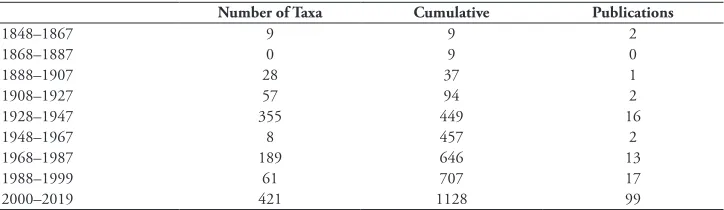
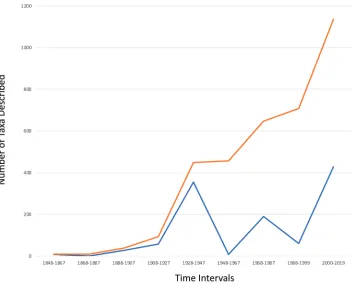
In the 170-year history of continental diatom discovery in China, 1128 taxa have been described at the level of species and below (Table 1). This was not a smooth, equal ac-cumulation of species over time, and if we examine the overall time period in groups of 20-year intervals, we can see there were times when significant numbers of taxa were described. For example, the time interval of 1928 to 1947 there were 355 taxa described in 16 publications, and between 1968 and 1987, 189 taxa were described in only 13 publications. In both instances, most of the publications were by a single author (See Appendices 1 and 2). On the other hand, in the more recent period of 2000 to 2019, the highest number of taxa were described (421), and published in 99 separate publications. Many of these papers were multi-authored. Periods of low publication of new species can be found in the earliest periods (1848–1887) and in the period 1948–1967 (Fig. 1).
In the next sections, we break down the work of continental diatom discovery in China into two periods, the initial period (1848–1999) and more recent period of continental diatom discovery (2000–2019). We examine the changes in approach and productivity during these time periods and compile a list of the taxa described and the references in which they were published.
The initial period: 1848–1999
Studies on the continental diatoms of China date back to the mid 1800’s, to the work of Ehrenberg. From these initial works through ¾ of the 20th century, there were many
1976b). Neither of these genera have been reported since they were first described, and neither of these names are in use today.
Table 1 and Appendix 1 show that from 1848 until 1999, a total of 707 taxa were described from continental in China. Of these, 218 were recognized as separate spe-cies, while 489 were described as varieties and forms. These taxa were included across 48 genera. Genera with the most taxa described include Pinnularia (138), Navicula sensu lato (98), Cymbella sensu lato (56) and Nitzschia (43) and Gomphonema (39).
The data for this period were organized into 20-year intervals (except the last pe-riod) and show some interesting trends. The first works in which new taxa were de-scribed were penned by Europeans working alone. This included Ehrenberg being the first in 1848 and then again in 1854, but after that more than 50 years went by before another publication that included a new species described was produced. In 1906 Mereschkowsky studies diatoms from Tibet, and in 1922 Hustedt worked on diatoms from Tibet and the northwestern part of China. Starting in the late 1920’s, through the 1940’s, the description of continental diatom taxa was dominated by Boris V. Skvort-zov. Williams et al. (2016) have provided insights into the life and work of Skvortzov, and Gololobova (2012) has created a checklist of the taxa described by him. Unlike his predecessors who described continental diatoms from China, Skvortzov actually lived and worked in China (though he studied from many parts of Asia, from the Philippines, Russia and to India, and further afield, and received samples from many individuals). His base was in Harbin, in Heilongjiang Province, in the northeastern part of the country. Thus, while species he described were from many areas and di-verse ecosystems across China, many of the taxa described were from the northeastern part of the country. Skvortzov trained students in Harbin, and later work on diatom taxonomy in China has been carried out by three generations of scientists who can trace their academic lineages back to him. During the same time period as Skvortzov was describing many taxa, some Europeans also contributed to our knowledge of new continental diatoms, such as Skuja (1937) and Voigt (1942a, b).
In the period following Skvortzov’s large work published in 1946, only one other publication appeared (in which 8 taxa were described), until another large work on the continental diatoms of China was published by Skvortzov in 1976. From 1950 to 1976
table 1. Number of taxa described, Cumulative number of described taxa and number of publications in which new taxa were described from freshwaters in China, 1848–2019.
Number of Taxa Cumulative Publications
1848–1867 9 9 2
1868–1887 0 9 0
1888–1907 28 37 1
1908–1927 57 94 2
1928–1947 355 449 16
1948–1967 8 457 2
1968–1987 189 646 13
1988–1999 61 707 17
was a period of dramatic challenges and cultural change in China. The first occurred with the severe famine that hit the country in 1950, lasting three years. The impacts of that famine led to the deaths of tens of millions of people, and this had lasting impacts on society for many years afterwards. In addition, the Cultural Revolution, in part a reaction to the great famine, also had negative impacts on life in China, and those impacts on academics are well-documented. Thus, with the few publications produced in this time period within the narrow discipline of diatom taxonomy and biodiversity discovery, we can see the impacts of natural disasters, economic decline and political and cultural change on the output and continuation of scientific research and training.
Skvortzov left China during the cultural revolution, and ended up in Sao Paulo, Brazil. While there, he published two large works in which nearly 140 taxa were de-scribed from Chinese continental (Skvortzov 1976a, b). These were to be his last works on the topic of continental diatoms from China while he was alive. His collections have never been found (See Williams et al. 2016).
Despite his death, and the uncertainty regarding his collections, Skvortzov’s legacy lives on with the works of his students, especially Professor Bao (who is currently in Harbin) and Professor Qi (who is currently in Guangzhou), both of whom are officially retired, as well as Professor Zhang, previously of Jinan University in Guangzhou (now deceased). All of these scientists ended up forming collaborations with scientists in the USA, with C.W. Reimer at the Academy of Natural Sciences of Philadelphia (who vis-ited Harbin and hosted Bao, Qi and Zhang in Philadelphia) and E.F. Stoermer at the University of Michigan. Professor Qi visited Reimer at the Academy in Philadelphia while attending the International Diatom Symposium there in 1982 and stayed with Stoermer at his home in Ann Arbor, while on an extended trip to the USA in 1984. These connections yielded published collaborative works (Qi et al. 1984; Stoermer et al. 1986; Bao and Reimer 1992).
In the latter part of the 20th century, we see important floristic works being
pub-lished on the diatoms from Tibet, Yunnan and other localities, and some emphasis on freshwater fossil diatoms by Chinese researchers. In these books and papers, a new generation of scientists had come on the scene, and there was the initiation of an important series focused on documenting the freshwater diatom flora of the country (“Flora Algarum Sinicarum Aquae Dulcis” Qi 1995; Qi and Li 2004; Li and Qi 2010; Shi 2004, 2013; Wang and You 2018).
The recent period (2000–2019)
In the 20-year time period, from 2000 to 2019, a total of 421 taxa, consisting of 252 species and 169 subspecific taxa across 67 genera have been described from continental waters in China (Appendix 2; Table 2). In addition, 6 new genera have been described. The breadth of lineages represented in these works during this period is remarkable, since several groups of “centric” and “araphid” diatoms have been described, as well as taxa among the major raphid lineages (Eunotiales, Bacillariales, Naviculales, Cymbellales, Rhopalodioid and Surirellales) are all included. For example, new genera of centric dia-toms include Edtheriotia and the new genus of araphid diatoms is represented by Tibet-iella. Raphid genera are included in the Eunotiales (Sinoperonia), Naviculales ( Sichuan-iella, Pseudofallacia) and Cymbellales (Gomphosinica). New species can be found among the centrics (in the genera Cyclotella, Edtheriotia, Urosolenia, Orthoseira, and Melosira), araphids (Fragilaria, Tabularia, Diatoma and Tetracyclus) and across the raphid diatoms, including the Eunotiales (Eunotia), Bacillariales (Simonsenia, Achnanthes), Monoraphids (Achnanthidium, Platessa), Naviculoids (Germainiella, Neidium, Pinnularia. Muelleria), Cymbelloids (Cymbella, Delicata), Rhopalodioids (Epithemia) and Surirelloids ( Cymato-pleura, Surirella). Please note that Achnanthes, though monoraphid, has been shown to be more closely related to members of the Bacillariales (Bruder and Medlin 2008); the monoraphid condition has evolved several times in the raphid diatom lineage (Kociolek et al. 2019a). Genera with the most species described in this period include Pinnularia
There is also great geographic breadth represented in these studies, with taxa being described in the northwestern portion of the country, Tibet and Yunnan, across the biodiverse regions of the karst belt extending from Yunnan to Guizhou, the central part of China, and from Hainan to the extreme Northeast.
Since 2000, there have been floristic studies that have yielded description of new taxa, such as Zhu and Chen’s (2000) tome on the diatoms of Tibet, as well as revi-sionary work, such as Shi’s (2004) study on gomphonemoid diatoms. While these were published in Chinese, the trend has been in more recent years for works to be published in English-language journals, such as Phytotaxa, Phycologia, Fottea, Cryp-togamie: Algologie, Nova Hedwigia, and Diatom Research. Some research continues to be published in several Chinese-language journals as well.
In 2012, Kulikovskiy et al. included a paper offered by Gololobova and Kuliko-vskiy where they traced a manuscript submitted in the 1960’s by Skvortzov to Dr. Proschkina-Lavrenko in Moscow for publication. but the paper was, for unknown reasons, never published. In this paper, which has been published in the 23rd volume
of Iconographia Diatomologica, Skvortzov presents 445 taxa, that represent either new names, transfers or new taxon descriptions. This work includes taxa from India, China, Philippines, Japan, Korea, Australia and even Cuba. For the purposes of the current work, 208 of the taxa were newly described from China, and recorded for the year of publication (2012) even though the work was submitted 4 decades previously. These new taxon descriptions were not validly published (they lacked designation of type
table 2. Number of taxa described, cumulative number of taxa, and number of publications in which taxa were described of freshwater diatoms in China, 2000–2019.
Year Number of taxa described Cumulative number of
described taxa Number of Publications
2000 2 2 1
2001 0 2 0
2002 1 3 1
2003 8 11 3
2004 10 21 2
2005 1 22 1
2006 1 23 1
2007 1 24 1
2008 1 25 1
2009 4 29 3
2010 8 37 6
2011 1 38 1
2012 209 247 3
2013 28 275 7
2014 17 292 7
2015 14 306 9
2016 11 317 9
2017 36 353 13
2018 38 391 15
2019 30 421 15
specimens) but are included here since they represent the identification and publica-tion of new taxa in China.
In total, since 2000, the 421 described taxa were included in nearly 100 published books and papers (Table 2), nearly twice the number of publications than was pub-lished in the preceding 150 years. In some of the recent studies, observations have veri-fied the continued presence of endemics described in earlier works (e.g. Gomphonema eminens Skuja in Yunnan; Liu et al. 2020; several species of Pinnularia from the Great A’er Mountains; Liu et al. 2018; and species of centric diatoms from Yunnan), though the population sizes of these endemic taxa are reported to be declining (Li et al. 2012b).
The degree of collaboration between Chinese researchers within and between in-stitutions, and the inclusion of students in these works, are both striking and a dem-onstration that this area of research will have a fruitful period of work ahead. Amongst the senior and corresponding authors of these papers we see the impact of Skvortzov, whose academic grandchildren and great-grandchildren working on freshwater dia-toms are now in Shanghai, Taiyuan, and Harbin. There are also well-established labs in Beijing, Shanghai, Kunming, Nanjing, and Jishou, whose focus may include the study of ecological and palaeoecological interpretation, as well as biodiversity discovery and description. Collaborations with non-Chinese scientists is also hallmark of this most recent era, with partners joining in these works from the U.K., Spain, Macedonia, Germany, Luxembourg, Belgium, Canada, and the USA.
Discussion: A look ahead
While there has been a tremendous amount of work done to document the freshwater diatom flora of China, there are still many areas across the country that await initial or additional in-depth study. Some of these areas include, Yunnan Province, the vast karst region across Yunnan/Guangxi/Guizhou provinces, the subtropical southern part of the country, Xinjiang Autonomous Region, and Tibet, to name a few. In these re-gions are the two biodiversity hotspots the are fully in China (Myers et al. 2000; CEPF 2019). Also, the two longest rivers in China, The Yangtze River and Yellow River, have had isolated studies, but not comprehensive analyses. There exist specialized habitats such as also high mountain ranges, waterfalls, and hot springs, to name a few, where more intensive studies are warranted.
many challenges, especially in situations where several varieties or forms were dissected from the same species, or for the large number of taxa described in his 1976 and 2012 papers, where the illustrations are of a quality that might not facilitate making positive identifications. It also appears that the collections of Chen and Zhu have been lost, and typification of their taxa will also be an important activity for taxonomists.
The loss of several important collections in China is not restricted to that country. Collections have been discarded by many universities and research institutes across the world. Currently, China does not have a national diatom collection. Such a repository might be useful in the future, as the significant, current activities of collection-building and biodiversity discovery and description, which appears to still be in a log growth phase (see Fig. 1). The fate of the collections that have been established and blossomed in a single generation in Shanghai, Harbin, Taiyuan, Beijing and other labs will always be tenuous. Having a national collection would potentially provide a repository for the country to serve future generations of scientists.
Although there is tremendous described diversity in the continental diatom flora of China, and it is likely that there is still much to do to achieve a more comprehensive knowledge of that flora, the number of strains of continental diatoms in GenBank traceable to a source in China is modest. In fact, this is all the more surprising since some groups of continental diatoms have a tremendous diversity in China, and some endemic genera in Asia have representatives in the Chinese flora (Kociolek 2019). Some of these groups include the Thalassiosiraceae and Cymbellales. In the latter group, the only endemic genera known for that lineage worldwide are from Asia and include species from China (e.g. Zhang et al. 2018). Workflows and resources will need to be developed so that the number of molecular sequences generated from Chinese taxa are commensurate with the diversity and unique nature of the flora.
Acknowledgements
This paper is dedicated to Profs. Bao and Qi, for all of their hard work and support of students in the study of diatoms in China. This work was funded in part by the One-hundred Talent Program of Shanxi Province and the Shanxi ‘1331’ Project. We appreciate the comments of the reviewers and editors, and communications with Dr. David Williams regarding nomenclature and typification.
references
Bao W-M, Reimer CW (1992) New taxa of the diatoms from Changbaishan Mountain, China. Bulletin of Botanical Research 12(4): 357–361.
Cao Y, Yu P, You Q, Lowe RL, Williams DM, Wang Q-X, Kociolek JP (2018) A new species of Tabularia (Kützing) Williams & Round from Poyang Lake, Jiangxi Province, China, with a cladistic analysis of the genus and their relatives. Phytotaxa 373(3): 169–183. https://doi. org/10.11646/phytotaxa.373.3.1
CEPF [Critical Ecosystem Partnership Fund] (2019) The biodiversity hotspots. https://www. cepf.net/our-work/biodiversity
Chen J (1980) Shui Sheng Sheng Wu Hsueh Bao 7(2): 253–256. [Notes on some new species and variety of the genus Melosira (Bacillariophyta)]
Chen J (1987) A new variety of the Cyclotella asterocostata (Bacillariophyta). Shui Sheng Sheng Wu Hsueh Bao 11(4): 1.
Chen J, Zhu H (1983) Amphiraphisales, a new order of the pennatae, Bacillariophyta. Zhiwu Fenlei Xuebao 21(4): 449–457.
Chen J, Zhu H (1985) Studies on the freshwater centricae of China. Shui Sheng Sheng Wu Hsueh Bao 9(1): 80–83.
Cheng Y, Liu Y, Kociolek JP, You Q, Fan Y (2018) A new species of Gomphosinica (Bacil-lariophyta) from Lugu Lake, Yunnan Province, SW China. Phytotaxa 348(2): 118–124. https://doi.org/10.11646/phytotaxa.348.2.6
Ehrenberg CG (1848) Mittheilung über vor Kurzem vom dem Preufs. Seehandlungs Schiffe, der Adler, aus Canton mitgebrachte verkäufliche, chinesische Blumen-Cultur-Erde, wiefs deren reiche Mischung mit mikroskopischen Organismen und verzeichniss 124 von ihm selbst beobachteten Arten chinesischer kleinster Lebensformen. Bericht über die zur Be-kanntmachung geeigneten Verhandlungen der Königlich-Preussischen Akademie der Wis-senschaften zu Berlin 1847: 476–485.
Ehrenberg CG (1854) Mikrogeologie. Einundvierzig Tafeln mit über viertausend grossentheils colorirten Figuren, Gezeichnet vom Verfasser. [Atlas]. Leopold Voss, Leipzig.
Fan Y, Shi Z, Bao W, Wang Q-X (2004) A New combination and Two varieties of Polystigmate Gomphonema (Gomphonemaceae Bacillariophyta) from Heilongjiang Province, China. Chinese Journal of Oceanology and Limnology 22(2): 198–200. https://doi.org/10.1007/ BF02842593
Fourtanier E, Kociolek JP (2011) Catalogue of Diatom Names, California Academy of Sci-ences, On-line Version. http://research.calacademy.org/research/diatoms/names/index.asp Fu D, Tong G, Dai T, Liu W, Yang Y, Zhang Y, Cui L, Li L, Yun H, Wu Y, Sun A, Liu C, Pei W,
Gaines RR, Zhang X (2019) The Qingjiang biota-A Burgess Shale-typeee fossil Lagerstätte from the early Cambrian of South China. Science 363(6433): 1338–1342. https://doi. org/10.1126/science.aau8800
Gololobova MA (2012) Checklist of Boris V. Skvortsow’s diatom taxa. Iconographia Diatomo-logica 23: 611–742.
Gong Z, Li Y (2011) Cymbella fuxianensis Li and Gong sp. nov. (Bacillariophyta) from Yun-nan Plateau, China. Nova Hedwigia 92(3–4): 551–556. https://doi.org/10.1127/0029-5035/2011/0092-0551
Gong Z, Li Y, Metzeltin D, Lange-Bertalot H (2013) New species of Cymbella and Placoneis (Bacillariophyta) from late Pleistocene fossil, China. Phytotaxa 150(1): 29–40. https://doi. org/10.11646/phytotaxa.150.1.2
Gong Z, Metzeltin D, Li Y, Edlund M (2015) Three new species of Navicula (Bacillario-phyta) from lakes in Yunnan Plateau (China). Phytotaxa 208(2): 135–146. https://doi. org/10.11646/phytotaxa.208.2.2
Gower D, Johnson K, Richardson J, Rosen B, Rüber L, Williams S (Eds) (2012) Biotic Evolu-tion and Environmental Change in Southeast Asia. Systematics AssociaEvolu-tion Special Volume. Cambridge University Press, Cambridge. https://doi.org/10.1017/CBO9780511735882 Guiry MD, Guiry GM (2020) AlgaeBase. World-wide electronic publication, National
Univer-sity of Ireland, Galway. https://www.algaebase.org
Guo Y-Q, Xie S-Q, Li J-S (1997) (A new species of the genus Amphor (Bacillariophyta).). Zhiwu Fenlei Xuebao 35(3): 273–274.
Hamsher SE, Graeff CL, Stepanek JG, Kociolek JP (2014) Variation in valve and girdle band morphology in freshwater Denticula (Bacillariophyceae) species: Implications for the systematic position of the genus including the description of Tetralunata gen. nov. (Epithemiaceae, Rhopalodiales). Plant Ecology and Evolution 147: 346–365. https://doi. org/10.5091/plecevo.2014.990
Hu Z, Li Y, Metzeltin D (2013) Three new species of Cymbella (Bacillariophyta) from high altitude lakes, China. Acta Botanica Croatica 72(2): 359–374. https://doi.org/10.2478/ botcro-2013-0005
Huang C, Liu S, Chen Z (1998) Atlas of Limnetic Fossil Diatoms of China. China Ocean Press, Beijing. [in Chinese]
Hustedt F (1922) Bacillariales aus Innerasien. Gesammelt von Dr. Sven Hedin. In: Hedin S (Ed.) Southern Tibet, discoveries in former times compared with my own researches in 1906–1908. Lithographic Institute of the General Staff of the Swedish Army, Stockholm 6(3): 107–152. https://doi.org/10.5962/bhl.title.64226
Hustedt F (1938a) Systematische und ökologische Untersuchungen über die Diatomeen-Flora von Java, Bali und Sumatra nach dem Material der Deutschen Limnologischen Sunda-Expedition. Allgemeiner Teil. I. Übersicht über das Untersuchengsmaterial und Charak-teristik der Diatomeen flora der einzelnen Gebiete. “Tropische Binnengewässer, Band VII. Archiv für Hydrobiologie (Supplement, 15): 638–790.
Hustedt F (1938b) Systematische und ökologische Untersuchungen über die Diatomeen-Flora von Java, Bali und Sumatra nach dem Material der Deutschen Limnologischen Sunda-Ex-pedition. Allgemeiner Teil. II. Die Diatomeenflora der untersuchtn Gewässertypen. "Tro-pische Binnengewässer, Band VII". Archiv für Hydrobiologie. Supplement 16(1): 1–155. Hustedt F (1939) Systematische und ökologische Untersuchungen über die Diatomeen-Flora
von Java, Bali und Sumatra nach dem Material der Deutschen Limnologischen Sunda-Ex-pedition. Allgemeiner Teil. III. Die ökologischen Faktoren und ihr Einfluß auf die Diato-meenflora. "Tropische Binnengewässer, Band VII". Archiv für Hydrobiologie. Supplement 16(1): 274–394.
Jao C, Zhu H, Lee Y (1974) The fresh-water algae from Mount Qomolangma district (in Tibet). Report of the Scientific Survey of Mount Qomolangma district, 1966–1968: 92–126.
Jiang Z, Liu Y, Kociolek JP, Fan Y (2018) One new Gomphonema (Bacillariophyta) species from Yunnan Province, China. Phytotaxa 349(3): 257–264. https://doi.org/10.11646/phyto-taxa.349.3.6
Jin TG (1951) A list of Chinese diatoms, from 1847 to 1946. Amoy Fisheries Bulletin 1: 41–143.
Kociolek JP (2019) A worldwide listing and biogeography of freshwater diatom genera: A phy-logenetic perspective. Diatom Research 33(4): 509–534. https://doi.org/10.1080/026924 9X.2019.1574243
Kociolek JP, You Q-M, Wang Q-X, Liu Q (2015) Consideration of some interesting freshwater gomphonemoid diatoms from North America and China, and the description of Gom-phosinica gen. nov. Nova Hedwigia. Beiheft 144: 175–198.
Kociolek JP, You Q-M, Stepanek J, Lowe RL, Wang Q-X (2016a) A new freshwater diatom genus, Edtheriotia gen. nov. of the Stephanodiscaceae Glezer & Makarova (Bacillari-ophyta) from south-central China. Phycological Research 64(4): 274–280. https://doi. org/10.1111/pre.12145
Kociolek JP, You Q-M, Stepanek J, Lowe RL, Wang Q-X (2016b) A new Eunotia C.G. Ehren-berg (Bacillariophyta: Bacillariohyceae: Eunotiales) species from karst formations of south-ern China. Phytotaxa 265: 285–293. https://doi.org/10.11646/phytotaxa.265.3.10 Kociolek JP, Ector L, Coste M (2018) Nomenclatural corrections and clarifications for names
of diatoms (Bacillariophyta) in two volumes of Bibliotheca Diatomologica. Notulae al-garum 77: 1–3.
Kociolek JP, Williams DM, Stepanek J, Liu Q, Liu Y, You Q-M, Karthick B, Kulikovskiy M (2019a) Rampant homoplasy and adaptive radiation in pennate diatoms. Plant Ecology and Evolution 152(2): 131–141. https://doi.org/10.5091/plecevo.2019.1612
Kociolek JP, You Q-M, Lou F, Yu P, Lowe RL, Wang Q-X (2019b) First report and new fresh-water species of the genus Germainiella from China, based on collections from the Maolan Nature Reserve, Guizhou Province. Phytotaxa 393: 35–46. https://doi.org/10.11646/phy-totaxa.393.1.3
Kociolek JP, Balasubramanian K, Blanco S, Coste M, Ector L, Liu Y, Kulikovskiy M, Lund-holm N, Ludwig T, Potapova M, Rimet F, Sabbe K, Sala S, Sar E, Taylor J, Van de Vijver B, Wetzel CE, Williams DM, Witkowski A, Witkowski J (2020) DiatomBase. http://www. diatombase.org
Kulikovskiy MS, Lange-Bertalot H, Metzeltin D, Witkowski A (2012) Lake Baikal: Hotspot of endemic diatoms I. Iconographia Diatomologica 23: 7–608.
Kulikovskiy MS, Lange-Bertalot H, Kuznetsova I (2015) Lake Baikal: Hotspot of endemic diatoms II. Iconographia Diatomologica 26: 1–656.
Krammer K (2002) Cymbella. Diatoms of Europe. 3: 1–584.
Lei G, Liu Y, Kociolek JP, Fan Y (2014a) New Gomphonema (Bacillariophyta) species from Xing-kai Lake, China. Phytotaxa 175: 249–255. https://doi.org/10.11646/phytotaxa.175.5.2 Lei G, Liu Y, Kociolek JP, Fan Y (2014b) Newly recorded species in Pinnularia
(Bacillari-ophyta) from Xingkai Lake, China. Acta Hydrobiologia Sinica 38: 669–674.
Li JY (1982). Acta Botanica Sinica 24(5): 456–467. [Miocene diatom assemblage of Shanwang, Shandong Sheng]
Li JY (1984) Zhiwu Fenlei Xuebao 22(3): 231–236. [Some new species and varieties of the genus Tetracyclus Ralfs (Bacillariophyta)]
Li JY (1988) A new fossil (diatom) recorded and its significance. Bulletin of Botanical Research 8: 129–132.
Li YL (1999) Some new fossil species and varieties of the genus Tetracyclus Ralfs. Acta Geosci-entica Sinica. 20: 439–446.
Li Y, Gong Z (2013) Eucocconeis lichunhaii Li, sp. nov. (Bacillariophyta) from high moun-tain lakes, China. Algological Studies 141(1): 29–36. https://doi.org/10.1127/1864-1318/2012/0002
Li JY, Qi YZ (2010) Flora Algarum Sinicarum Aquae Dulcis. Tomus XIV. Bacillariophyta. Naviculaceae (I). Science Press, Beijing, 177 pp.
Li N, Shi ZX, Lei AP (1999) New taxa of Gomphonema (Bacillariophyta) from Hubei. Shui Sheng Sheng Wu Hsueh Bao 23(2): 192–193.
Li YL, Shi ZX, Xie P, Rong KW (2003) New varieties of Gomphonema and Cymbella (Bacillari-ophyta) from Qinghai province. Shui Sheng Sheng Wu Hsueh Bao 27(2): 147–148. Li YL, Gong ZJ, Xie P, Shen J (2005) New species and new records of fossil diatoms from the
late Pleistocene of the Jianghan Plain, Hubei Province. Acta Micropalaeontologica Sinica 22(3): 304–310.
Li Y, Gong Z, Xie P, Shen J (2006) Distribution and morphology of two endemic gomphonemoid species, Gomphonema kaznakowi Mereschkowsky and G. yangtzensis Li, nov. sp. in China. Diatom Research 21(2): 313–324. https://doi.org/10.1080/0269249X.2006.9705672 Li YL, Gong ZJ, Xie P, Shen J (2007) New species and new records of fossile diatoms from
China. Shui Sheng Sheng Wu Hsueh Bao 31(3): 319–324.
Li YL, Gong ZJ, Wang CC, Shen J (2010a) New species and new records of diatoms from Lake Fuxian, China. Journal of Systematics and Evolution 48(1): 65–72. https://doi. org/10.1111/j.1759-6831.2009.00059.x
Li Y, Kociolek JP, Metzeltin D (2010b) Gomphonema sichuanensis Li and Kociolek sp. nov.
and Gomphonema laojunshanensis Li, Kociolek and Metzeltin sp. nov. from two high
mountain lakes, China. Diatom Research 25(1): 87–98. https://doi.org/10.1080/02692 49X.2010.9705831
Li Y, Metzeltin D, Gong Z (2010c) Two new species of Sellaphora (Bacillariophyta) from a deep oligotrophic plateau lake, Lake Fuxian in subtropical China. Chinese Journal of Oceanol-ogy and LimnolOceanol-ogy 28(6): 1160–1165. https://doi.org/10.1007/s00343-010-9028-z Li YL, Williams DM, Metzeltin D, Kociolek JP (2010d) Tibetiella pulchra gen. nov. et sp. nov.,
Li JK, Nel A, Zhang XP, Fleeck G, Gao MX, Lin L, Zhou J (2012) A third species of the relict family Epiophlebiidae discovered in China (Odonta: Epiproctophora). Systematic Ento-mology 37(2): 408–412. https://doi.org/10.1111/j.1365-3113.2011.00610.x
Li YL, Gong ZJ, Shen J (2012) Effects of eutrophication and temperature on Cyclotella rhom-boideo-elliptica Skuja, endemic diatom to China. Phycological Research 60(4): 288–296. https://doi.org/10.1111/j.1440-1835.2012.00659.x
Li YL, Metzeltin D, Gong ZJ (2013) Two new species of Sellaphora (Bacillariophyta) from a deep oligotrophic plateau lake, Lake Fuxian in subtropical China. Chinese Journal of Oceanol-ogy and LimnolOceanol-ogy 28(6): 1160–1165. https://doi.org/10.1007/s00343-010-9028-z Li Y, You Q-M, Kociolek JP, Wang L-Q, Zhang W (2019) Gomphosinica selincuoensis sp. nov., a
new gomphonemoid species (Bacillariophyceae) from North Tibet, China. Phytotaxa 423: 195–205. https://doi.org/10.11646/phytotaxa.423.3.8
Liao M-N, Li YL (2018) One new Gomphonema Ehrenberg (Bacillariophyta) species from a high mountain lake in Yunnan Province, China. Phytotaxa 361(1): 123–130. https://doi. org/10.11646/phytotaxa.361.1.11
Liu Y, Fu C, Wang Q-X, Stoermer EF (2010a) A new species, Diatoma rupestris, from the Great Xing’an Mountains, China. Diatom Research 25(2): 337–347. https://doi.org/10.1080/0 269249X.2010.9705854
Liu Y, Fu C, Wang Q-X, Stoermer EF (2010b) Two new species of Pinnularia from Great Xing’an Mountains, China. Diatom Research 25(1): 99–109. https://doi.org/10.1080/02 69249X.2010.9705832
Liu Y, Kociolek JP, Fan Y, Wang Q-X (2012) Pseudofallacia gen. nov., a new freshwater diatom (Bacillariophyceae) genus based on Navicula occulta Krasske. Phycologia 51(6): 620–626. https://doi.org/10.2216/11-098.1
Liu Y, Kociolek JP, Wang Q-X (2013) Six new species of Gomphonema Ehrenberg (Bacillari-ophyceae) from the Great Xing’an Mountains, Northeastern China. Cryptogamie. Algolo-gie 34(4): 301–324. https://doi.org/10.7872/crya.v34.iss4.2013.301
Liu Q, Kociolek JP, Wang Q-X, Fu C (2014a) Valve morphology of three species of Neidiomorpha (Bacillariophyceae) from Zoigê Wetland, China, including description of Neidiomorpha si-chuaniana nov. sp. Phytotaxa 166(2): 123–131. https://doi.org/10.11646/phytotaxa.166.2.3 Liu Y, Kociolek JP, Wang Q-X, Fan Y (2014a) A new species of Neidium (Bacillariophyceae)
and a checklist of the genus from China. Diatom Research 29(2): 165–173. https://doi.or g/10.1080/0269249X.2013.872192
Liu Q, Kociolek JP, Wang Q-X, Fu C (2014b) Two new Prestauroneis Bruder & Medlin (Bacil-lariophyceae) species from Zoigê Wetland, Sichuan Province, China, and comparison with Parlibellus E.J. Cox. Diatom Research 30(2): 133–139. https://doi.org/10.1080/026924 9X.2014.988292
Liu Y, Kociolek JP, Wang Q-X, Fan Y (2014b) Two new species of monoraphid diatom (Bacil-lariophyceae) from South of China. Phytotaxa 188(1): 31–37. https://doi.org/10.11646/ phytotaxa.188.1.4
Liu B, Sterrenburg F, Huang B (2015b) Gyrosigma xiamenense sp. nov. (Bacillariophyta) from the middle intertidal zone, Xiamen Bay, southern China. Phytotaxa 222(4): 259. https:// doi.org/10.11646/phytotaxa.222.4.3
Liu B, Williams DM, Huang B (2015c) Gyrosigma rostratum sp. nov. (Bacillariophyta) from the low intertidal zone, Xiamen Bay, southern China. Phytotaxa 203(3): 254–262. https://doi. org/10.11646/phytotaxa.203.3.4
Liu B, Blanco S, Long H, Xu J, Jiang X (2016) Achnanthidium sinense sp. nov. (Bacillari-ophyta) from the Wuling Mountains Area, China. Phytotaxa 284(3): 194. https://doi. org/10.11646/phytotaxa.284.3.4
Liu Y, Kociolek JP, Fan Y (2016) Urosolenia and Acanthoceras species from Hainan Province, China. Phytotaxa 244(2): 161. https://doi.org/10.11646/phytotaxa.244.2.4
Liu Q, Kociolek JP, Li B, You Q-M, Wang Q-X (2017) The diatom genus Neidium Pfitzer (Bacillariophyceae) from Zoige Wetland, China. Bibliotheca Diatomologica 63: 1–120. Liu B, Williams DM, Blanco S, Jiang XY (2017a) Two new species of Luticola (Bacillariophyta)
from the Wuling Mountains Area, China. Nova Hedwigia. Beiheft 146: 197–208. https:// doi.org/10.1127/1438-9134/2017/197
Liu B, Williams DM, Ou Y (2017b) Adlafia sinensis sp. nov. (Bacillariophyceae) from the Wul-ing Mountains Area, China, with reference to the structure of its girdle bands. Phytotaxa 298(1): 43–54. https://doi.org/10.11646/phytotaxa.298.1.4
Liu B, Williams DM, Tan L (2017c) Three new species of Ulnaria (Bacillariophyta) from the Wuling Mountains Area, China. Phytotaxa 306(4): 241–258. https://doi.org/10.11646/ phytotaxa.306.4.1
Liu Q, Yang L, Nan F, Feng J, Lv J, Kociolek JP, Xie S (2018a) A new diatom species of Aneumastus D. G. Mann & Stickle ((Bacillariophyta, Bacillariophyceae, Mastogloiales, Mastogloiaceae) from Tibet, China. Phytotaxa 373(3): 231–235. https://doi.org/10.11646/phytotaxa.373.3.6 Liu Y, Kociolek JP, Wang Q-X, Fan Y (2018b) The diatom genus Pinnularia from Great Xing’an
Mountains, China. Bibliotheca Diatomologica 65: 1–298.
Liu B, Blanco S, Qing-Yan L (2018a) Ultrastructure of Delicata sinensis Krammer et Metzeltin and D. williamsii sp. nov. (Bacillariophyta) from China. Fottea 18(1): 30–36. https://doi. org/10.5507/fot.2017.009
Liu Y, Kociolek JP, Glushchenko A, Kulikovskiy M, Fan Y (2018b) A new genus of Eunotiales (Bacillariophyta, Bacillariophyceae: Peroniaceae), Sinoperonia, from Southeast Asia, exhib-iting remarkable phenotypic plasticity with regard to the raphe system. Phycologia 57(2): 147–158. https://doi.org/10.2216/17-21.1
Liu B, Williams DM, Ector L (2018c) Entomoneis triundulata sp. nov. (Bacillariophyta), a New Freshwater Diatom Species from Dongting Lake, China. Cryptogamie. Algologie 39(2): 239–253. https://doi.org/10.7872/crya/v39.iss2.2018.239
Liu B, Williams DM, Liu Q (2018d) A new species of Cymbella (Cymbellaceae, Bacillariophy-ceae) from China, possessing valves with both uniseriate and biseriate striae. Phytotaxa 344(1): 39–46. https://doi.org/10.11646/phytotaxa.344.1.5
Liu Q, Glushchenko A, Kulikovskiy M, Maltsev Y, Kociolek JP (2019a) New Hannaea Patrick (Fragilariaceae, Bacillariophyta) Species from Asia, with Comments on the Biogeography of the Genus. Cryptogamie. Algologie 40(5): 41–61. https://doi.org/10.5252/cryptog-amie-algologie2019v40a5
Liu B, Williams DM, Blanco S, Liu ZX, Liu D (2019b) Three new species of Ulnaria (Kützing) Compere (Bacillariophyta) from China, with reference to the fine structure of their valvo-copula. Cryptogamie. Algologie 40(11): 119–139. https://doi.org/10.5252/cryptogamie-algologie2019v40a11
Liu Q, Li J, Nan F, Feng J, Lv J, Xie S, Kociolek JP (2019b) New and interesting diatoms from Tibet: I. Description of a new species of Clipeoparvus Woodbridge et al. Diatom Research 34(1): 33–38. https://doi.org/10.1080/0269249X.2019.1578697
Liu B, Blanco S, Ector L, Liu ZX, Ai J (2019c) Surirella wulingensis sp. nov. and fine struc-ture of S. tientsinensis Skvortzov (Bacillariophyceae) from China. Fottea 19(2): 151–162. https://doi.org/10.5507/fot.2019.006
Liu Y, Kociolek JP, Fan Y (2020) Valve ultrastructure of two species of the diatom genus Gom-phonema Ehrenberg (Bacillariophyta) from Yunnan Province, China. Fottea 20(1): 25–35. https://doi.org/10.5507/fot.2019.012
Liu Q, Li B, Wang Q-X (2018) Muelleria pseudogibbula, a new species from a newly recorded genus (Bacillariophyceae) in China. Journal of Oceanology and Limnology 36: 556–558. https://doi.org/10.1007/s00343-018-6194-x
López-Pujol J, Ren MX (2009) China: A hot spot of relict plant taxa. In: Rescigno V, et al. (Eds) Biodiversity Hotspots. Nova Science Publishers, 1–20.
López-Pujol J, Zhang FM, Sun HQ, Ying TS, Ge S (2011) Mountains of southern China as “Plant Museums” and “Plant Cradles”: Evolutionary and conservation insights. Mountain Research and Development 31(3): 261–269. https://doi.org/10.1659/MRD-JOURNAL-D-11-00058.1
Lowe RL, Kociolek JP, You Q-M, Wang Q-X, Stepanek J (2017) Diversity of the diatom genus Humidophila in karst areas of Guizhou, China. Phytotaxa 305: 269–284.
Lu L-M, Mao L-F, Yang T, Ye J-F, Liu B, Li H-L, Sun M, Miller JT, Mathews S, Hu H-H, Niu Y-T, Peng D-X, Chen Y-H, Smith SA, Chin M, Xiang K-L, Le C-T, Dang V-C, Lu A-M, Soltis PS, Soltis DE, Li J-H, Chen Z-D (2018) Evolutionary history of the angiosperm flora of China. Nature 554: 234–238. https://doi.org/10.1038/nature25485
Luo F, You Q-M, Yu P, Pang W, Wang Q (2019) Eunotia (Bacillariophyta) biodiversity from high altitude, freshwater habitats in the Mugecuo Scenic Area, Sichuan Province, China. Phytotaxa 394(2): 133–147. https://doi.org/10.11646/phytotaxa.394.2.2
Mereschkowsky C (1906) Diatomées du Tibet. Imperial Russkoe geograficheskoe obshchestvo. St. Petersburg, 40 pp.
Metzeltin D, Lange-Bertalot H, Nergui S (2009) Diatoms in Mongolia. In: Lange-Bertalot H (Ed.) Iconographia Diatomologica. Annotated Diatom Micrographs 20: 3–686.
Ouyang L, Pan Y, Huang C, Tang YJ, Xiao W (2015) Water quality assessment of benthic diatom communities for water quality in the subalpine karstic lakes of Jiuzhaigou, a world heritage site in China. Journal of Mountain Science 13. https://doi.org/10.1007/s11629-014-3392-7
Peng Y, Rioual P, Jin Z, Sterrenburg FAS (2016) Gyrosigma peisonis var. major var. nov., a new variety of Gyrosigma peisonis (Bacillariophyta) from Lake Qinghai, China. Phytotaxa 245(2): 119–128. https://doi.org/10.11646/phytotaxa.245.2.3
Peng Y, Rioual P, Williams DM, Zhang Z, Zhang F, Jin Z (2017) Diatoma kalakulensis sp. nov. – a new diatom (Bacillariophyceae) species from a high-altitude lake in the Pamir Mountains, Western China. Diatom Research 32(2): 175–184. https://doi.org/10.1080/0 269249X.2017.1335239
Proust AW, Gao C, Varricchio DJ, Wu J, Zhang F (2020) A new microraptorine theropod from the Jehol biota and growth in early Dromaeosaurids. The Anatomical Record 303(4): 963–987. https://doi.org/10.1002/ar.24343
Qi Y (1995) Flora Algarum Sinicarum Aquae Dulcis. Tomus IV. Bacillariophyta. Centricae. Science Press, Beijing, 104 pp.
Qi YZ, Li JY (2004) Flora Algarum Sinicarum Aquae Dulcis. Tomus X. Bacillariophyta. Ara-phidales & Raphidionales. Science Press, Beijing, 161 pp.
Qi YZ, Yang JR (1985) New data on the early Pleistocene fossil diatoms from Miyi, Sichuan, China. Acta Micropalaeontologica Sinica 2: 283–288.
Qi YZ, Reimer CW, Mahoney RK (1984) Taxonomic studies of the genus Hydrosera. I. Com-parative morphology of H. triquetra Wallich and H. whampoensis (Schwarz)Deby, with ecological remarks. In: Mann DG (Ed.) Proceedings of the 7th International Diatom Sym-posium. O. Koeltz, Koenigstein, 231–224.
Rioual P, Wang L (2009) Environmental and climatic changes inferred from lake depos-its in China: A review of recent progress. PAGES News 17(3): 110–112. https://doi. org/10.22498/pages.17.3.110
Rioual P, Gao Q, Peng Y, Chu G (2013) Stauroneis lacusvulcani sp. nov. (Bacillariophyceae), a new diatom from volcanic lakes in northeastern China. Phytotaxa 148(1): 47–56. https:// doi.org/10.11646/phytotaxa.148.1.3
Rioual P, Morales EA, Chu GQ, Han JT, Li D, Liu JQ, Liu Q, Mingram J, Ector L (2014) Staurosira longwanensis sp. nov., a new araphid diatom (Bacillariophyta) from Northeast China. Fottea 14(1): 91–100. https://doi.org/10.5507/fot.2014.007
Rioual P, Flower RJ, Chu G, Lu Y, Zhang Z, Zhu B, Yang X (2017a) Observations on a fragilar-ioid diatom found in inter-dune lakes of the Badain Jaran Desert (Inner Mongolia, China), with a discussion on the newly erected genus Williamsella Graeff, Kociolek & Rushforth. Phytotaxa 329(1): 28–50. https://doi.org/10.11646/phytotaxa.329.1.2
Shen R, Ren H, Yu P, You Q-M, Pang W, Wang Q-X (2018) Benthic diatoms of the Ying River (Huaihe River Basin, China) and their application in water trophic status assessment. Wa-ter (Basel) 10(8): 1013. https://doi.org/10.3390/w10081013
Shi Z-X (1991) Acta Micropalaeontologica Sinica 8(4): 449–459. [New taxa of fossil diatoms from borehole 47 in the Jianghan Plain, Hubei]
Shi Z-X (2004) Flora Algarum Sinicarum Aquae Dulcis. Tomus XII. Bacillariophyta. Gompho-nemaceae. Science Press, Beijing, 147 pp.
Shi Z-X (2013) Flora Algarum Sinicarum Aquae Dulcis. Tomus XVI. Bacillariophyta. Cymbel-laceae. Science Press, Beijing, 217 pp.
Shi Z-X, Li N, Li YL (2003) New species of Gomphocymbella from Hubei Province, China. Shui Sheng Sheng Wu Hsueh Bao 27(4): 405–407.
Skuja H (1937) Algae. Symbolae Sinicae: botanische Ergebnisse der Expedition der Akademie der Wissenschaften in Wein nach Sudwest-China, 1914–1918. Wien. 1:1–105.
Skvortzov BV (1927) Diatoms from Tientsin North China. Le Journal de Botanique 65(772): 102–109.
Skvortzov BV (1928a) Diatoms from ponds of Peking. The Peking Society of Natural History Bulletin 3: 43–48.
Skvortzov BV (1928b) Diatoms of Khingan, North Manchuria, China. Philippine Journal of Science 35(1): 39–51.
Skvortzov BV (1928c) Ein Beitrag zur Bacillariaceen-Flora der Nordostlichen Mongolei. Hed-wigia 68: 311–314.
Skvortzov BV (1929a) Alpine Diatoms from Fukien Province, South China. Philippine Journal of Science 41(1): 39–49.
Skvortzov BV (1929b) Freshwater Diatoms from Amoy, South China. The China Journal. Shanghai 2 (11)(1):40–44.
Skvortzov BV (1929c) A Contribution to the Algae, Primorsk District of Far East, U.S.S.R. Diatoms of Hanka Lake. Memoirs of the Southern Ussuri Branch of the State Russian Geographical Society. Vladivostok, 66 pp.
Skvortzov BV (1930) Diatoms from Dalai-Nor Lake, Eastern Mongolia. Philippine Journal of Science 41(1): 31–37.
Skvortzov BV (1937) Subaerial diatoms from Hangchow, Chekiang province, China. Bulletin of the Fan Memorial Institute of Biology (Botany) 7(6): 219–230.
Skvortzov BV (1938a) Subaerial diatoms from Pin-Chiang-Sheng Province, Manchoukuo. Philippine Journal of Science 65(3): 263–281.
Skvortzov BV (1938b) Diatoms from a mountain bog, Kaolingtze, Pinchiang-Sheng Province, Manchoukuo. Philippine Journal of Science 66(3): 343–362.
Skvortzov BV (1938c) Diatoms from Chengtu, Szechwan, Western China. Philippine Journal of Science 66(4): 479–496.
Skvortzov BV (1938d) Diatoms from Argun River, Hsing-An-Pei Province, Manchoukuo. Philippine Journal of Science 66(1): 43–72.
Skvortzov BV (1946) Species novae et minus cognitae Algarum, Flagellatarum et Phycomic-etarum Asiae, Africae, Ameriae et Japoniae nec non Ceylon anno 1931–1945, descripto et illustrato per tab. 1–18. Proceedings of the Harbin Society of Natural History and Eth-nography, Harbin, 2: 1–34.
Skvortzov BV (1976a) Moss diatom flora from River Gan in the northern part or Great Khin-gan Mountains, China, with description of a new genera Porosularia gen. nov. from North-ern and SouthNorth-ern China. (First Part). Quarterly Journal of the Taiwan Museum 29(1–2): 111–152.
Skvortzov BV (1976b) Moss diatoms flora from River Gan in the northern part of Great Kh-ingan Mts, China. With descriptions of a new genera Porosularia gen. nov. from northern and southern China, The Second Part. Quarterly Journal of the Taiwan Museum 29(3–4): 397–439.
Skvortzov BV (2012) New and little known fresh- and brackish water diatoms chiefly from Eastern part of Asia and their geographical distribution with a map and 499 figures. Iconographia Diatomologica 23: 749–861.
Stachura-Suchoples K, Jahn R (2009) Middle Miocene record of Pliocaenicus changbaiense sp. nov. from Changbai (Jilin Province, China). Acta Botanica Croatica 68(2): 211–220. Stoermer EF, Qi YZ, Ladewski TB (1986) A quantitative investigation of shape
varia-tion in Didymosphenia (Lyngb.). M. Schmidt. Phycologia 25(4): 494–502. https://doi. org/10.2216/i0031-8884-25-4-494.1
Voigt M (1942a) Notes sur quelques espèces chinoises du genre Cymbella. Musée Heude, Uni-versité l'Aurore, Changhai. Notes de Botanique Chinoise 5: 1–46.
Voigt M (1942b) Les Diatomées du parc de Koukaza dans la Concession Française de Changhi. Musée Heude, Université l'Aurore, Changhai. Notes de Botanique Chinoise 3: 1–126. Wang J-W, Seibert M (2017) Prospects for commercial production of diatoms. Biotechnology
for Biofuels 10(1): 16. https://doi.org/10.1186/s13068-017-0699-y
Wang Q-X, You Q-M (2018) Flora algarum sinicarum aquae dulcis. Tomus XXII. Bacillario-phyta-Aulonoraphidinales. Science Press, Beijing.
Wang C, Zhang J (2004) Studies on DCCA of the attached diatom community in headwater streams of Fenhe Reservoir. Zhongguo Huanjing Kexue 24: 28–31.
Williams DM (2004) On diatom endemism and biogeography. Tetracyclus and Lake Baikal’s endemic species. In: Poulin M (Ed.) Proceedings of the 17th International Diatom Sympo-sium. Biopress, Ltd., Bristol, 433–459.
Williams DM, Li J (1990) Observations on the diatom genus Tetracyclus Ralfs (Bacillariophy-ta). III. Description of two new species from Chinese fossil deposits. British Phycological Journal 25(4): 335–338. https://doi.org/10.1080/00071619000650371
Williams DM, Reid G (2006) Amphorotia nov. gen., a new genus in the family Eunotiaceae (Bacillariophyceae), based on Eunotia clevei Grunow in Cleve et Grunow. Diatom Mono-graphs 6: 1–153.
Wu Z, Sun H, Zhou Z, Peng H, Li D (2007) Origin and differentiation of endemism in the flora of China. Frontiers of Biology in China 2(2): 125–143. https://doi.org/10.1007/ s11515-007-0020-8
Xie S-Q, Cai S-S (1981) Journal of the University of Shanxi 3: 14–32. [A contribution to in-land water centric diatoms of Shanxi, Hebei, Inner Mongolia and Henan provinces] Xie S-Q, Li T (1994) A new diatom species of salt lake from Shanxi Province. Zhiwu Fenlei
Xuebao 32(3): 273–274.
Xie S-Q, Qi YZ (1984) Light, scanning and transmission electron microscopic studies on the morphology and taxonomy of Cyclotella shanxiensis sp. nov. In: Mann DG (Ed.) Proceed-ings of the Seventh International Diatom Symposium, Philadelphia, August 22–27, 1982. Koeltz Science Publishers, Koenigstein, 185–196.
Xie S-Q, Lin B, Cai S-S (1985) Zhiwu Fenlei Xuebao 23(6): 473–475. [Studies by means of LM and EM on a new species, Cyclotella asterocostata Lin, Xie et Cai]
Xu J-X, You Q-M, Kociolek JP, Wang Q-X (2017) Taxonomic studies of the centric diatom from the lake Changhai, Jiuhaigou Valley, China, including the description of a new spe-cies. Shui Sheng Sheng Wu Hsueh Bao 41: 1140–1148.
Yang JG (1990) New material of the diatoms from China. Bulletin of Botanical Research 10(4): 11–12.
Yang JG (1994) New materials of Navicula (Naviculaceae) from Anhui, China. Zhiwu Fenlei Xuebao 32(4): 378–379.
Yang J (1995) A new species of Eunotia (Bacillariophyta) from Anhui, China. Zhiwu Fenlei Xuebao 33(2): 206–207.
Yang J-R, Stoermer EF, Kociolek JP (1994) Aulacoseira dianchiensis sp. nov., a new fossil dia-tom from China. Diadia-tom Research 9(1): 225–231. https://doi.org/10.1080/026924 9X.1994.9705298
Yang L, You Q-M, Kociolek JP, Wang L-Q, Zhang W (2019) Gomphosinica selincuoensis sp. nov., a new gomphonemoid species (Bacillariophyceae) from North Tibet, China. Phyto-taxa 423: 195–205. https://doi.org/10.11646/phytotaxa.423.3.8
You Q-M, Liu Y, Wang Y, Wang Q-X (2008) Synedra ulna var. repanda, a new variety of Synedra (Bacillariophyta) from Xinjiang, China. Chinese Journal of Oceanology and Limnology 26(4): 419–420. https://doi.org/10.1007/s00343-008-0419-3
You Q-M, Liu Y, Wang Y, Wang Q-X (2009) Taxonomy and distribution of diatoms in the genera Epithemia and Rhopalodia from the Xinjiang Uygur Autonomous Region, China. Nova Hedwigia 89(3): 397–430. https://doi.org/10.1127/0029-5035/2009/0089-0397 You Q-M, Kociolek JP, Wang X-X (2013) New Gomphoneis Cleve (Bacillariophyceae) species
from Xinjiang Province, China. Phytotaxa 103: 1–24. https://doi.org/10.11646/phyto-taxa.103.1.1
You Q-M, Kociolek JP, Wang Q-X (2015a) The diatom genus Hantzschia (Bacillariophyta) in Xinjiang province, China. Phytotaxa 197(1): 1–14. https://doi.org/10.11646/phyto-taxa.197.1.1
You Q-M, Kociolek JP, Wang Q-X (2015c) Taxonomic studies of the diatom genus Halam-phora (Bacillariophyceae) from the mountainous regions of southwest of China, including the description of two new species. Phytotaxa 205(2): 75–89. https://doi.org/10.11646/ phytotaxa.205.2.1
You Q-M, Kociolek JP, Yu P, Cai M, Lowe RL, Wang Q-X (2016) A new species of Simonsenia from a karst landform, Maolan Nature Reserve, Guizhou Province, China. Diatom Re-search 31(3): 269–275. https://doi.org/10.1080/0269249X.2016.1227377
You Q-M, Kociolek JP, Cai M-J, Lowe RL, Liu Y, Wang Q-X (2017a) Morphology and ultra-structure of Sellaphora constrictum sp. nov. (Bacillariophyta), a new diatom from southern China. Phytotaxa 327(3): 261–268. https://doi.org/10.11646/phytotaxa.327.3.5
You Q-M, Kociolek JP, Cai M, Yu P, Wang Q-X (2017b) Two new Cymatopleura taxa (Bacil-lariophyta) from Xinjiang, China with slightly twisted frustules. Fottea 17(2): 291–300. https://doi.org/10.5507/fot.2017.014
You Q-M, Cao Y, Yu P, Kociolek JP, Zang L, Wu B, Lowe RL, Wang Q-X (2019a) Three new subaerial Achnanthidium (Bacillariophyta) species from a karst landform in the Guizhou Province, China. Fottea 19(2): 138–150. https://doi.org/10.5507/fot.2019.005
You Q-M, Yu P, Kociolek JP, Wang Y, Luo F, Lowe RL, Wang Q-X (2019b) A new species of Achnanthes (Bacillariophyceae) from a freshwater habitat in a karst landform from south‐central China. Phycological Research 67(4): 303–310. https://doi.org/10.1111/ pre.12381
Yu P, You Q-M, Kociolek JP, Lowe RL, Wang Q-X (2017) Nupela major sp. nov., a new diatom species from Maolan Nature Reserve, south-central China. Phytotaxa 311(3): 245–254. https://doi.org/10.11646/phytotaxa.311.3.4
Yu P, Kociolek JP, You Q-M, Wang Q-X (2019a) Achnanthidium longissimum sp. nov. (Bacillari-ophyta), a new diatom species from Jiuzhai Valley, Southwestern China. Diatom Research: 1–10. https://doi.org/10.1080/0269249X.2018.1545704
Yu P, You Q-M, Kociolek JP, Wang Q-X (2019b) Three new freshwater species of the genus Achnanthidium (Bacillariophyta, Achnanthidiaceae) from Taiping Lake, China. Fottea 19(1): 33–49. https://doi.org/10.5507/fot.2018.015
Yu P, You Q-M, Pang W, Cao Y, Wang Q-X (2019c) Five new Achnanthidiaceae species (Bacil-lariophyta) from Jiuzhai Valley, Sichuan Province, Southwestern China. Phytotaxa 405(3): 147–170. https://doi.org/10.11646/phytotaxa.405.3.5
Zhang YX (2019) Current Diatom Research in China. In: Seckbach J, Gordon R (Eds) Diatoms: Fundamentals and Applications. Scrivener Publishing, Hoboken, NJ, 43–98. https://doi.org/10.1002/9781119370741.ch4
Zhang ZA, Qi YZ (1994) Some new taxa and records of the order Araphidinaies from China. Journal of Jinan University 15(1): 125–129. [Natural Science]
Zhang D, Wang Y, Cai J, Pan JF, Jiang XG, Jiang YG (2012) Bio-manufacturing technology based on diatom micro- and nanostructure. Chinese Science Bulletin 57(30): 3836–3849. https://doi.org/10.1007/s11434-012-5410-x
Zhang W, Pereira AC, Kociolek JP, Liu C, Xu X, Wang L (2016) Pinnularia wuyiensis sp. nov., a new diatom (Naviculales, Bacillariophyceae) from the north region of Wuyi Mountains, Jiangxi Province, China. Phytotaxa 267(2): 121–128. https://doi.org/10.11646/phyto-taxa.267.2.4
Zhang W, Wang L-Q, Kociolek JP, Zhang R-L (2016a) Oricymba xianjuensis sp. nov., a new freshwater diatom (Bacillariophyceae) from Xianju National Park in Zhejiang Province, China. Phytotaxa 272(2): 134–140. https://doi.org/10.11646/phytotaxa.272.2.4
Zhang W, Xu X-Y, Kociolek JP, Wang L-Q (2016b) Gomphonema shanghaiensis sp. nov., a new diatom species (Bacillariophyta) from a river in Shanghai, China. Phytotaxa 278(1): 29–38. https://doi.org/10.11646/phytotaxa.278.1.3
Zhang ZG, Rioual P, Peng YM, Yang XP, Jine ZD, Ector L (2017) Cymbella pamirensis sp. nov. (Bacillariophyceae) from an alpine lake in the Pamir Mountains, Northwestern China. Phytotaxa 308(2): 249–258. https://doi.org/10.11646/phytotaxa.308.2.6
Zhang W, Shang G-X, Kociolek JP, Wang L-Q, Zhang R-L (2018) Oricymba rhynchocephala sp. nov., a new cymbelloid species (Bacillariophyceae) from Xianju National Park in Zhejiang Province, China. Phytotaxa 340(1): 63–70. https://doi.org/10.11646/phyto-taxa.340.1.4
Zhang W, Du C, Kociolek JP, Zhao T-T, Wang L-Q (2018a) Gomphonema wuyiensis sp. nov., a new freshwater species (Bacillariophyceae) from Wuyi Mountains, China. Phytotaxa 375(1): 113–120. https://doi.org/10.11646/phytotaxa.375.1.8
Zhang W, Shang G, Kociolek JP, Wang L, Tan H (2018b) Gomphonema bicepiformis sp. nov., a new diatom species (Bacillariophyta) from a stream in Zhejiang, China. Phytotaxa 375(4): 274–282. https://doi.org/10.11646/phytotaxa.375.4.3
Zhang W, Shang G-X, Kociolek JP, Wang L-Q, Zhang R-L (2018c) Oricymba rhynchocephala sp. nov., a new cymbelloid diatom (Bacillariophyceae) from Xianju National Park in Zhejiang Province, China. Phytotaxa 340(1): 63–70. https://doi.org/10.11646/phyto-taxa.340.1.4
Zhang W, Wang T, Levkov Z, Jüttner I, Ector L, Zhou Q-C (2019) Halamphora daochengen-sis sp. nov., a new freshwater diatom species (Bacillariophyceae) from a small mountain lake, Sichuan Province, China. Phytotaxa 404(1): 12–22. https://doi.org/10.11646/phy-totaxa.404.1.2
Zhang H, Jaric I, Roberts DL, He Y, Du H, Wu J, Wang C, Wei Q (2020) Extinction of one of the world’s largest freshwater fishes: Lessons for conserving the endangered Yangtze fauna. The Science of the Total Environment 710: 136242. https://doi.org/10.1016/j.sci-totenv.2019.136242
Zhu HZ, Chen JY (1994) Study on the diatoms of the Wuling Mountain Region. Compilation of reports on the survey of algal resources, 405pp.
Zhu HZ, Chen JY (1995) New taxa of diatom (Bacillariophyta) from Xizang (Tibet) (I). Zhiwu Fenlei Xuebao 33(5): 516–519.
Zhu HZ, Chen JY (1996) New taxa of diatom (Bacillariophyta) from Xizang (Tibet). (II). Zhiwu Fenlei Xuebao 34(1): 102–104.
Appendix 1
Taxa of continental diatoms described from China, 1848–1999.
Achnanthes affinis var. biseriata Skvortzov 1938c
Achnanthes cucurbita Skvortzov 1935
Achnanthes fragilis Skvortzov 1938b
Achnanthes fukiensis Skvortzov 1929a
Achnanthes girinensis Skvortzov 1935
Achnanthes guizhouensis Chen and Zhu 1994
Achnanthes hedini Hustedt 1922
Achnanthes hankensis Skvortzov 1929c
Achnanthes himalayensis Jao and Zhu in Jao, Zhu and Lee 1974
Achnanthes inflata var. sinica Skvortzov 1929a
Achnanthes kansouensis Skvortzov 1935
Achnanthes linearis var. kankouensis Skvortzov 1935
Achnanthes linearis f. minuta Skvortzov 1935
Achnanthes medioconvexa Zhu and Chen 1996
Achnanthes mesoconstricta Zhu and Chen 1996
Achnanthes minutissima var. constricta Skvortzov 1935
Achnanthes pamirensis Hustedt 1922
Achnanthes pinnata Hustedt 1922
Achnanthes schmidtiana var. tibetica Jao and Zhu in Jao, Zhu and Lee 1974
Achnanthes sublinearis Skvortzov 1938c
Achnanthes sublinearis var. complexa Skvortzov 1938c
Achnanthes sublinearis var. elliptica Skvortzov 1938c
Achnanthes tibetica Jao 1964
Actinella brasiliensis var. curta Skvortzov 1929c
Actinella miocenica Li 1988
Amphiprora medulica var. sinensis Skvortzov 1927
Amphiraphia Chen and Zhu 1983
Amphiraphia xizangensis Chen and Zhu 1983
Amphiraphia xizangensis var. major Chen and Zhu 1983
Amphora angusta var. sinensis Skvortzov 1927
Amphora asiatica Skvortzov 1935
Amphora dalaica var. hinganica Skvortzov 1976b
Amphora dalaica var. oculata Skvortzov 1976b
Amphora delicatissima f. sinica Skvortzov 1935
Amphora geniculata Hustedt 1922
Amphora ostenfeldii Hustedt 1922
Amphora ovalis f. mongolica Skvortzov 1930
Anomoeoneis polygramma var. rhomboides Jao 1964
Anomoeoneis polygramma var. tibetica Jao 1964
Aulacoseira dianchiensis Yang, Stoermer and Kociolek 1994
Caloneis bacillum f. latilanceolatum Zhu and Chen 1995
Caloneis chansiensis Skvortzov 1935
Caloneis fasciata var. pekinensis Skvortzov 1928a
Caloneis holstii var. tibetica Jao 1964
Caloneis hunanensis Chen and Zhu 1989
Caloneis lepidula var. angustata Skvortzov 1976a
Caloneis patagonica var. sinica Skvortzov 1938c
Caloneis schroderi var. densestriata Skvortzov 1976a
Caloneis schumanniana var. biconstricta f. minor Zhu and Chen 1995
Caloneis silicula var. hankensis Skvortzov 1929c
Caloneis schumanniana f. gracilis Skvortzov 1935
Caloneis silicula var. hinganica Skvortzov 1976a
Caloneis sphagnicola Skvortzov 1938b
Ceratoneis arcus var. orientalis Skuja 1937
Cocconeis placentula var. rotunda Skvortow 1928a
Coscinodiscus sinicus Skvortzov 1946
Cyclotella asterocostata Lin, Xie & Cai in Xie et al. 1985
Cyclotella asterocostata var. borealis Xie and Cai 1985
Cyclotella asterocostata var. striata Chen 1987
Cyclotella curvistriata Chen and Zhu 1985
Cyclotella florida Voigt 1942
Cyclotella hinganica Skvortzov 1976a
Cyclotella hubeiana Chen and Zhu 1985
Cyclotella kuetzingiana var. hankensis Skvortzov 1929b
Cyclotella lacunarum Hustedt 1922
Cyclotella meneghiniana var. hankiensis Skvortzov 1929b
Cyclotella meneghiniana var. hinganica Skvortzov 1976a
Cyclotella miyiensis Qi and Yang 1985
Cyclotella obliquata Qi and Yang 1985
Cyclotella rhomboideo-elliptica Skuja, 1937
Cyclotella rhomboideo-elliptica var. rounda Qi and Yang 1985
Cyclotella shanxiensis Xie and Qi 1984
Cyclotella tibetana Hustedt 1922
Cymatopleura sinensis Skvortzov 1927
Cymatopleura solea var. hankensis Skvortzov 1929c
Cymbella affinis var. elegans Mereschkowsky 1906
Cymbella amphioxys var. asiatica Skvortzow 1938e
Cymbella amoyensis Voigt 1942
Cymbella angustata var. hinganica Skvortzov 1976b
Cymbella aspera var. fossilis Skvortzov 1937
Cymbella aspera var. intermedia Skvortzov 1929c
Cymbella aspera var. manschurica Skvortzov 1928b
Cymbella aspera var. shantungensis Voigt 1942
Cymbella australica var. hankensis Skvortzov 1929c
Cymbella austriaca var. hankensis Skvortzov 1929c
Cymbella cantonensis Voigt 1942
Cymbella cantonensis var. obtusa Voigt 1942
Cymbella cesatii var. asiatica Skvortzov 1938b
Cymbella cistula var. asiatica Mereschkowsky 1906
Cymbella cistula var. heterostriata Mereschkowsky 1906
Cymbella cistula var. hinganensis Skvortzov 1928b
Cymbella cistula var. manschurica Skvortzov 1928b
Cymbella cistula var. recta Shi 1991
Cymbella cistula var. rotundata Voigt 1942
Cymbella cistula var. woosungensis Voigt 1942
Cymbella delicatula var. capitata Skvortzov 1935
Cymbella delicatula var. fasciata Voigt 1942
Cymbella delicatula var. magna Chen & Zhu in Zhu & Chen, 1994
Cymbella ehrenbergii var. apiculata Skvortzov 1976b
Cymbella ehrenbergii var. hankensis Skvortzov 1929c
Cymbella globosa Voigt 1942
Cymbella gracilis var. arcuata Voigt 1942
Cymbella gracilis var. arcuata Skvortzov 1976b
Cymbella gracilis f. crassiostriata Skvortzov 1976b
Cymbella gracilis var. kansouensis Skvortzov 1935
Cymbella gracilis f. sphagnicola Skvortzow 1938e
Cymbella heteropleura var. hinganica Skvortzov 1976b
Cymbella lanceolata var. grossepunctata Skvortzov 1976b
Cymbella jianghanensis Shi 1991
Cymbella jilinensis Huang in Huang et al, 1983
Cymbella jolmolungenesis C.C. Jao & Y.Y. Lee in C.C. Zao, H.Z. Zhu & Y.Y. Lee 1974
Cymbella lacustris var. subtropica Voigt 1942
Cymbella lata var. sinica Skvortzov 1935
Cymbella muralis Skvortzov 1937
Cymbella naviculiformis f. constricta Skvortzov 1938d
Cymbella naviculiformis var. stauroptera Voigt 1942
Cymbella pavlovi Skvortzov 1938b
Cymbella perpusilla f. elongata Skvortzow 1938e
Cymbella ruttneri var. liaotungensis Skvortzov 1946
Cymbella signata var. chinensis Skvortzov 1929a
Cymbella sinica Skvortow 1938c
Cymbella stuxbergii var. tumida Skvortzov 1938c
Cymbella tenuistriata Shi 1991
Cymbella tibetana Hustedt 1922
Cymbella tumidula f. recta Skvortzov 1938c
Cymbella turgida var. hinganica Skvortzov 1976b
Cymbella ventricosa var. major Skvortzov 1929c
Cymbella ventricosa var. pekinensis Skvortzov 1929a
Cymbella ventricosa f. major Mereschkowsky 1906
Denticula elegans var. hinganica Skvortzov 1976b
Diatoma shenonngia Zhang and Qi 1994
Diploneis elliptica var. hankae Skvortzov1929b
Diploneis elliptica var. mongolica Mereschkowsky 1906
Diploneis finnica var. sinica Skvortzov 1929a
Diploneis lijingensis Huang in Huang et al. 1998
Diploneis rupestris Skvortzov 1938a
Discoplea atmosphaerica Ehrenberg 1848
Discoplea sinensis Ehrenberg 1848
Epithemia hyndmanii var. chinensis Skvortzov 1929a
Epithemia zebra var. hankensis Skvortzov 1929c
Eucocconeis hinganica Skvortzov 1976a
Eunotia anhuiensis J.Yang 1995
Eunotia arcus var. bindulata Skvortzov 1976a
Eunotia arcus var. crassistriata Skvortzov 1976a
Eunotia arcus var. hinganica Skvortzov 1976a
Eunotia arcus var. triundulata Skvortzov 1976a
Eunotia asiatica Skvortzow 1938e
Eunotia asiatica var. interrupta Skvortzow 1938e
Eunotia bigibba var. rupestris Skvortzov 1938a
Eunotia clevei var. sinica Skvortzov 1929a
Eunotia faba var. lunata Skvortzov 1976a
Eunotia faba var. minor Skvortzov 1976a
Eunotia formica var. elongata Skvortzov 1929c
Eunotia fragilariodes var. elongata Skvortzov 1929b
Eunotia gracilis var. densestriata Skvortzov 1976a
Eunotia hainanensis Zhang et Qi 1993
Eunotia hinganica Skvortzov 1976a
Eunotia lunaris var. undulata Skvortzov 1976a
Eunotia major var. asiatica Skvortzov 1929a
Eunotia major var. hankensis Skvortzov 1929b
Eunotia monodon var. asiatica Skvortzov 1936
Eunotia asiatica var. interrupta Skvortzow 1938e
Eunotia parallela f. asiatica Skvortzov 1938b
Eunotia pectinalis var. chinensis Skvortzov 1929b
Eunotia plicata Jao 1964
Eunotia praerupta var. tibetica Mereschkowsky 1906
Eunotia sudetica var. hankensis Skvortzov 1929b
Eunotia suecica f. hankensis Skvortzov 1929c
Eunotia suecica var. hinganica Skvortzov 1976a
Eunotia suecica var. simplex Skvortzov 1976a
Eunotia tautoniensis var. hankensis Skvortzov 1929b Eunotia tautoniensis var. undulata Skvortzov 1929c
Fragilaria asiatica Hustedt 1922
Fragilaria brevistriata var. bigibba Jao 1964
Fragilaria brevistriata var. tibetica Mereschkowsky 1906
Fragilaria curvata Skvortzov 1935
Fragilaria hainanensis Zhang et Qi 1994
Fragilaria hinganensis Skvortzov 1928b
Fragilaria hinganensis var. longissima Skvortzov 1928b
Fragilaria indigema Skvortzov 1976a
Fragilaria lapponica var. lanceolata Zhang and Qi 1994
Fragilaria leptostauron var. hainanensis Zhang in Zhang and Qi 1994
Fragilaria mesotyla Ehrenberg 1848
Fragilaria shangdongensis Li 1982
Fragilaria subtriundulata Li 1999
Fragilaria virescens var. acicularis Skvortzov 1976a
Fragilaria virescens var. obtusa Skvortzov 1976a
Fragilaria virescens var. restratus Skvortzov 1976a
Frustulia chinensis Skvortzov 1929b
Frustulia vulgaris var. asiatica Skvortzov 1928b
Frustulia vulgaris var. constricta Skvortzov 1929b
Frustulia vulgaris var. muscosa Skvortzov 1937
Frustulia vulgaris var. rupestris Skvortzov 1938a
Gloeonema sinense Ehrenberg 1848
Gomphonema acuminatum f. elongatum Skvortzov 1929c
Gomphonema acuminatum var. sinica Skvortzov 1935
Gomphonema acuminatum var. tibeticum Jao 1964
Gomphonema augur f. hankensis Skvortzov 1929c
Gomphonema augur f. orientalis Skvortzov 1929c
Gomphonema augur var. sinica Skvortzov 1946
Gomphonema changyangicum Li et al 1999
Gomphonema clevei f. heterovalvata Voigt 1942
Gomphonema clevei var. sinensis Voigt 1942
Gomphonema constrictum var. amphicephala Mereschkowsky 1906
Gomphonema constrictum var. elongata Skvortzov 1929c