R E S E A R C H
Open Access
Creating
‘
obesogenic realities
’
; do our
methodological choices make a difference when
measuring the food environment?
Thomas Burgoine
1*, Seraphim Alvanides
2and Amelia A Lake
3Abstract
Background:The use of Geographical Information Systems (GIS) to objectively measure‘obesogenic’food environment (foodscape) exposure has become common-place. This increase in usage has coincided with the development of a methodologically heterogeneous evidence-base, with subsequent perceived difficulties for inter-study comparability. However, when used together in previous work, different types of food environment metric have often demonstrated some degree of covariance. Differences and similaritiesbetweendensity and proximity metrics, andwithin
methodologically different conceptions of density and proximity metrics need to be better understood.
Methods:Frequently used measures of food access were calculated for North East England, UK. Using food outlet data from local councils, densities of food outlets per 1000 population and per km2were calculated for small administrative areas. Densities (counts) were also calculated based on population-weighted centroids of administrative areas buffered at 400/800/1000m street network and Euclidean distances. Proximity (street network and Euclidean distances) from these centroids to the nearest food outlet were also calculated. Metrics were compared using Spearman’s rank correlations. Results:Measures of foodscape density and proximity were highly correlated. Densities per km2and per 1000 population were highly correlated (rs= 0.831). Euclidean and street network based measures of proximity (rs= 0.865) and density (rs= 0.667-0.764, depending on neighbourhood size) were also highly correlated. Density metrics based on administrative areas and buffered centroids of administrative areas were less strongly correlated (rs= 0.299-0.658). Conclusions:Density and proximity metrics were largely comparable, with some exceptions. Whilst results suggested a substantial degree of comparability across existing studies, future comparability could be ensured by moving towards a more standardised set of environmental metrics, where appropriate, lessening the potential pitfalls of methodological variation between studies. The researchers’role in creating their own obesogenic‘reality’should be better understood and acknowledged.
Keywords:Obesogenic Environments, Foodscape, Methods, Exposure, Density, Proximity
Introduction
With the scale of the obesity epidemic ever increasing, there has been a recent and growing body of literature that suggests an environmental contribution of the food environment (foodscape) to dietary choices and obesity [1]. Food choices are made in context, within our respect-ive foodscapes at micro and macro levels [2,3], and hold the potential to shape our behaviour. Research studies of
the food environment at the neighbourhood level have reported a variety of outcomes and have employed a range of methodologies [4]; many use Geographical Information Systems (GIS) to objectively measure the potential envir-onmental influence on individuals’behaviours and overall health.
Practically, there has been increased attention paid to the ways in which environmental foodscape attributes pertaining to weight can be modelled using GIS [5]. Many studies of the ‘obesogenic’ [1] food environment utilise measures of density and proximity to measure food ‘access’. Food outlet density is a measure designed * Correspondence:[email protected]
1UKCRC Centre for Diet and Activity Research (CEDAR), Box 296, Institute of Public Health, Forvie Site, Robinson Way, University of Cambridge, Cambridge CB2 0SR, UK
Full list of author information is available at the end of the article
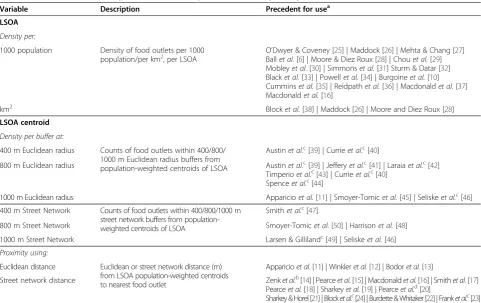
to reflect the range or‘intensity’of any given food outlet type, in terms of the number of food outlets present around an individual [6,7]. Food outlet proximity is usu-ally the distance to the nearest food outlet, with distance inversely related to utilisation [8,9]. Charreire et al. [4] systematically demonstrated the pervasiveness of density and proximity metrics in the published literature. How-ever, the substantive differences between density and proximity metrics, beyond their theoretical distinction, are under-studied. Do areas with high food outlet dens-ity always offer residents food outlets at a closer proxim-ity? Could ensuing analyses be simplified by using only one foodscape exposure metric? Two previous studies have concluded that both measures “tell a consistent story about food access”[9,10], questioning the extent to which both measures are necessary, considering the ef-fort required to compute multiple metrics and the prob-lems associated with covariance in later analyses; more research is required to better understand this issue.
Moreover, precise definitions of density and proximity vary between studies. For example, when evaluating prox-imity, studies have used straight line (Euclidean) distance [11-13], or street network distance to the nearest food outlet [14-24], which in reality may be very different distances. Despite this, only one US study has addressed differences in food outlet proximity estimates when using either street network or Euclidean approaches [9]; no international comparison has been provided in the litera-ture to date. Other common approaches to estimating food outlet access include: studies using food outlet dens-ity per head of population [6,10,16,25-37], whilst others, density per square unit of area [26,28,38]; all of these stu-dies have calculated exposure within some previously de-fined administrative boundary (census tracts, electoral wards and so on), whereas others have chosen to use GIS to buffer study participants [39-49], or where these loca-tions are unknown, the centroids of these administrative areas (geographic- or population-weighted) [11], creating
‘neighbourhoods’at a range of spatial scales (for example 400/800/1000), which here we proprietarily refer to as
‘pseudo-individual’ neighbourhoods; using the latter ap-proach, or again the exact locations of study participants, both Euclidean [11,39-45], and street network based defi-nitions of neighbourhood have been employed [49,50]. Table 1 gives more detail about these common approaches to estimating food outlet access, but a recent methodo-logical review comprehensively described the wide range of approaches to calculating density and proximity taken in the literature [4], including others, such as novel inverse distance weighting (IDW) approaches to calculating food access [48], that have been used less frequently in the literature to date. This methodological heterogeneity is potentially problematic, yet the extent to which it may contribute to a lack of comparability between foodscape
research findings is unknown. A methodologically hetero-geneous evidence-base is often simply the bi-product of development within a science over time, and may not be associated with grave implications for inter-study compar-ability. However, it is nonetheless important to continue to work to understand the possible consequences of this evolution. Recent studies have begun to employ multiple metrics of foodscape exposure, and have considered the implications of methodological nuance between types of density metrics and between types of proximity metrics [9,39,40,51]. However direct comparisons of metrics were either not made or the range of metrics assessed was lim-ited. In one study [9], the two density metrics compared represent only two of the many methodological options available for objectively capturing food outlet exposure. A more comprehensive comparison of types of density and proximity metrics is required in order to understand what implications our methodological choices have in deter-mining estimates of geographic access to food outlets.
Our study used GIS to compute a range of commonly employed foodscape density and proximity metrics in the North East of England, UK. The research had two principle aims. Firstly, to compare food outlet density and proximity metrics to one another using correlation ana-lysis. Secondly, to compare different metrics of density and proximity in a sensitivity analysis, to determine whether methodological differences in the calculation of each type of metric might serve to limit comparability between existing research findings. Comparisons made were as follows: 1) administrative area density per 1000 population vs. administrative area density per km2; 2) ad-ministrative area densities vs. 400/800/1000 m ‘ pseudo-individual’ densities; 3) 400/800/1000 m‘pseudo-individual’ densities, when using either Euclidean vs. street network buffers; 4) Euclidean vs. street network measures of prox-imity from population-weighted LSOA centroids. These four binaries of methodological comparison represent common-sense comparisons, and have been suggested as necessary in empirical work and systematic reviews in the literature [4,11,51-53].
Methods
The study area for this research was the former North East Government Office Region, UK, an environmentally heterogeneous area covering 8676 km2. Locations of food outlets (n = 14,454) were sourced from local councils (n = 23) under Freedom of Information (FOI) requests (for more details on the FOI Act 2000, see http://www.legisla-tion.gov.uk/ukpga/2000/36/data.pdf). This data represents the most accurate secondary source of food outlet location data in the UK [54,55]. Food outlets were categorised into
For brevity, only the geographies of ‘Food Bought Out of the Home’ outlets were considered in this study (‘supermarkets’,‘convenience’,‘discount’and‘department’ stores, plus ‘specialist’retailers (butchers, delicatessens, bakers, fishmongers, confectioners, greengrocers, health, organic, fair trade, artisan, sweet and oriental stores)); results not presented showed no differences in findings when analysing ‘Food Consumed Out of the Home’ outlets (‘restaurants’,‘pubs’, pizzerias’,‘fast food’,‘cafés’/ coffee shops’,‘takeaways’,‘sandwich shops’,‘bakers – re-tail’,‘hotels’,‘entertainment’,‘health and leisure’,‘novelty stores’ and ‘pharmacies’). Using lookup tables from GeoConvert (http://geoconvert.mimas.ac.uk/), food out-let locations were mapped based on their postcodes using ArcGIS 9.3 (ESRI Inc., Redlands, CA). Recent pre-cedent has been set in the literature for geocoding at the postcode level in the UK [47].
Details of the exposure metrics deduced are shown in Table 1 (the‘Variable’column). Neighbourhood densities of food outlets were calculated per 1000 population (popula-tion data from the 2001 UK census) and per km2within Lower Super Output Areas (LSOAs); these are small ad-ministrative areas (median size 0.49 km2), each containing roughly 1500 residents (available from UKBORDERS, http://
edina.ac.uk/census/). Densities (counts of food outlets) were also calculated within 400m, 800m and 1000m Euclidean and street network buffers from the population-weighted centroids of LSOAs. We refer to these buffered LSOA centroids as‘pseudo-individual’neighbourhoods on the assumption that food access at this calculated location is representative of the rest of the LSOA. Street network data were provided by Ordnance Survey as part of their MasterMap Integrated Transport Network (ITN). Proxim-ity, Euclidean and street network distance to the nearest food outlet, was also calculated from these population-weighted centroids. Precedent for the frequent use of each metric, is also shown in Table 1, informed by recent sys-tematic review articles [4,52,53,58], which should be re-ferred to for acomprehensivereview of the literature. The metrics compared and contrasted in this study represent those that have been widely employed in obesogenic en-vironment studies to date.
Statistical analysis
Analyses were performed throughout using SPSS 17.0 (SPSS Inc., Chicago, 2006). Descriptive statistics (medians, interquartile ranges, and ranges) for our environmental metrics are presented first. As our exposure metrics were
Table 1 Food environment exposure metrics compared in this study, and precedent for their use in the literature
Variable Description Precedent for usea
LSOA
Density per:
1000 population Density of food outlets per 1000
population/per km2, per LSOA OBall’Dwyer & Coveney [25] | Maddock [26] | Mehta & Chang [27]et al.[6] | Moore & Diez Roux [28] | Chouet al.[29] Mobleyet al.[30] | Simmonset al.[31] Sturm & Datar [32] Blacket al.[33] | Powellet al.[34] | Burgoineet al.[10] Cumminset al.[35] | Reidpathet al.[36] | Macdonaldet al.[37] Macdonaldet al.[16]
km2 Blocket al.[38] | Maddock [26] | Moore and Diez Roux [28]
LSOA centroid
Density per buffer at:
400 m Euclidean radius Counts of food outlets within 400/800/ 1000 m Euclidean radius buffers from population-weighted centroids of LSOA
Austinet al.c[39] | Currieet al.c[40]
800 m Euclidean radius Austinet al.c[39] | Jefferyet al.c[41] | Laraiaet al.c[42] Timperioet al.c[43] | Currieet al.c[40]
Spenceet al.c[44]
1000 m Euclidean radius Apparicioet al.[11] | Smoyer-Tomicet al.[45] | Seliskeet al.c[46] 400 m Street Network Counts of food outlets within 400/800/1000 m
street network buffers from population-weighted centroids of LSOA
Smithet al.c[47]
800 m Street Network Smoyer-Tomicet al.[50] | Harrisonet al.[48]
1000 m Street Network Larsen & Gillilandc[49] | Seliskeet al.[46] Proximity using:
Euclidean distance Euclidean or street network distance (m) from LSOA population-weighted centroids to nearest food outlet
Apparicioet al.[11] | Winkleret al.[12] | Bodoret al.[13]
Street network distance Zenket al.b[14] | Pearceet al.[15] | Macdonaldet al.[16] | Smithet al.[17] Pearceet al.[18] | Sharkeyet al.[19] | Pearceet al.d[20]
Sharkey & Horel [21] | Blocket al.c[24] | Burdette & Whitaker [22] | Franket al.c[23]
a
Methodologically similar, not necessarily using LSOAs; using imperial or metric measurements; geographic- or population-weighted centroids.
b
Manhattan block distance used as an alternative to street network distance.
c
Buffer sizes employed around known home or school address.
d
continuous variables, differencesbetweendensity and prox-imity metrics, andwithintypes of density and types of prox-imity metrics were assessed using correlation analyses. We used Spearman’s rank correlations because the vast ma-jority of our access metrics were not normally distributed, with their distributions tending to be positively skewed. When comparing density and proximity metrics directly, we present the inverse of the correlation co-efficient obtained. As higher proximity values actually relate to greater distances (worse access to the food outlet), this al-lows, for example, a positive co-efficient to be interpreted as greater density allied with greater proximity (less distance).
Results
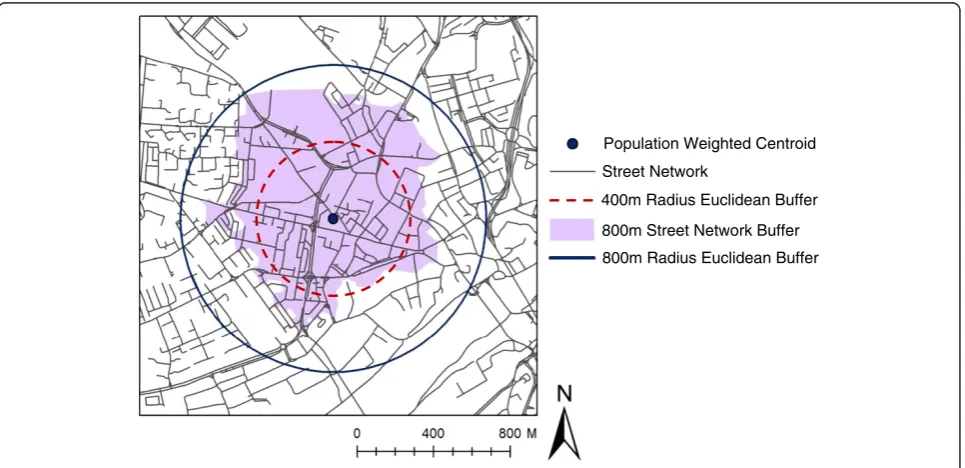
Descriptive statistics for the exposure metrics created are shown in Table 2. The median number of food out-lets per 1000 population was 0.8, whilst the median number per km2was 2.0. There was a linear increase in median access as neighbourhood buffer sizes increased, as expected, and more so for Euclidean than street net-work buffers (which tend to be smaller, as illustrated in Figure 1). Median Euclidean distance to the nearest food bought out of the home outlet was 239.8 m, but 398.8 m when constrained to the street network, and with a much greater range.
Density compared to proximity
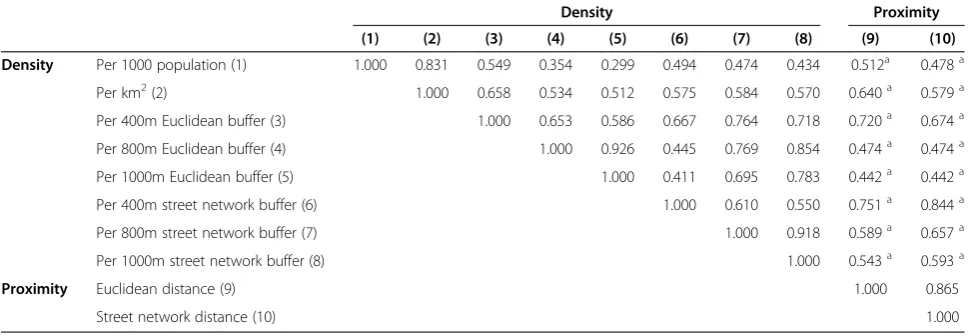
This section compares food outlet density and proximity measures throughout the study area. Table 3 shows Spearman’s rank correlations between density and prox-imity exposure metrics (all p < 0.001). Two salient trends emerged: 1) relationships within categories of density/ proximity were moderately to strongly correlated in uni-form directions (co-efficients ranging between 0.299 and 0.926 for density metrics (mean rs= 0.615); 0.865 for the
relationship between proximity metrics); 2) relationships
between categories of density/proximity were also simi-lar, with co-efficients having positive signs (i.e. all mea-sures of density are moderate to strongly positively correlated with measures of proximity, and vice versa).
Heterogeneity within exposure metrics
This section examines the extent to which methodological heterogeneity within exposure metrics may impact upon comparability between findings in the literature to date. We make four necessary comparisons, as outlined in the aims.
Density per 1000 population vs. density per km2
Correlation analysis (Table 3) showed that whether LSOA density of ‘Food Bought-’ outlets is calculated per 1000 population or per km2, both measures were correlated very strongly (rs= 0.831, p < 0.001) giving similar
impres-sions of food access throughout the study area.
Area level vs. 400/800/1000m‘pseudo-individual’level density
Table 3 showed that only moderate/moderately-strong correlations existed between area level and‘ pseudo-indi-vidual’level metrics, ranging between rs= 0.299 and rs=
0.658. Whilst they are all significant (p < 0.001) and in the same positive direction, these correlations suggest that we could be less sure of comparing results across studies that utilise these different approaches. The specific degree to which this statement holds true was attenuated by the metric examined: area and ‘ pseudo-individual’ metrics were more comparable at smaller Euclidean and street network buffer distances, largely decreasing in strength at 800m, and further still at 1000m. The more nuanced street network buffers of
‘pseudo-individual’density were largely more comparable with area level metrics, however, the 400m Euclidean buf-fer was the most similar (rs= 0.549 for LSOA density per
1000 population, rs= 0.658 for LSOA density per km2,
both p < 0.001).
Street network vs. Euclidean 400/800/1000m‘ pseudo-individual’level density
Correlation results (Table 3) showed that levels of‘ pseudo-individual’density were similar whether using a Euclidean or street network approach (at the same distance), and in-creasingly so when accounting for larger neighbourhoods (400m rs= 0.667; 800m rs= 0.769; 1000m rs= 0.783, all p
< 0.001). 400m Euclidean neighbourhood densities were however more strongly correlated with 800m street net-work densities (rs= 0.764), and 800m Euclidean densities
with 1000m street network densities (rs= 0.854).
Street network vs. Euclidean proximity
Results presented in Table 3 showed that ‘Food Bought-’ proximity was comparable when assessed via Euclidean and street network distances (rs= 0.865, p < 0.001). Much
like the similarity displayed between Euclidean and street network ‘pseudo-individual’ neighbourhoods, this finding suggested that there was a substantial degree of compar-ability between the two metrics.
Discussion
employ only a single, representative metric of foodscape exposure. Indeed, correlation analyses presented here pro-vided tentative evidence that these measures represent the foodscape in very similar ways, suggesting that neigh-bourhoods with high food outlet density were also those where residents live within closer proximity to food, supporting previous findings [9,10]. However, this study does not represent definitive evidence that this is always the case, and opposite results have been observed [11]. Furthermore, although incidental, at the very least each measure may be susceptible to a different level of meas-urement error [59]. For example, where food outlet loca-tion data is not totally comprehensive, measures of food outlet density may be more prone to error (systematic underestimation of exposure) than measures of proximity (which, by chance, may remain completely accurate).
Secondly, this paper evaluated the extent to which methodological heterogeneity in calculating an exposure metric (density or proximity) contributes to a lack of inter-study comparability in findings. To some extent, re-sults here suggested that such criticisms may be unfounded: measures of proximity from population-weighted centroids were highly correlated when using Euclidean or street network distance, corroborating findings from the only one comparable previous US study [9]. In addition, measures of
‘pseudo-individual’ density using Euclidean or street net-work distances were nearly equal at similar geographical scales, as has also been found elsewhere [51,60], whilst be-coming more similar at greater distances. Buffer distances beyond 1000m have been used in the literature [6,11,12,25] and we could therefore expect even greater convergence. This said, there was evidence to suggest that Euclidean
Table 2 Descriptive statistics for exposure metrics across administrative areas (n = 1656)
Median Interquartile range Minimum Maximum
Density Per 1000 population 0.8 0.0-2.0 0.0 35.0
Per km2 2.0 0.0-6.2 0.0 105.4
Per 400m Euclidean buffer 2.0 1.0-4.0 0.0 40.0
Per 800m Euclidean buffer 7.0 3.0-12.0 0.0 81.0
Per 1000m Euclidean buffer 10.0 5.0-18.0 0.0 94.0
Per 400m street network buffer 0.0 0.0-2.0 0.0 34.0
Per 800m street network buffer 3.0 1.0-6.0 0.0 63.0
Per 1000m street network buffer 4.0 2.0-9.0 0.0 80.0
Proximity Euclidean distance 239.8 141.6-379.7 6.1 8535.4
Street network distance 398.8 229.8-652.2 0.2 17886.4
400m Radius Euclidean Buffer Street Network
Population Weighted Centroid
800m Street Network Buffer
800m Radius Euclidean Buffer
buffers were most comparable to marginally larger street network buffers: 400m Euclidean buffers most strongly cor-related with 800m street network buffers and 800m Euclidean buffers most strongly correlated with 1000m street network buffers, confirming similar results from Thorntonet al.[51]. This is likely to be because in general, Euclidean buffers result in a larger footprint, thus encapsu-lating more food stores, as illustrated in Figure 1. Statistical investigations also reported density per km2and per 1000 population to be similar, inviting comparability across this methodological binary.
Measures of density at the area or ‘pseudo-individual’ level were only moderately correlated with one another, suggesting a limited extent to which findings across this divide should be compared. Unfortunately, this divide across metrics at the area or ‘pseudo-individual’ level separates two large bodies of academic work (Table 1), where studies have either located individuals within ad-ministrative area neighbourhoods, or created bespoke neighbourhood buffers around said individuals. Therefore, it may be of benefit to the field if a single (area or
‘pseudo-individual’) density metric were to be used in fu-ture research to maximise inter-study comparability, wherever possible. At the very least, studies should con-sider providing a rationale for their preference of approach to density calculation, whilst better and more fully ac-knowledging the assumptions and limitations inherent to either choice.
Beyond implying comparability across studies then, re-sults suggest that there may only be small gains made from using street network distances for measures of
‘pseudo-individual’ density or proximity. This may be important when time or resources are at a premium or where street network data is unavailable. However, we dis-agree with Sparkset al.[9] who conclude that this equates
to a reduced“computational burden on those wishing to use GIS methodology” –from which we infer that through not having to use more complex street network data, the usability of GIS methods is increased. It is argued here that there is a‘tipping point’, where the value of using in-creasingly detailed metrics begins to diminish in relation to the computational effort required to create them. How-ever, as we know little of this‘tipping point, and we should be’ mindful of scale differences (calculating street network avail-ability may be more critical at 400m radii than 1000m radii, for example), we should always try to do the best that we can, even when confronted with technological challenges.
We argue here that we need to further consider how we can advance our methods and our metrics of exposure in objective studies of obesogenic food environments. Some studies have already sought to use measures of variety in relation to the food environment [6,11,32]; for example, the ratio of fast food to full service restaurants [32], designed to complement measures of density and proxim-ity. Others have begun to use inverse distance weighted (IDW) measures of facility access, which to some extent ameliorate concerns arising over the relatively arbitrary definitions of ‘neighbourhood’applied throughout the lit-erature [48]. In reality however, it may never be possible, or even appropriate, to reach a point where even a well-conceived measure of food access can become a universal standard, suitable for use across all studies, as has been tentatively suggested [61]. Other methodological differ-ences between studies – in statistical techniques, or in terms of study populations and their characteristics, which might vary between countries for example, and so on – ensure that two studies will rarely, if ever, be completely comparable to one another. This does not detract however from the importance of attempting to understand the im-plications of such diversity, which is what we have begun
Table 3 Spearman’s rank correlations between LSOA (n = 1656) density and proximity measures*
Density Proximity
(1) (2) (3) (4) (5) (6) (7) (8) (9) (10)
Density Per 1000 population (1) 1.000 0.831 0.549 0.354 0.299 0.494 0.474 0.434 0.512a 0.478a
Per km2(2) 1.000 0.658 0.534 0.512 0.575 0.584 0.570 0.640a 0.579a
Per 400m Euclidean buffer (3) 1.000 0.653 0.586 0.667 0.764 0.718 0.720a 0.674a
Per 800m Euclidean buffer (4) 1.000 0.926 0.445 0.769 0.854 0.474a 0.474a
Per 1000m Euclidean buffer (5) 1.000 0.411 0.695 0.783 0.442a 0.442a
Per 400m street network buffer (6) 1.000 0.610 0.550 0.751a 0.844a
Per 800m street network buffer (7) 1.000 0.918 0.589a 0.657a
Per 1000m street network buffer (8) 1.000 0.543a 0.593a
Proximity Euclidean distance (9) 1.000 0.865
Street network distance (10) 1.000
* All results p < 0.001.
a
to address here. A valid and reliable research evidence base, where differences in study findings can be fully understood and appreciated with respect to the methods used, from which conclusions about neighbourhood level effects on diet can be accurately drawn, will be absolutely critical in justifying neighbourhood interventions or pilot interventions designed to promote health, such as restric-ting the clustering of unhealthy food retailers.
This paper has a number of limitations. In this study we did not compare all foodscape metrics employed in the field to date; instead, we focused on many of the most commonly used metrics in order to relate to as much of the field as possible. Also, we did not investi-gate the entire foodscape here; different relationships may have been found for ‘Food Consumed Out of the Home’ outlets, although work not presented suggests this is not the case. There is also little compelling logic to suggest that the relationships tested here might be systematically biased according to the type of food outlet selected for study. Furthermore, the category of ‘Food Bought Out of the Home’ includes outlet types such as
‘supermarkets’ and ‘convenience stores’, density and proximity of which are frequently assessed in the litera-ture. We did not have access to data on the exact loca-tions of participants in this study, hence measures of proximity and some measures of density were calculated from administrative area population-weighted centroids, where we assumed at least one individual to live. This is an approach adopted in the literature where participant location data has not been available [11,20], however we acknowledge that this could constitute a type of ‘ errors-in-variables’ bias and that exposure throughout any given administrative area will vary [62], and would be likely to decrease away from population-weighted centroids. Our approach of using population-weighted centroids was at least consistent between areas. External validity in findings cannot be assumed, and we cannot rule out that results here may be particular to the North East of England, despite the large and heterogeneous study area, and the similarities between the study area and many other regions of the UK, notably in terms of its diverse socio-economic profile, with which we know foodscape exposure varies [15,35,37]. Lastly, we acknowledge that a greater density or proximity of food does not necessarily equate to more utilisation of these facilities. Consider-ations such as transport preferences, motivation to walk, economic factors, neighbourhood perceptions and so on will all contribute broadly to ‘access’ beyond purely a geographic perspective. We know for example that in Newcastle upon Tyne, in the North East of England, adults conducting their main supermarket shop on foot travel a median distance one-way of 510 m, as compared to 2528 m for those with access to a car [63]. It is also worth considering that the vast majority of food
environment exposure studies have tended to focus exclu-sively on residential neighbourhood exposure, despite the apparent necessity of accounting for time spent in wider
‘activity spaces’ [64], too. This said, our study compared foodscape metrics that are widely used in the field, render-ing this research highly relevant, regardless of whether these previous studies conceived of access in a purely spatial sense or otherwise.
Conclusions
Our findings should be viewed in the context of creating different ‘obesogenic realities’during the research design and analysis process. Despite occasional assertions to the objectivity of the “scientific approach”, quantitative re-searchers are‘critical agents’in the GIS process [65,66], and are required throughout their research to make a myriad of choices; the potential for these choices to impact upon re-sults has been suggested elsewhere [67], and demonstrated to some extent here. In this way we create our own obesogenic realities and we should remain reflexive to-wards, and critical of these creations, in order to improve results and to chart a course for better future research.‘ Re-searcher bias’has been well discussed in qualitative litera-tures, where data is often seen as being‘generated’rather than‘collected’as a reflection of the investigator’s input into the research process [68,69]. Such issues of bias are less fre-quently discussed in quantitative discourse, particularly in relation to GIS, despite their apparent poignancy, although feminist critiques of GIS amongst others seek to increas-ingly understand the“exclusions, silences, and marginaliz-ing [sic] power of our representations” [70-72]. Objective GIS studies are often based on the notion of‘technological determinism’[65,69], yet the extent to which this is possible is arguably limited. Leszczynski [73] warns against commit-ting the‘ontic fallacy’, whereby we unquestioningly accept our representation of reality to “mirror nature”, and through failing to acknowledge the impact of the choices we make as researchers on the results we obtain, we risk falling into the ontological trap of what can truly be known. This paper demonstrates the need for such concern by con-trasting an extensive range of environmental metrics and demonstrating that at least in some instances, the choices that we make do matter.
evidence in obesogenic environment research, by dem-onstrating that heterogeneity between most exposure metrics is not necessarily problematic.
Competing interests
The authors declare they have no competing interests.
Authors’contributions
The study design was jointly devised by TB, SA and AL. TB was responsible for data collection, and led on data analysis, in consultation with SA and AL. TB drafted the manuscript. All authors read and approved the final manuscript.
Acknowledgements
The data collection for this work was partly supported by an Economic and Social Research Council quota PhD studentship [ES/F021976/1]. The data analysis was undertaken by the Centre for Diet and Activity Research (CEDAR), a UK Clinical Research Collaboration (UKCRC) Public Health Research Centre of Excellence. Funding from the British Heart Foundation, Economic and Social Research Council, Medical Research Council, the National Institute for Health Research and the Wellcome Trust under the auspices of the UK Clinical Research Collaboration, is gratefully acknowledged. The digital maps used hold Crown Copyright from EDINA Digimap, a JISC supplied service. We are grateful to local councils throughout the study area for kindly supplying data to enable this work and to Ordnance Survey for supplying their MasterMap Integrated Transport Network (ITN) data.
Author details
1UKCRC Centre for Diet and Activity Research (CEDAR), Box 296, Institute of Public Health, Forvie Site, Robinson Way, University of Cambridge, Cambridge CB2 0SR, UK.2Geography and the Built Environment, Ellison Building, Northumbria University, Newcastle upon Tyne NE1 8ST, UK.3Centre for Public Policy and Health, School of Medicine, Pharmacy and Health, Wolfson Research Institute, Queen’s Campus, Thornaby, Durham University, Stockton-on-Tees TS17 6BH, UK.
Received: 23 April 2013 Accepted: 23 June 2013 Published: 2 July 2013
References
1. Egger G, Swinburn B:An‘ecological approach' to the obesity pandemic. British Med J1997,315:477–480.
2. Lake AA, Townshend T:Obesogenic environments: exploring the built and food environment.Perspect Pub Health2006,126:262–267. 3. Townshend T, Lake AA:Obesogenic urban form: theory, policy and
practice.Health Place2009,15:909–916.
4. Charreire H, Casey R, Salze P, Simon C, Chaix B, Banos A, Badariotti D, Weber C, Oppert J-M:Measuring the food environment using geographical information systems: a methodological review.Pub Health Nutr2010, 13:1773–1785.
5. Brownson RC, Hoehner CM, Day K, Forsyth A, Sallis JF:Measuring the built environment for physical activity: state of the science.Am J Prevent Med 2009,36:S99–S123.
6. Ball K, Timperio A, Crawford D:Neighbourhood socioeconomic inequalities in food access and affordability.Health Place2009,15:578–585.
7. Thornton LE, Pearce JR, Kavanagh AM:Using geographic information systems (GIS) to assess the role of the built environment in influencing obesity: a glossary.Int J Behavior Nutr Physic Act2011,8:1–9.
8. Van Meter EM, Lawson AB, Colabianchi N, Nichols M, Hibbert J, Porter DE, Liese AD:An evaluation of edge effects in nutritional accessibility and availability measures: a simulation study.Int J Health Geograph2010,9:1–30.
9. Sparks AL, Bania N, Leete L:Comparative approaches to measuring food access in urban areas: the case of Portland, Oregon.Urban Studies2011, 48:1715–1737.
10. Burgoine T, Alvanides S, Lake AA:Assessing the obesogenic environment of North East England.Health Place2011,17:738–747.
11. Apparicio P, Cloutier M-S, Shearmur R:The case of Montreal's missing food deserts: evaluation of accessibility to food supermarkets.Int J Health Geograph2007,6:1–13.
12. Winkler E, Turrell G, Patterson C:Does living in a disadvantaged area mean fewer opportunities to purchase fresh fruit and vegetables in the area? Findings from the Brisbane food study.Health Place2006,12:306–319. 13. Bodor JN, Rose D, Farley TA, Swalm C, Scott SK:Neighbourhood fruit and
vegetable availability and consumption: the role of small food stores in an urban environment.Pub Health Nutr2007,11:413–420.
14. Zenk SN, Schultz AJ, Israel BA, James SA, Bao S, Wilson ML:Neighbourhood racial composition, neighbourhood poverty, and the spatial accessibility of supermarkets in metropolitan Detroit.Am J Pub Health2005,95:660–667. 15. Pearce J, Blakely T, Witten K, Bartie P:Neighbourhood deprivation and
access to fast-food retailing: a national study.Am J Prevent Med2007, 32:375–382.
16. Macdonald L, Ellaway A, Macintyre S:The food retail environment and area deprivation in Glasgow City, UK.Int J Behavior Nutr Physic Act2009, 6:1–7.
17. Smith D, Cummins S, Taylor M, Dawson J, Marshall D, Sparks L, Anderson AS:Neighbourhood food environment and area deprivation: spatial accessibility to grocery stores selling fresh fruit and vegetables in urban and rural settings.Int J Epidemiol2009,39:277–284.
18. Pearce J, Hiscock R, Blakely T, Witten K:The contextual effects of neighbourhood access to supermarkets and convenience stores on individual fruit and vegetable consumption.J Epidemiol Comm Health 2008,62:198–201.
19. Sharkey JR, Horel S, Han D, Huber JC Jr:Association between neighborhood need and spatial access to food stores and fast food restaurants in neighborhoods of Colonias.Int J Health Geograph2009,8:1–17.
20. Pearce J, Witten K, Bartie P:Neighbourhoods and health: a GIS approach to measuring community resource accessibility.J Epidemiol Comm Health 2006,60:389–395.
21. Sharkey JR, Horel S:Neighbourhood socioeconomic deprivation and minority composition are associated with better potential spatial access to the ground-truthed food environment in a large rural area.J Nutr 2008,138:620–627.
22. Burdette HL, Whitaker RC:Neighbourhood playgrounds, fast-food restaurants, and crime: relationships to overweight in low-income preschool children.Prevent Med2004,38:57–63.
23. Frank LD, Glanz K, McCarron M, Sallis J, Saelens B, Chapman J:The spatial distribution of food outlet type and quality around schools in differing built environment and demographic contexts.Berkeley Plann J2006,19:79–95. 24. Block JP, Christakis NA, O'Malley AJ, Subramanian SV:Proximity to food
establishments and body mass index in the Framingham Heart Study offspring cohort over 30 years.Am J Epidemiol2011,174:1108–1114. 25. O'Dwyer LA, Coveney J:Scoping supermarket availability and accessibility by
socio-economic status in Adelaide.Health Promo J Australia2006,17:240–246. 26. Maddock J:The relationship between obesity and the prevalence of fast
food restaurants: state-level analysis.Am J Health Promo2004,19:137–143. 27. Mehta NK, Chang VW:Weight status and restaurant availability: a
multilevel analysis.Am J Prevent Medi2008,34:127–133.
28. Moore LV, Diez-Roux AV:Associations of neighbourhood characteristics with the location and type of food stores.Am J Pub Health2006,96:325–331. 29. Chou S-Y, Grossman M, Saffer H:An economic analysis of adult obesity:
results from the Behavioural Risk Factor Surveillance System.J Health Econ2004,23:565–587.
30. Mobley LR, Root ED, Finkelstein EA, Khavjou O, Farris RP, Will JC: Environment, obesity, and cardiovascular disease risk in low-income women.Am J Prevent Med2006,30:327–332.
31. Simmons D, McKenzie A, Eaton S, Cox N, Khan MA, Shaw MA, Zimmet P: Choice and availability of takeaway and restaurant food is not related to the prevalence of adult obesity in rural communities in Australia. Int J Obes2005,29:703–710.
32. Sturm R, Datar A:Body mass index in elementary school children, metropolitan area food prices and food outlet density.Public Health2005, 119:1059–1068.
33. Black JL, Macinko J, Dixon LB, Fryer GE Jr:Neighbourhoods and obesity in New York City.Health Place2010,16:489–499.
34. Powell LM, Auld C, Chaloupka FJ, O'Malley PM, Johnston LD:Association between access to food stores and adolescent body mass index. Am J Prevent Med2007,33:S301–S307.
36. Reidpath DD, Burns C, Garrard J, Mahoney M, Townsend M:An ecological study of the relationship between social and environmental determinants of obesity.Health Place2002,8:141–145. 37. Macdonald L, Cummins S, Macintyre S:Neighbourhood fast food
environment and area deprivation - substitution or concentration? Appetite2007,49:251–254.
38. Block JP, Scribner RA, Desalvo KB:Fast food, race/ethnicity, and income: a geographic analysis.Am J Prevent Med2004,27:211–217.
39. Austin SB, Melly SJ, Sanchez BN, Patel A, Buka S, Gortmaker SL:Clustering of fast-food restaurants around schools: a novel application of spatial statistics to the study of food environments.Am J Pub Health2005, 95:1575–1581.
40. Currie J, Della Vigna S, Moretti E, Pathania V:The effect of fast food restaurants on obesity.American Association of Wine Economists.Working Paper; 2009.
41. Jeffery RW, Baxter J, McGuire M, Linde J:Are fast food restaurants an environmental risk factor for obesity?Int J Behavior Nutr Physic Act2006,3:1–6. 42. Laraia BA, Siega-Riz AM, Kaufman JS, Jones SJ:Proximity of supermarkets is
positively associated with diet quality index for pregnancy.Prevent Med 2004,39:869–875.
43. Timperio A, Ball K, Roberts R, Campbell K, Andrianopoulos N, Crawford D: Children's fruit and vegetable intake: associations with the
neighbourhood food environment.Prevent Med2008,46:331–335. 44. Spence JC, Cutumisu N, Edwards J, Raine KD, Smoyer-Tomic K:Relation
between local food environments and obesity among adults.BMC Public Health2009,9:1–6.
45. Smoyer-Tomic KE, Spence JC, Amrhein C:Food deserts in the prairies? Supermarket accessibility and neighbourhood need in Edmonton, Canada.Profession Geograph2006,58:307–326.
46. Seliske L, Pickett W, Rosu A, Janssen I:The number and type of food retailers surrounding schools and their association with lunctime eating behaviours in students.Int J Behavior Nutr Physic Act2013,10:1–9. 47. Smith D, Cummins S, Clark C, Stansfeld S:Does the local food
environment around schools affect diet? Longitudinal associations in adolescents attending secondary schools in East London.BMC Public Health2013,13:1–10.
48. Harrison F, Jones AP, van Sluijs EMF, Cassidy A, Bentham G, Griffin SJ: Environmental correlates of adiposity in 9-10 year old children: considering home and school neighbourhoods and routes to school. Soc Sci Med2011,72:1411–1419.
49. Larsen K, Gilliland J:Mapping the evolution of 'food deserts' in a Canadian city: Supermarket accessibility in London, Ontario, 1961-2005. Int J Health Geograph2008,7:16–32.
50. Smoyer-Tomic KE, Spence JC, Raine KD, Amrhein C, Cameron N, Yesonovskiy V, Cutumisu N, Hemphill E, Healy J:The association between neighbourhood socioeconomic status and exposure to supermarkets and fast food outlets.Health Place2008,14:740–754.
51. Thornton LE, Pearce JR, Macdonald L, Lamb KE, Ellaway A:Does the choice of neighbourhood supermarket access measure influence associations with individual-level fruit and vegetable consumption? A case study from Glasgow.Int J Health Geograph2012,11:1–12.
52. Black JL, Macinko J:Neighbourhoods and obesity.Nutrition Rev2008,66:2–20. 53. Feng J, Glass TA, Curriero FC, Stewart WF, Schwartz BS:The built
environment and obesity: a systematic review of the epidemiologic evidence.Health Place2010,16:175–190.
54. Lake AA, Burgoine T, Greenhalgh F, Stamp E, Tyrrell R:The foodscape: classification and field validation of secondary data sources.Health Place 2010,16:666–673.
55. Lake AA, Burgoine T, Stamp E, Grieve R:The foodscape: classification and field validation of secondary data sources across urban/rural and socio-economic classifications.Int J Behavior Nutr Physic Act2012,9:3–12. 56. Cummins S, Macintyre S:Food environments and obesity
-neighbourhood or nation?Int J Epidemiol2006,35:100–104.
57. Burgoine T:Collecting accurate secondary foodscape data: a reflection on the trials and tribulations.Appetite2010,55:522–527.
58. Caspi CE, Sorensen G, Subramanian SV, Kawachi I:The local food
environment and diet: a systematic review.Health Place2012,18:1172–1187. 59. Moore LV, Diez-Roux AV, Nettleton JA, Jacobs DR:Associations of the local
food environment with diet quality - a comparison of assessments based on surveys and geographic information systems.Am J Epidemiol 2008,167:917–924.
60. Boone-Heinonen J, Gordon-Larsen P, Kiefe CI, Shikany JM, Lewis CE, Popkin BM:Fast food restaurants and food stores: longitudinal associations with diet in young to middle-aged adults: the CARDIA Study.Arch Int Med 2011,171:1162–1170.
61. Forsyth A, Schmitz KH, Oakes M, Zimmerman J, Koepp J:Standards for environmental measurement using GIS: toward a protocol for protocols. J Physic Act Health2006,3:241–257.
62. Fortney J, Rost K, Warren J:Comparing alternative methods of measuring geographic access to health services.Health Serv Outcomes Res Methodol 2000,1:173–184.
63. White M, Bunting J, Williams L, Raybould S, Adamson A, Mathers J:Do 'food deserts' exist? A multi-level, geographical analysis of the relationship between retail food access, socio-economic position and dietary intake.Final Report to the Food Standards Agency;2004.
64. Kestens Y, Lebel A, Daniel M, Thériault M, Pampalon R:Using experienced activity spaces to measure foodscape exposure.Health Place2010, 16:1094–1103.
65. Kwan M-P:Is GIS for women? Reflections of the critical discourse in the 1990s.Gender Place Culture2002,9:271–279.
66. Chrisman N:Full circle: more than just social implications of GIS. Cartographica: Int J Geograph Info Geovisual2005,40:23–35. 67. Caspi CE, Kawachi I, Subramanian SV, Adamkiewicz G, Sorensen G:The
relationship between diet and perceived and objective access to supermarkets among low-income housing residents.Soc Sci Med2012, 75:1254–1262.
68. Mason J:Qualitative researching.London: SAGE Publications Ltd; 1996. 69. Kvale S:Interviews: an introduction to qualitative research interviewing.
London: SAGE Publications Ltd; 1996.
70. Kwan M-P:Feminist visualisation: re-envisioning GIS as a method in feminist geographic research.Ann Assoc Am Geograph2002,92:645–661. 71. Rose G:Visual methodologies: an introduction to the interpretation of visual
materials.London: Sage; 2001.
72. Elwood S:Thinking outside the box: engaging critical geographic information systems theory, practice and politics in human geography. Geography Compass2010,4:45–60.
73. Leszczynski A:Poststructuralism and GIS: is there a 'disconnect'? Environ Plann D: Soc Space2009,27:581–602.
doi:10.1186/1476-072X-12-33
Cite this article as:Burgoineet al.:Creating‘obesogenic realities’; do our
methodological choices make a difference when measuring the food environment?International Journal of Health Geographics201312:33.
Submit your next manuscript to BioMed Central and take full advantage of:
• Convenient online submission
• Thorough peer review
• No space constraints or color figure charges
• Immediate publication on acceptance
• Inclusion in PubMed, CAS, Scopus and Google Scholar
• Research which is freely available for redistribution