CASE STUDY
Making complex interventions
work in low resource settings: developing
and applying a design focused implementation
approach to deliver mental health
through primary care in India
Rohit Ramaswamy
1,2†, Rahul Shidhaye
2,3*†and Sharmishtha Nanda
2Abstract
Background: Globally, there is a large treatment gap for people with mental disorders, and this gap is especially extreme in Low and Middle Income Countries. This gap can be potentially bridged by integrating evidenced based mental health interventions into primary care, but there is little knowledge about how to do this well, especially in countries with weak health systems. Research into the best implementation approaches is a priority, but in order to do so, it is first necessary to adapt implementation science principles and tools for mental health services in low resource settings.
Results: The frameworks that have been used to implement evidence-based behavioral health and health care interventions in High Income Countries do not directly apply to contexts where resources and processes for service delivery and support do not exist. We propose an implementation approach for low resource settings, called design-focused implementation, emphasizing the design of delivery systems using systematic design methods as precursor to implementation in severely resource constrained environments. This approach draws from existing literature in design thinking, quality implementation, improvement science and evaluation and we describe its use in creating the processes, organizations and the enabling environment for integration of mental health service delivery into primary care in India.
Conclusions: Design-focused implementation will be useful for guiding research and practice in closing the imple-mentation gap for a wide variety of complex interventions in low resource settings.
Keywords: Mental health, Primary care, Implementation science, Research, India
© The Author(s) 2018. This article is distributed under the terms of the Creative Commons Attribution 4.0 International License (http://creativecommons.org/licenses/by/4.0/), which permits unrestricted use, distribution, and reproduction in any medium, provided you give appropriate credit to the original author(s) and the source, provide a link to the Creative Commons license, and indicate if changes were made. The Creative Commons Public Domain Dedication waiver (http://creativecommons.org/ publicdomain/zero/1.0/) applies to the data made available in this article, unless otherwise stated.
Background and context
The first and second Lancet series on Global Men-tal Health [1, 2], World Health Organization’s (WHO) mhGAP Intervention Guidelines [3] and mhGAP inter-vention guide, version 2.0 [4], a series of papers published in PLoS Medicine [5], WHO-WONCA report on mental
health in primary health care [6] and the Disease Con-trol Priorities’ mental health volume [7], summarize the strong evidence base for integration of mental health ser-vices in primary care in Low and Middle Income Coun-tries (LMIC). Unfortunately there is a huge gap between what is known about the effectiveness of a range of phar-macological, psychological, and social interventions that can transform lives and enhance communities and what is provided to and experienced by individuals in primary care and community care settings [8]. There is little evi-dence that evievi-dence-based mental health treatments are
Open Access
*Correspondence: [email protected]
†Rohit Ramaswamy and Rahul Shidhaye contributed equally to this work 2 Public Health Foundation of India, New Delhi, India
either adopted or successfully implemented in primary care either in High Income Countries (HICs) [9] or in LMICs [10]. This is result of poor knowledge translation between those who generate evidence and those who are expected to use and apply it [11].
Our limited understanding of how best to deliver evi-dence-based interventions across the full range of exist-ing health systems and in the wide diversity of possible settings, serves as the major barrier to translate evidence into practice. The Institute Of Medicine report has pro-posed a five-step framework to bring evidence-based interventions into practice [12]. The first three steps involve evidence generation and synthesis activities such as efficacy and effectiveness research and the develop-ment of clinical guidelines. This has been the primary focus of mental health research over the years, and has resulted in the creation of guidelines such as WHO’s mhGAP for implementing evidence-based mental health interventions in LMICs. The last two steps of the IOM framework emphasize the creation of quality metrics to assist in the improvement of the quality of care and the development of methods for implementation in practice. This is the focus of the work described in this paper.
In this paper, we present the approach used by the PRIME (PRogramme for Improving Mental Health CarE) project in India to develop an implementation strategy to deliver mental health interventions through the dis-trict level primary health care system. PRIME, a research program consortium funded by UK aid aims to gener-ate evidence on the implementation and scaling up of integration of mental health services in primary care in Ethiopia, India, Nepal, South Africa and Uganda, ulti-mately to improve health, social and economic outcomes for individuals with depression, alcohol use disorder and psychosis [13]. In India, PRIME is implemented in the state of Madhya Pradesh through a three-way partner-ship involving the Ministry of Health, Government of Madhya Pradesh, Sangath (a Goa based NGO working in the sector of public mental health) and the Public Health Foundation of India. The details of the setting, baseline situational analysis focusing on broader policy environ-ment and overall program context for impleenviron-mentation are described elsewhere [14].
Implementation challenges in PRIME
PRIME project began as an implementation research effort to understand the best strategies for integrating WHO recommended mental health interventions into the Indian primary health care system. The situation analysis performed for PRIME and described elsewhere [14] brought to light the weakness of the health system in Madhya Pradesh. The infrastructure needed to deliver mental health services through the primary health care
system in our project area of Sehore district, which cov-ers an area of more than 2500 square miles and a popula-tion of 1.3 million was primarily non-existent, and even where something was in place, was non-functional. The entire district has four psychiatric beds in the general hospital (Sehore district hospital), one psychiatrist and one psychologist and no other trained mental health pro-fessional. The state of Madhya Pradesh, where Sehore is located, has no mental health policy or mental health care plan, and there was no possibility of availing of addi-tional government resources to implement the mental health program.
Need to design context‑specific implementation approach
The situational analysis revealed more than ever the need for the adoption of a systematic implementation approach. While there has been significant work in identifying commonly used implementation strategies for improv-ing adherence and sustainability of clinical programs and practice in the US [15], there is no analogous work in low resource settings. However, as we began reviewing the existing implementation science literature for commonly used models and frameworks that could apply to the Indian context, we found this to be a challenging endeavor. As described by Nilsen [16], the last decade has witnessed a significant increase in theories, frameworks and mod-els, but many of them provide limited support for how they could be used, especially in low resource settings. As part of our scan of existing frameworks, we reviewed both what Nilsen refers to as “process” and “determi-nant” frameworks. For process frameworks, we reviewed the Quality Implementation Framework developed by Meyer and his colleagues [17] and the Interactive Systems Framework (ISF) developed by Wandersman [18]. For determinant frameworks, we included National Imple-mentation Research Network’s (NIRN) Active Implemen-tation Frameworks [19], Damschroder’s Consolidated Framework for Implementation Research (CFIR) [20] and the UK Medical Research Council’s (MRC) framework for implementing complex interventions [21].
At the same time, it was also apparent that none of the frameworks were directly applicable to settings such as Madhya Pradesh, where, as evidenced by the results of the situational analysis, the systems in place are not strong enough to provide basic capacity for implementa-tion, and where resources are not available for intensive technical assistance and support. The activities recom-mended by NIRN at each implementation stage [19] or key components of quality implementation described in the Quality Implementation Framework [17] (e.g. the development of an implementation team and imple-mentation plans, fostering a supportive organizational climate, providing training and technical assistance, col-laboration between experts and practitioners and good evaluation) reinforce the idea, and rightly so, that suc-cessful implementation requires a systematic planning and build out process, and that a new program cannot simply be added on to existing operations without the appropriate supports and additional resources. But to accommodate these supports and resources, the exist-ing system needs to have basic capability, with stable and defined service delivery processes, reliable staff, com-mitted leadership and functioning supply chains and monitoring systems. This was not the case in the facilities where the PRIME interventions were to take place. Our implementation of a new mental health program needed to take place in a setting where the need for new ser-vices is overwhelming but where implementation readi-ness falls well below the lowest possible rating available in assessment instruments such as NIRN’s Hexagon tool [24]. Given the complexity and uncertainty of our envi-ronment, a formative iterative learning approach based on design thinking and the developmental evaluation concepts proposed by Patton [25] was needed since there was no pre-existing evidence that would inform an a pri-ori selection of appropriate implementation strategies.
In addition to non-existent facility capacity, the project also had limited resources to support the implementa-tion. The PRIME team in India had four staff members and no implementation resources within the health sys-tem, making it impossible for multi-level implementation teams and intermediary experts to guide the imple-mentation. We also found that using the implementa-tion assessment and planning tools recommended in the implementation science literature require a level of sophistication on the part of both users and facilitators, and was well beyond the linguistic and educational capa-bility of many front line health workers.
As a result of these constraints, we needed to develop an implementation approach that was informed by the frameworks that were reviewed but was adapted to fit the conditions in India. Our approach focused first on designing the service delivery and support system that
could be used to deliver mental health services through the existing primary healthcare facilities and then opti-mizing it using simplified implementation and improve-ment science tools. We believe that this approach, which we call “design focused implementation” can be used to implement other complex health interventions in weak health systems.
Design focused implementation: an overview
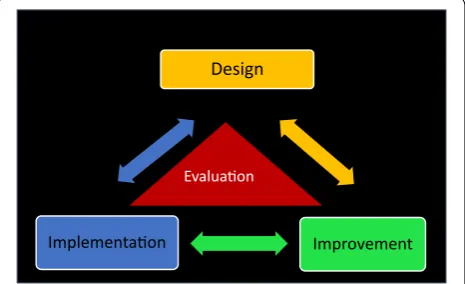
The design focused implementation model, shown in Fig. 1, consists of three interlinked phases: design, imple-mentation, and improvement. Evaluation is woven into each of these with appropriate evaluation questions for each component of the model.
We use the word “phases” in a broad sense. This is because these cannot be used in a formulaic way. They provide guidance for systematic implementation in set-tings where there is the need to do what is possible with limited resources, but the particular tools that are used will vary by context. Design refers to the development of a blueprint for implementation which involves a descrip-tion of the implementadescrip-tion logic, an enumeradescrip-tion of the components or activities needed for implementation, the description, on paper, of the key processes through which service needs to be delivered, and the enabling environ-ment needed to assure high quality delivery. To create this blueprint, principles of design thinking, defined as “an approach to innovation that is centered on user needs and creates solutions by rapidly generating and test-ing new ideas” [26] were used, particularly the idea that a deep understanding of the context of users of the ser-vice is a pre-requisite for good design, and that solutions need to be co-created with those using and operating the system [27]. Design was the driving force behind this implementation approach, and provided the guidance for the rest of the phases of the model. A viable and feasi-ble design of the delivery system and its key components, arrived at in collaboration with users, service providers and other stakeholders was seen to be a pre-requisite for
Design
Improvement Implementaon
Evaluaon
successful implementation. Implementation refers to the resources, capacities and support structure to execute the design and to ensure that the service delivery pro-cesses are instantiated within the health system. We use the word “implementation” here as a combination of multiple implementation stages [19], involving both pre-implementation planning activities based on the design (identification of staffing needs, training and capacity building plans, creation of operating procedures etc.) and the activities needed to deliver service, monitor per-formance and make iterative corrections to the design. This is because, in a system with no prior experience or capacity to deliver a new program, preparing for imple-mentation is inextricably intertwined with the act of implementation, as the delivery processes, training mate-rials and operating procedures were implemented and iteratively refined until they “work” in the local context. Initial assessments of readiness or prior planning were meaningless because the system was profoundly unpre-pared and unable to mobilize for any kind of change. Our approach therefore was to implement the design as systematically as possible, realizing that the initial imple-mentation would be incomplete, and perhaps ineffective, and to conduct iterative modifications of the implemen-tation until a working solution is obtained. The end of the implementation phase was the creation of a functional delivery system based on the principles of the design, but with the local adaptations needed to make it inde-pendently capable of delivering the services required by the program. The Improvement phase used improvement science methods to identify post-implementation perfor-mance gaps, to optimize the perforperfor-mance of the service delivery processes and to create a monitoring system to track performance and to proactively identify potential points of vulnerability and risk. Improvement princi-ples were used to support implementation in two ways. Rapid improvement PDSA cycles [28] were conducted in the implementation phase for local adaptation of the design. Formal Quality Improvement (QI) projects using the Lean Six Sigma approach [28] were undertaken in the improvement phase to close performance gaps.
Results
Applying design focused implementation to PRIME: a case study
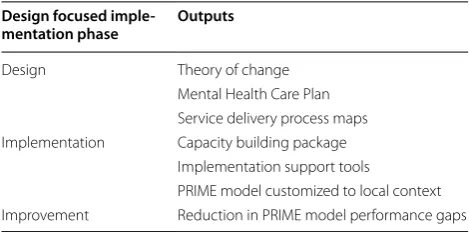
We applied the four phases of our model to implement a program for treatment of three mental disorders (depres-sion, alcohol use disorder and psychosis) delivered across three levels of the health system (community, primary care and district hospitals). The outputs of each phase are shown in Table 1.
Design phase: creating a District Mental Health Care Plan
There were three outputs from the design phase: (a)
Theory of Change model; (b) Mental Health Care Plan
(MHCP) and (c) Service Delivery Process Maps. The situational analysis served as our starting point for the design process. Data from this analysis led to the development of a local Theory of Change (ToC) which provided the conceptual model for how to bring about change to achieve our desired outcome, given our understanding of the local situation. The ToC illus-trates the pathway of linked outcomes that need to be achieved in order to successfully provide mental health care through the primary health care system in Sehore district. The ToC was developed in conjunction with key stakeholders in the government health care system representing the needs and perspectives of the service providers who are responsible for delivering the mental health program through the clinics and hospitals. The details of the ToC approach are described elsewhere [29].
The ToC map led to the development of the service delivery processes through which care would be deliv-ered, as well as the systems strengthening processes needed to build system capability to support mental health delivery. The four delivery processes are aware-ness, detection, treatment and recovery for depression, alcohol use disorder and psychosis across the com-munity, primary care and district hospitals levels. The systems strengthening processes included Health Man-agement Information Systems (HMIS), human resources, supply chain, advocacy and monitoring and evaluation. These processes were assembled into a district Mental Health Care Plan (MHCP) shown in Fig. 2. The MHCP, described elsewhere in detail [30] served as the blueprint for implementation. The MHCP also served as a com-munication tool to reinforce to stakeholders that the pro-gram cannot be sustained without the support processes in place.
Table 1 Outputs for each phase of design focused imple-mentation for PRIME
Design focused imple‑
mentation phase Outputs
Design Theory of change
Mental Health Care Plan Service delivery process maps Implementation Capacity building package
Implementation support tools
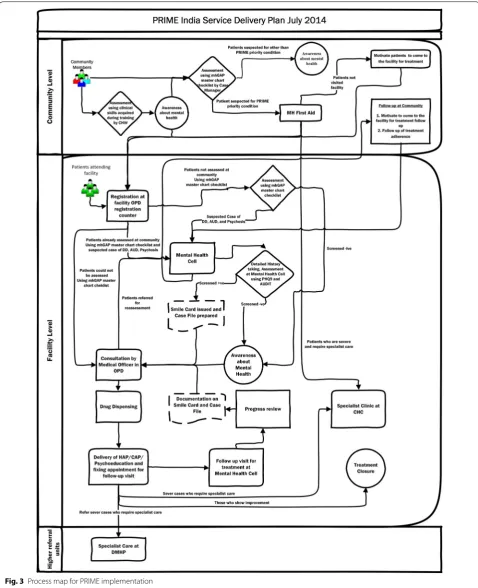
Based on the MHCP, process maps were created for the overall program implementation and for each ser-vice delivery and support process depicting the detailed flow or sequence of events that needed to take place for care to be delivered for each condition and system level. These maps used a format referred to as “cross functional mapping” that shows not only the process steps but also the organizations or people responsible for carrying out the steps, helping in the documentation of organizational hand-offs that identify potential areas of risk or poor
performance affecting patient experience and outcomes. The high level process map for the entire program imple-mentation is shown in Fig. 3.
Taken together, the ToC, the MHCP and the process maps engaged key stakeholders in the design of the various clinical and system components that needed to be in place in advance to achieve successful mental health outcomes in the PRIME setting. These outputs served to guide the activities of the implementation phase.
Implementation phase: developing delivery capacity and support systems
The concept for the implementation phase was adapted from the Interactive System Framework (ISF) developed by Wandersman [18], which emphasizes the need for a
support system where capacities are built for implemen-tation. Two types of capacities are identified in the ISF: (1) innovation-specific capacity, which is the necessary knowledge that is required for implementing and using a particular innovation and (2) general capacity, which rep-resents the infrastructure, skills and motivation required to support implementation of an innovation. To build these two types of capacity, Wandersman and his col-leagues identify four critical components: tools, training, technical assistance (coaching and support) and quality assurance [31].
Following this guidance, we developed three outputs from the implementation phase: (a) capacity building package (b) implementation support tools and (c) PRIME service delivery model that adapted the Mental Health Care Plan (MHCP) developed in the design phase for Sehore district. This was first implemented in one sub-district hospital. Since there was no prior experience with either the delivery system or on the best mechanisms for building capacity, an iterative approach was followed, testing adaptations of the MHCP based on data from the situational analysis and improving them through suc-cessive cycles of change based on monitoring results as described below. Retrospectively, we discovered this approach aligned with several implementation strategies enumerated in Powell et al. [15].
Iteration 1: This iteration involved developing the first version of the tools (checklists, job aids and operating procedures based on the process maps provided to case managers and medical officers) for screening patients, provision of pharmacological and psycho-social inter-ventions, follow-up of patients, procurement and supply chain management of drugs and establishing an information system to monitor progress of vari-ous program components. A 2 days training program was offered to medical officers using WHO training materials and a separate 2 days program focusing on both innovation specific capacity (detection of mental health disorders in the community) and general capac-ity (overview of mental health and stigma reduction) was provided to front-line workers (community health workers) and nurses. Technical assistance was provided through weekly face-to-face meetings with both medi-cal officers and front-line staff with the PRIME project team and quality assurance was performed using a monitoring system that tracked the number of patients detected, treated and referred.
Iteration 2: Eight weeks after implementation, moni-toring data found poor performance on key indicators, unavailability of psychotropic drugs and lack of report-ing of mental health indicators in the HMIS system. Based on this data and on interviews with the staff, it became apparent that the linkage between the com-munity and the facility could not be sustained without intense facilitation by PRIME staff. This brought about some improvements, but this model lacked fidelity to the process design because the health system func-tions were now taken over by program staff. In achiev-ing the balance between fidelity and fit of implemen-tation of an intervention, Castro [32] emphasizes the need for invariance in the core components of a pro-gram, and this iteration violated the core design.
Iteration 3: The implementation strategy for this was based on the learning from iteration 2 but tested a solution that was being promoted by the government in the new District Mental Health Program [33] and for which government resources were potentially available, but which had never been implemented. This involved the recruitment of a new resource called a “Case Manager” who provided screening functions and basic counseling services but also coordinated care within the medical officers. Case managers were also provided with tools and training and weekly sup-port meetings, and this iteration resulted in a signifi-cant increase in detection and treatment. More details about the implementation of PRIME are provided elsewhere [30]. Figures 4 and 5 show the progress in detection and treatment of patients with depression and alcohol use disorders across the multiple itera-tions of the model.
Improvement phase: optimizing performance
performance gaps were identified in two key areas: (a) the accuracy of clinical diagnosis by medical officers in the primary care facilities and (b) the rate of return of patients for follow-up counseling visits. Quality improve-ment projects were launched to address these issues, involving analyses to identify root causes and develop-ment of improvedevelop-ment solutions in consultation with case managers. Our approach in this phase is not different from standard practice, as tools in healthcare have been well documented [34]. The point we want to emphasize is the need to integrate improvement science meth-ods such as PDSA and Lean Six Sigma into the imple-mentation process to support and sustain the quality of implementation.
Evaluation phase: using learning to improve implementation
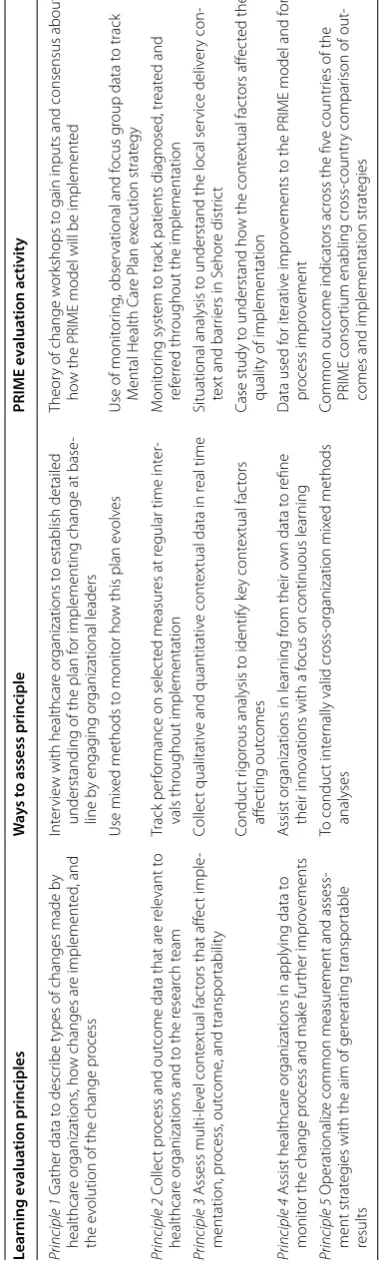
As shown in Fig. 1, evaluation activities were incorpo-rated into each phase of the design-focused implemen-tation approach. The specific evaluation methods used varied by phase, but were all intended to provide rapid feedback for learning and improvement, and therefore were embedded into the design, implementation and improvement phases. Our approach was informed by the principles of learning evaluation [26], which is an approach that collects real-time data to learn about and improve the implementation process. Table 2 shows how these principles were applied to evaluate the vari-ous phases of the PRIME implementation model. 0
100 200 300 400 500 600
Aug-14 Sep-14 Oct-14 Nov-14 Dec-14 Jan-15
300
370
150
528 516 582
54 52
25 33 73 45
Screening and Treatment for Depression
Screening Treatment Fig. 4 Progression of screening and treatment for depression
0 100 200 300 400 500 600
Aug-14 Sep-14 Oct-14 Nov-14 Dec-14 Jan-15
300 370
150
528 516 582
13 6 4 11 30 38
Screening and Treatment for Alcohol Use Disorder
Table 2 A pplic ation of learning e valua
tion principles t
o PRIME Learning ev alua tion principles W ay s t o assess principle PRIME ev alua tion ac tivit y Principle 1 G
ather data t
o descr
ibe t
ypes of changes made b
y
healthcar
e or
ganizations
, ho
w changes ar
e implement
ed
, and
the e
volution of the change pr
ocess
Int
er
vie
w with healthcar
e or
ganizations t
o establish detailed
understanding of the plan f
or implementing change at base
-line b y engag ing or ganizational leaders Theor
y of change w
or
kshops t
o gain inputs and consensus about
ho
w the PRIME model will be implement
ed
Use mix
ed methods t
o monit
or ho
w this plan e
volv
es
Use of monit
or
ing
, obser
vational and f
ocus g
roup data t
o track
M
ental Health C
ar e P lan ex ecution strat egy Principle 2 C ollec t pr
ocess and out
come data that ar
e r ele vant t o healthcar e or
ganizations and t
o the r
esear
ch t
eam
Track per
for
mance on selec
ted measur
es at r
egular time int
er -vals thr oughout implementation M onit or ing syst em t
o track patients diag
nosed , tr eat ed and ref er red thr
oughout the implementation
Principle 3 A ssess multi-le vel cont ex tual fac
tors that aff
ec t imple -mentation, pr ocess , out come
, and transpor
tabilit
y
Collec
t qualitativ
e and quantitativ
e cont
ex
tual data in r
eal time
Situational analysis t
o understand the local ser
vice deliv
er
y con
-tex
t and bar
riers in S
ehor e distr ic t Conduc t r igor
ous analysis t
o identify k
ey cont ex tual fac tors aff ec ting out comes
Case study t
o understand ho
w the cont
ex tual fac tors aff ec ted the qualit
y of implementation
Principle 4
A
ssist healthcar
e or
ganizations in applying data t
o
monit
or the change pr
ocess and mak
e fur ther impr ov ements A ssist or
ganizations in lear
ning fr
om their o
wn data t
o r
efine
their inno
vations with a f
ocus on continuous lear
ning
Data used f
or it
erativ
e impr
ov
ements t
o the PRIME model and f
or pr ocess impr ov ement Principle 5 Operationaliz
e common measur
ement and assess
-ment strat
eg
ies with the aim of generating transpor
table
results
To conduc
t int
er
nally valid cr
oss-or ganization mix ed methods analyses Common out come indicat ors acr
oss the fiv
e countr
ies of the
PRIME consor
tium enabling cr
oss-countr
y compar
ison of out
-comes and implementation strat
eg
The quality of the implementation process was assessed during each phase and modifications were continually made to improve implementation fidelity. During the design phase, the Theory of Change model was evaluated using two qualitative workshops conducted with state and district health officials, service providers and front line staff. Data on model accuracy was collected through individual interviews and group discussions with these stakeholders, and this data was used to modify and final-ize the model and to develop the MHCP.
During the implementation phase, a mixed methods approach was used to collect evaluation data to guide the iterative cycles of change. Quantitative monitoring data was collected on the number of patients referred, the number of patients diagnosed, the number of patients treated by primary care physicians and by specialists. In addition, observational data was used to assess the quality of care and in-depth interviews and focus group discussions provided data on the acceptability and sus-tainability of the implementation strategy. This data was used to make iterative modifications to the execution strategy of the MHCP as described previously. Once the implementation model was finalized and stabilized across all selected facilities in the district, a field based monitor-ing system on the Mobenzi m-health platform was put in place to collect ongoing data on referrals, diagnoses and treatment, which served to identify improvement projects for the improvement phase. The improvement phase used statistical process control charts [35] which is standard approach to evaluate the effect of improvement interventions by collecting and plotting data regularly over time. Finally, a summative evaluation will be con-ducted for the entire implementation process of PRIME using a case study methodology with the objective of pro-viding generalizable knowledge on how best to use the tools and methods of design focused implementation for future applications.
In addition, PRIME has an outcome evaluation design that uses repeated community-based cross-sectional sur-veys to measure change in treatment coverage, a repeated facility based survey to assess the impact on detection of disorders and disorder-specific cohorts to assess the effect of care on patient outcomes. The details of this design, which has harmonized outcome measures across the five countries of the PRIME consortium to enable cross-country comparison are described elsewhere [36], since it is not the focus of this paper.
Discussion
In this paper, we show how different implementation sci-ence frameworks in the literature were adapted for our setting where the systems for delivery did not just need to be strengthened and supported to introduce new
services, but where the core and enabling processes for implementing mental health services first needed to be designed and then integrated into the existing system. We believe that this implementation approach, and the tools presented here will be a model that practitioners implementing other programs in LMICs under simi-lar circumstances can adopt and enhance, and will also provide important research questions about the most effective methods for successful and sustainable service delivery of programs through government health systems in low resource settings.
The need for advancements in implementation research for implementing complex interventions in low resource settings is now well established. There has been increasing attention on research to reduce the evidence-practice gap, starting from Donabedian’s classic model from half a century ago [37]. Depending on the orienta-tion of the researchers, different terms have been used to describe these efforts including dissemination and implementation, quality assurance, quality improve-ment, knowledge translation, knowledge utilisation, knowledge transfer and exchange, innovation diffusion, implementation research, research utilisation, evidence-informed policy, and evidence-evidence-informed health systems [38], resulting in overlapping and confusing language that makes it difficult for practitioners to determine the best strategies needed to address their particular implementa-tion problems. But there is general agreement that more research is needed on the tools and approaches required to implement evidence-based interventions with fidelity and quality in particular context.
Mental health is a prime example of a field that would benefit from such research, since implementing mental health programs require a combination of highly con-text dependent bio-medical, psycho-social and structural interventions, and there is a large translation gap from evidence to practice. However, implementation research can only be conducted in the context of implementation practice, and there is limited knowledge of the tools and approaches to embed mental health programs in weak health systems. Moreover, implementation tools and methods are scattered across a variety of disciplines such as engineering, management and psychology that are not traditionally associated with public health, and therefore are not often available in an integrated manner to sup-port high quality implementation. Several frameworks for applied implementation exist, but they are difficult to apply in settings where service delivery and enabling pro-cesses have to be first constructed before service can be provided.
for low resource settings where the system is weak, and resources for intensive coaching and support are unavail-able. We demonstrate the application of this approach to mental health service delivery in one district in India through the use of specific tools that were relevant to this context; other tools may be added or substituted to this framework for other programs. In other PRIME set-tings in Ethiopia, Nepal, South Africa and Uganda, the local contextual factors guided the implementation pro-cess. In none of these settings, any formal implementa-tion science framework was used though in practice all the research teams followed quite a similar approach to ensure implementation of their respective MHCPs. We are currently analyzing the process data from all five set-tings and plan to publish case studies related to imple-mentation of MHCPs in these settings in 2018.
Conceptually, our approach provides a way of ensur-ing implementation quality through its entire lifecycle in low resource settings—from the creation of service deliv-ery and systems strengthening processes, to their opera-tionalization in a real-world setting, through ongoing improvement and optimization of performance. Using this approach systematically will result in tested imple-mentation packages for complex interventions that can include a detailed description of the processes, organi-zations, technologies, supply chains, equipment, facili-ties etc. that are needed to put the evidence to work in practice, as well as the system performance requirements to ensure that implementation failure does not get in the way of achieving outcomes.
Conclusion
Design-focused implementation will be useful for guid-ing research and practice in closguid-ing the implementation gap for mental disorders as well as a wide variety of com-plex interventions in low resource settings.
Authors’ contributions
RR, RS and SN conceptualized the design of the paper. RS wrote the first draft and contributed to revisions of the drafts; RR substantially modified the first draft and commented and edited all versions of the draft. SN commented on all versions of the draft. All authors read and approved the final manuscript.
Author details
1 Public Health Leadership and Maternal and Child Health, University of North Carolina, Chapel Hill, USA. 2 Public Health Foundation of India, New Delhi, India. 3 CAPHRI (Care and Public Health Research Institute), Maastricht Univer-sity, Maastricht, Netherlands.
Acknowledgements
The authors thank the officials of the Department of Public Health and Family Welfare, Government of Madhya Pradesh, India.
Competing interests
The authors declare that they have no competing interests.
Availability of data and materials
Interested parties may notify the PRIME investigators of their inter-est in collaboration, including access to the data set analysed
here, through the following website: https://docs.google.com/
forms/d/1–4oNm5xdEPlq-RjL_4GUyCPMpVWtyaNVcfDewnx-iL4/viewform.
Consent for publication Not Applicable.
Ethics approval and consent to participate
The institutional research boards of Sangath (Goa, India), University of Cape Town (South Africa) and World Health Organization (Geneva, Switzerland) and Indian Council for Medical Research approved the study protocol.
Funding
This study is an output of the PRogramme for Improving Mental health carE (PRIME) which was funded by UK aid from the UK Government (GB-1-201446); however, the views expressed do not necessarily reflect the UK Government’s official policies. The funders had no role in study design, data collection and analysis, decision to publish or preparation of the manuscript.
Publisher’s Note
Springer Nature remains neutral with regard to jurisdictional claims in pub-lished maps and institutional affiliations.
Received: 1 September 2017 Accepted: 12 January 2018
References
1. Chisholm D, et al. Scale up services for mental disorders: a call for action. Lancet. 2007;370(9594):1241–52.
2. Patel V, et al. A renewed agenda for global mental health. Lancet. 2011;378(9801):1441–2.
3. Dua T, et al. Evidence-based guidelines for mental, neurological, and substance use disorders in low- and middle-income countries: summary of WHO recommendations. PLoS Med. 2011;8(11):e1001122.
4. WHO. Intervention Guide—Version 2.0 for mental, neurological and sub-stance use disorders in non-specialized health settings. Geneva: World Health Organization; 2016.
5. Patel V, Thornicroft G. Packages of care for mental, neurological, and substance use disorders in low- and middle-income countries: PLoS Medicine Series. PLoS Med. 2009;6(10):e1000160.
6. WHO, WONCA. Integrating mental health in primary care: a global per-spective. Geneva: World Health Organization; 2008.
7. Patel V, et al. Addressing the burden of mental, neurological, and sub-stance use disorders: key messages from disease control priorities, 3rd edition. Lancet. 2015;387:1672–85.
8. Patel V, Saxena S. Transforming lives, enhancing communities—innova-tions in global mental health. N Engl J Med. 2014;370(6):498–501. 9. Proctor EK, et al. Implementation research in mental health services: an
emerging science with conceptual, methodological, and training chal-lenges. Adm Policy Ment Health. 2009;36(1):24–34.
10. Hanlon C, et al. Challenges and opportunities for implementing inte-grated mental health care: a district level situation analysis from five low- and middle-income countries. PLoS ONE. 2014;9(2):e88437.
11. Grimshaw JM, et al. Knowledge translation of research findings. Imple-ment Sci. 2012;7:50.
12. Pincus H, England M. Improving the quality of psychosocial interventions for mental and substance use disorders: a report from the iom. JAMA. 2015;314(12):1227–8.
13. Lund C, et al. PRIME: a programme to reduce the treatment gap for mental disorders in five low- and middle-income countries. PLoS Med. 2012;9(12):e1001359.
14. Shidhaye R, et al. Challenges for transformation: a situational analysis of mental health care services in Sehore District, Madhya Pradesh. Com-munity Ment Health J. 2015;51(8):903–12.
• We accept pre-submission inquiries
• Our selector tool helps you to find the most relevant journal
• We provide round the clock customer support
• Convenient online submission
• Thorough peer review
• Inclusion in PubMed and all major indexing services
• Maximum visibility for your research
Submit your manuscript at www.biomedcentral.com/submit
Submit your next manuscript to BioMed Central
and we will help you at every step:
16. Nilsen P. Making sense of implementation theories, models and frame-works. Implement Sci IS. 2015;10:53.
17. Meyers DC, Durlak JA, Wandersman A. The quality implementation frame-work: a synthesis of critical steps in the implementation process. Am J Community Psychol. 2012;50(3–4):462–80.
18. Wandersman A, et al. Bridging the gap between prevention research and practice: the interactive systems framework for dissemination and implementation. Am J Community Psychol. 2008;41(3–4):171–81. 19. Fixsen DL, et al. Implementation research: a synthesis of the literature;
2005. http://nirn.fpg.unc.edu/resources/implementation-research-syn-thesis-literature. Accessed 28 Dec 2015.
20. Damschroder LJ, et al. Fostering implementation of health services research findings into practice: a consolidated framework for advancing implementation science. Implement Sci IS. 2009;4:50.
21. Craig P, et al. Developing and evaluating complex interventions: the new Medical Research Council guidance. BMJ. 2008;337:a1655.
22. Chinman M, et al. The getting to outcomes demonstration and evalua-tion: an illustration of the prevention support system. Am J Community Psychol. 2008;41(3–4):206–24.
23. Balasubramanian BA, et al. Learning evaluation: blending quality improvement and implementation research methods to study healthcare innovations. Implement Sci IS. 2015;10:31.
24. Blase K, Kiser L, Van Dyke M. The hexagon tool: exploring context. Chapel Hill: National Implementation Research Network, FPG Child Development Institute, University of North Carolina at Chapel Hill; 2013.
25. Patton MQ. Developmental evaluation. Eval Pract. 1994;15(3):311–9. 26. Ulrich K, Eppinger S, Design Product. Product design and development.
New York: McGraw-Hill; 2012.
27. Brown T. Design thinking. Harvard business review. 2008;86(6):84–92. 28. Taylor MJ, et al. Systematic review of the application of the
plan-do-study-act method to improve quality in healthcare. BMJ Qual Saf. 2014;23(4):290–8.
29. Breuer E, et al. Planning and evaluating mental health services in low- and middle-income countries using theory of change. Br J Psychiatry. 2015;208:s55–62.
30. Shidhaye R, et al. Development and piloting of a plan for integrating mental health in primary care in Sehore district, Madhya Pradesh. India. Br J Psychiatry. 2015;208:s13–20.
31. Wandersman A, Chien VH, Katz J. Toward an evidence-based system for innovation support for implementing innovations with quality: tools, training, technical assistance, and quality assurance/quality improve-ment. Am J Community Psychol. 2012;50(3–4):445–59.
32. Castro FG, Barrera M Jr, Martinez CR Jr. The cultural adaptation of preven-tion intervenpreven-tions: resolving tensions between fidelity and fit. Prev Sci. 2004;5(1):41–5.
33. MOHFW. XIIth Plan District Mental Health Programme. http://mhpolicy. files.wordpress.com/2012/07/final-dmhp-design-xii-plan2.pdf. Accessed 30 June 2016.
34. Varkey P, Reller MK, Resar RK. Basics of quality improvement in health care. Mayo Clin Proc. 2007;82(6):735–9.
35. Benneyan J, Lloyd R, Plsek P. Statistical process control as a tool for research and healthcare improvement. Qual Saf Health Care. 2003;12(6):458–64.
36. De Silva MJ, et al. Evaluation of district mental healthcare plans: the PRIME consortium methodology. Br J Psychiatry. 2015;208:s63–70. 37. Donabedian A. Evaluating the quality of medical care. 1966. Milbank Q.
2005;83(4):691–729.