R E S E A R C H
Open Access
Schizophrenia and quality of life: how important
are symptoms and functioning?
Anna Galuppi
1*, Maria Cristina Turola
3, Maria Giulia Nanni
2, Paola Mazzoni
4, Luigi Grassi
2Abstract
Objective:the relationship between Quality of life (QoL) and global functioning and symptoms in outpatients with Schizophrenia
Method:The study was carried out on the outpatients with schizophrenia attending a Community Mental Health Centre in 2008. Each patient completed the WHO QoL Instrument - Brief and was administered the Brief Psychiatric Rating Scale-24 to assess psychiatric symptoms and the VADO Personal and social Functioning Scale to assess the level of functioning.
Results:subjects showed an intermediate satisfaction on the overall QoL and health; these data can be juxtaposed to the national standard sample rates. QoL resulted positively associated to personal and social functioning, while it was negatively related to psychiatric symptoms.
Conclusion:patients showed a fairly good satisfaction in regard to their QoL. The severity of psychiatric symptoms is one of the elements influencing QoL, together with personal and social functioning that plays a relevant role.
Introduction
A specific interest regarding quality of life of patients with schizophrenia dates back to the de-institutionalisa-tion process which took place in the 1960 s and 1970 s in several western countries [1,2]. In fact, as a result of mental health reforms, the effects of the shift of care from asylum to community health centres became a necessity for clinicians, researchers and health policy makers.
It was apparent that capturing psychopathological symptoms alone was not sufficient to reflect relevant outcomes. In particular, information on the social func-tioning and quality of life are regarded as essential for evaluating long-term outcomes.
Quality of life may be defined as a person’s sense of wellbeing and satisfaction with his/her life circum-stances, as well as a person’s health status and access to resources and opportunities [3]. Clearly, such an out-come is of particular importance in order to develop treatments that can help individuals with schizophrenia to lead more fulfilling and satisfying lives [4].
Unfortunately, factors influencing QoL in schizophre-nia are not well known. Studies addressing QoL for patients with schizophrenia and other severe mental ill-nesses have identified a number of important influential factors, such as social support [5], unmet needs, [6] and medication side effects [7].
However, most of the research examining factors affecting QoL has primarily focused on the impact of psychiatric symptoms. Some studies found from small to moderate relationships between psychiatric symptoms and QoL [8,9] while others presented findings suggest-ing that certain aspects of these concepts may be indis-tinguishable [10,11], particularly as far as negative symptoms and general psychopathology (eg, anxiety, depression) are concerned [4]. In recent years, several research groups have concluded that the so-called nega-tive symptoms of schizophrenia are much more closely related to quality of life than positive symptoms [12,13].
In a study of 128 patients, Norman et al. [11] have examined the relationship of symptoms and level of functioning in schizophrenia to the quality of life: their results show that negative symptoms, level of function-ing and positive symptoms all were related to the Qual-ity of Life Scale.
* Correspondence: [email protected] 1
Section of Child Neurology and Psychiatry, Children’s Hospital A.Meyer -University of Florence, Italy
Full list of author information is available at the end of the article
On the contrary, in a study of 193 patients, Fitzgerald et al. [10] showed that subjectively reported life satisfac-tion was not related to positive or negative symptoms of schizophrenia but did correlate with depressive symp-toms. A study in five European centres [6] measuring QoL and other patient and illness characteristics in a group of 143 outpatients with schizophrenia, found that patient’s QoL is predicted mainly by anxiety and depres-sion and by global functioning.
These variations among studies appear to be at least partially due to differences in the definition and mea-surement of QoL [14], given the complexity and hetero-geneity of the concept of quality of life [15]. Some definitions of QoL refer to it as a multidimensional set of components consisting of a person’s [1] satisfaction with his/her life as a whole, or general wellbeing; [2] observable social and material wellbeing, or objective QoL; [16] satisfaction with his/her social and material wellbeing, or subjective QoL; and [17] health and func-tional status, or health-related QoL [3]. Clarifying the relationship between psychiatric symptoms, global func-tioning and QoL represents an important step both in elucidating factors affecting QoL for individuals with schizophrenia and in understanding the utility of the concept of QoL for guiding future treatment develop-ment efforts [4].
Italy has implemented a decentralisation of its mental health services since 1978 with a major function in psy-chiatric care being placed in the Community Mental Health Centres (CMHC) that provide psychiatric inte-grated interventions in different settings, including out-patients clinics, and out-patients’own homes [18].
The aim of the present study was to assess the out-comes in all subjects with schizophrenic diagnosis attending a Community Mental Health Centre in Cop-paro (Ferrara-Italy) and to examine the relationships between quality of life, psychiatric symptoms and level of functioning.
Materials and methods
Study procedure
The present study was carried out from August to Sep-tember 2008 in a Community Mental Health Centre, Copparo, of the Integrated Department of Mental Health in Ferrara, Emilia-Romagna Region, Northern Italy. Since the creation of the Department of Mental Health and the implementation of the psychiatric ser-vices after the 1978 reform in the Emilia-Romagna Region [18], community mental health centers have played a central role in delivering integrated care for patients with schizophrenia and their families.
Copparo Center is the health facility to which 37.803 inhabitants refer to, 19678 females and 18125 males; 4051 are under 18 and 10526 are over 65. Population is
spread over 6 municipalities and mainly works in agri-cultural, commercial and industrial activities, in a flat countryside, well-supplied with facilities.
The Center is made up by an outpatient department and a day-hospital, both open eight hours a day on working days; it provides medical examinations and home consulting, drug therapies whenever needed, group therapies, individual and group rehabilitations activities, meetings with family members. Compulsory psychiatric hospitalizations for acute illnesses are made by the Psychiatric Unit of Ferrara Hospital, which is 18 km far, while voluntary hospitalizations for severe ill-nesses use both Ferrara and Lagosanto Hospital Units, 30 km far. Both units provide 15 beds, for the whole district, with 351463 caseload.
Rehabilitating hospitalizations, with projects from 1 to 3 months, are made in specific district facilities. There are three residences, providing 50 beds.
The Centre staff is composed by 6 psychiatric nurses, 2 psychiatrists, 1 psychologist and 1 social worker. The Centre deals with any sort of psychiatric illness, from reactive forms to psychoses, and supplies consulting at the local hospital and cooperates with family doctors and with the Department for Drug Abuse, which is in a different building. All subjects, even non-residents, have the right to receive free assistance, paying simply a money contribution. Subjects with a low income or with severe illnesses don’t pay the money contribution. Schi-zophrenic subjects have totally free assistance.
Criteria for the inclusion in the study were: a) being outpatients at the CMHC; b) a diagnosis of schizophre-nia according to the WHO-ICD-10 classification (F20.0 - F20:9) [19] c) age above 18 years.
Each patient was contacted by a research psychiatrist and a visit scheduled into the outpatient clinic of the CMH service, informed consent according to the Local Ethical Committee was gathered during the meeting.
A series of instruments were used to assess psycho-pathology, level of functioning and quality of life.
an item is missing, the average of other items in the domain is substituted. Where more than two items are missing from the domain, the domain score should not be calculated (with the exception of domain 3, where the domain should only be calculated if < 1 item is missing) [16].
The VADO Personal and Social Functioning Scale (FPS), which is a modified version of the Social and Occupational Functioning Assessment Scale (SOFAS) [17], was used to assess the patients’level of functioning in four main areas: work and/or socially useful activities; family, personal and social relationships; self-care; aggressive and destructive behaviours. Suicide risk is considered in the score only as much as suicidal rumi-nations may interfere with social-functioning. The FPS requires a brief and simple training, that is described in the VADO manual [20]. An evaluation is assessed according to the following levels: absent, slight, evident, marked, severe. The evaluation is then turned into a score from 0 to 100 (higher scores correspond to better functioning) according to VADO guide instructions.
In the present study, separate evaluations were carried out by two psychiatrists with training in the administra-tion of the scale.
The Italian version of Brief Psychiatric Rating Scale (BPRS), in its 24-item 4.0 version [21,22] was used to assess psychiatric symptoms.
Each item is rated on a seven-point Likert scale (from 1 = no symptom to 7 = extremely severe symptom -range score = 24-168), yielding four factors: positive symptoms (items 9-12, 14-15, and 24), negative symp-toms (items 13, 16-18, and 20), anxiety and depression (item 1-5, and 19), mania and hostility (items 6-8. and 21-23).
Statistical Analysis
Statistic analysis was carried out using the SPSS 12.0 and Winstat for Excel statistic systems. Statistic proce-dure included the following survey: descriptive statistics, variation in answer distributions (frequencies), Pearson r Test, significance (p) test with a level of significance set at 0.05.
Results
Patients’characteristics
The study was proposed to all the 107 subjects of the Centre: 3 subjects, 2 women over 70, and a man who was 36 years’old refused to participate.
The characteristics of the subjects participating in the study are reported in Table 1. The sample consisted of 104 patients, of whom 62 males (59,6%) and 42 females (40,4%) with a mean age of 47 years (SD 13.5) The mean age of first contact with the CMH was 33.3 years (SD 13.6), and the duration of illness 13.4 years
(SD 7.4). Distribution by age groups is shown in figure 1. 32 of the subjects (30.7%) were employed, 4 (3.8%) unemployed, 6 (5.7%) retired and 62 (59.6%) had a dis-ability pension. 89 (85.6%) lived in their own house, while the rest lived in a group home, boarding home, or halfway house. 40 (38.5%) had a partner and 64 (61.5%) were single.
2 subjects had no therapy, 20 subjects were under typic antipsychotics therapy, 54 atypics antipsychotics and 28 depot antipsychotics (26 of them were atypics).
The average hospitalization rate is 18.0 days per year of disease in males, 7.3 days per year in females.
On average, males had 54.15 ambulatory interventions, females 39.1; ambulatory interventions include examina-tions, conversaexamina-tions, group or family therapy meetings, with both nurse and doctor staff members.
32 males (51.6%) have attended a Day Center for at least a month, whereas only 12 females have (28.5%).
Outpatients in the past had 50 compulsory admissions in males, out of 358 admissions (13.97%), and 15 for females, out of 254 admissions (5.9%). Hospital admis-sions in the latest year were 8, divided among 6 persons, 5 males e 1 female: a man had three hospitalizations in a year, 5 subjects were undergoing a 6-months residen-tial rehabilitation program.
Quality of Life
Table 2 shows the mean scores related to every item of the four domains of the WHOQoL-BREF. In the first two items of the test, quality of life perception (Q1) recorded a 3.21 (SD 0.94) average score and 3.14 mean score on the perception of one’s own health (Q2), corre-sponding to “neither satisfied nor dissatisfied”. Total mean scores of the four domains show a higher level of satisfaction on physical and environmental health domain, while a lower level of satisfaction emerged in social relations domain.
In table 3 the scores of the first 2 items and of the four domains are presented separately for men and women and by age groups (< 45 years and≥45 years). Males’ scores reveal a higher level of satisfaction than females’scores in all domains except domain 3 (social); males who were over 45 showed a wider quality of life perception (Q1) and perception of one’s own health (Q2) than younger males, and show a better QoL in social and environmental relations; they show, however, a lower satisfaction in physical and psychological domain. Among the females, the group aging over 45 declared a lower satisfaction than the younger ones in all WHOQoL domains. Regarding physical health, differ-ences between sexes and ages are statistically significant (p < 0.05).
national Italian WHOQoL validation group [23]. The comparison showed that sample subjects had a lower degree of satisfaction in social relations and psychologi-cal domain; however, greater satisfaction in environmen-tal and physical domain emerged. (Figure 2)
Psychiatric symptoms and global functioning
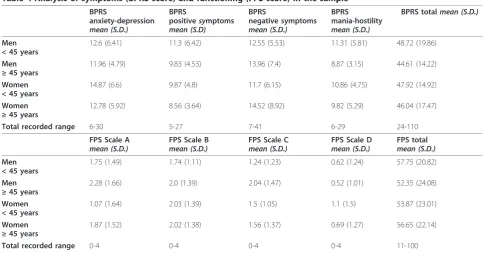
Average score obtained by symptoms survey through BPRS was 47.3 (SD 18.1; range from 24 to 110). Accord-ing to the BPRS cut-off score, 12.5% of subjects had a BPRS >72, 27.9% between 49 and 72, and 59.6%≤48. Table 4 shows average scores obtained by the four sub-scales characterising BPRS. The total average score obtained in anxiety-depression subscale is 12.88 (SD 5.9), in positive symptoms is 21.02 (SD 5.3), in negative symptoms is 13.41 (SD 7.2) and in mania-hostility 10.39 (SD 5.3).
Average scores obtained by Personal and Social Func-tioning Scale are presented in Table 4; total average score is 55.35 (SD 22.4), ranging from 11 to 100. 31.7% of subjects had severe or very severe social difficulties (FPS ≤ 40), 24% had marked difficulties (FPS 41-60), 34.6% had plain or light difficulties (FPS 61-80) and 9.6% had very light or no difficulties at all (FPS >80). In the 4 domains examined by FPS, most difficulties were
found in work and socio-relational functioning (diffi-culty degree mostly between light and plain), followed by self-care and health domain, and finally in disturbed and aggressive behaviours, where only light or no diffi-culties at all are recorded.
Variables associated with QoL in patients with schizophrenia
Correlations between WHOQoL, BPRS and FPS are shown in table 5.
WHOQoL results related to FPS total score and sub-scales, especially health and environment satisfaction scales. Personal and social functioning is related negatively to the“health satisfaction”-WHOQoL domain 1 (r = 0.57; p < 0.0005), to the “social relationships satisfaction” -WHOQoL domain 3 (r = 0.37; p < 0.05) and to the" environment satisfaction”-WHOQoL domain 4 (r = 0.43; p < 0.0005).
Patients’ age was also negatively correlated to QoL, particularly to “health satisfaction” (r = - 0.35; p < Table 1 Socio-demographic characteristics of the sample (n =104)
Male Female Total
Number (%) 62 (59.6%) 42 (40.4%) 104
Age at 2008 (years) 44.9 ± 12.2 51.9 ± 12.5 47.0 ± 13.5
Age at T0* (years) 31.0 ± 11.4 37.9 ± 12.8 33,3 ± 13.6
Length of illness (years) 13.2 ± 7.1 13.5 ± 7.1 13.4 ± 7.37
Hospitalization rate Dd/year 18.0 ± 43.7 7.3 ± 62.8
Outpatient intervention n/year 54.15 ± 52.8 39.1 ± 46.6
Marital status Single 64 61.5%
Partner 40 38.5%
Housing Private house 89 85,6%
Group home/Boarding home/halfway house 15 14,4%
Occupation Employed 32 30.7%
unemployed 4 3.8%
Disabled 62 59.6%
Retired 6 5.7%
*T0 age = age when first arrived at Mental Health Department
Figure 1Distribution by age groups.
Table 2 Perceived quality of life survey: mean scores on WHOQoL-BREF single items and mean scores on WHOQoL-BREF four domains
Domain Mean single item
(SD)
Mean domain (SD)
Q1 3.21 (0.94)
Q2 3.14 (0.98)
Domain 1 (Physical) 3.26 (0.74) 22.8 (5.2)
Domain 2 (Psychological)
2.98 (0.52) 17.8 (3.2)
Domain 3 (Social) 2.43 (0.98) 7.2 (2.9)
Domain 4 (Environment) 3.06 (0.70) 24.4 (5.6)
0.0005) and to“psychological health satisfaction” (r = -0.12; p < 0.05); similarly disease length was negatively correlated to“health satisfaction”(r = - 0.18; p < 0.05).
Global functioning in our subjects (FPS tot) resulted negatively related to symptoms (BPRS tot), in particular to negative symptoms with a marked negative correla-tion (r = - 0.65; p < 0.0005).
Significant correlations between negative symptoms (BPRS negative symptoms) and“physical area"-WHO-QoL domain 1 (r = 0.29; p < 0.05) and“environment domain"-WHOQoL domain 4 (r = 0.16; p < 0.05) were found; general psychopathology (BPRS anxiety-depres-sion) was related to“psychological domain"-WHOQoL domain 2 (r = - 0.28; p < 0.05), to the"social domain"-WHOQoL domain 3 (r = - 0.15; p < 0.05) and to the individual’s overall perception of QoL -Q1 (p = -0.32; p < 0.05); also positive symptoms (BPRS positive symp-toms) had correlation to “social domain"-WHOQoL
domain 3 (r = - 0.15; p < 0.05) and individual’s overall perception of QoL (p = - 0.17; p < 0.05).
Discussion
In the present study we examined all the subjects with a diagnosis of schizophrenia attending the same Commu-nity Mental Health Centre in Northern Italy. Taking into account schizophrenia outcome variability [24-26], psychiatric symptoms and overall functioning and qual-ity of life were assessed in order to verify the relation-ship between these variables and quality of life.
First, findings obtained through self-administered WHOQoL-BREF suggest that quality of life is not extremely negative, though schizophrenia is often an impairing chronic illness. In some respects, the popula-tion studied obtained higher scores on environment and physical dimensions of the WHO-QoL-Bref than average of the national Italian WHOQoL validation group.
With aging, perceived physical health quality gets worse, probably in relation to the increase of such dis-eases as hypertension, diabetes and rheumatic disdis-eases, that were recorded in our analysis. Curiously enough, as the disease length increases, perceived QoL does not get worse, on the contrary, overall QoL gets better. This could be caused by an increased knowledge of the dis-ease and its treatment possibilities.
In WHOQoL single items scoring, major insatisfac-tions regard sexual life (absolutely nonsatisfying for 59.7% of males and 54.7% of females), working life (54.8% of males and 50% of females are totally unsatis-fied of their working life);
The relation with the health department, including mental health service, is considered negatively only by 12.9% of males and 0.5% of females, a flattering result for the staff members; over 70% of the subjects declare to be satisfied with the environments where they live and of the facilities that are provided.
Table 3 Analysis of QoL in the sample (WHOQoL score) Q1 mean score
(SD) Q2 mean score(SD) D1(SD)mean score D2(SD)mean score D3(SD)mean score D4(SD)mean score Men
< 45 years
2.22 (0.89) 2.19 (0.95) 21.75 (5.33) 13.85 (4.48) 4.00 (2.62) 16.77 (5.26)
Men
≥45 years
2.39 (0.89) 2.43 (0.94) 20.30 (6.56) 13.69 (4.93) 4.56 (2.95) 17.78 (5.72)
Women < 45 years
2.27 (1.16) 2.33 (0.97) 22.53 (5.78) 14.13 (3.97) 5.80 (3.00) 15.93 (5.83)
Women
≥45 years
1.95 (1.04) 1.62 (0.94) 16.46 (6.28) 11.67 (4.90) 3.42 (2.83) 15.50 (5.67)
Men Total recorded range
2.29 (0.87) 2.29 (0.93) 21.05 (5.87) 13.73 (4.59) 4.17 (3.20) 16.95 (5.64)
Women Total recorded range
2.12 (1.09) 1.95 (1.02) 19.1 (6.97) 12.8 (4.82) 4.47 (3.20) 15.87 (5.81)
Q1 = quality of life perception; Q2 = perception of one’s own health; D1 = domain 1; D2 = domain 2; D3 = domain 3; D4 = domain 4
0 20 40 60 80 100 120
Physical Psychological Social Environment
Quality of Life (WHOQoL-BREF)
Patients with schizophrenia Control
In our study the psychiatric symptoms and overall functioning resulted diversified, as one third of subjects showed severe or extremely severe functioning difficul-ties. Consistently with literature [25,27], this suggests that schizophrenia is an extremely heterogeneous illness with many possible variables influencing psychopathol-ogy and disability.
Regarding the association of psychiatric symptoms and global functioning to QoL, we found a statistically sig-nificant correlation between BPRS and quality of life. Literature shows a great variability among studies on symptoms and QoL in schizophrenia, mostly due to wide variations in measurement strategies and defini-tions of QoL. Fitzgerald et al. [10], in a study comparing subjective to observer-rated QoL in schizophrenia, showed how subjective reported life satisfaction, mea-sured with“SCAP instrument” (which is a 100-item
self-report instrument that contains a number of items of self-report life satisfaction) was not related to positive or negative symptoms, but was correlated with depressive symptoms. Ross et al. [11], in a study on QoL, symp-toms and level of functioning in schizophrenia, suggest that QoL in schizophrenia is more highly related to negative rather than positive symptoms. Weighted effect size analyses revealed small relationships between psy-chiatric symptoms and QoL, with general psychopathol-ogy showing the strongest negative associations across all QoL indicators [4].
In our study, we found a statistically significant corre-lation between symptoms and quality of life. More symptomatic subjects have a worse perception of QoL. Especially anxiety-depression symptoms determine a worse evaluation of general QoL, satisfaction own health and psychological health, whilst negative symptoms are Table 4 Analysis of symptoms (BPRS score) and functioning (FPS score) in the sample
BPRS
anxiety-depression mean (S.D.)
BPRS
positivesymptoms mean (S.D)
BPRS
negative symptoms mean (S.D.)
BPRS
mania-hostility mean (S.D.)
BPRS totalmean (S.D.)
Men < 45 years
12.6 (6.41) 11.3 (6.42) 12.55 (5.53) 11.31 (5.81) 48.72 (19.86)
Men
≥45 years
11.96 (4.79) 9.83 (4.53) 13.96 (7.4) 8.87 (3.15) 44.61 (14.22)
Women < 45 years
14.87 (6.6) 9.87 (4.8) 11.7 (6.15) 10.86 (4.75) 47.92 (14.92)
Women
≥45 years
12.78 (5.92) 8.56 (3.64) 14.52 (8.92) 9.82 (5.29) 46.04 (17.47)
Total recorded range 6-30 5-27 7-41 6-29 24-110
FPS Scale A
mean (S.D.) FPS Scale Bmean (S.D.) FPS Scale Cmean (S.D.) FPS Scale Dmean (S.D.) FPS totalmean (S.D.) Men
< 45 years
1.75 (1.49) 1.74 (1.11) 1.24 (1.23) 0.62 (1.24) 57.75 (20.82)
Men
≥45 years
2.28 (1.66) 2.0 (1.39) 2.04 (1.47) 0.52 (1.01) 52.35 (24.08)
Women < 45 years
1.07 (1.64) 2.03 (1.39) 1.5 (1.05) 1.1 (1.5) 53.87 (23.01)
Women
≥45 years
1.87 (1.52) 2.02 (1.38) 1.56 (1.37) 0.69 (1.27) 56.65 (22.14)
Total recorded range 0-4 0-4 0-4 0-4 11-100
Table 5 Correlation between global functioning, symptoms and Quality of life (n = 104)
Q 1 Q 2 WHOQoL domain 1 WHOQoL domain 2 WHOQoL domain 3 WHOQoL domain 4
Age in 2008 -0.04 -0.09 -0.35** -0.21* -0.12* -0.08
Disease length 0.19* 0.07 -0.18* -0.06* 0.04 -0.05
FPS total 0.28* 0.30* 0.57** 0.34* 0.37* 0.43**
BPRS anxiety-depression -0.32* -0.29* -0.08 -0.28* -0.15* -0.05
BPRS positive symptoms -0.17* -0.16* -0.08 -0.10* -0.15* -0.10*
BPRS negative symptoms -0.06 -0.13* -0.29* -0.08 -0.10* -0.16*
BPRS mania-hostility -0.22* -0.25* -0.06 -0.13* -0.14* -0.03
BPRStot -0.25* -0.28* -0.20* -0.20* -0.19* -0.12*
*p < 0.05 **p < 0.0005
associated with a bad perception of health satisfaction. These results agree with what reported by other authors [10,11,28].
Major statistically significant correlations of QoL regarded overall functioning; most correlations were found between all subscales of FPS and WHOQoL domain 1 (physical area), and domain 4 (environment), while lower, even if statistically significant, correlations were shown between FPS tot and WHOQoL domains 2 and 3 (psychological and social). As the level of personal and social disability increases, the dissatisfaction about physical health, environment, social and eventually psy-chological aspects increases, in an overall unsatisfaction about QoL.
These results point out how personal and social func-tioning plays a key role, in schizophrenia, in determining subjects’quality of life, while symptoms, though related to QoL, do not seem to be the major variable in mold-ing QoL.
Psychiatric symptoms also were found to be negatively associated with overall functioning. The results of a cross-sectional study using data from a large study [29] suggested similarly that symptoms may be strongly related to functioning [30]. According to our data, a major highly significant correlation is related to negative symptoms and functioning measured through FPS (r = 0.65; p < 0.0005). These findings confirm the well-docu-mented strong relationship between negative symptoms and social disability [31-33].
Certain limitations of the study should be mentioned. First, the study was cross-sectional; therefore, the exploration of causal relationship was rather tentative. Second, a relatively limited number of variables was examined; in addition to socio-demographic and clinical data, a complex interaction of other factors, such as self-esteem, premorbid adjustment, therapy and social support network could also play a role in determining subjective quality of life.
Finally, a potential limitation of the study was the use of the WHOQOL-BREF, a generic questionnaire that may not have detected subtle changes of subjective QoL in the specific population of schizophrenia patients.
Conclusions
The World Health Organisation [34] reports that there has been a worldwide pattern shift from hospital care to community-based care of people with mental illnesses. Italy has worked on decentralising its mental health ser-vices since 1978. The present research on social func-tioning, psychiatric symptoms and QoL in people with schizophrenia suggests that symptoms, but, above all, personal and social functioning are important elements to determine QoL. These studies point to the impor-tance of looking beyond symptom-reduction strategies
for improving QoL in schizophrenia; furthermore, they underline how rehabilitation facilities and increased par-ticipation of families and communities in the treatment significantly improve quality of life of people with men-tal illness.
Acknowledgements
The authors wish to thank all the staff and patients of Community Mental Health Centre of the Integrated Department of Mental Health and Drug Abuse in Ferrara (Italy) who participated in, or aided in the conduct of this study.
Author details
1Section of Child Neurology and Psychiatry, Children’s Hospital A.Meyer
-University of Florence, Italy.2Section of Psychiatry, University of Ferrara, Italy. 3Unit of Clinical Psychiatry, Integrated Department of Mental Health and
Drug Abuse, Local Health Agency, Ferrara, Italy.4Community Mental Health Centre, Integrated Department of Mental Health and Drug Abuse, Local Health Agency, Ferrara, Italy.
Authors’contributions
All authors participated in the design of the study. AG, MCT, MGN and PM wrote the manuscript. MCT and LG reviewed the manuscript. MCT performed the statistical analysis. All authors read and approved the final manuscript.
Competing interests
The authors declare that they have no competing interests.
Received: 11 August 2010 Accepted: 8 December 2010 Published: 8 December 2010
References
1. Bachrach L:Deinstitutionalisation: an analytic review and sociological perspective.Rockville, MD: National Institute of Mental Health; 1970. 2. Lamb RH:The new asylums in the community.Archives of General
Psychiatry1979, ,36:129-134.
3. Lehman AF:Instruments for measuring quality of life in mental illnesses.
InQuality of Life in Mental Disorders.Edited by: Katschnig H, Freeman H, Sartorius N. New York, NY: Wiley; 1997:79-94.
4. Eack SM, Newhill CE:Psychiatric Symptoms and Quality of Life in Schizophrenia: A Meta-Analysis.Schizophrenia Bullettin2007,
33(5):1225-1237.
5. Ritsner M:Predicting changes in domain-specific quality of life of schizophrenia patients.J Nerv Ment Dis2003,191:287-294.
6. Becker T, Leese M, Krumm S, Ruggeri M, Vazquez-Barquero JL:Needs and quality of life among patients with schizophrenia in five European centres: what is the impact of global functioning scores.Soc Psychiatry Psychiatr Epidemiol2005,40:628-634.
7. Awad AG, Voruganti LNP, Heslegrave RJ:A conceptual model of quality of life in schizophrenia: description and preliminary clinical validation.Qual Life Res1997,6:21-26.
8. Ritsner M, Kurs R, Gibel A, Ratner Y, Endicott J:Validity of an abbreviated Quality of Life Enjoyment and Satisfaction Questionnaire (Q-LES-Q-18) for schizophrenia, schizoaffective, and mood disorder patients.Qual Life Res2005,14:1693-1703.
9. Sim K, Mahendran R, Siris SG, Heckers S, Chong SA:Subjective quality of life in first episode schizophrenia spectrum disorders with comorbid depression.Psychiatry Res2004,129:141-147.
10. Fitzgerald PB, Williams CL, Corteling N, Filia SL, Brewer K, Adams A, de Castella AR, Rolfe T, Davey P, Kulkarni J:Subject and observer-rated quality of life in schizophrenia.Acta Psychiatr Scand2001,103:387-392.
11. Norman RM, Malla AK, McLean T, Voruganti LP, Cortese L, McIntosh E, Cheng S, Rickwood A:The relationship of symptoms and level of functioning in schizophrenia to general wellbeing and the Quality of Life Scale.Acta Psychiatr Scand2000,102:303-309.
13. Galletly CA, Clark CR, McFarlane AC, Weber DL:Relationship between changes in symptom ratings, neuropsychological test performance and quality of life in schizophrenic patients trated with clozapine.Psychiatry Res1997,72:161-166.
14. Lambert M, Naber D:Current issues in schizophrenia: overview of patient acceptability, functioning capacity and quality of life.CNS Drugs2004,
18:5-17.
15. McNary SW, Lehman AF, O’Gardy KE:Measuring subjective life satisfaction in persons with severe and persistent mental illness: a measurement quality and structural model analysis.Psychol Assess1997,9:503-307. 16. WHO:WHOQOL-BREF. Introduction, administration, scoring and generic
version of the assessment. Field Trial Version.Programme in mental health world health organisation. Geneva1996.
17. Morosini P, Magliano L, Brambilla L, Ugolini S, Pioli R:Development, reliability and acceptability of a new version of the DSM IV Social and Occupational Functioning Assessment Scale (SOFAS) to assess routine social functioning.Acta Psychiatr Scand2000,101:323-329.
18. Garaci E:Thirty years after the reform of the Italian Law on mental health: time for celebrating, evaluating, moving forward.Ann Ist Super Sanita2009,45(1):3-4.
19. ICD-10:International Statistical Classification of Diseases and Related Health Problems 10th Revision.World Health Organisation. Geneva;, 2 20072.
20. Morosini P, Magliano L, Brambilla L:V.A.D.O Valutazione di Abilità e Definizione di Obiettivi.Trento: Edizioni Erickson; 1998.
21. Ventura J, Lukoff D, Nuechterlein KH, Liberman RP, Green M, Shaner A:
Appendix 1: Brief Psychiatric Rating Scale (BPRS) Expanded Version (4.0) scales, anchor points and administration manual.International Journal of Methods in Psychiatric Research1993,3:227-243.
22. Morosini P, Roncone R, Impallomeni M, Casacchia M:Presentazione dell’adattamento italiano della Brief Psychiatric Rating Scale, versione 4.0 ampliata (BPRS 4.0).Rivista di riabilitazione psichiatrica e psicosociale1994,
3(94):195-198.
23. De Girolamo G, Rucci P, Scocco P, Becchi A, Coppa F, D’Addario A, Darú E, De Leo D, Galassi L, Mangelli L, Marson C, Neri G, Soldani L:Quality of life assessment: Validation of the Italian version of the WHO-QOL-BREF. Epidemiol Psichiatr Soc2000,9:45-55.
24. Davidson L, McGlashan TH:A five-year followup study of deficit and nondeficit schizophrenia.Schizophrenia Research1997,49:253-260. 25. WHO-World Health Organization:Schizophrenia and public health.Geneva
1998.
26. WHO-World Health Organisation:Course and outcome of schizofrenia.
[http://www.who.int/mental_health/management/schizophrenia]. 27. Jobe HT:Long-term outcome of patients with schizophrenia: a review.
Can J Psychiatry2005,50:892-900.
28. Browne S, Roe M, Lane A, Gervin M, Morris M, Kinsella A, Larkin C, Callaghan EO:Quality of life in schizophrenia: relationship to
sociodemographic factors, symptomatology and tardive dyskinesia.Acta Psychiatrica Scandinavica1996,94:118-124.
29. Stroup TS, McEvoy JP, Swartz MS, Byerly MJ, Glick ID, Canive JM, McGee MF, Simpson GM, Stevens MC, Lieberman JA:The National Institute of Mental Health Clinical Antipsychotic Trials of Intervention Effectiveness (CATIE) project: schizophrenia trial design and protocol development.Schizophr Bull2003,29:15-31.
30. Perlick DA, Rosenheck RA, Kaczynski R, Bingham S, Collins J:Association of symptomatology and cognitive deficits to functional capacity in schizophrenia.Schizophr Res2008,99:192-199.
31. Lysaker PH, Davis L:Social function in schizophrenia and schizoaffective disorder: associatios with personality, symptoms and neurocognition. Health and Quality of Life Outcomes2004,2:15.
32. Milev P, Ho BC, Arndt S, Andreasen NC:Predictive values of neurocognition and negative symptoms on functional outcome in schizophrenia: a longitudinal first-episode study with 7-year follow-up. Am J Psychiatry2005,162:495-506.
33. Wiersma D, Wanderling J, Dragomirecka E, Ganev K, Harrison G, An Der Heiden W, Nienhuis FJ, Walsh D:Social disability in schizophrenia: its development and prediction over 15 years in incidence cohorts in six European centres.Psychol Med2000,30:1155-1167.
34. WHO- World Health Organisation:The world health report - 2001.Geneva 2001.
doi:10.1186/1752-4458-4-31
Cite this article as:Galuppiet al.:Schizophrenia and quality of life: how
important are symptoms and functioning?.International Journal of Mental Health Systems20104:31.
Submit your next manuscript to BioMed Central and take full advantage of:
• Convenient online submission
• Thorough peer review
• No space constraints or color figure charges
• Immediate publication on acceptance
• Inclusion in PubMed, CAS, Scopus and Google Scholar
• Research which is freely available for redistribution