The Journal of Public Space 2018 | Vol. 3 n. 1
https://www.journalpublicspace.org
EDITORIAL TEAM
Editor in Chief
Luisa Bravo, City Space Architecture, Italy
Scientific Board
Davisi Boontharm, Meiji University, Japan
Simone Brott, Queensland University of Technology, Australia Julie-Anne Carroll, Queensland University of Technology, Australia
Margaret Crawford, University of California Berkeley, United States of America Philip Crowther, Queensland University of Technology, Australia
Simone Garagnani, University of Bologna, Italy
Pietro Garau, University of Rome “La Sapienza”, Italy Carl Grodach, Monash University, Australia
Chye Kiang Heng, National University of Singapore, Singapore Miquel Marti, Universitat Politècnica de Catalunya, Spain Maggie McCormick, RMIT University, Australia
Darko Radovic, Keio University, Japan
Estanislau Roca, Universitat Politècnica de Catalunya, Spain Joaquin Sabate, Universitat Politècnica de Catalunya, Spain Robert Saliba, American University of Beirut, Lebanon Claudio Sgarbi, Carleton University, Canada
Hendrik Tieben, Chinese University of Hong Kong, Hong Kong
Strategic Advisory Board
Cecilia Andersson, UN-Habitat Global Public Space Programme, Kenya Tigran Haas, KTH Royal Institute of Technology, Sweden
Michael Mehaffy, KTH Royal Institute of Technology, Sweden Laura Petrella, UN-Habitat Global Public Space Programme, Kenya
Advisory Board for Research into Action
Ethan Kent, Project for Public Spaces, United States of America Gregor Mews, Urban Synergies Group, Australia
Luis Alfonso Saltos Espinoza, LASE+CityUrb, Ecuador
Editorial Board
Linda Carroli, Queensland University of Technology, Australia Valerio Francia, City Space Architecture, Italy
Severine Mayere, Queensland University of Technology, Australia
Journal Manager
Luisa Bravo, City Space Architecture, Italy
The Journal of Public Space | 2018, Vol. 3 n. 1 | Editorial Team and Policies
Founding Editors
Luisa Bravo, City Space Architecture, Italy
Mirko Guaralda, Queensland University of Technology, Australia
Correspondents
Roberto Andrés, Universidade Federal de Minas Gerais, Brazil
Michael Barke, University of Northumbria at Newcastle, United Kingdom Gem Barton, Brighton University, United Kingdom
Simon Bell, Estonian University of Life Sciences, Estonia Christopher Brisbin, University of South Australia, Australia Liz Brogden, Queensland University of Technology, Australia Martin Bryant, University of Technology Sydney, Australia
Glenda Caldwell, Queensland University of Technology, Australia Philippa Carnemolla, University of Technology Sydney, Australia Dave Colangelo, Portland State University, United States of America Debra Cushing, Queensland University of Technology, Australia Pak Damrongsak, Thammasat University, Thailand
Camilo Vladimir de Lima Amaral, Universidade Federal de Goias, Brazil Raul Dias De Carvalho, Queensland University of Technology, Australia
Thomas Fowler, California Polytechnic State University, United States of America Emilio Garcia, University of Auckland, New Zealand
Pedro Ressano Garcia, Universidade Lusófona, Portugal
Morten Gjerde, Victoria University of Wellington, New Zealand Maria Goula, Cornell University, United States of America Adrian Gras-Velazquez, Swarthmore College, United States Kai Gu, University of Auckland, New Zealand
Daniel O'Hare, Bond University, Australia
Phil Heywood, Queensland University of Technology, Australia Konstantinos Ioannidis, Aristotle University of Thessaloniki, Greece Marjut Kirjakka, Aalto University, Finland
Anoma Kumarasuriyar, Queensland University of Technology, Australia Matthew D. Lamb, Pennsylvania State University, United States of America Yoav Lerman, Tel Aviv University, Israel
Marieta Maciel, Universitade Federal de Minas Gerais, Brazil Michael Marriott, Queensland University of Technology, Australia Nicola Marzot, TU Delft, Netherlands
Galyna MacLellan, Queensland University of Technology, Australia Marisha McAuliffe, Queensland University of Technology, Australia Ari Mattes, University of Notre Dame, Australia
The Journal of Public Space | 2018, Vol. 3 n. 1 | Editorial Team and Policies
Nga Nguyen, Vietnam National University Ho Chi Minh City, Vietnam Vitor Oliveira, University of Porto, Portugal
Kaan Ozgun, University of Queensland, Australia Leonardo Parra, Universidad de Los Andes, Colombia
Mark Pennings, Queensland University of Technology, Australia Gavin Perin, University of Technology Sydney, Australia
Helena Piha, Queensland University of Technology, Australia Dorina Pojani, University of Queensland, Australia
Lakshmi Priya Rajendran, Anglia Ruskin University, United Kingdom Renato Rego, Universidade Estadual de Maringá - UEM, Brazil Yodan Rofe, Ben-Gurion University of the Negev, Israel Paul Sanders, Queensland University of Technology, Australia Leigh Shutter, Griffith University, Australia
Massimo Santanicchia, Iceland Academy of the Arts, Iceland Thomas Sigler, University of Queensland, Australia
Claudia Justino Taborda, Queensland University of Technology, Australia Mark Taylor, University of Newcastle, Australia
Goran Vodicka, University of Sheffield, United Kingdom
Bing Wang, Beijing University of Civil Engineering and Architecture, China Margaret Ward, Griffith University, Australia
Katharine Willis, Plymouth University, United Kingdom Zhen Xu, Nanjing Forestry University, China
Yannis Zavoleas, University of Newcastle, Australia
The Journal of Public Space | 2018, Vol. 3 n. 1 | Editorial Team and Policies
FOCUS AND SCOPE
The Journal of Public Space is the first, international, interdisciplinary, academic, open access journal entirely dedicated to public space.
Established on a well-consolidated global network of scholars and professionals, The Journal of Public Space is committed to expand current scholarship by offering a global perspective and providing the opportunity for unheard countries to speak up and to discuss neglected as well as emerging topics that are usually sidelined in mainstream knowledge.
The Journal of Public Space is addressing social sciences and humanities as a major field, and is interested also in attracting scholars from several disciplines. It will perform as a scholarly journal but also as an interdisciplinary platform of discussion and exchange by scholars, professionals, organizations, artists, activists and citizens, whose activities are related to public space.
The Journal of Public Space will be enriched by hosting papers on design projects, art performances and social practices, fostering civic engagement and non-expert knowledge.
TOPICS
Authors are welcome to submit original research articles dealing with themes relating to the vision of the journal, which may include, but are not confined to:
SPACE SOCIETY SYSTEMS
Architecture Urban Planning Urban Design Urban Morphology Urban Resilience Landscape architecture Interior design
Interactive and visual design Art City transformation Infrastructure Environment Ecology Climate change Gender Human scale People Everyday life Social engagement Health and safety Perception and senses Human rights Social justice Education Heritage History Culture Geography Anthropology Ethnography Community empowerment Migrations Conflicts Inclusion/Exclusion Informality
Sub and fringe cultures
Economy Political power Governance
The Journal of Public Space | 2018, Vol. 3 n. 1 | Editorial Team and Policies
POLICIES
Peer Review Process
A double blind peer review process, based on a distinguished board of editors and
editorial advisors, ensures the quality and high standards of research papers. Each paper is assessed by two reviewers and any identifying information in relation to the author is removed during the review process. Reviewers follow an evaluation framework and recommendation guidelines to ensure objectivity and fairness.
Submitted articles should not have been previously published. If publication or
dissemination through presentation has occurred, then the article should acknowledge this and pay due credit to the original source.
Publication Ethics Statement
The Journal of Public Space aligns itself with the Committee on Publication Ethics (COPE) best practice guidelines for dealing with ethical issues in journal publishing.
http://publicationethics.org/
Open Access Policy
The Journal of Public Space is licensed under a Creative Commons Attribution- NonCommercial 4.0 International License. It provides immediate open access to its content on the principle that making research freely available to the public supports a greater global exchange of knowledge.
https://creativecommons.org/licenses/by-nc/4.0/
CONTACT
PublisherQueensland University of Technology Brisbane, AUSTRALIA
www.qut.edu.au
Partners
City Space Architecture non-profit cultural association Bologna, ITALY
www.cityspacearchitecture.org
UN Habitat - United Nations Human Settlements Program Nairobi, KENYA
www.unhabitat.org
Editorial offices
Queensland University of Technology 2 George Street, Brisbane
QLD 4000, AUSTRALIA [email protected]
City Space Architecture
Via Paolo Giovanni Martini 26/d 40134 Bologna, ITALY
The Journal of Public Space | 2018, Vol. 3 n. 1 | Editorial Team and Policies
Call for papers | 2018 issues
The Journal of Public Space welcomes full papers for 2018 issues, to be published in April, August and December.
Deadline for April issue: January 10, 2018 Deadline for August issue: May 10, 2018
Deadline for December issue: September 10, 2018
Submissions will be ongoing throughout the year. Submission can be made:
- using the OJS platform by registering online. If you are already a registered author you can log in using your username and password;
- by sending an email to Founding Editors Luisa Bravo and Mirko Guaralda at this email address: [email protected].
Before submitting, please read: - the Focus and Scope of the journal - the Author Guide Lines
Full papers should be between 5.000 and 8.000 words.
The Journal of Public Space 2018 | Vol. 3 n. 1
https://www.journalpublicspace.org
TABLE OF CONTENTS
EDITORIAL
The implementation of the New Urban Agenda. Our ongoing efforts after almost two years from the Habitat III conference
Luisa Bravo
1-2
OVERVIEW
Skypeography: investigating and mapping the public mind space of urbaness Maggie McCormick
3-12
SPACE
Dialogue, Ambivalence, Public Space Thomas-Bernard Kenniff
Greening and Opening the Public Space of the Nile Banks A demonstration case study in Maadi, Cairo
Amir Gohar
13-30
31-48
SOCIETY
What the Mapping of Byron Shires Informal Settlements teaches us about having a home without having a house
Verity Nunan, Karine Dupre
49-74
Dangerous Safety or Safely Dangerous: and the effects on individual responsibility and environmental awareness
Anna Svensdotter, Mirko Guaralda
SYSTEMS
Exploring Environmental Colour Design in urban contexts Galyna McLellan, Mirko Guaralda
75-92
93-102
VIEWPOINT
Application to Occupy Grace Leone
The Journal of Public Space | 2018, Vol. 3 n. 1 | Table of Contents
PORTFOLIO
Lebanon Cities’ public spaces
Maryam Nazzal, Samer Chinder 119-152
REPORTS FROM 9th WORLD URBAN FORUM
We the people, We the public space. An interactive exhibition at the 9th World Urban Forum
Luisa Bravo, Valerio Francia
We the public space. Strategies to deal with inequalities in order to achieve inclusive and sustainable urban environments
Luisa Bravo
Public Space in the New Urban Agenda. The Challenge of Implementation Peter Elmlund, Tigran Haas, Michael Mehaffy
Give Us Space! Augmented public space geographies in the changing public/private relationships
Manfredo Manfredini, Adrian Lo, Dory E. Reeves
Smart City, Just City. An IHC Global Initiative in Support of the New Urban Agenda
Judith Hermanson
Contribution of older urban residents Katherine Kline
Time for action. Implementing the New Urban Agenda in public spaces for health and wellbeing
Gregor Mews, Milica Muminovic, Paul Tranter
153-162
163-164
165-170
171-178
179-186
187-192
193-202
The Journal of Public Space 2018 | Vol. 3 n. 1
https://www.journalpublicspace.org
EDITORIAL
The implementation of the New Urban Agenda.
Our ongoing efforts after almost two years from
the Habitat III conference
Luisa Bravo
City Space Architecture, Italy
When City Space Architecture was selected to be part of Habitat III, the United Nations
conference on Housing and Sustainable Urban Development, held in Quito in 2016,1 I realized
that our efforts to promote public space culture and to give a contribution on the ongoing global discourse around public space were clearly visible and well understood. At the same it was clear to me that being part of the Habitat III conference was our once-in-a-lifetime opportunity to start an ambitious and difficult path that could potentially have lead to remarkable achievements.
City Space Architecture is a non-profit cultural association based in Bologna, Italy. Its strength is based on the ideals that are the pillars of its foundation: trust, solidarity and cooperation. All our affiliated members are volunteering their time because they are willing to give and I myself, as Founder and current President-elect, too. Our members come from academia, industry, governmental institutions and NGOs but we also engage students since our mission is mostly focused on quality education related to public space culture of young generations of future leaders. We always engage students in our projects, events and activities since we know they will carry the burden to build a more sustainable urban future for all, they will serve communities and will be asked to work as decision makers and influential advisors. We want them to be proud, committed and responsible ambassadors of public space culture, we want them to be servants of the public good.
Nowadays we are facing an unprecedented situation: the ‘urban’ is complex, like never before, and a great suffer comes from the humanity as a whole. The rise of poverty has generated conflicts and political instability in many countries. Equity, social justice and democracy are challenged by private interests and public space is seriously at risk. The New Urban Agenda adopted at the Habitat III conference and the related Sustainable Development
Goals and their targets, with particular reference to SDG 11.72, recognize that public space is
a key element for sustainable urban development. I strongly and passionately believe that
1 At the Habitat III conference City Space Architecture organized and I coordinated the networking event
‘Stand up for Public Space!’ and a talk at the Urban Library for the launch of the first issue of The Journal of Public Space. Both events were very well attended. A report of both events is published on the issue Vol. 2, n. 1 (2017) of the journal. More on Habitat III here: http://habitat3.org/.
2 According to the global indicator framework, the target retlated to SDG 11.7 is: ‘By 2030, provide
universal access to safe, inclusive and accessible, green and public spaces, in particular for women and children, older persons and persons with disabilities’ - https://sustainabledevelopment.un.org/sdg11
The implementation of the New Urban Agenda
public space is a fundamental human right, it is so precious but also so fragile that needs to be protected and preserved, if we really want to build cities for all, leaving no one behind.
In 2017 I was engaged in two major UN events: I was nominated to attend the 26th
UN-Habitat Governing Council in Nairobi and then granted an ad hoc-accreditation by Member States with a letter of invitation signed by the former UN-Habitat Executive Director Dr. Joan Clos; I was then selected by a Committee appointed by UN NGLS Non-Governmental Liaison Services to attend the High Level Meeting on the New Urban Agenda in New York. In 2018 City Space Architecture was selected to organize a networking event, that I
coordinated, at the 9th World Urban Forum (WUF9)3 in Kuala Lumpur and was also selected
as exhibitor (the only Italian exhibitor) together with 200 exhibitors from 50 countries. WUF9 was the first session to focus on the implementation of the New Urban Agenda adopted in Habitat III, under the theme ‘Cities 2030: Cities for All’ and attracted more than 22,000 participants from 165 countries. At the close of the meeting, WUF9 launched the Kuala Lumpur Declaration on Cities 2030, which calls for accelerating NUA implementation and maintaining UN-Habitat as the UN focal point for follow-up and review of the NUA. Since the Habitat III conference in Quito, and afterwards in Nairobi, New York and Kuala Lumpur, I had the chance to meet and share knowledge with global stakeholders, to establish connections with many institutions that are promoting projects and programmes addressing global challenges, to be observer and speaker in relevant roundtable discussions, and I learned more about public space, how it is improved, appropriated and lived but also undermined, neglected and abused. More than ever, we need to be committed and continue our work on promoting public space culture and spread awareness on the importance of public space in cities.
This issue (Vol. 3, n.1, 2018) of The Journal of Public Space includes a section with reports from WUF9 from major stakeholders addressing challenges related to public space, that City Space Architecture supported as partners during meetings and events at WUF9: KTH Royal Institute of Technology and Ax:son Johnson Foundation (Sweden), the University of Auckland (New Zealand), UN General Assembly of Partners Older Persons (USA), IHC Global (USA) and Urban Synergies Group (Australia).
City Space Architecture is currently organizing a symposium which will take place at the Venice Architecture Biennale on September 22, in the framework of the educational programme ‘Biennale Session’. In Venice several insttitutions will convene and continue the discussion on public space, such as: KTH Royal Institute of Technology (Sweden), TU Vienna (Austria), Stanford Human Cities Initiative (USA), Keio University (Japan), Lodz University of Technology (Poland), The Graudate Center of the City University of New York (USA) and others are currently confirming their attendance. Some representatives from the UN-Habitat’s Global Public Space Programme will also attend.
It’s time to take action and we need to work all together.
3 More on WUF9 here: http://wuf9.org/ and on events on public space at WUF9 here: To cite this article:
Bravo, L. (2018). The implementation of the New Urban Agenda. Our ongoing efforts after almost two years from the Habitat III conference. The Journal of Public Space, 3(1), 1-2, DOI:
10.5204/jps.v3i1.314
The Journal of Public Space 2018 | Vol. 3 n. 1
https://www.journalpublicspace.org
Skypeography. Investigating and mapping
the public mind space of urbaness
Maggie McCormick
Adjunct Professor, RMIT University, Australia Professor, Reutlingen University, Germany [email protected]
Abstract
‘Skypeography: investigating and mapping the public mind space of urbaness’ is an overview of the public space of Skype. This article discusses how mediation by screens is creating new urban concepts across an emerging new spatial geography and its new sociologies and cartographies. It begins by tracing an overview from perceptions of ‘city’ to experiences of ‘urbaness’ and explores the role of screens in creating a mobile state of being and a
conceptualization of urban public space as transient and paradoxical mind space. The paper argues that an appropriate urban lexicon or cartographic recording is yet to be developed in relation to the public space of screens. In an increasingly visualized world, art practice has a significant role to play in exploring and mapping urban transience, movement, rhythm and paradox that forms a state of ‘urbaness’. This article explores the concept of ‘Skypeography’ through the methods and aesthetics of artistic screen research practice undertaken in the fluid space of the SkypeLab research project. Key to the research is the project to identify 100 Questions emerging out of the practice of SkypeLab. Through its experimental approach in digital space, SkypeLab poses and exposes questions arising out of the practice, about urban space itself. Through both answers and questions, SkypeLab and its ‘Skypeography’ method contribute valuable knowledge towards an understanding of new conceptual territory within a profoundly changing urbanscape.
Keywords: urban consciousness, digital screen mediation, Skype space, urban lexicon, spatial urban mapping, urban public space, Skypeography.
TH E JO U R N A L OF PU B L IC SP A C E
To cite this article:
McCormick, M. (2018). Skypeography. Investigating and mapping the public mind space of urbaness. The Journal of Public Space, 3(1), 3-12, DOI 10.5204/jps.v3i1.315
This article has been peer-reviewed and accepted for publication in The Journal of Public Space. Please see the Editorial Policies under the ‘About’ section of the journal website for further information.
Skypeography
Introduction
This article provides an overview of the public space of Skype. It discusses how mediation by screens is creating new urban concepts across an emerging new spatial geography and its emerging sociologies and cartographies. It begins by tracing an overview from
perceptions of ‘city’ to experiences of ‘urbaness’ and explores the role of screens in creating a mobile state of being and a conceptualization of urban public space as transient and paradoxical mind space. The article argues that an appropriate urban lexicon or cartographic recording is yet to be developed in relation to the public space of screens. In an increasingly visualized world, art practice has a significant role to play in exploring and mapping urban transience, movement, rhythm and paradox which form a state of
‘urbaness’. This article explores the concept of ‘Skypeography’ through the methods and aesthetics of artistic screen research practice undertaken in the fluid space of the
SkypeLab research project. Key to the research is the project to identify 100 Questions emerging out of the practice of SkypeLab. Refer to the Appendix for a summary of the SkypeLab research.
From City to Urbaness
Concepts of the ‘city’ are central to contemporary understanding of urban public space. ‘What is a City?’ This often-quoted question posed by Lewis Mumford in the 1930s (LeGates, Stout 2011) is today a far more complex question in the context of a fluid urbanized and digitalized world. Mumford was an American historian and sociologist, particularly known for his study of cities. While his view of the city as a theatre of social action recognized it as more than a constructed, physical space, he could not have envisioned the complex action and interaction of urban and digital networks that are experienced by today’s societies. Mumford’s thinking was framed at a time when the idea of the modern city was emerging and changing. Other urban concepts were yet to come. Among these was the idea of the ‘Megalopolis’ or urban cluster or corridor, posed in the 1960s by urban geographer Jean Gottmann (1961) that linked regionally connected cities such as BosWash (Boston and Washington), recognising the natural connections between existing cities. Later, this concept was extended to connect rapidly developing urban spaces within the economic zone of the Pearl River Delta in China, reflecting in part a changing emphasis in urban research from connecting cities of Europe and the USA to the expanding city space of Asia. This in itself reflects the rapid growth in urbanization across the planet and the speed of growth within the Asian region in particular.
Sociologist Saskia Sassen (1991) coined the term ‘Global City’ in the early 1990s
recognizing the interconnection between the three mega cities of New York, London and Tokyo. She observed that the flight between New York and London is one of the world’s most heavily used connection routes, so it is not surprising to find that New York and London might have more in common with each other, than with other cities in the United States or the United Kingdom. For some, such journeys between physical cities are as much the city, as the two cities themselves. Gottmann’s concept of BosWash (Boston/Washington) can now be extended to the NyLon (New York/London) concept. Going one step further in the conceptualization of the ‘city’ as a network of connections, the AMO Atlas published in Content (2004), aims to snap shot the world in
Maggie McCormick
physical and non-physical, interconnected, global information and trends that link cities across the world. From McDonald outlets to Chinatowns, the AMO Atlas records
diverse urban connections, from commercial expansion to cultural dispersions. What this does, is create different ways of looking at spatially networked geographies and draws attention to new urban sociologies and cartographies.
The AMO Atlas exemplifies the text ‘World = City’ that appears on the back cover of another of Koolhaas’s publications, on the project, Mutations: Harvard project on the city (2001). This project explored understanding the city well beyond its concrete
manifestations in relation to ‘what used to be the city’ (2001: 19). Here definitions of the ‘city’ can be seen as shaped by the contemporaneity of the conditions shaped by rapid urbanization and digitalization. Koolhaas refers to this as a ‘City of Exacerbated
Difference (COED)’, a copyrighted term he devised through the Harvard Project. While he was specifically referring to the Pearl River Delta, the concept also applies more broadly. The idea of ‘exacerbated difference’ finds its roots in such thinking as urban philosopher Henri Lefebvre’s ‘arrythmia’ or colliding rhythms in his theory of
Rhythmanalysis (2004) first published in French in 1992. While digitalization as we know it was a long way off, Lefebvre was in a sense observing through a screen of sorts as he used his Paris window to record and analyse the patterns of everyday life. The connection of urban rhythms was considered in earlier versions of this thinking in The
Rhythmanalytical Project and Attempt at the Rhythmanalysis of Mediterranean Cities, co-written with urban philosopher Catherine Régulier (1986).These concepts laid the groundwork for deciphering the new urban situation where physical cities are created through rapid movement from place to place, and urban mind space is created though the digital movement in the space between those places. By its very nature this creates a connected territory of new urban rhythms or ‘arrythms’ constructed around difference. While difference is central to a great deal of thinking today in deciphering the lives we live and the spaces we inhabit, so too is transience or movement, often expressed as the ‘mobilities paradigm’ (Elliott, Urry 2010: 15). The term ‘mobilities’ emerged in the Social Sciences primarily in the work of John Urry (2000). Urry argues that for contemporary sociology to be relevant it needs to address a borderless world. While much of his
research focuses on the impact of ‘mobile lives’ (Elliott, Urry 2010), on how people’s lives are being reorganised, these studies also address the role the ubiquitous presence of networked screens play in shaping lives. Earlier sociologist Manual Castells (1996) amongst others, outlined a networked society that changed concepts of the space of places - one could insert separate city spaces here - to a spatial concept of flows.
Skypeography
Urban Lexicons
Tracing from concepts of the individual ‘city’ to the networked urban condition of ‘urbaness’ leads us to new questions about urban public space. If we ask Mumford’s question again - ‘What is a city?’ - the answer may now be in another question - What is ‘urbaness’? The term ‘urbaness’ refers to a specific state of urban consciousness, shaped by transience between, and compression of, space, time and difference, where collision is perceived as the norm. Forms of urban consciousness are as old as cities themselves, with concepts of transience and compression, embedded in the trains, cars and planes, that have increasingly diminished the distance and time between and within cities and people. The difference now, is not only the speed at which this takes place, but also an
understanding of ‘increased mind mobility’ (McCormick 2013:117) and the concept that one is ‘born urban, born transient’ (McCormick 2009: 17) in both body and mind, as a contemporary life experience. Instantaneous satellite connection means we can simultaneously be in many places and time zones. Urban experience is both seen and unseen, within a cacophony of layered, fragmented, transient alignments, shaped by multiple screens. Our current urban vocabulary is closely linked to concepts of belonging to, and identifying with, individual city spaces. These terms include ‘cosmopolitanism’, ‘urbanity’ and even Saska Sassen’s more recent term ‘cityness’ (2005). While grounded in ideas of connectivity, the latter too is embedded in primarily global economic circuits. The term ‘urbophilia’ (Radovic, Dukanoic 2007) comes closer to capturing the essence of the times and the love of the urban. While architect, academic and urban thinker Darko Radovic may be right when he suggests the urban phenomenon by its very nature
‘escapes complete understanding or any attempt at definite definition’ (2007: 151) a new urban lexicon is emerging.
What additional language have we developed to express and record urban experience mediated by digital screens? In the 1990s, architect and urban designer William J Mitchell described the digital city using familiar city terms like ‘digital highway’ (1995). While such language helped us to begin to understand this space, new terms have now entered our vocabulary to explain the urban phenomenon more fully. In a digitally connected urban world, we now understand space through urban perception and experience within the framework of such concepts as sociologists Manuel Castells ‘space of flows’ (1996) and Zygmunt Bauman’s ‘liquid times’ (2000). Media theorist McKenzie Wark describes the condition as ‘telesthesia’, where information and ideas move faster than people or things between spaces, ‘to bring what is distant near, and make what is distant a site of action’ (2012). It is argued here that the term ‘urbaness’ (McCormick 2009) comes closest to expressing the consciousness of networked urban space. To decipher ‘urbaness’ as a spatial experience of transience and paradox, there is a need to expand our urban lexicon beyond words and towards the visual. Significant advances have been made in the
Maggie McCormick
effectiveness of social and built public space. In these fields of urban study through digital methods urban place and space are central rather than the collective idea of being urban and its associated mind space. Bill Hillier, Professor of Architectural and Urban
Morphology (Bartlett School of Architecture, University of London) is credited as the originator of the conceptual framework of Space Syntax through the Space Syntax
Laboratory, UCL. While he has written about the human mind in this equation (2012) his focus is on understanding cities though a geometric mathematical prism. A gap has still been left in the urban lexicon and the potential for analysis of the public space of
collective urban mind space though the specific expressive language of art. This move to visualization sits well within our everyday experience of the visual language we are increasingly relying on in our everyday digital communication such as Selfies, Emojis and the endless Facebook photos we send, as well as evident in our contracted 140
characters Tweets social platform. Information is conveyed to us through mobile phone, iPad, and computer screens. Amongst the screen mediators is Skype. Created by
Scandinavians Niklas Zennström and Janus Friis in 2003, it today has multiple versions to choose from, such as Zoom and WhatsApp, but it is ‘Skype’ and ‘Skyping’ that have entered the urban lexicon as verbs. By now (2018) over 560 million people have used Skype at one time or another. Experience of such dense, transient, and at times fragmented and frustrating space plays a pivotal role in the formation of knowledge. In contrast to Facebook, Instagram, or Email, Skype communication is directly through seeing each other’s face. We are actively engaged. Skype continues to be one of the screens that we ‘see’ the new everyday conceptual transient ‘city’ of paradox through, by seeing the other, the self, space and time concurrently.
Skypeography and SkypeLab
As we have seen, like the subject itself, a study of the public space of ‘urbaness’ requires a cacophony of interconnected disciplines. Amongst the mix is art practice which is often overlooked in the wider fields of urban studies. In this article, the focus is on the particular practice of ‘Skypeography’ through the methods and aesthetics of artistic screen research practice undertaken in the SkypeLab project. The term ‘Skypeography’ like the term ‘urbaness’ has been purposefully created in an effort to expand the lexicon to better express the experience of our times. ‘Skypeography’ plays with the idea of Skype as public urban space, as a new geography with a new cartography. Embedded in its processes is a networking of understandings drawn across urban studies, including
geography, sociology, cartography and art. Carto-City for example is the title of
cartographer Denis Cosgrove’s chapter in Else/Where: Mapping New Cartographies of Networks and Territories (Abrams and Hall 2006). Cosgrove concludes with the statement ‘Urban space and cartographic space remain inseparable; as each is
transformed, their relationship alters’ (2006). In our contemporary situation, Cosgrove’s conclusion reminds us of the continuously changing understanding of both city and cartography, and how each is intertwined. Being urban is embedded in paradox and mediated through screens, while cartography itself is dominated by screens. GIS
(geographic information systems) are designed to capture, analyse and present all manner of spatial or geographic data, resulting in Google Maps and GPS global positioning
Skypeography
other hand, transience and paradox are the territory of contemporary art practice and its specific mode of research and mapping.
Contemporary artistic modes of practice reflect a shift from individual to what is often termed relational or socially engaged, mirroring the digital network where each collision creates a new direction. In this era is not new for the arts to engage with the digital sphere in a multiplicity of ways. Of its time, SkypeLab 2014-2018, grew out of its predecessor Skypetrait 2012-2013. Both explore the cartography of ‘urbaness’ through the interconnection between art practice, public space and digital technology. The SkypeLab concept grew out of a Skype conversation between Henning Eichinger,
Professor at Reutlingen University in Germany and me, in 2012 about our observations of the increasing use of screens by our respective art in public space and design students. Unlike much of the engagement between art and technology, the SkypeLab interest is not in digital art as such. Rather, questions arose about the impact of ‘seeing’ and ‘knowing’ through screens: Questions about the impact of the everyday experience of connecting across contiguous urban digital public space on urban perception. Questions about how art and design practice might interpret and map this space. Questions about what role the hand, and the body still played in an urbanized and digitalized world. What answers, but more importantly, what questions might arise from this approach? While all research is by nature investigating the unknown, SkypeLab allows the unknown state to remain a core part of its philosophy reflecting the nature of art practice that begins with an idea and comes to the question through the practice iiself. Integral to its processes, SkypeLab is compiling the 100 Questions project over 2018/2019. The questions arise out of the experience of the participants of both the state of ‘urbaness’ and the practice of
‘Skypeography’ through the filter of screens. To enquire into the questions, SkypeLab is being undertaken as a series of research laboratories across increasingly expanding
networks, across urban public space as well as disciplines and mediums. Labs to date have created a networked ‘city’ or urban space between universities in Reutlingen, Melbourne, Shanghai, Rio De Janeiro, Barranquilla, Hobart and Barcelona. Within long timeframes and geographical distances, SkypeLab purposefully brings together differing and colliding urban time zones, seasons and cultures, mediated through digital screens where all are collapsed into a common urban space – a common ‘city’, if you like.
SkypeLab is witness to Castell’s urban ‘space of flows’, Bauman’s ‘liquid times’ and Wark’s ‘telesthesia’, first hand. In this context, the research curatorial practice ‘Skypeography’ was designed by Henning Eichinger and me and employs a methodology shaped by ephemeral and transient urban experience, mediated by digital screens. In the process, contributions are made to an urban lexicon that expands our capacity to express our experience of this new conceptual cityscape. The interest in how difference plays out in this space as well the interest in the role of the hand in a digital space, led us to invite German, Australian, Chinese and South American artists, who had not met previously, to work in pairs or opposites. They undertook Blind Contour Drawing sessions via Skype over periods of several months. The technique is intimate as it involves looking at your partner intensively on the screen, and drawing with one continuous line, reminiscent of cartographic contour lines. A stranger crosses this public space to enter the private space of your bedroom or living room, while you traverse in the opposite direction. The
Maggie McCormick
adapted by art educator Betty Edwards in her book Drawing on the Right Side of the Brain
(1979), here in SkypeLab it is transformed into a research tool - a tool for investigating urban ephemera mediated by digital screens while concurrently exploring the role of the hand in our digital world. The methodology, as employed by the artists, favours the juxtaposition of difference (including culture and language), long time frames, and
geographical distance. While, in more traditional cartography, contour lines indicate the shape of the earth’s surface, here contour lines record the connection between complete strangers. They look directly at each other through the screen, at much closer distances than the usual physical encounter, and yet separated by distance, time, culture and often language. Here perception is transformed, as it responds to paradox, through frozen moments and fluidity, distance and nearness, connection and disconnection, hand and brain, light and dark, clarity and loss of detail, confidence and awkwardness, limitation and possibility, amidst a myriad of other apparent contradictions. Paradoxical fragments become everyday framing of how knowledge is formed and how perceptions are created, and experiences recorded. ‘Drawing via the Skype screen interface reinforces the idea, that when we draw we mirror ourselves, as much as the other, and in the process, we redefine ourselves’ (McCormick 2013) as mapmaker and the map itself – ‘I have got you at the end of my pen’ (Eichinger, McCormick 2013: 76).
In recording ‘Skypeography’ practice, artists talk of the physical contradiction of ‘Drawing faster/moving slower to capture a moment’ (Eichinger, McCormick 2013: 75), and the ambiguity of the screen itself, where ‘Textures of the city swallow her face’ (Eichinger, McCormick 2013: 74) as one sees the other, the self, their space, your space and layered reflections on glasses and mirrors. Some project participants gave all their attention to the space around the person, the partially visible space that opens up the imagination, some tracked the virtual space between the two screens, some recorded those somewhat undefinable noises that can be heard on line, some recorded soundscapes while walking and Skyping in physical public spaces and in the process erasing the distance. For others erasure itself was the focus referring to ‘the ephemeral nature of online
Skypeography
Conclusion
This article has explored the impact of mediation through digital screens on the meaning of the contemporary ‘city’, and how experience of urban public space is being redefined. Rather than viewing cities as separate spaces, the concept of ‘urbaness’ poses the idea of ‘being urban’ within perceptions of the contemporary ‘city’ as a state of urban
consciousness. The need for an expanded urban lexicon and new ways of mapping the contemporary ‘city’ have been discussed through the method of ‘Skypeography’ and the research project SkypeLab. Through its non-traditional and experimental approach within public digital space, SkypeLab poses and exposes questions arising out of the practice about the impact of the digital screen itself. In so doing it contributes to broader fields of urban inquiry. As we look into this new mind space of ‘urbaness’, SkypeLab asks: How do the layers, reflections and fragmentations of `seeing’ and encountering each other via digital screen space shape our urban experience and inform our urban perceptions? What role does artistic practice play in the language and cartography of contemporary urban public space? Through both answers and questions, SkypeLab contributes valuable
knowledge to an understanding of new conceptual territory within a profoundly changing urbanscape.
Appendix
SkypeLab is undertaken in collaboration with the Goethe Institutes in Australia and China and funded through the Baden-Württemberg Foundation, Germany. Its predecessor Skypetrait received a research and teaching award in 2013 in Germany. Over 2012 to 2018, the mapmaking evolving out of this research process has taken multiple forms. These include street projections, street performance, public space interventions,
Maggie McCormick
References
Bauman, Z. (2000). Liquid Modernity. Cambridge, UK: Polity Press.
Castells, M. (1996). The Rise of the Network Society. Malden, Massachusetts: Blackwell. Chaudron, S., Eichinger, H. (2017). Eagle-eye on Identities in the Digital World. Joint Research
Centre (JRC) Technical Report. Luxembourg: Publications Office of the European Union. Cosgrove, D. (2006). Carto-City. J. Abrams & P. Hall (eds.), Else/Where: Mapping – New
Cartographies of Networks and Territories (pp.148-157). Minneapolis: University of Minnesota Design Institute.
Edwards, B. (1979). Drawing on the Right Side of the Brain. Los Angeles: J. P. Tarcher. Elliott, A., Urry J. (2010). Mobile Lives. USA, Canada: Routledge.
Gottmann, J. (1961). Megalopolis: The Urbanized North Eastern Seaboard of the United States. New York: Twentieth Century Fund.
Hillier, B. (2012). Studying Cities to Learn about Minds: Some Possible Implications of Space Syntax for Spatial Cognition. Environment and Planning B: Urban Analytics and City Science. Volume: 39 Issue 1 (pp. 12-32). London: Sage Publications.
Koolhaas, R. (Ed.) (2004). Content. Cologne: Taschen.
Koolhaas, R., Boeri, S., Kwinter, S., and Tazi, N. (2001). Mutations: Harvard project on the city. Arc en reve centred’architecture.
Lefebvre, H. (2004). Rhythmanalysis: Space, Time and Everyday Life, (trans. S. Elden and G. Moore). London and New York: Continuum. First published in French 1992.
Skypeography
McCormick, M., Eichinger, H. (eds.) (2016). SkypeLab: Transcontinental Faces and Spaces. Germany: Keber Publications.
McCormick, M (2013). The Transient City: The city as urbaness. E. Grierson, & K. Sharp (eds.). Reimagining the City: Art, globalization and urban spaces (pp. 109-128). Bristol UK/Chicago USA: Intellect.
McCormick, M., Eichinger, H. (eds.) (2013). Skypetrait: Transcontinental Faces. Reutlingen, Germany: Stat Reutlingen.
McCormick, M. (2009). The Transient City: Mapping urban consciousness through contemporary art practice. PhD Thesis. Melbourne: The University of Melbourne.
Mitchell, W. J. (1995). City of Bits: Space, Place and the Infobahn. Cambridge, Massachusetts: MIT Press.
Mumford, L. (2011). What is a City? LeGates, R., T. and Stout, F. (eds.). The City Reader. Fifth Edition (pp. 91-95). London and New York: Routledge. First published in Architectural Record 1937.
Nicolaides, K. (1941). The Natural Way to Draw. Boston: Houghton Miffin Co.
Radovic, D., Dukanovic, Z. (2007). Urbophilia. Belgrade: Faculty of Architecture, University of Belgrade.
Sassen, S. (2005). Cityness in the Urban Age. Urban Age Bulletin 2 (pp. 1-3).
Sassen, S. (1991). The Global City: New York, London, Tokyo. New Jersey: Princeton University Press.
Urry, J. (2000). Sociology Beyond Societies: Mobilities for the Twenty-First Century. London and New York: Routledge.
The Journal of Public Space 2018 | Vol. 3 n. 1
https://www.journalpublicspace.org
Dialogue, ambivalence, public space
Thomas-Bernard Kenniff
Université du Québec à Montréal, Canada École de design
Abstract
Public space is neither a fixed thing, nor a stable concept. This paper applies the term ‘dialogue’ as a conceptual basis for the idea of public space as something that changes according to multiscalar and overlapping contexts, with use and discourse. The concept of dialogue is developed from the dialogism of Mikhail Bakhtin whose related notions of ambivalence, polyphony, heteroglossia, carnival and chronotope are used to support a dialogical understanding of public space. The paper develops this understanding by creating a parallel between Bakhtin’s dialogism and the Barking Town Square by muf architecture/art (2004-2010). Through this parallel reading, the paper suggests that design proposals for the public realm are valued propositions that suggest a particular transformation of aesthetic, ethical, social and political relations through the ordering and transformation of spatial relations. No design, no conception, and therefore no dialogue creating public space can be neutral—but inevitably takes place within a fraught dialogical context inseparable from individual positioning and responsibility. The question of boundary maintenance thus arises inevitably, and the paper examines a range of such problematic demarcations, including between public and private, typologies and flexible criteria, immediate and social contexts, and ideals and reality. Given dialogue’s condition of ambivalence and incompleteness, the paper argues that the inherent contradictions to the concept of ‘public space’ are its very conditions for existence.
Keywords: dialogue, ambivalence, incompleteness, public space
TH
E
JO
U
R
N
A
L
OF
PU
B
L
IC
SP
A
C
E
To cite this article:
Kenniff, T. B. (2018). Dialogue, ambivalence, public space. The Journal of Public Space, 3(1), 13-30. DOI: 10.5204/jps.v3i1.316
This article has been peer-reviewed and accepted for publication in The Journal of Public Space.
Please see the Editorial Policies under the ‘About’ section of the journal website for further information.
This work is licensed under a Creative Commons Attribution - Non Commercial 4.0
Dialogue, ambivalence, public space
Introduction
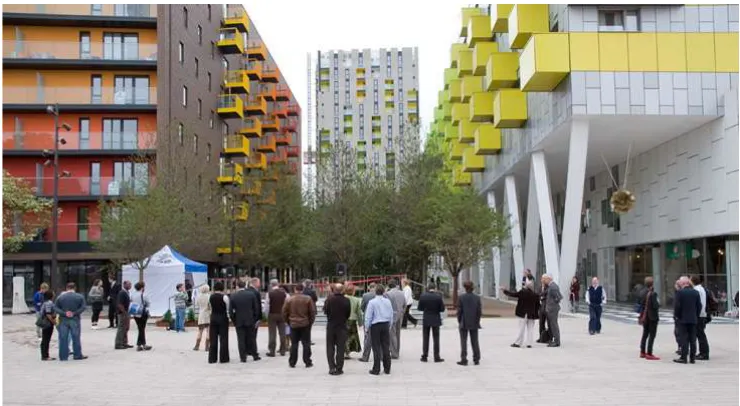
The 2008 European Prize for Urban Public Space was attributed to the Barking Town Square, a project by muf architecture/art in the East London borough of Barking and Dagenham. In the reports following the announcement of the winner, the jury’s chair, architect Manuel de Sola-Morales, is quoted saying that the jury wanted to valorise ‘not a design, but a process, a methodology that seeks to combine the old with the new, the private and the public and the citizen’s relation with architecture’ 1 Explicitly distancing itself from public space as a physical thing, the jury encouraged the notion of public space as a boundless territory which responds to and creates new typologies, as action, as well as a discursive field whose polyphony is orchestrated by a design project. This paper will periodically come back to Barking Town Square - the subject of a fieldwork-based case study by the author between 2009 and 20122 -, but for now the Square serves as a case for Sola-Morales’ argument that ‘all urban space is more or less public’ (Angles, 2010: 25). The Square is a space-time marker for the 2008 European Prize discourse that saw the concept of ‘public space’ becoming diffuse and begging the question of its definition. This discourse highlighted the fluidity of the concept of public space and its multiple ambiguities: those between material and social, public and private, and the design object and its production. Public space as a design preoccupation has always been fascinating because of the overlap between a discursive public realm (communication, politics) and a physical public realm (material configurations). Furthermore, the idea of public space is continuously marked by the blurring of public and private boundaries, strict theoretical denominations that tend to dissolve with actual use and reveal internal contradictions buried within the concept.
To start any discussion, the word ‘public’ has to be situated in a particular context to acquire any precision. Considering the ‘public realm’, an extensive field that blurs discourse with spatial organisation, social and political theorist Jeff Weintraub points to the impossibility of formulating a ‘grand dichotomy’ with public/private. Weintraub highlights four conflicting and overlapping paradigms for the dichotomy, and states that the distinction is nevertheless useful if only because its terms of reference, ‘public’ and ‘private’, inevitably imply meaning and our society is structured along the ambiguity of these terms (Weintraub, 1997: 37). Defining public space raises similar issues where the reliance on a precise division between public and private can only be contextual and partially accurate. As Weintraub notes, the concept of ‘public space’ is further
problematised given the fact that the city is both the object of study and the metaphorical source of many of the key concepts of Western social thought and political theory
(Weintraub, 1997: 26).
Calling Barking Town Square a ‘freely accessible and pedestrianised public forum’ (Fraser, 2012: 20) signals a particular conception of public space that ties the project with an archetype of Western urban and political form rather than its immediate context. The
1 Sola-Morales is quoted in Serra, C. (2008, April 30). ‘Espacio público sin maquillar’, El País, p. 48. The
original Spanish reads: ‘Hemos querido valorar en este premio no un diseño, sino un proceso, una manera de hacer
en la que lo que se busca es combinar lo viejo y lo nuevo, lo privado y lo público y la relación del ciudadano con la arquitectura.’
2 The study involved 60 interviews with designers, developers, politicians, council officials and local
Thomas-Bernard Kenniff
public character of such a Square depends on a range of factors, including time of day, opening hours, weather, bylaws, civic order, commercial activities, inter-subjective relationships, etc. Elsewhere, I have previously described how the identity of Barking Town Square emerges from a series of relationships as space-time figures, or
chronotopes: those of London and Essex, Barking and Dagenham, Old and New Barking, Town Centre and Town Square, as well as chronotopes within the Town Square, in which distinct parts contribute to the assemblage of the whole (Kenniff, 2013). In this sense, the ‘public space’ of Barking Town Square relates to what political scientist
Margaret Kohn describes as a ‘cluster concept’ whose definition is multiple and sometimes contradictory and captures the public-private hybridity of social space in both its
relational multiscalarity and its public character (Kohn, 2004: 11). Here, I propose that it is these ambiguities that define public space as a design problem.3
The paper builds on the contradictions of public space before developing a conceptual framework based on the concept of ‘dialogue’ that responds to and makes sense of these contradictions. This framework is constructed through the work and the legacy of
linguist, literary critic and thinker Mikhail Bakhtin (1895-1975). Bakhtin’s work, spanning diverse areas of the humanities and arts and synthesised as dialogism (See Todorov, 1984; and Holquist, 1990), is particularly relevant to the study of public space, especially when considering the ambiguities described above. Bakhtinian dialogism frames immediacy, presence, corporeality, indeterminacy and incompleteness, as well as establishing
conceptual links between language, speech, space and time. The dialogic, in this sense, is both an ontological and an aesthetic principle that, in contrast to the dialectic, offers no synthesis. In this paper, some of dialogism’s principal concepts (dialogue, ambivalence, carnival, chronotope and heteroglossia) serve as foundation for our conception of ‘dialogical public space’. 4
3 For a specific description of muf architecture/art’s project for Barking Town Square and their design
process in relation to dialogism, see Kenniff, 2016.
4 Brief descriptions of Bakhtinian concepts used in this paper (in alphabetical order):
ambivalence = The result of the conjunction of opposites in dialogue, and whose encounter points in two
directions simultaneously (both/and rather than one/or). Ambivalence is a crucial notion because it underpins
the whole of dialogism: the ambivalence between self and Other, utterance and language, monologue and
dialogue, fear and laughter, sacred and profane, etc. For a discussion of ‘dialogic ambivalence’, see Zima,
1981.
carnival / carnivalesque / carnivalise = A temporary public situation predicated on laughter and ambivalence
brought forth by the conjunction of opposites. Carnival laughter aims at the temporary overturning of
ideals, fears, the sacred, and structures and figures of authority. From the point of view of carnival, strict
oppositions (dichotomies) lose meaning. See Bakhtin, 1984b; LaCapra, 2003; Lachmann, Eshelman & Davis, 1988; and Zima, 1981.
chronotope = A spacetime unit of analysis that ‘makes narrative events concrete’ by ‘materialising time in
space’ (Bakhtin, 1981: 250). Chronotopes can be symbolic (the square), historical (a particular period), or refer to, in our case, the process of writing or of design (the author’s own timespace markers, or the project’s place in time).
dialogism = The system of thought based on dialogue that, in its Bakhtinian version (as opposed to the
dialogism of Martin Buber or Emmanuel Levinas) and for the scope of this paper, encompasses ambivalence,
carnival, chronotope, heteroglossia and polyphony.
dialogue = A mode of relation and encounter between entities that supports that the encounter between them cannot be superseded or transcended synthetically. According to Tzvetan Todorov, the dialogic
principle is that ‘it is impossible to conceive of any being outside of the relations that link it to the other’ (Todorov,
Dialogue, ambivalence, public space
From symbolic types to fields of interactions
Because of blurred boundaries and ambiguous meanings attributed to the terms ‘public’ and ‘private’, public space eludes, perhaps like no other design problem, strict
classification and typology. Attempts at classifying public spaces according to types usually produce longer lists fated to be edited in the future, expanded and adjusted to the
‘evolution of public life’ (see for example Carr, Francis, Rivlin, & Stone, 1992: xi). The problem with classification and typology, however, is that they eventually fail to grasp the full complexity of public space and, as architect and planner Matthew Carmona (2010) writes, the approach tends to produce an infinite complexity of types. As a possible solution, Carmona emphasises the tendency to move away from rigid classification toward more flexible evaluation criteria. He applies four: three are from Margaret Kohn, ownership, accessibility and intersubjectivity, with the fourth being management. Although Carmona’s classification of urban spaces follows the idea of social space oscillating
between the truly public and the truly private, it also begs the question of whether categorisation is ultimately inevitable even when dealing with flexible criteria, since we might keep fixing variables to understand a place according to a particular social concept, time, or value while continually relying on the polarity between uncertain and problematic notions of ‘public’ and ‘private’.
Attributing a specific type to a place is trying to fix something that cannot be fixed. This attribution fixes meaning, but the meaning will change with the use of the place, its management, the connections it fosters, its perception in the local community, and with time. The typological expression ‘town square’, for example, attributed early on to the project for a public space in front of Barking Town Hall, has invited a constant debate between the projection of civic ideals and the reality of social life within Barking Town Centre. The debate can be heard in every attempt by local authorities to give a clear civic identity to the project and the place vis-a-vis the noise of local residents and users
performing and producing spatial configurations or loose identities for it that are patently equivocal to the official discourse. A flexible (rather than a typological) model, however, recognises that ‘public space’ may have more to do with experience and use than regular forms or physical/spatial archetypes like squares and streets. Flexible criteria have their own problems but do seem like the most promising approach to the problem of defining public space as a socio-material construct while engaging the full complexity of spatial production.
In the case of Barking Town Square, conversations with local residents, politicians and designers reveal the social and material ambiguities of public space. While most public reactions imply a physical public realm as a particular location (partly owing to the formulation of the question), they also imply cross-overs between physical and social aspects of the public realm: public life, meeting strangers, crowds, speech, etc. In workshops and interviews, the expression ‘public realm’ (routinely used in the UK to identify a project of public space) rarely referred to an abstract public sphere of political and social interactions isolated from the physical world, and rarely implied ‘public space’ existing beyond and apart from public and social life. In some instances, the expression
heteroglossia = Linguistic stratification and diversification. Every speech act works toward heteroglossia and
against the homogenising tendency of a ‘unitary language’ (Bakhtin, 1981: 272) by inflecting language with tone, genre, position and affectation.
polyphony = A plurality of equal and unmerged voices within the same subject, object or event. Polyphony
Thomas-Bernard Kenniff
was used multiple times by the same person to describe different concepts, or objects.5 This type of ambiguity, implying both physical and social elements, expresses the idea that working on public space projects implies making propositions about the organisation of society.
The relationship between physical, spatial and social aspects of public space must be framed appropriately. Criteria beyond the physical properties of place are relevant to how we conceive public space. It is no longer appropriate to understand public space as a purely physical aspect of cities, a given stage for the enactment of human interaction (Crang & Thrift, 2000: 3);6 nor is it appropriate to extend a set of typological locations and settings to support new aspects of social life (Hajer and Reijdorp, 2001: 16).7 Rather, ’public space’ can be understood through Henri Lefebvre’s work as both physical and social, a production of human society, where morphological elements express specific social production processes, and a reciprocal production of social behaviours through space (Lefebvre, 1991; see also Paquot, 2009). And nor can public space be conceived without addressing theoretical models for which human and non-human aspects have reciprocity and share agency; the city as an enactment of material and
socio-technical assemblages of ‘heterogeneous actors, material and social aspects’ (Farías, 2009: 14). Geographer Ash Amin argues the same about public space saying that the concept should include the total dynamics, human and non-human, of a public setting (Amin, 2008). From these positions, which derive in part from assemblage theory and actor-network theory, we can take the necessity of treating human actors and human constructs (language, culture, norms, structures, design, technology, etc.) reciprocally with actors exterior to (or not immediately tied to) human beings or culture (ecosystems, ‘nature’, weather, other living beings, substances and materials, etc.), as well as material/immaterial relationships, new technologies, digital and virtual spaces. ‘Public space’, then, moves irrevocably from the physical thing to the thing in becoming, from the type to the field: Seeing public space in this way, as an enactment or a performance, suggests that ‘there is no archetypal public space, only variegated space-times of aggregation’ (Amin 2008: 9). The scope, here, is enormous, but the above lines of thought bring up the necessity to develop models that address the complexity of public space or, put differently, that address the fields of interactions from which public space emerges.
Voice and dialogic ambivalence
As will be developed below, Bakhtinian dialogism offers a promising way of dealing, in part, with this complexity by focusing on human actors (their actions and behaviour)
5 An architect who worked on Barking Central, the mixed-use regeneration project that includes Town
Square, referred to the public realm as: the freely accessible built environment (‘…The more you put on the
site, the more you could pay for the public realm…’), the realm of information accessible to any UK citizen (‘…Every planning application has to be put into the public realm…’), and the space of social interaction (‘…The principles of the public realm are…routes here, big space here, big space there, something tall there, library and police station here, and allowing things to knit through.’).
6 Crang and Thrift propose that space has to be understood as process rather than a given abstract
category.
7 Hajer and Reijdorp write that thinking about public space at the turn of the millennium is determined by
Dialogue, ambivalence, public space
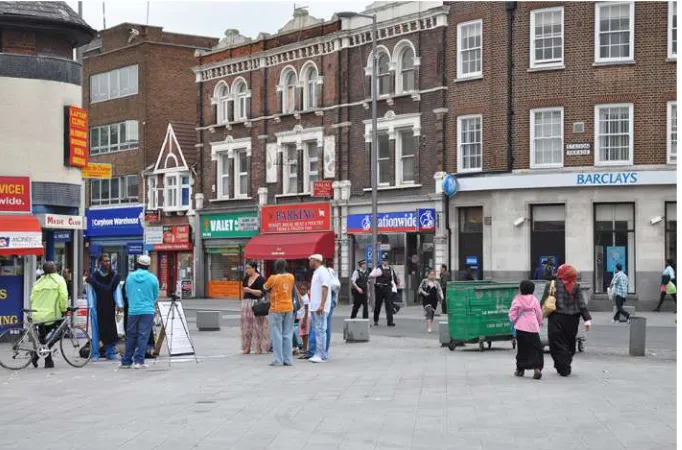
while opening the possibility to read discourse and intention in the organisation and ordering of various spatial contexts. What ties human actions and spatial contexts together in ‘dialogue’ is ‘voice’ and ambivalence. Not solely the voice of the person, but the communicative capacity of any entity8 and the way this ‘act’ actualises both a specific local context and a generic social context. In the case of Barking Town Square, the paper looks at how speech acts and discourses parallel the material (physical, spatial) project for public space as sets of ‘voices’ that come into interaction, agreement and (or) conflict.9 A public space like Barking Town Square should be understood as a product specific to its particular local context, culture, and political organization. It is a particular enactment or assemblage in space and time, a produced space, or process, rather than an architectural ‘thing’. The meaning we attribute to the Town Square, or to any other place, is then accredited to its production, resulting from a dialectical relationship between objects and social practices. This is an important step in developing the background for a dialogical theory of public space, because it sets up a question about the relationship between space and dialogue and the accounting for myriad contributing actors. It would be impossible, for example, to dissociate Barking Town Square from the official views of the London Thames Gateway Development Corporation and its development production processes and biases from the clearly conflicting public use of the Square as a rallying point by rioters and looters during the 2011 London riots.10 But the scale and content of these views conflict only if we see public space as a given fixed entity.
The kind of telescopic reach described above between the scales of territorial agency and strategy and immediate local action enfolded in the production of public space illustrates, once more, the complexity of any attempt at classifying public spaces. Categorisation at any time leads to a fragmentary understanding of public space. It should always be possible to understand public space as a momentary production whose design, social, political, cultural, and (or) financial aspects overlap definitive boundaries. Ideal projections of and aspirations for public space are thus constantly challenged or affirmed by use and experience. Drawing an analogy with geographer and urban theorist Edward Soja’s description of the socio-spatial dialectic (Soja, 1980), it is possible to say that ideal public space and real (lived) public space involve, underpin and pre-suppose each other; they reciprocally, continuously express and affect each other. The meaning of any public space, then, is worked at in the problematic—and non-synthesisable—relationship between authority and experience, and between ideals and their real counterparts. The fact that this relationship cannot be synthesised is one of the fundamental principles of the dialogic: ‘dialogue’ means an ambivalent relation between entities that are neither subsumed into nor transcended by the encounter. Public space, in other words, acquires form and meaning dialogically. The next sections of this paper address this proposition.
8 Bakhtin criticises the tendency of logically (structurally) defining all relations between entities and the
necessary ‘depersonalization’ of the process. He, instead, hears ‘voices in everything and dialogic relations among them’ (Bakhtin, 1986: 169).
9 The particularities of Bakhtinian dialogism and Barking Town Square are two markers, therefore, for the
scope of this paper, its potential and limitations in addressing the full complexity of public space. The aim, here, is an initial exploration into what ‘dialogical public space’ could mean so that it may eventually complement and lead to further productive encounters with other models for public space.
10 The London Thames Gateway Development Corporation was set up by the UK government between
2004-2013 to oversee the urban development of a portion of the Thames Gateway area (including Barking Town Centre and the Lower Lea Valley, the 2012 Olympics’ site). Its CEO, Peter Andrews, in a personal