A New Method of Technical Analysis to Optimise the Design of
Low Impact Energy Systems for Buildings
Roberto De Lieto Vollaro, Matteo Calvesi, Gabriele Battista
*, Luca Evangelisti, Paola Gori,
Claudia Guattari
University of Roma Tre, Department of Engineering, Via Vito Volterra 69, 00146 Rome, Italy.
Received 11 June 2013; received in revised form 2 July 2013; accepted 2 September 2013
Abstract
Energy consumption for civil constructions represents about 40% of total energy requirements, so it is necessary to achieve the goal of energy savings and the consequent reduction of greenhouse gases emissions. The study in content aims to provide a design methodology enables to identify the best plant configuration for buildings from a technical, economic and environmental point of view. To assess validity of the calculation model, an analysis of an historical building was carried out in combination with two softwares of proven reliability: TRNSYS, used to evaluate the thermal demand of users, and RETScreen, used to estimate the validity of the chosen energy model.
Keywords: RETScreen, TRNSYS, historical buildings, energy efficiency, conditioning, CCHP
1.
Introduction
The energy requalification of an historical building has always been problematic due to the existing architectural restrictions. Indeed, on the one hand, we try to improve the energy performance of the building in order to reduce greenhouse gases released into the environment; on the other hand, we need to respect the historical-cultural aspect of building. This problem is not new, of course, but its importance has been increasing as the time goes by, especially for increasingly stringent restrictions given by the rules to save energy, both nationally and internationally.
The system Building-Plant needs energy to maintain the internal conditions. A large amount of this energy is wasted because of the poor efficiency of the plants and poor energy performance of facilities. This phenomenon represents a serious expense weigh on our energy network consumption. A high consideration has to be given to the environmental impact. When the energy consumption due to the use of the conventional primary sources increase (gas, oil, etc.), the pollutants amount released in the environment increase, too. Saving energy in buildings is, therefore, the world objective to reach sustainable development of the whole community in the near future.
The classical approach involves an energy loads analysis of the structures under steady conditions, and a consequent planning of energy requalification project of the building according to technicians’ experience.
Very often, the design choices have to take into account different kind of restrictions and requirements that do not allow achieving the best solution. This is because of the lack of a prospective analysis of feasibility which allows a comparison of energy, environmental and financial data between different design and plant assumptions [2, 9].
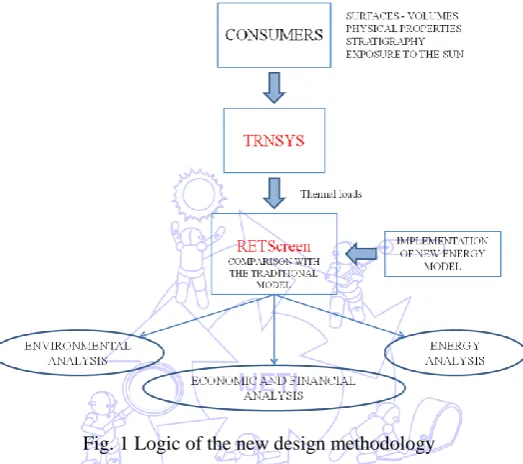
In this study, it has been propose a new procedure which allows reaching the optimal plant configuration for the building. This new approach schematise in Fig. 1 where we considered an integrated use in series of two scientifically validated calculation methods (TRNSYS [3] and RETScreen [27]). This fact allows us a prospective analysis of feasibility; the first step is the definition of the input data relating to the user such as calculation of surfaces and volumes, physical properties, stratigraphy and sun exposure [23-26]. Following is possible to determine the energy loads of the structure in dynamic conditions through the TRNSYS, in order to simulate the real needs of the structure, in function of its use. Thus, output data obtained are used as an input in the calculation model RETScreen that allows to compare a traditional model of subservience and different new concept systems configurations from the energy, environmental and financial point of view, with an analysis of investment, operation and maintenance costs that allows to determine the economic benefit of intervention and then the feasibility of the investment.
Fig. 1 Logic of the new design methodology
Traditional methodologies, today considered valid, cannot faithfully reproduce the variation of climatic conditions and inertial properties of the structures, given that the calculation runs under steady conditions. Through TRNSYS is possible to obtain more accurate results that allow to achieve a correct coupling Building-Plant. Furthermore, the traditional methodology often leads to choose a conventional plant while RETScreen allows getting a financial-economic assessment for innovative energy systems and low environmental impact. Especially, for complex structures often enslaved by centralized plants, computational analysis can help the design phase and the optimal choice of intervention through comparison of the data returned by the calculation model RETScreen. Thanks to TRNSYS, it’s possible to get a correct calculation and dimensioning of the structure energy demand that allows us to provide a financial and economic analysis more accurate than the traditional model.
2.
Calculation of thermal loads with TRNSYS
To achieve the technical and economic convenience of a plant requires a specific and accurate analysis of the electrical, heating and cooling loads needed by the user. This involves the evaluation of the maximum power demand and daily, monthly and seasonal load curves.
To assess the requirement of thermal power by the building, it is necessary to estimate the building’s total heat loss during the year. Using TRNSYS software is possible to determinate the heat loads of the building in dynamic conditions unlike traditional software where the calculation runs in steady conditions with consequent less accuracy owing to the impossibility to reproduce the variation of climatic conditions and inertial properties of the structures. Therefore, with the TRNSYS is possible to obtain more accurate results that allow you to achieve a correct coupling Building-Plant.
As the first step, the procedure adopted was an analysis of the structural and heat engineering features of the building such as the geographical position, the solar exposure, the climate zone, and the outdoor temperature.
The design conditions adopted in this study are as follows: external conditions are in summer 34 °C with 50% RH and in winter 0 °C with 80% RH; internal project condition are in summer 26 °C and in winter 20 °C.
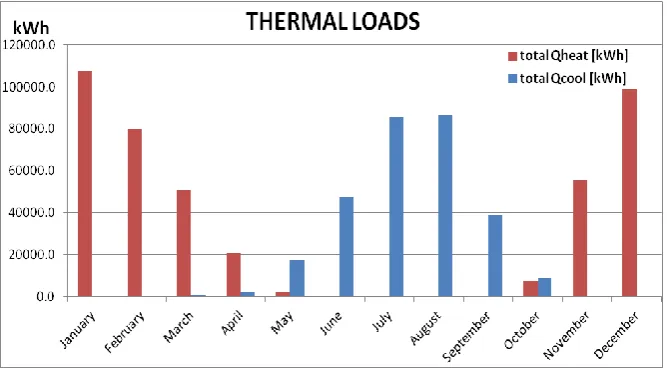
The dynamic thermal loads calculated through TRNSYS are reported in Fig. 2. This graph shows both the thermal loads for heating and cooling in kWh during the year for the examined building.
Fig. 2 Monthly thermal loads required by the user
In order to evaluate the need of electrical power of the building were considered illuminance levels required in each room and the loads required by each utility. Furthermore, appropriate coefficients of simultaneity and utilization have been taken into account. The total electric power installed is 340144 W.
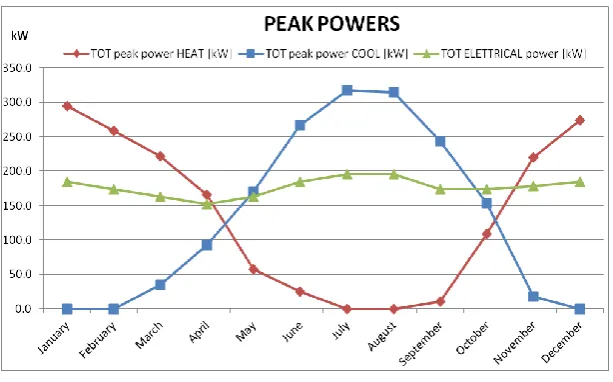
Fig. 3 reports the peak powers during the year of heating, cooling and electrical power for the examined building. In this graph, we can see the peak powers required for heating in winter and cooling in summer of the building are respectively 294.9 kW and 317.4 kW.
The annual energy loads are respectively: 422991 kWh/year for heating annual load; 287141 kWh/year for cooling annual load; 84 kWh/year m2 for heating annual load to useful surface; 57 kWh/year m2 for cooling annual load to useful surface.
Fig. 3 Power trend required by the user
3.
Comparison of different solutions to optimise energy systems with RETScreen
The RETScreen Clean Energy Project Analysis Software (called RETScreen) is composed by software used to determine the feasibility of energy models (including renewable energy systems or high performance) and tools to assess energy efficiency. The software allows the modelling of any power plant for real estate providing output useful data to a technical, economical and environmental analysis in order to make an investment in a 'clean energy' project or cogeneration, as in this case study. The calculation model has been developed by the Canadian Government in collaboration with other governments and with the technical support of several industries, institutions and experts.
The traditional methodology often leads to choose a conventional plant system whereas the features of the RETScreen make possible to assess the feasibility of complex, innovative and low environmental impact systems such as trigeneration [5], which requires an energy diagnosis deepened. The software performs a comparison between a base case, typically the conventional technology or measure, and a proposed case considering not only the economic impact of the choice, but also the consequent reduction of greenhouse gas emissions associated with the change of technology from the base case to the proposed case.
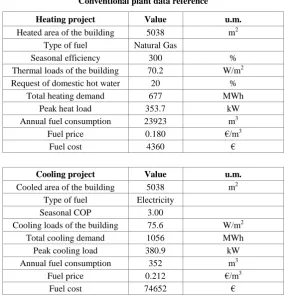
The output data obtained from the TRNSYS become the input data for the RETScreen that allow us to model various plant configurations suitable to the case study. In the first step, we improve in RETScreen the conventional scenario of enslavement of a residential or school users which became the reference case that will be used such as a parameter to define the validity of our new innovative configurations.
Table 1 Conventional scenario of enslavement of the residential or school users taken as reference
Conventional plant data reference
Heating project Value u.m.
Heated area of the building 5038 m2 Type of fuel Natural Gas
Seasonal efficiency 300 %
Thermal loads of the building 70.2 W/m2 Request of domestic hot water 20 %
Total heating demand 677 MWh
Peak heat load 353.7 kW
Annual fuel consumption 23923 m3
Fuel price 0.180 €/m3
Fuel cost 4360 €
Cooling project Value u.m.
Cooled area of the building 5038 m2 Type of fuel Electricity
Seasonal COP 3.00
Cooling loads of the building 75.6 W/m2
Total cooling demand 1056 MWh
Peak cooling load 380.9 kW
Annual fuel consumption 352 m3
Fuel price 0.212 €/m3
Fuel cost 74652 €
Once modelled thermal, electrical and cooling production plant through conventional configurations, it was made a comparison with alternative energy systems for the case study that use innovative technologies in order to obtain a low energy impact. This has been aimed to reach an energy saving and a consequent reduction of greenhouse gases emissions. For the case study, three possible configurations of trigeneration plant were considered: with an Internal Combustion Engine, with Gas Turbine, with Fuel Cells.
Once implemented the energy model all cost items have been introduced, such as initial, management and annual maintenance costs [20]. Starting from these specifications, it was possible to evaluate year to year savings attributable to each type of plant compared to the reference; also, taking into account the incentives imposed by law.
The financial plan rated for a project life 15 years long, taking into account the current financial parameters (inflation rate, discount rate and rate of indexation of fuel). The financial incentives which can used for this kind of cogeneration plant (> 200 kW) are White Certificates and Credit for reduction of greenhouse gases. [8]
It is important to remind that all cogeneration plants with "high efficiency" for electric power up to 200 kW, can take advantage of the service “Net metering” in Italy. Plants characterized by a capacity are greater than 200 kW can still sell electricity to the grid at favorable conditions laid down under the “Withdrawal dedicated” [19].
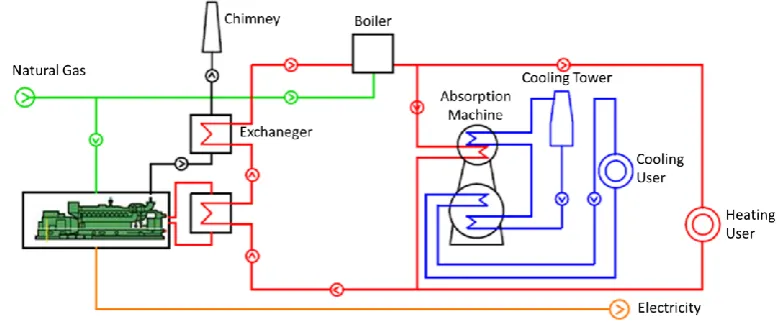
Fig. 4 Block diagram of the trigeneration plant
Technological progress, thanks to the constant research in this field, has resulted that trigeneration plants afford to offer an efficiency superior to 90%, low environmental impact, low noise and, thanks to electronics, greater ease of use and management. The fundamental performances of a cogeneration plant are expressed through its electrical efficiency, the ratio between the net electricity produced and the energy of the fuel used, and its thermal efficiency, the ratio between the useful thermal energy and the energy of the fuel used [11]. The sum of the two efficiency expresses the overall performance of the cogeneration plant and it represents the portion of the fuel energy converted into useful energy:
ηcogen = (Eelectricity + Ethermal) / Efuel = ηel + ηth (1)
CHP is a technological alternative to the conventional plant that is more frequently present in the civil contest. In fact, the conventional solution is currently most prevalent in urban areas to satisfy the energy needs of civilians [7], is represented by the connection to the electricity grid. It happens to meet the demand for electricity and the use of centralized or autonomous boilers, to meet the demand of thermal energy relative and the production of domestic hot water. The diffusion of cogeneration technologies in domestic residential requires an effective convenience from the energy, economic and environmental point of view.
4.
Analyzed configurations and results
The first scenario consideres a use of a combustion engine with a total recovery, which concern the exhaust gas, recovered heat from the coolant, and the recovery of the lubricating oil [10, 14, 15, 17].
In this system, shown in Fig. 5, the full heat recovery from the engine will take advantage of the thermal energy output at different temperature levels [10]. In the moment in which the electricity demand exceeds the availability provided by the cogeneration plant, the system is able to exchange and then receive energy from the electrical grid. As for the thermal energy peak load, the system has assumed a gas boiler relief (installed power of 498 kW) and refrigeration compressors (installed power of 104 kW with seasonal COP of 3.87) regarding the appli cation of cold. The total power of the engine is equal to 852 kW, 330 kW than electricity while the recoverable at 120 °C equal to 358 kW. This model is able to reach an overall efficiency of 81%.
The thermal energy required to satisfy the hygrometric comfort of users in winter is transformed, in the summer, in cooling energy, thanks to absorption machines. The installed power of the absorption machine (single -effect), in this trigeneration plant, is equal to 348 kW with a seasonal COP of 0.7.
The second case analyzed with RETScreen is characterized by a cogeneration plant based on gas turbine [1]. Regarding the production systems of electrical and heating energy, the same machines used in the previous case are used. The heat recovery is possible thanks to the high temperature of exhaust gases leaving the turbine [10]. Also, in this case energy parameters, investment, operating and maintenance costs and annual pollutant emissions (tCO2 / MWh) were analyzed. In this case, we calculated an installed power of 1330 kW, an electric power of 400 kW and a power recoverable at 280 °C equal to 358 kW. It was necessary to use an installed capacity greater than the internal combustion engine because a significant reduction in power has greatly increased the initial inves tment costs, which for turbines raise exponentially [16, 18]. The values of efficiency, achieved in this configuration, are equal to 71%.
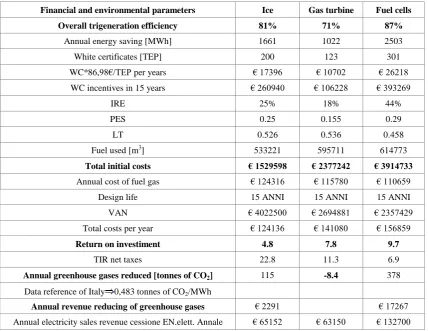
Table 2 Comparison of the different trigeneration plants
Financial and environmental parameters Ice Gas turbine Fuel cells
Overall trigeneration efficiency 81% 71% 87%
Annual energy saving [MWh] 1661 1022 2503
White certificates [TEP] 200 123 301
WC*86,98€/TEP per years € 17396 € 10702 € 26218
WC incentives in 15 years € 260940 € 106228 € 393269
IRE 25% 18% 44%
PES 0.25 0.155 0.29
LT 0.526 0.536 0.458
Fuel used [m3] 533221 595711 614773
Total initial costs € 1529598 € 2377242 € 3914733
Annual cost of fuel gas € 124316 € 115780 € 110659
Design life 15 ANNI 15 ANNI 15 ANNI
VAN € 4022500 € 2694881 € 2357429
Total costs per year € 124136 € 141080 € 156859
Return on investiment 4.8 7.8 9.7
TIR net taxes 22.8 11.3 6.9
Annual greenhouse gases reduced [tonnes of CO2] 115 -8.4 378
Data reference of Italy 0,483 tonnes of CO2/MWh
Annual revenue reducing of greenhouse gases € 2291 € 17267
If one wishes to satisfy the hygrometric comfort of the building through a "Low-Impact" configuration, it is possible to introduce a fuel cell at high temperature in the trigeneration plant. In this case, the aim is to increase the overall efficiency to reduce the consumption of fuel and greenhouse gases. The FuelCell Energy (FCE) operates in the field of Molten-Carbonate Fuel Cells (MCFC) and has developed a technology known as DFC, Direct Fuel Cells, in which the process of reforming the fuel (natural gas, biogas, coal gas) occurs within the cell. The program of the FCE is based on products development for the distributed power generation market for applications below 40 MW. In the case of cogeneration applications total efficiencies that can exceed 80% are achieved. The fuel used in this case study is the methane gas [17]. Using these high-temperature cells, the initial and annual costs will be increased compared to the other configurations, there is a need to replace the stack after only four or five years of operation [22]; this issue is caused the corrosion and the high thermal stress the stack is subjected to. The installed capacity is equal to 1064 kW, the electricity is equal to 500 kW while the recoverable downstream of the electrolytic process is 423 kW. With this configuration an overall trigeneration efficiency of 87% is reached.
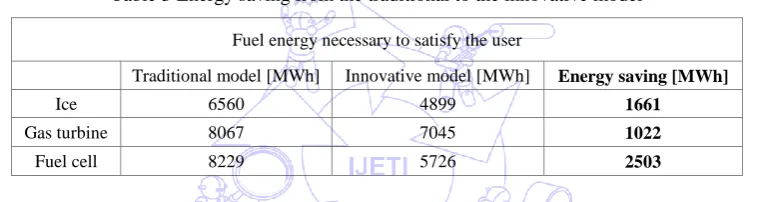
The analyses made are summarized in Table 2 which shows the economic/environmental comparison between the different trigeneration plants taken into account. Moreover , Table 3 shows the energy saving from the traditional to the innovative model for the systems taken in consideration.
Table 3 Energy saving from the traditional to the innovative model Fuel energy necessary to satisfy the user
Traditional model [MWh] Innovative model [MWh] Energy saving [MWh]
Ice 6560 4899 1661
Gas turbine 8067 7045 1022
Fuel cell 8229 5726 2503
The analyses made have shown that the most suitable solution for the trigeneration plant is the use of an internal combustion engine (ICE). This conclusion was reached with the aim of finding a meeting point among the technical, economic, and environmental analysis performed. With this configuration, it is possible to reach values of an overall cogeneration efficiency of 81%. From an economic and financial point of view, the choice results in a low initial investment compared to the other configurations and also an economic return on investment after only 5 years. The chosen configuration has the property of conjugate perfectly with the balance between electricity and thermal required by the user (the relationship between electrical energy and thermal energy equal to 0.7); also, this configuration can effectively meet the demand of thermal energy at a low temperature (<120 °C) required for domestic heating.
Regarding the emission values, the ICE is not the choice for a lower environmental impact compared to other layout; however, it has a good compromise compared to the configuration with the gas turbine. Using an internal combustion engine in Total recovery mode you get to reduce the CO2 emissions of about 115 tonnes compared with the Italian average reference that takes into account the traditional model of enslavement.
these requirements are difficult to meet because the thermal and electrical energy for each building are satisfied in a single and separate approach [13]. If it is considered the possibility to meet the hygrometric comfort of each building with a medium power plant, the situation will be changed. In the near future, it will be possible to size a single heating and electric production for a residential area, neighbourhood or group of buildings [6]. This new concept could lead to several advantages: higher efficiency than any other heating plant; specific fuel consumption reduced; significant environmental benefits due to a lower CO2 emissions than the national average, especially in the urban context; greater environmental benefits with a renewable fuel such as biogas instead natural gas (and consequently, there is the possibility of access to the Green Certificates [8]); operating and maintenance costs are shared with many users.
5.
Conclusions
The study undertaken, as well as the optimal plant configuration for the complex and mainly problematic structure as historical buildings, has allowed us to apply a new method for sizing and design thermo-mechanical systems that have low impact energy, such as trigeneration plants or other innovative systems with a lacking know-how. Indeed, the software TRNSYS allows us to perform a dynamic and accurate analysis of the thermal loads dispersed by the user during the course of the year, whereas the software RETScreen permits an energy and environmental assessment and preliminary design rather flexible and accurate.
Thanks to the two software used in series (TRNSYS and RETScreen), it was possible to obtain a new method to estimate the economic and environmental feasibility of a power plant, also for complex and newly developed plants. Furthermore, this new methodology allows an evaluation of the economic and financial prevision with an immediate feedback in the numerical software, with different levels of accuracy depending on the number of input data (all types of costs or credits acquired, etc.).
References
[1] F. Armanasco, “Sperimentazione sul sistema trigenerativo con microturbina a gas e frigorifero ad assorbimento,” CESI Ricerca, 2009.
[2] Ing. Bruno Frinzi, “Studio di fattibilità tecnico-economica di un impianto di rigenerazione in abbinamento ad un impianto fotovoltaico di uno stabilimento industriale,” Protecnos, 2009.
[3] A. Simonetti, G. Corallo, R. Caria, L. Cipolletta, “Realizzazione dell’ impianto di solar cooling dell’ edificio F51 del centro ENEA della Casaccia - Monitoraggio dell’Impianto,” Enea, 2010.
[4] “Analisi del potenziale della microgenerazione in Italia,” Federazione Italiana per l’uso razionale dell’Energia, FIRE, 2008.
[5] E. Macchi, S. Campanari, P. Silvia, “La micro generazione a gas naturale,” Polipress, 2010.
[6] G. Tomassetti, “Generazione distribuita e cogenerazione,” Le barriere alla diffusione – La termotecnica, 2003.
[7] C. Belvedere, “Unità di micro generazione e piccola – Installazione ed esercizio – Procedure autorizzative semplificate,” Documento di proprosta, Cogena, 2007.
[8] D. Di Santo, “Gli incentivi per l’efficienza energetica,” Corso Enea, FIRE per Energy Manager, 2006. [9] M. Grecchi, “Fiscalità e incentivi sulla micro generazione,” Senertec Gmbh - gruppo CTI, 2006.
[10] Nikmat Ecopower, “Unità di cogenerazione e rigenerazione a gas naturale e biogas,” Divisione di DSF Tecnologia, 2005. [11] F. Bonfà, G. Caruso, I. De Santoli, G. Lo Basso, “Studio di un esempio dimostrativo di impiego di tecnologie
energeticamente efficienti,” Enea, Citera, 2010.
[12] M. Bianchi, P. Ruggero Spina, “Integrazione di sistemi cogenerativi innovativi di piccolissima taglia nelle reti di distribuzione dell’energia elettrica,” termica e frigorifera, Enea, Università di Ferrara, 2010.
[13] John A. Jacobs III, M. Schneider, “Cogeneration application considerations,” GE Energy, 2009.
[16] S. Consonni, “Optimization of cogeneration systems operation. Part A: Prime movers modelization, in: Proceedings of the American society of mechanical engineers Cogen-Turbo international symposium on turbomachinery, combined-cycle technologies and cogeneration,” Nice, France, 1989.
[17] J. Klimstra, C. Hattar, “Performance of natural gas. Fueled engine heading towards their optimum, in: Proceedings of the American society of mechanical engineers internal combustion engine division,” Spring Technical Conference, Aachen, Germany, ASME, 2006.
[18] N. Petchers, “Combined heating, cooling & power handbook. Technologies & applications. An integrated approach to energy resources optimization,” Liburn (GA), The Fairmont, 2003.
[19] L. Castellazzi, B. Di Pietra, “Studio e progettazione di un impianto di trigenerazione dimostrativo presso il centro ENEA di Casaccia,” Enea, 2010.
[20] Externe, “Fuel cycles for emerging and end-use technologies,” Transport & Waste, 1999.
[21] E. Cardona, A. Piacentino, “Optimal design of CHCP plants in the civil sctor by thermoeconomics,” Elsevier Applied Energy, 2007.
[22] M. Rocchetti, “Celle a combustibile Stato di sviluppo e prospettive della tecnologia,” Enea, Ministro dello Sviluppo Economico, 2009.
[23] L. Chiara Tagliabue, F. Leonforte, J. Compostella, “Renovation of an UNESCO heritage settlement in southern Italy: ASHP and BIPV for a ‘spread hotel’ project - Elsevier applied energy,” 2012.
[24] D. Bosia, “Energetic behaviour and renewable energy in traditional rural architecture,” UNDP Croatia. United Nations Development Program, 2011.
[25] G. Castanheira, L. Bragança, “Urban renovation of portuguese historical centres,” Universidade do Minho, Departamento de Engenharia Civil, 2012.
[26] “BP statistical review of world energy,” bp.com/statisticalreview, June, 2012.