I
I
n
n
t
t
e
e
r
r
n
n
a
a
t
t
i
i
o
o
n
n
a
a
l
l
J
J
o
o
u
u
r
r
n
n
a
a
l
l
o
o
f
f
S
S
c
c
i
i
e
e
n
n
c
c
e
e
s
s
Research Article
(ISSN 2305-3925)
Volume 2, Issue Apr 2013
http://www.ijSciences.com
A Novel Accelerating Algorithm and Its
Implement in Real Sequence FFT
Hong-gui Deng
1,2
, Sheng-wei Guo
1
, Jian Duan
3
1
Xinjiang Nonferrous Central South University Joint Research Institute, Urumqi, 830000, China
2
Department of Electronics and Information, Central South University, Changsha, 410083, China
3
State Key Laboratory of High-performance Complex Manufacturing, Central South University, Changsha 410083, China
Abstract: We propose an improved FFT algorithm, which costs only a half of the calculation time compared with the conventional FFT if the input data are real numbers. The algorithm is optimized by
dividing 2N data points into 2 separated groups through parity. The odd part and even part of the 2N data points are used as the real part and imaginary part of a new complex data sequence with N data points. After
FFT of this new data sequence, the FFT of the original 2N data points can be calculated through formulations. From our experiment based on FPGA, this new implementation is more effective than conventional FFT by saving half of calculation time.
Keywords: FFT, real sequence, FPGA
0 Introduction
Discrete Fourier Transform (DFT), which is
employed to transform the signal from the time domain to the frequency domain, is a key tool in
digit signal processing, especially in the areas of acoustics, electronics and imaging processing, which are driven by the trend of the increased
using of filtration, frequency spectral thining, and spectrum estimation.[1~3]
One of the most efficient methods of performing this transformation is the Fast Fourier transform (FFT), which was proposed by Cooley and
Tukey in 1965. The Simplest and most common form of FFT is the radix-2 butterfly algorithm.
Each butterfly consists of multipliers and adders that calculate two input points and give two
output points based on the coefficients chosen from a sine table. The amounts of multiplication computation in N-points DFT are reduced from
N2 to (N/2)*log2N, which greatly reduce the
computing time of the DFT. [4,5]
Unfortunately, conventional FFT only considers
that the input data is a complex data sequences. However, real data sequences are very common
in engineering fields.[6,7] The typical solution for this problem is to fill the imaginary part with
zeros, which make computing efficiency relative low, A new method is introduced in this paper based on the symmetry and periodicity of Fourier
Transform (FT) to improve the computing efficiency. In the algorithm, a 2N-point sequence
is divided into two separated groups by the parity and for a new complex N-point sequence. We can obtain the FT of the original 2N-point data
through calculating this N-point complex sequence to save the computing time.
We can implement high-speed and real-time digital signal processing on FPGA. Based on the
improved algorithm, our experiment shows that it can save both memory and computing time.
1 The principle of present real sequence algorithm
Transform (FT) of the {x(0), x(1),┅, x(N-1) }
where WN ej(2 / N). Then
1
( ) ( ) , 0,1, ..., 1 0
N nk
x k x n WN k N
n
(1)
Let Xr(k) and Xi(k) be the real and imaginary
parts of X(k)= Xr(k)+ jXi(k).
FT can transform the data sequence
x(0),x(1),…x(N-1)(time domain sample) to the data sequence X(0),X(1),…,X(N-1), which are
defined in frequency domain. According to the definition, x(n) is a complex sequence. In a practical practice, if input is a real sequence, the
traditional way is to fill the imaginary parts with zeros.
We describe a new algorism, which can save a half of computing time if the input data sequence
is a real data sequence. Provided that x(n) is a 2N-points real sequence, it can be divided into 2 separated groups by the parity. The data with odd
serial numbers can form a sequence g(n), and the data with even serial numbers can be used to
built another new sequence h(n). Both g(n) and h(n) are N-points real sequences. G(k) and H(k) are Fourier transform sequences of g(n) and h(n)
by FFT, respectively. According to the FFT Radix-2 algorithm of Cooley-Tukey, we have:
( ) ( ) K ( )
X k G k WN H K k 0,1, ...,N1 (2)
( ) ( ) K ( )
X kN G k WN H k k 0,1, ...,N1 (3) In the process of calculating G(k) and H(k) by
DFT, these formulas can be employed to divide x(n) into 2 groups, continue to implement in the same way until they are 2-points sequences. In
the process of computation, the 2-points are calculated by DFT first, stage by stage until
getting the results of original sequence by DFT. The amounts of multiplication computation of this method are N*log22N times, (2N-points
sequence)
2 The principle of the accelerating algorithm for real sequence
In equations (2) and (3), for a division, it is required to calculate the transformed data sequences G(k) and H(k). By observing the
symmetry and periodicity of Fourier Transform, a new method is adopted to transform 2 N-points
real sequences into an N-points complex sequence. The amount of computation can be reduced by half. The principle is given as
follows:
Assuming an N-point finite complex sequence y n( )g n( )ih n( ) and Y(k) is transformed from y(n) by FT defined as:
2 ( / )
1
( ) ( ( ) ( )) 0
j nk N
N
Y k g n ih n
n
e
0 , 1 , . . . , 1 k N (4) Substituting k by N-k, we have:
2 ( / )
1
( ) ( ( ) ( )) 0
j nk N
N
Y N k g n ih n
n
e
0 , 1 , . . . 1 k N (5)
Then, expanding
e
j
cos( )
j
sin( )
we have1
( ) ( ) 2 ( ( ) ( )) 0
1
( ) ( ) 2 ( ( ) ( )) sin 0
cos(2
/
)
(2
/
)
N
Y N k Y k g n ih n
n N
Y N k Y k J g n ih n n
nk N
nk N
k0 , 1 , . . . ,N (6) 1
Since Yr(k) and Yi(k) are the real and imaginary
parts of Y(k)= Yr(k)+j Yi(k), it follows that
1
( ) ( ) 2 ( ) cos(2 / ) 2 ( ) 0
1
( ) ( ) 2 ( ) cos(2 / ) 2 ( ) 0,1,..., 1 (7) 0
1
( ) ( ) 2 ( ) sin(2 / ) 2 ( ) 0
1
( ) ( ) 2 ( ) sin(2 / ) 2 ( ) 0,1,. 0
i
N
Yr k Yr N k g n nk N Gr k n
N
Y k Y Ni k h n nk N Hr k k N
i n
N
Yr k Yr N k h n nk N H k
n N
Y ki Y Ni k g n nk N G k ki n
..,N1 (8)
Since G(k)=Gr(k)+ jGi(k) and H(k)=Hr(k)+ jHi(k),
we have
1
k [ Y N-k Y k (Y N-k Y k )] 2
1
k [ Y N-k Y k (Y N-k Y k )] 0,1,..., 1 (9) 2
G r r j i i
H i j r r k N
i
If Y(k), which is transformed from y(n) by FFT, can be obtained, G(k) and H(k) can be obtained by separation. According to equation (2) and (3),
the transformed sequence X(N) can also be obtained. In the Cooley-Tukey algorithm, the
complexity of transforming an N-point complex sequence by FFT is similar to the transformation of N-point real sequence by DFT, which is lower
than to the transformation of 2N-point real sequence by DFT. Therefore the computational
efficiency will be higher.
3 The Realization of real sequence algorithm
Generally, there are two platforms are typically employed
to perform FFT: DSP and FPGA. Both of them have advantages
and disadvantages. Specifically, the operational speed of DSP is slower than that of FPGA. The
interface of DSP is not flexible, and the enormous storage
demanded during the operation is not efficient. In addition, DSP requires a special external interface to control the chip and RAM that
increase the complexity. On the other hand, the technology is more mature, and the exploitation
cost is lower than that of FPGA. As a result, most of hardware realizations for FFT are to take advantage of DSP. However, with the
development of micro electronics and FPGA, both the operational speed and the capacity of
FPGA have been significantly improved, and multiplier units are embedded into some FPGA devices. As FPGA surpasses DSP in terms of
volume, operational speed and flexibility, it has become the ideal choice of the hardware
realization for FFT algorithms. The FPGA device EP1S20F484C5 of Stratix series of Altera Corporation is used as an example in this paper.
3.1 The frame of real sequence processor
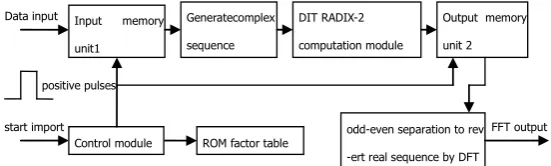
FPGA-based FFT processor includes input memory unit 1, output memory unit 2,
computation module, control module, and ROM factor table, as showed in figure 1. In this design, input is a real sequence. Thus, 2N-point real
sequence should be transformed into an N-points complex sequence for FFT and finally form 2
N-point real sequence is restored by separating odd and even sequence.
3.2 Parallel processor and same address operation
By employing Cooley-Tukey’s DFT Radix-2 algorithm, log2n steps of the butterfly
computation is required to transform an N-point
sequence by FFT, and each step is composed of n/2 butterfly units.
The butterfly units are executed step by step. At
each step, n/2 units are independent and they can be executed in parallel. In this way, the
calculation only requires n/2 butterfly units, which saves internal memory of FPGA and
accelerates the operating speed because of the parallel computing. Meanwhile, the execution of each butterfly unit is not relevant to that of
other butterfly units. Each butterfly can be computed at the same address. And output data
can still be saved at the same units wih the input data. This will save storage space and let searching addresses easily.
3.3 Creation of W factor
In FFT, rotator factor is referred as,
c o s ( 2 / ) s i n ( 2 / ) nk
WN nk N i nk N .
There are two methods to generate rotator factor by:
Input memory
unit1
Generatecomplex
sequence
DIT RADIX-2
computation module
Output memory
unit 2
Control module ROM factor table odd-even separation to rev -ert real sequence by DFT Data input
positive pulses
start import FFT output
a) Directly calculating. The value of rotator factor is calculated each time when is required. This method can save ROM memory.
b) Creating a table for W factor. Because
nk
WN only has n different values, the values of
nk
WN can be calculated in advance and saved in
the ROM of FPGA. The values can be searched when they are requested. This method can
accelerate operating speed. In some real-time signal processing system, operating speed of FFT is very important. Therefore, this method may
have a wide application.
3.4 Complex multiplication units and the improvement
The Input data xxr jxi multiplies rotator
factorW cos jsin , where 2 nk N
cos sin
yr xr xi (10)
cos sin
yi xi xr (11)
Generally, in a calculation period, 4 real number multiplier units and 2 real numbers adder units are required. Equations (10) and (11) can be
modified in this paper to save the amount of computation as follows:
( ) cos (sin cos ) yr xrxi xi (12)
( ) cos (sin cos ) yi xrxi xr (13)
Three values: cosθ, sinθ+cosθ, sinθ-cosθ can be calculated in advance and be saved in ROM.
According to (12) and (13), a normal complex multiplication can be realized only by three real
number multiplications and three real number additions. Because area taken by a real number
adder unit is much smaller than that of real number multiplication, operating speed of the adder unit is much faster than that of multiplier
unit. It will significantly improve the operating speed and save the memory space.
4 Quality Comparison
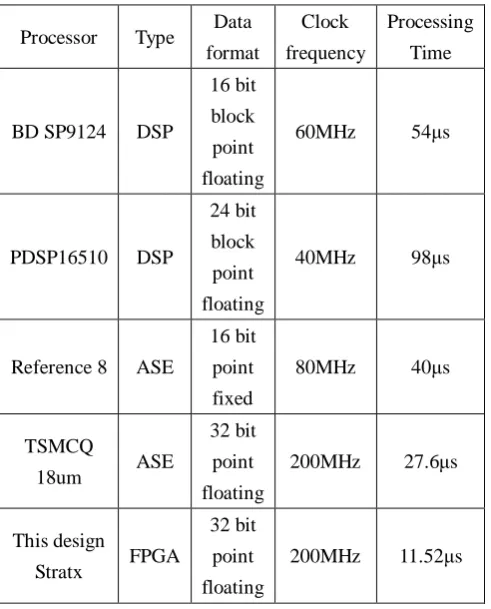
Table 1 is the comparison of some hardware realizations of FFT, parallel stream line butterfly
unit of FPGA device EP1S20F484C5 of Stratix serious can work steadily on the clock of
200MHz. Log2N steps in N-points FFT are
required. Each stage has N/2 butterfly units. In this design, the improved odd-even separated
algorithm is employed. A real sequence with 1024-points is used as an example, it can
transform a 1024 real sequence into two 512-points complex sequences, and there are
total 9 steps, and each step requires 256 butterfly caculations. About T=256×9×5ns=11.520μs is required to finish an FFT of the 1024-point real
sequence.
Processor Type Data format
Clock frequency
Processing Time
BD SP9124 DSP
16 bit
block point floating
60MHz 54μs
PDSP16510 DSP
24 bit block point
floating
40MHz 98μs
Reference 8 ASE
16 bit point
fixed
80MHz 40μs
TSMCQ
18um ASE
32 bit point
floating
200MHz 27.6μs
This design
Stratx FPGA
32 bit point
floating
200MHz 11.52μs
5 Conclusion
Based on two major features of FFT, symmetry
and periodicity, we proposed an improved accelerating FFT algorithm for real sequence
inputs. The algorithm separates a 2-N point into two sequences by parity, then generates a new complex sequence which takes the odd and even
serial numbers of the former sequence as the real and imaginary parts. Subsequently, the
implement of the algorithm based on FPGA is described and the experiment results describe a memory saving and a gain in the performance of
operational speed compared with present methods. Hence, the new algorithm will breed
significant influence in engineering practice.
Acknowledgements
This work was financially supported by Natural
Science Foundation of Xinjiang Uygur Autonomous Region, China (Grant No.
2013211A035).
Reference
[1] S Sukhsawas, K Benkrid. A High-level Implementation
of a High Performance Pipeline FFT on Virtex-E FPGAs
IEEE Computer Society Annual Symposium on VLSI, p
229-230, 2004
[2] Kumhom P. Johnson J.R. Nagvajara P. Design,
Optimization, and Implementation of a Universal FFT
Processor. Proceedings of 13th Annual IEEE International
ASIC/SOC Conference (Cat. No.00TH8541), p 182-187,
2000
[3] Chen he, Zhao zhong-wu. ASIC design of floating-point
FFT pro-cessor[J] Journal of University of Beijing for
Science & Technology:English Version 2004,13(4): 389-393.
[4] LU Jianfeng. Real time Fourier Transform syetem design
based on double DSP[J] Photoelectric engineering,
2005,32(11): 93-96.
[5] Radhouane, R. Liu, P.; Modlin, C. Minimizing the
memory requirement for continuous flow FFT
implementation: continuous flow mixed mode FFT
(CFMM-FFT) 2000 IEEE International Symposium on
Circuits and Systems. Emerging Technologies for the 21st
Century. Proceedings (IEEE Cat No.00CH36353), p 116-134
vol.1, 2000
[6] GAN Liang-cai, DING Ya-hu. CPLD implementation of
1024-point FFT of short-wave wideband channel
simulator[J].Electricity Journal:English version, 2006,15(4):
692-696.
[7] Cepisca, C., Grigorescu, S.D., Covrig, M.,Andrei, H..
About the Efficiency of Real Time Sequences FFT
Computing. Proceedings of the 2007 IEEE Workshop on
Design and Diagnostics of Electronic Circuits and Systems,
DDECS, p 211-214, 2007
[8] M. Rawshi, M.Wojtyski. Distributed arithmetic based
implementation of Fourier transform targeted at FPGA
architectures[C]. Proceedings of the 14th International
Conference "Mixed Design of Integrated Circuits and
Systems", MIXDES 2007, p 152-156, 2007
[9] LIU Guodong,CHEN Boxiao,CHEN Duofang. FPGA
design of FFT processor[J]. Aviation calculation technology,
2004,34(3): 101-104.
[10] KUO JC,WEN CH,WUAY. Implementation ofa
programmable 64-2048-pointFFT/IFFT processor forOFDM
based communication sys-tems[C]. Proceeding of IEEE
International Symposium on Circuits and Systems. 2003:
121-124.
[11] Wang, Yuke;Tang, Yiyan Jiang; Yingtao; Chung,
Jin-Gyun; Song, Sang-Seob; Lim, Myoung-Seob. Novel
memory reference reduction methods for FFT
implementations on DSP processors. IEEE Transactions on