http://www.sciencepublishinggroup.com/j/ajss doi: 10.11648/j.ajss.20190704.11
ISSN: 2330-8559 (Print); ISSN: 2330-8540 (Online)
Characterization of Heart Rate Response During Frontside
and Backside Wave Riding in an Artificial Wave Pool
Maya Saulino
1, Natalie Skillern
1, Mackenzie Elizabeth Warner
1, Antonio Martinez
1, Bruce Moore
2,
Jeff Andrew Nessler
1, Sean Christian Newcomer
1, *1
Department of Kinesiology, California State University San Marcos, San Marcos, United States of America 2Hurley International, LLC., Costa Mesa, United States of America
Email address:
*
Corresponding author
To cite this article:
Maya Saulino, Natalie Skillern, Mackenzie Elizabeth Warner, Antonio Martinez, Bruce Moore, Jeff Andrew Nessler, Sean Christian Newcomer. Characterization of Heart Rate Response During Frontside and Backside Wave Riding in an Artificial Wave Pool. American Journal of Sports Science. Vol. 7, No. 4, 2019, pp. 136-140. doi: 10.11648/j.ajss.20190704.11
Received: August 19, 2019; Accepted: September 21, 2019; Published: October 9, 2019
Abstract:
There are currently no published data describing the kinetics of the heart rate (HR) response during frontside and backside wave riding on a surfboard, or for wave riding bouts longer than 15 seconds. The purpose of this study was to characterize the HR response of surfers performing frontside and backside wave riding in an artificial wave pool that allowed surfers to ride waves for up to 60 seconds. It was hypothesized that HR response would differ between the two surfing orientations, because their levels of complexity are perceived to be different by surfers. Twenty male (n=17) and female (n=3) junior professional athletes (14.7 ± 1.2 years old) participated in this study. Following parental consent, participants completed a questionnaire and were instrumented with a HR monitor (Polar RCX5 Sports Watch), which recorded HR at 1-second intervals. Researchers initiated HR sampling prior to surfer participation in a one-hour surf session in an artificial wave pool (Kelly Slater Wave Co) and synchronized HR with video recordings of wave riding. Seven subjects that did not ride at least one frontside and backside wave were excluded from the analysis. The average duration of the wave ride was 33.2 ± 8.4 seconds. Average and peak HR while wave riding was 174.1 ± 12.6 and 184.9 ±13.0 bpm, respectively. There were no significant differences in HR response or wave riding duration between frontside and backside directions. These results provide insight into the cardiovascular requirements of wave riding in an artificial wave pool.Keywords:
Action Sports, Physical Activity, Physiology, Cardiac1. Introduction
Several studies have described physical activity that occurs during a typical surfing session, yet much remains unknown regarding a surfer’s physiological response to wave riding itself. [1-7] This is due, in large part, to the unique challenges associated with making measurements in the ocean. Surfing occurs in an environment that is inherently complex and unpredictable; storms, swell direction, wind, bottom contour, and tide are all factors that impact the shape of each wave. These shifting forces of nature yield waves that vary significantly in size, shape, and velocity, and these differences preclude direct comparison of performance
to accommodate different levels of surfer. These factors effectively solve both of the primary challenges associated with making measurements in the ocean and establish the wave pool as an ideal location for scientific inquiry into the physiological requirements of wave riding. A greater understanding of the physiological response during this activity may lead to improvements in an athlete’s training and preparation for competition. Study of human performance during wave riding may also help to inform the design of surf competitions in wave pools that can facilitate waves of longer duration.
The heart rate response during wave riding is one index of human performance that may help athletes to understand the physiological demands of this activity and lend insight to their training. Interestingly, brief wave-riding bouts have been reported to elicit average and peak heart rates of approximately 140 and 190 beats per minutes, respectively. [2-3, 6-7, 10] These findings suggest that wave-riding elicits heart rate ranges indicative of moderate to high intensity exercise. However, these data should be interpreted with caution since the majority of studies sampled heart rate at a frequency (5 to 15 seconds) that was lower than the duration of the wave ride. [2, 6, 7, 10] Currently, no data exist with sufficient time resolution and wave duration to thoroughly characterize the kinetics of the heart rate response during wave riding. Therefore, the purpose of this study was to characterize the heart rate response of surfers performing frontside and backside wave riding in the Kelly Slater Wave Pool. Since existing data on wave riding are limited, it was hypothesized that heart rate response would be different between the frontside and backside surfing directions because their levels of complexity are perceived by surfers to be different. However, it is important to note that within the surfing community there is little consensus as to which direction is more difficult.
2. Materials and Methods
2.1. Participants
A total of twenty male (n=17) and female (n=3) junior professional athletes sponsored by Hurley International, ranging in ages between 10-17 years old, volunteered to participate in this study. Written parental informed consent and child assent were obtained and subjects were informed of the benefits and risks prior to participation. All procedures were approved by Institutional Review Board at California State University, San Marcos (#863327-4). Participants completed a one-page surfing history questionnaire, which included questions pertaining to their current surfing activity and experience level. In addition, weight was measured using a SECA 874dr portable scale (SECA, Hamburg, Germany) and height was self-reported by either the parent or participant.
Data for 13 (male n=10 and female n=3) of the 20 recruited subjects were included in the final analysis. Subjects were excluded from the analysis if they did not ride
at least one frontside and one backside wave. In addition, waves with greater than 5% of heart rate data missing were excluded from the analysis. The participant ranged in ages between 12 and 17 years old, with an average age of 14.7 ± 1.2 years old. On average, subjects were 163.0 ± 6.0 cm tall with a mass of 53.23 ± 11.63 kg. Subjects reported an average of 9.8 ± 2.2 years of surfing experience, and 15.92 ± 9.37 hours of surfing per week.
2.2. Experimental Overview
Following completion of the child assent and parental consent forms, subjects were instrumented with a Polar RCX5 HR receiver on their wrist and T31 HR transmitter, which was located around the chest below the pectoralis major muscles (Polar Electro Inc., Lake Success NY). Researchers initiated HR sampling immediately prior to subjects participating in a one-hour surf session in an artificial wave pool (Kelly Slater Wave Co., Lemoore, CA) and recorded the start time to allow for video synchronization. Over the course of the hour, researchers observed the surf session through a live video stream and recorded the exact time in minutes and seconds in which wave riding was initiated and completed for each wave ridden. Initiation of the wave ride was defined as the moment when the subject’s hand released the rail of the board during the pop up and completion of the wave ride was defined as the moment that the bottom of the feet were no longer in contact with the deck of the board. Following completion of the surf session, HR data were uploaded using Polar WebSync Software from the RCX5 HR receiver. In addition, the live-stream time stamped videos of the surf session were archived and synchronized with HR data. Videos were also used to determine wave direction (right or left) and surfer position (frontside or backside) during wave riding HR analysis.
2.3. Statistical Analyses
3. Results
The 13 subjects in this study rode a combined total of 44 waves. Of these 44 waves, subjects rode 23 and 21 waves in the frontside and backside orientation, respectively. Average wave riding duration was 33.2 ± 8.4 seconds and average
duration was not significantly different between frontside and backside (35.0 ± 11.5 vs 31.0 ± 11.5 seconds respectively, p=0.246).
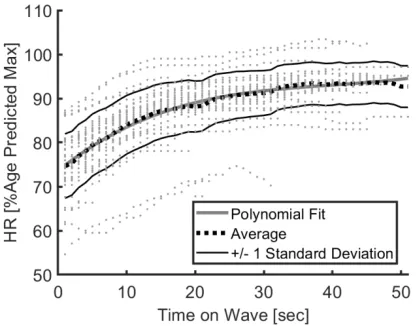
The subjects’ average HR response during wave riding is depicted in figure 1 and was best fit with a fourth order polynomial:
= −1.2394 × 10 + 0.0014 − 0.06 + 1.6549 + 72.565
where P(x) represents the predicted HR and x refers to time spent on the wave (R2=0.4647, standard error of the estimate = 5.87 bpm).
Figure 1. The relationship between heart rate and time on wave. All waves
are presented here (n=44 waves, surfed by 13 athletes) with an average and 4th order polynomial fit. Heart rate is expressed as a percentage of participants’ age predicted max.
Subjects’ average HR while wave riding (all waves combined) was 174.1 ± 12.6 bpm, which represented 85.3 ± 0.1% of their age predicted maximal heart rate. The average HR during frontside wave riding was 175.6 ± 13.5 bpm (85.5± 6.6% of age predicted maximal heart rate) and was not significantly different than the 172.7 ± 15.6 bpm (85.0 ± 4.4% of age predicted maximal heart rate) average HR during backside wave riding (p=0.332).
Subjects reached their average peak HR of 184.9 ±13.0 bpm (90.0 ± 0.1% of age predicted maximal heart rate) at an average wave riding duration of 28.1 ± 7.1 seconds. The frontside average peak HR was 185.1 ± 14.1 bpm (90.5 ± 0.1% of age predicted maximal heart rate) and was not significantly different than the 183.2 ± 15.4 bpm (89.0 ± 0.1% of age predicted maximal heart rate) average backside peak HR (p=0.333). There were also no significant differences in the average duration to reach peak HR between frontside (29.4 ± 10.8 seconds) and backside (26.4 ± 9.0 seconds) directions (p=0.261). Finally, no significant difference in HR rate of increase during the first 15 seconds of wave riding was detected between frontside and backside directions (1.9±0.6 vs 1.8±0.4 bpm·sec-1, respectively, p=0.417).
4. Discussion
Despite the increasing popularity in the sport of surfing, little is known about the kinetics of the heart rate response
during wave riding. In an attempt to characterize the heart rate response during wave riding in a controlled environment, we measured heart rates of thirteen junior professional surfers across twenty-three frontside and twenty-one backside waves in an artificial wave pool environment. The results of this study suggest for the first time that: 1) frontside and backside wave riding do not elicit significant differences in heart rate responses or wave riding duration, 2) the heart rate response during frontside and backside wave riding in youth can be described by a fourth order polynomial fit equation for wave riding up to one minute, and 3) length of wave ride may be influenced by peak heart rate. Taken together, these results provide significant insight into the cardiovascular requirements of wave riding.
Previous data collected in the ocean suggests that wave riding elicits heart rate ranges that are indicative of moderate to high intensity exercise. [2-3, 6-7, 10] Specifically, average heart rates during wave riding have been reported to range between 140 and 150 bpm in recreational surfers. [2, 6-7] Interestingly, average heart rate during wave riding in the current study was 174.1 ± 12.6 bpm, or approximately 85% of the age predicted max HR. One can speculate that these reported differences between average heart rates during wave riding in the ocean and artificial wave pool are likely the result of increased wave riding duration in the wave pool (33.2 ± 8.4 seconds) compared to those previously reported in the ocean (5 and 14-seconds). [8] Greater wave-riding durations in the wave pool may also have contributed to a higher peak heart rate (184.9 ± 13.0 bpm, 90% age predicted max HR) in the current study compared to the average peak heart rate of 171.0 ± 7.5 bpm previously reported while surfing in the ocean. [10] However, it is important to note that methodological differences in sampling rate may also have contributed to these differences, since the heart rate was sampled at 15-second intervals in the Meir et al. study. This is supported by the fact that an average peak heart rate of 190.0 ± 12.0 bpm has been reported at the end of wave riding in the ocean when heart rate was sampled at 1-second intervals. [3] The similarities in average peak heart rates reported in the current study and the Farley et al. study highlight the importance of sampling rate when measuring peak heart rate during relatively brief activities such as wave riding.
the current study provide the first empirical evidence that no significant differences exist in heart rate response during frontside and backside wave riding. These findings suggest that differences in perceived difficulty between frontside and backside wave riding are likely not a result of differences in cardiovascular requirements associated with wave riding direction. It is also important to note that wave riding duration was not significantly different during frontside and backside wave riding (35.0±11.5 vs 31.0±11.5 seconds, respectively, p=0.246). Interestingly, the length of the wave ride seems to have been influenced more by attainment of peak heart rate than surfing orientation. The current data were remarkably consistent; on average the termination of the wave ride (33.2 ± 8.4 seconds) occurred approximately 5 seconds after subjects reached peak heart rate (28.1 ± 7.1 seconds). One can speculate that surfing an artificial wave that requires a surfer to sustain near maximal exercise intensities for up to one minute presents a unique physiological challenge that likely leads to performance deficits and may lead to premature falls. This is supported by evidence that increases in heart rate caused by high intensity exercise lead to short term deficits in postural control. [11-14]
It is important to acknowledge that the current investigation has several limitations that could influence the interpretation of the results. Specifically, our sample size may have limited our ability to detect significant differences in heart rate and duration between frontside and backside wave riding. However, it is important to note that access to this artificial wave is limited and opportunities to collect data in this environment are rare. In fact, this was the first scientific study performed at the Kelly Slater Wave Company’s Surf Ranch facility. Another potential limitation to the current study was the age of the participants. Specifically, subtle differences in exercise induced heart rate responses between children and adults could limit the ability to apply these findings to adult populations.
In conclusion, these findings suggest that surfers riding waves of this duration in an artificial wave pool are consistently achieving near maximal heart rates. This substantial cardiovascular demand may be impacting their ability to maintain optimal performance. This is important given that the World Surf League (WSL), the professional surfing organization recognized for the world championship tour, is introducing artificial waves as a platform for competition. In 2018, the WSL added an artificial wave pool (The Kelly Slater Wave Company’s Surf Ranch) as a competition location for the first time and thus introduced the surfing world to the potential future of competitive surfing. The format of this competition was unique in that it required the athletes to surf the sixty-second artificial wave frontside and backside with only a three-minute rest in between wave rides. Data from the current investigation suggest that the cardiovascular demands of competing in this type of format are significantly higher than those typically experienced in the ocean. In the future, athletes and coaches should use the heart rate data reported in the current study to develop strength and conditioning programs specific to the
cardiovascular requirements of competing in an artificial wave pool. It is also important to note that the sport of surfing will make its Olympic debut in 2020 and the use of artificial wave pools will likely become more prevalent since many future host countries will not have access to the ocean or quality waves. Therefore, the information provided in this study can help inform future Olympic organizers on potential ways to format wave pool competitions to optimize wave-riding performance. One can speculate that the current format, which provides 3-minute recovery periods between near maximal intensity 60-second wave rides, is suboptimal and likely impairs performance on the second wave. Lastly, the equation derived from the current data allows both competitive and recreational youth surfers to calculate the percentage of their maximal heart rate they are likely to achieve based on the duration of their wave ride. This information can be used to develop land based conditioning programs that are targeted to specific competition wave lengths.
Acknowledgements
We would like to thank the Hurley sponsored surfers for participating in this study. No funding was used to support this study.
Conflict of Interest
The authors declare no conflicts of interest.
References
[1] Secomb, J. L.; Sheppard, J. M.; Dascombe, B. J. Reductions in sprint paddling ability and countermovement jump performance after surfing training. J Strength Cond Res 2015,
29, 1937-1942.
[2] Barlow, M. J.; Gresty, K.; Findlay, M.; Cooke, C.; Davidson, M. The effect of wave conditions and surfer ability on performance and the physiological response of recreational surfers. J Strength Cond Res 2014, 28, 2946-2953, doi: 10.1519/JSC.0000000000000491.
[3] Farley, O.; Harris, N. K.; Kilding, A. E. Physiological demands of competitive surfing. J Strength Cond Res 2012,
26, 1887-1896, doi: 10.1519/JSC.0b013e3182392c4b. [4] Mendez-Villanueva, A.; Bishop, D. Physiological aspects of
surfboard riding performance. Sports Medicine 2005, 35, 55-70.
[5] Mendez-Villanueva, A.; Bishop, D.; Hamer, P. Activity profile of world-class professional surfers during competition: a case study. J Strength Cond Res 2006, 20, 477-482, doi: 10.1519/16574.1.
[7] Bravo, M.; Nessler, J. A.; Cummins, K.; Newcomer, S. C. Heart rate responses of high school students participating in surfing physical education. J Strength Cond Res 2016, 30, 1721-1726, doi: 10.1519/JSC.0000000000001263.
[8] Farley, O.; Secomb, J. L.; Raymond, E. R.; Lundgren, L. E.; Ferrier, B. K.; Abbiss, C. R.; Sheppard, J. M. Workloads of competitive surfing: work-to-relief ratios, surf-break demands, and updated analysis. J Strength Cond Res 2018, 32, 2939-2948.
[9] Cohen, J. The perfect wave. Science 2017, 358, 711-713, doi: 10.1126/science.358.6364.711.
[10] Meir, R. A.; Lowdon, B. J.; Davie, A. J. Heart rates and estimated energy expenditure during recreational surfing. J Sci Med Sport 1991, 23, 70-74.
[11] Fox, Z. G.; Mihalik, J. P.; Blackburn, J. T.; Battaglini, C. L.; Guskiewicz, K. M. Return of postural control to baseline after anaerobic and aerobic exercise protocols. Journal of Athletic Training 2008, 43, 456-463.
[12] Vuillerme, N.; Hintzy, F. Effects of a 200 W-15 min cycling exercise on postural control during quiet standing in healthy young adults. Eur J Appl Physiol 2007, 100, 169-175. [13] Hill, M. W.; Oxford, S. W.; Duncan, M. J.; Price, M. J. The
effects of arm crank ergometry, cycle ergometry and treadmill walking on postural sway in healthy older females. Gait & Posture 2015, 41, 252-257.