http://www.sciencepublishinggroup.com/j/ogce doi: 10.11648/j.ogce.20180606.17
ISSN: 2376-7669 (Print); ISSN: 2376-7677(Online)
An Equation for the Adsorption Under Variable Temperature
and Pressure Condition
Li Dong, Hao Jingyuan, Ma Qinghua, Zhang Xuemei
Energy & Chemical Engineering Research Center, Xi’an Siyuan University, Xi’an, China
Email address:
To cite this article:
Li Dong, Hao Jingyuan, Ma Qinghua, Zhang Xuemei. An Equation for the Adsorption Under Variable Temperature and Pressure Condition.
International Journal of Oil, Gas and Coal Engineering. Vol. 6, No. 6, 2018, pp. 171-176. doi: 10.11648/j.ogce.20180606.17
Received: October 9, 2018; Accepted: November 21, 2018; Published: December 19, 2018
Abstract:
A temperature-pressure-adsorption equation (TPAE) has been introduced to treat accurately the adsorption under variable temperature and pressure of 4 coal seams with different ranks. The TPAE has four parameters, two parameters (A, B) relate the testing coal properties, one parameter ∆ relates temperature influence, one parameter β relate to pressure influence. All necessary pieces information, such as adsorption, partial differential of temperature, partial differential of pressure, and complete differential, can be accurately calculated. When temperature effect ∆ and pressure effect β of coal sample has been measured and under certain temperature and pressure conditions, maximum adsorption occurs and inter-related to coal metamorphism (Vitrines maximum reflectivity). The accuracy of TPAE, regarding the fitting of the adsorption under variable temperature and pressure of 4 coal seams with different ranks, has been verified either with the average relative error or with pictorial illustration. Since TPAE is an equation with triple variable (temperature, pressure, adsorption volume), its partial and full derivations, are conducted to interpret numerically why and how the temperature increasing has negative effect, but pressure increasing has positive effect. Furthermore, partial derivations of TPAE have shown that the temperature effect and pressure effect are intertwine. Finally, the “variable temperature and pressure adsorption” method has been suggested to replace the conventional series isothermal adsorption for the evaluation of adsorptive power of coal under a certain geological condition of temperature and pressure.Keywords:
Coal, Temperature-Pressure-Adsorption Equation (TPAE), Average Relative Error, Derivations, Variable Temperature and Pressure Adsorption1. Introduction
Adsorptive gas content in coal is not only an important parameter for coalbed methane geological reserves and recoverable reserves, but also a key indicator for designing the production process [1-3]. The adsorption amount of gas to solid is a function of both temperature and pressure. It is easily to determine the relationship between two variables by fixing one variable, such as isobaric adsorption, isothermal adsorption, isometric adsorption. As early as in 1918, Langmuir proposed his famous equation to interpret the isothermal adsorption data [4]. In the past, a series of isothermal adsorption experiments were used to study coal petrography [5-7], including high temperature at 100°C [8], gas mixture adsorption [9], adsorption and desorption [10]. It is well known that as the depth coal seam is increasing, both temperature and pressure of the coal reservoir are
simultaneously increasing. Zhang Qing-Ling has tried to simulate the formation temperature and pressure by conducting the variable temperature and pressure adsorptions of four kinds of coal with different ranks [11]. Even with a good intention of “ using variable temperature and pressure adsorption to reflect the in-situ buried condition”, without a mathematical formulation to treat testing data, the relationship involving temperature pressure adsorption still remains an enigmatic problem. Therefore, a Temperature Pressure Adsorption Equation is introduced first and then verified by the all adsorptions data of coal with different ranks under variable temperature and pressure.
2. Mathematical Formulation
1.5 1
[ exp( )]
V A BP T
T MT
β ∆
= + (1)
where,
A is a geometric shape constant of coal; B is an adsorption flow coefficient of coal;
M is the molecular weight of absorbate, methane, 16; P is the testing pressure, MPa;
T is the testing temperature, K; V is the adsorbed volume, cm3/g; β is a parameter related to pressure effect; ∆ is a parameter related to temperature effect, K.
3. Verification
Apparently, TPAE is a triple variables mathematical expression regarding temperature pressure adsorption. Despite of that TPAE has been used to treat several cases of series isothermal adsorptions [12-17], it is very necessary to reexamine the suitability of TPAE with the result from variable temperature and pressure adsorptions [11]. The regression of variable temperature and pressure adsorptions follows a same procedure of series isothermal adsorptions [14]. The Celsius temperature °C is transformed into Absolute temperature K. By calculating the relative error between the
measured and the calculated values, it is easy to judge the fitness between the mathematical formulation and the variable temperature and pressure adsorptions.
The relative error is defined as:
100% Ri Ci
i
Ri V V
V
δ = − × (2)
The average relative error is defined as
12
1 1
100% 12
Ri Ci
Ri i
V V
V δ
= −
=
∑
× (3)here,
Ri
V is the measured adsorbed volume at i condition (temperature and pressure) [11];
Ci
V is the calculated adsorbed volume at i condition (temperature and pressure);
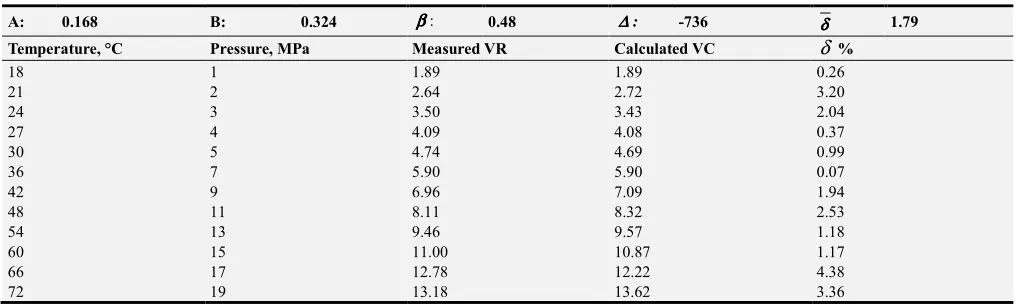
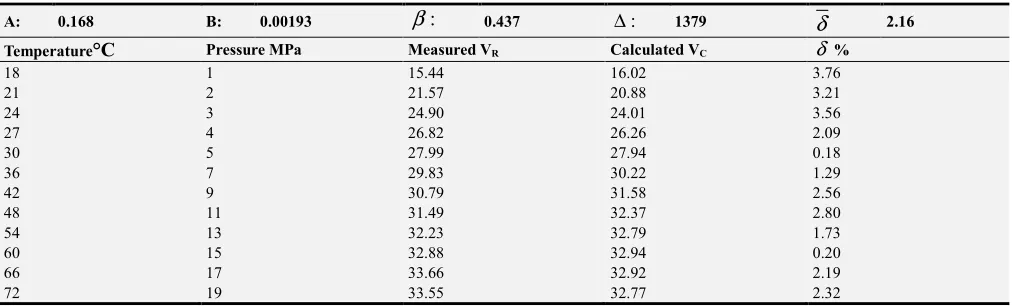
Since the TPAE is a mathematical expression of temperature-pressure-adsorption, so it could be presented in a three-dimensional picture. The total 12 measured adsorbed volume must be 12 points on the three-dimensional curved surface if they are fitted very well. The following tables and figures are created according these arguments.
Table 1. TPAE parameters and the comparison between the measured and calculated values for Long-flame coal.
A: 0.168 B: 0.324 ββββ: 0.48 ∆∆∆∆: -736 δδδδ 1.79
Temperature, °C Pressure, MPa Measured VR Calculated VC δ %
18 1 1.89 1.89 0.26
21 2 2.64 2.72 3.20
24 3 3.50 3.43 2.04
27 4 4.09 4.08 0.37
30 5 4.74 4.69 0.99
36 7 5.90 5.90 0.07
42 9 6.96 7.09 1.94
48 11 8.11 8.32 2.53
54 13 9.46 9.57 1.18
60 15 11.00 10.87 1.17
66 17 12.78 12.22 4.38
72 19 13.18 13.62 3.36
Table 2. TPAE parameters and the comparison between the measured and calculated values for Coking coal.
A: 0.168 B: 0.0426 ββββ: 0.268 ∆∆∆∆: 323 δδδδ 2.64
Temperature °C Pressure MPa Measured VR Calculated VC δ %
18 1 9.05 9.41 3.93
21 2 11.62 11.31 2.64
24 3 13.16 12.60 4.26
27 4 13.97 13.60 2.66
30 5 14.54 14.43 0.79
36 7 15.54 15.77 1.48
42 9 16.28 16.86 3.54
48 11 17.15 17.78 3.69
54 13 18.10 18.60 2.75
60 15 19.48 19.33 0.76
66 17 20.81 20.01 3.86
72 19 20.91 20.63 1.33
Figure 2. The illustration of temperature-pressure-adsorption for Coking coal.
Table 3. TPAE parameters and the comparison between the measured and calculated values for Meager coal.
A: 0.168 B: 0.00035
β
: 0.4448 ∆: 1880δ
1.63Temperature°C Pressure MPa Measured VR Calculated VC δ %
18 1 16.01 16.24 1.42
21 2 21.57 20.90 3.09
24 3 24.25 23.71 2.23
27 4 25.68 25.55 0.50
30 5 26.36 26.79 1.62
36 7 27.70 28.13 1.55
42 9 28.48 28.56 0.28
48 11 29.15 28.46 2.35
Table 4. TPAE parameters and the comparison between the measured and calculated values for Anthracite.
A: 0.168 B: 0.00193
β
: 0.437 ∆: 1379δ
2.16Temperature°C Pressure MPa Measured VR Calculated VC δ %
18 1 15.44 16.02 3.76
21 2 21.57 20.88 3.21
24 3 24.90 24.01 3.56
27 4 26.82 26.26 2.09
30 5 27.99 27.94 0.18
36 7 29.83 30.22 1.29
42 9 30.79 31.58 2.56
48 11 31.49 32.37 2.80
54 13 32.23 32.79 1.73
60 15 32.88 32.94 0.20
66 17 33.66 32.92 2.19
72 19 33.55 32.77 2.32
Figure 4. The illustration of temperature-pressure-adsorption for Anthracite.
From these tables and figures, it is beyond controversy to claim that TPAE treats accurately the variable temperature and pressure adsorptions.
4. Partial Derivative of TPAE
If the parameter A value is relatively small, TPAE can be simplified to:
exp( ) B
V T P
T M
β
∆
= (4)
The equation (4) means that the adsorbed volume still is a function of two variables, T temperature and P pressure. Therefore, it can, therefore, be operated the derivation as:
P T
V V
dV dT dP
T P
∂ ∂
=∂ +∂
(5)
here: T V P ∂ ∂
is the derivative of V with respect to P, treating T as a constant, is called the partial derivative with respect to P;
P V T ∂ ∂
is the derivative of V with respect to T, treating P as a constant, is called the partial derivative with respect to T;
Follow the standard operation, it is easy to get:
( V)P B P exp( )(1 )
T M T T
β
∂ = ∆ −∆
∂ (6)
According to the equation (5-1), under the isobaric
condition, ( V)P T
∂
∂ could be either negative or positive
depending on 1 T ∆
−
. If 1 T ∆
−
is negative, less than zero, then the right-hand side of equation (6) must be less than zero, which means that increasing temperature has negatively effect. Vice versa. Even under isobaric condition, both pressure “P” and parameter “
β
” have contribution, according to the equation (6).Follow the standard operation, it is easy to get:
1 ( V)T B Texp( ) P
T M T
β β −
∂ = ∆
Under isothermal condition, because the right side of equation (7) is always positive, never to be negative by any chance, therefore, the adsorption pressure always has a positive influence. Even under isothermal condition, both temperature “T” and parameter “∆” have contributed into the value of the right-hand side of equation (7).
5. Application
Coalbed methane mainly occurs as the state of absorption and free in coal reservoirs. The amount of coal absorbed gas is one indispensable piece of information in logging interpretation. Until now, the isothermal adsorption and Langmuir equation have been recommended in the national stand of testing the content of coalbed methane. Based on the discussion above, the variable temperature and pressure adsorptions and Temperature-Pressure-Adsorption Equation should be suggested to replace the conventional isothermal adsorption and Langmuir equation.
6. Conclusion
Several conclusions can be drawn as:
1)The measurement of absorbed coalbed methane must consider the formation temperature and pressure. The variable temperature and pressure adsorption has one unique advantage of being more truly reflect the in-situ buried conditions of coal seams.
2)TPAE can be used quantitatively to deal with the experimental data of variable temperature and pressure adsorption. Regarding the total 44 pieces adsorption data, the maximum relative error is 4.38% and the minimum is 0.07%. The range of average relative error for 4 different coal ranks is 1.63% to 2.64%.
3)The refinement of TPAE has been testified through both the relative error calculation and with pictorial illustration of three-dimensional view of temperature, pressure and adsorption capacity. Therefore, the gas content of coal seam at any depth can be obtained. 4)The possibility of using variable temperature and
pressure adsorptions and
Temperature-Pressure-Adsorption Equation to replace the conventional isothermal adsorption and Langmuir equation should be discussed further.
References
[1] LIU Shu-sen, GUO Xuan, REN Jun. Comprehensive utilization Status of coalbed methane in China [J], Modern Chemical Industry, 2018, 38(3): 4-8.
[2] QING Yong. The situation and Challenge of Coal-bed methane industrialization in China (II)-Key science and technology issues [J], Nature Gas Industry, 2006, 26(2): 6-10.
[3] LIU Shu-sen, GUO Xuan, Ren Jun. Comprehensive Utilization Status of Coalbed Methane in China [J], Modern Chemical Industry, 2018, 38(3): 4-8.
[4] Langmuir I. The adsorption of gases on plane surfaces of glass, mica and platinum [J], J Am Chem Soc . 1918, 40: 1361-1403. [5] ZHONG Ling-Wen,ZHENG Yu-Zhu, YUN Zheng-Rong, et al.
The adsorption capability of coal under integrated influence of temperature and pressure and predicted of content quantity of coal bed gas [J], JOURNAL OF CHINA COAL SOCIETY, 2002,27(6): 581-585.
[6] FU Xue-Hai, QIN Yong, QUAN Biao, et al. Study of Physical and Numerical Simulations of Adsorption Methane Content on Middle rank Coal [J], ACTA GEOLOGICA SINICA, 2008, 82(10): 1368-1371.
[7] ZHANG Tian-Jun, XU Hong-Jie, LI Shu-Gang, et al. The effect of temperature on the adsorbing capability of coal [J], JOURNAL 0F CHINA COAL SOCIETY, 2009, 34(6): 802-805.
[8] ZHAO Li-Juan, QIN Yong, Geoff WANG, et al. Adsorption Behavior of Deep Coal-bed Methane Under High Temperatures and Pressures [J], Geological Journal of China Universities, 2013, 19(4): 648-654.
[9] TANG Shu-Heng, YANG Qi, TANG Da-Zhen. Comparison between the experiment data of binary component gas adsorption isotherm and the calculating result with extended Langmuir equation [J], Geological Science and Technology Information, 2003, 22(2): 68-70.
[10] MA Dong-Min, Zhang Sui-An, Lin Ya-Bing. Isothermal adsorption and desorption experiment of coal and experimental results accuracy fitting [J]. Journal of China Coal Society, 2011, 36(3): 476-480.
[11] ZHANG Qing-ling. Adsorption mechanism of different coal ranks under variable temperature and pressure conditions [J], Journal of China University of Mining and Technology, 2008, 18(3): 395-400.
[12] LI Dong, HAO Jing-yuan. Temperature-pressure-adsorption equation of gas separation in inorganic membrane and its application on adsorption [J]. Membrane Science and Technology, 2018, 38(4): 127-131.
[13] LI Dong, WANG Yong-Jie, WEI Ya-Ling, et al. Error analysis of coal variable temperature and pressure swing adsorption between measured and theoretical value [J]. China Coal-bed Methane, 2017, 14(1): 28-31.
[14] LI Dong, HAO Jing-yuan, ZHANG Xue-Mei, et al. To establish and calculate the regression sample set for temperature - pressure - adsorption equation [J]. UNCONVENTIONAL OIL & GAS, 2018, 5 (2): 46-49. [15] LI Dong, HAO Jing-Yuan. Study on Methane Adsorption
Variation of Coal Under Variable Temperature and Pressure [J]. UNCONVENTIONAL OIL & GAS, 2017, 4 (2): 8-12. [16] MIAO Ze-kai, LI Dong, WANG Zhen. Study on adsorption
behavior of coal-bed methane under variable temperature and pressure [J]. Coal Quality Technology, 2017, 3: 25-28. [17] LI Dong, HAO Jing-Yuan, SUN Chenguang, et al. Comparison