Published online July 30, 2014 (http://www.sciencepublishinggroup.com/j/ijefm) doi: 10.11648/j.ijefm.20140204.12
ISSN: 2326-9553 (Print); ISSN: 2326-9561 (Online)
Ordering decision research on perishable goods under
consumer strategy behaviour condition
Li Zhou
1, *, Jing Li
21
School of Information, Beijing Wuzi University, Beijing, China 2
Graduate department, Beijing Wuzi University, Beijing, China
Email address:
[email protected] (Li Zhou)
To cite this article:
Li Zhou, Jing Li. Ordering Decision Research on Perishable Goods Under Consumer Strategy Behaviour Condition.International Journal of Economics, Finance and Management Sciences. Vol. 2, No. 4, 2014, pp. 240-244. doi: 10.11648/j.ijefm.20140204.12
Abstract:
It considers the retailer's optimal ordering policy under the deterministic demand and uncertainty demand two circumstances. Based on the consumers’ purchase analysis, establish the reasonable ordering decision to influence corporate inventory, compare the consumers’ waiting cost and losing goods cost, aim at coping with the consumer's strategic behavior.Keywords:
Consumer Strategy, Perishable Goods, Dynamic Pricing, Ordering Decision1. Introduction
Effective order strategy provides a solid guarantee for the normal operation of enterprises selling. Unreasonable order strategy will lead business inventory too much or too little, will ultimately affect the enterprise's profit. For perishable products, it will be more apparent.
Peng Zhiqiang(2008)[1] introduces the thought of consumers deciding the transaction price to the revenue management, establish the service provider two period pricing model based on customer pricing models, studies show that consumer heterogeneity affects the dynamic pricing strategy of the service provider. On the assumption that consumers are heterogeneous value of product, when consumers value less than the price of new products, may buy remanufactured products,.
Peng Zhiqiang (2009a) [2] studies a kind of differential pricing model based on the re-manufacturing and consumer waiting behavior. Research shows that the optimal pricing decisions and profits are influenced by the manufacturing cost and the consumer waiting behavior.
Liu Xiaofeng (2008) [3] given perishable products inventory in beginning of the sales cycle , and classifies consumers into two types price in accordance with evaluation method, then design a return contract to obtain maximum high reservation price of consumer surplus.
Liu Dewen(2003) [4] according to the analysis of the characters of perishable hi_tech products in their life cycle of declining period, presents a solution to deal with pricing
of perishable hi_tech products in their life cycle of declining period in view of the idea of revenue management so as to increase the revenue. Its basic point of view to solve the problem with a revenue management model is put forward, based on which several arithmetical examples are given to demonstrate the advantage of the notion of revenue management applied in tackling perishable hi_tech products in their life cycle of declining period. He reaches a conclusion that the profit of perishable hi_tech products can be increased by means of revenue management technology, and an interesting research inclination of pricing and manufacturing strategy of perishable hi_tech products in their declining period is pointed out.
Li Xiaohua(2004) [5] uses the dynamic pricing considering the airline revenue management pricing and inventory control of unified analysis, proposes a comprehensive model that integrates the two decision processes in airline revenue management. He assumes that the airline serves multiple fare classes. Demand of each fare class follows a Poisson process whose intensity is time dependent. Given the state of remaining seats and time-to-go, the airline determines an optimal fare-mix and an optimal fare for the customer class if it is open. He develops a three-stage strategy for the optimal policy which is fairly simple and tractable.
obtains that the parallel output and benefit allocation rules is better than random allocation rule conclusion.
Jiang Wei (2010) [7] solves the problem of pricing and ordering uncertainty for perishable products, the mathematical model based on the optimal method was established, and the condition of the unique optimal policy and the iteration method for the joint decision problem were provided. He proves that the price is an increasing function of the probability of the wasters and the delivery delay, that the safety inventory is a decreasing function of the probability of the wasters and the delivery delay, and that when the price was given, the optimal order number and the expected profit is a decreasing function of the probability of the wasters and the delivery delay. The numerical analysis conforms to his results, and shows that the optimal profit is a decreasing function of the probability of the wasters and the delivery delay. Retailers should select a supplier with the greater capability of supply after consideration.
This paper will first consider determining demand and uncertainty demand circumstances, the retailer's optimal ordering policy. Based on the consumer purchase analysis, establish the reasonable ordering decision to influence corporate inventory, compare the waiting cost and less goods cost, slow down the consumer's strategic behavior. In a reasonable ordering decision conditions, can effectively alleviate the consumer strategy situation, also won't cause inventory backlog or shortage, or damage enterprise gains.
2. The Optimal Order Decision under
the Condition of Determined Demand
Under the determined total consumer demand situation, retailers continued to implement the two phase strategy, price strategy in the process is p1> p2. Consumers are rational in the purchase process; select the maximum consumer surplus time to buy.
Assume that:
(1) Consumer demand is N, the retail inventory in the sales period is C;
(2) Pricing cycle is two stage pricing(p p1, 2), unit product cost is k, and p1> p2 >k , in order to simplify the calculation, and set
1 1, 2 1
p = p =ap =a .
(3) The reservation price of consumers is V, the distribution function of the consumer's reservation price is assumed to be F(V), and obey uniform distribution in[0, w].
Strategy consumer's proportion is r, the ratio of non-strategic consumers is 1-r. Non-strategic consumers are short-sighted that buy with acceptable price and don't wait; they don't buy when price is not acceptable. Set high retention value ratio of non-strategic consumers isρ.
In the above assumptions, consumer surplus in the first stages is V-1, remaining consumer surplus in the second stage is V-a. The consumer will get different consumer
surplus in different stages, the final choice is that purchase in the biggest consumer surplus stage.
2.1. Consumers Purchase Strategy Analysis under Deterministic Demand
Consider from the consumer's point of view, there is all high retention consumers in the first stage, their purchase time will also earlier than the second stages consumer. So retailers will give priority to meet the first stage consumers to buy. Assume the probability of consumers get the goods in first stage is q1, probability of getting goods in the second stage is q2, high reservation price consumers are sensitive lower than the low reservation price consumer. Utility loss at the same time also higher than that of low reservation prices consumers, thus high reservation price consumers will choose to buy in the first stage, so as to reduce the risk of purchase nothing.
Consumers in the two stage condition, strategy consumers will buy goods according to the consumer surplus, the first stage consumer surplus is q V1( −1) , second stages consumer surplus is q2(δV −a), where,
δ
is value retention ratio. At this time there will be a critical combination point of (q q1, 2), let both the first stage and second stage of the consumer can obtain the same utility.1( 1) 2( )
q V− =q δV−a . (1)
Thus, 1 2 1 2
1 2
( , ) q q a
V q q
q qδ
− =
− , the zero bound set is( ,q q1' 2'), when V q q( 1, 2)>V q q( ,1' '2), consumers will buy in the first
stage; when V q q( 1, 2)<V q q( ,1' 2'), consumers will buy in the second stage.
2.2. The Retailer's Ordering Policy under Determined Demand
Assuming that the consumer is risk neutral, then let the consumer's utility function is U x( )=x. In the case with deterministic demand, the number of consumers to buy in the first stage is Nr(1−F V q q( ( ,1' 2')))+N(1−r)ρ , the number of consumers to buy in the second stage is
' '
1 2 2
( ( ( , )) F(V(p ))) (1 )(1 )
Nr F V q q − +N −r −ρ . We can get the profits of retailers is
' '
1 1 1 1 2
' '
2 2 1 2 2
( (1 ( ( , ))) (1 ) )
+ ( ( ( ( , )) F(V(p )))
(1 )(1 ))
p q Nr F V q q N r
p q Nr F V q q N r kC
π ρ
ρ
= − + −
−
+ − − −
(2)
of consumer demand in the first stage, at the same time ensure inventory remaining quantity is very small, so we will assumeq1=1, inventory allowance is zero. Get the order quantity C is:
' ' 1 2
' ' ' '
2 1 2 2 2
(1 ( ( , ))) (1 )
( ( ( , )) F(V(p ))) (1 )(1 )
C Nr F V q q N r
Nrq F V q q Nq r
ρ
ρ
= − + − +
− + − − (3)
Due to the assumption that q1=1,
2 2
2
1 (1, )
1
q a V q
qδ
− =
− , at
this time, seem it as a unary function of 2 2 2
1 ( )
1
q a V q
qδ
− =
− ,
simplification formula (3) can be obtained
' 2 ' 2 '
' 2
2 '
2 1
(1 ) (1 )
(1 )
1
( ) (1 )(1 ) 1
q a
C Nr N r
w q
q a
Nr Nq r
w q
ρ δ
ρ δ
−
= − + −
− −
+ + − −
−
. (4)
Bring C values into the profit function, we can obtain one final element function aboutq2'.
Get profit function is
' 2
1 1 '
2 ' 2
2 ' 1
2 '
2 2
1
( ) (1 )
(1 )
1
( ) ( ) (1 ) ( ) 1
( ) (1 )(1 )
q a p k Nr
w q
q a
p k Nr N r p k
w q
p k N r q
π
δ
ρ δ
ρ −
= − −
− −
+ − + − −
−
+ − − −
(5)
Where, p1=1,p2 =ap1=a, the partial derivative on '
2 q is
' 2
1 2
'
2 2
( ) 1
( ) ( ) (1 )(1 )
( ) (1 )
q a Nr
a k N r w w q
ϕ π ρ
ϕ π δ
−
= − + − − −
− . (6)
Two order partial derivatives on q2' is
1
2 2
' 2 ' 3
2 2
2 (1 a) 1 0 (1 )
Nr w
q q
π
ϕ
ϕ δ
−
= − <
− . (7)
According to the first order partial derivatives and the two order partial derivative of q'2, on the assumption that the other variables are exogenous, the characteristic of
1
π is increased withq2' first, then decreased, there exists a maximum extreme point. Assume exist probability of the extreme value point is ''
2
q , then according to the formula of C to get optimal inventory number.
If consumers fixed demand is N=100,
1 1, 2 1 0.2, 1
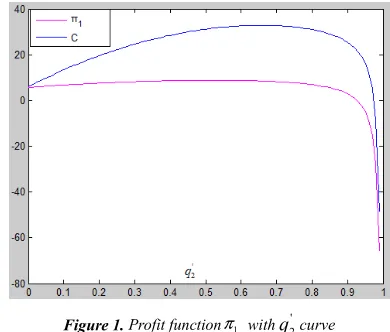
p = p =ap = =a w= , inventory cost k=0.05, in non-strategic consumers, high reserve value proportion of consumers ρ=0.2,δ =0.1 , at the same time, the proportion of strategy consumers r=0.7, we can get the profit function π1 with
' 2
q
curve in “fig. 1” below.Figure 1. Profit functionπ1 with
' 2 q curve
Find that the maximum π1value is 8.8453, then the corresponding '
2
q value is 0.53, the number of optimal inventory is 31.59.
3. The Optimal Ordering Decision
under Uncertainty Demand Cases
After consideration of the determination demand situation, we need to explore the uncertainty demand on consumers. In real life, people actually sales exist more uncertain factors, in face of most uncertain demand. In the uncertain demand case, the retailer needs more accurate judgment to consumer demand, in order to choose an optimal ordering strategy, to reduce the retailer's inventory cost. Assume that the number of consumers with uncertainty set as N, N is uniform distribution in the interval of [m,z], and it is assumed that when N=m, the first phase consumer demand can be met.
3.1. The Optimal Ordering Policy with Inventory Supplement Timely
Under inventory supplement timely situation, when consumer demand is higher than the inventory quantity, the retailer can re-order to meet consumer demand, set the inventory replenishment cost is nk, the initial order cost is k, there will be p1> p2 >k, strategy consumers still decide purchase by compare two phase consumer surplus. We assume the existence of a critical point, so that consumers have no difference in the two stages purchase utility,
then 2 2
2 1 ( )
1
q a V q
qδ
− =
− .
Assume that:
(1) Pricing cycle is two stage pricing (p p1, 2) , setp1=1,p2=ap1=a.
(2) The consumer reservation price of the product is V, the distribution function of the consumer's reservation price is assumed to be F(V), and obey uniform distribution in the [0, w] ;
assumption, we can get the profit function for retailers.
'
2 1 2
' '
2 2 1 2 2
' 2 ' '
2 1 2
2
( (1 ( ( ))) (1 ) )
( ( ( ( , )) ( ( )
(1 )(1 ) max[0, ( (1 ( ( )))
(1 ) ) ( ( ( ( , )) ( ( )) (1 )(1 )) ]
p Nr F V q N r
p q Nr F V q q F V p
N r nk Nr F V q
N r q Nr F V q q
F V p N r C kC
π ρ ρ ρ ρ = − + − + − + − − − − + − − − + − − − − (8)
Because of consumer demand uncertainty, will lead to insufficient or surplus of inventory, will cause some shortage cost or the cost of the product. But because the inventory can be added in a timely manner, so that to some extent the shortage cost can be reduced. Compare of supplementary cost of goods nk with second phase of the sale pricep2, the retailer from their profits point of view to determine replenishment in the famine situation. The replenishment cost is no less than the second stage cost, from the point of view of earnings; retailers also need to find an optimal inventory, to avoid yield reducing caused by the replenishment. The first stages of consumer value high retention, and retailer’s pricing is rational, the first phase of the pricep1>nk, in the inventory quantity, the retailer can meet the first stages of consumer demand. Assuming that the number of consumers is x.
The profit function of retailers can be expressed as:
'
2 1 2
' '
2 2 1 2 2
' 2 ' '
2 1 2
2
( (1 ( ( ))) (1 ) )
( ( ( ( , )) ( ( )
(1 )(1 )) ( (1 ( ( )))
(1 ) ) ( ( ( ( , )) ( ( )) (1 )(1 ))
p Nr F V q N r
p q Nr F V q q F V p
N r k Nr F V q
N r q Nr F V q q
F V p N r
π ρ ρ ρ ρ = − + − + − + − − − − + − − − + − − (9)
Simplify formula (8) can be:
' 2 3 ' 2 ' 2 ' 2 ' 2 1
(1 ) (1 )
(1 )
1 ( ) ( )
1 (1 ) (1 )
( ) (1 )(1 )
q a k Nr
w q
q a
a k Nr
w q
k N r
a k Nq r π ρ ρ − = − − − − + − − + − − + − − − (10)
The partial derivative on q2' is
2 3
' '
2 2
( ) 1
( ) ( ) (1 )(1 )
( ) 1
Nr a
a k N r w
q q
ϕ π ρ
ϕ = − −− + − − − (11)
According to the first order partial derivatives and the two order partial derivative of q'2, on the assumption that the other variables are exogenous, the characteristic of
1
π is increased withq2' first, then decreased, there exists a maximum extreme point π3 , corresponding optimal inventory number is C.
' ' '
2 2 2
' '
2 2
' 2
1 1
(1 ) ( )
(1 ) 1
(1 ) (1 )(1 )
q a Nrq q a C Nr
w
w q q
N r N r q
δ δ ρ ρ − − = − + − − + − + − − (12)
3.1.1. When the Second Stage Pricingp2 >nk, and n=1 In this case, retailers will reduce inventory to avoid causing the product cost. As consumer demand uncertainty, assumptions of changes equal to consumer quantity N. Retailer will accord with minimum number of consumers to order goods thus refer x=N =m to order, so as not to order too much to cause retailer inventory loss.
3.1.2. When the Second Stage Pricingp2 >nk, andn>1 Supplementary cost of retailers is lower than the second phase selling cost. When the inventory is insufficient, retailers timely supply inventory in order to obtain more profits. When the retailers' order quantity is excessive, they will eventually lead to a backlog of inventory cost. When
out of stock situations, probability isx C
z m
−
− , retailers through
the replenishment to get the benefit as
2
( )( )
x C
x C p nk z m
− − −
− .
When the retailers' inventory exist backlog of goods, this
probability can be expressed asC x
z m
−
− , because of excessive
inventory resulted in the retailers' loss is C x(C x k)
z m
− −
− .
According to the formula of gains and losses, the retailer will still out of stock selection, even replenishment, still can get profits, while if retailers' inventory is more, it will directly stock losses. So retailer will accord with minimum number of consumers to order goods thus refer x=N =m
to order, so as not to order too much to cause retailer inventory loss.
3.1.3. When the Second Stage Pricingp2 ≤nk
In this case, replenishment cost is higher than the cost of inventory, so retailers once out of stock will no longer replenishment order. At the same time, if the inventory than consumer demand, there would still be the inventory cost, but the order quantity little, the income reduce.
When lack of inventory, the potential expected revenue
that retailer loss is ( (C )( 2))
x m
E x nk p z m
− − −
− .
When the goods remaining, the expected loss of retailers
inventory is ( (C )( 2))
x m
E x nk p z m
− − −
− .
According to the expected loss of both can be seen, when consumer quantity is equal to the inventory quantity, the expected loss of retailers can reduce to zero. So we can get
inventory quantity 2
z m
N= + refer to the expected number
of consumers.
3.2. The Optimal Ordering Strategy under Fixed Inventory
products that cannot cause the potential loss of profit because of shortage, but may be caused the backlog of products, resulting in the inventory cost and goods cost; if retailer's order quantity is little, the backlog risk is less , but may result in potential profit loss. Therefore retailers order amount of products need meet the consumers to obtain profits, at the same time remain few products, so retailers can make more profits. According to the discussion of optimal order inventory C, this is still only the problem of discussion consumer quantity N.
This is similar to the previous pricing situationp2 ≤nk, because the inventory is fixed, we can set the replenishment cost of N is great, analysis when shortage and surplus goods, the gains and losses case of retailers.
When lack of inventory, the potential expected revenue
that retailer loss is ( ( ) 2)
x C E x C p
z m
− −
− .
When the goods remaining, the expected loss of retailers
inventory is E(C x(C x k) )
z m
− −
− .
When the potential expected return loss is equal to retailer inventory loss, there will bep2=k.
(1) Whenp2 =k, with two cases the same loss, and expected consumption quantity and expected inventory quantity is the same, retailers expected loss is minimum, the inventory orders quantity is
determined according to
2
z m N= =x + ;
(2) whenp2 >k, the retailer will pay more attention to the potential loss, this time the inventory quantity should be more than the number of process (1) , but will be lower than the standard of x=N=m. (3) when p2>k, retailers will be more attention to
inventory loss, so the number of inventory should be less than the number of process (1) , but will be higher than x=N=z, in order to avoid too much inventory, resulting in potential profit greatly reduced.
4. Conclusion
Retailers face some strategy consumers; strategy consumers will buy goods according to the maximum utility of two stage process. Because the perishable product sales cycle is short, the retailer order products too much,
will make the retailers inventory cost in the end sales, at the same time when retailers order is too small, it will produce shortage cost, so that the final revenue reduce. So retailers in considering the consumer strategy behavior, consider the consumer demand certain and uncertain conditions, develop the optimal ordering strategy of perishable goods.
Acknowledgements
The study is supported by Beijing Wuzi University scientific research base of science and technology innovation platform of modern logistics, information and control technology research (project code: PXM2014_014214_000086).
References
[1] Peng Zhiqiang, Xiong Zhongkai, Li Hao, “The service provider pricing strategy based on customer pricing model”, Statistics & Decision, vol.273, No.21, pp.169-171, Nov. 2008.
[2] Peng Zhiqiang, Xiong Zhongkai, Li Hao, “Research on Discrimination Pricing Model Based on Remanfacturing and Waiting Behaviour of Customers”, Soft Science, vol.23,pp.123-126, March 2009a.
[3] Liu Xiaofeng. “Dynamic pricing and return the contract design strategy of the consumer”, Journal of Zhongnan University of Economics and Law, vol.168, pp.128-133, March 2008.
[4] Liu Dewen, Xiao Baichun, Lu Ruoyu, “Revenue management of perishable hi_tech product in declining period”, Journal of Management Sciences in China, vol.6, pp.66-71, Jun 2003.
[5] Li Xiaohua, Xiao Baichun, “Comprehensive analysis of pricing and seat inventory control in airline revenue management”, Journal of Management Sciences in China, vol.7, pp.63-69, Jun. 2004.
[6] Xu Hong, Hu Yunquan, Li Jun, “Study on Airlin Pricing and Seat Allocation”, Systems Engineering-theory & Practice, No.12, pp.44-48, Dec. 2004.