ISSN: 2306-9007 Uygur & Sümerli (2013) 980
EFQM Excellence Model
AKYAY UYGUR
Assistant Professor Gazi University Tourism Faculty Golbası-Ankara Turkey
E-mail: [email protected]
Phone: +90 312 485 14 60/137
SEVGI SÜMERLİ
Lecturer, Erciyes University Kayseri Vocational School Kayseri Turkey
E-mail: [email protected] Phone: +90 352 2076666/40733
Abstract
Performance improvement is high on the agenda of many companies around the world and with the growing number of improvement models now available care has to be taken to adopt an approach that will yield the most attractive return on investment. The EFQM Excellence model is a non-prescriptive framework for continuous quality improvement that can be used by any kind of organization, regardless of sector, size, structure, or maturity. The essential elements that constitute the EFQM are the fundamental concepts of excellence. EFQM Excellence Model is one of the self assessment tools helping companies in regularly questioning their own activities and results of activities and determining strong and weak points. The aim of this study is to investigate the relation between results of basic performance, leadership, partnership and resources, and process parameters of a company operating in manufacturing industry.
Key Words: EFQM Excellence Model, Performance Measurement, EFQM, Quality İmprovement.
Introduction
Changing market conditions and increasing intensive competition day by day make the firms wishing to continue their existence become in pursuit of different areas. European Foundation for Quality Management has developed “EFQM Excellence Model” for the purpose of leading these firms that are in search of such areas. The model belongs to European Foundation for Quality Management (EFQM). In Turkey, Turkish Quality Association (KalDer) is responsible for management of this model.
European Foundation for Quality Management (EFQM) was established in 1988 by 14 leading companies (Bosch, British Telecom, Bull, Ciba-Geigy, Dassault, Electrolux, Fiat, KLM, Nestle, Olivetti, Philips,
Renault, Sulzer, Volkswagen ) in Europe with the mission “Being Stimulus of Sustainable Excellence” and
the vision “A World That European Organizations Strive Excellence” (Nabitz; Klazınga; Walburg, 2000,
192). Based upon membership system, European Foundation for Quality Management (EFQM) is a non-profit organization (Moeller, 2001, 45; www.efqm.org/en).
European Foundation for Quality Management (EFQM) now represents over 800 members in 38 countries all over the world. The members of EFQM are company communities that are comprised of worldwide known and successful brands. Besides, EFQM contains Academic Institutions, Research Institutions, Management Committees, National Commercial Development Association and National Partnership Organizations.
ISSN: 2306-9007 Uygur & Sümerli (2013) 981
The Scope and Importance of EFQM Excellence Model
EFQM Excellence Model used at National Quality Award is not a model whose boundaries are determined exactly. The organizations are in favor of different approaches that provide permanent excellence as well (Ulaş, 2002, 39).
EFQM Excellence Model is a practical tool that indicates the position of business organizations on excellence path and helps them to determine their shortcomings and encourages appropriate solutions. EFQM Excellence Model was presented as an outline framework at the beginning of 1992 for the organizations that assess European Quality Award. The aforementioned model is now used widely as an organizational framework in Europe and provides a basis for both national and regional quality awards as well (Eskildsen and Dahlgaard, 2000, 1081-1082).
The prominent theme of the model is customer satisfaction, employee satisfaction and excellent business results in society. Based on the fact that numerous approaches may exist in order to carry out sustainable excellence at all dimensions that are related to performance, EFQM Excellence Model is based the statement “Excellent results reflecting on performance, clients, employees and society can be achieved with aid of an appropriate understanding of policy and strategy, employees, resources and processes.” (Kaya; Üçgül; Aşkar vd., 2007, 274).
Excellence is not a theory. It is necessary that the evidence concerning performance at fundamental field of activities and processes are available. The evidence is not limited to financial results indicating past performance. Among evidence is customer satisfaction and loyalty, employee motivation and competence, measured excellence result concerning society loyalty as well.
The principles of total quality management generate the basis of EFQM Excellence Model (Yılmaz, 2010, 65). In this regard, the model is the most applied model in Europe for total quality management. EFQM Excellence Model contains different elements of total quality management and inspires organizational awareness by performing a catalyst duty. Therefore, total quality management and EFQM Excellence Model complement each other as to required achievement in order that businesses and organizations are able to continue their existence in the current market (İnan; Yayla; Yıldız, 2010, 337).
EFQM Excellence Model always updates the model by gathering inputs of the best applications that are executed inside and outside Europe. Thus, the model is being dynamic and provides current views about the management (Basım ve Şeşen, 2007, 203). Accordingly, the model was reviewed four times in 1997, 1999, 2003 and 2010 and current information and new approaches were enhanced. As a result of the review in 1999, the model was named “EFQM Excellence Model” (KalDer, 2010, 30).
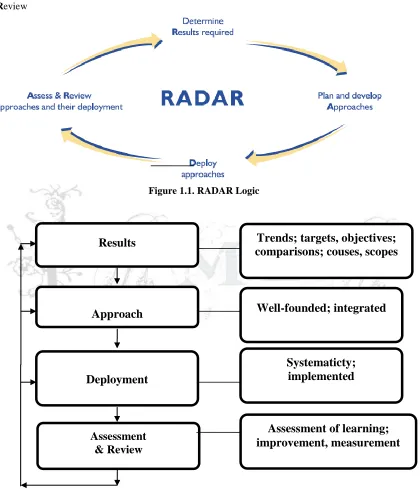
The model has a logic called RADAR in its heart (as seen in Figure 1.1). RADAR is a dynamic assessment
framework and powerful tool management that provides a structural approach for the purpose of examining the performance of any organization. RADAR states that an organization must take the followings into consideration (Moeller; Breinlinger-O’Reilly; Esler, 2000, 255).
Determine the results; it is aiming for assesment consider trends, targets, comparisons, couses and
scopes.
Plan and devolope an intagrated set of sound approaches to attain the results.
Deploy approaches in a systematic way.
Assess and review the approaches by monitoring and analysing the results achieved.
In the course of application of model, Radar Scoring Matrix is used. As seen in Figure 1.2. RADAR Scoring Matrix is composed of these components and elements (Moeller; Breinlinger-O’Reilly; Esler, 2000, 255; KalDer, 2010, 33):
ISSN: 2306-9007 Uygur & Sümerli (2013) 982 - Results
- Approach - Deployment - Assessment - Review
Figure 1.1. RADAR Logic
Figurel 1.2. Continous Improvement Cycle on RADAR
Nabitz; Klazınga; Walburg, 2000, 194.
These components constituting RADAR logic are expressed in the following (Kalder, 2000, 17; EFQM, 2010, 14):
Results
Approach
Deployment
Assessment
& Review
Trends; targets, objectives;
comparisons; couses, scopes
Well-founded; integrated
Systematicty;
implemented
Assessment of learning;
improvement, measurement
ISSN: 2306-9007 Uygur & Sümerli (2013) 983
Results: Result dimension indicates what an organization has obtained. In an organization having reached excellence, the results must always indicate positive tendency and/or a good performance; the targets must become appropriate and reachable; the performance must become high when comparing to other organizations; all results must be emerged from the approach. In addition to these, the results must contain relevant areas and activities.
Approach: The approach contains what and why an organization plans. In an organization having reached excellence, the approach must become well based; that is it is expected that the approach must be set a clear basis. It must become well-defined and have the developed processes and focus on shareholder’s requirements clearly and become integrated. On the other hand, it must comply with the policy and strategy of organization as well as becoming associated with other approaches.
Deployment: The deployment contains what an organization does in order to actualize its approach. In an organization having reached excellence, it is expected that the approach is carried out systematically for relevant areas.
Assessment and Review: This dimension contains an organization’s approach and what it does so as to
assess and review the deployment of approach. In an organization having reached excellence, it is expected that approach and its deployment are measured regularly and learning activities are performed. As a result of these two activities, enhancement practice of obtained information is determined. The priorities related to this issue are determined and the approach is used so as to plan and carry out enhancement.
Each component of RADAR Scoring Matrix must be associated with sub-criteria of “Input” at EFQM
Excellence Model in Figure 1.4 and “Results” criteria must be associated with sub-criteria of “Result”
(Moeller, 2001, 46). When an organization is scored in accordance with RADAR, a separate weight coefficient is used for each criterion in order to determine total score. These weight coefficients were first determined as a result of extensive agreement all over the Europe in 1991 (Moeller; Breinlinger-O’Reilly; Esler, 2000, 254) and the weight coefficients are regularly reviewed by EFQM and the weight coefficients being valid as 0f 2010 (KalDer, 2010, 31) are shown in Figure 1.3.
Figure 1.3. Weight Coefficients of EFQM Excellence Model (KalDer, 2010, 31; EFQM, 2010, 6.) Customer
Results %10
Empleyee Results %10 Policy&
Strategy %10
Employees %10
Processes %10
Society Results %10
Key Performan ce Results %10
Partnership &Resources %10 Leadership
%10
Inputs 500 Points
Customer
Results
Results 500 Points
Customer Results
ISSN: 2306-9007 Uygur & Sümerli (2013) 984 In general, criterion weight coefficients are distributed to sub-criterion equally. The score is given for each sub-criterion out of 100 points by using RADAR assessment table that is the first step of scoring. This scoring is carried out by taking dimensions and elements of RADAR table being related to criteria (Nabitz; Klazınga; Walburg, 2000, 193- 194). As a consequence of putting these scores given out of 100 points in relevant parts of summary table, total scoring is calculated out of 1000 points (Eskildsen and Dahlgaard, 2000, 1082-1083).
For example, an organization using excellence model for the purpose of self-assessment1 can create a scoring in the course of assessment in accordance with the model in Figure 1.4 by abiding by excellence criteria (Eskildsen and Dahlgaard, 2000, 1083; Moeller; Breinlinger-O’Reilly; Esler, 2000, 255).
Inputs
Leadership (% 10) 100 Points, Employees (% 9) 90 Points, Policy & Strategy (% 8) 80 Points, Partnership & Resources (% 9) 90 Points, Processes 140 Points.
Total Enablers 500 Points
Results
Customer Results (% 9) 90 Points, Employee Results (% 20) 200 Points, Society Results (% 6) 60 Points, Key Performance Results (%15) 150 Points.
Total Results 500 Points.
EFQM Excellence Model Criteria
In line with today’s developed quality and management approaches, the countries adapting organizational excellence insight encourage this modern approach via different national and international models. Deming in Japan (1951), Malcolm Baldrige in USA (1987) and EFQM in Europe (1992) are the most recognized and used organizational excellence models (Nabitz; Klazınga; Walburg, 2000, 192). In our country, Excellence Model which is based on EFQM criteria has been adapted.
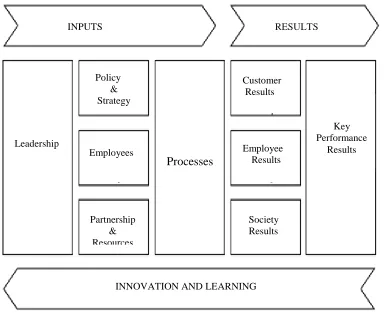
EFQM Excellence Model is based upon 9 main dimensions and these dimensions are called criteria. Each criterion is supported by a wide range of sub-criteria in order to be understood better. As seen in Figure 1.4, when observing context and structure of the Model, five criteria out of nine criteria generate “input” criteria while four out of nine criteria generate “result” criteria (Moeller; Breinlinger-O’Reilly; Esler, 2000, 254-255; Nabitz; Klazınga; Walburg, 2000, 192).
INPUT CRITERIA
1. Leadership
2. Policy & Strategy
3. People
4. Partnership & Resources
5. Processes
1 Self-assessment is a comprehensive, systematic and regularly reviewed activity of activities and business
results of an organization by being compared to a model basing EFQM Excellence Model. Self-assessment is a self-Self-assessment process of a compamy. (Ulaş, 2002, 38).
ISSN: 2306-9007 Uygur & Sümerli (2013) 985 RESULT CRITERIA
6. Customer Results
7. Empleyee Results
8. Society Results
9. Key Performance Results
The answer of the question “how” at input criteria and the question “what do we obtain” at result criteria is sought. In this respect, input criteria contain the activities an organization has carried out. Result criteria indicate what the organization is able to perform. Results emerge from inputs and inputs are enhanced by feedback obtained from the results (KalDer, 2000, 15; Yılmaz, 2010, 66).
Figure 1.4. The EFQM Excellence Model KalDer, 2010, 31.
Arrows underside and upside of figure indicate dynamics of the model. These arrows indicate learning, creativity and innovation approach providing enhancements at inputs and therefore leading to enhancements at results.
As the basis of EFQM Excellence Model, each concept has a direct or indirect relationship with different criteria and sub-criteria. In the model, there are 32 criteria in total, 24 of them are input criteria while 8 of them result criteria. Sub-criteria consist of a wide range of questions to be answered in the course of assessment (Aksu, 2000, 130). Moreover, each main concept has an influence on the other. Criteria and sub-criteria are presented in Table 1.1.
Policy & Strategy
Employees
Partnership & Resources
Customer Results
Employee Results
Society Results INPUTS
RESULTS
INNOVATION AND LEARNING
Leadership
Key Performance
Results
Processes
ISSN: 2306-9007 Uygur & Sümerli (2013) 986
Table 1.1. EFQM Excellence Model Criteria and Criterion Parts
Moeller, 2001, 49.
ISSN: 2306-9007 Uygur & Sümerli (2013) 987
Input Criteria
Leadership
Leaders must become involved in cultural development activities and determination of quality culture. The leadership perception supporting quality and permanent enhancement will set an example for other employees and such determination will lead to success of organization (Pakdil, 2004, 171-172).
As well as these tasks, the leaders must make an effort in order to provide necessary
resources that employees need, determine long-term targets of organization, organize such activities, facilitate the coordination and reach these targets (Pakdil, 2004, 172).
Excellent organizations have leaders who shape the future and realize it, set an example in accordance with values and ethical approach of organization and instill confidence. Leaders of excellent organizations have a flexible personality and guarantees that factors leading to success of organization will be estimated and carried out (KalDer, 2010, 31; EFQM, 2003, 13).
Employees
Among resources an organization possesses, human is the only one not to be changed by another resource. Human resource is active factor in order that organizations are able to compete and survive in the market. With reference to the statement “The one doing the best knows how to do a business,” employees must be given an opportunity to take part in decision process and reveal their creativity skills (Pakdil, 2004, 173).
Excellent organizations value their employees and create a culture at which individual and organizational targets benefit one another. Such organizations also develop their employee’s skills; look after employees; communicate with them; recognize, motivate and appreciate them. The employees are given opportunities to use their information and skills in favor of organization (KalDer, 2010, 31).
Policy and Strategies
The structure of policies and strategies is a significant step for quality. By following opportunities and threats in the market, sharing all processes with employees is ranks among requirements of the model (Yılmaz, 2010, 66).
Excellent organizations create their mission and vision by creating a shareholder-based strategy. Policies, schedules, targets and processes are created and applied so as to actualize the strategy (KalDer, 2010, 31; KalDer, 2006, 11-12; EFQM, 2003, 13).
Partnerships and Resources
Once examining cooperation and resources criteria that are highly important, it is overemphasized that cooperation should be developed and it is important over financial resources. Upon examining buildings, equipment and management of material resources, it is investigated whether these are used efficiently or not. Excellent organizations plan and manage their cooperation outside the organization, suppliers and internal resources in such a way that they support strategies and policies of the organization and the processes are effective (KalDer, 2006, 15-16; EFQM, 2003, 14).
Processes
In accordance with the process criterion that is ranked the most important on among input criteria, it is necessary that the processes must be identified and followed reliably. Excellent organizations design processes, products and services and manage and enhance them so as to attribute value to their customers and other shareholders (İnan; Yayla; Yıldız, 2010, 339; EFQM, 2003, 14).
ISSN: 2306-9007 Uygur & Sümerli (2013) 988
Result Criteria
Results of Employees
As well as measuring employee’s efficiency thanks to a real approach, this criterion also
measures employees’ satisfaction. When examining the extent to which targets of organization have been reached, the performance of employees is assessed objectively.An overview of employees is performed by examining absence rate, job satisfaction,participation to job processes, duty ratio and occupational accidents (KalDer, 2006, 24-25).
Results of Customers
Result criterion related to customers reveals how effective the studies are and provides that reasonable decisions will be taken by reviewing the methods. When observing how the general image has an influence on customers in detail, it is aimed that service quality will reach to maximum level permanently. How serious and effective support processes before and after sale is carried out in order to create customer loyalty is another key point (KalDer, 2006, 22-23).
Results of Society
For the model adopting the opinion that the organization is not composed of only employees and customers, the society is as important as customers, for the damages and benefits in society reflects to the organization more effectively. Therefore, it is impossible to ignore the society. How society perceives the organization is one of the main indications. What the organization contributes to local and national economy is used in order to examine whether the organization appropriate for the model (KalDer, 2006, 26-27; EFQM, 2003, 15).
Results of Key Performance
Whether the organization is appropriate for the model or not in accordance with main performance results is assessed separately under titles of financial results and nonfinancial results. Within financial results, it is examined if sales, profit, cash flow and budget are performed appropriately with regard to scheduled structure.
At nonfinancial results where productivity and cycle processes are examined, the results are assessed within specific standards (EFQM, 2003, 15).
The criteria at inputs are related to how the organization works in order to reach business results and it reaches these results. The criteria at results are related to what the organization has reached and continued to reach them in terms of business results (KalDer, 2006, 28-29). The real purpose of organization contains issues such as profit, capacity level to make money for its partners and shareholders. Organizations that have reached high performance level for all criteria are regarded as excellent organizations.
Concepts of EFQM Excellence Model
In today’s organizations, the word “quality” is replaced by the word “excellence.” The word “excellence” refers to strategy, culture and philosophical change rather than a system (İnan; Yayla; Yıldız, 2010, 336).
Excellence is total efforts in order to have a long-term success by estimating shareholder’s (customer, employees, society, shareholders) satisfaction or having a skill to create extraordinary results and sustain them for shareholders. When viewed from this aspect, excellence can be created and sustained by excellent cooperation established by employees and necessary processes to satisfy customers (İnan; Yayla; Yıldız, 2010, 336).
ISSN: 2306-9007 Uygur & Sümerli (2013) 989 In order to create sustainable success for any organization, a number of main concepts are necessary. These concepts can be used principal of necessary factors for an excellent organizational culture. Main Concepts constitute a common language of senior management. These concepts are main concepts of excellence in some ways. Main concepts of excellence creating the basis of EFQM Excellence Model are valid irrespective of sector, industry or size (Işığıçok, 2007, 2) and relationships among concepts are shown in Figure 1.5.
Figure 1.5. Concepts of EFQM Excellence Model
KalDer, 2010, 30; EFQM, 2010, 7-8.
As seen in Figure 1.5, excellence is composed of eight main concepts. These concepts are summarized in the following (KalDer, 2010, 32; Yazıcı, 2000, 32; Kılıç ve Türker, 2005):
Actualizing Balanced Results
Excellent organizations meet short-term and long-term requirements of all shareholders (shareholders, employees, customers and society) in a planned way and therefore actualize their mission thanks to balanced results and head for their vision. The primary benefits are (Kılıç ve Türker, 2005);
To create a value for all stakeholders,
To ensure sustainable long-term success,
To establish mutually beneficial relationships,
To make the measurements associated with all stakeholders, including the leading domestic
indicators.
Actualizing Balanced Results
Taking Responsibility
for a Sustainable
Future Adding Value for
Customers
Creating
Cooperation Visionary,
Inspiring and total
Leadership
Creativity and
Maintaining
Innovation
Management via Processes
Achieving with Employees
ISSN: 2306-9007 Uygur & Sümerli (2013) 990
Adding Value for Customers
Customer is the one who assesses product and service quality on the last phase. The best way to create customer loyalty, gain customer and obtain market share is to focus on the requirements of available and potential customers clearly.
Excellent organizations are aware of innovations for their customers by understanding or estimating customer’s requirements or expectations and basic reason of customer’s existence as well as adding value to their customers (Kalite El Kitabı, 2007, 14-15).
The primary benefits are (Ulaş, 2002, 18-20; Kılıç ve Türker, 2005);
To increase in market share,
To produce value for the customer,
To minimize transaction costs,
Long-term success.
Visionary, Inspiring and Total Leadership
Excellent organizations have leaders who shape and actualize the future and set an example in line with organization values and ethic values. A leader’s behaviors within an organization provide clarity of target and cooperation and create an atmosphere where both organization and employees are able to reach the excellence (Kalite El Kitabı, 2007, 18). The primary benefits are (Ulaş, 2002, 22-24);
To maximize the stability and effectiveness of employees,
To find out more clearly the direction of the organization,
A respectable position in the market,
All of the activities in a structured and systematic process, enterprise-wide implementation of consistent and widespread..
Management via Processes
Excellent organizations are managed thanks to processes by which evidence based decisions are taken in order to create consistent, balanced and sustainable results. The organizations show their best performances when decisions that all related activities are managed systematically and processes and enhancement take place are taken (Kalite El Kitabı, 2007, 21). The primary benefits are (Kılıç ve Türker, 2005; İnan; Yayla; Yıldız, 2010, 339-340);
Focus on the desired results,
The highest level of employee evaluation and resources,
Consistency and variability of the results to be kept under control,
Based on the data to determine realistic goals and strategic orientation in relation to governance.
Achieving With Employees
Excellent organizations value their employees and create an authorization culture where individual targets are actualized in a balanced way. Common values and a reliable and
authorization culture should be available in order that potential of employees in an organization can be actualized ultimately (KalDer, 2010, 32). Such an atmosphere enables everybody to take part in activities. The primary benefits are;
the highest level of participation, positive attitude and high morale,
to gain and retention of members,
effective sharing of data retention,
Provide opportunities for learning and developing new skills to employees.
ISSN: 2306-9007 Uygur & Sümerli (2013) 991
Creativity and Maintaining Innovation
By prompting creativity of their shareholders, excellent organizations create value and performance levels increased by permanent and systematic innovation (Kalder, 2010, 32). If an organization’s performance is managed and shared by enhancement culture, permanent learning and innovation, its performance increases to top level. The primary benefits are (Kılıç ve Türker, 2005);
Business agility,
Cost reduction,
Additional opportunities,
Removing the optimum level of performance,
Improvement of all employees in their daily work activities.
Creating Cooperation
Excellent organizations create reliable relationships with various organizations and improve and sustain them in order to guarantee mutual success. The cooperation can be created thanks to customers, society, basic supplier, educational institution or non-governmental organization (Kalder, 2010, 32). Whether an organization shows the best performance depends on creating reliability with other organizations; sharing knowledge; integration and creating mutual beneficial relationships. The primary benefits are (İnan; Yayla; Yıldız, 2010, 339);
To create value for all relationships,
To gain a competitive edge through continuous relationships,
Creating synergies on costs and resorurces.
Taking Responsibility for a Sustainable Future
The core culture of excellent organizations is composed of ethical approach, well-defined values and high standards regarding organizational behavior. These factors provide the sustainability of organizations in terms of economic, social and natural environment. Securing long-term benefits of the organization and its employees depends on adopting an ethical approach and exceeding social expectations and available regulations. The primary benefits are (Kılıç ve Türker, 2005);
the organization's reputation increases,
Performance increases
Price increases,
Community awareness, security, and self-confidence in others.
The Advantage of EFQM Excellence Model
EFQM Excellence Model is a practical tool providing various advantages from the perspective of empirical research just like other quality awards. The EFQM Excellence Model is a practical tool that offers several advantages (Santos-Vijande and Alvarez-Gonzalez, 2007, 24):
1. The model is regularly revised and updated, incorporating the contributions of EFQM
consultants. Therefore, the set of constructs underlying the model is not limited to a single researcher’s view of TQM, which also guarantees its comprehensiveness, dynamism and tracking of the latest developments in TQM.
2. It provides an extensive set of sub-criteria to detail the exact meaning of each criterion. This facilitates the items’ identification in the scale development.
ISSN: 2306-9007 Uygur & Sümerli (2013) 992 3. Additionally, award models are intended to be instruments for comparing an organisation with its competitors in order to achieve and/or maintain competitive advantage. When survey data based on these models is provided to the firms, the self-assessment of TQM implementation and the identification of areas for improvement in relation to the firm’s closest competitors is substantially facilitated, which increases the practical implications of the research. The EFQM Excellence Model has obvious prestige among European firms as a sound quality standard and there is an ever-increasing number of firms involved in the recognition process to achieve the European Quality Award (EQA). As this happens, the benchmarking utility of the model increases.
4. In the case of the EFQM Excellence Model, the increasing convergence of European markets dissipates any concern regarding the universalism issue. Therefore, empirical evidence relative to the effects on performance of TQM practices according to this model acquires great relevance for all firms competing in the European Union.
Employees and shareholders such as society in the model are represented in order to support a more integrated profile of an organization. One of strong points of the model is related to financial results. The whole model has a structure expressing causal relationships among criteria that help the model to be comprehended.
Causal relationships seem to be logical and strong. The causal relationship starts with a leadership which is responsible for developing required structure and infrastructure so as to achieve desirable results (satisfaction of employees and customers, social influence and financial results).
Conclusion
In order to provide sustainable excellence of the organizations in Europe, EFQM Excellence Model has
become a stimulus. Its vision is ““A World That European Organizations Strive Excellence.” Therefore,
the aforementioned model was developed.
This model emphasizes that success, policies and strategies, employees, resources and processes related to employee satisfaction and society can be shaped and achieved by an appropriate leadership and therefore excellence can be reached at business results.
By recording which phases an organization has experienced so as to reach excellence, EFQM Excellence Model is a practical tool that helps organizations to improve their management system. Furthermore, the Model encourages organizations to create solutions by enabling organizations to notice their strong points and areas to be enhanced.
EFQM updates the model by gathering relevant inputs about the best applications, which provides the model to become dynamic and reflect current views, therefore. A business can obtain information about its activity and final assessments at systematic, scientific and analytical level by comparing this model with another model.
Considering that this model has beneficial and positive influences on both employees and organizations, it is possible to make reliable assessments. Informing employees about excellence concepts increases their consciousness. Likewise, by observing department of businesses, the model reveals active and efficient applications and therefore helps organizations to create excellent plans and strategies.
Consequently, it is provided that a common language, view and manner can be adopted by all departments. Starting point of the EFQM Excellence Model, European institutions to ensure sustainable excellence is the driving force. It’s vision is: "Europe is a world organizations to be perfect is". Wherein said model is developed accordingly.
ISSN: 2306-9007 Uygur & Sümerli (2013) 993
References
Aksu, A. (2000). “Malcolm Baldrige Kalite Ödülü”. Standart Dergisi, 39 (462), 128-135.
Basım, H. N. ve Harun Ş. (2007). “EFQM Mükemmellik Modeli Uygulamalarının Çalışanların
Tükenmişlikleri Üzerine Etkisi: Sağlık Sektöründe Bir Araştırma”. İktisadi Ve İdari Bilimler Dergisi,
21(1), 201-213.
EFQM, European Foundation for Quality Management, http://www.efqm.org/en. (01.05.2011).
EFQM. (2003). “The European Foundation for Quality Management”. EFQM Publications.
EFQM. (2010). “EFQM Transition Guide: How to upgrade to the EFQM Excellence Model 2010”. EFQM Publications.
Eskildsen, J. K. and J. J. Dahlgaard. (2000). “A Causal Model for Employee Satisfaction”. The TQM Magazine, 11(8), 1081-1094
İnan, A. T., Yayla Y. and Yıldız A. (2010). “EFQM Mükemmellik Modeli ile İşletmelerin Temel
Performans İncelenmesine İlişkin Bir Uygulama”. Mühendislik ve Fen Bilimleri Dergisi, Sigma 28,
335-345.
Kaya, S., Ö. Üçgül, Aşkar Ö. D. and Rerhani M. (2007). “Konfeksiyon Sektörü için ISO 9000: 2000 ve
EFQM Mükemmellik Modeli’nin Karşılaştırılması”. Ege Üniversitesi Tekstil ve Konfeksiyon
Araştırma uygulama Merkezi, 17(4), 273-278.
Kılıç, R. and Turker E. (2005). “Süreç Yönetimi'nin EFQM Mükemmellik Modeli'ndeki Önemi (Eczacıbaşı Vitra A.Ş. Örneği)”. Mevzuat Dergisi, 8(87).
http://www.mevzuatdergisi.com/ (01.04.2011).
Moeller, J., J. Breinlinger-O'Reilly and J. Elser. (2000). “Quality Management in German Health Care- The
EFQM Excellence Model”. International Journal of Health Care Quality Assurance, 13(6), 254-258.
Moeller, J. (2001). “The EFQM Excellence Model. German Experiences with the EFQM Approach in Health Care”. International Journal of Health Care, 13(1), 45-49.
Nabitz, U., N. Klazınga and J. Walburg. (2000). “The EFQM Excellence Model: Europian and Dutch
Experiences with the EFQM Approach in Health Care”. International Journal of Health Care, 12(3),
191-201.
Pakdil, F. (2004). “Kalite Kültürünü Etkileyen Faktörler Üzerine Bir Derleme”. Dokuz Eylül Üniversitesi
Sosyal Bilimler Enstitüsü Dergisi, 6(3), 167-183.
Santos-Vijande, M. L. and L. I. Alvarez-Gonzalez. (2007). “TQM and Firms Performance: An EFQM
Excellence Model Research Based Survey”. Int. Journal of Business Science and Applied
Management, 2(2), 21-41.
Ulaş, S. (2002). “Toplam Kalite Yönetiminde İnsan Kaynaklarının Rolü: Liderlik Üzerine Bir Uygulama”.
Türkiye Cumhuriyeti Merkez Bankası İnsan Kaynakları Genel Müdürlüğü Uzmanlık Yeterlik Tezi, Ankara
Yılmaz, H. (2010). “Bilgi Yönetimi Sürecinde Performans Yönetim Modellerinin Uygulanması”. Mehmet
Akif Ersoy Üniversitesi Sosyal Bilimler Enstitüsü Dergisi, 2(2),59-76.
Türkiye Kalite Derneği. (2000). “EFQM Özdeğerlendirme Yöntemleri ve Uygulama Rehberi”. KalDer Yayınları, İstanbul.
Türkiye Kalite Derneği. (2003). “EFQM Mükemmellik Modeli El Kitabı” , Kamu ve Sivil Toplum İçin
Mükemmellik Modeli El Kitabı, KalDer Yayınları, İstanbul.
Türkiye Kalite Derneği. (2006). “Ortak Değerlendirme Çerçevesi (ODÇ) Kuruluşun Özdeğerlendirme Aracılığıyla Geliştirilmesi”. KalDer Yayınları, İstanbul.
Türkiye Kalite Derneği. (2010). “2010 Ulusal Kalite Ödülü Kitabı”. KalDer Yayınları, İstanbul.