Challenges in multimodal gesture recognition
Sergio Escalera [email protected]
Computer Vision Center UAB and University of Barcelona
Vassilis Athitsos [email protected]
University of Texas
Isabelle Guyon [email protected]
ChaLearn, Berkeley, California
Editors:Zhuowen Tu
Abstract
This paper surveys the state of the art on multimodal gesture recognition and introduces the JMLR special topic on gesture recognition 2011-2015. We began right at the start of the KinectT Mrevolution
when inexpensive infrared cameras providing image depth recordings became available. We pub-lished papers using this technology and other more conventional methods, including regular video cameras, to record data, thus providing a good overview of uses of machine learning and computer vision using multimodal data in this area of application. Notably, we organized a series of chal-lenges and made available several datasets we recorded for that purpose, including tens of thousands of videos, which are available to conduct further research. We also overview recent state of the art works on gesture recognition based on a proposed taxonomy for gesture recognition, discussing challenges and future lines of research.
Keywords: Gesture Recognition, Time Series Analysis, Multimodal Data Analysis, Computer Vision, Pattern Recognition, Wearable sensors, Infrared Cameras, KinectT M.
1. Introduction
Gestures are naturally performed by humans. Gestures are produced as part of deliberate actions, signs or signals, or subconsciously revealing intentions or attitude. They may involve the motion of all parts of the body, but the arms and hands, which are essential for action and communication, are often the focus of studies. Facial expressions are also considered gestures and provide important cues in communication.
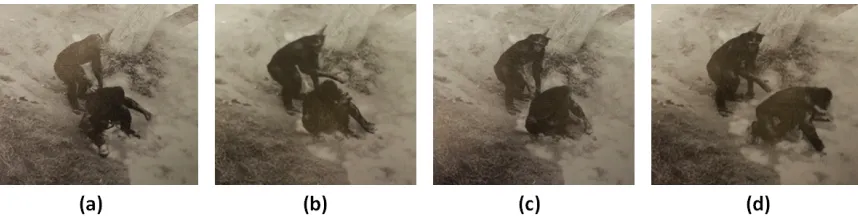
Gestures are present in most daily human actions or activities, and participate to human com-munication by either complementing speech or substituting themselves to spoken language in envi-ronments requiring silent communication (under water, noisy envienvi-ronments, secret communication, etc.) or for people with hearing disabilities. The importance of gestures in communication is rooted in primal behaviors: the gesture-first theory, supported by the analysis of mirror neurons in pri-mates (Hewes, 1973), indicated that the first steps of language phylogenetically were not speech, nor speech with gesture, but were gestures alone (McNeil, 2012; Hewes, 1973). See examples of primate communication by means of gestures in Figure 1.
Figure 1: Example of possible bonobo iconic gestures. (a) Start of swing gesture (or shove); (b) End of swing gesture (or shove); (c) Start of iconic swing, other bonobo starts to move; (d) End of iconic swing, other moving. Image from (McNeil, 2012).
also review some gesture recognition systems with data acquired from wearable sensors, although the comprehensive review of papers focus on the analysis of different visual modalities.
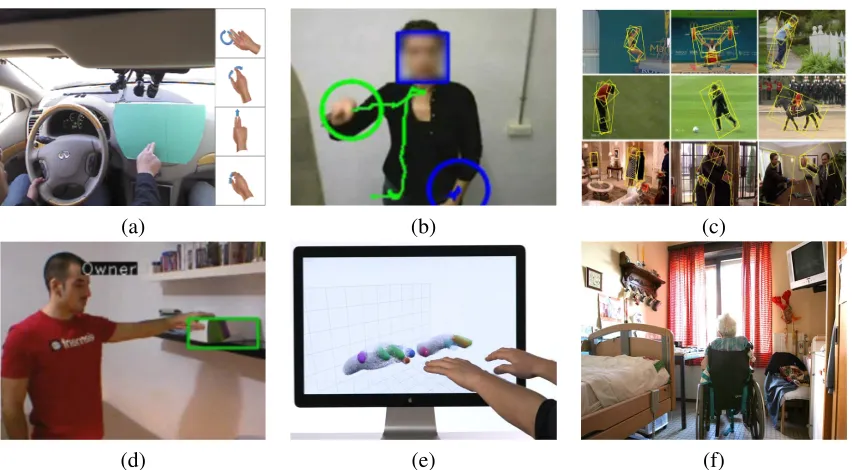
Applications are countless, like Human Computer Interaction (HCI), Human Robot Interaction (HRI) (also named human machine interaction HMI), communication, entertainment, security, art, semiotics, commerce and sports, while having an important social impact in assistive technologies for the handicapped and the elderly. Some examples of applications are illustrated in Fig. 2.
In addition to the recent advances in human and gesture recognition from classical RGB visual data, the automatic analysis of human body from sensor data keeps making rapid progress with the constant improvement of (i) new published methods that constantly push the state-of-the-art and (ii) the recent availability of inexpensive 3D video sensors such as KinectT M, providing a
complemen-tary source of information, and thus allowing the computation of new discriminative feature vectors and improved recognition by means of fusion strategies. In section 2 we review the state of the art in gesture recognition.
(a) (b) (c)
(d) (e) (f)
Figure 2: Some applications of gesture recognition. (a) Gesture recognition for driver assistance, from (Ohn-Bar and Trivedi, 2014), (b) Sign Language Recognition, (c) action/gesture recognition for content retrieval and categorization, from (Ma et al., 2013), (d) surveil-lance, (e) Human Computer/Robot/Machine Interaction, and (f) Assistive technology for people with reduced autonomy.
Our first workshop at CVPR from our 2011 challenge emphasized mostly 2D video data mean-while our second and third workshops at CVPR, ICPR, ICMI, ECCV conferences from our 2012, 2013, and 2014 challenges were focused on affordable 3D sensors for gesture recognition research, also including audio information. In ECCV 2014 and CVPR 2015 workshops we also promoted different aspects of looking at people, including pose recovery, activity recognition, and scene un-derstanding where humans are present. In addition to best challenge results, many research papers devoted to gesture recognition were published and presented in our challenge workshops. We also invited keynote speakers in diverse areas of pose and gesture research, including sign language recognition, body posture analysis, action and activity recognition, and facial expression or emotion recognition.
In this special topic on gesture recognition, extension of best challenge and workshop papers from previous events have been published. In addition, new description and learning strategies papers related to gesture recognition have been published. All of them will be shortly reviewed in the following sections.
related to ChaLearn competitions. Section 5 describes special topic published papers related to ges-ture recognition which are not based on ChaLearn competitions. Finally, Section 6 discusses main observations about the published papers.
2. Related Work in Gesture Recognition
In this section we present a taxonomy for action/gesture recognition, we review most influential works in the field, and finally we review existing datasets for action/gesture recognition together with the performance obtained by state of the art methods.
2.1 Taxonomy for gesture recognition
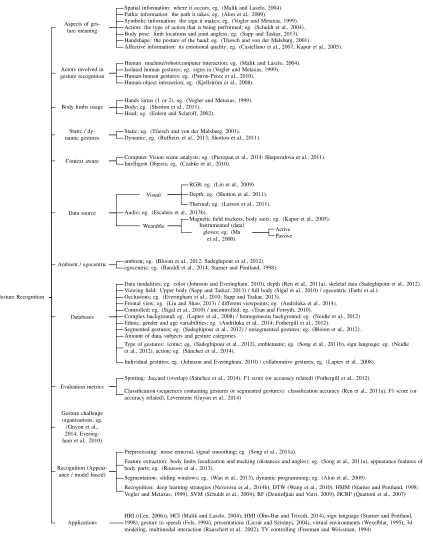
Fig. 3 is an attempt to create a taxonomy of the various components involved in conducting research in action/gesture recognition. We include various aspects relating to the problem setting, the data acquisition, the tools, the solutions, and the applications.
First, regarding the problem setting, the interpretation of gestures critically depends on a number of factors, including the environment in which gestures are performed, their span in time and space, and the intentional meaning in terms of symbolic description and/or the subconscious meaning re-vealing affective/emotional states. The problem setting also involves different actors who may par-ticipate in the execution of gestures and actions: human(s) and/or machine(s) (robot, computer, etc.), performing with or without tools or interacting or not with objects. Additionally, independently of the considered modality, for some gestures/actions different parts of the body are involved. While many gesture recognition systems only focus on arms and hands, full body motion/configuration and facial expressions can also play a very important role. Another aspect of the problem setting involves whether recognized gestures are static or dynamic. For the first case, just considering fea-tures from an input frame or any other acquisition device describing spatial configuration of body limbs, a gesture can be recognized. In the second case, the trajectory and pose of body limbs pro-vide the highest discriminative information for gesture recognition. In some settings, gestures are defined based not only on the pose and motion of the human, but also on the surrounding context, and more specifically on the objects that the human interacts with. For such settings, one approach for achieving context awareness is scene analysis, where information is extracted from the scene around the subject (e.g., Pieropan et al. (2014); Shapovalova et al. (2011)). Another approach is to have the subject interact with intelligent objects. Such objects use embedded hardware and software to facilitate object recognition/localization, and in some cases to also monitor interactions between such objects and their environment (e.g., Czabke et al. (2010))
Gesture Recognition
Aspects of ges-ture meaning
Spatial information: where it occurs; eg. (Malik and Laszlo, 2004). Pathic information: the path it takes; eg. (Alon et al., 2009). Symbolic information: the sign it makes; eg. (Vogler and Metaxas, 1999). Action: the type of action that is being performed; eg. (Schuldt et al., 2004). Body pose: limb locations and joint angless; eg. (Sapp and Taskar, 2013). Handshape: the posture of the hand; eg. (Triesch and von der Malsburg, 2001). Affective information: its emotional quality; eg. (Castellano et al., 2007; Kapur et al., 2005).
Actors involved in gesture recognition
Human machine/robot/computer interaction; eg. (Malik and Laszlo, 2004). Isolated human gestures; eg. signs in (Vogler and Metaxas, 1999). Human-human gestures; eg. (Patron-Perez et al., 2010). Human-object interaction; eg. (Kjellstr¨om et al., 2008).
Body limbs usage
Hands /arms (1 or 2); eg. (Vogler and Metaxas, 1999). Body; eg. (Shotton et al., 2011).
Head; eg. (Erdem and Sclaroff, 2002).
Static / dy-namic gestures
Static; eg. (Triesch and von der Malsburg, 2001). Dynamic; eg. (Ruffieux et al., 2013; Shotton et al., 2011).
Context aware Computer Vision scene analysis; eg. (Pieropan et al., 2014; Shapovalova et al., 2011).Intelligent Objects; eg. (Czabke et al., 2010).
Data source
Visual
RGB; eg. (Lin et al., 2009). Depth; eg. (Shotton et al., 2011).
Thermal; eg. (Larson et al., 2011). Audio; eg. (Escalera et al., 2013b).
Wearable
Magnetic field trackers, body suits; eg. (Kapur et al., 2005). Instrumented (data)
gloves; eg. (Ma et al., 2000).
Active Passive
Ambient / egocentric ambient; eg. (Bloom et al., 2012; Sadeghipour et al., 2012). egocentric; eg. (Baraldi et al., 2014; Starner and Pentland, 1998).
Databases
Data modalities; eg. color (Johnson and Everingham, 2010), depth (Ren et al., 2011a), skeletal data (Sadeghipour et al., 2012). Viewing field: Upper body (Sapp and Taskar, 2013) / full body (Sigal et al., 2010) / egocentric (Fathi et al.).
Occlusions; eg. (Everingham et al., 2010; Sapp and Taskar, 2013).
Frontal view; eg. (Liu and Shao, 2013) / different viewpoints; eg. (Andriluka et al., 2014). Controlled; eg. (Sigal et al., 2010) / uncontrolled; eg. (Tran and Forsyth, 2010).
Complex background; eg. (Laptev et al., 2008) / homogeneous background; eg. (Neidle et al., 2012) Ethnic, gender and age variabilities; eg. (Andriluka et al., 2014; Fothergill et al., 2012). Segmented gestures; eg. (Sadeghipour et al., 2012) / unsegmented gestures; eg. (Bloom et al., 2012). Amount of data, subjects and gesture categories
Type of gestures: iconic; eg. (Sadeghipour et al., 2012), emblematic; eg. (Song et al., 2011b), sign language; eg. (Neidle et al., 2012), action; eg. (S´anchez et al., 2014).
Individual gestures; eg. (Johnson and Everingham, 2010) / collaborative gestures; eg. (Laptev et al., 2008).
Evaluation metrics
Spotting: Jaccard (overlap) (S´anchez et al., 2014), F1 score (or accuracy related) (Fothergill et al., 2012).
Classification (sequences containing gestures or segmented gestures): classification accuracy (Ren et al., 2011a), F1 score (or accuracy related), Levenstein (Guyon et al., 2014)
Gesture challenge organizations, eg. (Guyon et al., 2014; Evering-ham et al., 2010)
Recognition (Appear-ance / model based)
Preprocessing: noise removal, signal smoothing; eg. (Song et al., 2011a).
Feature extraction: body limbs localization and tracking (distances and angles); eg. (Song et al., 2011a), appearance features of body parts; eg. (Roussos et al., 2013).
Segmentation: sliding windows; eg. (Wan et al., 2013), dynamic programming; eg. (Alon et al., 2009).
Recognition: deep learning strategies (Neverova et al., 2014b), DTW (Wang et al., 2010), HMM (Starner and Pentland, 1998; Vogler and Metaxas, 1999), SVM (Schuldt et al., 2004), RF (Demirdjian and Varri, 2009), HCRF (Quattoni et al., 2007)
Applications
HRI ((Lee, 2006)), HCI (Malik and Laszlo, 2004), HMI (Ohn-Bar and Trivedi, 2014), sign language (Starner and Pentland, 1998), gesture to speech (Fels, 1994), presentations (Lics´ar and Szir´anyi, 2004), virtual environments (Wexelblat, 1995), 3d modeling, multimodal interaction (Rauschert et al., 2002), TV controlling (Freeman and Weissman, 1994)
Figure 3:Taxonomy for gesture recognition.
(a) (b) (c)
(d) (e) (f)
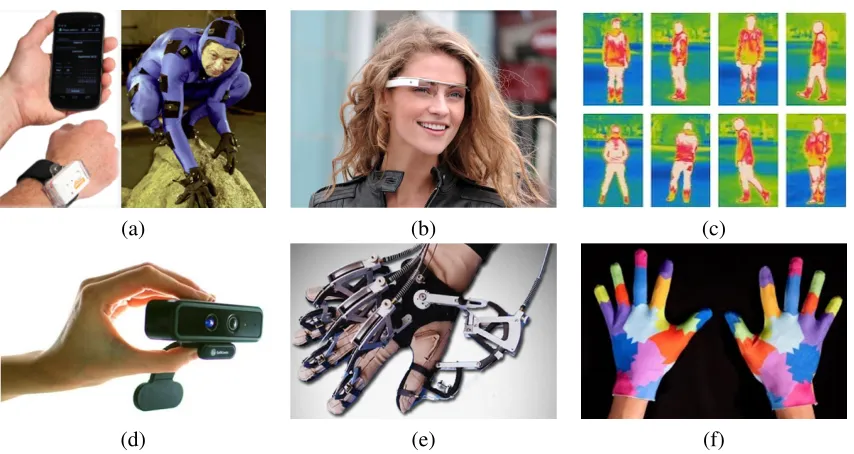
Figure 4: Some examples of acquisition devices for gesture recognition. (a) left: mobile with GPS and accelerometer, right: inertial sensor with accelerometer and gyroscope, (b) Google Glasses for egocentric computing, (c) thermal imagery for action recognition, (d) audio-RGB-depth device, (e) active glove, and (f) passive glove.
(objects with sensors that emit signals related to proximity and interaction). Some examples of acquisition devices are shown in Figure 4.
Third, the field of gesture recognition has shaped up thanks to the adoption of standard method-ology. In order to advance in the design of robust action/recognition approaches, several datasets with different complexity have been published, and several world challenges helped to push the research in the area. This required the definition of standard evaluation metrics to render methods comparable. Notably, when one wants to recognize actions/gestures from data, common steps in-volve pre-processing of the acquired data, feature extraction, segmentation of begin-end of gesture and its final gesture/action label classification. Many datasets include preprocessed and/or thor-oughly annotated data.
Fourth, gesture recognition has offered many opportunities to algorithm developers to innovate. The approaches, which essentially can be categorized into appearance-based and model-based meth-ods, are going to be reviewed in the next section. We will mention only the most influential works for action/gesture recognition illustrating various aspects of the problem setting, data acquisition, and methodology defined in our taxonomy. Note that although we defined a general taxonomy for gesture recognition, in this paper, we put special emphasis on computer vision and machine learning methods for action/gesture recognition.
2.2 Overview of gesture recognition methods
Different surveys have been published so far reviewing gesture recognition systems (LaViola Jr., 1999; Mitra and Acharya, 2007; Chaudhary et al., 2011; Ibraheem and Khan, 2012; Avci et al., 2010; Khan and Ibraheem; Kausar and Javed, 2011). In this section, we present an up-to-date review of most influential works in the field.
2.2.1 RECOGNIZING STATIC GESTURES AND HAND POSE
In the case of static gestures, frequently hand shape is the important differentiating feature (Cui and Weng, 2000; Freeman and Roth, 1996; Kelly et al., 2010; Ren et al., 2011b; Triesch and von der Malsburg, 2002), although the pose of the rest of the body can also be important, e.g., (Yang et al., 2010; Van den Bergh et al., 2009). For static hand pose classification, some approaches rely on visual markers, such as a color glove with a specific color for each finger, e.g., (Wang and Popovi´c, 2009). Other approaches can recognize the hand pose on unadorned hands. Appearance-based methods, like (Moghaddam and Pentland, 1995; Triesch and von der Malsburg, 2002; Freeman and Roth, 1996; Wu and Huang, 2000), can be used for recognizing static hand postures observed from specific viewpoints.
Model-based methods for hand pose estimation (Oikonomidis et al., 2011; de La Gorce et al., 2011; Oikonomidis et al., 2010; Rehg and Kanade, 1995) typically match visual observations to instances of a predefined hand model. Single frame pose estimation methods try to solve the hand pose estimation problem without relying on temporal information (Athitsos and Sclaroff, 2003). Most recently, due to the advent of commercially available depth sensors, there is an increased interest in methods relying on depth data (Keskin et al., 2012; Mo and Neumann, 2006; Oikonomidis et al., 2011; Pugeault and Bowden, 2011; Lopes et al., 2014).
2.2.2 FROM BODY PART DETECTION TO HOLISTIC PATTERN DETECTION
Dynamic gestures are characterized by both the pose and the motion of the relevant body parts. Much effort has traditionally be put into detecting firstbody partsand then tracking their motion. In color videos, detecting hands can be quite challenging, although better performance can be achieved by placing additional constraints on the scene and the relative position of the subject and the hands with respect to the camera (Cui and Weng, 2000; Isard and Blake, 1998; Kolsch and Turk, 2004; Ong and Bowden, 2004; Stefanov et al., 2005; Stenger et al., 2003; Sudderth et al., 2004). Commonly-used visual cues for hand detection such as skin color, edges, motion, and background subtraction (Chen et al., 2003; Martin et al., 1998) may also fail to unambiguously locate the hands when the face, or other “hand-like” objects are moving in the background.
In (Li and Kitani, 2013) the authors propose a hand segmentation approach from egocentric RGB data by the combination of color and texture features. In(Baraldi et al., 2014), dense features are extracted around regions selected by a new hand segmentation technique that integrates super-pixel classification, temporal and spatial coherence. Bag of visual words and linear SVM are used for final representation and classification.
pro-posed to measure the dissimilarity between hand shapes. It matches the finger parts while not the whole hand based on hand segmentation and contour analysis. The method is tested on their own 10-gesture dataset.
Instead of estimating hand position and/or body pose before recognizing the gesture, an alterna-tive is to customize the recognition module so that it does not require the exact knowledge of hand positions, but rather accepts as input a list of several candidate hand locations (Alon et al., 2009; Sato and Kobayashi, 2002; Hernandez-Vela et al., 2013b).
Another approach is to use global image/video features. Such global features include mo-tion energy images (Bobick and Davis, 2001), thresholded intensity images and difference images (Dreuw et al., 2006), 3D shapes extracted by identifying areas of motion in each video frame (Gore-lick et al., 2007) and histograms of pairwise distances of edge pixels (Nayak et al., 2005). Gestures can also be modelled as rigid 3D patterns (Ke et al., 2005), from which features can be extracted using 3D extensions of rectangle filters (Viola and Jones, 2001). The work of (Kong et al., 2015) uses pixel-level attributes in a hierarchical architecture of 3D kernel descriptors, and efficient match kernel is used to recognize gestures from depth data.
Along similar lines, (Ali and Shah, 2010) propose a set of kinematic features that are derived from the optical flow for human action recognition in videos: divergence, vorticity, symmetric and antisymmetric flow fields, second and third principal invariants of flow gradient and rate of strain tensor, and third principal invariant of rate of rotation tensor, which define spatiotemporal patterns. These kinematic features are computed by Principal Component Analysis (PCA). Then multiple instance learning (MIL) is applied for recognition in which each action video is represented by a bag of kinematic modes. The proposal is evaluated on the RGB Weizmann and KTH action data sets, showing comparable result to state of the art performances.
Much effort has also been put intospatiotemporal invariant features. In (Yuan et al., 2011) the authors propose a RGB action recognition system based on a pattern matching approach, named naive Bayes mutual information maximization (NBMIM). Each action is characterized by a collec-tion of spatiotemporal invariant features which are matched with an accollec-tion class by measuring the mutual information between them. Based on this matching criterion, action detection is to localize a subvolume in the volumetric video space that has the maximum mutual information toward a spe-cific action class. A novel spatiotemporal branch-and-bound (STBB) search algorithm is designed to efficiently find the optimal solution. Results show high recognition results on KTH, CMU, and MSR data sets, showing speed up inference in comparison with standard 3D branch-and-bound.
Another example is the paper of (Derpanis et al., 2013) in which a compact local descriptor of video dynamics is proposed for action recognition in RGB data sequences. The descriptor is based on visual spacetime oriented energy measurements. An associated similarity measure is introduced that admits efficient exhaustive search for an action template, derived from a single exemplar video, across candidate video sequences. The method is speeded up by means of a GPU implementation. Method is evaluated on UCF and KTH data sets, showing comparable results to state of the art methods.
2.2.3 SEGMENTATION OF GESTURES AND GESTURE SPOTTING
Dynamic gesture recognition methods can be further categorized based on whether they make the assumption that gestures have already been segmented, so that the start frame and end frame of each gesture is known. Gesture spotting is the task of recognizing gestures in unsegmented video streams, that may contain an unknown number of gestures, as well as intervals were no gesture is being performed. Gesture spotting methods can be broadly classified into two general approaches: the direct approach, where temporal segmentation precedes recognition of the gesture class, and the indirect approach, where temporal segmentation is intertwined with recognition:
• Direct methods(also called heuristic segmentation) first compute low-level motion param-eters such as velocity, acceleration, and trajectory curvature (Kang et al., 2004) or mid-level motion parameters such as human body activity (Kahol et al., 2004), and then look for abrupt changes (e.g., zero-crossings) in those parameters to identify candidate gesture boundaries.
• Indirect methods(also called recognition-based segmentation) detect gesture boundaries by finding, in the input sequence, intervals that give good recognition scores when matched with one of the gesture classes. Most indirect methods (Alon et al., 2009; Lee and Kim, 1999; Oka, 1998) are based on extensions of Dynamic Programming (DP) e.g., Dynamic Time Warping (DTW) (Darrell et al., 1996; Kruskal and Liberman, 1983), Continuous Dynamic Program-ming (CDP) (Oka, 1998), various forms of Hidden Markov Models (HMMs) (Brand et al., 1997; Chen et al., 2003; Stefanov et al., 2005; Lee and Kim, 1999; Starner and Pentland, 1998; Vogler and Metaxas, 1999; Wilson and Bobick, 1999), and most recently, Conditional Random Fields (Lafferty et al., 2001; Quattoni et al., 2007). Also hybrid probabilistic and dy-namic programming approaches have been recently published (Hernandez-Vela et al., 2013a). In those methods, the gesture endpoint is detected by comparing the recognition likelihood score to a threshold. The threshold can be fixed or adaptively computed by a non-gesture garbage model (Lee and Kim, 1999; Yang et al., 2009), equivalent to silence models in speech.
When attempting to recognize unsegmented gestures, a frequently encountered problem is the
sub-gesture problem: false detection of gestures that are similar to parts of other longer gestures. (Lee
and Kim, 1999) address this issue using heuristics to infer the user’s completion intentions, such as moving the hand out of camera range or freezing the hand for a while. An alternative is proposed in (Alon et al., 2009), where a learning algorithm explicitly identifies subgesture/supergesture rela-tionships among gesture classes, from training data.
Another common approach for gesture spotting is to first extract features from each frame of the observed video, and then to provide a sliding window of those features to a recognition module, which performs the classification of the gesture (Corradini, 2001; Cutler and Turk, 1998; Darrell et al., 1996; Oka et al., 2002; Starner and Pentland, 1998; Yang et al., 2002)). Oftentimes, the extracted features describe the position and appearance of the gesturing hand or hands (Cutler and Turk, 1998; Darrell et al., 1996; Starner and Pentland, 1998; Yang et al., 2002)). This approach can be integrated with recognition-based segmentation methods.
2.2.4 ACTION AND ACTIVITY RECOGNITION
in the action graph. The authors propose a projection based sampling scheme to sample the bag of 3D points from the depth maps. In (Sminchisescu et al., 2006) it is proposed the first condi-tional/discriminative chain model for action recognition.
The work of (Zanfir et al., 2013) propose the non-parametric Moving Pose (MP) framework for low-latency human action and activity recognition. The moving pose descriptor considers both pose information as well as differential quantities (speed and acceleration) of the human body joints within a short time window around the current frame. The descriptor is used with a modified kNN classifier that considers both the temporal location of a particular frame within the action sequence as well as the discrimination power of its moving pose descriptor compared to other frames in the training set. The method shows comparable results to state of the art methods on MSR-Action3D and MSR-DailyActivities3D data sets.
In (Oreifej and Liu, 2013), it is proposed a new descriptor for activity recognition from videos acquired by a depth sensor. The depth sequence is described using a histogram capturing the distri-bution of the surface normal orientation in the 4D space of time, depth, and spatial coordinates. To build the histogram, 4D projectors are created, which quantize the 4D space and represent the possi-ble directions for the 4D normal. Projectors are initialized using the vertices of a regular polychoron. Projectors are refined using a discriminative density measure, such that additional projectors are in-duced in the directions where the 4D normals are more dense and discriminative. The proposed descriptor is tested on MSR Actions 3D, MSR Gesture 3D, and MSR Daily Activity 3D, slightly improving state of the art results.
In (Wang et al., 2014), the authors propose to characterize the human actions with an “actionlet” ensemble model, which represents the interaction of a subset of human joints. Authors train an ensemble of SVM classifiers related to actionlet patterns, which includes 3D joint features, Local Occupancy Patterns, and Fourier Temporal Pyramid. Results on CMU MoCap, MSR-Action3D, MSR-DailyActivity3D, Cornell Activity, and Multiview 3D data sets show comparable and better performance than state of the art approaches.
The work of (Yang and Tian, 2014a) presents an approach for activity recognition in depth video sequences. Authors cluster hypersurface normals in a depth sequence to form the polynormal which is used to jointly characterize the local motion and shape information. In order to globally capture the spatial and temporal orders, an adaptive spatio-temporal pyramid is introduced to subdivide a depth video into a set of space-time grids. It is then proposed a scheme of aggregating the low-level polynormals into the super normal vector (SNV) which can be seen as a simplified version of the Fisher kernel representation. Authors validate the proposed approach on MSRAction3D, MSRDailyActivity3D, MSRGesture3D, and MSRActionPairs3D data sets slightly improving in all cases state of the art performances.
In (Yu et al., 2014) the authors propose the orderlets to capture discriminative information for gesture recognition from depth maps. Orderlet features are discovered looking for frequent sets of skeleton joints that provide discriminative information. Adaboost is used for orderlets selection. Results on the ORGBD data set shows a recognition rate of 71.4% mean class average accuracy, improving by near 5% state of the art results on this data set, and near 20% improvement regarding frame level classification. However the results showed on the MSR-DailyActivity3D data set are inferior to the ones reported in (Luo et al., 2014).
segmentation. Then, a Superpixel-Markov Random Field (SMRF) parsing scheme is used to enforce the spatial smoothness and the label co-occurrence prior to remove the misclassified regions.
2.2.5 APPROACHES USING NON-VIDEO MODALITIES AND MULTIMODAL APPROACHES
In terms of multimodal approaches for gesture recognition, (Luo et al., 2014) propose a sparse coding-based temporal pyramid matching approach (ScTPM) for feature representation using depth maps. The authors also propose the Center-Symmetric Motion Local Ternary Pattern (CS-Mltp) scriptor to capture spatial-temporal features from RGB videos. By fusing both RGB and Depth de-scriptors, the authors improve state of the art results on MSR-Action3D and MSR-DailyActivity3D data sets, with a 6% and 7% of improvement, respectively.
In (Ionescu et al., 2014), it is presented the Human3.6M data set, consisting of 3.6Million ac-curate 3D Human poses, acquired by recording the performance of 5 female and 6 male subjects, under 4 different viewpoints, for training realistic human sensing systems and for evaluating the next generation of human pose estimation models and algorithms. Authors also provide a set of large scale statistical models and evaluation baselines for the dataset illustrating its diversity.
In (Xiao et al., 2014) a wearable Immersion CyberGlove II is used to capture the hand posture and the vision-based Microsoft KinectT Mtakes charge of capturing the head and arm posture. An effective and real-time human gesture recognition algorithm is also proposed.
In (Liang et al., 2013) it is proposed to detect and segment different body parts using RGB and Depth data sequences. The method uses both temporal constraints and spatial features, and performs hand parsing and 3D fingertip localization for hand pose estimation. The hand parsing algorithm incorporates a spatial-temporal feature into a Bayesian inference framework to assign the correct label to each image pixel. The 3D fingertip localization algorithm adapts is based on geodesic extrema extraction to fingertip detection. The detected 3D fingertip locations are finally used for hand pose estimation with an inverse kinematics solver. The work of (Joshi et al., 2015) use random forest for both segmenting and classifying gesture categories from data coming from different sensors.
Although many works base only on inertial data (Benbasat and Paradiso, 2001; Berlemont et al., 2015), multimodal approaches are often considered in order to combine trajectory information will pose analysis based on visual data. The works of (Liu et al., 2014; Pardo et al., 2013) present approaches for gesture recognition based on the combination of depth and inertial data. In (Liu et al., 2014) skeleton obtained from depth data and data from inertial sensors are train within HMM in order to perform hand gesture recognition. A similar approach is presented in (Pardo et al., 2013), but also recognizing objects present in the scene and using DTW for recognition with the objective of performing ambient intelligent analysis to support people with reduced autonomy. In (Gowing et al., 2014), it is presented a comparison of WIMU aWireless/Wearable Inertial Measurement Unit and KinectT M. However, comparison is performed independently, without considering a fusion strategy.
The work of (Escalera et al., 2013b) summarizes a 2013 challenge on multimodal gesture recog-nition, where in addition to RGB and depth data, audio can be used to identify the performed ges-tures.
Few works considered context information in order to improve gesture/action recognition sys-tems. In (Wilhelm) it is proposed to adapt gesture recognition based on a dialogue manager as a par-tially observable Markov decision process (POMDP). In (Caon et al., 2011) two KinectT Mdevices and smart objects are used to estimate proximity and adapt the recognition prior of some gestures.
The recent emergence of deep learning systems in computer vision have also been applied to action/gesture recognition systems. In (Neverova et al., 2014a), it is presented a deep learning based approach for hand pose estimation, targeting gesture recognition. The method integrates local and global structural information into the training objective. In (Nagi et al., 2011), deep neural net-work (NN) combining convolution and max-pooling (MPCNN) is proposed for supervised feature learning and classification of RGB hand gestures given by humans to mobile robots using colored gloves. The hand contour is retrieved by color segmentation, then smoothed by morphological im-age processing which eliminates noisy edges. The system classifies 6 gesture classes with 96% accuracy, improving performance of several state of the art methods. The work of (Duffner et al., 2014) presents an approach that classifies 3D gestures using jointly accelerometer and gyroscope signals from a mobile device using convolutional neural network with a specific structure involving a combination of 1D convolution. In (Molchanov et al., 2015) convolutional deep neural networks are used to fuse data from multiple sensors (short-range radar, a color camera, and a depth camera) and to classify the gestures in a driver assistance scenario.
2.3 Sign language recognition
An important application of gesture recognition is sign language recognition. American Sign Lan-guage (ASL) is used by 500,000 to two million people in the U.S. (Lane et al., 1996; Schein, 1989). Overall, national and local sign languages are used all over the world as the natural means of com-munication in deaf communities.
Several methods exist for recognizing isolated signs, as well as continuous signing. Some re-searchers have reported results on continuous signing with vocabularies of thousands of signs, using input from digital gloves, e.g., (Yao et al., 2006). However, glove-based interfaces are typically ex-pensive for adoption by the general public, as well as intrusive, since the user has to wear one or two gloves connected with wires to a computer.
Computer vision methods for sign language recognition offer hope for cheaper, non-intrusive interfaces compared to methods using digital gloves. Several such methods have been proposed (Bauer et al., 2000; Cui and Weng, 2000; Dreuw et al., 2006; Kadir et al., 2004; Starner and Pent-land, 1998; Vogler and Metaxas, 1999; Wang et al., 2010; Zieren and Kraiss, 2005). However, com-puter vision methods typically report lower accuracies compared to methods using digital gloves, due to the difficulty of extracting accurate information about the articulated pose and motion of the signer.
interest-ing research has aimed at enablinterest-ing automated construction of large datasets. For example, (Cooper and Bowden, 2009) aim at automatically generating large corpora by automatically segmenting signs from close-captioned sign language videos. As another example, (Farhadi et al., 2007) pro-pose a method where sign models are learned using avatar-produced data, and then transfer learning is used to create models adapted for specific human signers.
The recent availability of depth cameras such as KinectT Mhas changed the methodology and improved performance. Depth cameras provide valuable 3D information about the position and trajectory of hands in signing. Furthermore, detection and tracking of articulated human motion is significantly more accurate in depth video than in color video. Several approaches have been published in recent years that use depth cameras to improve accuracy in sign language recognition Conly et al. (2015); Wang et al. (2015a); Zafrulla et al. (2011).
2.4 Data sets for gesture and action recognition
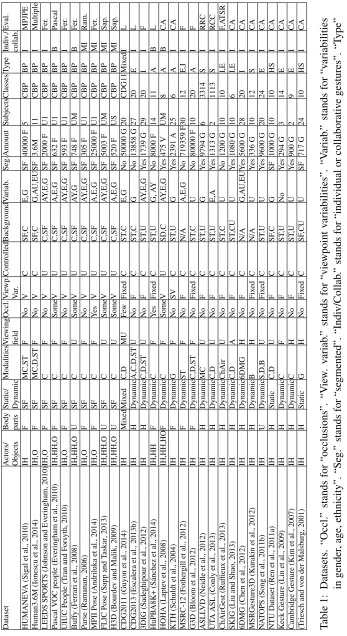
Tens of gesture recognition datasets have been made available to the research community over the last several years. A summary of available datasets is provided in Table 1. In that table, for each data set we mark some important attributes of the dataset, such as the type of gestures it contains, the data modalities it provides, the viewing field, background, amount of data, and so on. Regarding the “occlusions” attribute in that table, we should clarify that it only refers to occlusions of the subject by other objects (or subjects), and not to self occlusions. Self occlusions are quite common in gestures, and are observed in most datasets. We should also note that, regarding the complexity of the background, dynamic and/or cluttered backgrounds can make gesture recognition challenging in color images and video. At the same time, a complex background can be quite easy to segment if depth or skeletal information is available, as is the case in several datasets on Table 1.
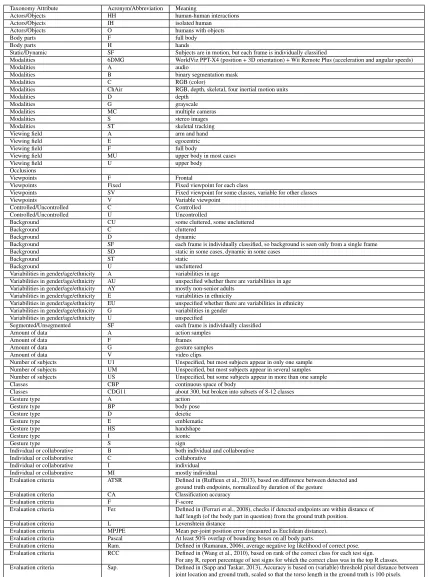
In order to be able to fit Table 1 in a single page, we had to use abbreviations quite heavily. Table 2 defines the different acronyms and abbreviations used in Table 1.
Taxonomy Attribute Acronym/Abbreviation Meaning
Actors/Objects HH human-human interactions
Actors/Objects IH isolated human
Actors/Objects O humans with objects
Body parts F full body
Body parts H hands
Static/Dynamic SF Subjects are in motion, but each frame is individually classified
Modalities 6DMG WorldViz PPT-X4 (position + 3D orientation) + Wii Remote Plus (acceleration and angular speeds)
Modalities A audio
Modalities B binary segmentation mask
Modalities C RGB (color)
Modalities ChAir RGB, depth, skeletal, four inertial motion units
Modalities D depth
Modalities G grayscale
Modalities MC multiple cameras
Modalities S stereo images
Modalities ST skeletal tracking
Viewing field A arm and hand
Viewing field E egocentric
Viewing field F full body
Viewing field MU upper body in most cases
Viewing field U upper body
Occlusions
Viewpoints F Frontal
Viewpoints Fixed Fixed viewpoint for each class
Viewpoints SV Fixed viewpoint for some classes, variable for other classes
Viewpoints V Variable viewpoint
Controlled/Uncontrolled C Controlled Controlled/Uncontrolled U Uncontrolled
Background CU some cluttered, some uncluttered
Background C cluttered
Background D dynamic
Background SF each frame is individually classified, so background is seen only from a single frame Background SD static in some cases, dynamic in some cases
Background ST static
Background U uncluttered
Variabilities in gender/age/ethnicity A variabilities in age
Variabilities in gender/age/ethnicity AU unspecified whether there are variabilities in age Variabilities in gender/age/ethnicity AY mostly non-senior adults
Variabilities in gender/age/ethnicity E variabilities in ethnicity
Variabilities in gender/age/ethnicity EU unspecified whether there are variabilities in ethnicity Variabilities in gender/age/ethnicity G variabilities in gender
Variabilities in gender/age/ethnicity U unspecified
Segmented/Unsegmented SF each frame is individually classified
Amount of data A action samples
Amount of data F frames
Amount of data G gesture samples
Amount of data V video clips
Number of subjects U1 Unspecified, but most subjects appear in only one sample Number of subjects UM Unspecified, but most subjects appear in several samples Number of subjects US Unspecified, but some subjects appear in more than one sample
Classes CBP continuous space of body
Classes CDG11 about 300, but broken into subsets of 8-12 classes
Gesture type A action
Gesture type BP body pose
Gesture type D deictic
Gesture type E emblematic
Gesture type HS handshape
Gesture type I iconic
Gesture type S sign
Individual or collaborative B both individual and collaborative Individual or collaborative C collaborative
Individual or collaborative I individual Individual or collaborative MI mostly individual
Evaluation criteria ATSR Defined in (Ruffieux et al., 2013), based on difference between detected and ground truth endpoints, normalized by duration of the gesture
Evaluation criteria CA Classification accuracy
Evaluation criteria F F-score
Evaluation criteria Fer. Defined in (Ferrari et al., 2008), checks if detected endpoints are within distance of half length (of the body part in question) from the ground truth position. Evaluation criteria L Levenshtein distance
Evaluation criteria MPJPE Mean per-joint position error (measured as Euclidean distance). Evaluation criteria Pascal At least 50% overlap of bounding boxes on all body parts.
Evaluation criteria Ram. Defined in (Ramanan, 2006), average negative log likelihood of correct pose. Evaluation criteria RCC Defined in (Wang et al., 2010), based on rank of the correct class for each test sign.
For any R, report percentage of test signs for which the correct class was in the top R classes. Evaluation criteria Sap. Defined in (Sapp and Taskar, 2013), Accuracy is based on (variable) threshold pixel distance between
joint location and ground truth, scaled so that the torso length in the ground truth is 100 pixels.
3. Gesture recognition challenges
In this section we review the series of gesture and action recognition challenges organized by ChaLearn from 2011 to 2015, as well as other international challenges related to gesture recog-nition.
3.1 First ChaLearn Gesture Recognition Challenge (2011-2012): One shot learning
ChaLearn launched in 2012 a challenge with prizes donated by Microsoft using datasets described in (Guyon et al., 2014). We organized two rounds in conjunction with the CVPR conference (Provi-dence, Rhode Island, USA, June 2012) and the ICPR conference (Tsukuba, Japan, November 2012). Details on the challenge setting and results are found in (Guyon et al., 2013). We briefly summarize the setting and results.
3.1.1 2011-2012 CHALLENGEPROTOCOL ANDEVALUATION
The task of the challenge was to built a learning system capable of learning a gesture classification problem from asingle training exampleper class, from dynamic video data complemented by a depth map obtained with KinectT M. The rationale behind this setting is that, in many computer
interface applications to gesture recognition, users want to customize the interface to use their own gestures. Therefore they should be able to retrain the interface using a small vocabulary of their own gestures. We have also experimented with other use cases in gaming and teaching gesture vocabularies. Additionally, the problem of one-shot-learning is of intrinsic interest in machine learning and the solutions deviced could carry over to other applications. It is in a certain way an extreme case of transfer learning.
To implement this setting in the challenge, we collected a large dataset consisting of batches, each batch corresponding to the video recording of short sequences of gestures performed by the same person. The gestures in one batch pertained to a small vocabulary of gestures taken from a variety of application domains (sign language for the deaf, traffic signals, pantomimes, dance postures, etc.). During the development phase, the participants had access to hundreds of batches of diverse gesture vocabularies. This played the role of “source domain data” in the transfer learning task. The goal of the participants was to get ready to receive new batches from different gesture performers and different gesture vocabularies, playing the role of “transfer domain data”. Their system would then need to learn from a single example of gesture performed by the particular performer, before being capable of recognizing the rest of the gestures in that batch. The full dataset is available fromhttp://gesture.chalearn.org/data.
was to predict those labels. We used the Kaggle platform to manage submissions1The participants received immediate feed-back on validation data on a on-line leaderboard. The final evaluation was carried out on the final evaluation data, and those results were only revealed after the challenge was over. The participants had a few days to train their systems and upload their predictions. Prior to the end of the development phase, the participants were invited to submit executable software for their best learning system to a software vault. This allowed the competition organizers to check their results and ensure the fairness of the competition.
To compare prediction labels for gesture sequences to the truth values, we used the generalized Levenshtein distances (each gesture counting as one token). The final evaluation score was com-puted as the sum of such distances for all test sequences, divided by the total number of gestures in the test batch. This score is analogous to an error rate. However, it can exceed one. Specifically, for each video, the participants provided an ordered list of labelsRcorresponding to the recognized gestures. We compared this list to the corresponding list of labels T in the prescribed list of ges-tures that the user had to play. These are the “true” gesture labels (provided that the users did not make mistakes). We computed the generalized Levenshtein distanceL(R,T), that is the minimum number of edit operations (substitution, insertion, or deletion) that one has to perform to go from
RtoT (or vice versa). The Levenhstein distance is also known as “edit distance”. For example:
L([124],[32]) =2;L([1],[2]) =1;L([222],[2]) =2.
We provided code to browse though the data, a library of computer vision and machine learning techniques written in Matlab featuring examples drawn from the challenge datasets, and an end-to-end baseline system capable of processing challenge data and producing a sample submission. The competition pushed the state of the art considerably. The participants narrowed down the gap in performance between the baseline recognition system initially provided ('60% error) and human performance ('2% error) by reaching '7% error in the second round of the challenge. There remains still much room for improvement, particularly to recognize static postures and subtle finger positions.
3.1.2 2011-2012 CHALLENGE DATA
The datasets are described in details in a companion paper (Guyon et al., 2014). Briefly, the data are organized in batches: development batches devel01-480, validation batches valid01-20, and final evaluation batches final01-20 (for round 1) and final21-40 (for round 2). For the development batches, we provided all the labels. To evaluate the performances on “one-shot-learning” tasks, the valid and final batches were provided with labels only forone example of each gesture classin each batch (training examples). The goal was to automatically predict the gesture labels for the remaining unlabelled gesture sequences (test examples).
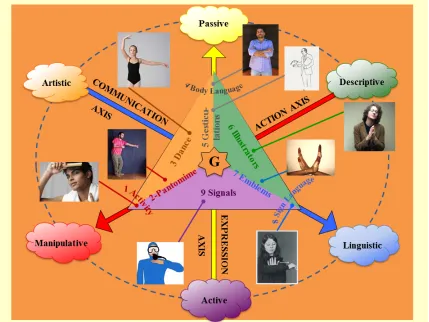
Each batch includes 100 recorded gestures grouped in sequences of 1 to 5 gestures performed by the same user. The gestures are drawn from a small vocabulary of 8 to 12 unique gestures, which we call a “lexicon”. For instance a gesture vocabulary may consist of the signs to referee volleyball games or the signs to represent small animals in the sign language for the deaf. We selected lexicons from nine categories corresponding to various settings or application domains (Figure 5):
1. Body languagegestures (like scratching your head, crossing your arms).
Team Public score Private score For comparison score on validation set on final set #1 on final set #2
Alfnie 0.1426 0.0996 0.0915
Pennect 0.1797 0.1652 0.1231
OneMillionMonkeys 0.2697 0.1685 0.1819
Immortals 0.2543 0.1846 0.1853
Zonga 0.2714 0.2303 0.2190
Balazs Godeny 0.2637 0.2314 0.2679
SkyNet 0.2825 0.2330 0.1841
XiaoZhuwWudi 0.2930 0.2564 0.2607
Baseline method 1 0.5976 0.6251 0.5646
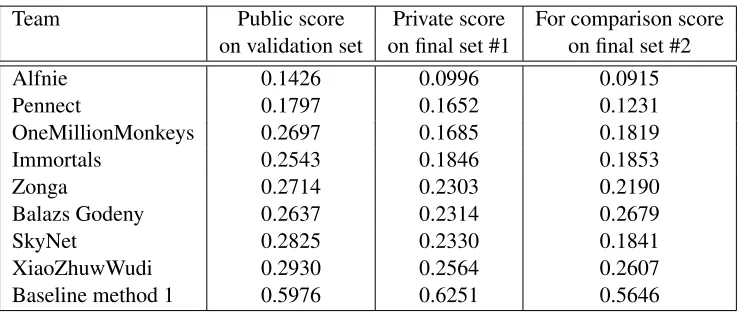
Table 3: Results of round 1. In round 1 the baseline method was a simple template matching method (see text). For comparison, we show the results on the final set number 2 not available in round 1.
2. Gesticulationsperformed to accompany speech.
3. Illustrators(like Italian gestures).
4. Emblems(like Indian Mudras).
5. Signs(from sign languages for the deaf).
6. Signals (like referee signals, diving signals, or Marshalling signals to guide machinery or vehicle).
7. Actions(like drinking or writing).
8. Pantomimes(gestures made to mimic actions).
9. Dance postures.
During the challenge, we did not disclose the identity of the lexicons and of the users.
3.1.3 2011-2012 CHALLENGERESULTS
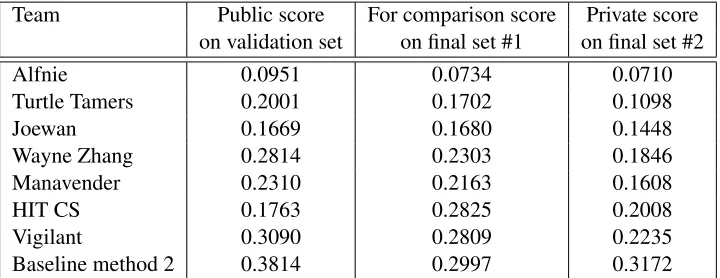
The results of the top ranking participants were checked by the organizers who reproduced their results using the code provided by the participants before they had access to the final evaluation data. All of them passed successfully the verification process. These results are shown in Tables 3 and 4.
3.1.4 2011-2012 CHALLENGE, SUMMARY OF THEWINNERMETHODS
Figure 5: Types of gestures. We created a classification of gesture types according to purpose de-fined by three complementary axes: communication, expression and action. We selected 85 gesture vocabularies, including Italian gestures, Indian Mudras, Sign language for the deaf, diving signals, pantomimes, and body language.
The winner of both rounds (Alfonso Nieto Casta˜non of Spain, a.k.a. alfnie) used a novel technique called “Motion Signature analyses”, inspired by the neural mechanisms underlying infor-mation processing in the visual system. This is an unpublished method using a sliding window to perform simultaneously recognition and temporal segmentation, based solely on depth images. The method, described by the authors as a “Bayesian network”, is similar to a Hidden Markov Model (HMM). It performs simultaneous recognition and segmentation using the Viterbi algorithm. The preprocessing steps include Wavelet filtering replacement of missing values and outlier detection. Notably, this method is one of the fastest despite the fact that he implemented it in Matlab (close to real time on a regular laptop). The author claims that it has linear complexity in image size, number of frames, and number of training examples.
Team Public score For comparison score Private score on validation set on final set #1 on final set #2
Alfnie 0.0951 0.0734 0.0710
Turtle Tamers 0.2001 0.1702 0.1098
Joewan 0.1669 0.1680 0.1448
Wayne Zhang 0.2814 0.2303 0.1846
Manavender 0.2310 0.2163 0.1608
HIT CS 0.1763 0.2825 0.2008
Vigilant 0.3090 0.2809 0.2235
Baseline method 2 0.3814 0.2997 0.3172
Table 4: Results of round 2. In round 2, the baseline method was the “Principal Motion” method (see text).
Both methods are based on an HMM-style model using HOG/HOF features to represent movie frames. They differ in that Pennect used RGB images only while Turtle Tamers used both RGB and depth. Another difference is that Pennect used HOG/HOF features at 3 different scales while Turtle Tamers created a bag of features using K-means clustering from only 40x40 resolution and 16 orientation bins. Pennect trained a one-vs-all linear classifier for each frame in every model and used the discriminant value as a local state score for the HMM while Turtle Tamers used a quadratic-chi kernel metric for comparing pairs of frames in the training and test movie. As preprocessing, Pennect uses mean subtraction and compensates for body translations while Turtle Tamers replaces the missing values by the median of neighboring values. Both teams claim a linear complexity in number of frames, number of training examples, and image size. They both provided Matlab software that processes all the batches of the final test set on a regular laptop in a few hours.
The next best ranked participants (who won third place in round 2), the Joewan team, who published in this special topic (Wan et al., 2013), used a slightly different approach. They relied on the motion segmentation method provided by the organizers to pre-segment videos. They then represented each video as a bag of 3D MOSIFT features (integrating RGB and depth data), and then used a nearest neighbor classifier. Their algorithm is super-quadratic in image size, linear in number of frames per video, and linear in number of training examples. The method is rather slow and takes over a day to process all the batches of the final test set on a regular laptop.
Methods robust against translation include those of Joewan (Wan et al., 2013) and Immor-tals/Manavender (this is the same author under two different pseudonyms for round 1 and round 2). The team Immortals/Manavender published their method in this special topic (Malgireddy et al., 2013). Their representations are based on a bag of visual words, inspired by techniques used in action recognition (Laptev, 2005). Such representations are inherently shift invariant. The slight performance loss in translated data may be due to partial occlusions.
Although the team Zonga did not end up ranking among top ranking participants, the authors, who published their method in this special topic, proposed a very original method and ended up winning the best paper award. Notably, their outperformed all baseline methods early on in the challenge by applying their method without tuning it to the tasks of the challenge and remained at the top of the leaderboard for several weeks. The used a novel technique based on tensor geometry, which provides a data representation exhibiting desirable invariances and yields a very discriminat-ing structure for action recognition.
ChaLearn also organized demonstration competitions of gesture recognition systems using KinectT M, in conjunction with those events. Novel data representations were proposed to tackle with success, in real time, the problem of hand and finger posture recognition. The demonstration competition winners showed systems capable of accurately tracking in real time hand postures in application for touch free exploration of 3D medical images for surgeons in the operating room, finger spelling (sign language for the deaf), virtual shopping, and game controlling. Combining the methods proposed in the demonstration competition tackling the problem of hand postures and those of the quantitative evaluation focusing on the dynamics of hand and arm movements is a promising direction of future research. For a long lasting impact, the challenge platform, the data and software repositories have been made available for further research2.
3.2 ChaLearn Multimodal Gesture Recognition Challenge 2013
The focus of this second challenge was onmultiple instance, user independent learning of gestures
from multimodal data, which means learning to recognize gestures from several instances for each
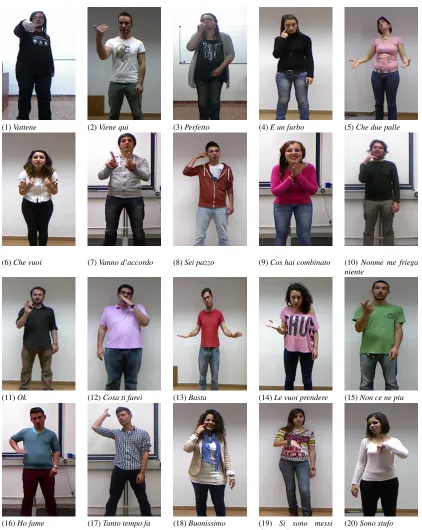
category performed by different users, drawn from a vocabulary of 20 gesture categories(Escalera et al., 2013b,a). A gesture vocabulary is a set of unique gestures, generally related to a par-ticular task. In this challenge we focus on the recognition of a vocabulary of 20 Italian cul-tural/anthropological signs (Escalera et al., 2013b), see Figure 6 for one example of each Italian gesture.
3.2.1 2013 CHALLENGE DATA
In all the sequences, a single user is recorded in front of a KinectT M, performing natural
commu-nicative gestures and speaking in fluent Italian. The main characteristics of the dataset of gestures are:
•13.858 gesture samples recorded with the KinectT Mcamera, including audio, skeletal model, user
mask, RGB, and depth images.
•RGB video stream, 8-bit VGA resolution (640×480) with a Bayer color filter, and depth sensing video stream in VGA resolution (640×480) with 11-bit. Both are acquired in 20 fps on average.
•Audio data is captured using KinectT M20 multiarray microphone.
•A total number of 27 users appear in the data set.
(1)Vattene (2)Viene qui (3)Perfetto (4)E un furbo (5)Che due palle
(6)Che vuoi (7)Vanno d’accordo (8)Sei pazzo (9)Cos hai combinato (10)Nonme me friega niente
(11)Ok (12)Cosa ti farei (13)Basta (14)Le vuoi prendere (15)Non ce ne piu
(16)Ho fame (17)Tanto tempo fa (18)Buonissimo (19) Si sono messi d’accordo
(20)Sono stufo
Figure 6:Data set gesture categories.
Table 5:Easy and challenging aspects of the data. Easy
Fixed camera
Near frontal view acquisition Within a sequence the same user
Gestures performed mostly by arms and hands Camera framing upper body
Several available modalities: audio, skeletal model, user mask, depth, and RGB
Several instances of each gesture for training Single person present in the visual field Challenging
Within each sequence:
Continuous gestures without a resting pose Many gesture instances are present
Distracter gestures out of the vocabulary may be present in terms of both gesture and audio
Between sequences:
High inter and intra-class variabilities of gestures in terms of both ges-ture and audio
Variations in background, clothing, skin color, lighting, temperature, resolution
Some parts of the body may be occluded Different Italian dialects
of frames of the data set is 1.720.800.
•All the gesture samples belonging to 20 main gesture categories from an Italian gesture dictionary are annotated at frame level indicating the gesture label.
•81% of the participants were Italian native speakers, while the remaining 19% of the users were not Italian, but Italian-speakers.
•All the audio that appears in the data is from the Italian dictionary. In addition, sequences may contain distractor words and gestures, which are not annotated since they do not belong to the main dictionary of 20 gestures.
This dataset, available athttp://sunai.uoc.edu/chalearn, presents various features of in-terest as listed in Table 5. Examples of the provided visual modalities are shown in Figure 7.
RGB Depth User mask Skeletal model
Figure 7:Different data modalities of the provided data set.
3.2.2 2013 CHALLENGE PROTOCOL AND EVALUATION
evaluation of the challenge entries was via theKaggleplatform3. The official participation rules were provided on the website of the challenge. In addition, publicity and news on the ChaLearn Multimodal Gesture Recognition Challenge were published in well-known online platforms, such as LinkedIn, Facebook, Google Groups and the ChaLearn website.
During the development phase, the participants were asked to build a system capable of learn-ing from several gesture samples a vocabulary of 20 Italian sign gesture categories. To that end, the teams received the development data to train and self-evaluate their systems. In order to monitor their progress they could use the validation data for which the labels were not provided. The predic-tion results on validapredic-tion data could be submitted online to get immediate feed-back. A real-time leaderboard showed to the participants their current standing based on their validation set predic-tions.
During the final phase, labels for validation data were published and the participants performed similar tasks as those performed in previous phase, using the validation data and training data sets in order to train their system with more gesture instances. The participants had only few days to train their systems and upload them. The organizers used the final evaluation data in order to generate the predictions and obtain the final score and rank for each team. At the end, the final evaluation data was revealed, and authors submitted their own predictions and fact sheets to the platform.
As an evaluation metric we also used the Levenshtein distance described in previous section. A public score appeared on the leaderboard during the development period and was based on the validation data. Subsequently, a private score for each team was computed on the final evaluation data released at the end of the development period, which was not revealed until the challenge was over. The private score was used to rank the participants and determine the prizes.
3.2.3 2013 CHALLENGE RESULTS
The challenge attracted high level of participation, with a total of 54 teams and near 300 total number of entries. This is a good level of participation for a computer vision challenge requiring very specialized skills. Finally, 17 teams successfully submitted their prediction in final test set, while providing also their code for verification and summarizing their method by means of a fact sheet questionnaire.
After verifying the codes and results of the participants, the final scores of the top rank partici-pants on both validation and test sets were made public: these results are shown in Table 6, where winner results on the final test set are printed in bold. In the end, the final error rate on the test data set was around 12%.
3.2.4 2013 CHALLENGE SUMMARY OF THEWINNERMETHODS
Table 7 shows the summary of the strategies considered by each of the top ranked participants on the test set. Interestingly, the three top ranked participants agree in the modalities and segmentation strategy considered, although they differ in the final applied classifier. Next, we briefly describe in more detail the approach designed by the three winners of the challenge.
The first ranked teamIVAMMon the test set used a feature vector based on audio and skele-tal information, and applied late fusion to obtain final recognition results. A simple time-domain end-point detection algorithm based on joint coordinates is applied to segment continuous data sequences into candidate gesture intervals. A Gaussian Hidden Markov Model is trained with
Table 6:Top rank results on validation and test sets. TEAM Validation score Test score
IVA MM 0.20137 0.12756
WWEIGHT 0.46163 0.15387
ET 0.33611 0.16813
MmM 0.25996 0.17215
PPTK 0.15199 0.17325
LRS 0.18114 0.17727
MMDL 0.43992 0.24452
TELEPOINTS 0.48543 0.25841 CSI MM 0.32124 0.28911
SUMO 0.49137 0.31652
GURU 0.51844 0.37281
AURINKO 0.31529 0.63304 STEVENWUDI 1.43427 0.74415 JACKSPARROW 0.86050 0.79313
JOEWAN 0.13653 0.83772
MILAN KOVAC 0.87835 0.87463 IAMKHADER 0.93397 0.92069
Table 7: Team methods and results. Early and late refer to early and late fusion of features/classifier outputs. HMM: Hidden Markov Models. KNN: Nearest Neighbor. RF: Random Forest. Tree: Decision Trees. ADA: Adaboost variants. SVM: Support Vector Machines. Fisher: Fisher Linear Discriminant Analysis. GMM: Gaussian Mixture Models. NN: Neural Networks. DGM: Deep Boltzmann Machines. LR: Logistic Regression. DP: Dynamic Programming. ELM: Extreme Learning Machines.
TEAM Test score Rank Modalities Segmentation Fusion Classifier
IVA MM 0.12756 1 Audio,Skeleton Audio None HMM,DP,KNN
WWEIGHT 0.15387 2 Audio,Skeleton Audio Late RF,KNN
ET 0.16813 3 Audio,Skeleton Audio Late Tree,RF,ADA
MmM 0.17215 4 Audio,RGB+Depth Audio Late SVM,Fisher,GMM,KNN PPTK 0.17325 5 Skeleton,RGB,Depth Sliding windows Late GMM,HMM
LRS 0.17727 6 Audio,Skeleton,Depth Sliding windows Early NN MMDL 0.24452 7 Audio,Skeleton Sliding windows Late DGM+LR TELEPOINTS 0.25841 8 Audio,Skeleton,RGB Audio,Skeleton Late HMM,SVM
CSI MM 0.28911 9 Audio,Skeleton Audio Early HMM
SUMO 0.31652 10 Skeleton Sliding windows None RF
GURU 0.37281 11 Audio,Skeleton,Depth DP Late DP,RF,HMM
AURINKO 0.63304 12 Skeleton,RGB Skeleton Late ELM
STEVENWUDI 0.74415 13 Audio,Skeleton Sliding windows Early DNN,HMM JACKSPARROW 0.79313 14 Skeleton Sliding windows None NN
JOEWAN 0.83772 15 Skeleton Sliding windows None KNN
MILAN KOVAC 0.87463 16 Skeleton Sliding windows None NN
IAMKHADER 0.92069 17 Depth Sliding windows None RF
dimension MFCC features and generates confidence scores for each gesture category. A Dynamic Time Warping based skeletal feature classifier is applied to provide complementary information. The confidence scores generated by the two classifiers are firstly normalized and then combined to produce a weighted sum. A single threshold approach is employed to classify meaningful gesture intervals from meaningless intervals caused by false detection of speech intervals.
Figure 8:ExtraTreesClassifier Feature Importance.
Figure 9: Recognition of test sequence by the three challenge winners. Black bin means that the complete list of ordered gestures has been successfully recognized.
vectors are then defined using a log-spaced audio spectrogram and the joint positions and orienta-tions above the hips. At each time sample the method subtracts the average 3D position of the left and right shoulders from each 3D joint position. Data is down-sampled onto a 5 Hz grid consider-ing 1.8 seconds. There were 1593 features total (9 time samples×177 features per time sample). Since some of the detected windows can contain distractor gestures, an extra 21st label is intro-duced, defining the ‘not in the dictionary’ gesture category. Python’s scikit-learn was used to train two models: an ensemble of randomized decision trees (ExtraTreesClassifier, 100 trees, 40% of features) and a K-Nearest Neighbor model (7 neighbors, L1 distance). The posteriors from these models are averaged with equal weight. Finally, a heuristic is used (12 gestures maximum, no repeats) to convert posteriors to a prediction for the sequence of gestures.
Figure 8 shows the mean feature importance for the windows size of 1.8 seconds for the three sets of features: joint coordinates, joint orientations, and audio spectogram. One can note that features from the three sets are selected as discriminative by the classifier, although skeletal features becomes more useful for the ExtraTreesClassifier. Additionally, the most discriminative features are those in the middle of the windows size, since begin-end features are shared among different gestures (transitions) and thus are less discriminative for the classifier.
frames for each gesture to build the training samples. The prediction phase uses a sliding window. The authors create a weighted average of the output of these two models. The features considered were skeleton information and audio signal.
Finally, we extracted some statistics from the results of the three challenge winners in order to analyze common points and difficult aspects of the challenge. Figure 9 shows the recognition of the 276 test sequences by the winners. Black bin means that the complete list of ordered gestures was successfully recognized for those sequences. Once can see that there exists some kind of correlation among methods. Taking into account that consecutive sequences belong to the same user performing gestures, it means that some some gestures are easier to recognize than others. Since different users appear in the training and test sequences, it is sometimes difficult for the models to generalize to the style of new users, based on the gesture instances used for training.
We also investigated the difficulty of the problem by gesture category, within each of the 20 Ital-ian gesture categories. Figure 10 shows for each winner method the deviation between the number of gesture instances recognized and the total number of gestures, for each category. This was com-puted for each sequence independently, and adding the deviation for all the sequences. In that case, a zero value means that the participant method recognized the same number of gesture instances for a category that was recorded in the ground truth data. Although we cannot guarantee with this measure that the order of recognized gesture matches with the ground truth, it gives us an idea of how difficult the gesture sequences were to segment into individual gestures. Additionally, the sum of total deviation for all the gestures for all the teams was 378, 469, and 504, which correlates with the final rank of the winners. The figure suggests a correlation between the performance of the three winners. In particular, categories 6, 7, 8, 9, 16, 17, 18, and 19 were the ones that achieved most accuracy for all the participants, meanwhile 1, 2, 3, 5, and 12 were the ones that introduced the highest recognition error. Note that the public data set provides accurate label annotations of end-begin of gestures, and thus, a more detailed recognition analysis could be performed applying a different recognition measurement to Leveinstein, such as Jaccard overlapping or sensitivity score estimation, which will also allow for confusion matrix estimation based on both inter and intra user and gesture category variability. This is left to future work.
3.3 ChaLearn Multimodal Gesture Spotting Challenge 2014
In ChaLearn LAP 2014 (Escalera et al., 2014) we focused on the user-independent automatic spot-ting of a vocabulary of 20 Italian cultural/anthropological signs in image sequences, see Figure 6.
3.3.1 2014 GESTURE CHALLENGE DATA
This challenge was based on an Italian gesture data set, called Montalbano gesture dataset, an enhanced version of the ChaLearn 2013 multimodal gesture recognition challenge (Escalera et al., 2013b,a) with more ground-truth annotations. In all the sequences, a single user is recorded in front of a KinectT M, performing natural communicative gestures and speaking in fluent Italian. Examples of the different visual modalities are shown in Figure 7.
The main characteristics of the data set are:
•Largest data set in the literature, with a large duration of each individual performance showing no resting poses and self-occlusions.
Training seq. Validation seq. Test seq. Sequence duration FPS 393 (7,754 gestures) 287 (3,362 gestures) 276 (2,742 gestures) 1-2 min 20
Modalities Num. of users Gesture categories Labeled sequences Labeled frames
RGB, Depth, User mask, Skeleton 27 20 13,858 1,720,800
Table 8: Main characteristics of theMontalbanogesture dataset.
•High intra-class variability of gesture samples and low inter-class variability for some gesture categories.
A list of data attributes for data set used in track 3 is described in Table 8.
3.3.2 2014 GESTURE CHALLENGE PROTOCOL ANDEVALUATION
The challenge was managed using the Microsoft Codalab platform4. We followed a development (February 9 to May 20 2014) and tests phases (May 20th - June 1st 2014)) as in our previous challenges.
To evaluate the accuracy of action/interaction recognition, we use the Jaccard Index, For then
action, interaction, and gesture categories labelled for a RGB/RGBD sequences, the Jaccard Index is defined as:
Js,n=
As,nTBs,n
As,nSBs,n
, (1)
whereAs,nis the ground truth of action/interaction/gesturenat sequences, andBs,nis the prediction
for such an action at sequence s. As,n and Bs,n are binary vectors where 1-values correspond to
frames in which then−th action is being performed. The participants were evaluated based on the mean Jaccard Index among all categories for all sequences, where motion categories are independent but not mutually exclusive (in a certain frame more than one action, interaction, gesture class can be active).
In the case of false positives (e.g. inferring an action, interaction or gesture not labelled in the ground truth), the Jaccard Index is 0 for that particular prediction, and it will not count in the mean Jaccard Index computation. In other wordsnis equal to the intersection of action/interaction/gesture categories appearing in the ground truth and in the predictions.
An example of the calculation for two actions is shown in Figure 11. Note that in the case of recognition, the ground truth annotations of different categories can overlap (appear at the same time within the sequence). Also, although different actors appear within the sequence at the same time, actions/interactions/gestures are labelled in the corresponding periods of time (that may overlap), there is no need to identify the actors in the scene. The example in Figure 11 shows the mean Jaccard Index calculation for different instances of actions categories in a sequence (single red lines denote ground truth annotations and double red lines denote predictions). In the top part of the image one can see the ground truth annotations for actions walk and fight at sequence s. In the center part of the image a prediction is evaluated obtaining a Jaccard Index of 0.72. In the bottom part of the image the same procedure is performed with the action fight and the obtained Jaccard Index is 0.46. Finally, the mean Jaccard Index is computed obtaining a value of 0.59.
Figure 11: Example of mean Jacquard Index calculation for gesture and action/interaction spotting.
3.3.3 2014 GESTURE CHALLENGE RESULTS