Swim Speed Tests as a Method for
Differentiating the Profiles of Young
Swimmers
Klara Šiljeg
1, Joško Sindik
2and Goran Leko
3Affiliations: 1University of Zagreb, Faculty of Kinesiology, Croatia, 2Institute for Anthropological Research, Croatia, 3University of Zagreb, Faculty of Kinesiology, Croatia
Correspondence: Klara Šiljeg, University of Zagreb, Faculty of Kinesiology, Croatia, Horvaćanski zavoj 15, 10000 Zagreb, Croatia. E-mail: [email protected]
ABSTRACT Swimming tests are used in every training cycle and seasons with purpose of estimating swimming performance and evaluate certain training types. Th e focus of this study is an attempt to distinguish between the potential short-distance and longer-distance swimmers, as well as the swimmers who could have desirable profi les for particular swimming styles. For this purpose, several aims are given: () to determine the latent dimensions of the performances in swimming tests, conducted on various distances and performed using diff erent swimming styles; 2) to determine the correlations between speeds on various distances using diff erent swimming styles; 3) to determine the diff erences in various distance speeds at the same swimmers ; 4) to determine the profi les of swimmers, based on the various distance speeds (4). Male swimmers (N=68), aged 14 to 16 from fi ve Zagreb clubs were tested. Four swimming tests were used to measure speed (25-m freestyle, backstroke, breaststroke, butterfl y), fi ve swi(25-m(25-ming tests (25-measured speed endurance (50-(25-m freestyle, 100-m freestyle, backstroke, breaststroke, butterfl y), while only one test measured endurance (800-m freestyle). Th e results revealed two interpretable and highly reliable latent dimensions of swimming tests. Factor analysis of the scores in swimming tests diff erentiated the variables of swimming tests that describe breaststrokes and other strokes. Most of the scores in the swimming tests are positively correlated (in range 0.25–0.85), while no diff erences in various distance speeds among the same swimmers are found. Th e results indicate the importance of using swimming tests, especially in breaststrokes styles, because of their specifi c motor structure.
KEY WORDS Breaststroke, Swimming Styles, Various Distances.
Introduction
Th e key to success does not lie in training hard, but in training purposefully and carefully (Olbrecht, 2000). Th e purpose of this research is to emphasize the importance of testing the swimmers by using specifi c swimming tests. Th ese tests are direct indicators of the current status of the swimmers and serve for possible changes (corrections) in the training process, as well as the orientation for directing a swimmer to train with a particular swimming technique.
Swimming tests and the role of the coach
Th e goal of a successful coach is to improve the performance of his swimmers, and coaches are aware that a training program has great infl uence on fi nal swimming performance (Richards, 1999; Costa, 2016). Th erefore, swimming coaches use the swimming tests (ST) to evaluate basic speed, stroke mechanics, starts and turning ability, the physiological factors of basic and specifi c endurance, anaerobic power and capacity, muscle power and fl exibility and, fi nally, the psychological factors of motivation and stress management (Smith, Noris & Hogg, 2002; Costa, 2016). All of that has a certain impact on the fi nal results in swimming
Accepted aft er revision: February 03 2017 | First published online: September 01 2017
© 2017 by the author(s). License MSA, Podgorica, Montenegro. Th is article is an open access article distributed under the terms and conditions of the Creative Commons Attribution (CC BY).
Confl ict of interest: None declared. @MJSSMontenegro
SWIM SPEED TESTS
performance. To control training tasks or to obtain insight into a current state of a competing swimmer, testing during training is conducted daily. With testing, a coach can predict future competitive performance and provide recommendations for continued directional training (Smith et al., 2002).
Young swimmers
Swimmers from 14 to 16 years old conducted training in all zones of intensity, mostly in the aerobic zone, and all swimming techniques (Th orton, 2012; Vorontsov, 2002). Many scientists suggest that male swimmers’ specialization begins at 13 to 16 years old (Vorontsov, 2002; Sokolovas, 2006). Timely and quality specialization would result in a longer retention of swimmers in competitive swimming and enable the full development of their potentials. It is oft en the case that junior swimmers are equally successful in more than one discipline, especially in swimming associations that have the smallest number of competing swimmers (Šiljeg, 2012); the same author suggests that knowing the connection between specifi c control tests and success in certain swimming techniques would lower the possibility of mistakes when directing a swimmer towards a certain discipline.
Specifi cs of swimming techniques and young swimmers
Th e anthropometric characteristics, the motor structure, and energy expenditure are quite diff erent in four techniques (Barbosa et al., 2006; Leko, Šiljeg & Zoretić, 2011). For example, a more propulsive force is made by the motion of the hand in freestyle and backstroke (Brooks, Lance & Sawhill, 2000; Maglischo, 2003) or by undulating the body like in butterfl y (Maglischo, 2003), but in the breaststroke (BS) the kick is more essential for power and effi ciency (Strzała et al., 2012; Maglischo, 2003; Sweetenham, 2003). Freestyle, backstroke, and butterfl y strokes require much greater mobility and range of motion because of the high demand for rotation in the shoulder joint (Bishop, Cree, Read, Chavda, Edwards & Turner, 2013). Nuber, Jobe, Perry and Moynes (1986) provided supporting evidence to the notion of less rotational requirement in the breaststroke.
Injuries are also diff erent according to diff erent swim technique. Freestyle and butterfl y swimmers are frequently associated with impingement syndrome in shoulders because of the repetitive nature of rotation, but this injury is not frequent in breaststroke swimmers (Nuber et al., 1986; Maglischo, 2003). In breaststroke swimmers, hip adductors, and knee joint injuries were signifi cantly more common than in non-breaststroke swimmers (Keskinen, Eriksson & Komi, 1980; Grote, Lincol & Gamble, 2004). Th e above-mentioned expresses the controlled important especially in this critical forming age when interests are changing, and personal crisis occurs, creating the question whether to continue swimming or not (Šiljeg, 2012). Numerous authors have reported that the high prediction of swimming performance has had on specifi c ST in the water (Šiljeg, 2012; Latt et al., 2010; Arrelano, 2004). Hence, the ST in this research has been performed to measure: swimming speed (on the distance of 25 m for all four techniques), speed endurance (on the distance of 50 m, only for the freestyle and on the distance of 100 m in all four techniques) and endurance (on the distance of 800 m, only for the freestyle).
Th e focus of this study is an attempt to distinguish between the potential short-distance and a longer-distance swimmers, as well as the swimmers who could have desirable profi les for particular swimming styles. Th e various swimming strokes are quite diff erent in terms of the patterns of muscle recruitment, the force and power produced, as well as the energy required for a given swimming speed (Nelson, Pyne & Sweetenham, 1991). Control of progress with timely and valid specialization would ensure the maximum utilization of the genetic potential of any swimmer (Vorontsov, 2002). A breaststroker usually does not fi nd his/her optimal swimming style spontaneously (Soons, Colman & Persin, 2003). However, instructional intervention could signifi cantly improve the technique and performance in certain techniques, according to Havriluk (2006). Th erefore, the training process should be tailored to the individual needs of certain swimmers, according to their technique of swimming.
In order to apply the knowledge obtained by ST for improving orientation (choosing the most convenient swimming technique for each swimmer), as well as to adjust the training process to the individual specifi cs of each swimmer, several goals of our study were defi ned: fi rst, to determine the latent dimensions of the performances in ST, conducted on various distances and performed using diff erent swimming techniques; second, to determine the correlations between speeds on various distances using diff erent swimming styles; third, to determine the diff erences in various distance speeds of the same swimmers; fourth, to determine the profi les of swimmers, based on the latent dimensions revealed.
Methods
Participants
Materials and Procedure
Swimmers were tested in specifi c motor skills. Four ST were used to measure speed (25-m freestyle, backstroke, breaststroke and butterfl y), fi ve ST measured speed endurance (50-m freestyle, 100-m freestyle, backstroke, breaststroke and butterfl y), while only one test measured endurance (800-m freestyle) (Šiljeg, 2012). Th e 25-m, 50-m and 800-m ST were used in the assessment of swimming speed applying the technique. Th e task was performed in the water at the starter’s signal by pushing off from the wall. Th e result was measured with an Omega electronic device with one-hundredth-of-a-second accuracy. Th e 100-m results were taken at offi cial swimming competitions in a 25-m length pool in the period of one month during the testing. Tests in the water were carried out in two phases, with a break of two days between testing for adequate recovery swimmers. Th e fi rst phase consisted of the tests of speed (25 m) and speed endurance (50 m). Since the measuring was performed electronically, the swimmers fi rst performed ST 25 m for all the techniques in the order: butterfl y, backstroke, breaststroke and freestyle. Th e interval between each 25-m swimming section of was 6 minutes. Aft er this phase, the swimmers swam a maximum of 50-m freestyle (Šiljeg, 2012). Aft er a two-day break, the swimmers performed ST 800-m with freestyle technique (Šiljeg, 2012).
Statistical analysis
Th e basic descriptive indicators for certain ST were calculated (means and standard deviations). Next, the latent dimensions on the standardized scores in ST (Z-scores) were determined, by using Principal Component Analysis (hereinaft er PCA) with Varimax rotation, with the criteria of the interpretability of components obtained, along with the Guttman-Kaiser criterion and the Scree Plot. All ST were included in PCA for the fi rst time and in the second PCA only chosen ST were. Cronbach alpha coeffi cients are used to determine internal consistency reliability of the latent dimensions obtained. Th e diff erences in certain swimming speeds in the same swimmers are determined using the nonparametric Friedman test. K-means cluster analysis is used in the taxonomization of standardized swimming speeds on various distances, using diff erent swimming styles. For all the analyses, IBM SPSS 24.0 package was used. All diff erences and correlations are commented on the levels less than p<0.05 and p<0.01.
Results
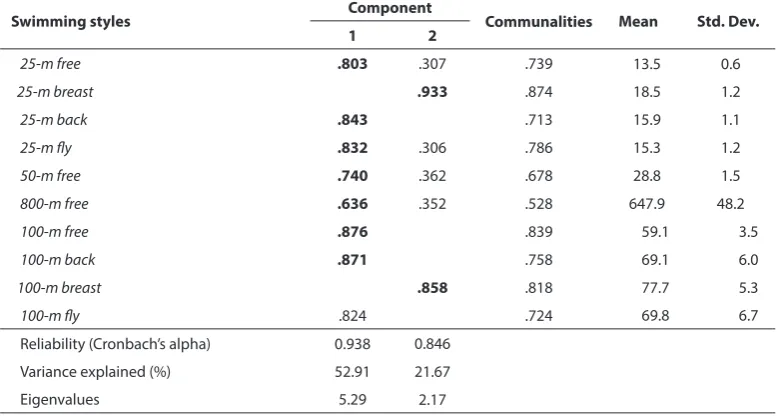
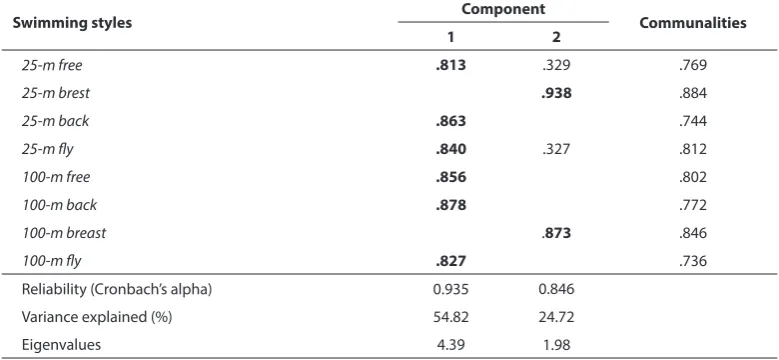
Th e results showed that two principal components (PCs) were obtained. Th e second PC describes the breaststroke swimming style only (on the distances 25 and 100 m), while the fi rst PC describes the correlations between all other swimming styles, on various distances (Table 1). In Table 2, there is a similar situation as in Table 1. For the results without tests of endurance (800-m freestyle), two PCs were obtained. One describes breaststroke swimmers, while the other (fi rst) describes the correlations between all other swimming styles in both distances.
Th e correlations between standardized speeds of the swimmers on various distances using diff erent swimming styles confi rm the fact that breaststroke style is relatively “isolated” from diff erent swimming styles (Table 3); it is in lower correlation with other styles. Th e sizes of all correlations range from very low to high. Th e highest correlations are found between the scores in ST for the same style (discipline) in various distances. Th e lowest statistically signifi cant correlation is between the 100-m breaststroke and 25-m backstroke. Quite diff erent motor structure and length of swimming are the main reasons for the low correlation. Th e highest size of signifi cant (positive) correlations between diff erent disciplines is among the 100-m fl y and 100-m freestyle. TABLE 1 Factor structure (Principal component analysis with Varimax rotation) of standardized
swimming speeds on various distances with descriptive statistics
Swimming styles Component Communalities Mean Std. Dev.
1 2
25-m free .803 .307 .739 13.5 0.6
25-m breast .933 .874 18.5 1.2
25-m back .843 .713 15.9 1.1
25-m fl y .832 .306 .786 15.3 1.2
50-m free .740 .362 .678 28.8 1.5
800-m free .636 .352 .528 647.9 48.2
100-m free .876 .839 59.1 3.5
100-m back .871 .758 69.1 6.0
100-m breast .858 .818 77.7 5.3
100-m fl y .824 .724 69.8 6.7
Reliability (Cronbach’s alpha) 0.938 0.846
Variance explained (%) 52.91 21.67
Eigenvalues 5.29 2.17
It can be explained by using the same motor structure of hand (full-scale “S” stroke). Among freestyle techniques, the highest correlation is found between ST on the distances 25-m and 100-m freestyle. Between 50-m freestyle and 100-m freestyle, the correlation is similarly high as the correlations between 25-m and 100-m freestyle. Th e lowest correlation is found between 25-m freestyle and 800-m freestyle. Although it is the same technique, the lowest correlation can be explained by using diff erent energy expenditure, according to lengthwise discipline.
Table 4 provides an insight into the diff erences between standardized (z-score) speeds of the swimmers on various distances using freestyle only. Th ere are no relative diff erences in the median speed between the same swimmers who are swimming with the same style (freestyle) on diff erent distances.
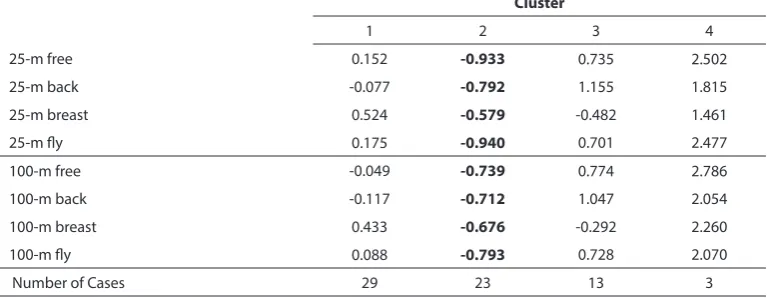
Table 5 provides an insight in the taxonomization of the standardized (z-score) speeds of the swimmers on various distances using all styles. Th e fourth cluster represents the swimmers who are the slowest, while the largest distance is found from the second cluster, where the swimmers are the fastest. Th e fi rst and third clusters could not be similarly unambiguously explained, refl ecting the interaction between swimming distances and styles. Th ese two clusters are therefore very close.
TABLE 2 Factor structure (Principal Component Analysis with Varimax rotation) of standardized swimming speeds on the distances of 100 metres and 25 metres
Swimming styles Component Communalities
1 2
25-m free .813 .329 .769
25-m brest .938 .884
25-m back .863 .744
25-m fl y .840 .327 .812
100-m free .856 .802
100-m back .878 .772
100-m breast .873 .846
100-m fl y .827 .736
Reliability (Cronbach’s alpha) 0.935 0.846
Variance explained (%) 54.82 24.72
Eigenvalues 4.39 1.98
Legend: Bold – saturations in variables that defi ne certain principal component
TABLE 3 Correlations between standardized speeds of the swimmers on various distances using diff erent swimming styles
25m free
25m
back 25m
25m breast
50m free
800m free
100m free
100m back
100m breast
100m fl y
25-m free 1 .657** .748** .346** .652** .499** .791** .666** .481** .674**
25-m back 1 .708** .115 .554** .374** .616** .798** .253* .568**
25-m fl y 1 .363** .674** .534** .733** .633** .471** .848**
25-m breast 1 .377** .295* .267* .107 .733** .216
50-m free 1 .646** .765** .581** .427** .607**
800-m free 1 .699** .524** .414** .579**
100-m free 1 .741** .466** .778**
100-m back 1 .348** .618**
100-m breast 1 .413**
100-m fl y 1
Legend: **signifi cant at a level of p< .01; *signifi cant at a level of p< .05
TABLE 4 Diff erences between standardized (z-score) speeds of the swimmers on various distances using free style only (paired samples)
Distance 25m free 50m free 800m free 100m free Friedman test (p)
Discussion
Th e results revealed that factor analysis without the test endurance and with it obtained two PCs. One principal component (in both cases) describes breaststroke (BS) swimmers, while the other one describes the correlations between all other swimming styles in various distances. Th is result can be explained by specifi cs of BS technique. BS is quite diff erent than other strokes in certain anthropometric characteristics. Moreover, they are diff erent according to their use of muscle categories, and the percentage of muscle usage while swimming BS in comparison to other swimming techniques. BS is the oldest, slowest, and most energy demanding of all swimming techniques (Barbosa et al, 2006). BS is the ancestor of butterfl y and freestyle. BS is the appropriate technique to maintain on the water but it can be hard to learn, except for children who are “natural breaststroke swimmers”. It is the least effi cient of the four competitive strokes; swimmers encounter more frontal resistance in it than in any of the others (Hannula, 2003). Th e diff erences between BS and other strokes can be observed in the fi rst movement aft er the swimmer leaves the wall. Th eir arms start fi rst (in contrast with other strokes) and then kick during the latter part of the arm stroke. A single kick occurs during each stroke cycle. In BS, the movement of the arms and legs are symmetrical and they are carried out under the water. Th ey simultaneously stroke with both hands and they have distinctive kick of the legs. Hand movement is diverse in comparison to other strokes in the propulsive phase and does not make a complete “S” stroke and does not have the last stroke phase (phase upsweep). Because of the specifi c simultaneous leg and hand work, swimmers have large deviation in a velocity during one stroke cycle. Th is is one of the reasons that BS is the slowest and most demanding technique. Even though a large propulsive force is created during the propulsive phase, there is a certain slow movement of the body going forward while preparing to kick with the legs. BS has the greatest intra-cyclic velocity variations of the four competitive strokes due to the underwater recoveries and the relatively long glide times (Seifert, Leblanc, Herault, Komar, Button & Chollet, 2011; Leblanc, Seifert & Chollet, 2009; Miyashita, 1974;). During these periods, the resistive forces are much greater than propulsive forces. With some swimmers, BS completely loses speed and they stop going forward while swimmers in the other competitive stroke lose only about one third of their forward velocity during recovery period in stroke cycles (Maglischo, 2003); the same author emphasizes that BS swimmers must create a much greater force than swimmers using other techniques, simply by accelerating their body forward to the competing velocity during the stroke cycle.
According to Montgomery and Chambers (2009), the BS has a certain degree of fl exibility in the ankle, knee and hip that allows legs and feet to hold or grab more water while kicking. Th e legs are symmetrical and bent in the knee, at the same time and in the form of a triangle, with the feet turn outwards. What has been stated shows that, other than fl exibility (Russel, 2015; Montgomery & Chambers, 2009), a swimmer must have strong legs in order to produce a strong kick (Kippenhan, 2001; Strzala et al.,2012).
Th ey have a specifi c way of breathing. Swimmers take a breath with every stroke cycle by raising the head and torso upwards and forwards. Extra force is used in the relaxation phase of the hand because, in the propulsive phase, it is going through the water and it begins to create extra resistance, which slows down the body when going forward. Th e structure of one’s legs and feet may also play a role in becoming a good breaststroker, described by others as “walking like a duck” (Bixler, 2005).
Everything mentioned confi rms that the BS technique is relatively “isolated” from diff erent swimming styles. Consequently, the results that indicate the low correlation of BS technique with other styles on various distances were not unexpected. Th e lowest statistically signifi cant correlation is found between 100-m BS and 25-m backstroke. Th is fi nding can be explained with completely diff erent motor structures, body position and TABLE 5 Cluster analysis of the standardized (z-score) speeds of the swimmers on various distances
using all styles
Cluster
1 2 3 4
25-m free 0.152 -0.933 0.735 2.502
25-m back -0.077 -0.792 1.155 1.815
25-m breast 0.524 -0.579 -0.482 1.461
25-m fl y 0.175 -0.940 0.701 2.477
100-m free -0.049 -0.739 0.774 2.786
100-m back -0.117 -0.712 1.047 2.054
100-m breast 0.433 -0.676 -0.292 2.260
100-m fl y 0.088 -0.793 0.728 2.070
Number of Cases 29 23 13 3
way of breathing in these two techniques, as well as with diff erent energy exposure according to the length of duration of the ST. Because of all of these specifi c characteristics, many coaches say, “Breaststrokers are born not made” (Montgomery & Chambers, 2009).
No relative diff erences in median speed between the same swimmers who are swimming on diff erent distances in freestyle are found. Th e results of one swimmer to various distances lie in one direction, if it is swum with an even pace and at full power. Th is is the basis for calculating critical speed: swimming velocity at about maximal lactate steady state, expressed as yards or metres per second. When results are standardized, then it is expected that the diff erences of each swimmer in relation to the other swimmers on the Z scale are approximately the same (no signifi cant diff erence). Th at was expected because specialization for swimmers in lengthwise swimming and technique begins at approximately the age of 16. In this research we observed swimmers aged 14 to 16 and all had a training process that contains a lot of aerobic training and a lot of mixed swimming (Šiljeg, 2012). Aft er the specialization of the swimmers in lengthwise distance, there is a change in the slope which improves the results of the individual distance and then an occurrence of statistical signifi cant diff erences could be expected.
Th e advantage of this research is that all the swimmers from Zagreb swimming clubs are measured. Th erefore, the sample of young swimmers is very representative of the population of Zagreb (Croatian) swimmers. Th eir achievements revealed unique work in all four swimming techniques, which could refl ect coaches’ good work in all clubs. Furthermore, there is no specialization among swimmers in freestyle swimming on various distances. Specific (specialized) training from an early age is not an indispensable precondition for later success; moreover, early participation in specifi c training programmes correlated negatively with long-term senior success (Vaeyens, Gullich, Chelsea, Warr & Philippaerts, 2009).
Th e main shortcoming of the research is that the age range in the tested sample of swimmers is very large (3 years). Anderson, Hopkins, Roberts & Pyne (2006) indicated a high variability in swimmers responses and results according to age. However, tested swimmers are undergoing a phase of accelerated growth and development, with possible large individual variations (Mišigoj, 2008), and it would be better if the swimmers in the same age could be observed separately.
For future studies, the authors suggest testing each age separately (Costa, 2016) as well as adding tests that control just legs (swimming with kickboard) and just hand work (swimming with pull-buoy). Furthermore, it would be interesting to do the testing in all phases (general, preparation, competition and relaxation) of the training process.
Practical implications of this research indicate that progress in the BS discipline is only controlled by the tests done while swimming BS. It is very important to apply a diff erent practice program, which includes much work in BS technique if the improvement of the performance in BS discipline is to be accomplished. According to some research, leg work is the most responsible for propulsion swimming in the BS technique and must be the most represented in the training process of swimmers BS techniques (Maglischo, 2003). Swimmers’ BS techniques in daily practice must have leg work three times more than in other techniques (Oxford et al., 2010). Considering swimmers age, it is necessary to apply specialization according to lengthwise swimming, especially among 16-year-old swimmers (Costa, Marinho, Reis, Silva, Bragada & Barbosa, 2010).
Conclusions
Th e results revealed two interpretable and highly reliable latent dimensions of ST. Factor analysis of the ST diff erentiated the variables of ST that describe breaststrokes (BS) and other strokes (OS). Most of ST were positively correlated (in range 0.25–0.85), while no diff erences in various distance speeds among the same swimmers are found. However, the correlations found between BS and OS are the lowest. Cluster analysis revealed clear profi les of the swimmers who are the slowest and those who are the fastest. However, the fi rst and third clusters could not be similarly unambiguously explained, refl ecting the interaction between swimming distances and styles (with the particular role of breaststroke swimming style). Th e results indicate the importance of using ST, especially in BS techniques, by developing diff erent practice programs, which include specifi c approaches in BS technique training.
R E F E R E N C E S
Anderson, M.E., Hopkins, W.G., Roberts, A.D., & Pyne, D.B. (2006). Monitoring seasonal ad long-term changes in test performance in elite swimmers. European Journal of Sport Science, 6, 145-154.
Arellano, R. (2004). Applying biomechanical testing to swimming training. Seminario Europeo de Entrenadores de Natacion - Madrid. Retrieved August 5, 2015, from http://homepage.mac.com/ natacion/SwimmingScience/page4/page57/fi les/2004ArellanoEuroSem.pdf
Barbosa, T.M., Fernandes, R., Keskinen, K.L., Colaço, P., Cardoso, C., Silva, J., & Vilas-Boas, J.P. (2006). Evaluation of the energy expenditure in competitive swimming strokes. Sports Medicine,27(11), 894-899.
of Sports Medicine and Science, 96. Massachusetts: Blackwell Science Ltd.
Brooks, R.W., Lance, C.C., & Sawhill, J.A. (2000). Kicking is not a signifi cant source of propulsion. Th e biomechanical interaction of lift and propulsion forces during swimming. Medical Science of Sports Exercise, 32(5), Supplement abstract 910.
Costa, M.J. (2016). Longitudinal interventions in elite swimming: relationship between energetics, biomechanics and performance. Doctoral Dissertation. Retrieved September 20, 2016 from http://repositorio.utad. pt//handle/10348/5875.
Costa, M.J., Marinho, D.A., Reis, V.M., Silva, A.J., Bragada, J.A., & Barbosa, T.M. (2010). Stability and prediction of 100 m Breaststroke performance during the elite swimmers career. In P.L. Kjendlie, R.K. Stallman, & J. Cabri (Eds.). Proceedings of the XIth International Symposium on Biomechanics and Medicine in Swimming. Norway, pp. 272-273.
Grote, K, Lincoln, T.L., & Gamble J.G. (2004). Hip adductor injury in competitive swimmers. Th e American Journal of Sports Medicine, 32, 104–108.
Hannula, D. (2003). Coaching swimming successfully. Champaign IL: Human Kinetics.
Havriluk, R. (2006). Magnitude of the eff ect of an instructional intervention on swimming technique and performance. In J. P. Vilas-Boas, F. Alves, A. Marques (Eds.), Biomechanics and Medicine in Swimming X. Portuguese Journal of Sport Sciences, 6(S2), 218-220.
Keskinen, K., Eriksson, E., & Komi, P. (1980). Breaststroke swimmer’s knee: Abiomechanical and arthroscopic study. Th e American Journal of Sports Medicine, 8, 228–231.
Latt, E., Jurimae, J., Maestu, J., Purge, P., Ramson, R., Haljaste, K., Keskinen, K.L., Rodrigez, F.A., & Jurimae, T. (2010). Physiological, biomechanical and anthropometrical predictors of sprint swimming performance in adolescent swimmers. Journal of Sports Science and Medicine, 9, 398-404.
Leblanc, H., Seifert, L., & Chollet, D. (2009). Arm–leg coordination in recreational and competitive breaststroke swimmers. Journal of Science and Medicine in Sport, 12, 352–356.
Leko, G., Šiljeg, K., & Zoretić, D. (2011). Predictors on performance in swimming strokes. 5th ISN International Sports Medicine and Sports Science Conference. Kuala Lumpur.
Kippenhan, B.C. (2001). Infl uence of lower extremity joint motions of the eff ectiveness of the kick in breaststroke swimming. In: J.R. Blackwel, & R.H. Sanders (Eds.) Proceedings of swim sessions: XIX International Symposium on Biomechanics in Sports, 48-52. San Francisco, CA.
Maglischo, E.W. (2003). Swimming fastest. California, London, Toronto: Mayfi eld Publishing Company Mountain.
Mišigoj-Duraković, M. (2008). Kinantropologija. Biološki aspekti tjelesnog vježbanja. Zagreb: Kineziološki fakultet Sveučilišta u Zagrebu.
Montgomery, J., & Chambers, M. (2009). Mastering swimming. Champaign IL: Human Kinetics.
Miyashita, M. (1974). Method of calculating mechanical power in swimming the breast stroke. Research Quarterly, 45(2), 128-137.
Nelson, B., Pyne, D., & Sweetenham, B. (1991). National talent identifi cation and development program for swimming. Paper presented as the 1999 ASCTA Convention. Western Australian Institute of Sport. Retrieved September 11, 2011, from http://www.wasa.asn.au/html/coaching/rtf/tid-ascta.rtf.
Nuber, G.W., Jobe, F.W., Perry, J., Moynes, D.R., & Antonelli, D. (1986). Fine wire electromyography analysis of muscles of the shoulder during swimming. Th e American Journal of Sports Medicine,14, 7–11. Olbrecht, J. (2000). Th e Science of Winning. Luton, England: Swimshop.
Oxford, S. W., James, R., Price, M., & Payton, C. (2010). Coordination changes during a maximal eff ort 100m short-course breaststroke swim. XIth International Symposium for Biomechanics and Medicine in Swimming, Oslo: Norwegian School of Sport Sciences.
Richards, R. (1999). Talent identifi cation and development. ASCTA Convention. Australia.
Russel, M. (2015). Butterfl y Technique. In S. Riewald, S. & Rodeo (Eds). Science of Swimming Faster, 87-96. Champaign: Human Kinetics.
Seifert, L., Leblanc, H., Herault, R., Komar, J., Button, C., & Chollet, D. (2011). Inter-individual variability in the upper-lower limb breaststroke coordination. Human Movement Science, 3, 550-565.
Smith, D. J., Norris, S., & Hogg, J., M. (2002). Performance Evaluation of Swimmers. Sports Medicine, 32(9), 539-554.
Soons, B., Silva, A., Colman, V., & Persyn, U. (2003). Specifi c movement variables important for performance in diff erent breaststroke styles. In J.C. Chatard (Ed.) IX. International Symposium for Biomechanics and Medicine in Swimming, 295. St. Etienne: Publications de l’Université de St. Etienne.
Sokolovas, G. (2006). Analysis of swimming’s all-time top 100 times. In: J.P. Vilas-Boas, F., & Alves, A. Marques (Ed). Xth International Symposium on Biomechanics and Medicine in Swimming, 315-317. Porto: University of Porto.
Strzała, M., Krężałek, P., Kaca, M., Głąb ,G., Ostrowski, A., Stanula, A., & Tyka, A. (2012). Swimming Speed of Th e Breaststroke Kick. Journal of Human Kinetics, 35, 133–139.
Sweetenham, B. & Atkinson, J. (2003). Championship swim training. Champaign IL: Human Kinetics. Šiljeg, K. (2012). Povezanost antropoloških karakteristika i specifi čnih plivačkih sposobnosti s uspješnošću u
plivanju. Doctoral Dissertation. Zagreb: Kineziološki fakultet.
Vaeyens, R., Güllich, A., Chelsea, R., Warr, C.R., & Philippaerts, R. (2009). Talent identifi cation and promotion programmes of Olympic athletes. Journal of Sports Sciences, 27(13), 1367-1380.