CARIBBEAN EXAMINATIONS COUNCIL
Car ib b e an Se con d ar y Ed u cat ion Ce r t if icat e
®CSEC
®MATHEMATICS
SYLLABUS
Published in Jamaica by the Caribbean Examinations Council
All rights reserved. No part of this publication may be reproduced, stored in a retrieval system, or transmitted in any form, or by any means electronic, photocopying, recording or otherwise without prior permission of the author or publisher.
Correspondence related to the syllabus should be addressed to:
The Pro-Registrar
Caribbean Examinations Council Caenwood Centre
37 Arnold Road, Kingston 5, Jamaica
Telephone Number: +1 (876) 630-5200 Facsimile Number: +1 (876) 967-4972 E-mail Address: [email protected] Website: www.cxc.org
Contents
RATIONALE. ... 1
AIMS. ... 1
ORGANISATION OF THE SYLLABUS. ... 2
FORMAT OF THE EXAMINATIONS ... 3
CERTIFICATION AND PROFILE DIMENSIONS ... 4
REGULATIONS FOR RESIT CANDIDATES ... 5
REGULATIONS FOR PRIVATE CANDIDATES ... 5
SYMBOLS USED ON THE EXAMINATION PAPERS ... 6
FORMULAE AND TABLES PROVIDED IN THE EXAMINATION ... 9
USE OF ELECTRONIC CALCULATORS ... 10
SECTION 1 – NUMBER THEORY AND COMPUTATION. ... 11
SECTION 2 – CONSUMER ARITHMETIC ... 15
SECTION 3 – SETS. ... 18
SECTION 4 – MEASUREMENT ... 20
SECTION 5 – STATISTICS ... 23
SECTION 6 – ALGEBRA ... 26
SECTION 7 – RELATIONS, FUNCTIONS AND GRAPHS ... 30
SECTION 8 – GEOMETRY AND TRIGONOMETRY ... 35
SECTION 9 – VECTORS AND MATRICES ... 40
GUIDELINES FOR THE SCHOOL-BASED ASSESSMENT ... 43
RECOMMENDED TEXTS ... 52
GLOSSARY OF EXAMINATIONS TERMS ... 53
This document CXC 05/G/SYLL 08 replaces the syllabus CXC 05/O/SYLL 01 issued in 2001.
Please note that the syllabus has been revised and amendments are indicated by italics.
Mathematics Syllabus
RATIONALE
The Caribbean society is an integral part of an ever-changing world. The impact of globalisation on most societies encourages this diverse Caribbean region to revisit the education and career opportunities of our current and future citizens. A common denominator of the Caribbean societies is to create among its citizens, a plethora of quality leadership with the acumen required to make meaningful projections and innovations for further development. Further, learning appropriate problem-solving techniques, inherent to the study of mathematics, is vital for such leaders. Mathematics promotes intellectual development, is utilitarian, and applicable to all disciplines. Additionally, its aesthetics and epistemological approaches provide solutions fit for any purpose. Therefore, Mathematics is the essential tool to empower people with the knowledge, competencies and attitudes which are precursors for this dynamic world.
The syllabus addresses the personal development and educational needs of Caribbean students by encapsulating a variety of skills integral to everyday life and prerequisites for entering environments of work and academia. These skills include critical and creative thinking, problem-solving, logical reasoning, modelling ability, team work, decision making, research techniques, information communication and technological competencies for life-long learning. The syllabus also uniquely details a smooth progression of concepts that caters for students with primary or rudimentary knowledge of mathematics, and it can be easily subdivided to match the curricula of the different grades within the local high schools. Moreover, it is centrally positioned within the CXC sequence of examinations bridging the CPEA and CCSLC with the CSEC Additional Mathematics and CAPE®
Mathematics syllabuses. Additionally, the competencies and certification acquired upon completion of this course of study is comparable with the mathematics curricula of high schools world-wide. The syllabus also provides teachers with useful approaches and techniques, as well as resources which are suitable for every learning style.
This syllabus will contribute to the development of the Ideal Caribbean Person as articulated by the CARICOM Heads of Government in the following areas: “demonstrate multiple literacies, independent and critical thinking, and innovative application of science and technology to problem solving. Such a person should also demonstrate a positive work attitude and value and display creative imagination and entrepreneurship”. In keeping with the UNESCO Pillars of Learning, on completion of this course the study, students will learn to do, learn to be and learn to transform themselves and society.
AIMS
This syllabus aims to:
2. help students appreciate the use of Mathematics as a form of communication;
3. help students acquire a range of mathematical techniques and skills and to foster and maintain the awareness of the importance of accuracy;
4. help students develop positive attitudes, such as open-mindedness, resourcefulness, persistence and a spirit of enquiry;
5. prepare students for the use of Mathematics in further studies;
6. help students foster a ‘spirit of collaboration’, with their peers and others within the wider community;
7. help students apply the knowledge and skills acquired to solve problems in everyday situations; and,
8. integrate Information Communications, and Technology (ICT) tools and skills in the teaching and learning processes.
ORGANISATION OF THE SYLLABUS
The topics of the syllabus are arranged in Sections as outlined below. Each topic is defined by its specific objectives and content/explanatory notes. It is expected that students would be able to master the specific objectives and related content after pursuing a course in Mathematics over five years of secondary schooling.
SECTION 1 – NUMBER THEORY AND COMPUTATION
SECTION 2 – CONSUMER ARITHMETIC
SECTION 3 – SETS
SECTION 4 – MEASUREMENT
SECTION 5 – STATISTICS
SECTION 6 – ALGEBRA
SECTION 7 – RELATIONS, FUNCTIONS AND GRAPHS
SECTION 8 – GEOMETRY AND TRIGONOMETRY
FORMAT
OF THE EXAMINATIONS
The examination will consist of three papers: Paper 01, an objective type paper, Paper 02, structured or problem-solving type paper and Paper 031, the School-Based Assessment or Paper 032, the Alternative to Paper 031.
Paper 01
(1 hour 30 minutes)
The Paper will consist of 60 multiple-choice items, drawn from all Sections of the syllabus as outlined below.
Sections No. of items
Number Theory and Computation 6
Consumer Arithmetic 8
Sets 6
Measurement 8
Statistics 6
Algebra 6
Relations, Functions and Graphs 8
Geometry and Trigonometry 8
Vectors and Matrices 4
Total 60
Each item will be allocated one mark.
Paper 02
(2 hours and 40 minutes)
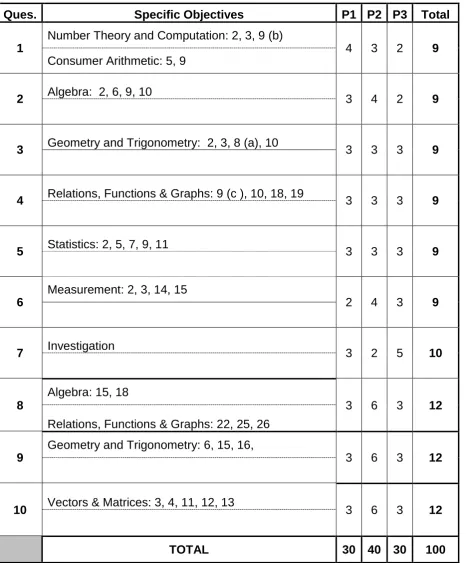
The Paper consists of ten compulsory structured questions.
The marks allocated to the topics are:
Sections No. of marks
Number Theory, Consumer Arithmetic, and Computation
9
Measurement 9
Statistics 9
Algebra 10
Relations, Functions and Graphs 20
*Investigation 10
Geometry and Trigonometry 21
Vectors and Matrices 12
Total 100
SCHOOL- BASED ASSESSMENT: Paper 031 and Paper 032
Paper 031 (20 per cent of Total Assessment)
Paper 031 comprises a project.
The project requires candidates to demonstrate the practical application of Mathematics in everyday life. In essence it should allow candidates to probe, describe and explain a mathematical area of interest and communicate the findings using mathematical symbols, language and tools. The topic(s) chosen may be from any section or combination of different sections of the syllabus.
See Guidelines for School Based-Assessment on pages 43 – 47.
Paper 032 (Alternative to Paper 031)
(1 hour)
This paper is an alternative to Paper 031 and is intended for private candidates. This paper comprises two compulsory questions. The given topic(s) may be from any section or combination of different sections of the syllabus.
CERTIFICATION AND PROFILE
DIMENSIONS
The subject will be examined for certification at the General Proficiency. Candidates’ performance will be reported under Knowledge, Comprehension and Reasoning.
In each paper, items and questions will be classified, according to the kind of cognitive demand made, as follows:
Knowledge requires the recall of rules, procedures, definitions and facts, that is, items characterised by rote memory as well as simple computations and constructions.
Comprehension requires algorithmic thinking that involves translation from one mathematical mode to another. The use of algorithms and the application of these algorithms to familiar problem situations.
Reasoning requires:
(i) translation of non-routine problems into mathematical symbols and then choosing suitable algorithms to solve the problems;
(ii) combination of two or more algorithms to solve problems;
(iii) use of an algorithm or part of an algorithm, in a reverse order, to solve a problem;
(iv) inferences and generalisations from given data;
(v) justification of results or statement; and,
WEIGHTING OF PAPER AND PROFILES
The percentage weighting of the examination components and profiles is as follows:
PROFILES PAPER 01 PAPER 02 PAPER 03 TOTAL (%)
Knowledge (K) 18 30 6 (12) 60 (30%)
Comprehension (C) 24 40 8 (16) 80 (40%)
Reasoning (R) 18 30 6 (12) 60 (30%)
TOTAL 60 100 20 (40) 200
Percentage 30% 50% 20% 100%
REGULATIONS FOR RESIT CANDIDATES
Resit candidates must complete Papers 01 and 02 of the examination for the year for which they re-register.
Resit candidates may opt to complete the School-Based Assessment (SBA) or may opt to re-use their previous SBA score which satisfies the condition below.
A candidate who rewrites the examination within two years may reuse the moderated SBA score earned in the previous sitting within the preceding two years. Candidates reusing SBA scores in this way must register as “Resit candidates” and provide their previous candidate number.
All resit candidates may register through schools, recognised educational institutions, or the Local Registrar’s Office.
REGULATIONS FOR PRIVATE CANDIDATES
Private candidates must be registered for the examination through the Local Registrar in their respective territories and will be required to sit Papers 01, 02 and 032,
SYMBOLS
USED ON THE EXAMINATION PAPERS
The symbols shown below will be used on examination papers. Candidates, however, may make use of any symbol or nomenclature provided that such use is consistent and understandable in the given context. Measurement will be given in S I Units.
SYMBOL MEANING
Sets
𝑈 universal set
∪ union of sets
∩ intersection of sets
∈ element of
{ } 𝑜𝑟 ф the null (empty) set
subset of
𝐴′ complement of set 𝐴
{𝑥: . . . } the set of all 𝑥 such that . . .
Relations, Functions and Graphs
𝑦 𝑥𝑛 𝑦 varies as 𝑥𝑛
𝑓(𝑥) value of the function 𝑓 at 𝑥
𝑓−1(𝑥) the inverse of the function 𝑓(𝑥)
𝑔𝑓(𝑥) , 𝑔[𝑓(𝑥)] composite function of the functions 𝑓 and 𝑔
𝑔2(𝑥) 𝑔[𝑔(𝑥)]
0 1 2 3 4 {𝑥 ∶ 1 ≤ 𝑥 ≤ 3}
Number Theory
𝕎 the set of whole numbers
ℕ the set of natural (counting) numbers
ℤ the set of integers, where
{ℤ
+ are positive integers
ℤ− are negative integers
ℚ
the set of rational numbersℝ
the set of real numbers5.432 432 432 . . .
9.87212121 . . .
Measurement
05:00 h. 5:00 a.m.
13:15 h. 1:15 p.m.
7 mm ± 0.5 mm 7 mm to the nearest millimetre
10 m/s or 10 ms-1 10 metres per second
Geometry
For transformations these symbols will be used.
M reflection
R rotation through 𝜃𝑜
T translation
G glide reflection
E enlargement
MR rotation through followed by reflection
∡
,
∠
,
∧
angle is congruent to
2 3 4 5.
𝐴 𝐵 line 𝐴𝐵
A 𝐵 ray 𝐴𝐵
line segment 𝐴𝐵 𝐴 𝐵
Vectors and Matrices
a or a vector a
AB vector 𝐴𝐵
|𝐴𝐵⃗⃗⃗⃗⃗ | magnitude of vector 𝐴𝐵
𝐴 = (𝑎 𝑏
𝑐 𝑑) or 𝐴 = [
𝑎 𝑏
𝑐 𝑑] the matrix 𝐴
|𝐴| or det(𝐴) the determinant of 𝐴
Adj(A) the adjoint of a matrix 𝐴.
𝐴−1 inverse of the matrix 𝐴
𝐼 = (1 0
0 1) identity matrix under multiplication
(0 0
0 0) zero matrix or identity matrix under addition
Other Symbols
= is equal to
is greater than or equal to
is less than or equal to
≃ is approximately equal to
implies
𝐴 𝐵 if 𝐴, then 𝐵 or 𝐴 implies 𝐵
𝐴 ⟺ 𝐵
𝐼𝑓 𝐴 𝑡ℎ𝑒𝑛 𝐵 𝑎𝑛𝑑 𝐼𝑓 𝐵 𝑡ℎ𝑒𝑛 𝐴
USE OF ELECTRONIC CALCULATORS
Candidates are expected to have an electronic nonprogrammable calculator and are encouraged to use such a calculator in Paper 02 and Paper 032.
Guidelines for the use of electronic calculators are listed below.
1. Silent, electronic handheld calculators may be used.
2. Calculators should be battery or solar powered.
3. Candidates are responsible for ensuring that calculators are in working condition.
4. Candidates are permitted to bring a set of spare batteries in the examination room.
5. No compensation will be given to candidates because of faulty calculators.
6. No help or advice is permitted on the use or repair of calculators during the examination.
7. Sharing calculators is not permitted in the examination room.
8. Instruction manuals and external storage media (for example, card, tape, disk, smartcard or plug-in modules) are not permitted in the examination room.
9. Calculators with graphical display, data bank, and dictionary or language translation are not
allowed.
SECTION 1
–
NUMBER THEORY AND COMPUTATION
GENERAL OBJECTIVES
On completion of this Section, students should:
1. demonstrate computational skills;
2. be aware of the importance of accuracy in computation;
3. appreciate the need for numeracy in everyday life;
4. demonstrate the ability to make estimates fit for purpose;
5. understand and appreciate the decimal numeration system;
6. appreciate the development of different numeration systems;
7. demonstrate the ability to use rational approximations of real numbers;
8. demonstrate the ability to use number properties to solve problems; and,
9. develop the ability to use patterns, trends and investigative skills.
SPECIFIC OBJECTIVES
CONTENT/
EXPLANATORY NOTES
Students should be able to:
1. distinguish among sets of numbers;
Sets of numbers:
natural numbers ℕ = {1, 2, 3, . . . }; whole numbers 𝕎 = {0, 1, 2, 3, . . . }; integers ℤ = {. . . −2, −1, 0, 1, 2, . . . };
rational numbers ℚ = {𝑝
𝑞∶
𝑝 and 𝑞 are integers, 𝑞 ≠ 𝜊};
irrational numbers (numbers that cannot be expressed as terminating or recurring decimals, for example, numbers such as and √2);
real numbers ℝ =
{the union of rational and irrational numbers};
inclusion relations, for example, ℕ ⊂ 𝕎 ⊂ ℤ ⊂ ℚ ⊂ ℝ; and,
NUMBER THEORY AND COMPUTATION (cont’d)
SPECIFIC OBJECTIVES
CONTENT/
EXPLANATORY NOTES
Students should be able to:
2. compute powers of real numbers of
the form 𝓍𝑎, where 𝑎 ∈ ℚ ;
Including squares, square roots, cubes, cube roots.
3. evaluate numerical expressions
using any of the four basic operations on real numbers;
Addition, multiplication, subtraction and division of whole numbers, fractions and decimals; order of operations.
4. convert among fractions, per cents and decimals;
Conversion of fractions to decimals and percents, conversion of decimal to fractions and percents, conversion of percents to decimals and fractions.
5. list the set of factors and multiples of a given integer;
Positive and negative factors of an integer.
6. compute the H.C.F. or L.C.M. of two or more positive integers;
Highest common factors and lowest common multiples.
7. state the value of a digit of a numeral in a given base;
Place value and face value of numbers in bases 2, 4, 8, and 10.
8. convert from one set of units to another;
Conversion using conversion scales, converting within the metric scales, 12-hour and 24-hour clock.
9. express a value to a given number of:
(a) significant figures; and,
(b) decimal places.
1, 2 or 3 significant figures. 0, 1, 2 or 3 decimal places.
10. use properties of numbers and operations in computational tasks;
Properties of operations such as closure, associativity, additive and multiplicative identities and inverses, commutativity and distributivity.
11. write any rational number in scientific notation;
Scientific notation.
For example 759000 = 7.59 × 10⁵
12. calculate any fraction or percentage of a given quantity;
NUMBER THEORY AND COMPUTATION (cont’d)
SPECIFIC OBJECTIVES
CONTENT/
EXPLANATORY NOTES
Students should be able to:
13. express one quantity as a fraction or percentage of another;
Comparing two quantities using fractions and percentages.
14. compare quantities; Ratio, proportion and rates.
15. order a set of real numbers; Rearranging a set of real numbers in ascending or
descending order. For example
1.1,7
2, √2, 1.45, 𝜋 in ascending order is
1.1, √2, 1.45, 𝜋,7
2.
16. compute terms of a sequence given a rule;
17. derive an appropriate rule given the terms of a sequence;
18. divide a quantity in a given ratio; and,
Ratio, proportion of no more than three parts.
19. solve problems involving concepts in number theory.
Including ratio, rates and proportion.
Suggested Teaching and Learning Activities
To facilitate students’ attainment of the objectives of this Section, teachers are advised to engage students in the teaching and learning activities listed below.
1. Encourage the use of:
(a) calculators;
(b) games and quizzes; (for example, to investigate whether a given number is rational or irrational)
(c) appropriate software;
(d) examples of computation drawn from current affairs;
(e) recipes in teaching ratio and proportion; and,
(f) online demonstrative videos.
NUMBER THEORY AND COMPUTATION (cont’d)
2. Explore the link between mathematics and other disciplines, for example:
(a) Music: the octave;
(b) Sciences and Nature: periodic tables, counting petals, leaves and other random natural events;
(c) Art and Geography: enlargement of photos as compared with ratio and proportion;
(d) Architecture: number patterns and lighting patterns, ratio of width to length to height of a building or building part;
(e) Health and Family Life Education: nutrition facts of food products; and,
(f) Business Studies: using approximations in transactions, finding percentages of investments and capital.
3. Teachers can ask the students to conduct research on the history of numbers.
4. Teachers can engage students in the process of “mental computation” including divisibility tests and other ready reckoners and properties such as associativity.
5. Below are two examples to develop mental computation in the classroom. Provide oral or written questions and encourage students to explain how they arrived at their answers and to compare their problem-solving strategies with those of their classmates..
(a) A flight departs on a journey at 0800 hours. After 30 minutes of flying time the journey is 13 complete. Estimate the arrival time of the flight assuming the flight was at constant speed throughout the journey.
SECTION 2 – CONSUMER
ARITHMETIC
GENERAL OBJECTIVES
On completion of this Section, students should:
1. develop the ability to perform the calculations required in normal business transactions, and in computing their own budgets;
2. appreciate the need for both accuracy and speed in calculations;
3. appreciate the advantages and disadvantages of different ways of investing money;
4. appreciate that business arithmetic is indispensable in everyday life; and,
5. demonstrate the ability to use concepts in consumer arithmetic to describe, model and solve real-world problems.
SPECIFIC OBJECTIVES
CONTENT/
EXPLANATORY NOTES
Students should be able to:
1. calculate:
(a) discount;
(b) sales tax;
(c) profit; and,
(d) loss;
2. calculate
(a) percentage profit; and,
(b) percentage loss;
3. express a profit, loss, discount, markup and purchase tax, as a percentage of some value;
4. solve problems involving marked price, selling price, cost price, profit, loss or discount;
5. solve problems involving payments by
CONSUMER ARITHMETIC (cont’d)
SPECIFIC OBJECTIVES CONTENT/ EXPLANATORY NOTES
Students should be able to:
6. solve problems involving simple interest;
Principal, time, rate, amount.
7. solve problems involving compound interest;
Formulae may be used in computing compound interest. The use of calculators is encouraged.
8. solve problems involving appreciation and depreciation;
9. solve problems involving measures and money; and,
Currency conversion.
10. solve problems involving:
(a) rates and taxes;
(b) utilities;
(c) invoices and shopping bills;
(d) salaries and wages; and,
(e) insurance and investments.
Suggested Teaching and Learning Activities
To facilitate students’ attainment of the objectives of this Section, teachers are advised to engage students in the teaching and learning activities listed below.
1. Encourage the use of:
(a) calculators;
(b) games and quizzes;
(c) appropriate software (for example, create an excel document to calculate utility bills and net salary);
(d) examples of consumer arithmetic drawn from current affairs;
CONSUMER ARITHMETIC (cont’d)
(f) advertisement clippings for comparing prices; comparing prices and determining best buy; calculating hire purchase; and,
(g) bills and financial forms, for example, calculating utility cost and completing tax forms.
2. Solve problems using the straight line and reducing balance method.
3. Conduct surveys or solve problems based on comparative shopping; calculating total price for an item purchased online.
4. Encourage in-class role play of market situations and Cambio transactions.
SECTION 3
–
SETS
GENERAL OBJECTIVES
On completion of this Section, students should:
1. demonstrate the ability to communicate using set language and concepts;
2. demonstrate the ability to reason logically; and,
3. appreciate the importance and utility of sets in analysing and solving real-world problems.
SPECIFIC OBJECTIVES
CONTENT/
EXPLANATORY NOTES
Students should be able to:
1. explain concepts relating to sets;
Examples and non-examples of sets, description of sets using words, membership of a set, cardinality of a set, finite and infinite sets, universal set, empty set, complement of a set, subsets.
2. represent a set in various forms;
Representation of a set. For example,
(a) Description: the set A comprising the first three natural numbers.
(b) Set builder notation: 𝐴 = {𝑥: 0 < 𝑥 < 4, 𝑥 ∈ ℕ};
(c) Listing: 𝐴 = {1,2,3}
3. list subsets of a given set; Identifying the subsets as well as determining the number of subsets of a set with n elements.
4. determine elements in intersections, unions and complements of sets;
Intersection and union of not more than three sets. Apply the result
.
5. describe relationships among sets using set notation and symbols;
Universal, complement, subsets, equal and equivalent sets, intersection, disjoint sets and union of sets.
6. draw Venn diagrams to
represent relationships among sets;
Not more than 4 sets including the universal set.
7. use Venn diagrams to
represent the relationships among sets; and,
) ( ) ( ) ( )
(A B n A n B n A B
SETS (CONT’D)
8. solve problems in Number Theory, Algebra and Geometry using concepts in Set Theory.
Suggested Teaching and Learning Activities
To facilitate students’ attainment of the objectives of this Section, teachers are advised to engage students in the teaching and learning activities listed below.
1. Encourage the use of:
(a) calculators;
(b) games and quizzes;
(c) appropriate software (for example, whiteboard apps for drawing and labelling Venn diagrams);
(d) examples of sets drawn from current affairs;
(e) recipes in teaching sets; and,
(f) online demonstrative videos.
2. Explore the link between sets and other disciplines, for example:
(a) Music: types of instruments, classification of songs;
(b) Sciences: periodic tables; find the number of elements in a naturally occurring set based on characteristics of other sets;
(c) Art and Geography: classifying regions according to soil type, altitude or other features;
(d) Architecture: classifying buildings according to the style of roof, shape of building, number of floors, historical design or other features;
(e) Health and Family Life Education: use medical records to categorize patients by disease, identify intersections for example hypertension and diabetes; and,
(f) Business Studies: types of businesses, types of products and services.
3. Engage in activities which assign students to groups based on their interests (sets) noting those in more than one group (intersection) and those not in a group (complement).
SECTION 4
–
MEASUREMENT
GENERAL OBJECTIVES
On completion of this Section, students should:
1. understand that the attributes of geometrical objects can be quantified using measurement;
2. appreciate that all measurements are approximate and that the relative accuracy of a measurement is dependent on the measuring instrument and the measurement process; and,
3. demonstrate the ability to use concepts in measurement to model and solve real-world problems.
SPECIFIC OBJECTIVES
CONTENT
/ EXPLANATORY NOTES
Students should be able to:
1. convert units of length, mass, area, volume, capacity;
Refer to Sec 1, SO8.
2. use the appropriate SI unit of measure for area, volume, capacity, mass, temperature and time (24-hour clock) and other derived quantities;
Refer to Sec 1, SO8.
3. determine the perimeter of a plane shape;
Estimating and measuring the perimeter of compound and irregular shapes.
Calculating the perimeter of polygons and circles.
4. calculate the length of an arc of a circle;
Perimeter of sector of a circle
5. estimate the area of plane shapes;
Finding the area of plane shapes without using formulae.
6. calculate the area of polygons and circles;
7. calculate the area of a sector of a circle;
8. calculate the area of a triangle given two sides and the angle they form;
Use of formulae. Including given two sides and included angle.
MEASUREMENT (
cont’d
)
Suggested Teaching and Learning Activities
To facilitate students’ attainment of the objectives of this Section, teachers are advised to engage students in the teaching and learning activities listed below.
1. Encourage the use of:
(a) calculators;
(b) games and quizzes;
(c) appropriate software (for example, use of white board software for sketching diagrams; Mobile apps: Math Ref with list of formulae); and,
(d) online demonstrative videos.
SPECIFIC OBJECTIVES
CONTENT
/EXPLANATORY NOTES
Students should be able to:
10. calculate the surface area of solids;
Prisms including cubes and cylinders; right pyramids including cones; spheres. Surface area of sphere, 𝐴 = 4𝜋𝑟2.
11. calculate the volume of solids;
Prism including cube and cuboid, cylinder, right
pyramid, cone and sphere. Volume of sphere, 𝑉 =4
3𝜋𝑟 3
12. solve problems involving the
relations among time,
distance and speed;
Average speed.
13. estimate the margin of error for a given measurement;
Sources of error.
Maximum and minimum measurements.
14. use scales and scale
drawings to determine distances and areas; and,
(Link to Geography)
15. solve problems involving measurement.
MEASUREMENT (cont’d)
2. Explore the link between measurement and other disciplines, for example:
(a) Music: creating music with bottles of water where the height/volume of water results in a particular tone;
(b) Sciences and Nature: area of naturally occurring surfaces; length of the beach or water edge; experiments in calculating speed, distance or time; plot a graph to show the cooling rate of boiling water as time elapses; use various measurement instruments from a science laboratory;
(c) Art and Geography: use of rain gauge, map reading, measuring distances on map including irregular paths;
(d) Architecture: finding the perimeter, area or volume of structures: roof, wall, floor, room, column, eaves;
(e) Health and Family Life Education: experiment to calculate BMI; and,
(f) Business Studies: determining amounts to buy given various units of lengths, area and volume.
3. Use teacher-made resources: grid for finding area of irregular shapes, rubric for peer to peer assessment by students.
SECTION 5
–
STATISTICS
GENERAL OBJECTIVES
On completion of this Section, students should:
1. appreciate the advantages and disadvantages of the various ways of presenting and representing data;
2. appreciate the necessity for taking precautions in collecting, analysing and interpreting statistical data, and making inferences;
3. demonstrate the ability to use concepts in statistics and probability to describe, model and solve real-world problems; and,
4. understand the four levels/scales of measurement that inform the collection of data.
SPECIFIC OBJECTIVES
CONTENT
/EXPLANATORY NOTES
Students should be able to:
1. differentiate between sample and population attributes;
Sample statistics and population parameters.
2. construct a frequency table for a given set of data;
Discrete and continuous variables. Ungrouped and grouped data.
3. determine class features for a given set of data;
Class interval, class boundaries, class limits, class midpoint, class width.
4. construct statistical diagrams; Pie charts, bar charts, line graphs, histograms with bars of equal width and frequency polygons.
5. determine measures of central tendency for raw, ungrouped and grouped data;
Ungrouped data: mean, median and mode
Grouped data: modal class, median class and the estimate of the mean.
6. determine when it is most appropriate to use the mean, median and mode as the average for a set of data;
Levels of measurement (measurement scales): nominal, ordinal, interval and ratio.
Sets with extreme values or recurring values.
7. determine the measures of dispersion (spread) for raw, ungrouped and grouped data;
Range, interquartile range and semi-interquartile range; estimating these measures for grouped data.
8. use standard deviation to
compare sets of data;
STATISTICS (cont’d)
Suggested Teaching and Learning Activities
To facilitate students’ attainment of the objectives of this Section, teachers are advised to engage students in the teaching and learning activities listed below.
1. Encourage the use of:
(a) calculators;
(b) games and quizzes;
(c) appropriate software (for example, use of applications to generate and solve statistical problems including charts and calculating measures of central tendencies);
(d) examples of statistics drawn from newspapers, magazines and other sources of current affairs; and,
(e) online demonstrative videos.
SPECIFIC OBJECTIVES
CONTENT
/EXPLANATORY NOTES
Students should be able to:
9. draw cumulative frequency curve (Ogive);
Appropriate scales for axes. Class boundaries as domain.
10. analyse statistical diagrams; Finding the mean, mode, median, range, quartiles, interquartile range, semi-interquartile range; trends and patterns.
11. determine the proportion or percentage of the sample above or below a given value from raw data, frequency table or cumulative frequency curve;
12. identify the sample space for simple experiment;
Including the use of coins, dice and playing cards. The use of contingency tables.
13. determine experimental and theoretical probabilities of simple events; and,
The use of contingency tables.
Addition for exclusive events; multiplication for independent events.
14. make inference(s) from statistics.
STATISTICS (cont’d)
2. Explore the link between statistics and other disciplines, for example:
(a) Music: comparing record sales of various artistes, number of weeks artistes are in the top ten chart;
(b) Sciences: statistics (birth and death rates) on various types of populations: people, plants and animals;
(c) Geography: track rain fall, population count and density;
(d) Art and Architecture: average floor size of rooms in a buildings, house lots;
(e) Health and Family Life Education: monitoring weight and height, average amounts of calories, nutritional facts; and,
(f) Business Studies: Gross Domestic Product, predicting sales, purchasing decision.
3. Discuss when it is most appropriate to use Nominal, Ordinal, Interval or Ratio scales.
SECTION 6
–
ALGEBRA
GENERAL OBJECTIVES
On completion of this Section, students should:
1. appreciate the use of algebra as a language and a form of communication;
2. appreciate the role of symbols and algebraic techniques in solving problems in mathematics and related fields; and,
3. demonstrate the ability to reason with abstract entities.
SPECIFIC OBJECTIVES
CONTENT
/EXPLANATORY NOTES
Students should be able to:
1. use symbols to represent numbers, operations, variables and relations;
Symbolic representation.
2. translate between algebraic
symbols and worded
expressions;
3. evaluate arithmetic
operations involving directed numbers;
4. simplify algebraic
expressions using the four basic operations;
5. substitute numbers for
variables in algebraic
expressions;
6. evaluate expressions
involving binary operations (other than the four basic operations);
Commutative, associative and distributive properties.
7. apply the distributive law to factorise or expand algebraic expressions;
For example,
𝑥(𝑎 + 𝑏) = 𝑎𝑥 + 𝑏𝑥 𝑎𝑛𝑑
ALGEBRA (cont’d)
SPECIFIC OBJECTIVES
CONTENT
/ EXPLANATORY NOTES
Students should be able to:
8. simplify algebraic fractions; The four basic operations on algebraic fractions.
9. use the laws of indices to manipulate expressions with integral indices;
For m 𝜖 ℤ, n 𝜖 ℤ.
(i) 𝑥𝑚× 𝑥𝑛= 𝑥𝑚+𝑛
(ii) n m n
m
x
x
x
(iii)
m n m nx
x
(iv) m
x m
x
1
10. solve linear equations in one unknown;
11. solve simultaneous linear equations, in two unknowns, algebraically;
12. solve a simple linear inequality in one unknown;
13. change the subject of formulae;
Including equations involving roots and powers.
14. factorise algebraic expressions;
Expressions of the type: 𝑎2 − 𝑏2 ;
𝑎𝑥 + 𝑏𝑥 + 𝑎𝑦 + 𝑏𝑦 𝑎𝑥2 + 𝑏𝑥 + 𝑐
where 𝑎, 𝑏, and 𝑐 are integers and 𝑎 ≠ 0
15. rewrite a quadratic
expression in the form
2
( )
a xh k
Completing the square of a quadratic expression.
16. solve quadratic equations algebraically;
Formula and methods of factorisation and completing the square.
2
2 2ab b
ALGEBRA (cont’d)
17. solve word problems; Linear equation, Linear inequalities, two simultaneous linear equations, quadratic equations. Applications to other subjects for example demand and supply functions of business studies.
18. solve a pair of equations in two variables when one equation is quadratic or non-linear and the other non-linear;
19. prove two algebraic expressions to be identical;
Equations vs. identities.
20. represent direct and inverse variation symbolically;
𝑦 varies directly as 𝑥: 𝑦 ∝ 𝑥, 𝑦 = 𝑘𝑥 𝑦 varies inversely as 𝑥: 𝑦 ∝1
𝑥, 𝑦 = 𝑘 𝑥
21. solve problems involving direct variation and inverse variation.
Suggested Teaching and Learning Activities
To facilitate students’ attainment of the objectives of this Section, teachers are advised to engage students in the teaching and learning activities listed below.
1. Encourage the use of:
(a) calculators;
(b) games and quizzes;
(c) appropriate software (for example, equation solving apps);
(d) examples of algebraic problems drawn from real-life situations; and,
(e) online demonstrative videos.
2. Explore the link between algebra and other disciplines, for example:
(a) Music: the use of music symbols;
(b) Sciences and Nature: rearranging scientific formulae;
(c) Architecture: determine the size or number of tiles/windows/doors of a floor or wall; and,
ALGEBRA (cont’d)
3. Introduce students to symbolic representation using examples drawn from everyday life such as safety symbols, road signs and other familiar informational and warning signs.
4. Promote appropriate use of variables. For example, differentiate between 5 𝑚 as an abbreviation for 5 metres and 5𝑚, where 𝑚 represents the number of mangoes bought.
5. Explore the concept of equality through the use of:
(a) Pan Balance activities with numbers (8 + 4 = 𝑥 – 2) and shapes; and,
(b) Hands-on Algebra.
6. Use manipulatives such as integer chips, algebra tiles and other appropriate materials to develop the understanding of:
(a) operations with integers;
(b) simplifying algebraic expressions (adding/subtracting like terms);
(c) multiplying binomials of power 1;
(d) solving linear equations with one unknown; and
(e) rearranging an equation/formula.
SECTION 7
–
RELATIONS, FUNCTIONS AND GRAPHS
GENERAL OBJECTIVES
On completion of this Section, students should:
1. appreciate the importance of relations in Mathematics;
2. appreciate that many mathematical relations may be represented in symbolic, tabular or pictorial form; and,
3. appreciate the usefulness of concepts in relations, functions and graphs to solve real-world problems.
SPECIFIC OBJECTIVES
CONTENT
/ EXPLANATORY NOTES
Students should be able to:
1. explain basic concepts associated with relations;
Concept of a relation, types of relations, examples and non-examples of relations, domain, range, image, co-domain.
2. represent a relation in various ways;
Set of ordered pairs, arrow diagrams, graphically, algebraically.
3. state the characteristics that define a function;
Concept of a function, examples and non-examples of functions.
4. use functional notation; For example, 𝑓 ∶ 𝑥 𝑥2; or 𝑓(𝑥) = 𝑥2 as well as
𝑦 = 𝑓(𝑥) for given domains. The inverse function 𝑓−1(𝑥). Composite functions 𝑓𝑔 = 𝑓[𝑔(𝑥)]
5. distinguish between a relation and a function;
Ordered pairs, arrow diagram, graphically (vertical line test).
6. draw graphs of linear functions;
Concept of linear function, types of linear function (𝑦 = 𝑐; 𝑥 = 𝑘; 𝑦 = 𝑚𝑥 + 𝑐;
where 𝑚, 𝑐 and 𝑘 are real numbers).
7. determine the intercepts of the graph of linear functions;
𝑥-intercepts and 𝑦-intercepts, graphically and algebraically.
8. determine the gradient of a straight line;
RELATIONS, FUNCTIONS AND GRAPHS (cont’d)
SPECIFIC OBJECTIVES
CONTENT
/ EXPLANATORY NOTES
Students should be able to:
9. determine the equation of a straight line;
Using:
(a) the graph of the line;
(b) the co-ordinates of two points on the line;
(c) the gradient and one point on the line;
(d) one point on the line or its gradient, and its relationship to another line.
10. solve problems involving the gradient of parallel and perpendicular lines;
11. determine from co-ordinates on a line segment:
(a) the length; and,
(b) the co-ordinates of the midpoint;
The concept of magnitude or length, concept of midpoint.
12. solve a pair of simultaneous linear equations in two unknowns graphically;
Intersection of graphs.
13. represent the solution of linear inequalities in one variable using:
(a) set notation;
(b) the number line; and,
(c) graph.
RELATIONS, FUNCTIONS AND GRAPHS (cont’d)
SPECIFIC OBJECTIVES
CONTENT
/EXPLANATORY NOTES
Students should be able to:
15. use linear programming techniques to graphically solve problems involving two variables;
16. derive the composition of functions;
Composite function of no more than two functions, for example, 𝑓𝑔, 𝑓2 given 𝑓 and 𝑔.
Non-commutativity of composite functions (𝑓𝑔 ≠ 𝑔𝑓) in general.
17. state the relationship between a function and its inverse;
The concept of the inverse of a function;
The composition of inverse functions
𝑓(𝑥) and 𝑓−1(𝑥) is commutative and results in 𝑥.
18. derive the inverse of a function;
𝑓−1, (𝑓𝑔)−1
19. evaluate a function 𝑓(𝑥) at a given value of 𝑥
𝑓(𝑎), 𝑓−1(𝑎), 𝑓𝑔(𝑎), where 𝑎 ∈ ℝ.
20. draw and use the graph of a
quadratic function to identify its features:
(a) an element of the domain that has a given image;
(b) the image of a given element in the domain;
(c) the maximum or minimum value of the function; and,
(d) the equation of the axis of symmetry;
RELATIONS, FUNCTIONS AND GRAPHS (cont’d)
SPECIFIC OBJECTIVES
CONTENT
/EXPLANATORY NOTES
Students should be able to:
21. interpret the graph of a
quadratic function to
determine:
Concepts of gradient of a curve at a point, tangent, turning point. Roots of the function.
(a) the interval of the domain for which the elements of the range may be greater than or less than a given point;
(b) an estimate of the value of the gradient at a given point;
(c) intercepts of the function;
22. determine the equation of the axis of symmetry and the maximum or minimum value of a quadratic function expressed in the form
𝑎(𝑥 + ℎ)2 + 𝑘;
23. sketch the graph of a quadratic function expressed in the form
𝑦 = 𝑎(𝑥 + ℎ)2 + 𝑘 and
determine the number of roots;
24. draw graphs of non-linear functions;
𝑦 = 𝑎𝑥𝑛 where 𝑛 = −1, −2 and + 3 and 𝑎 is a constant. Including distance-time and speed-time.
25. interpret graphs of functions; and,
Including distance-time graphs and speed-time graphs.
RELATIONS, FUNCTIONS AND GRAPHS (cont’d)
Suggested Teaching and Learning Activities
To facilitate students’ attainment of the objectives of this Section, teachers are advised to engage students in the teaching and learning activities listed below.
1. Encourage the use of:
(a) calculators;
(b) games and quizzes;
(c) appropriate software (for example, the use of graphing apps in demonstrating properties of graphs);
(d) examples of functions and graphs obtained from magazines and newspapers; and,
(e) online demonstrative videos.
2. Explore the link between relations, functions and graphs and other disciplines, for example:
(a) Music: create a mapping of the number of beats to the music notes;
(b) Sciences: plot graphs of sound waves, path of a projectile such as a shot putt, 2-dimensional graph of a terrain;
(c) Art and Geography: identifying locations on a map using coordinate systems, the use of GPS technology;
(d) Architecture: gradient of a roof, ramp;
(e) Health and Family Life Education: plotting a graph of weight against time and finding the rate using the gradient of a function; and,
(f) Business Studies: finding marginal cost using the concept of gradient, break even analysis.
3. Provide students with samples of ordered pairs and be required to determine the domain, the range and whether the relation is or is not a function.
4. Have students describe a function based on its properties and not the independent variable.
5. Use functions machines to show input and output.
6. Demonstrate relationships between a function and its inverse: for example doubling will undo halving, geometric interpretation as a reflection in the line 𝑦 = 𝑥.
7. Relate reverse processes of real-life situations to functions and their inverses, for example, the route from home to school.
SECTION 8
–
GEOMETRY AND TRIGONOMETRY
GENERAL OBJECTIVES
On completion of this Section, students should:
1. appreciate the notion of space as a set of points with subsets of that set (space) having properties related to other mathematical systems;
2. understand the properties and relationship among geometrical objects;
3. understand the properties of transformations;
4. demonstrate the ability to use geometrical concepts to model and solve real-world problems; and,
5. appreciate the power of trigonometrical methods in solving authentic problems.
SPECIFIC OBJECTIVES
CONTENT
/EXPLANATORY NOTES
Students should be able to:
1. explain concepts relating to geometry;
Points, lines, parallel lines, intersecting lines, perpendicular lines, line segments, rays, curves, planes; types of angles; number of faces, edges and vertices.
2. draw and measure angles and line segments accurately using appropriate instruments;
3. construct lines, angles, and polygons using appropriate instruments;
Parallel and perpendicular lines. Bisecting line segments and angles.
Constructing a line perpendicular to another line, L, from a point that is not on the line, L.
Triangles, quadrilaterals, regular and irregular polygons.
Angles include 30𝑜, 45𝑜, 60𝑜, 90𝑜, 120𝑜 and their combinations.
4. identify the type(s) of symmetry possessed by a given plane figure;
GEOMETRY AND TRIGONOMETRY
(cont’d)
SPECIFIC OBJECTIVES
CONTENT
/EXPLANATORY NOTES
Students should be able to:
5. solve geometric problems using properties of:
(a) lines, angles, and polygons;
(b) congruent triangles;
(c) similar figures;
(d) faces, edges and vertices of solids; and,
(e) classes of solids;
Determining and justifying the measure of angles: adjacent angles, angles at a point, supplementary angles, complementary angles, vertically opposite angles.
Parallel lines and transversals, alternate angles, corresponding angles, co-interior angles.
Triangles: equilateral, isosceles, scalene, obtuse, right, acute.
Quadrilaterals: Square, rectangle, rhombus, kite, parallelogram, trapezium.
Other polygons.
Cases of congruency.
Properties of similar triangles
Prisms, pyramids, cylinders, cones, sphere.
6. solve geometric problems
using properties of circles and circle theorems;
Radius, diameter, chord, circumference, arc, tangent, segment, sector, semicircle, pi.
Determining and justifying angles using the circle theorems:
(a) The angle which an arc of a circle subtends at the centre of a circle is twice the angle it subtends at any point on the remaining part of the circumference.
(c) The angle at the circumference subtended by the diameter is a right angle.
(d) The opposite angles of a cyclic quadrilateral are supplementary.
GEOMETRY AND TRIGONOMETRY
(cont’d)
SPECIFIC OBJECTIVES
CONTENT
/EXPLANATORY NOTES
Students should be able to:
(e) The exterior angle of a cyclic quadrilateral is equal to the interior opposite angle.
(f) The angle between a tangent to a circle and a chord through the point of contact is equal to the angle in the alternate segment.
(g) A tangent of a circle is perpendicular to the radius/diameter of that circle at the point of contact.
(h) The lengths of two tangents from an external point to the points of contact on the circle are equal.
(i) The line joining the centre of a circle to the midpoint of a chord is perpendicular to the chord.
7. represent translations in a
plane using vectors; Column matrix notation .
8. determine and represent the location of :
(a) the image of an object under a transformation;
(b) an object given the image under a transformation;
Translation in the plane.
Reflection in a line in that plane.
Rotation about a point (the centre of rotation) in that plane.
9. state the relationship between an object and its image in the plane under geometric transformations;
Orientation, similarity, congruency.
10. describe a transformation given an object and its image;
Translation: vector notation.
Reflection: mirror line/ axis of symmetry.
Rotation: centre of rotation, angle of rotation, direction of rotation.
Enlargement: centre, scale factor 𝑘 such that |𝑘| > 1 or 0 < |𝑘| < 1.
11. locatethe image of an object under a combination of transformations;
Combination of any two of :
(a) enlargement;
(b) translation;
(c) rotation; and,
(d) reflection.
GEOMETRY AND
TRIGONOMETRY
(cont’d)
SPECIFIC OBJECTIVES
CONTENT
/EXPLANATORY NOTES
Students should be able to:
12. use Pythagoras’ theorem to solve problems;
13. define the trigonometric
ratios of acute angles in a right triangle;
Sine, Cosine, Tangent.
14. relate objects in the physical world to geometric objects;
Angle of elevation, angle of depression, bearing.
15. apply the trigonometric
ratios to solve problems;
Spatial geometry and scale drawing, angles of elevation and depression.
16. use the sine and cosine rules to solve problems involving triangles; and,
17. solve problems involving bearings.
Suggested Teaching and Learning Activities
To facilitate students’ attainment of the objectives of this Section, teachers are advised to engage students in the teaching and learning activities listed below.
1. Encourage the use of:
(a) calculators;
(b) games and quizzes;
(c) appropriate software (for example, 3-D sketching software, 2-D apps such as Geogebra);
(d) concrete models of geometric figures in common places; and,
(e) online demonstrative videos.
GEOMETRY AND
TRIGONOMETRY
(cont’d)
2. Explore the link between geometry and trigonometry and other disciplines, for example:
(a) Music: Exploring geometric properties of musical instruments;
(b) Sciences: orbital locus of planets, galaxies; geometry in nature: leaves, shells, waves, spherical objects;
(c) Geography: the use of bearings;
(d) Art and Architecture: geometry of structures, triangles, circles; using geometric figures to create art such as paintings, tessellations; symmetry, similarity and congruency in structures such as the roof; and,
(e) Health and Family Life Education: the geometry of postures in exercise and athletics.
3. Explore concepts of elevation, depression, bearings in real-life situations.
4. Estimate distances and area using geometry, pictures with a known distance.
5. Engage students in activities of detecting which of two objects is taller.
6. Construct shapes for art work such as collages.
SECTION 9
–
VECTORS
AND MATRICES
GENERAL OBJECTIVES
On completion of this Section, students should:
1. demonstrate the ability to use vector notation and concepts to model and solve real-world problems;
2. develop awareness of the existence of certain mathematical objects, such as matrices, that do not satisfy the same rules of operation as the real number system; and,
3. appreciate the use of vectors and matrices in representing certain types of linear transformations in the plane.
SPECIFIC OBJECTIVES
CONTENT
/EXPLANATORY NOTES
Students should be able to:
1. explain concepts associated with vectors;
Concept of a vector, magnitude, unit vector, direction, scalar.
Scalar multiples: parallel vectors, equal vectors, inverse vectors.
2. simplify expressions involving
vectors;
Vector algebra: addition, subtraction, scalar multiplication.
Vector geometry: triangle law, parallelogram law.
3. write the position vector of a point 𝑃(𝑎, 𝑏) as 𝑂𝑃⃗⃗⃗⃗⃗ = (𝑎𝑏)
where 𝑂 is the origin (0,0);
Displacement and position vectors; including the use of co-ordinates in the x-y plane to identify and determine displacement and position vectors.
4. determine the magnitude of a vector;
Including unit vectors.
5. determine the direction of a vector;
6. use vectors to solve problems in geometry;
Points in a straight line, Parallel lines; displacement, velocity, weight.
7. explain basic concepts associated with matrices;
Concept of a matrix, row, column, square, identity rectangular, order.
8. solve problems involving matrix operations;
Addition and subtraction of matrices of the same order. Scalar multiples.
Multiplication of conformable matrices.
VECTORS AND MATRICES (cont’d)
SPECIFIC OBJECTIVES
CONTENT
/ EXPLANATORY NOTES
Students should be able to:
9. evaluate the determinant of a ‘2 x 2’ matrix;
10. define the multiplicative
inverse of a non-singular square matrix;
Identity the square matrices.
11. obtain the inverse of a non-singular ‘2 x 2’ matrix;
Determinant and adjoint of a matrix.
12. determine a ‘2 x 2’ matrix associated with a specified transformation; and,
Transformation which is equivalent to the composition of two linear transformations in a plane (where the origin remains fixed).
(a) Reflection in: the 𝑥-axis, 𝑦-axis, the lines 𝑦 = 𝑥 and 𝑦 = – 𝑥.
(b) Rotation in a clockwise and anticlockwise direction about the origin; the general rotation matrix.
(c) Enlargement with centre at the origin;
13. use matrices to solve simple problems in Arithmetic, Algebra and Geometry .
Data matrices, equality. Use of matrices to solve linear simultaneous equations with two unknowns.
Problems involving determinants are restricted to 2x2 matrices. Matrices of order greater than ‘mxn’ will not be set, where m ≤ 4, n ≤ 4.
Suggested Teaching and Learning Activities
To facilitate students’ attainment of the objectives of this Section, teachers are advised to engage students in the teaching and learning activities listed below.
1. Encourage the use of:
(a) calculators;
(b) games and quizzes;
VECTORS AND MATRICES (cont’d)
(d) data matrix that are extracted from sources such as grades spread sheet; and,
(e) online demonstrative videos.
2. Explore the link between vectors and matrices and other disciplines, for example:
(a) Sciences and Nature: the effects of a river current as a vector quantity;
(b) Art and Geography: dividing an image/photo into a matrix of smaller images for enlargement; and,
(c) Architecture: representing items in the classroom such as a tile on the floor using vector notation.
3. Tabulate data into matrix form.
4. Find hidden treasures using clues given as vectors.
GUIDELINES FOR THE SCHOOL-BASED ASSESSMENT
RATIONALE
School-Based Assessment is an integral part of student assessment in the course covered by this syllabus. It is intended to assist students in acquiring certain knowledge, skills and attitudes that are associated with the subject. The activities for the School-Based Assessment are linked to the syllabus and should form part of the learning activities to enable the student to achieve the objectives of the syllabus.
During the course of study for the subject, students obtain marks for the competence they develop and demonstrate in undertaking their School-Based Assessment assignments. These marks contribute to the final marks and grades that are awarded to students for their performance in the examination.
The guidelines provided in this syllabus for selecting appropriate tasks are intended to assist teachers and students in selecting assignments that are valid for the purpose of School-Based Assessment. The guidelines provided for the assessment of these assignments are intended to assist teachers in awarding marks that are reliable estimates of the achievement of students in the School-Based Assessment component of the course. In order to ensure that the scores awarded by teachers are in line with the CXC standards, the Council undertakes the moderation of a sample of the School-Based Assessment assignments marked.
School-Based Assessment provides an opportunity to individualise a part of the curriculum to meet the needs of students. It facilitates feedback to the student at various stages of the experience. This helps to build the self-confidence of students as they proceed with their studies. School-Based Assessment also facilitates the development of the critical skills and abilities that are emphasised by this CSEC subject and enhances the validity of the examination on which candidate performance is reported. School-Based Assessment, therefore, makes a significant and unique contribution to the development of relevant skills and the testing and rewarding of students for the development of those skills.
The Caribbean Examinations Council seeks to ensure that the School-Based Assessment scores are valid and reliable estimates of accomplishment. The guidelines provided in this syllabus are intended to assist in doing so.
THE PROJECT
The project may require candidates to collect data or demonstrate the application of Mathematics in everyday situations.
The activities related to the Project should be integrated into the classroom instruction so as to enable the candidates to learn and practise the skills needed to complete the project.
Some time in class should be allocated for general discussion of project work; allowing for discussion between teacher and student, and student and student.
Role of the Teacher
The role of the teacher is to:
2. Provide guidance throughout the project and guide the candidate through the SBA by helping to resolve any issues that may arise.
3. Ensure that the project is developed as a continuous exercise that occurs during scheduled class hours as well as outside of class times.
4. Assess the project and record the marks. Hardcopies of the completed documents should be kept by both the teacher and the student. The teacher should use the mark scheme provided by CXC and include comments pertinent to the conduct of the assessment.
Assignment
The School-Based Assessment consists of ONE project to be marked by the teacher in accordance with
CXC guidelines.
Why a project?
The study of mathematics is essential to everyday life. It pervades almost every aspect of our daily activities: planning a picnic, baking a cake, comparing performances in a 100 metre race, shopping for groceries, all require applying mathematical concepts and principles to investigate, describe, explain or predict some real-world phenomena.
However, to those engaged in learning mathematics in secondary schools, the links between mathematics and the real world are often not recognised or at least not identified and practised. The purpose of a project is to encourage students to apply mathematical concepts, skills and procedures to investigate, describe and explain real-world phenomena, to practise problem-solving, and to evaluate results. These experiences are to be realised by encouraging all students to:
1. define problems in personal ways, especially by how the problems were motivated;
2. discuss the problems with (a) their teachers, (b) their classmates and (c) their parents and resource persons from the wider community;
3. develop ways of solving the problems of interest and of curiosity;
4. record their problems and the ways they would attempt t