www.biogeosciences.net/7/387/2010/
© Author(s) 2010. This work is distributed under the Creative Commons Attribution 3.0 License.
Biogeosciences
A possible role of ground-based microorganisms on cloud formation
in the atmosphere
S. Ekstr¨om1, B. Nozi`ere1, M. Hultberg2, T. Alsberg1, J. Magn´er1, E. D. Nilsson1, and P. Artaxo3 1Department of Applied Environmental Science (ITM), Svante Arrhenius v¨ag 8, Stockholm University, 106 91 Stockholm, Sweden
2Department of Horticulture, Swedish University of Agricultural Sciences, Alnarp, Sweden 3Department of Physics, University of S˜ao Paolo, S˜ao Paolo, Brazil
Received: 26 August 2009 – Published in Biogeosciences Discuss.: 26 October 2009 Revised: 21 January 2010 – Accepted: 25 January 2010 – Published: 29 January 2010
Abstract. The formation of clouds is an important process for the atmosphere, the hydrological cycle, and climate, but some aspects of it are not completely understood. In this work, we show that microorganisms might affect cloud for-mation without leaving the Earth’s surface by releasing bi-ological surfactants (or biosurfactants) in the environment, that make their way into atmospheric aerosols and could sig-nificantly enhance their activation into cloud droplets.
In the first part of this work, the cloud-nucleating ef-ficiency of standard biosurfactants was characterized and found to be better than that of any aerosol material stud-ied so far, including inorganic salts. These results iden-tify molecular structures that give organic compounds ex-ceptional cloud-nucleating properties. In the second part, atmospheric aerosols were sampled at different locations: a temperate coastal site, a marine site, a temperate forest, and a tropical forest. Their surface tension was measured and found to be below 30 mN/m, the lowest reported for aerosols, to our knowledge. This very low surface tension was at-tributed to the presence of biosurfactants, the only natural substances able to reach to such low values.
The presence of strong microbial surfactants in aerosols would be consistent with the organic fractions of exceptional cloud-nucleating efficiency recently found in aerosols, and with the correlations between algae bloom and cloud cover reported in the Southern Ocean. The results of this work also suggest that biosurfactants might be common in aerosols and thus of global relevance. If this is confirmed, a new role for microorganisms on the atmosphere and climate could be identified.
Correspondence to: B. Nozi`ere ([email protected])
1 Introduction
In this work, rather than studying the role of airborne mi-croorganisms in the formation of cloud droplets we study the role of substances that are produced by some microorganisms at the Earth’s surface and released in the environment, biosur-factants. Unlike the microorganisms these substances could make their way into sub-micron aerosol particles, which are important for cloud droplet nucleation. They would thus al-low microorganisms to affect cloud formation without leav-ing the Earth’s surface. In a first part of this work, the CCN properties of standards biosurfactants are studied and com-pared to those of inorganic salts. In a second part, the pres-ence of biosurfactants in real aerosol samples and their effect on their surface tension is investigated.
2 Experimental
2.1 Biosurfactant standards
The first part of this work focused on characterizing the CCN efficiency of standard biosurfactants. Three different classes of biosurfactants were studied: rhamnolipids, galactolipids (mono- and di-galactosyl diacylglyceride), and a lipopeptide, (surfactin). Most biosurfactants have to be extracted from microorganisms. The known rhamnolipid sample JBR425 (Jeneil Biosurfactant Company, USA) used in our study was provided by Dr. Wang, PEER Centre, California Institute of Technology, USA (extract 1). Its composition is described in Wang et al. (2007). Another biosurfactant extract (extract 2) isolated from an environmental strain of P. aeruginosa was also studied (Hultberg et al., 2008). The extraction was per-formed as described in Zhang and Miller (1992). Mono-galactosyl diacylglyceride (∼95%), digalactosyl diacylglyc-eride (≥95%), and surfactin (≥98%) were purchased from Aldrich.
2.2 Aerosol sampling
For the second part of the work, aerosols were sampled at Aspvreten, Sweden (forested/coastal region), 58◦480N 17◦230E, from April to May 2008; in the Stockholm Archipelago ∼20 km at sea, Sweden (“marine” sample), 59◦4705 N 19◦3005 E, in July 2007 during an algae bloom; in Hyyti¨al¨a, Finland (temperate forest), 61◦850N 24◦280E, in July 2008; in the tropical forest, Brazil, 2◦370N 60◦120W, in May 2008. The samples were taken on Quartz fiber filters using high-volume samplers, for a duration between 48 and 150 h, corresponding to a total of 100–500 m3 of sampled air. For the marine samples, 150 L of seawater were sam-pled just below the sea-surface and the aerosols were gen-erated by jet impact on the surface of this water in a stain-less steal tank. This technique has been previously shown to produce aerosols physically and chemically similar to those emitted by the sea surface (M˚artensson et al., 2003; Facchini et al., 2008). Because the analyses required large amounts of
aerosol material, the size fraction sampled at these sites was PM10, except in Aspvreten, where it was PM2.5.
2.3 Sample extraction
The filters were extracted in Milli-Q water at 4◦C and filtered through Millipore 0.45 µm syringe filters. An absorbent, sil-icone, was added and rotated (20–25 rpm) for 24 h. The am-phiphilic fraction was extracted in methanol, dried, and di-luted in MilliQ-water. For the surface tension measurements, 1 to 3 filters were extracted together. The efficiency of this extraction method and its specificity towards surface-active compounds was tested by measuring the surface tension of water extracts before and after the second extraction step (see Sect. 2.5 below).
2.4 Chemical analysis
In this work, chemical analyses are presented only for the identification of one of the microbial extracts (JBR425). These analyses were performed by tandem mass spectrome-try (MSMS) with a Quadrupole Time-of-Flight Premier (Wa-ters, Manchester, UK) mass spectrometer with an electro-spray ion source. The microbial extract was introduced by di-rect infusion or following separation on an Acquity BEH C8 column fitted to an Acquity UPLC (Ultraperformance Liquid Chromatography) system (Waters, Milford, USA).
2.5 Osmolality and surface tension measurements
In the first part of this work, the CCN efficiency of stan-dard substances was quantified by their K¨ohler curves, repre-senting the water vapor pressure (or supersaturation = water vapor in excess to saturation) necessary to activate particles made of these substances into cloud droplets. These curves were built point by point from solutions of these substances in water and their subsequent dilutions, following a method developed recently (Kiss and Hansson, 2004; Varga et al., 2007; Ekstr¨om et al., 2009). The surface tension was mea-sured with a FT ˚A 125 tensiometer and the osmolality with a KNAUER K – 7000 vapor pressure osmometer.
solutions obtained from the second extractions were those used to determine the surface tension curves, the original so-lutions corresponding to the largest concentrations and the lowest surface tensions on the curves. Control tests with “blank” samples were also performed to ensure that these measurements were free from artifacts from the extraction or from contamination of the filters during sampling. The ex-traction method itself did not lead to any artifacts, the surface tension obtained for blank filters being within 5% of the one of pure water, which was within the experimental uncertain-ties (Ekstr¨om et al., 2009). Only one blank filter displayed evidence for a small contamination, possibly due to bacterial growth on the sampler, but which affected the surface tension by less than 10%. A systematic cleaning of the sampler was subsequently performed and no further contamination was observed.
3 Results and discussion
3.1 Cloud-forming efficiency of standard biosurfactants
A large variety of microorganisms are known to synthesize strong surfactants, or biosurfactants, that are present at their cell surface or released into the environment, and can re-duce the surface tension of water from 73 mN/m to less than 30 mN/m (Hommel and Ratledge, 1993; Desai and Banat, 1997). The production of biosurfactants is however not com-mon to all microorganisms, and the ability of some species rather than others to synthesize these substances, as well as their physiological functions, are still unclear. But while common biological material such as cell fragments, extra-cellular materials, and metabolites, all display some surface-active properties, only specific molecules are able to reduce the surface tension of water below 40 mN/m and qualify as biosurfactants (Hommel and Ratledge, 1993; Desai and Ba-nat, 1997). These exceptional properties are of great inter-est for industrial applications, and artificial surfactants have been synthesized to try to match them. But the presence of artificial surfactants in natural environments and, in particu-lar, in the aerosols samples studied in this work is unlikely.
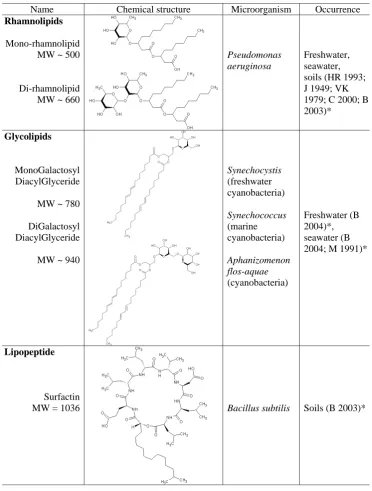
The first part of this work focused on investigating the CCN efficiency of standard biosurfactants, chosen among the most common in the environment (Table 1):
– rhamnolipids, which are produced by Pseudomonas aeruginosa (Jarvis and Johnson, 1949), and belonging to the fluorescent pseudomonads, ubiquitous in the en-vironment (Van der Kooij, 1979; Cho and Tedje, 2000; Bodour et al., 2003) and even in cloud and rainwater (Ahern et al., 2007),
– galactolipids (mono- and di-galactosyl diacylglyceride), which are common in freshwater and marine cyanobac-teria (Merritt et al., 1991; Ikawa et al., 1994), such as those responsible for algae blooms (Shapiro, 1973), and
– lipopeptide (surfactin), produced by Bacillus subtilis, also common in the environment (Bodour et al., 2003). In particular, the rhamnolipids studied in this work were from two different bacterial strains and extracted by slightly ferent techniques (see Sect. 2.1). They contained thus dif-ferent mixtures of mono- and dirhamnolipids giving them slightly different physico-chemical properties (Benincasa et al., 2004). The molecular structure of the surfactants con-tained in these extracts was confirmed by Electrospray Ion-ization High Resolution Hybrid Mass Spectrometry. For in-stance, Fig. 1 shows the MSMS spectra obtained from the extract of JBR425 and displaying the characteristic patterns of rhamnolipids (Mw: 504.330): the negative ion mode pro-vided the pseudomolecular ion [M-H]−at m/z=503.33, frag-ment ions of the fatty acid moiety (hydrophobic chain) at m/z=169.12, and fragmentations of the rhamnose moiety (hy-drophilic part) at m/z=163.07.
The cloud-forming efficiency of the standard microbial surfactants was determined from their K¨ohler curves, repre-senting the water vapor (expressed as the ratio over the sat-uration pressure, supersatsat-uration) necessary to activate parti-cles made of these substances into cloud droplets. As micro-bial surfactants are always mixed with water-soluble com-pounds in the environment, produced by the microorganisms or present as nutrients (Hommel and Ratledge, 1993; Desai and Banat, 1997; Benincasa et al., 2004), the most realis-tic description of their CCN properties was given by mix-ing them with small amounts of sodium chloride or ammo-nium sulfate (∼0.07–0.2 M). The K¨ohler curves obtained for these mixtures were determined as described in Sect. 2.5, and the results are shown on Fig. 2 for an initial (“dry”) particle of diameter 60 nm. It is clear on Fig. 2 that all the curves for the standard biosurfactants have a critical supersaturation (maximum) lower than those for sodium chloride and am-monium sulfate: Sc=0.08–0.21, compared with Sc=0.25 for NaCl, and 0.34 for (NH4)2SO4. To our knowledge it is the first time that specific organic molecules are shown to have better cloud-forming efficiencies than inorganic salts (Mc-Figgans et al., 2006). These results are important because they identify the molecular structures that give to organic compounds exceptional CCN properties, and which should be investigated in atmospheric aerosols. The K¨ohler curves also imply that aerosol particles containing these substances would nucleate into cloud droplets at lower supersaturation than inorganic salt particles or that, at similar supersatura-tion, would form larger cloud droplets. These larger droplets would be more prone to precipitation, thereby affecting the optical properties of the clouds and, at large scale, their con-tribution to climate (see for instance Ervens et al., 2005). 3.2 Presence of biosurfactants in atmospheric aerosols
Table 1. Standard microbial substances studied in this work, and examples of microorganisms producing them and their occurrences in the environment.
23 486
Table 1
Name Chemical structure Microorganism Occurrence
Rhamnolipids
Mono-rhamnolipid MW ~ 500
Di-rhamnolipid MW ~ 660
Pseudomonas aeruginosa
Freshwater,
seawater,
soils (HR 1993; J 1949; VK 1979; C 2000; B 2003)*
Glycolipids
MonoGalactosyl DiacylGlyceride
MW ~ 780
DiGalactosyl DiacylGlyceride
MW ~ 940
Synechocystis
(freshwater cyanobacteria)
Synechococcus
(marine cyanobacteria)
Aphanizomenon flos-aquae
(cyanobacteria)
Freshwater (B 2004)*, seawater (B 2004; M 1991)*
Lipopeptide
Surfactin
MW = 1036 Bacillus subtilis Soils (B 2003)*
487
488
489
*HR 1993: Hommel & Ratledge, 1993; J 1949: Jarvis & Johnson, 1949; VK 1979: Van der
Kooij, 1979; C 2000: Cho & Tedje, 2000; B 2003: Bodour et al., 2003; B 2004: Benincasa et
al., 2004; M 1991: Merritt et al., 1991.
∗HR 1993: Hommel and Ratledge, 1993; J 1949: Jarvis and Johnson, 1949; VK 1979: Van der Kooij, 1979; C 2000: Cho and Tedje, 2000;
B 2003: Bodour et al., 2003; B 2004: Benincasa et al., 2004; M 1991: Merritt et al., 1991.
Archipelago, Sweden, Hyyti¨al¨a, Finland, and near Manaus, Brazil) and their amphiphilic fraction was extracted as de-scribed in Sect. 2.3. LC/MSMS analyses were first applied to the aerosol extracts but the sensitivity required for the identi-fication of microbial surfactants was not sufficient. Another approach had thus to be used. Since the objective of this
Io
n
i
n
te
n
si
ty
,
%
[image:5.595.309.544.61.244.2]m/z
Fig. 1. MSMS spectrum of the reference rhamnolipid JBR425 (Mw: 504.330) in negative ion mode: Parent ion (m/z=503.33), fragment ions of the rhamnose moiety, “Rha-residue” (m/z=163.07), and of the fatty acid moiety “C10:1-residue”, (m/z=169.12).
Fig. 2. K¨ohler curves for inorganic salts and standard microbial sur-factants in aqueous solutions of sodium chloride 0.07–0.2 M (dry diameter=60 nm). sodium chloride: red; ammonium sulfate: green; monogalactosyl diacylglyceride (“MGDG”): pale blue; digalactosyl diacylglyceride (“DGDG”): orange; surfactin: black; rhamnolipid (extract 1, “Rhamno1”): dark purple (this curve with ammonium sulfate instead of sodium chloride); rhamnolipid (extract 2, “Rham-noJBR”): pale purple.
sodium chloride, ammonium sulfate, organic acids (malonic acid), HULIS, and the standard biosurfactants studied in the first part of the work. The results are presented in Fig. 3.
[image:5.595.53.283.65.247.2]First, comparing the curves for the standard compounds between them (curves with full triangles) shows the unique features of the microbial surfactants and their dramatic ef-fects on the surface tension:
Fig. 3. Effect on the surface tension of water of different standard compounds as function of their molar concentration (curves with filled triangles): sodium chloride: red; ammonium sulfate: green; malonic acid: dark blue; HULIS: grey; monogalactosyl diacylglyc-eride: pale blue; digalactosyl diacylglycdiacylglyc-eride: orange; surfactin: black; rhamnolipid (extract 1): dark purple; rhamnolipid (extract 2): pale purple. Comparison with the surface tension of aerosol sample extracts (curves with open circles): coastal site (Aspvreten, Swe-den): brown; marine site during algae bloom (SweSwe-den): clear blue; temperate forest (Hyyti¨al¨a, Finland): pale green; Amazonian forest (Manaus, Brazil): dark green.
– the very low surface tension values at large concentra-tions, less than 30 mN/m for some compounds, – the very low concentrations necessary to achieve the
minimum surface tension (3–5 orders of magnitude lower than the concentrations of HULIS or organic acids in aerosols),
– a sharp transition on the curves (>20 mN/m for a fac-tor 10 in concentration) contrasting with the gradual ef-fects of the other compounds, such as HULIS or organic acids, on the surface tension.
[image:5.595.50.284.318.501.2]Dobson et al. (2000). The values of the CMC for the com-pounds studied here are∼10 µM for rhamnolipids (Desai and Banat, 1997), 13 µM for digalactosyl diacylglycerol (Vish-wanath et al., 1996), 24 µM for surfactin (Desai and Banat, 1997). This implies that only a few tens of µM of biosur-factants would lower the surface tension of water to about 30 mN/m. By contrast, 20 mM (∼20 gL−1)of HULIS would only lower the surface tension to 45 mN/m (Taraniuk et al., 2007), and 10 M of malonic acid would lower it to 50 mN/m. Note that at large concentrations (in particular beyond the CMC) all surface tension curves should reach a plateau, as the maximum effect on the surface tension is achieved. The curves on Fig. 3 (and in the literature) that do not reach such a plateau indicate that the measurements were limited by ex-perimental difficulties (usually, the inability to concentrate the samples enough) and that the actual minimum was not attained.
Comparing the curves for the standard compounds with those obtained with the aerosol extracts on Fig. 3 (curves with open circles) clearly show that the latter have the distinct signatures of microbial surfactants: a surface tension below 30 mN/m at high concentrations, and a sharp transition char-acteristic of micelle-forming surfactants. Their positions on the x-axis in Fig. 3 are, however, arbitrary as the surfactant concentrations in these samples were unknown. These po-sitions corresponded approximately to the total organic con-centrations in the samples. The relative position of the curves for the standard biosurfactants thus suggested that the con-centrations of surfactants in the aerosol extracts could have been of the order of 100 to 10 000 times lower than the total organic concentration. The very low surface tension values obtained with the aerosol samples were attributed to the pres-ence of biosurfactants, because these compounds are the only natural substances able to have such strong effects on the sur-face tension (Hommel and Ratledge, 1993; Desai and Ba-nat, 1997). A contamination of the samples or the measure-ments by artificial surfactants was unlikely as artificial sur-factants require concentrations several orders of magnitude larger than biosurfactants to achieve the same surface ten-sion effects. For instance, sodium dodecyl sulfate, the most common detergent, would require 8 mM to lower the surface tension to 40 mN/m (Williams et al., 1955), which would be comparable to the total organic content of the aerosols. A contribution of airborne microorganisms to the aerosol sam-ples collected was also expected to be negligible because the latter represent a very small fraction of the aerosol mass in the atmosphere (1%, P´osfai et al., 2003; Harrison et al., 2005), only some of them produce surfactants (Ahern et al., 2007).
The volumes extracted from the aerosol samples also gave some information on the effect of these surfactants on the surface tension of the aerosols. These volumes were larger (30–100 µL) than the initial aerosol samples (<10 µL, as-suming a maximum aerosol loading of 100 µg m−3) imply-ing that the extracts were diluted compared to the aerosols
and, therefore, that the lowest surface tension reported here are upper limits of those of the aerosols collected (at least, in average). The surfactants were thus concentrated enough in the aerosols to reduce dramatically their surface tension, or at least the one of some particles in them. As the surface tension curves for the aerosol samples were similar to those of the standard biosurfactants, they are also likely to have similar K¨ohler curves and to be activated into cloud droplets at lower water vapor than particles made of other material, including inorganic salts.
4 Discussion and conclusion
The first part of this work established that biosurfactants such as rhamnolipids, galactolipids, or lipopeptides would be bet-ter CCN mabet-terial than any aerosol mabet-terial studied until now, including inorganic salts. These exceptional CCN properties result both from the dramatic effect of these molecules on the surface tension of water (<30 mN/m) and to the extremely small concentrations necessary to achieve them (tens of µM). These results identify thus molecular structures providing or-ganic compounds with exceptional surface-active and CCN properties, which should be investigated in aerosols.
The results of this work suggest that the presence of bio-surfactants could make aerosols more CCN-efficient than in-organic salt particles. This, in turn, would affect the onset of precipitation and the optical properties of the clouds, which are essential for climate. Modeling studies have shown that the effects of surface-active organic compounds on cloud for-mation would be especially important for low-level clouds or air masses with small vertical updraft (Ervens et al., 2005). However, none of the previous modeling studies expected or-ganic compounds to have the dramatic effect on the surface tension of aerosols evidenced in this work (−1σ/σ >58%). The contribution of biosurfactants to cloud formation re-mains thus to be investigated. The very small concentrations at which biosurfactants operate were not expected in pre-vious model studies either. These very low concentrations and the limited mixing of these biosurfactants with the bulk aerosol contents would also be consistent with the apparent lack of correlation between CCN numbers and aerosol chem-ical composition.
A role of microbial substances on cloud formation would be consistent with the correlations between cloud cover and algae bloom reported for the Southern Ocean (Meskhidze and Nenes, 2006). The very low surface tensions obtained with all the aerosol samples in this work would also be con-sistent with the ubiquitous presence of surfactant-producing microorganisms on Earth, even in the most hostile environ-ments (Bodour et al., 2003; Perfumo et al., 2006; Gulati et al., 2008), and suggest the global relevance of biosurfactants for aerosols. If the role of biosurfactants in cloud forma-tion is confirmed, new links between the biosphere, atmo-spheric processes, the hydrological cycle, and climate would be identified, where the responses of the microbial popula-tions to climate change would constitute new climate feed-backs. Confirming a role of microorganisms on cloud forma-tion would bring other interesting quesforma-tions, such as whether this role is fortuitous or a survival strategy developed by the microorganisms to control the availability of water in their environment.
Acknowledgements. Hans Karlsson (Stockholm Univ.) is gratefully acknowledged for the sampling in Aspvreten, Hans Wegmann for the cruise in the Stockholm Archipelago and the marine samples, and Janne Levula (Univ. of Helsinki) for the aerosol sampling in Hyyti¨al¨a, Finland. The European Commission is acknowledged for funding through a Marie Curie Chair (BN), an International Reintegration Grant (BN), and the research programs EUSAAR (sampling in Hyyti¨al¨a) and NOMIRACLE (development of ex-traction techniques). The Swedish Research Council (VR) and the Swedish Research Council for Environment, Agricultural science and spatial planning (FORMAS) are acknowledged for funding. G. Feingold (NOAA, USA) and R. M. Maier (Univ. of Arizona, USA) are gratefully acknowledged for their useful comments on the manuscript.
Edited by: C. Spirig
References
Ahern, H. E., Walsh, K. A., Hill, T. C. J., and Moffett, B. F.: Fluo-rescent pseudomonads isolated from Hebridean cloud and rain water produce biosurfactants but do not cause ice nucleation, Biogeosciences, 4, 115–124, 2007,
http://www.biogeosciences.net/4/115/2007/.
Asa-Awuku, A., Sullivan, A. P., Hennigan, C. J., Weber, R. J., and Nenes, A.: Investigation of molar volume and surfactant charac-teristics of water-soluble organic compounds in biomass burning aerosol, Atmos. Chem. Phys., 8, 799–812, 2008,
http://www.atmos-chem-phys.net/8/799/2008/.
Bauer, H., Giebl, H., Hitzenberg, R., Kasper-Giebl, A., Reschl, G., Zibushka, F., and Puxbaum, H.: Airborne bacteria as cloud condensation nuclei, J. Geophys. Res., 108, 4658, doi:10.1029/2003JD003545, 2003.
Benincasa, M., Abalos, A., Oliveira, I., and Manresa, A.: Chemical structure, surface Properties and biological activities of the bio-surfactant produced by Pseudomonas aeruginosa LBI from soap-stock, Antonie van Leeuwenhoek, 85, 1–8, 2004.
Bodour, A. A., Drees, K. P., and Maier, R. M.: Distribution of biosurfactant-producing Bacteria in undisturbed and contami-nated arid Southwestern soils, Appl. Environ. Microbiol., 69, 3280–3287, 2003.
Charlson, R. J., Lovelock, J. E., Andreae, M. O., and Warren, S. G.: Oceanic phytoplankton, atmospheric sulphur, cloud albedo and climate, Nature, 326, 655–661, 1987.
Charlson, R. J., Seinfeld, J. H., Nenes, A., Kulmala, M., Laakso-nen, A., and Facchini, M. C.: Reshaping the Theory of Cloud Formation, Science, 292, 2025–2026, 2001.
Cho, J. C., and Tiedje, J. M.: Biogeography and Degree of demicity of Fluorescent Pseudomonas Strains in Soil, Appl. En-viron. Microbiol., 66, 5448–5456, 2000.
Desai, J. D. and Banat, I. M.: Microbial production of surfactants and their commercial Potential, Microbiol. Mol. Biol. R., 61, 47– 64, 1997.
Dobson, C. M., Ellison, G. B., Tuck, A. F., and Vaida, V.: Atmo-spheric aerosols as prebiotic chemical reactors, P. Natl. Acad. Sci. USA, 97, 11864–11868, 2000.
Ekstr¨om, S., Nozi`ere, B., and Hansson, H.-C.: The Cloud Con-densation Nuclei (CCN) properties of 2-methyltetrols and C3-C6 polyols from osmolality and surface tension measurements, At-mos. Chem. Phys., 9, 973–980, 2009,
http://www.atmos-chem-phys.net/9/973/2009/.
Ellison, G. B., Tuck, A. F., and Vaida, V.: Atmospheric processing of organic aerosols, J. Geophys. Res., 101, 11633–11641, 1999. Ervens, B., Feingold, G., and Kredenweis, S. M.:
In-fluence of water-soluble organic carbon on cloud drop number concentration, J. Geophys. Res., 110, D18211, doi:10.1029/2004JD005634, 2005.
Facchini, M. C., Mircea, M., Fuzzi, S., and Charlson, R. J.: Cloud albedo enhancement by surface-active organic solutes in growing droplets, Nature, 410, 257–259, 1999.
Facchini, M. C., Rinaldi, M., Decesari, S., Carbone, C., Finessi, E., Mircea, M., Fuzzi, S., Ceburnis, D., Flanagan, R., Nilsson, E. D., de Leeuw, G., Martino, M., Woeltjen, J., and O’Dowd, C. D.: Primary submicron marine aerosol dominated by insoluble or-ganic colloids and Aggregates, Geophys. Res. Lett., 35, L17814, doi:10.1029/2008GL034210, 2008.
atmo-spheric constituents and in radiative forcing, in: Climate Change 2007: The Physical Science Basis, edited by: Solomon, S., Qin, D., Manning, M., et al., Cambridge University Press, Cambridge, UK, a) 171–172; b) p. 160, 2007.
Gulati, A., Rahi, P., and Vyas, P.: Characterization of phosphate-solubilizing fluorescent Pseudomonads from the rhizosphere of seabuckthorn growing in the cold deserts of Himalayas, Current Microbiol., 56, 73–79, 2008.
Harrison, R. M., Jones, A. M., Biggins, P. D. E., Pomeroy, N., Cox, C. S., Kidd, S. P., Hobman, J. L., Brown, N. L., and Beswick, A.: Climate factors influencing bacterial count in background air samples, Int. J. Biometeorol., 4, 167–178, 2005.
Hommel, R. K. and Ratledge, C.: Biosynthetic mechanisms of low molecular weight surfactants and their precursor molecules, in Biosurfactants, edited by: Kosaric, N., Marcel Dekker, New York, USA, p. 5, 1993.
Hultberg, M., Bergstrand, K. J., Khalil, S., and Alsanius, B.: Pro-duction of biosurfactants and antibiotics by fluorescent pseu-domonads isolated from a closed hydroponic system equipped with a slow filter, Antonie van Leeuwenhoek, 93, 373–380, 2008. Ikawa, M., Sanser, J. J., and Haney, J. F.: Lipids of cyanobacterium Aphanizomenon flos-aquae and inhibition of Chlorella growth, J. Chem. Ecol., 20, 2429–2436, 1994.
Jarvis, F. G. and Johnson M. J.: A Glyco-lipide produced by Pseu-domonas aeruginosa, J. Am. Chem. Soc., 71, 4124–4126, 1949. Kiss, G. and Hansson, H.-C.: Application of osmolality for the
de-termination of water activity and the modelling of cloud forma-tion, Atmos. Chem. Phys. Discuss., 4, 7667–7689, 2004, http://www.atmos-chem-phys-discuss.net/4/7667/2004/. Kourtchev, I., Ruuskanen, T., Maenhaut, W., Kulmala, M., and
Claeys, M.: Observation of 2-methyltetrols and related photo-oxidation products of isoprene in boreal forest aerosols from Hyyti¨al ”a, Finland, Atmos. Chem. Phys., 5, 2761–2770, 2005, http://www.atmos-chem-phys.net/5/2761/2005/.
Lin, J. J. and Lee, L.-C.: Characterization ofn-alkanes in urban submicron aerosol particles (PM1), Atmos. Environ., 38, 2983– 2991, 2004.
McFiggans, G., Artaxo, P., Baltensperger, U., Coe, H., Facchini, M. C., Feingold, G., Fuzzi, S., Gysel, M., Laaksonen, A., Lohmann, U., Mentel, T. F., Murphy, D. M., O’Dowd, C. D., Snider, J. R., and Weingartner, E.: The effect of physical and chemi-cal aerosol properties on warm cloud droplet activation, Atmos. Chem. Phys., 6, 2593–2649, 2006,
http://www.atmos-chem-phys.net/6/2593/2006/.
Merritt, M. V., Rosenstein, S. P., Loh, C., Hui-Sui Chou, R., and Allen, M. M.: A comparison of the major lipid classes and fatty acid composition of marine unicellular cyanobacteria freshwater species, Arch. Microbiol., 155, 107–113, 1991.
Meskhidze, N. and Nenes, A.: Phytoplankton and cloudiness in the Southern ocean, Science, 314, 1419–1423, 2006.
Mhler, O., DeMott, P. J., Vali, G., and Levin, Z.: Microbiology and atmospheric processes: the role of biological particles in cloud physics, Biogeosciences, 4, 1059–1071, 2007,
http://www.biogeosciences.net/4/1059/2007/.
M˚artensson, E. M., Nilsson, E. D., de Leeuw, G., Cohen, L. H., and Hansson, H. C.: Laboratory simulations and parameterization of the primary marine aerosol production, J. Geophys. Res., 108, 4297, doi:10.1029/2002JD002263, 2003.
Nilsson, E. D. and Leck, C.: A pseudo-Lagrangian study of the sulfur budget in the remote Arctic marine boundary layer, Tellus, 54B, 213–230, 2002.
Perfumo, A., Banat, I. M., Canganella, F., Marchant, R.: Rhamno-lipid production by a novel thermophilic hydrocarbon-degrading Pseudomonas aeruginosa AP02-1, Appl. Microbiol. Biotechnol., 72, 132–138, 2006.
P´osfai, M., Li, J., Anderson, J. R., and Buseck, P. R.: Aerosol bac-teria over the Southern Ocean during ACE-1, Atmos. Res., 66, 231–240, 2003.
Pratt, K., DeMott, P. J., French, J. R., Wang, Z., Westphal, D. L., Heymsfield, A. J., Twohy, C. H., Prenni, A. J., and Prather, K. A.: In situ detection of biological particles in cloud ice-crystals, Nature Geosci., 2, 398–401, 2009.
Schnell, R. C. and Vali, G.: Atmospheric ice nuclei from decom-posing vegetation, Nature, 236, 163–167, 1972.
Schnell, R. C.: Bacteria acting as ice nucleants at temperatures ap-proaching−1◦C, B. Am. Meteorol. Soc., 57, 1356–1357, 1976. Shapiro, J.: Blue-Green Algae: Why they become dominant,
Sci-ence, 179, 382–384, 1973.
Shaw, G. E.: Biocontrolled thermostasis involving the sulfur cycle, Climate Change, 5, 297–303, 1983.
Taraniuk, I., Graber, E. R., Kostinski, A., and Rudich, Y.: Surfactant properties of atmospheric and model humic-like substances (HULIS), Geophys. Res. Lett., 34, L16807, doi:10.1029/GL029576, 2007.
Van der Kooij, D.: Characterization and classification of fluores-cent pseudomonads isolated from tap water and surface water, Antonie van Leeuwenhoek, 45, 225–240, 1979.
Varga, Z., Kiss, G., and Hansson, H.-C.: Modelling the cloud con-densation nucleus activity of organic acids on the basis of surface tension and osmolality measurements, Atmos. Chem. Phys., 7, 4601–4611, 2007,
http://www.atmos-chem-phys.net/7/4601/2007/.
Vishwanath, B. S., Eichenberger, W., Frey, F. J., and Frey, B. M.: In-teraction of plant lipids with 14 kDa phospholipase A2 enzymes, Biochem. J., 320, 93–99, 1996.
Wang, Q., Fang, X., Bai, B., Liang, X., Shuler, P. J., Goddard, W. A., and Tang, Y.: Engineering bacteria for production of rhamno-lipid as an agent for enhanced oil recovery, Biotechnol. Bioeng., 98, 842–853, 2007.
Williams, R. J., Philips, J. N., and Mysels, K. J.: The critical mi-celle concentration of sodium lauryl sulphate at 25◦C, T. Fara-day Soc., 51, 728–737, 1955.
Yang, H., Yu, J. Z., Ho, S. S. H., Xu, J., Wu, W. -S., Wan, C. H., Wang, X., Wang, X., and Wang, L.: The chemical composition of inorganic and carbonaceous materials in PM2.5in Nanjing, China, Atmos. Environ., 39, 3735–3749, 2005.
Zhang, Q. and Anastasio, C.: Free and combined amino compounds in atmospheric fine particles (PM2.5)and fog waters from North-ern California, Atmos. Environ., 37, 2247–2258, 2003.