Biological Macromolecules Lab
Cells, the fundamental units of life, are composed of various combinations of organic macromolecules: carbohydrates, lipids, proteins, and nucleic acids. This lab exercise is designed to show you the qualitative tests commonly used to detect their presence.
Objectives
Test for the presence of carbohydrates:
o Monosaccharides & disaccharides by using the Benedict’s test o starch, a polysaccharide, by using the Lugol’s iodine test
Test for the presence of lipids by using the Sudan IV test
Test for the presence of proteins by using the Biuret reagent test
Determine the identity of an unknown substance by detecting the presence of organic macromolecules using the above tests
Introduction
Biological macromolecules are defined as large molecules made up of smaller organic molecules. There are four classes of macromolecules: carbohydrates, lipids, proteins, and nucleic acids. The base elements of carbohydrates and lipids are carbon (C), hydrogen (H), and oxygen (O). Proteins are also made up of these base elements but it also contains nitrogen (N).
Carbohydrates have the general formula [CH2O]n (where n is the number of
repeating units). The main function of carbohydrates is short-term energy storage (such as glucose). A secondary function is intermediate-term energy storage (as in starch for plants and glycogen for animals). In addition, some carbohydrates are involved as structural components in cells, such as cellulose in the cell walls of plants and chitin in the exoskeleton of arthropods.
Sugars are structurally the simplest carbohydrates. They are the structural units which make up the other classes of carbohydr
ates.
Monosaccharides
are
single (mono) sugars.
Important monosaccharides include
ribose(C5H10O5), glucose (C6H12O6), and fructose (an isomer of glucose). Disaccharides are
formed when two monosaccharides are chemically bonded together.
that requires the loss of one water molecule is called dehydration synthesis. Sucrose, a common plant disaccharide, is composed of the monosaccharides glucose and fructose. Lactose, which is a sugar found in milk, is a disaccharide composed of glucose and the monosaccharide galactose. Polysaccharides are large molecules composed of individual monosaccharide units. A common plant polysaccharide is starch, which is made up of many glucose subunits. Glycogen is another polysaccharide that accumulates in the vertebrate liver and serves as a storage product for energy. Cellulose is a polysaccharide found in plant cell walls that forms the fibrous and rigid part of the cell wall. In terms of human diets, cellulose is indigestible and thus forms an important part of dietary fiber.
Lipids are primarily involved in long-term energy storage. They are generally insoluble in polar substances such as water. Additionally, lipids serve as
structural components (as in the case of phospholipids which are the major building blocks in cell membranes) and as “messengers” (hormones) that play roles in communications within and between cells.
Fats and oils function as an energy source. Animals convert excess sugars (beyond their glycogen storage capacities) into fats. Most plants store excess sugars as starch, although some seeds and fruits have energy stored as oils (for example, corn oil, peanut oil, palm oil, canola oil, and sunflower oil). Fat molecules consist of a glycerol molecule (a 3-carbon alcohol) and three fatty acids (of varying lengths).
Another use of fats is as insulators and cushions. The human body naturally accumulates some fats in the “posterior” area. Subdermal (under the skin) fat plays an important role in insulation. Waxes are an important structural component for many organisms, such as the cuticle, a waxy layer covering the leaves and stems of many land plans, as well as protective coverings on skin and fur of animals.
reaction). Structural proteins function in the cell membrane, muscle tissues, etc. The building block of any protein is the amino acid, which has an amino end (NH2)
and a carboxylic acid end (COOH). The R indicates the variable or differing component (also known as the “R-group” of each amino acid..
Biological Macromolecules Lab Procedures
Part A. Testing for Monosaccharides & Disaccharides:
Benedict’s Test
To test for the presence of monosaccharides and disaccharides, we will use the Benedict’s test for reducing sugars (monosaccharides). Benedict’s reagent is clear blue (from the presence of cupric copper ions, Cu++), but when combined and heated to boiling with a substance containing glucose in a chain form, the cupric ions are reduced to a cuprous form (Cu+) and then oxidized to form copper oxide (Cu2O). Copper oxide is a brownish-orange substance that is insoluble in water.
Therefore, a positive reaction in a Benedict’s test is the change of the clear light blue solution to an opaque orange-brown solution in a boiling water bath. This color change indicates the presence of glucose in a given solution.
Materials:
- Electric hot plate (or water bath) - Sucrose solution
- 250-400mL beaker - Potato juice (filtered)
- Test tubes (6) - Onion juice (filtered)
- Test tube holder - Starch solution
- Test tube rack - Glucose solution
- Benedict’s Reagent dropper bottle - Distilled water Part I:
1. Prepare a water bath by filling a beaker slightly over halfway with tap water. 2. Place the water-filled beaker on the electric hot plate, turn it on high, and
bring the water to a boil.
3. Number six medium-sized test tubes, using the wax pencil. 4. Place 10 drops of Benedict’s reagent in each tube.
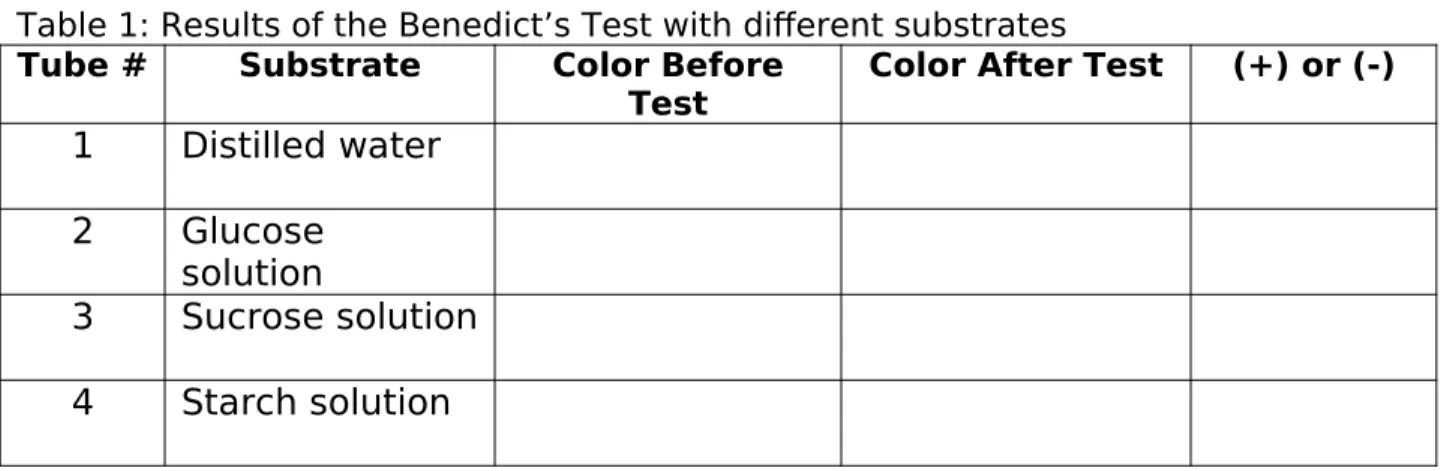
5. In the tube labeled 1, place 10 drops of distilled water; in the tube labeled 2, place 10 drops of glucose solution; in the tube labeled 3, place 10 drops of sucrose solution; in the tube labeled 4, place 10 drops of starch solution. Set aside tubes 5 & 6 for part II.
6. Record the color of each tube before heating in the column labeled, “Color Before Test,” in Table 1.
7. Place the four tubes into the boiling water, being careful not to burn yourself. 8. Allow the test tubes to stay in the boiling water for five minutes. Carefully use
9. In the last column of the data table, indicate presence of a sugar with a +, and absence with a -.
Table 1: Results of the Benedict’s Test with different substrates
Tube # Substrate Color Before
Test Color After Test (+) or (-)
1
Distilled water
2
Glucose
solution
3
Sucrose solution
4
Starch solution
Part II: Using Table 1 results to identify the type of substrate contained in Potatoes and Onions
1. Prepare tubes 5 and 6 (already containing 10 drops of Benedict’s solution) with 10 dropbs each of potato juice (tube 5) and onion juice (tube 6).
2. Record the color of each tube before heating in the column labeled, “Color Before Test,” in Table 2.
3. Place the four tubes into the boiling water, being careful not to burn yourself. 4. Allow the test tubes to stay in the boiling water for five minutes. Carefully use
the test tube holder to remove each tube and place it in the test tube rack. Record the color & observations in the column labeled, “Color After Test,” in Table 1. Note: reducing sugars cause a color change in Benedict’s solution from its original color to green, yellow, orange, or red.
5. In Table 2, indicate the presence of a sugar with a +, and absence with a -, and then identify the substrate.
Table 2. Identifying different substances using the Benedict’s test Tube
#
Substrate Color Before Test Color After Test (+ ) or (-)
Type of Substrate from Table 1
Biological Macromolecules Lab Procedures
Part B. Testing for Starch (a Polysaccharide): Lugol’s
Iodine Test
Potassium iodine solution reacts with starch to produce a purple or black color change.
Materials:
- Lugol’s potassium iodide - Starch solution
- Test tubes (6) - Potato juice (filtered)
- Test tube rack - Onion juice (filtered)
- Glucose solution - Wax pencil
- Sucrose solution
1. Place 15 drops of distilled water in another test tube and label it with the letter W.
2. Place 15 drops of glucose solution in another test tube and label it with the letter G.
3. Place 15 drops of sucrose solution in another test tube and label it with the letter S.
4. Place 15 drops of starch solution in another test tube and label it with the letter T.
5. Place 15 drops of potato juice in another test tube and label it with the letter P.
6. Place 15 drops of onion juice in another test tube and label it with the letter O.
7. Record the color of each tube in the column labeled, “Color Before Test,” in Table 3.
8. In each of the test tubes, place 2 drops of Lugol’s iodine.
9. Record the color of each tube in the column labeled, “Color After Test,” in Table 3.
10.In the last column of Table 3, indicate the presence or absence of starch in each tube, using a (+) symbol to indicate presence, and a (-) symbol to indicate absence.
Table 3. Results of the Iodine Test for Starch with different substrates
Test 1 Distilled water (W)
Biological Macromolecules Lab Procedures
Part C. Testing for Lipids: Sudan IV Test
Lipids may be detected in a number of ways. The application of a fat-soluble dye known as Sudan IV will allow lipids to be detected. The dye sticks to fats and can be seen in with a reddish-orange color change.
Materials:
- Sudan IV dye - Distilled water
- Pencil - Canola oil
- One small box of filter paper - Almond extract - Two Petri dish lids - Peppermint extract - Forceps
1. Mark a small dry piece of filter paper with a pencil as shown below (NOTE: do not use pen or wax pencil):
2. Place one or two drops of almond extract in the circle next to the letter A. 3. Place one or two drops of peppermint extract in the circle next to the letter P. 4. Place one or two drops of Canola oil in the circle next to the letter C.
5. Place one or two drops of distilled water in the circle next to W.
6. Record the color of each dot on the filter paper before the test in Table 4. 7. Dry the extracts and water using the fan at the side lab station. Stay with
your filter paper as it dries.
8. Drop some of the Sudan IV dye solution into a clean Petri dish lid into which you have previously placed (letter side up) the filter paper you have marked. Then, pour enough of the Sudan dye to just barely cover the paper – you don’t need very much of this stain.
9. Gently agitate the dish by sliding it back and forth on the lab bench for three minutes.
10.Use forceps to remove the filter paper from the dye and briefly wash it in distilled water in another Petri dish lid. Agitate the dish by sliding it back and forth. Do a second wash if the paper is still pink after the first wash.
11.Record the color of the spots on the filter paper after the test in Table 4 below.
12.In the last column of the data table, indicate the presence of lipids with a (+) and the absence of lipids with a (-). Sudan IV will stain lipids reddish-orange. Table 4. Results of the Sudan IV Test with different substrates
Material Tested Color Before Test Color After Test (+) or (-) Almond extract (A)
A P W
Peppermint extract (P)
Canola oil (C) Distilled water (W)
Biological Macromolecules Lab Procedures
Part D. Testing for Proteins: Biuret Reagent Test
Biuret is a reagent that will change color from blue to violet when it detects peptide bonds between amino acids of a protein. Violet is a positive test, while blue is a negative test.
Materials:
- Biuret reagent (in a dropper bottle) - Potato juice (filtered)
- Test tubes - Albumin solution
- Test tube rack - Chicken broth solution
- Glucose solution - Distilled water
- Sucrose solution - Wax pencil
- Onion juice (filtered)
1. Label eight clean small test tubes 1- 8, as indicated in Table 5.
2. Place 5 drops of the indicated material in each of the labeled test tubes. Record the color of each tube in Table 5.
3. Place 5 drops of Biuret Reagent into each of the labeled test tubes. 4. Record the color and other observations in Table 5.
5. In the last column of the data table, indicate the presence of proteins with a (+) and the absence of proteins with a (-).
Table 5. Results of the Biuret Test with different substrates
Material Tested Color Before Test Color After Test (+) or (-) 1 Distilled water
Biological Macromolecules Lab Procedures
Part E. Testing an Unknown Substance
There are 3 sets of bottles (A, B, and C), each containing a different unknown substance. Your challenge is to select two of the unknown substances and perform the various tests you’ve just used to identify each unknown. Indicate the presence of the type of macromolecule with a (+) and the absence of that type of
macromolecule with a (-). Unknown 1
The sample labeled is identified by the following tests as
Benedict’s Test Lugol’s Iodine
Test Sudan III Test Biuret Test
Unknown 2
The sample labeled is identified by the following tests as
Benedict’s Test Lugol’s Iodine