Witkowski Grzegorz, Padała Olga, Dzikowski Wojciech, Naylor Katarzyna, Domańska-Glonek Ewa, Torres Anna, Torres Kamil. In situ simulation training in First Aid. Pilot study. First aid in a dangerous workplace. Journal of Education, Health and Sport.
2017;7(4):435-446. eISSN 2391-8306. DOI http://dx.doi.org/10.5281/zenodo.495774
http://ojs.ukw.edu.pl/index.php/johs/article/view/4390
The journal has had 7 points in Ministry of Science and Higher Education parametric evaluation. Part B item 1223 (26.01.2017). 1223 Journal of Education, Health and Sport eISSN 2391-8306 7
© The Author (s) 2017;
This article is published with open access at Licensee Open Journal Systems of Kazimierz Wielki University in Bydgoszcz, Poland
Open Access. This article is distributed under the terms of the Creative Commons Attribution Noncommercial License which permits any noncommercial use, distribution, and reproduction in any medium, provided the original author(s) and source are credited. This is an open access article licensed under the terms of the Creative Commons Attribution Non Commercial License (http://creativecommons.org/licenses/by-nc/4.0/) which permits unrestricted, non commercial use, distribution and reproduction in any medium, provided the work is properly cited. This is an open access article licensed under the terms of the Creative Commons Attribution Non Commercial License (http://creativecommons.org/licenses/by-nc/4.0/) which permits unrestricted, non
commercial
use, distribution and reproduction in any medium, provided the work is properly cited. The authors declare that there is no conflict of interests regarding the publication of this paper.
Received: 25.03.2017. Revised 27.03.2017. Accepted: 07.04.2017.
In situ simulation training in First Aid. Pilot study. First aid in a dangerous
workplace
Abstract
Purpose
The aim of the study was to evaluate the newly develop course prepared for the employees working in the forest and mountain environment
Methodology
31 people participated in the course. They were employees of Roztocze National Park and the Forestry Commission Lutowiska. A diagnostic survey was implemented in a form of a questionnaire. The respondents were provided with two original questionnaires and a telephone survey. Surveys were anonymous and voluntary.
Findings
The average assessment of First Aid knowledge before the workshop was 2.48 and majority of participants assesed First Aid as difficult. After the workshop, the respondents assessed the knowledge on
Grzegorz Witkowski
Department of Didactics and Medical Simulation, Chair of Human Anatomy, Medical University of Lublin, Poland
Olga Padała
Students' Scientific Association of Medical Simulation, Medical University of Lublin, Poland
Wojciech Dzikowski
Department of Didactics and Medical Simulation, Chair of Human Anatomy, Medical University of Lublin, Poland
Katarzyna Naylor
Department of Didactics and Medical Simulation, Chair of Human Anatomy, Medical University of Lublin, Poland
Ewa Domańska-Glonek
Department of Didactics and Medical Simulation, Chair of Human Anatomy, Medical University of Lublin, Poland
Anna Torres
Laboratory of Biostructure, Chair of Human Anatomy, Medical University of Lublin, Poland
Kamil Torres
average as 3.87 and as much as 58% declared that definitely would provide First Aid to a stranger; 81% to a close person. Over 80% of respondents noticed the need of regular training in First Aid.
Research implication
The analysis showed that regular improvement of First Aid skills is required by the participants. The training should be adjusted to the group’s needs in terms of the program, teaching techniques and the place of training. There is a need to implement such training on a wider scale among forestry and mountain workers.
Originality
Uncovering the gaps in First Aid training in mountain and forest workers in their professional training.
Key words: First Aid, , foresters, battlefield medicine, occupational exposure, health and safety rules
1. Introduction
In mountain and forest conditions, the availability of emergency services is limited. Employees of the national parks and forest districts are constantly exposed to the threats resulting from the specificity of the area (Zafren et al. 2005). Injuries and accidents are the third cause of death in Poland, according to data from the Central Statistical Office (GUS) and the WHO (2012, Polish Central Statistical Office 2016). However, no detailed statistics of such events were found in case of forest districts' employees. In the forest conditions, the csualty can only count on help of witnesses or co-workers (Imray & Oakley 2006). Knowledge of first aid may be the only chance of survival for the victim of an accident and facilitate successful assistance provided by the emergency services (Wiśniewski & Majewski 2007). Additional problems obstructing access to rapid specialized medical assistance is the terrain (Imray & Oakley 2006). The response (arrival to the scene) time of EMS (ZRM) in non-urban area is extended from 8 to 15 minutes, however, in the mountain or forest conditions this time is difficult to determine owing to many factors, including the weather (Polish Act of State Medical Rescue 2006). Injuries that usually are not life threatening, when taking place in the mountains or in the woods, without a quick and effective management may result in adverse health consequences or even death. In the case of sudden cardiac arrest (SCA), the irreversible neurological changes occur after 4-5 minutes. Only effective chest compressions (CPR) can extend this time (Grześkowiak et al. 2008, Rasmus et al. 2004, Dziedzic 2009). In accordance with the principle of the golden hour, the injured person should be in the hospital within 60 minutes of the incident, and each additional minute of delay can result in further complications (Gałązowski et al. 2014). Possessing the skills to provide an appropriate treatment needed after the injury give chances to minimize the consequences (Imray & Oakley 2006). Even though, working conditions of workshop participants were not combat, but the difficulty in accessing medical help may resemble tactical conditions. Hence the idea of organizing a first aid workshop enriched with elements of Tactical Combat Casualty Care (TCCC), including practical ways of bleeding control with conventional and combat dressings, tactical tourniquets (Vakili et al. 2014, Adelborg et al. 2010, Szpringer et al. 2014). During the workshop, medical simulation techniques in situ were implemented, to imitate the real working environment of the trainees.
The aim of this study was to analyze the usefulness of the innovative course program for employees of the national parks and forest districts in the mountain and forest conditions.
2. Material and methods
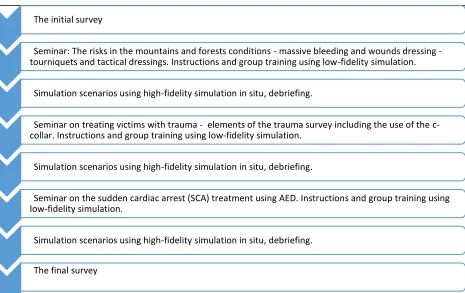
issues. Workshop topics included Basic Life Support (BLS) with AED (Automated External Defibrillator), dressing wounds, hemorrhage control (with tactical tourniquets and dressings) and the trauma survey. The topics of the course were selected after analyzing the core curriculum of the subject "Education for safety" developed by the Ministry of Education as well as participants’ expectations (Polish Ministry of Education 2016). The workshop lasted five academic hours. The program of the workshop is presented in Figure 1.
In the scenarios used during the workshop simulated patients were involved. Simulated patients are people playing roles of victims, whose task is to exhibit the behaviors and symptoms of the given condition or disease (Cooper & Taqueti 2004). Classes took place in the working environment of the participants (Tarnica and Roztocze National Park), and the simulations reflected the daily threats they encounter at their work. The workshop was conducted in September 2015. The instructors were paramedics, certified instructors BLS, ACLS and Battlefield Medicine - Combat Medic. The study received a positive opinion of the ethics committee of the Medical University of Lublin No. KE0254/306/2015.
2.1. The study group
31 people attended the pilot workshop. They were employees of Roztocze National Park (11 persons), trained at a training facility in Zwierzyniec and employees of the Forestry Commission Lutowiska (20 persons), trained in the Bieszczady National Park. The average age of participants was 46.5 years; the youngest person was 25 years old and the oldest 60 years old. The workshop was participants’ initiative. During the initial phone conversation with employees of The Roztocze National Park and the Forestry Commission Lutowiska, the analysis of the most common emergencies they encounter was conducted. Information was collected from participants based on two original questionnaires, which were voluntary and anonymous; one was conducted before the workshop, the second after the workshop. Questionnaires consisted of closed questions, single and multiple choice and open questions. Insix closed questions Likert scale from 1 to 5 was applied; where 1 is "very poor" and 5 means "very good". The preliminary survey consisted of 13 questions divided into sections: questions characterizing the group, subjective assessment of First Aid knowledge and capabilities, objective assessment of knowledge on First Aid. The second questionnaire was given to the participants after the workshop. It consisted of 16 questions divided into sections: assessment of the workshops in terms of usefulness and merits, subjective assessment of their knowledge and capabilities, objective assessment of basic knowledge related to first aid. After 6 months, according to the knowledge retention in teaching first aid described by European Resuscitation Council, the workshop participants took part in a short telephone survey, which was the last stage of the project evaluation (European Resuscitation Council Guidelines 2010). It contained 4 multiple choice questions related to the assessment of their skills in First Aid with elements of the battlefield medicine, the need of organizing such training in the future, assessment of in situ simulation method and open question about the possible reasons against in situ simulation.
The results were analyzed using Statistica v. 8.0 (StatSoft, Poland). Descriptive statistics (mean, standard deviation) were used to summarize the collected data. The obtained data was statistically analyzed, and the relationship between the variables was verified by Wilcoxon test, with a statistically significant result at the level of p <0.05.
3. Results
3.1. The results of a survey conducted before the workshop
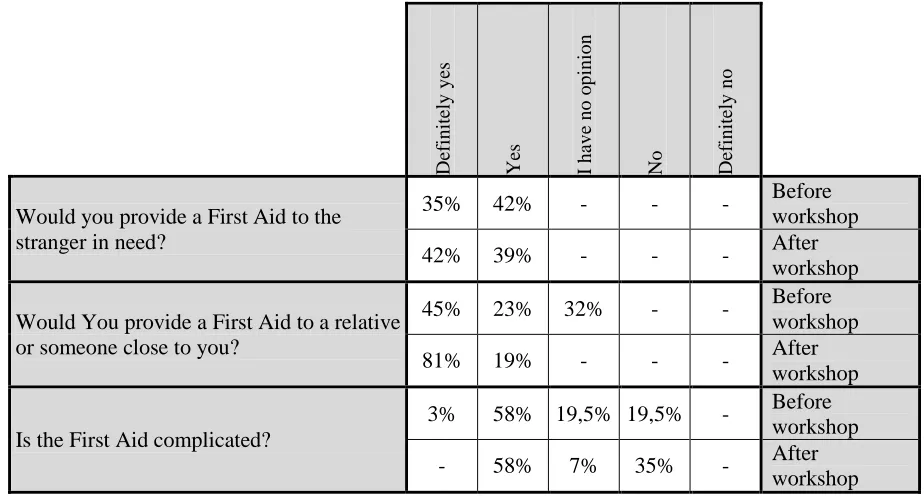
Workshop participants asked if they would provide a first-aid to an unknown person, most often answered "always" - 42%. To the question about providing first aid to a close person, the most common answer was "definitely always" - 45% [Tab. 1].
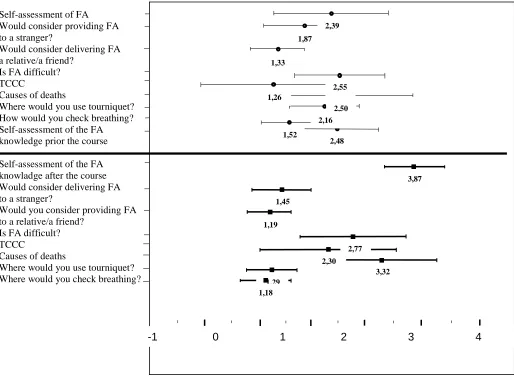
Fears of providing the first aid indicated in the open question: the fear of the consequences - 29%, the lack of skills and knowledge of first aid - 35%, the fear to cause an injury to the victim - 42%, fear of lack of the effect - 6 %, fear of HIV infection - 10%. 13% of people declared no fear of the first aid provision. The project participants were asked about whether first aid is complicated. Most people (average 2.55) answered "yes". When asked about the place of a tourniquet application, 87% of respondents answered "always on a limb just above the bleeding." When asked about the method of airway patency in an unconscious person, an average of 1.55 were correct answers [Fig.1 4]. 16% of study participants were not able to provide the correct answer concerning the EMS/Ambulance telephone number, indicating the police phone number as the correct answer.
3.2. The results of the survey conducted at the end of the workshop
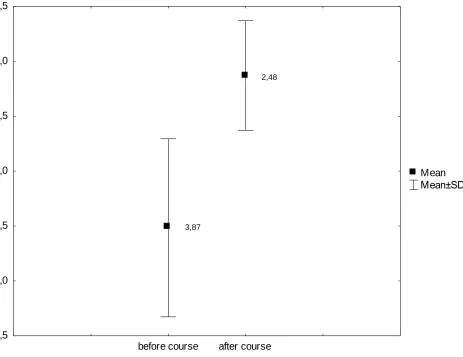
In the questionnaire conducted after the course, the respondents were asked about what could be changed in the workshops program or what they would expect more from such initiatives. Indicated proposals included: more practical training, use of their own equipment during the workshops, outdoor activities, regular and frequent trainings, more repetitions of the procedures. The knowledge of the topics covered during the course, after the workshop, respondents assessed on average at 3.87 in Likert scale. After completion of the course an increase in participants’ self-esteem in terms of knowledge of first aid was indicated. The difference between the assessment of knowledge before and after the course was statistically significant (p <0.05) (Figure 2), which was confirmed by Wilcoxon test.
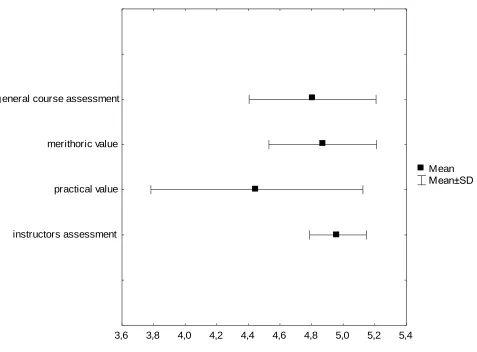
All participants were asked to anonymously assess the workshops. The average overall rating of the course was 4.81 in 1 - 5 Likert scale; 81% rated the course with 5. The presented content of the workshop also received a positive assessment (4.87), as well as their practical value (4.45). The instructors were also rated highly (4.97) (Figure 3). The respondents were asked about the need for implementation of such trainings, 81% marked the answer "definitely needed", 19% “needed”.
To the question concerning providing first aid to a stranger, 58% answered "definitely always", while to a close person 81% marked "definitely always." 58% of workshop participants asked again about whether the first aid is complicated, confirmed it is. Variations in participants’ opinions from before and after the course are presented in Table 1. (Table 1)
Among the concerns about first aid, 16% of respondents reported the fear of the consequences, 10% of respondents reported the lack of skills, 13% of respondents marked the lack of knowledge of the first aid principles, 19% of respondents reported the fear to cause injury, 6% the fear of lack of effect and 13% of the respondents were afraid of HIV infection. 32% of respondents did not have any concerns.
The workshops participants were asked about the place of a tourniquet application. 71% responded "on a limb, on a single bone", 29% "on a limb always just above the bleeding". To the question about opening the airway of the unconscious, 58% of the respondents chose the answer "Tilt the head back", 13% "jaw thrust", 29% did not give any answer. Figure 4 shows the averages and standard deviations of participants’ answers concerning the topics covered during the course. (Figure 1)
3.3. The results of a telephone survey conducted six months after the workshop
in the telephone survey, conducted six months after the workshop, the employees of The Roztocze National Park and the Forestry Commission Lutowiska assessed their skills in first aid to an average of 3.21. To the question whether first aid is complicated, 35% of respondents denied, and 65% of respondents confirmed its difficulty. All participants expressed their willingness to participate in First Aid training in the foreseeable future. Respondents were also asked about learning through in situ simulation method and 87% of respondents expressed their appreciation for the method.
4. Discussion
The employees of the forest districts or the national parks are exposed to tangible dangers arising from the nature of the profession and the workplace environment. Therefore, in this group, there is an undeniable need to possess the ability of dealing with health and life threatening emergencies in a specific working environment. Just as on the battlefield, the common emergencies include a massive hemorrhage. Therefore, the workshop was enriched by techniques used in combat. During the implementation of the workshop, perticipants had the opportunity, among other things, to master the technique of applying the tourniquet and tactical dressings.
Participants themselves initiated conducted training. The cooperation of the Medical University of Lublin, Roztocze National Park and the Forestry Commission Lutowiska enabled introduction of the in situ medical simulation techniques during the workshop. This innovative form of education facilitated learning in authentic conditions. Reliable information and professional first aid skills may be necessary in case of life and health threats, especially when in conditions hindering quick arrival of professional rescue team (Imray & Oakley 2006, Gałązowski et al. 2014).
Every Polish citizen is obligated, under the Article 162 of the Penal Code, to help the person in need of first aid (Polish Penal Code 1997). Therefore, every citizen of the Republic of Poland should regularly participate in trainings concerning basic life saving techniques. This increases the sense of safety in an emergency that may occur both, in private and professional life. These need increases for those exposed to emergency situations due to their profession, where it is necessary to implement the principles of first aid (Pawlak et al. 2016). Continuous improvement of their skills and the formation of good habits, guarantees remaining calm and self control in emergency situations requiring the use of their knowledge. The literature shows that public knowledge of first aid is insufficient (Wiśniewski & Majewski 2007, Grześkowiak et al. 2008, Rasmus et al. 2008, Dziedzic 2009)..
The authors of the present study attempted to obtain information about possible reports of the incidents requiring medical assistance by the Polish Foresters Association and the Regional Management of State Forests in Lublin. Employees of the first mentioned institution denied the existence of such documents, and employees of other institutions were unable to provide information about the reports of life and health-threatening situations. Polish Foresters Association, according to the information obtained by the authors of this study, has no medical training program for foresters. In addition, employees of PFA admitted that the biggest threat to the foresters might be a massive hemorrhage. Pawlak et al., in their study of firefighters’ accidents in their workplace, pay attention to the need for regular training, analyzing the causes of each event, and even penalty for non-compliance of safety rules (2016).
The use of in situ simulation in teaching first aid in a group of professional foresters was aimed at increasing the awareness of real dangers and was to make conducted classes more realistic. Overcoming the fear and skilful attempt to rescue another person can often prove to be the only chance of survival (Brandstorp et al. 2016). Through the use of in situ simulation, participants were involved in the training and were able to act in their real environment, where they proceed their professional activity and in which they should be prepared for emergency situations.
Before the workshop, only 3% of respondents knew the correct place of tourniquet application on the leg, while after the course the correct answer indicated 71% of respondents. The available literature topic confirms that training improves both theoretical knowledge and practical skills in the use of tactical tourniquet( Schreckengaust et al. 2014).
One of the key elements of the basic lifesaving techniques is the maneuver opening the airway. The present study demonstrated that before the course the correct answer (head tilt backwards) chose 32% of respondents, and after the course 58% of respondents. Similar results related to significant growth of the first aid knowledge level after the course, obtained Katona et al. (2015). Very disturbing is the fact that not all the respondents, before and after the workshop, were able to give the correct number to call Ambulance Service.
Similar results related to knowledge and skills in first aid, received Mahony et al., in a study of airlines employees crew (2008).
After analyzing available literature, the authors of this publication have not found reports on the identification of needs and implementation this type of workshop in a group of forestry and mountain areas workers who are exposed to the risk of accidents at work. No such reports also refer to a group of professional foresters in Poland. The only aspects of their work discussed in the literature are associated with occupational exposure to infectious diseases and noise (Bilski 2012).
The data obtained by the authors of the study before the training shows that 68% of respondents declare readiness to undertake rescue operations in case of a threat to a close relative and 77 % of respondents showed the will to help a unknown person. After a single workshop these values increased to 97% and 100%. It shows that participation in regular training increases self-confidence and results with a desire to try save lives in emergency situations (Oliver et al. 2013). Similar results were also obtained by Grześkowiak et al (2008). Lack of skills is not the only obstacle that discourages potential rescuers before attempting to save lives. 29% of the respondents are afraid of the consequences of their actions, some respondents feared the lack of effect, some were scared of the HIV infection. As many as 42% of respondents admitted that were afraid to harm another person. Similar results regarding concerns about the infliction of harm to the victim were also obtained by Wisniewski and Majewski (2007). In our study, after the workshop, the number of respondents without any fears or doubts increased from 13% to 32%.
5. Conclusions
1. The knowledge of first aid is insufficient among the workers interviewed in Roztocze National Park and the Forestry Commission Lutowiska. In the absence of regulations on training first aid skills, it can be concluded that other institutions of this type employees are also not properly trained.
2. To maintain appropriate standards of providing the first aid to the victim, regular trainings are crucial. They enable participants to consolidate the content of the theoretical and practical skills.
3. Conducting the training in situ simulation was an innovative solution. The aim was to indicate to the participants the realism of possible threats. Due to the positive reception of the training described in a pilot study, the organizers plan to take a similar initiative in next worhshops.
4. It is important to continue the cooperation in order to improve the workshops and extend the training on a larger group of employees.
Conflict of interest
None.
Acknowledgments
We do not have anyone to acknowledge.
References
Adelborg K, Thim T, Secher N, Grove E, Løfgren B. Benefits and shortcomings of mandatory first aid and basic life support courses for learner drivers. Resuscitation. 2011; 82: 614-7, http://dx.doi.org/10.1016/j.resuscitation.2010.12.018
Bilski B. Occupational Hazards and Diseases among Forestry Workers in Poland. 2012. 1: 252. doi:10.4172/scientificreports.252
Brandstorp H, Halvorsen P, Sterud B, Haugland B, Kirkengen A.: Primary care emergency team training in situ means learning in real context. Scand J Prim Health Care. 2016 Jul 21:1-9. Available at:
Central Statistical Office web page [The causes of death in Poland]. Information portal, Warsaw 2016 [citated 10.02.2016 r.]. Available at: http://stat.gov.pl/obszary-tematyczne/ludnosc/statystyka-przyczyn-zgonow/ . Polish
Cooper J, Taqueti V. A brief history of the development of mannequin simulators for clinical education and training. Qual Saf Health Care. 2004; 13: 11-18 http://dx.doi.org/10.1136/qshc.2004.009886
Dziedzic A. Do not be afraid to save the other's lives. Bezpieczeństwo Pracy. Nauka i Praktyka 2009; 1: 26-7. Polish
European Resuscitation Council Guidelines for Resuscitation 2010. Resuscitation 2010.
Gałązkowski R, Świeżewski1 S, Rabczenko D, Wejnarski A, Timler D, Michalak G. Life-saving procedures in severe injuries of the upper extremities - the role of air ambulance (HEMS) in the therapeutic process. Medycyna Pracy. 2014;65(6):765–776. Polish Available at:
http://dx.doi.org/10.13075/mp.5893.00144
Grześkowiak M, Pytliński A, Frydrysiak K. The knowledge on resuscitation of Wielkopolska society. Medical News. 2008; 77: 19-24. Polish
Hart J, Chilcote D. "Won't You Be My Patient?": Preparing Theater Students as Standardized Patients. J Nurs Educ. 2016;55(3):168-71. Available at: http://dx.doi.org/10.3928/01484834-20160216-09
Imray C, Oakley E. Cold Still Sills: Cold-Realated Illnessses in Military Practice. Freezing and Non-Freezing Cold Injury. A R Army Med. Corps. 2006; 152: 218-222.
Katona LB, Douglas WS, Lena SR, Ratner KG, Crothers D, Zondervan R. L. et al.: Wilderness First Aid Training as a Tool for Improving Basic Medical Knowledge in South Sudan. Prehosp Disaster Med. 2015;30(6):574-8. doi: 10.1017/S1049023X15005270.
Mahony P, Griffiths RF, Larsen P, Powell D. Retention of knowledge and skills in first aid and resuscitation by airline cabin crew. Resuscitation. 2008;76(3):413-8.
Oliver E, Cooper J, McKinney D. Can first aid training encourage individuals' propensity to act in an emergency situation? A pilot study. Emergency Medicine Journal. 2013; 31(6) :518-20
Pawlak A, Gotlib J, Gałązkowski R. The analysis outlining the occurrence and consequences of accidents in the work environment of the firefighters employed by the state fire service in Poland in 2008–2013. Medycyna Pracy. 2016;67(1):1–9. Available at: http://dx.doi.org/10.13075/mp.5893.00144
Polish Ministry of Education web page. Ministerstwo Edukacji Narodowej, Warsaw 2011 [citated 20.06.2016r.] [pdf] Available at: https://men.gov.pl/wp-content/uploads/2011/02/men_tom_8.pdf Polish Rasmus A, Balcerzyk-Barzdo E, Sikorski T, Kołodziejczyk-Wojtczak D. The willingness and ability of Poles in providing the first aid. Med. Intens. Rat. 2004; 7: 125-32. Polish
Schreckengaust R, Littlejohn L, Zarow G. Effects of training and simulated combat stress on leg tourniquet application accuracy, time, and effectiveness. Mil Med. 2014; 179(2):114-20. Available at: <http://dx.doi.org/doi: 10.7205/MILMED-D-13-00311>
Szpringer M, Komendacka O, Kosecka J, Sobczyk B. The assessment of the drivers' knowledge about first aid. Med. Ogólna i Nauki o Zdrow. 2014; 20: 260–264. Polish
The act of State Medical Rescue, September 8th of 2006 r. Dz. U. 2006 nr 191 poz. 1410. Polish The Penal Code, Art. 164 §1, Polish
Vakili M, Mohjervatan A, Heydari S, Akbarzadeh A, Hosini N. Alizad F. et al. The efficacy of a first aid training course for drivers: an experience from northern Iran. Chinese Journal of Traumatology. 2014;17: 289-292.
WHO, European Health Report 2012; Available at:
www.who.un.org.pl/common/files_download.php?fid=16
Wiśniewski J, Majewski WD. Assessment of the teachers' of secondary schools in West Pomerania first aid knowledge level. Annales Academiae Medicae Stetinensis. 2007;53(2): 114–123. Polish
The initial survey
Seminar: The risks in the mountains and forests conditions - massive bleeding and wounds dressing - tourniquets and tactical dressings. Instructions and group training using low-fidelity simulation.
Simulation scenarios using high-fidelity simulation in situ, debriefing.
Seminar on treating victims with trauma - elements of the trauma survey including the use of the c-collar. Instructions and group training using low-fidelity simulation.
Simulation scenarios using high-fidelity simulation in situ, debriefing.
Seminar on the sudden cardiac arrest (SCA) treatment using AED. Instructions and group training using low-fidelity simulation.
Simulation scenarios using high-fidelity simulation in situ, debriefing.
[image:8.612.78.543.355.648.2]The final survey
Mean Mean±SD
before course after course
[image:9.612.85.548.77.434.2]1,5 2,0 2,5 3,0 3,5 4,0 4,5
Figure. 2 Average and standard deviation of participants’ knowledge prior and after the course
2,48
Mean Mean±SD
3,6 3,8 4,0 4,2 4,4 4,6 4,8 5,0 5,2 5,4 instructors assessment
[image:10.612.84.561.74.426.2]practical value merithoric value general course assessment
Self-assessment of FA Would consider providing FA to a stranger?
Would consider delivering FA a relative/a friend?
Is FA difficult? TCCC
Causes of deaths
Where would you use tourniquet? How would you check breathing? Self-assessment of the FA knowledge prior the course
Self-assessment of the FA knowladge after the course Would consider delivering FA to a stranger?
Would you consider providing FA to a relative/a friend?
Is FA difficult? TCCC
Causes of deaths
[image:11.612.72.586.76.456.2]Where would you use tourniquet? Where would you check breathing?
Figure. 4. Comparison of knowledge of the participants prior and after the course
-1 0 1 2 3 4 5
2,39
1,87
1,33
2,55 1,26
2,50 2,16
1,52
2,48
3,87
1,45
1,19
2,77
2,30
3,32 1,29
Table 1. General questions related to First Aid.
D
ef
in
itely
y
es
Yes I h
av
e
n
o
o
p
in
io
n
No Def
in
itely
no
Would you provide a First Aid to the stranger in need?
35% 42% - - - Before
workshop
42% 39% - - - After
workshop
Would You provide a First Aid to a relative or someone close to you?
45% 23% 32% - - Before
workshop
81% 19% - - - After
workshop
Is the First Aid complicated?
3% 58% 19,5% 19,5% - Before workshop
- 58% 7% 35% - After