Volume 2008, Article ID 824797,8pages doi:10.1155/2008/824797
Research Article
Beamforming under Quantization Errors in
Wireless Binaural Hearing Aids
Sriram Srinivasan, Ashish Pandharipande, and Kees Janse
Philips Research, High Tech Campus 36, 5656AE Eindhoven, The Netherlands
Correspondence should be addressed to Sriram Srinivasan,[email protected]
Received 28 January 2008; Revised 5 May 2008; Accepted 30 June 2008
Recommended by John Hansen
Improving the intelligibility of speech in different environments is one of the main objectives of hearing aid signal processing algorithms. Hearing aids typically employ beamforming techniques using multiple microphones for this task. In this paper, we discuss a binaural beamforming scheme that uses signals from the hearing aids worn on both the left and right ears. Specifically, we analyze the effect of a low bit rate wireless communication link between the left and right hearing aids on the performance of the beamformer. The scheme is comprised of a generalized sidelobe canceller (GSC) that has two inputs: observations from one ear, and quantized observations from the other ear, and whose output is an estimate of the desired signal. We analyze the performance of this scheme in the presence of a localized interferer as a function of the communication bit rate using the resultant mean-squared error as the signal distortion measure.
Copyright © 2008 Sriram Srinivasan et al. This is an open access article distributed under the Creative Commons Attribution License, which permits unrestricted use, distribution, and reproduction in any medium, provided the original work is properly cited.
1. INTRODUCTION
Modern digital hearing aids perform a variety of signal processing tasks aimed at improving the quality and intel-ligibility of the received sound signals. These tasks include frequency-dependent amplification, feedback cancellation, background noise reduction, and environmental sound classification. Among these, improving speech intelligibility in the presence of interfering sound sources remains one of the most sought-after features among hearing aid users [1]. Hearing aids attempt to achieve this goal through beamforming using two or more microphones, and exploit the spatial diversity resulting from the different spatial positions of the desired and interfering sound sources [2].
The distance between the microphones on a single hearing aid is typically less than 1 cm due to the small size of such devices for aesthetic reasons. This small spacing limits the gain that can be obtained from microphone array speech enhancement algorithms. Binaural beamforming, which uses signals from both the left and right hearing aids, offers greater potential due to the larger inter-microphone distances corresponding to the distance between the two ears (16–20 cm). In addition, such a scheme also provides the possibility to exploit the natural attenuation provided by the head. Depending on the location of the interfering source,
the signal-to-interference ratio (SIR) can be significantly higher at one ear compared to the other, and a binaural system can exploit this aspect.
aid design. In this paper, we study analytically the trade-off in the performance of a GSC beamformer with respect to quantization bits.
Different configurations are possible for a binaural beamforming system, for instance, both hearing aids could transmit their received microphone signals to a central device where the beamforming is performed, and the result could then be transmitted back to the hearing aids. Alternatively, the hearing aids could exchange their signals and beamform-ing may be performed on each hearbeamform-ing aid. In this paper, to analyze the effect of quantization errors on beamforming, without loss of generality we assume that each hearing aid has one microphone and that the right hearing aid quantizes and transmits its signal to the left hearing aid, where the two signals are combined using a beamformer. This paper is an extension of our earlier work [11], incorporates the effect of head shadow and presents a more detailed experimental analysis.
If the power spectral density (PSD) of the desired source is known a priori, the two-microphone Wiener filter provides the optimal (in the mean squared error sense) estimate of the desired source. The effect of quantization errors in such a framework has been investigated in [12]. However, in practice the PSD is unknown. In this paper, we consider a particular beamformer, the generalized sidelobe canceller (GSC) [13], which does not require prior knowledge of the source PSD.
The GSC requires knowledge of the location of the desired source, which is available since the desired source is commonly assumed to be located at 0◦ (in front of the microphone array) in hearing aid applications [2]. The motivation behind this assumption is that in most real-life situations, for instance, a conversation, the user is facing the desired sound source. In a free field, the two-microphone GSC can cancel out an interfering sound source without distorting the desired signal, which is a desirable feature in hearing aids. Thus, the GSC is well suited for hearing aid applications, and we study the impact of quantization errors on the GSC in this paper.
The performance of the GSC may be affected by other sources of error such as microphone mismatch, errors in the assumed model (the desired source may not be located exactly at 0◦), reverberation, and so forth. Variations of the GSC that are robust to such imperfections are discussed in [14–16]. In this paper, we exclude such errors from our analysis to isolate the effect of the errors introduced by quantization on the performance of the GSC.
The remainder of this paper is organized as follows. We introduce the signal model and the head shadow model we use inSection 2. The binaural GSC and its behavior in the presence of quantization errors are discussed in Section 3. The performance of the GSC at different bit rates is analyzed inSection 4. Finally, concluding remarks and suggestions for future work are presented inSection 5.
2. SIGNAL MODEL
Consider a desired sources(n) in the presence of an interferer
i(n), wherenrepresents the time index. A block ofNsamples
of the desired and interfering signals can be transformed into the frequency domain using the discrete Fourier transform (DFT) as
S(k)= N−1
n=0
s(n)e−j2πnk/N,
I(k)= N−1
n=0
i(n)e−j2πnk/N, 0≤k < N,
(1)
wherekis the frequency index. Let E{S(k)S†(k)} = Φs(k), and E{I(k)I†(k)} = Φi(k), where † indicates complex conjugation. We assume that the left and right microphones each have one microphone. The signal observed at the microphone in the left hearing aid can be written as
XL(k)=HL(k)S(k) +GL(k)I(k) +UL(k), (2)
whereHL(k) andGL(k) are the transfer functions between the microphone on the left hearing aid and the desired and interfering sources, respectively, andUL(k) corresponds to uncorrelated (e.g., sensor) noise with E{UL(k)UL†(k)} =
Φu∀k. The transfer functionsHL(k) andGL(k) include the effect of head shadow. For eachk, we modelS(k),I(k), and
UL(k) as memoryless zero mean complex Gaussian sources, with variancesΦs(k),Φi(k), andΦu, respectively. Their real and imaginary parts are assumed to be independent with variancesΦs(k)/2,Φi(k)/2, andΦu/2, respectively.
The signal observed at the right ear can be written as
XR(k)=HR(k)S(k) +GR(k)I(k) +UR(k), (3)
where the relevant terms are defined analogously to the left ear. We assume that E{UR(k)UR†(k)} =Φu∀k, and thatS(k),
I(k),UL(k), andUR(k) are pairwise independent.
We use the spherical head shadow model described in [17] to obtain the head related transfer functions (HRTFs)
HL(k),HR(k),GL(k), andGR(k). Define the origin to be the center of the sphere. Letabe the radius of the sphere,rbe the distance between the origin and the sound source, and define
ρ=r/a. Letθdenote the angle between a ray from the origin to the sound source and a ray from the origin to the point of observation (left or right ear) on the surface of the sphere as shown inFigure 1. The HRTF corresponding to the angle of incidenceθis then given by [17]
H(ρ,k,θ)= −ρc
kaexp
−j2πk
N a c
Ψ(ρ,k,θ), (4)
with
Ψ(ρ,k,θ)=
∞
m=0
(2m+ 1)Pm(cosθ)hm
((2πk/N)ρa/c)
h
m((2πk/N)a/c) , (5)
wherePmis the Legendre polynomial of degreem,hmis the spherical Hankel function of orderm, andhmis the derivative ofhmwith respect to its argument.
5π
9
θs
θ r
a
Source
Left Right
Figure1: The head shadow model. The left and right hearing aids each have one microphone and are located at±5π/9 on the surface of a sphere of radiusa.
Fixed beamformer
Blocking
matrix W(k)
XL(k)
XR(k)
Yb(k)
Yr(k)
Z(k)
−
Figure2: Frequency-domain implementation of the GSC.
left and right hearing aids are assumed to be located at 5π/9 and−5π/9, respectively, on the surface of the sphere. For example, if inFigure 1,θs = −π/3, then the location of the source relative to the left ear is−θs+ 5π/9=8π/9. We have
HL(k)=H(ρ,k,−θs+ 5π/9),
HR(k)=H(ρ,k,−θs−5π/9).
(6)
Similarly, the transfer functions corresponding to the inter-ferer are given by
GL(k)=H(ρ,k,−θi+ 5π/9),
GR(k)=H(ρ,k,−θi−5π/9).
(7)
We consider the case where the quantities θi, Φs(k),
Φi(k), and Φu are all unknown. As is typical in hearing aid applications [2], we assume the desired source to be located in front of the user, that is, θs=0◦. Thus, due to symmetry, the HRTFs between the desired source and the left and right microphones are equal (this is valid in anechoic environments, and only approximately satisfied in reverberant rooms). LetHL(k)=HR(k)=Hs(k). The GSC structure [13] depicted inFigure 2 can then be applied in this situation. The fixed beamformer simply averages its two inputs as the desired source component is identical in the two signals. The blocking matrix subtracts the input signals resulting in a reference signal that is devoid of the desired signal, and forms the input to the adaptive interference canceller.
We assume that the hearing aid at the right ear quantizes and transmits its signal to the hearing aid at the left ear where the two are combined. LetXR(k) represent the reconstructed signal obtained after encoding and decodingXR(k) at a rate
Rkbits per sample resulting in a distortionDk, whereDk = E{|XR(k)−XR(k)|2}. Theforward channelwith respect to the squared error criterion can be written as [18, pages 100-101],
XR(k)=αk(XR(k) +V(k)), (8)
whereαk =(Φx(k)−Dk)/Φx(k),Φx(k)=E{XR(k)XR†(k)}, and V(k) is zero mean complex Gaussian with variance
Dk/αk. Recall that we modelS(k),I(k),UL(k), andUR(k) as memoryless zero mean complex Gaussian random sources for eachk, with independent real and imaginary parts. The rate-distortion relation for the complex Gaussian source follows from the rate-distortion function for a real Gaussian source [18, Chapter 4],
Rk(Dk)=log2
Φx(k)
Dk
, (9)
so that the distortionDkis obtained asDk=Φx(k)2−Rk. The signalsXL(k) andXR(k) form the two inputs to the GSC.
If the PSDs Φs(k), Φi(k), and Φu are known, more efficient quantization schemes may be designed, for example, one could first estimate the desired signal (using a Wiener filter) from the noisy observationXRat the right ear, and then quantize the estimate as in [12]. However, as the PSDs are unknown in our model, we quantize the noisy observation itself.
3. THE BINAURAL GSC
We first look at the case when there is no quantization and the left hearing aid receives an error-free description of XR(k). This corresponds to an upper bound in our performance analysis. We then consider the case whenXR(k) is quantized at a rateRkbits per sample.
3.1. No quantization
The GSC has three basic building blocks. The first is a fixed beamformer that is steered towards the direction of the desired source. The second is a blocking matrix that produces a so-called noise reference signal that is devoid of the desired source signal. Finally, the third is an adaptive interference canceller that uses the reference signal generated by the blocking matrix to cancel out the interference present in the beamformer output.
The output of the fixed delay-and-sum beamformer is given by
Yb(k)=F(k)X(k), (10)
whereF(k)=(1/2)[1 1],X(k)=[XL(k) XR(k)]T. We can rewriteYb(k) as
Yb(k)=Hs(k)S(k) +1
2I(k)(GL(k) +GR(k))
+1
2(UL(k) +UR(k)).
The blocking matrix is given byB(k)=[1 −1], so that the input to the adaptive interference cancellerW(k) is obtained as
Yr(k)=B(k)X(k)
=I(k)(GL(k)−GR(k)) +UL(k)−UR(k).
(12)
The adaptive filterW(k) is updated such that the expected energy of the residual given by ηk = E{|Yb(k) −
W(k)Yr(k)|2} is minimized, for example, using the nor-malized least mean square algorithm [19, Chapter 9]. Since
Yr(k) does not contain the desired signal, minimizing ηk corresponds to minimizing the energy of the interferer in the residual. Note that none of the above steps require knowledge of the PSD of the desired or interfering sources.
For our analysis, we require the optimal steady state (Wiener) solution forW(k), which is given by
Wopt(k)=E{Yb(k)Y
† r(k)} E{Yr(k)Yr†(k)}
, (13)
where
E{Yb(k)Yr†(k)} = 1
2Φi(k)(GL(k) +GR(k))(GL(k)−GR(k)) †
E{Yr(k)Yr†(k)} =Φi(k)|GL(k)−GR(k)|2+ 2Φu.
(14)
The GSC output can be written as
Z(k)=Yb(k)−Wopt(k)Yr(k), (15)
and the resulting estimation error is
ξk=E{(Hs(k)S(k)−Z(k))(Hs(k)S(k)−Z(k))†} =E{Yb(k)Yb†(k)} −E{Yb(k)Yr†(k)}Wopt† (k)
− |Hs(k)|2Φs(k),
(16)
where
E{Yb(k)Yb†(k)} = |Hs(k)|2Φs(k)
+1
4Φi(k)|GL(k) +GR(k)| 2
+1 2Φu.
(17)
3.2. Quantization at a rate R
The beamformer output in this case is given as
Yb(k)= 1
2(XL(k) +XR(k)) =1
2(1 +αk)Hs(k)S(k) + 1
2I(k)(GL(k) +αkGR(k))
+1
2(UL(k) +αkUR(k)) + 1 2αkV(k).
(18)
Comparing (18) with (11), since 0≤αk ≤1, it can be seen that while the fixed beamformer preserves the desired source in the unquantized case, there is attenuation of the desired source in the quantized case. The blocking matrix produces
Yr(k)=(1−αk)Hs(k)S(k) +I(k)(GL(k)−αkGR(k)) +UL(k)−αkUR(k)−αkV(k).
(19)
It is evident from (19) that due to the quantization, the reference signal Yr(k) is not completely free of the desired signal S(k), which will result in some cancellation of the desired source in the interference cancellation stage. The adaptive interference canceller is given by
Wopt(k)=E{
Yb(k)Yr†(k)} E{Yr(k)Yr†(k)}
, (20)
where
E{Yb(k)Yr†(k)} = 1 2(1−α
2
k)|Hs(k)|2Φs(k)
+1
2Φi(k)(GL(k) +αkGR(k)) ×(GL(k)−αkGR(k))†
+1 2(1−α
2
k)Φu−1 2α
2
kΦv(k),
E{Yr(k)Yr†(k)} =(1−αk)2|Hs(k)|2Φs(k) +Φi(k)|GL(k)−αkGR(k)|2
+ (1 +α2
k)Φu+α2kΦv(k),
(21)
whereΦv(k)=E{V(k)V†(k)}. The GSC output in this case is
Z(k)=Yb(k)−Wopt(k)Yr(k). (22)
The corresponding estimation error is
ξk(Rk)=E{(Hs(k)S(k)−Z(k))(Hs(k)S(k)−Z(k))†} =Pz(k)−αk|Hs(k)|2Φs(k)
+ (1−αk)|Hs(k)|2Φs(k)(Wopt(k) +Wopt† (k)), (23)
where
Pz(k)=E{Z(k)Z†(k)}
=E{Yb(k)Yb†(k)}−E{Yb(k)Yr†(k)}Wopt† (k),
E{Yb(k)Yb†(k)} = 1 4(1 +αk)
2|
Hs(k)|2Φs(k)
+1
4Φi(k)|GL(k) +αkGR(k)| 2
+1 4(1 +α
2
k)Φu+1 4α
2
kΦv(k).
(24)
4. GSC PERFORMANCE AT DIFFERENT BIT RATES
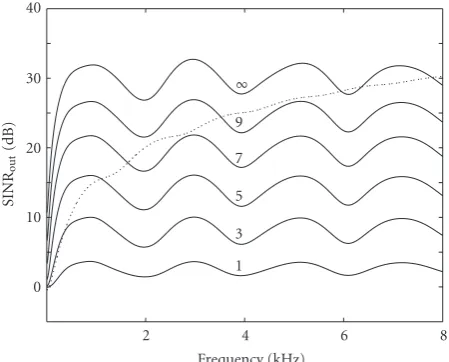
Using (23)-(24), the behavior of the GSC can be studied at different bit rates, and for different locations of the interferer. The solid curves inFigure 3plot the output signal-to-interference-plus-noise ratio (SINR) obtained from the binaural GSC at different bit rates for an interferer located at 40◦. The output SINR per frequency bin is obtained as
SINRout(k)=10 log10
|Hs(k)|2Φs(k)
ξk(Rk)
0 10 20 30 40
SINR
out
(dB)
2 4 6 8
Frequency (kHz) 1 3 5 7 9
∞
Figure 3: SINR after processing for input SIR 0 dB, input SNR 30 dB, and interferer located at 40◦. Solid curves correspond to binaural GSC at the specied bit rates (bits per sample), and the dotted curve corresponds to the monaural case.
For comparisons, we also plot the output SINR obtained using a monaural two-microphone GSC (dotted line). This would be the result obtained if there was only a single hearing aid on the left ear with the two microphones separated by 8 mm in an end-fire configuration. In the monaural case, we consider a rateR = ∞as both microphone signals are available at the same hearing aid. To obtain Figure 3, the relevant parameter settings were Φs(k) = Φi(k) = 1∀k,
a = 0.0875 m, d = 0.008 m,r = 1.5 m, andc = 343 m/s. The mean input SIR and signal-to-noise ratio (SNR) were set to 0 dB and 30 dB, respectively, where
SIR= 1
N
N
k=1
10 log10|Hs(k)| 2
Φs(k)
|GL(k)|2Φi(k) ,
SNR= 1
N
N
k=1
10 log10|Hs(k)| 2
Φs(k)
Φu .
(26)
It can be seen from Figure 3 that at a rate of 5 bits per sample, the binaural system outperforms the monaural system. Note that by bits per sample we mean bits allocated to each sample per frequency bin. Figure 4 shows the performance of the binaural GSC without considering the effect of head shadow, that is, assuming that the microphones are mounted in free space. In this case, the transfer functions
Hs(k), GL(k), and GR(k) correspond to the appropriate relative delays. The sharp nulls in Figure 4 correspond to those frequencies where it is impossible to distinguish between the locations of the desired and interfering sources due to spatial aliasing, and thus the GSC does not provide any SINR improvement. It is interesting to note that the differences introduced by head shadow helps in this respect, as indicated by the better performance at these frequencies in
Figure 3.
0 10 20 30 40
SINR
out
(dB)
2 4 6 8
Frequency (kHz) 1 3 5 7 9
∞
Figure 4: SINR after processing for input SIR 0 dB, input SNR 30 dB, and interferer located at 40◦, ignoring the effect of head shadow (microphone array mounted in free space). Solid curves correspond to binaural GSC at the specied bit rates (bits per sample), and the dotted curve corresponds to the monaural case.
0 10 20 30 40
SINR
out
(dB)
2 4 6 8
Frequency (kHz) 1 3 5 7 9
∞
Figure 5: SINR after processing for input SIR 0 dB, input SNR 30 dB, and interferer located at 120◦. Solid curves correspond to
binaural GSC at the specied bit rates (bits per sample), and the dotted curve corresponds to the monaural case.
−10 0 10 20 30
GSINR
0 10
20 30
SIR
0 10
20 30
SNR
Figure 6: Improvement in SINR after processing at 4 bits per sample for interferer located at 40◦, and for different values of SIR
and SNR.
−10 0 10 20 30
GSINR
0 10
20 30
SIR
0 10
20 30
SNR
Figure 7: Improvement in SINR after processing at 8 bits per sample for interferer located at 40◦, and for different values of SIR and SNR.
the interferer was located at 40◦. In this case, the binaural system needs to operate at a significantly higher bit rate to outperform the monaural system, and the benefits are mainly in the low-frequency range up to 4 kHz.
For an interferer located at 40◦, Figure 6 depicts the improvement in SINR averaged over all frequencies after processing by the GSC, for different values of the SIR and SNR. The improvement was calculated as
GSINR= 1
N
N
k=1
10 log10|Hs(k)|
2Φ
s(k)
ξk(Rk)
− 1
N
N
k=1
10 log10 |Hs(k)| 2
Φs(k)
|GL(k)|2Φi(k) +Φu
.
(27)
The largest improvements are obtained at low SIRs and high SNRs, where the adaptive interference canceller is able to perform well as the level of the interferer is high compared to the uncorrelated noise in the reference signalYr(k). At high SIR and low SNR values, the improvement reduces to the 3 dB gain resulting from the reduction of the uncorrelated noise due to the doubling of microphones. For low SNR
0 10 20 30
GSINR
(dB)
16 32 48 64 80 96 112 128
Rate (kbps)
Figure8: Improvement in SINR after processing averaged across all frequencies at different bit rates (kbps) for uniform rate allocation (solid) and greedy rate allocation (dotted).
values, the improvement due to the interference canceller is limited across the entire range of SIR values. However, as the SNR increases, the interference canceller provides a significant improvement in performance as can be seen in the right rear part of Figures 6 and 7. At high SNR and SIR values, a low bit rate (e.g., 4 bits per sample) results in degradation of performance as the loss due to quantization more than offsets the gain due to beamforming. At low bit rates, the reference signalYr(k), which forms the input to the adaptive interference canceller, is no longer devoid of the desired signal. This is one of the reasons for the poor performance of the binaural GSC at low bit rates as the adaptive filter cancels some of the desired signal. In fact, as observed in [20], in the absence of uncorrelated noise, the SIR at the output of the adaptive interference canceller is the negative (on a log scale) of the SIR inYr(k). At high input SIRs and SNRs, even a small amount of desired signal leakage results in a high SIR inYr(k), which in turn results in a low SIR at the output as seen inFigure 6. One approach to avoid cancellation of the desired signal is to adapt the filter only when the desired signal is not active [21]. The detections may be performed, for example, using the method of [22].
So far, we have looked at the effect of quantization at a bit-rateRindependently with respect to each frequency bin. In practice, the availableRbits need to be optimally allocated to each frequency bandk. The rate allocation problem can be formulated as
{R∗1,R∗2,. . .,R∗N} = argmin {R1,R2,...,RN}
N
k=1
ξk(Rk)
subject to N
k=1 Rk=R.
(28)
−40
−20 0 20 40
Φs
(
k
)(
d
B
)
0 2 4 6 8
Frequency (kHz)
Figure9: The PSDΦs(k), of a segment of the signal used to obtain the results inFigure 8.
scheme is necessary. The distortion functionξk(Rk) does not lend itself to a closed-form solution for the rate allocation, and suboptimal approaches such as a greedy allocation algorithm need to be employed. In a greedy rate allocation scheme, at each iteration, one bit is allocated to the band
k where the additional bit results in the largest decrease in distortion. The iterations terminate when all the available bits are exhausted.Figure 8shows the output SINR (averaged across all frequencies) at different bit rates for both uniform and greedy rate allocation. Here, the desired and interfering signals were assumed to be speech. The signals, sampled at 16 kHz, were processed in blocks ofN = 512 samples, and the results were averaged over all blocks.Figure 9shows the PSD of a segment of the signal. It can be seen fromFigure 8
that the greedy allocation (dotted) scheme results in better performance compared to the uniform rate allocation (solid) scheme. However, we note that the greedy algorithm requires knowledge of the PSDsΦs(k) andΦi(k), and the location of the interferer.
5. CONCLUSIONS
A wireless data link between the left and right hearing aids enables binaural beamforming. Such a binaural system with one microphone on each hearing aid offers improved noise reduction compared to a two-microphone monaural hearing aid system. The performance gain arises from the larger microphone spacing and the ability to exploit the head shadow effect. The binaural benefit (improvement compared to the monaural solution) is largest when an interfering source is located close to the desired source, for instance, in the front half plane. For interferers located in the rear half plane, the binaural benefit is restricted to the low-frequency region where the monaural system has poor spatial resolution. Unlike the monaural solution, the binaural GSC is able to provide a uniform performance improvement regardless of whether the interferer is in the front or rear half plane.
Wireless transmission is power intensive and battery life is an important factor in hearing aids. Exchange of microphone signals at low bit rates is thus of interest to conserve battery. In this paper, the performance of the binaural system has been studied as a function of the communication bit rate. The generalized sidelobe canceller (GSC) has been considered in this paper as it requires neither knowledge of the source PSDs nor of the location of the interfering sources. Both the monaural and binaural systems perform best when the level of uncorrelated noise is low, that is, at high SNRs, when the adaptive interference canceller is able to fully exploit the availability of the second signal. At an SNR of 30 dB and an SIR of 0 dB, the binaural system offers significant gains (15 dB SINR improvement for interferer at 40◦) even at a low bit rate of 4 bits per sample. At higher input SIRs, a higher bit-rate is required to achieve a similar gain.
In practice, the total number of available bits needs to be optimally allocated to different frequency bands. An optimal allocation would be nonuniform across the different bands. Such an allocation however requires knowledge of the source PSD and the location of the interferer. Alternatively, a suboptimal but practically realizable uniform rate allocation may be employed. It has been seen that such a uniform rate allocation results in a performance degradation of around 5 dB in terms of SINR compared to a nonuniform allocation obtained using a greedy optimization approach.
The main goal of this paper has been to investigate the effect of quantization errors on the binaural GSC. Several extensions to the basic theme can be followed. Topics for future work include studying the effect of reverberation and ambient diffuse noise on the performance of the beamformer. Binaural localization cues such as interaural time and level differences have been shown to contribute towards speech intelligibility. Future work could analyze the effect of quantization errors on these binaural cues.
REFERENCES
[1] S. Kochkin, “MarkeTrak V: ‘Why my hearing aids are in the drawer’: the consumers’ perspective,”The Hearing Journal, vol. 53, no. 2, pp. 34–42, 2000.
[2] V. Hamacher, J. Chalupper, J. Eggers, et al., “Signal processing in high-end hearing aids: state of the art, challenges, and future trends,” EURASIP Journal on Applied Signal Processing, vol. 2005, no. 18, pp. 2915–2929, 2005.
[3] Oticon, “True binaural sound processing in new Oti-con Epoq signals paradigm shift in hearing care,” Press release, April 2007,http://www.oticon.dk/dk da/Information/ PressReleases/downloads/epoq april2007.pdf.
[4] M. Dorbecker and S. Ernst, “Combination of two-channel spectral subtraction and adaptive Wiener post-filtering for noise reduction and dereverberation,” inProceedings of Euro-pean Signal Processing Conference (EUSIPCO ’96), pp. 995– 998, Trieste, Italy, September 1996.
[5] J. G. Desloge, W. M. Rabinowitz, and P. M. Zurek, “Microphone-array hearing aids with binaural output—I: fixed-processing systems,” IEEE Transactions on Speech and Audio Processing, vol. 5, no. 6, pp. 529–542, 1997.
a two-microphone adaptive system,” IEEE Transactions on Speech and Audio Processing, vol. 5, no. 6, pp. 543–551, 1997. [7] V. Hamacher, “Comparison of advanced monaural and
binaural noise reduction algorithms for hearing aids,” in
Proceedings of IEEE International Conference on Acoustic, Speech, and Signal Processing (ICASSP ’02), vol. 4, pp. 4008– 4011, Orlando, Fla, USA, May 2002.
[8] T. J. Klasen, S. Doclo, T. van den Bogaert, M. Moonen, and J. Wouters, “Binaural multi-channel wiener filtering for hearing aids: preserving interaural time and level differences,” inProceedings of IEEE International Conference on Acoustics, Speech and Signal Processing (ICASSP ’06), vol. 5, pp. 145–148, Toulouse, France, May 2006.
[9] R. H. Walden, “Analog-to-digital converter survey and analy-sis,”IEEE Journal on Selected Areas in Communications, vol. 17, no. 4, pp. 539–550, 1999.
[10] S. Kochkin, “MarkeTrak VII: customer satisfaction with hearing instruments in the digital age,”The Hearing Journal, vol. 58, no. 9, pp. 30–43, 2005.
[11] S. Srinivasan, A. Pandharipande, and K. Janse, “Effect of quantization on beamforming in binaural hearing aids,” in
Proceedings of the 3rd International Conference on Body Area Networks, Tempe, Ariz, USA, March 2008.
[12] O. Roy and M. Vetterli, “Collaborating hearing aids,” in
Proceedings of MSRI Workshop on Mathematics of Relaying and Cooperation in Communication Networks, Berkeley, Calif, USA, April 2006.
[13] L. Griffiths and C. Jim, “An alternative approach to linearly constrained adaptive beamforming,” IEEE Transactions on Antennas and Propagation, vol. 30, no. 1, pp. 27–34, 1982. [14] O. Hoshuyama, A. Sugiyama, and A. Hirano, “A robust
adaptive beamformer for microphone arrays with a blocking matrix using constrained adaptive filters,”IEEE Transactions on Signal Processing, vol. 47, no. 10, pp. 2677–2684, 1999. [15] W. Herbordt and W. Kellermann, “Frequency-domain
inte-gration of acoustic echo cancellation and a generalized sidelobe canceller with improved robustness,”European Trans-actions on Telecommunications, vol. 13, no. 2, pp. 123–132, 2002.
[16] B.-J. Yoon, I. Tashev, and A. Acero, “Robust adaptive beam-forming algorithm using instantaneous direction of arrival with enhanced noise suppression capability,” in Proceedings of IEEE International Conference on Acoustics, Speech and Signal Processing (ICASSP ’07), vol. 1, pp. 133–136, Honolulu, Hawaii, USA, April 2007.
[17] R. O. Duda and W. L. Martens, “Range dependence of the response of a spherical head model,” The Journal of the Acoustical Society of America, vol. 104, no. 5, pp. 3048–3058, 1998.
[18] T. Berger, Rate Distortion Theory: A Mathematical Basis for Data Compression, Information and System Sciences Series, Prentice-Hall, Englewood Cliffs, NJ, USA, 1971.
[19] S. Haykin,Adaptive Filter Theory, Prentice-Hall, Englewood Cliffs, NJ, USA, 3rd edition, 1995.
[20] B. Widrow, J. R. Glover Jr., J. M. McCool, et al., “Adaptive noise cancelling: principles and applications,”Proceedings of the IEEE, vol. 63, no. 12, pp. 1692–1716, 1975.
[21] D. van Compernolle, “Switching adaptive filters for enhanc-ing noisy and reverberant speech from microphone array recordings,” inProceedings of IEEE International Conference on Acoustics, Speech and Signal Processing (ICASSP ’90), vol. 2, pp. 833–836, Albuquerque, NM, USA, April 1990.