Volume 2008, Article ID 156960,9pages doi:10.1155/2008/156960
Research Article
Frequency-Domain Adaptive Algorithm for
Network Echo Cancellation in VoIP
Xiang (Shawn) Lin,1Andy W. H. Khong,1Milo˘s Doroslova˘cki,2and Patrick A. Naylor1
1Department of Electrical and Electronic Engineering, Imperial College London, London SW7 2AZ, UK
2Department of Electrical and Computer Engineering, The George Washington University, Washington, DC 20052, USA
Correspondence should be addressed to Xiang (Shawn) Lin,[email protected]
Received 1 November 2007; Accepted 8 April 2008
Recommended by Sen Kuo
We propose a new low complexity, low delay, and fast converging frequency-domain adaptive algorithm for network echo cancellation in VoIP exploiting MMax and sparse partial (SP) tap-selection criteria in the frequency domain. We incorporate these tap-selection techniques into the multidelay filtering (MDF) algorithm in order to mitigate the delay inherent in frequency-domain
algorithms. We illustrate two such approaches and discuss their tradeoffbetween convergence performance and computational
complexity. Simulation results show an improvement in convergence rate for the proposed algorithm over MDF and significantly reduced complexity. The proposed algorithm achieves a convergence performance close to that of the recently proposed, but substantially more complex improved proportionate MDF (IPMDF) algorithm.
Copyright © 2008 Xiang (Shawn) Lin et al. This is an open access article distributed under the Creative Commons Attribution License, which permits unrestricted use, distribution, and reproduction in any medium, provided the original work is properly cited.
1. INTRODUCTION
The popularity of voice over internet protocol (VoIP) coupled with an increasing expectation for natural com-munication over packet-switched networks has called for improvement in VoIP technologies in recent years. As network systems migrate from traditional voice telephony over public switch telephone network (PSTN) to packet-switched networks for VoIP, improving the quality of services (QoS) for VoIP has been and will remain a challenge [1, 2]. As described in [1], several factors that can affect the QoS for VoIP include the choice of speech coder-decoders (codecs) [3], algorithmic processing delay [4], and packet loss [5], where the algorithmic delay is one of the significant factors for determining the budget for delay introduced by network echo cancellers. The problem of network echo is introduced by the impedance mismatch between the 2- and 4-wire circuits of a network hybrid [6], which occurs in VoIP systems, where analog phones are involved in PC-to-phone or phone-PC-to-phone connections [7], where “PC” represents all-digital terminals. Acoustic echo, on the other hand, occurs when hands-free conversations are conducted [8]. Transmission and algorithmic processing cause the echo
to be transmitted back to the originator with a delay, hence impeding effective communication. As a result, network echo cancellation for IP networks has received increased attention in recent years. For effective network echo cancellation (NEC), adaptive filters such as shown inFigure 1have been employed for the estimation of network impulse response. Using the estimated impulse response, a replica of the echo is generated and subtracted from the far-end transmitted signal. The main aim of this work is therefore to address the problem of (NEC) with reduced complexity and low algorithmic delay through the use of adaptive algorithms.
x(n) 4-wire circuit
Adaptive filter lenght
L
h(n) Unknownsystem h
y(n)
e(n) y(n) w(n) Noise
−
+ +
Figure1: Network echo cancellation.
responses is the proportionate normalized least-mean-square (PNLMS) algorithm [9], where each filter coefficient is updated with a step-size which is proportional to the coefficient magnitudes. The PNLMS algorithm is then shown to outperform classical adaptive algorithms with a uniform step-size across all filter coefficients such as the normalized least-mean-square (NLMS) algorithm for NEC application [9]. Although the PNLMS algorithm achieves fast initial convergence, its rate of convergence reduces significantly. This is due to the slow convergence of filter coefficients hav-ing small magnitudes. To mitigate this problem, subsequent improved versions such as the improved PNLMS (IPNLMS) [10] and the improved IPNLMS [11] algorithms were proposed. These algorithms share the same characteristic of introducing a controlled mixture of proportionate (PNLMS) and nonproportionate (NLMS) adaptation. Consequently, these algorithms perform better than PNLMS for sparse impulse responses.
The increase in VoIP traffic in recent years has resulted a high demand for high density NEC in which it is desirable to run several hundred echo cancellers in one processor core. Defining L as the length of the impulse response, the PNLMS and IPNLMS algorithms require approximatelyO(3L) andO(4L) number of multiplications per sample iteration respectively compared toO(2L) for the substantially slower converging NLMS algorithm. Hence, in order to reduce the computational complexity of PNLMS and IPNLMS, the sparse partial update NLMS (SPNLMS) algorithm was recently proposed [12], which combines two adaptation strategies: sparse adaptation for improving rate of convergence and partial-updating for complexity reduction. For the majority of adapting iterations, under the sparse partial (SP) adaptation, only those taps corresponding to tap-inputs and filter coefficients both having large magni-tudes are updated. However, from time to time the algorithm gives equal opportunity for the coefficients with smaller magnitude to be updated by employing MMax tap-selection [13]. This only updates those filter taps corresponding to the M < Llargest magnitude tap-inputs. It is noted that partial update strategies have also been applied to the filtered-X LMS (FxLMS) algorithms as described in [14,15]. Other ways to reduce the complexity of adaptive filtering algorithm include the use of a shorter adaptive filter to model only the active region of the sparse impulse responses as described in [16].
0 100 200 300 400 500
Tap index
−0.2
−0.15
−0.1
−0.05 0 0.05 0.1 0.15 0.2 0.25 0.3
M
ag
nitude
Figure 2: A sparse network echo impulse response, sampled at 8 kHz.
It is well known that frequency-domain adaptive filtering such as the fast-LMS (FLMS) algorithm [17] offers an attrac-tive means of achieving efficient implementation. In contrast to time-domain adaptive filtering algorithms, frequency-domain adaptive algorithms incorporate block updating strategies, whereby the fast-Fourier transform (FFT) algo-rithm [18] is used together with the overlap-save method [19, 20]. However, one of the main drawbacks of these frequency-domain approaches is the delay introduced between the input and output, which is generally equal to the length of the adaptive filter. Since reducing the algorithmic processing delay for VoIP applications is crucial, frequency-domain adaptive algorithms with low delay are desirable especially for the identification of long network impulse responses. The multidelay filtering (MDF) algorithm [21] has been proposed in the context of acoustic echo cancellation for mitigating the problem of delay. This algorithm partitions an adaptive filter of lengthLintoKblocks each of lengthN. As a result, the delay of MDF algorithm is reduced by a factor of Kcompared to FLMS. The benefit of low delay for MDF over FLMS in the context of NEC has been shown in [22].
structure. Utilizing these results, we show how the SP tap-selection can be incorporated into the MDF structure for fast convergence and low delay. The computational complexity for the proposed algorithm is discussed in Section 3.3. In Section 4, we present the simulation results and discussions using both colored Gaussian noise (CGN) and speech inputs for NEC. Finally, conclusions are drawn inSection 5.
2. REVIEW OF THE SPNLMS AND MDF ALGORITHMS
We first review the problem of sparse system identification. With reference toFigure 1, we define tap-input vectorx(n), network impulse response h, and coefficients of adaptive filterh(n) as
x(n)=[x(n)· · ·x(n−L+ 1)]T,
h=h0· · ·hL−1
T
,
h(n)=h0(n)· · ·hL−1(n)
T
,
(1)
whereLis the length ofhand [·]Tis defined as vector/matrix transposition. The adaptive filterh(n), which is chosen to be of the same length as h, will model the unknown impulse responsehusing the near-end signal
y(n)=xT(n)h+w(n), (2)
wherew(n) is the additive noise.
2.1. The SPNLMS algorithm
The sparse partial (SP) update NLMS (SPNLMS) algorithm [12] utilizes the sparse nature of network impulse response. This algorithm incorporates two updating strategies: MMax tap-selection [13] for complexity reduction and SP adapta-tion for fast convergence. Although it is normal to expect that adapting filter coefficients using partial-updating strategies suffers from degradation in convergence performance, it was shown in [12] that such degradation can be offset by the SP tap-selection.
The updating equation for SPNLMS is given by
h(n)=h(n−1) +μ Q(n)x(n)e(n)
Q(n)x(n)2 2+δ
, (3)
whereμis the step-size,δis the regularization parameter and
·2is defined as thel2-norm. As shown inFigure 1, the a
priori error is given by
e(n)=y(n)−xT(n)h(n−1). (4)
TheL×Ltap-selection matrix
Q(n)=diagq0(n)· · ·qL−1(n)
(5)
in (3) determines the step-size gain for each filter coefficient and is dependent on the MMax and SP updating strategies for SPNLMS. The relative significance of these strategies is
controlled by the variableT∈Z+such that for mod(n,T)=
0, elementsqi(n) fori=0,. . .,L−1 are given by
qi(n)= ⎧ ⎨ ⎩
1 i∈indices of theM1maxima of|x(n−i)|
,
0 otherwise,
(6)
and for mod(n,T)=/0,
qi(n)= ⎧ ⎪ ⎪ ⎪ ⎨ ⎪ ⎪ ⎪ ⎩
1 i∈indices of theM2maxima of
x(n−i)hi(n−1),
0 otherwise.
(7)
The variablesM1andM2define the number of selected taps
for MMax and SP, respectively, and the MMax tap-selection criteria given by (6) for the time-domain is achieved by sorting x(n) using, for example, the SORTLINE [23] and short sort [24] routines. It has been shown in [12] that, including the modest overhead for such sorting operations, the SPNLMS algorithm achieves lower complexity than NLMS. To summarize, SPNLMS incorporates MMax tap-selection given by (6) and SP tap-tap-selection given by (7) for complexity reduction and fast convergence, respectively.
2.2. The MDF algorithm
The MDF algorithm [21] mitigates the problem of delay inherent in FLMS [17] by partitioning the adaptive filter into K subfilters each of lengthN, withL = KN andK ∈ Z+.
As a consequence of this partitioning, the delay for the MDF is reduced by a factor ofK compared to FLMS. To describe the MDF algorithm, we definemas the frame index and the following time-domain quantities given by
X(m)=x(mN)· · ·x(mN+N−1), (8)
y(m)=y(mN)· · ·y(mN+N−1)T, (9)
h(m)=hT0(m)· · ·hTK−1(m)
T
, (10)
y(m)=y(mN)· · ·y(mN+N−1)T
=XT(m)h(m),
(11)
e(m)=y(m)−y(m). (12)
We also define a 2N×1 tap-input vector
χ(m−k)=x(mN−kN−N)· · ·x(mN−kN+N−1)T, (13)
wherek=0,. . .,K−1 is defined as the block index and the subfilters in (10) are given as
hk(m)=hkN(m)· · ·hkN+N−1(m)
T
. (14)
We next define F2N as the 2N ×2N Fourier matrix and a
2N×2Nmatrix
D(m−k)=diagF2Nχ(m−k)
with diagonal elements containing the Fourier transform of
χ(m−k) for the kth block. We also define the following frequency-domain quantities [8]
y(m)=F2N ⎡ ⎣0N×1
y(m)
⎤
⎦, hk(m)=F2N ⎡ ⎣hk(m)
0N×1
⎤ ⎦,
e(m)=F2N
0N×1
e(m)
,
G01=F
2NW01F−2N1, W01=
0N×N 0N×N 0N×N IN×N
,
G10=F
2NW10F−2N1, W10=
IN×N 0N×N 0N×N 0N×N
,
(16)
where0N×Nis theN×Nnull matrix andIN×N is theN×N
identity matrix. The MDF algorithm is then given by [21]
e(m)=y(m)−G01 K−1
k=0
D(m−k)hk(m−1), (17)
S(m)=λS(m−1) + (1−λ)D∗(m)D(m), (18)
P(m)=S(m) +δI2N×2N =diag
p0(m)· · ·p2L−1(m)
, (19)
hk(m)=hk(m−1) +μG10D∗(m−k)P−1(m)e(m), (20)
where ∗ denotes complex conjugate, 0 λ < 1 is the forgetting factor and μ = β(1−λ) is the step-size with 0 < β≤1 [21]. Lettingσ2
x be the input signal variance, the
initial regularization parameters [8] areS(0) =σ2
x/100 and
δ =20σ2
xN/L. ForN =LandK =1, MDF is equivalent to
FLMS [17].
3. THE SPARSE PARTIAL UPDATE MULTIDELAY FILTERING ALGORITHM
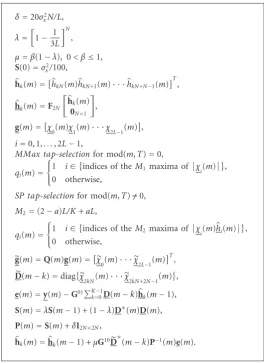
Our aim is to utilize the low delay inherent in MDF as well as the fast convergence and reduced complexity brought about by combining SP and MMax tap-selection for NEC. We achieve this aim by first describing how MMax tap-selection given in (6) can be incorporated into MDF. We next show, using an illustrative example, how the sparse nature of the impulse response is exploited in the frequency domain which then allows us to integrate the SP tap-selection given by (7). The proposed MMax-MDF and SPMMax-MDF algorithms are described by (17), (18), (19), and
hk(m)=hk(m−1) +μG10D∗(m−k)P−1(m)e(m). (21)
The difference between (20) and (21) is that the latter employsD∗(m−k), and we will describe in the following how this 2N×2Ndiagonal matrix can be obtained for the cases of MMax and SP tap-selection criterion.
3.1. The MMax-MDF algorithm
As described in Section 2.1, the MMax tap-selection given in (6) is achieved by sortingx(n). In the frequency-domain
MDF implementation, however, elements inD(m−k) are normalized by elementspi(m) in the vectorP(m) defined in
(19). Hence, for the frequency-domain MMax tap-selection, we select taps corresponding to the M1 maxima of the
Fourier transformed tap-inputs normalized by pi(m) with
i = 0,. . ., 2L − 1. For this tap-selection strategy, the concatenated Fourier transformed tap-input across all K blocks is given as
g(m)=χT(m)· · ·χT(m−K+ 1)T
=χ0(m)· · ·χ2L−1(m)T,
(22)
whereχ(m−k) is defined in (15) andχi(m), i=0,. . ., 2L−1 denotes the ith element of g(m). Elements of the 2L×2L diagonal MMax tap-selection matrixQ(m) are given by
qi(m)= ⎧ ⎪ ⎪ ⎨ ⎪ ⎪ ⎩
1 i∈
indices of theM1maxima of
χ∗
i(m)χi(m)
pi(m)
,
0 otherwise,
(23)
fori = 0,. . ., 2L−1 with 1 ≤ M1 ≤ 2L. Due to the
nor-malization by pi(m) in (23), we denote this algorithm as
MMax-MDFNand define a 2L×1 vectorg(m) containing
the subselected Fourier transformed tap-inputs as
g(m)=Q(m)g(m)=χ
0(m)· · ·χ2L−1(m)
T
. (24)
The 2N×2Ndiagonal matrixD(m−k) for MMax-MDFNis
then given by
D(m−k)=diagχ
2kN(m)· · ·χ2kN+2N−1(m)
,
k=0,. . .,K−1. (25)
Hence, it can be seen that elements in the vectorD(m−k) are obtained from the kth block of the selected Fourier transformed tap-inputs contained ing(m) with indices from 2kN to 2kN + 2N −1. The adaptation of MMax-MDFN
algorithm is described by (23)–(25) and (21).
It is noted that the MMax-MDFNalgorithm requires 2L
additional divisions for tap-selection due to the normal-ization by pi(m) in (23). Hence, to reduce the complexity
even further, we consider an alternative approach where such normalization is removed so that elements of the 2L×2L diagonal tap-selection matrixQ(m) are expressed as
qi(m)= ⎧ ⎨ ⎩
1, i∈indices of theM1maxima ofχi(m),
0, otherwise,
(26)
for i = 0,. . ., 2L −1 and 1 ≤ M1 ≤ 2L. As opposed
to MMax-MDFN, we denote this scheme as the
MMax-MDF algorithm since normalization by pi(m) is removed.
As will be shown inSection 4, the degradation in con-vergence performance due to tap-selection is less in MMax-MDFNthan in MMax-MDF. However, since reducing
com-plexity is our main concern, we choose to use MMax-MDF as our basis for reducing the computational complexity of the proposed algorithm. As will be described inSection 3.2, the proposed algorithm incorporates the SP tap-selection to achieve, in addition, a fast rate of convergence.
3.2. The SPMMax-MDF algorithm
We show in this section how the SP tap-selection can be incorporated into the frequency domain. The SP tap-selection defined by (7) was proposed to achieve fast con-vergence for the identification of sparse impulse responses. We note that the direct implementation of SP tap-selection into frequency-domain adaptive filtering such as FLMS is inappropriate since impulse response in the transformed domain is not necessarily sparse. To illustrate this, we study the effect ofK ≥1 on the concatenated impulse response of the MDF structurehdefined by
h=F2L ⎡ ⎣
h0
0N×1
T · · ·
hK−1
0N×1
T⎤ ⎦ T
, (27)
where
hk=
hkN· · ·hkN+N−1
T
, (28)
fork=0,. . .,K−1 is thekth subfilter to be identified and
F2L= ⎡ ⎢ ⎢ ⎢ ⎣
F2N · · · 0
..
. . .. ... 0 · · · F2N
⎤ ⎥ ⎥ ⎥ ⎦
2L×2L
(29)
is a 2L×2Lmatrix constructed byK Fourier matrices each of size 2N×2N. As indicated in (28), the impulse response
h is partitioned into smaller blocks in the time domain as K increases.Figure 3shows the variation of the magnitude of h for K = 1, K = 16 and K = 64, where MDF is equivalent to FLMS for K = 1. As can be seen from the figure, the magnitude ofhis not sparse for K = 1. Hence SP tap-selection in the MDF structure will not improve the convergence performance for K = 1. For the cases where K > 1, the number of taps with small magnitudes in h
increases withK, that is, the number of subfilters. InFigure 4, we show how the sparseness of the magnitude ofhvaries with Kusing the sparseness measure given by [25,26]
ξ= L
L−√L
1−√h1
Lh2
, (30)
where ·1 denotes l1-norm and it was shown in [26,27]
thatξincreases with the sparseness ofh, where 0≤ξ≤1. As can be seen fromFigure 4, the magnitude ofhbecomes more sparse asKincreases. As a consequence, we would expect SP tap-selection to improve the convergence rate of MDF for sparse system identification.
0 200 400 600 800 1000
0 0.2 0.4 0.6
M
ag
nitude
o
f
F
our
ier
tra
n
sf
o
rm
ed
h
(a) Index of Fourier transformedhforK=1
0 200 400 600 800 1000
0 0.2 0.4 0.6
M
ag
nitude
o
f
F
our
ier
tra
n
sf
o
rm
ed
h
(b) Index of Fourier transformedhforK=16
0 200 400 600 800 1000
0 0.2 0.4 0.6
M
ag
nitude
o
f
F
our
ier
tra
n
sf
o
rm
ed
h
(c) Index of Fourier transformedhforK=64
Figure3: Variation of the magnitude ofhof length 2LwithL=512
for (a)K=1, (b)K=16, and (c)K=64.
0 10 20 30 40 50 60 70
Number of blocks (K) 0
0.1 0.2 0.3 0.4 0.5 0.6 0.7 0.8 0.9
ξ
for
h
in
the
fr
eq
u
ency
domain
More sparse
Less sparse
Figure4: Sparseness of the magnitude ofhagainstK.
frequency-domain subfilters, hTk(m), k = 0,. . .,K −1 to
obtainh(m), which is of length 2L, that is,
h(m)=hT0(m)· · ·h
T K−1(m)
T
=h0(m)· · ·h2L−1(m)
T
.
(31)
Since SPMMax-MDF aims to obtain fast convergence with low complexity, our approach of achieving SP tap-selection is then to select 1 ≤ M2 ≤ 2Lelements from|χi(m)hi(m)|
fori=0,. . ., 2L−1, where elementsχ
i(m) can be obtained
fromg(m) defined in (22). Elements of the 2L×2Ldiagonal tap-selection matrixQ(m) are therefore given by
qi(m)= ⎧ ⎪ ⎪ ⎪ ⎪ ⎨ ⎪ ⎪ ⎪ ⎪ ⎩
1 i∈indices of theM2maxima of
χ
i(m)hi(m),
0 otherwise,
(32)
fori = 0,. . ., 2L−1. Employing (32), the diagonal matrix
D(m−k) in (21) for the SP tap-selection can be described by (24) and (25).
It should be noted that additional simulations performed using selection criteria by sorting|χ∗i (m)χi(m)hi(m)/ pi(m)|
showed no significant improvement for SPMMax-MDF as it was found that the sparseness effect of|hi(m)|dominates the
selection process compared to the termχ∗i(m)χi(m)/ pi(m),
which results in selecting the same filter coefficients for adaptation as would be selected using (32). In addition, normalization bypi(m) incurs an extra 2Ldivisions, which is
not desirable for our VoIP application. As a final comment, since the number of the “active” coefficients ofhreduces with increasingK, we chooseM2to be
M2=
(2−a)L
K +aL. (33)
This enablesM2to reduce with increasingKhence allowing
adaptation to be more concentrated on the “active” region. A good choice of a has been found experimentally to be given bya =1. The proposed SPMMax-MDF algorithm is described inAlgorithm 1.
3.3. Computational complexity
Although it is well known, from the computational com-plexity point of view, that N = L is the optimal choice for the MDF algorithm, it nevertheless is more efficient than time-domain implementations even for N < L [8]. As shown in Algorithm 1, the proposed SPMMax-MDF computesD(m−k) using tap-selection matrixQ(m), which is defined by (26) and (32) for mod(m,T) = 0 and mod(m,T)=/0, respectively. We show inTable 1the number of multiplications and divisions required for MDF, MMax-MDF, MMax-MDFN, and SPMMax-MDF to compute the
term D∗(m−k)P−1(m)e(m). We have also included the
recently proposed IPMDF algorithm [22] for comparison. It should be noted that for MMax and SP tap-selection in
Table1: Complexity of algorithms.
Algorithm Multiplication Division
MDF 2L 2L
IPMDF 3L 4L
MMax-MDF M1 M1
MMax-MDFN M1 M1+ 2L
SPMMax-MDF M1+ (T−1)M2
/T M1+ (T−1)M2
/T
Table2: Complexity for the case ofL=512, T=8, M1=0.5×2L,
andK=64.
Algorithm Multiplication Division
MDF 1024 1024
IPMDF 1536 2048
MMax-MDF 512 512
MMax-MDFN 512 1536
SPMMax-MDF 519 519
(26) and (32), no additional computational complexity is introduced since|χi(m)|and|χi(m)hi(m)|can be obtained
from (18) and (17), respectively. For MMax-MDFN, however,
computing the selected filter coefficients for adaptation using (23) incurs additional number of divisions. The complexity for each algorithm for an example case ofL=512, T =8, M1 = 0.5×2L, andK = 64 is shown in Table 2. It can
be seen that the complexity of the proposed SPMMax-MDF is approximately 50% of that for the MDF. Compared to MMax-MDF, SPMMax-MDF requires only an additional 2% of multiplications and divisions. However, as will be shown in Section 4, the performance of SPMMax-MDF is better than MMax-MDF. Finally, the complexity of SPMMax-MDF is 33% and 25% of that for the IPMDF algorithm in terms of multiplications and divisions, respectively.
4. RESULTS AND DISCUSSIONS
We present simulation results to illustrate the performance of the proposed SPMMax-MDF algorithm for NEC using a recorded network impulse responsehwith 512 taps [12], as shown in Figure 2. The performance is measured using normalized misalignment defined as
η= h−h(n)
2 2
h2 2
. (34)
We used a sampling frequency of 8 kHz and white Gaussian noise (WGN)w(n) was added to achieve a signal-to-noise ratio (SNR) of 20 dB. The following parameters for the algorithms are chosen for all simulations [22]:T = 8, λ =
[1−1/(3L)]N, S(0) = σ2
x/100, δ = 20σx22N/L. Step-size
control variableβhas been adjusted for each algorithm so as to achieve the same steady-state performance.
We first compare the variation in convergence of MMax-MDFN and MMax-MDF with M1 using step-size control
variables β = 0.7 and β = 0.6 for MMax-MDFN and
δ=20σ2
xN/L,
λ=1− 1
3L N
,
μ=β(1−λ), 0< β≤1, S(0)=σ2
x/100,
hk(m)=hkN(m)hkN +1(m)· · ·hkN+N−1(m)
T ,
hk(m)=F2N
hk(m)
0N×1
,
g(m)=χ
0(m)χ1(m)· · ·χ2L−1(m)
,
i=0, 1,. . ., 2L−1,
MMax tap-selectionfor mod(m,T)=0,
qi(m)=
⎧ ⎨ ⎩
1 i∈indices of theM1maxima ofχi(m),
0 otherwise,
SP tap-selectionfor mod(m,T)=/0,
M2=(2−a)L/K+aL,
qi(m)=
⎧ ⎨ ⎩
1 i∈indices of theM2maxima ofχi(m)hi(m),
0 otherwise,
g(m)=Q(m)g(m)=χ
0(m)· · ·χ2L−1(m)
T ,
D(m−k)=diagχ
2kN(m)· · ·χ2kN+2N−1(m)
,
e(m)=y(m)−G01K−1
k=0D(m−k)hk(m−1),
S(m)=λS(m−1) + (1−λ)D∗(m)D(m),
P(m)=S(m) +δI2N×2N,
hk(m)=hk(m−1) +μG10D ∗
(m−k)P−1(m)e(m).
Algorithm1: The SPMMax-MDF algorithm.
by filtering zero-mean WGN through a lowpass filter with a single pole [12]. It can be seen fromFigure 5that for each case ofM1, the degradation in convergence performance due
to tap-selection is less for the MMax-MDFNthan the
MMax-MDF. However, as shown in Tables1and2, MMax-MDFN
incurs 2Ladditional divisions compared to the MMax-MDF algorithm.
We next compare the convergence performance of SPMMax-MDF with MDF and IPMDF using CGN input forK = 1 inFigure 6. We have usedT = 8 andβ = 0.6 for all algorithms. We have also usedM1 = 0.5×2Lsince
it was shown in [28] that by such setting, a good balance between complexity reduction and performance degradation due to MMax tap-selection can be reached. As can be seen from the figure, the performance of SPMMax-MDF is close to that for the MDF since forK =1 which results inM2 =
2L according to (33). Consequently, under the condition of mod(m,T)=/0, all the 2Lfilter coefficients are updated, while under the condition of mod(m,T) = 0, M1 =
0.5×2L coefficients are updated. As a result of this, and consistent with any partial update algorithms presented in [28], the performance of SPMMax-MDF approaches that
for the MDF. Compared to IPMDF, SPMMax-MDF only requires approximately 63% and 47% of the number of multiplications and division, as indicated inTable 1.
We show in Figure 7 the convergence performance of SPMMax-MDF, MDF, and IPMDF for K > 1 using CGN input. As before, we have used the same step-size control variable ofβ=0.6 for all algorithms except for the cases of SPMMax-MDF, whereβ = 0.8 is used to archive the same steady-state performance. It can be seen that forK=64, the proposed SPMMax-MDF algorithm achieves faster rate of convergence in terms of normalized misalignment compared to the more complex MDF during adaptation. Since, as shown in Figure 4,ξ increases withK, it can therefore be expected that such improvement can be increased when largerK is employed. In addition, as the delay for MDF is reduced by a factor ofK compared to FLMS, the proposed SPMMax-MDF can archive further delay reduction for larger Kand thus is desirable for NEC. For the case ofM1=0.5×2L
andK = 64, the number of multiplications and divisions required for each algorithm is shown inTable 2.
0 1 2 3 4 5 6 7 8 Time (s)
−30
−25
−20
−15
−10
−5 0 5
N
o
rm
aliz
ed
misalig
n
ment
(dB)
MMax-MDFN(M1=0.75×2L)
MMax-MDF (M1=0.75×2L)
MMax-MDFN(M1=0.5×2L)
MMax-MDF (M1=0.5×2L)
MDF
Figure5: Variation of performance withM1for MMax-MDFNand
MMax-MDF.
0 1 2 3 4 5 6 7 8 9
Time (s)
−30
−25
−20
−15
−10
−5 0
N
o
rm
aliz
ed
misalig
n
ment
(dB)
IPMDF (K=1) SPMMax-MDF (K=1)
MDF (K=1)
Figure6: Performance of SPMMax-MDF using CGN input forT=
8, M1=0.5×2L, K=1.
0 1 2 3 4 5 6 7 8 9
Time (s)
−30
−25
−20
−15
−10
−5 0 5
N
o
rm
aliz
ed
misalig
n
ment
(dB)
IPMDF (K=16) IPMDF (K=64)
SPMMax-MDF (K=64) SPMMax-MDF (K=16)
MDF (K=64) MDF (K=16)
Figure7: Performance of SPMMax-MDF for CGN input withT=
8 andM1=0.5×2L.
0 5 10 15 20 25
Time (s)
−25
−20
−15
−10
−5
−30 0
N
o
rm
aliz
ed
misalig
n
ment
(dB)
MDF [1024, 1024] SPMMax-MDF [519, 519]
IPMDF [1536, 2048] Speech
Figure8: Performance of SPMMax-MDF using speech input for
T=8, M1=0.5×2L, K=64, and the computational complexity
required for each algorithm.
each algorithm are the same as that for the previous simulations except that for SPMMax-MDF, where we have usedβ = 1 to achieve the same steady-state performance. The computational complexity required for each algorithm is also shown in the figure between square brackets, where the first and the second integers represent the number of multiplications and divisions, respectively. It can be seen that SPMMax-MDF achieves approximately 5 dB improvement in terms of normalized misalignment with lower complexity in comparison to MDF. In addition, the performance of our low cost SPMMax-MDF algorithm approaches that of IPMDF.
5. CONCLUSIONS
REFERENCES
[1] B. Goode, “Voice over internet protocol (VoIP),”Proceedings
of the IEEE, vol. 90, no. 9, pp. 1495–1517, 2002.
[2] H. M. Chong and H. S. Matthews, “Comparative analysis of traditional telephone and voice-over-internet protocol (VoIP)
systems,” inProceedings of the IEEE International Symposium
on Electronics and the Environment (ISEE ’04), pp. 106–111, Phoenix, Ariz, USA, May 2004.
[3] H.-G. Kang, H. K. Kim, and R. V. Cox, “Improving the
transcoding capability of speech coders,”IEEE Transactions on
Multimedia, vol. 5, no. 1, pp. 24–33, 2003.
[4] G. L. Choudhury and R. G. Cole, “Design and analysis of
opti-mal adaptive de-jitter buffers,” Computer Communications,
vol. 27, no. 6, pp. 529–537, 2004.
[5] A. Raake, “Short- and long-term packet loss behavior: towards speech quality prediction for arbitrary loss distributions,”
IEEE Transactions on Audio, Speech, and Language Processing, vol. 14, no. 6, pp. 1957–1968, 2006.
[6] M. M. Sondhi and D. A. Berkley, “Silencing echoes on the
telephone network,”Proceedings of the IEEE, vol. 68, no. 8, pp.
948–963, 1980.
[7] J. Radecki, Z. Zilic, and K. Radecka, “Echo cancellation in
IP networks,” inProceedings of the 45th International Midwest
Symposium on Circuits and Systems (MWSCAS ’02), vol. 2, pp. 219–222, Tulsa, Okla, USA, August 2002.
[8] J. Benesty, T. G¨ansler, D. R. Morgan, M. M. Sondhi, and S.
L. Gay,Advances in Network and Acoustic Echo Cancellation,
Springer, Berlin, Germany, 2001.
[9] D. L. Duttweiler, “Proportionate normalized
least-mean-squares adaptation in echo cancelers,”IEEE Transactions on
Speech and Audio Processing, vol. 8, no. 5, pp. 508–518, 2000. [10] J. Benesty and S. L. Gay, “An improved PNLMS algorithm,” in
Proceedings of the IEEE International Conference on Acoustics, Speech and Signal Processing (ICASSP ’02), vol. 2, pp. 1881– 1884, Orlando, Fla, USA, May 2002.
[11] J. Cui, P. A. Naylor, and D. T. Brown, “An improved IPNLMS algorithm for echo cancellation in packet-switched
networks,” inProceedings of the IEEE International Conference
on Acoustics, Speech and Signal Processing (ICASSP ’04), vol. 4, pp. 141–144, Montreal, Quebec, Canada, May 2004.
[12] H. Deng and M. Doroslovaˇcki, “New sparse adaptive
algo-rithms using partial update,” inProceedings of the IEEE
Inter-national Conference on Acoustics, Speech and Signal Processing (ICASSP ’04), vol. 2, pp. 845–848, Montreal, Quebec, Canada, May 2004.
[13] T. Aboulnasr and K. Mayyas, “Complexity reduction of
the NLMS algorithm via selective coefficient update,” IEEE
Transactions on Signal Processing, vol. 47, no. 5, pp. 1421–1424, 1999.
[14] S. M. Kuo and D. R. Morgan, “Active noise control: a tutorial
review,”Proceedings of the IEEE, vol. 87, no. 6, pp. 943–973,
1999.
[15] A. Carini and G. L. Sicuranza, “Analysis of transient and
steady-state behavior of a multichannel filtered-x
partial-error affine projection algorithm,”EURASIP Journal on Audio,
Speech, and Music Processing, vol. 2007, Article ID 31314, 15 pages, 2007.
[16] H. Deng and M. Doroslovaˇcki, “Proportionate adaptive
algorithms for network echo cancellation,”IEEE Transactions
on Signal Processing, vol. 54, no. 5, pp. 1794–1803, 2006. [17] E. R. Ferrara, “Fast implementations of LMS adaptive filters,”
IEEE Transactions on Acoustics, Speech, and Signal Processing, vol. 28, no. 4, pp. 474–475, 1980.
[18] J. W. Cooley and J. W. Tukey, “An algorithm for the
machine calculation of complex Fourier series,”Mathematics
of Computation, vol. 19, no. 90, pp. 297–301, 1965.
[19] S. Haykin, Adaptive Filter Theory, Information and System
Science, Prentice-Hall, Upper Saddle River, NJ, USA, 4th edition, 2002.
[20] J. J. Shynk, “Frequency-domain and multirate adaptive
filter-ing,”IEEE Signal Processing Magazine, vol. 9, no. 1, pp. 14–37,
1992.
[21] J.-S. Soo and K. K. Pang, “Multidelay block frequency domain
adaptive filter,” IEEE Transactions on Acoustics, Speech, and
Signal Processing, vol. 38, no. 2, pp. 373–376, 1990.
[22] A. W. H. Khong, P. A. Naylor, and J. Benesty, “A low delay and fast converging improved proportionate algorithm for sparse
system identification,”EURASIP Journal on Audio, Speech, and
Music Processing, vol. 2007, Article ID 84376, 8 pages, 2007. [23] I. Pitas, “Fast algorithms for running ordering and max/min
calculation,”IEEE Transactions on Circuits and Systems, vol. 36,
no. 6, pp. 795–804, 1989.
[24] P. A. Naylor and W. Sherliker, “A short-sort M-Max NLMS partial-update adaptive filter with applications to echo
can-cellation,” inProceedings of the IEEE International Conference
on Acoustics, Speech and Signal Processing (ICASSP ’03), vol. 5, pp. 373–376, Hong Kong, April 2003.
[25] P. O. Hoyer, “Non-negative matrix factorization with
sparse-ness constraints,”Journal of Machine Learning Research, vol. 5,
pp. 1457–1469, 2004.
[26] J. Benesty, Y. A. Huang, J. Chen, and P. A. Naylor, “Adaptive algorithms for the identification of sparse impulse responses,” in Selected Methods for Acoustic Echo and Noise Control, E. H¨ansler and G. Schmidt, Eds., chapter 5, pp. 125–153, Springer, Berlin, Germany, 2006.
[27] A. W. H. Khong and P. A. Naylor, “Efficient use of sparse
adaptive filters,” inProceedings of the 40th Asilomar Conference
on Signals, Systems and Computers (ACSSC ’06), pp. 1375– 1379, Pacific Grove, Calif, USA, October-November 2006. [28] A. W. H. Khong and P. A. Naylor, “Selective-tap adaptive
filtering with performance analysis for identification of
time-varying systems,” IEEE Transactions on Audio, Speech, and
Language Processing, vol. 15, no. 5, pp. 1681–1695, 2007. [29] R. Ahmad, A. W. H. Khong, and P. A. Naylor, “Proportionate
frequency domain adaptive algorithms for blind channel
iden-tification,” inProceedings of the IEEE International Conference