Labeled Postings for Asynchronous Interaction
Lih-Juan ChanLin Fu-Jen Catholic University, Taiwan
Yong-Ting Chen
National Chengchi University, Taiwan [email protected]
Kung-Chi Chan Providence University, Taiwan
The internet promotes computer-mediated communications, and asynchronous learning network systems permit more flexibility in time, space, and interaction than the synchronous mode of learning. The key point of asynchronous learning is the materials for web-aided teaching and the flow of knowl-edge. This research focuses on improving online interaction by using labeled postings embedded in the e-Forum discus-sion tool developed for this research. Subjects for the study were students who enrolled in the “Drug and nutrient inter-action” course using the Problem-Based Learning (PBL) ap-proach. Students’ online discussion data were gathered during the academic years of 2004 and 2006. Data from the study reveal that the design of labels for postings promoted interac-tive responses among learners, and the frequency of personal discussion increased. Self-improvement and the development of new subjects from discussion forums were also observed among learners.
develop-ment courses have been growing rapidly over the past few years. The struc-ture of these courses varies enormously from fully online to occasionally face-to-face. among the different forms of online courses, some last a full semester, some are more limited in time and scope. however, almost all use the threaded discussion forum as a central locus of course activity. The dis-cussion forum has thus become the subject of considerable research, both in terms of designing discussion forum activities that support learning and of using the discussion forums to create a community that will support learning (Collison, elbaum, haavind, & Tinker, 2000; Lowes, Lin, & Wang, 2007).
in a web-based learning setting, students are encouraged to take respon-sibility for their own learning and use the internet as a study tool that allows information to be retrieved quickly to facilitate both discussion among mem-bers and the synthesis of knowledge. however, some studies have found that most students are incapable of regulating their learning to optimize self-directed learning in online environments (azevedo & Cromley, 2004; Kra-marski & Mizrachi, 2006). The limitation of textual communication through an online discussion tool might be a key element for effective knowledge interaction. innovations in communication technology merit serious consid-eration for improving the quality of communication in various educational settings (Downing, Schooley, Mate, nelson, & Martinez, 1988).
asynchronous electronic discussions using a bulletin board/discussion board aim to promote cognitive and critical thinking skills (Wu & hiltz, 2004) and facilitate student interaction with course materials on a deeper level (Biesenbach-Lucas, 2003). although students are provided with suffi-cient time to reflect on course context and have deeper interactions, there are more limitations than with face-to-face dialogue (King, 2001). For example, to reflect more effective communication, issues that need to be addressed and discussed often require referencing to an individual’s argument. From a student-oriented learning environment, students’ messages that are lengthy, cognitively deep, and embedded with peer references might be an indication of their understanding of course content and dialogue for knowledge inter-action (Wang, 2007).
To improve the quality of students’ learning, it is essential to increase and improve the interaction among participants in the learning community (Wang, 2007). in any web-based learning context, discussion tasks can be an effective learning approach that leads to progressive knowledge-seeking inquiry and expansive learning. however, it is a concern that the use of discussion will not necessarily promote expansive learning or higher level thinking unless students are cognitively involved in the process of interac-tion. The social technology tools developed for learning need to motivate a learner to be involved in activities with other students, organizations, and segments of a larger community, which envelope the context of the online learning environment (Maurino, 2007). The use of interactive technologies in the learning environment should promote not only person-to-group but also person-to-person communication, where each person’s contributions are respected. Thus, these technologies should have built-in mechanisms for the community to synthesize diverse views. Moreover, students need to use high level cognitive skills such as inferences and judgment as well as meta-cognitive strategies related to reflecting on experience and self-awareness (hara, Bonk, & angeli, 2000).
in computer-mediated communication, online discussions are conduct-ed asynchronously with discussion threads and responses enabling students to post contributions to multiple and concurrent conversational threads with-out being constrained by time and the processes of turn-taking often used to manage face-to-face discussions. in an online learning setting, students should have more time to evaluate carefully and respond to other students’ contributions to produce more in-depth discussions (Brooks & Jeong, 2007). however, it has also been observed that despite the convenience of using asynchronous threaded discussions, students rarely respond to one another’s points, and so there is a lack of continuity on specific issue (Koschmann, 2003; Veerman, 2003; Dozier, 2001). Students often produce discussions that lack coherence and depth (Brooks & Jeong).
as internet-based distance learning becomes more and more prevalent in both academic and training environments, there is an increasing need to determine critical elements related to effective online interaction. To pro-mote social learning in a technology-mediated discourse, it is necessary to emphasize cultural experiences, habits, behavior, and methods of reasoning. This is especially significant given the limitations of communication over physical distance (Moore, 1991). Thus, innovations to improve the quantity and quality of interaction are frequently discussed in the literature on online learning (anderson, 2002). For example, Langille and Pelletier (2003) sug-gested the use of cognotes—notes used to label postings as a guiding frame-work for students before posting. nussbaum, hartley, Sinatra, Reynolds, and Bendixen (2002) suggested using note starters and elaborated cases to trig-ger more student argumentation in their discussions. Both approaches are designed to lead to increased argumentation in students’ postings.
Method
The Instructional Settings and Subjects
The web-based course, “Drug and nutrient interactions,” contained “PBL scenario,” “presentation of instructional content,” “related resourc-es,” and “library and information skills.” The presentation of authentic problem scenarios in the instructional content served as the starting point for learning to increase the motivation of students. Then students progressed by integrating knowledge from foundation disciplines in pursuit of solu-tions to practical professional problems. in the learning setting, tasks were designed to encourage a sense of involvement in the use of reference ma-terials to solve problems. For example, for each problem scenario, students were requested to use references to support their assumptions and findings. in addition to instructional contents about various drug and nutrient interac-tions, instruction regarding how to prepare a research project and the use of academic electronic medical resources and databases was integrated in the web-based learning course. Students were provided with opportunities to search for topics of research and given information for exploring the area of interest. Details about the design of the web-based PBL instruction were reported in ChanLin & Chan (2004; 2007)
example of unlabeled posting
Reaction from eric
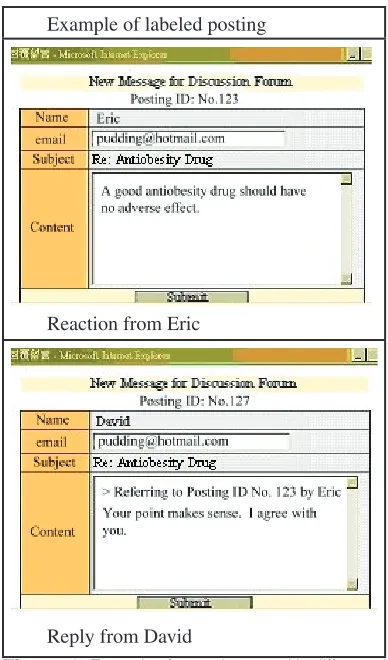
example of labeled posting
Reaction from eric
Reply from David
Figure 1. Examples for postings used in different designs
design of Posting Id
interac-tion. Meaningful responses can promote continuous interaction and effective communication in asynchronous online interaction.
Traditional threaded discussion emphasizes person-to-group interac-tion. however, in an interactive society, person-to-person dialogue needs to be addressed to meet specific communication needs. The use of labeling was intended to encourage more person-to-person interactions. Since all postings in the threaded discussion were labeled, all the postings could be responded to individually by their iD numbers. examples of postings with/without a labeled posting are shown in Figure 1.
Students’ postings in their group discussion forums across two academ-ic years were compared. analyses to evaluate the use of label postings were conducted statistically. in addition to quantitative analysis, textual data in discussion (for the labeled-posting group) were also gathered. To fully un-derstand the benefit of using labeled postings, unstructured interviews were also conducted for 17 students in the labeled posting group to assess their reactions to the design (question examples are listed in Table 1). To refer-ence the data presented, the data were coded as shown in Table 2.
table 1
Question Examples in Interview
Please describe your experience in using discussion forum in the course.
What were the experiences you had in our discussion forum? How was it different
from other chat room or online discussions?
In your responses to …..(Topics), you .…(use specific way) to share ideas with
your group. Could you explain what you expected to get? And how did you learn from this experience?
From these postings (Screens were downloaded and shown during the interviews),
you responded to a specific posting instead of responding to the topics. Could you describe your experience of different needs in online communication?
Please describe your experiences in using labeled postings.
What were the benefits of using labeled postings that you experienced in the
table 2
Description of Data Codes
Code Example Description of data
IV#mmdd(#n) IV#0917 Interview data on September 17 (#1, 2…More than one subject was interviewed on this date) LG#GGTT LG#0222 Learning Group 02, Topic #22
LG#GGTTDDD LG#0222009 Learning Group 02, Topic #22, Message #0 09
ResuLts
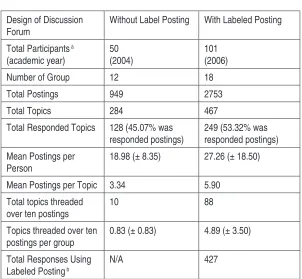
For comparison across two academic years, 2004 (using unlabeled postings) and 2006 (using labeled postings), there was a total of 50 partici-pants (divided into 12 groups) in 2004, and 101 participartici-pants (divided into 18 groups) in 2006. Textual-based data from the discussion forum indicated that the total postings were 949 and 2,753 for 2004 and 2006 respectively. Total topic threads were 284 for unlabeled posting group, and 467 for the la-beled posting group. however, not all the topics posted received responses, only 45.07% (128) topics in the unlabeled posting group and 53.32% (249) topics in the labeled posting group received responses. To further analyze how labeled postings encouraged extension of a discussion thread, threaded topics that received more than 10 postings were identified and summed. a total of 88 topics (4.89 ± 3.50 per group) were obtained in the labeled post-ing group, while only 10 topics (0.83 ± 0.83 per group) were obtained in the unlabeled posting group.
table 3
Comparison of Students’ Interaction
a only students involved full-time were included. b Labeled posting was only used in academic year 2006
MeetIng the need foR PeRson-to-PeRson CoMMunICAtIon
Student responses reflected the need for person-to-person communica-tion. as an asynchronous mode of communication, the online discussion was considered less natural than face-to-face interaction, demanding more effort from the communicators. Some students believed the traditional mode of asynchronous communication could not satisfy their personal discussion needs (iV#0922#2, iV#1001). however, they appreciated the use of post-ings to make communication more efficient. Students’ reactions to the use of labeled postings were positively reflected from the interview data. “The
Design of Discussion Forum
Without Label Posting With Labeled Posting
Total Participants a (academic year)
50 (2004)
101 (2006)
Number of Group 12 18
Total Postings 949 2753
Total Topics 284 467
Total Responded Topics 128 (45.07% was responded postings)
249 (53.32% was responded postings) Mean Postings per
Person
18.98 (± 8.35) 27.26 (± 18.50)
Mean Postings per Topic 3.34 5.90 Total topics threaded
over ten postings
10 88
Topics threaded over ten postings per group
0.83 (± 0.83) 4.89 (± 3.50)
Total Responses Using Labeled Posting b
posting indicated name and ID Number. He knew what I was talking about” (iV#0930#2).
Making Communication More functional for Web-Based Learning
Students expressed their use of labeled postings in several ways: (a) re-sponding to comments or requesting further explanation from a specific per-son (Lg#051556,Lg#0631012, Lg0915035), (b) elaborating on a specific posting (Lg#0711010, Lg#1816008), (c) answering questions or provid-ing further information for a specific inquiry (Lg#0709007, Lg#0922008, Lg#1715026, Lg#1635003), (d) providing verbal encouragement to a group member’s effort (Lg#0509004, Lg#1105011), (e) expressing reflections (Lg#0915028, Lg#1028002, Lg#1210021), and (f) reaching a decision (Lg#0409, Lg#0504). Respondents also agreed that the use of labeled post-ings fostered the continuity of a posted issue. any arguments posted could be referred to and questioned for clarification. Details about any arguments could be elaborated on and further explained. all these features were impor-tant for achieving effective discussion in a web-based learning setting.
Correcting Mistakes
extending an Issue for discussion
The use of labeled postings also served as an extension point for switch-ing group discussion to another new topic. “Usswitch-ing different functions in dis-cussion forum, such as issuing a new topic, responding to the topic, or re-sponding to a specific posting, we found that our discussion extended from the original interest to a new focus” (iV#0923#1). Similar points were also made by different respondents (iV#1008). The data gathered in the group discussion forum revealed similar phenomena. For example, in Lg#0518 and Lg#0704, while the group members were discussing a specific topic, the respondent to the cited postings was also leading the discussion to a new topic problem (Lg#0518, Lg#0704). Since cited postings sometimes trig-gered a new interest, group members might switch their discussion to a dif-ferent focus threaded from the initiation.
discussion
one of the great advantages of text-based, asynchronous online com-munication is the time it allows for reflection, thoughtful interaction, and the possibility for refining before posting one’s contributions to the discussion (Johnson, 2006; Zembylas & Vrasidas, 2005; Ziegahn, 2005). Throughout the web-based PBL process, person-to-person interaction played a very im-portant role in providing cognitive and affective support for accomplishing learning. With a well-planned, scaffolded PBL approach, students should be able to develop skills of self-directed learning, professional reasoning, and decision-making (Dunlap, 2005; Liu, hsieh, Cho, & Schallet, 2006). Consequently, the form of text-based, effective communication in an online asynchronous environment is an important issue to consider when encourag-ing meanencourag-ingful interaction. The key focus and emphasis of this study was the use of labeled postings to help participants identify the postings they intend to respond to. in the context of asynchronous communication in a web-based learning environment, we explored how students benefited from the use of labeled postings when engaged in through their asynchronous threaded discussions. Students were provided with options for responding to specific topics or specific individuals. allowing better appreciation of the community in threaded discussions, the use of labeled postings tended to make online conversations focus on the specific views and personality of the individual being responded to.
(Peterson-Lewinson, 2002; Joung, 2004; Spatariu, Quinn, & hartley, 2007). in our study, students viewed the citation of labeled postings as a self-correction function to help monitor their own learning when reflecting on a specific issue. Due to the specificity of labeled postings cited, students were also able to make corrections accordingly. From our observation, cited postings sometimes triggered a new interest, and group members might switch their discussion to a different focus thread from the initiated one. Students con-sidered this feature important for monitoring their own learning.
The results of our study indicated that labeled postings encouraged ex-tension of a discussion thread. Topics that were threaded to diverge from original topics might also lead to different argumentation or reflection, a situation that commonly occurs in actual social interactions. When a group conversation has reached a turning point, a new interest or reflection can trigger another topic thread for follow-up discussion. Through argumenta-tion and reflecargumenta-tion, students using the labeled postings benefited more from being actively involved in threaded discussions. With the specificity and per-son-to-person contact in the context of asynchronous interaction, the group interaction pattern revealed a more active social presence in a community of inquiry to project each individual socially. This form of social presence seems to support cognitive objectives since it encourages and supports meaningful critical thinking processes in a community of learners (Manca & Delfino, 2007). Students’ involvement can result in appealing, engaging, and rewarding group interactions that may lead to an increase in a higher level of thinking in online discussions (Christopher, Thomas, & Talent-Runnels, 2004).
ConCLusIon
in this study, we addressed the use of labeled postings to improve on-line communication. With the emphasis of identifying each individual’s postings, the social presence of each member in the community was recog-nized. The issue addressed in this study also provides a new vantage point from which to study effective online communication. in a world undergoing dramatic social and technological changes, educators should take advantage of all the ways in which interaction is manifested by individuals, and allow any small innovations to emerge as valuable elements in online learning.
References
albion, P. R., & gibson, i. W. (2000). Problem-based learning as a multimedia design framework in teacher education. Journal of Technology and Teacher Education, 8(4), 315-326.
anderson, T. (2002). an updated and theoretical rationale for interaction. iT Fo-rum Paper #63. Retrieved March 8, 2003, from http://it.coe.uga.edu/itfoFo-rum/ paper63/paper63.htm
azevedo, R., & Cromley, J. g. (2004). Does training of self-regulated learning facilitate student’s learning with hypermedia? Journal of Educational Psy-chology, 96, 523-535.
Biesenbach-Lucas, S. (2003). asynchronous discussion groups in teacher train-ing classes: Perceptions of native and non-native students. Journal of Asyn-chronous Learning Networks, 7(3), 24-46.
Brooks, C. D., & Jeong, a. (2007). effect of pre-structuring discussion threads on group interaction and group performance in computer- supported col-laborate argumentation. Distance Education, 27(3), 371-390.
ChanLin, L., & Chan, K. (2004). assessment of PBL design approach in a di-etetic web-based instruction. Journal of Educational Computing Research, 31(4), 435-450.
ChanLin, L., & Chan, K. (2007). integrating interdisciplinary experts for sup-porting PBL. Innovations in Education and Teaching International, 44 (2), 211-224.
Christopher, M. M., Thomas, J. a., & Tallent-Runnels, M. K. (2004). Raising the bar: encouraging high level thinking in online discussion forums. Roeper Review, 26(3), 166-171.
Collison, g., elbaum, B., haavind, S., & Tinker, R. (2000). Facilitating online learning: Effective strategies for moderators. Madison, Wi: atwood Pub-lishing.
Dozier, K. S. (2001). affecting education in the on-line “classroom”: The good, the bad, and the ugly. Journal of Interactive Instruction Development, 13(4), 17-20.
Dunlap, J. (2005) Problem-based learning and self-efficacy: how a capstone course prepares students for a profession. Educational Technology Research and Development, 53(1), 65-85.
haghparast, n., Sedghizadeh, P. P., Shuler, C. F., Ferati, D., & Christersson, C. (2007). evaluation of student and faculty perceptions of the PBL curriculum at two dental schools from a student perspective: a cross-sectional survey. European Journal of Dental Education, 11(1), 14-22.
hara, n., Bonk, C. J., & angeli, C. (2000). Content analysis of online discussion in an applied educational psychology course. Instructional Science, 28(2), 115-152.
Johnson, g.. (2006). Synchronous and asynchronous text-based CMC in educa-tional contexts: a review of recent research. TechTrends: Linking Research of Practice to Improve Learning, 50(4), 46-53.
Joung, S. (2004, March). The effects of high-structure cooperative versus low-structure collaborative design on decision change, critical thinking, and interaction pattern during online debates. Paper presented at the annual Meeting of the Society for information Technology and Teacher education international Conference, Phoenix, aZ.
King, K. P. (2001). educators revitalize the classroom “bulletin board”: a case study of the influence of online dialogue on face-to-face classes from an adult learning perspective. Journal of Research on Computing in Education, 33(4), 337-355
Koschmann, T. (2003). CSCL, argumentation, and Deweyan inquiry: argumen-tation is learning. in J. andriessen, M. Baker, & D. Suthers (eds.), Argu-ing to learn: ConfrontArgu-ing cognitions in computer-supported collaborative learning environments (pp. 261-269). Boston: Kluwer academic.
Kramarski, B., & Mizrachi, n. (2006). online discussion and self-regulated learning: effects of instructional methods on mathematical literacy. Journal of Educational Research, 99(4), 218-230.
Langille, L., & Pelletier, J. (2003). Collaborative electronic discussion groups: using cognotes to create accountability. Proceedings of theSociety for In-formation Technology and Teacher Education International Conference 2003 (pp. 2463-2466).
Liu, M., hsieh, P., Cho, Y., & Schallert, D. L. (2006). Middle school students’ self-efficacy, attitude, and achievement in a computer-enhanced problem-based learning environment. Journal of Interactive Learning Research, 17(3), 225-242.
Lowes, S., Lin, P., & Wang, Y. (2007). Studying the effectiveness of the discus-sion forum in online profesdiscus-sional development courses. Journal of Interac-tive Online Learning, 6(3), 181-210.
Maurino, P. S. M. (2007). online asynchronous threaded discussions: good enough to advance students through the proximal zone of activity Theory? Tech Trends, 51(2), 46-49.
Moore, M. g. (1991). editorial: Distance education theory. The American Jour-nal of Distance Education, 5(3), 1-6.
nussbaum, e. M., hartley, K., Sinatra, g. M., Reynolds, R. e., & Bendixen, L. D. (2002, april). Enhancing the quality of on-line discussions. Paper pre-sented at the 2002 annual Meeting of the american educational Research association, new orleans, La. (eRiC Document Reproduction Services no. eD466767)
Peterson-Lewinson, J. (2002, December). Facilitating the process of knowledge construction among preservice teachers through computer mediated com-munications. Paper presented at the international Conference on Computers in education, auckland, new Zealand.
Skylar, a., higgins, K., Boone, R., Jones, P., Pierce, T., & gelfer, J. (2005). Dis-tance education: an exploration of alternative methods and types of instruc-tional media in teacher education. Journal of Special Education Technology, 20(3), 25-33.
Spatariu, a., Quinn, L. F., & hartley, K. (2007). a review of research factors that impact aspects of online quality. Tech Trends, 51(3), 44-48.
Summers, J., Waigandt, a., & Whittaker, T. (2005). a comparison of student achievement and satisfaction in an online versus a traditional face-to-face statistics class. Innovative Higher Education, 29(3), 233-250.
Valadares, K. J. (2007). active engagement in health services administration sur-vey courses through problem-based learning. The Journal of Health Admin-istration Education, 23(3), 269-280.
Veerman, a. L. (2003). Constructive discussion through electronic dialogue. in J. andriessen, M. Baker, & D. Suthers (eds.), Arguing to learn: Confront-ing cognitions in computer-supported collaborative learnConfront-ing environments (pp. 117-143). Boston: Kluwer academic.
Wang, Y. (2007). internet uses in university courses. International Journal of E-Learning, 6(2), 279 -292.
Wu, D., & hiltz, S. R. (2004). Predicting learning from asynchronous online dis-cussions. Journal of Asynchronous Learning Networks, 8(2), 139-152. Zembylas, M., & Vrasidas, C. (2005). Levinas and the ‘‘inter-face’’: The ethical
challenge of online education. Educational Theory, 55 (1), 61-78.
Ziegahn, L. (2005). Critical reflection on cultural difference in the computer con-ference. Adult Education Quarterly, 56(1), 39-64.
Acknowledgement