ORIGINAL ARTICLE
Numerical Simulation and Experimental
Research on Microstructural Evolution During
Compact Hot Extrusion of Heavy Caliber
Thick-Wall Pipe
Lu Jia
1,2, Yongtang Li
2,3*, Tianjing Hui
2,3and Yang Zhang
4Abstract
Compact hot extrusion (CHE) process of heavy caliber thick-wall pipe is a new material-saving production process. In order to reveal the optimum hot extrusion parameters in CHE process, the effects of the extrusion parameters on the microstructural evolution are investigated systematically. The metadynamic recrystallization (MDRX) kinetic models and grain size models of as-cast P91 steel are established for the first time according to the hot compression tests performed on the Gleeble-3500 thermal-simulation machine. Then a thermal-mechanical and micro-macro coupled hot extrusion finite element (FE) model is established and further developed in DEFORM software. The results indi-cated that the grain size of the extruded pipe increases with the increasing of initial temperature and extrusion speed, decreases when extrusion ratio increases. Moreover, the grain size is more sensitive to the initial temperature and the extrusion ratio. The optimum hot extrusion parameters are including that, the initial extrusion temperature of 1250 °C, the extrusion ratio of 9 and the extrusion speed of 50 mm/s. Furthermore, in order to verify the simulation precisions, hot extrusion experiment verification on the heavy caliber thick-wall pipe is carried out on the 500 MN vertical hot extrusion equipment. The load–displacement curve of the extrusion process and the grain sizes of the middle part extruded pipe are in good accuracy with the simulation results, which confirms that the hot extrusion FE models of as-cast P91 steel could estimate the hot extrusion behaviors. The proposed hot extrusion FE model can be used to guide the industrial production research of CHE process.
Keywords: Heavy caliber thick-wall pipe, Compact hot extrusion process, Microstructural evolution, Numerical simulation, Average grain size
© The Author(s) 2019. This article is distributed under the terms of the Creative Commons Attribution 4.0 International License (http://creat iveco mmons .org/licen ses/by/4.0/), which permits unrestricted use, distribution, and reproduction in any medium, provided you give appropriate credit to the original author(s) and the source, provide a link to the Creative Commons license, and indicate if changes were made.
1 Introduction
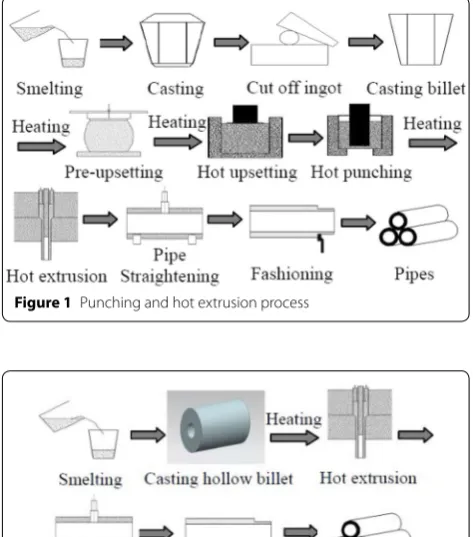
Heavy caliber thick-wall pipes are the critical and basic components of large supercritical thermal power gen-erator, nuclear power and petrochemical engineering. The current production technology on heavy caliber thick-wall pipe is mainly the punching and hot extrusion (PHE) process shown in Figure 1 [1–3]. This PHE pro-cess has several defects such as long production cycle, serious waste in material and investments of large scale
equipment. In order to solve these disadvantages, Refs. [4, 5] propose a new compact hot extrusion (CHE) pro-cess shown in Figure 2. Compared with the PHE process, the CHE process could save up to 30% materials, and shorten at least half of the production period. It also pre-sents advantages of energy conservation and pollution emission reduction.
Hot extrusion process is a complicated large deforma-tion process which coupled with thermo-mechanical and microstructure evolutions. The as-cast billet is under the severe three-dimensional stress state, which con-tributes to the homogeneous plastic deformation and the fully exploited metal performance. The pipe could not only meet the industrial requirements in shape and
Open Access
*Correspondence: [email protected]
2 Shanxi Key Laboratory of Metallic Materials Forming Theory and Technology, Taiyuan University of Science and Technology, Taiyuan 030024, China
size, but also is improved in mechanical properties and internal structures. The microstructural changes affect the mechanical characteristics of the materials. Thus, to obtain the thick-wall pipe with high performance and excellent mechanical properties in short production process, the microstructural evolution mechanism of as-cast billet during hot extrusion is required to be further investigated.
Compared with the experiments research, the numeri-cal simulation is the efficient and econominumeri-cal alternative method for studying the engineering problems. Many researchers [6–8] have studied the technological param-eters, microstructure evolution and mechanical proper-ties of heavy caliber thick-wall pipe during hot extrusion. Dang et al. [9] developed the thermal-mechanical and dynamic recrystallization (DRX) coupled finite element (FE) model for the hot extrusion process of Inconel 625 pipe, and revealed the influence rules of the key parame-ters on the average DRX grain size. Chang et al. [10] used the FE method to simulate the process of asymmetric hot extrusion, the strain rate during the extrusion was pro-posed as a key parameter to the grain size. Jiang et al. [11] developed the phenomenological model for the effect of strain rate on recrystallization and grain growth kinetics
in the 617B alloy, and the simulated microstructure agrees well with the actual manufactured pipe. Sathish-kumar et al. [12] studied the extrusion ratio at different billet temperature on the plastic strain and strain rate of aluminium matrix composite during hot extrusion by FE analysis. Tang et al. [13] established the Arbitrary Lagran-gian–Eulerian (ALE) method to investigate the influence of extrusion process on texture development of alloys. The study proposed that the method can be used as a useful tool in optimizing the extrusion process. In these categories of study, the dominant attention has been paid to the hot extrusion behaviors on the as-forged billet, which cannot be applied to the research of hot extrusion in CHE process. This is due to the fact that, the perfor-mance and mechanical properties of the as-forged billet have been improved before hot extrusion, and the main function of the extrusion process is the shape controlling. While the extruded work piece in CHE process is the as-cast billet, which demoulding under high temperature and directly squeezed under the extrusion temperature. The main purpose of CHE process is to realize the inte-gration on shape forming and performance improving during the extrusion. Therefore, the investigations on the effects of the hot extrusion parameters on the deforma-tion behaviors and microstructural evoludeforma-tion of as-cast alloy are significant to the workability and application on the CHE process.
For numerical simulations, it is necessary to establish the deformation constitutive models and microstructural evolution models of the materials firstly. P91 martensite heat-resistant steel is one of the leading materials in manufacturing industry of heavy caliber thick-wall pipe [14–17], and as-cast P91 alloy was employed as the raw materials in this study. Jia et al. [18] proposed that DRX was the main softening mechanism during hot extru-sion. While Lin et al. [19–23] indicated that the static recrystallization (SRX) and metadynamic recrystalliza-tion (MDRX) will exist after hot deformarecrystalliza-tion. When the strain reaches to the critical strain, the softening process after deformation is MDRX, in contrary the value of the strain is lower than the critical strain the SRX occurs. Although the extrusion process is completed with the materials flow out of the extrusion container, but the microstructures of the extruded pipe are still changing. In Ref. [24], the DRX evolution behaviors of as-cast P91 alloy was studied and the DRX simulation analysis during the hot extrusion indicated that the strains during extru-sion process are all above the critical strain. Thus, the main softening mechanism after hot extrusion is MDRX. Moreover, the pipes will have grain growth under high temperature as well. Thus, the microstructural evolutions of the hot extrusion process are much more complicated. The microstructural evolution models of as-cast P91 alloy
Figure 1 Punching and hot extrusion process
steel during hot extrusion are still incomplete based on the researcher of Refs. [25, 26]. Moreover, it is necessary to reveal the influence regularity of extrusion parameters on the microstructural evolution during hot extrusion for controlling the microstructures of the extruded pipes.
In this study, the MDRX kinetic equations and grain size model of as-cast P91 alloy steel are established for the first time. The coupled hot extrusion FE model com-bined with thermal-mechanical and microstructural evo-lution models are developed and encoded in DEFORM software for the hot extrusion simulation. Based on the FE simulation results, the effects of the extrusion param-eters impacting upon the grain sizes are revealed and the optimum extrusion parameters are proposed. In order to verify the simulation precisions, the hot extrusion experi-ment of as-cast billet is carried out and the comparisons between the simulated and the experimental results are presented. Finally, a brief conclusion is given in Section 6.
2 Hot Compression Experimental Procedure
The chemical composition of as-cast P91 alloy steel is shown in Table 1. The standard cylindrical specimens were machined with 8 mm in diameter and 12 mm in height. The two-pass isothermal hot compression tests were conducted on the Gleeble-3500 thermal-simulation machine, the experimental procedures can be found in Figure 3.
The specimens were heated to 1200 °C at the heat-ing rate of 5 °C/s, and held for 5 min to ensure the fully
austenitizing and elements were completely dissolved into solid solution. Then it cooled at the cooling rate of 5 °C/s to the deformation temperature and held for 1 min. In the following, the first stage compressions were applied in different deformation conditions (illustrated in Table 2). After deformation, the specimens were held under the deformation temperature for different inter-pass time t (2 s, 5 s and 30 s). Finally, the specimens were re-compressed under the same deformation conditions with the first stage. After the second compression, the deformed specimens were rapidly quenched in water.
The specimens were sectioned parallel to the com-pression axis. The sections were polished and electro-lytic corrosion in the mixed-liquid of nitric acid (8 mL), hydrochloric acid (12 mL) and ethanol (100 mL). The metallographic microstructures in the section plane were taken and the average grain sizes were measured by lin-ear intercept method.
3 Hot Compression Results and Analysis 3.1 MDRX Behaviors of As‑cast P91 Alloy
The true stress-strain curves of two-pass isothermal hot compression tests are given in Figure 4. The deformation degrees in these tests were 26%, 33% and 40% (the strains are 0.3, 0.4 and 0.5 respectively, and the strains are both larger than the critical strain [26]), which indicate that the main softening mechanism in the unloading peri-ods are MDRX. It can be obtained in Figure 4, the flow stresses of second deformation stages are smaller than the first stages. This is due to that, the MDRX softening during the inter-pass period has counteracted the resid-ual work hardening of the first deformation, so in the second deformation stage, there needs fewer work hard-enings to balance the DRX softening.
From Figure 4(a), the flow stresses of second defor-mation stages generally decrease as the inter-pass time increase under the same deformation conditions. What’s more, the deformation temperature and strain rate have pronounced effects on the flow stress of as-cast P91 alloy steel. As illustrated in Figure 4(b), the flow stresses have a dramatic decrease with the increase of temperature. Besides, the deformation resistance of P91 alloy steel is sensitive to the temperature. Under low deformation temperature, the work hardening and the deformation Table 1 Chemical composition of P91 alloy (wt.%)
Element C Si Mn P S Cr
Content 0.084 0.28 0.38 0.019 0.005 8.63
Element Ni Mo V Nb Al N
Content 0.21 0.96 0.21 0.084 0.009 0.031
Figure 3 Experimental procedures of two-pass isothermal hot compression tests
Table 2 Deformation parameters in compression test
Deformation
parameters TemperatureT (°C) εStrain rate˙ (s−1) Strain
ε (%)
Inter‑pass time
T (s)
1100, 1150,
resistance are large, and the flow stress increases as well. The flow stresses under different strain rates are shown in Figure 4(c), it is obviously that, the flow stresses increase with the increase of strain rate. This is due to the coun-teraction between work hardening and recrystallization softening during deformation. When under high strain
rate, there has no enough time for the offset, and the increase of flow stress is the macroscopic performance of the increasing deformation resistance.
The calculation method for the MDRX softening frac-tion can be summarized [27–29] as:
where XMDRX is the MDRX softening fraction, σm is the
flow stress at the interruption, σ1 and σ2 are the off-set stress (0.2%) at the first and second deformation, respectively.
The kinetic models of MDRX are usually defined by the exponent-type equations [27–29] as follows:
where QMDRX is the apparent activation energy of MDRX, t0.5 is the time for 50% MDRX, ε˙ is the strain rate, T is the deformation temperature, R is the gas constant, Am, Pm
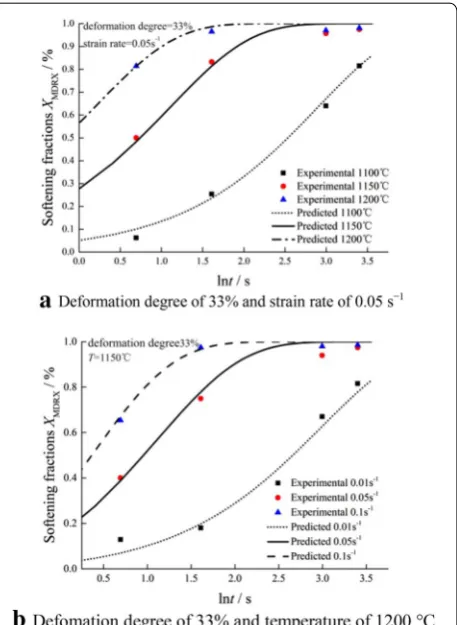
and n1 are the material dependent constants. Taking nat-ural logarithm on both sides of Eq. (2) and Eq. (3). Values of t0.5 are illustrated in Table 3 and the other constants are easy to evaluate form Figure 5. The values of the constants are calculated as, n1= 0.753, Am= 1.33 × 10¹⁸,
Pm=− 0.41 and QMDRX= 487.6 kJ/mol, respectively. The kinetic models of MDRX can be expressed as follows:
Comparisons of the calculated and experimen-tal MDRX softening fraction XMDRX at different
(1) XMDRX=
σm−σ2
σm−σ1
,
(2) XMDRX=1−exp
−0.693
t t0.5
n1 ,
(3)
t0.5=Amε˙Pmexp
QMDRX RT
,
(4) XMDRX=1−exp
−0.693
t t0.5
0.753 ,
(5) t0.5=1.33×10¹⁸ε˙−0.41exp
4876000
RT
.
Figure 4 Typical true tress-strain curves under different deformation conditions and inter-pass times
Table 3 Values of t0.5 under different deformation conditions
Deformation conditions t0.5 (s)
1200 °C—0.05 s−1—33% 1.09
1150 °C—0.01 s−1—33% 5.01
1150 °C—0.05 s−1—33% 3.25
1150 °C—0.1 s−1—33% 1.83
1150 °C—0.05 s−1—26% 5.23
deformation conditions are illustrated in Figure 6. It can be shown that the predicted results are in good agree-ment with the experiagree-mental results, which confirms that the proposed models can give an accurate and precise estimate of MDRX behaviors for the studied as-cast P91 alloy steel.
3.2 MDRX Grain Size Model
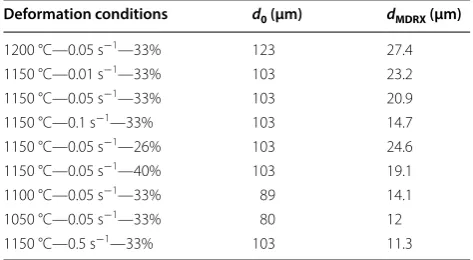
The complete MDRX time t0.95 is the time for 95% MDRX, and it can be calculated by Eqs. (4)‒(5). After the first pass compression, the specimens were kept under deformation temperature at t0.95 and directly quenched in water for holding the complete MDRX metallographic structures. Figure 7 illustrates the metallographic struc-tures under different compression temperastruc-tures. The average MDRX grain sizes under different deformation conditions are shown in Table 4.
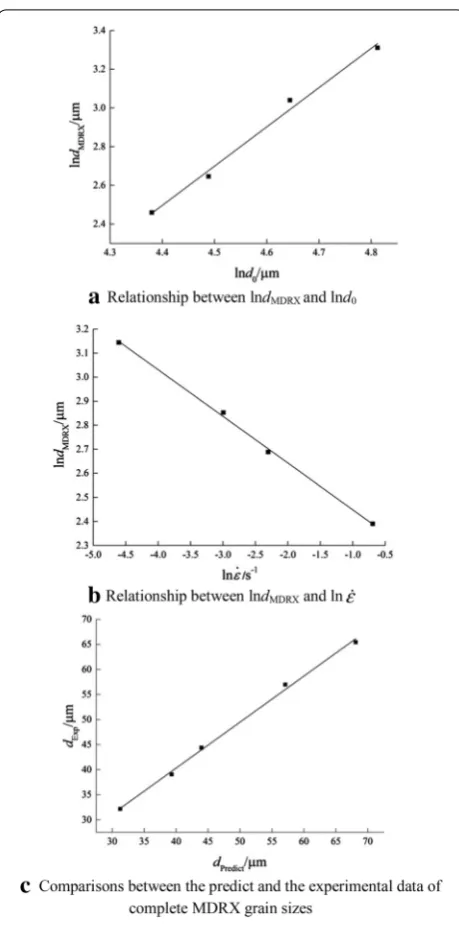
It can be found in Table 4, the average grain size of the complete MDRX increases with the increasing tempera-ture and decreases with the increasing of strain rate or deformation degree. The grain size model of MDRX [27–
29] is given below:
where d0 is the initial grain size, it can be obtained in Table 4 as well. The am, km and hm are the materials
dependent constants. Taking logarithm on both sides of Eq. (6), the constants km and hm can be calculated
through the linear fitting method. Figure 8(a) and (b) (6) dMDRX=amd0kmε˙hmexp
−Q MDRX RT
,
Figure 5 The calculations on the different constants of MDRX kinetic models
shows the relationships between lndMDRX-lnd0 and ln d-MDRX-ln ε˙ . By substituting the values of materials con-stants and forming parameters into Eq. (6), the value of am can be easily computed. The grain size model can be
expressed as:
(7)
dMDRX=9.37×10¹⁴d02.03ε˙−0.2exp
−
487598.64 RT
.
In order to verify the MDRX grain size model of as-cast P91 alloy, comparisons between measured and predicted results were carried out in Figure 8(c). The correlation coefficient between the experimental and predicted results is 0.92. It can be found that the predicted results are in good agreement with the experimental ones, which indicated that the grain size model can give an accurate estimate of average MDRX grain size of hot deformed as-cast P91 alloy.
Therefore, the MDRX kinetic models and the grain size model can be applied to theoretical research of hot extru-sion process.
4 Numerical Simulation
Hot extrusion FE model combined thermal-mechanical (constitutive model) with micro-macro (DRX models, MDRX models and grain growth model) of as-cast P91 alloy was further developed for simulation of the hot extrusion. Based on the hot extrusion FE model, the influ-ences of hot extrusion parameters on the grain sizes of the extruded pipe were investigated and the optimum extru-sion parameters were revealed.
4.1 Constitutive and Microstructural Models of As‑cast P91 Alloy Steel
The flow stress constitutive models were expressed by Eqs. (8)‒(10) from Ref. [25]. Moreover, Eqs. (11)‒(15) are the DRX grain size model which obtained from Ref. [26]. The grain growth model is established in Eq. (16) form Ref. [25]. In these equations, Z is the Zener–Hollomon parameter which is a function of temperature and strain rate. εP is the peak strain, εc is the critical strain, XDRX is the DRX volume fraction, ε0.5 represents the strain of 50% DRX volume fraction and dDRX is the average DRX grain size. dG is the average grain growth size, t1 is the growth time. Eqs. (17)‒(19) are the above established MDRX models. All these models agree well with the experimen-tal results.
Figure 7 Complete MDRX metallographic structures under strain rate of 0.05 s−1 and deformation degree of 33%
Table 4 Average grain sizes of MDRX
Deformation conditions d0 (μm) dMDRX (μm)
1200 °C—0.05 s−1—33% 123 27.4
1150 °C—0.01 s−1—33% 103 23.2
1150 °C—0.05 s−1—33% 103 20.9
1150 °C—0.1 s−1—33% 103 14.7
1150 °C—0.05 s−1—26% 103 24.6
1150 °C—0.05 s−1—40% 103 19.1
1100 °C—0.05 s−1—33% 89 14.1
1050 °C—0.05 s−1—33% 80 12
(8)
σ= 1
0.008
� Z
6.27×10¹⁷ �0.179
+ �
� Z
6.27×10¹⁷ �0.357
+1
�0.5
,
(9) ˙
ε=6.27×10¹⁷[sinh(0.008σ )]5.6×exp −447719.1 RT , (10) Z= ˙εexp
447719.1
RT
,
4.2 Further Development of Hot Extrusion FE Model in DEFORM
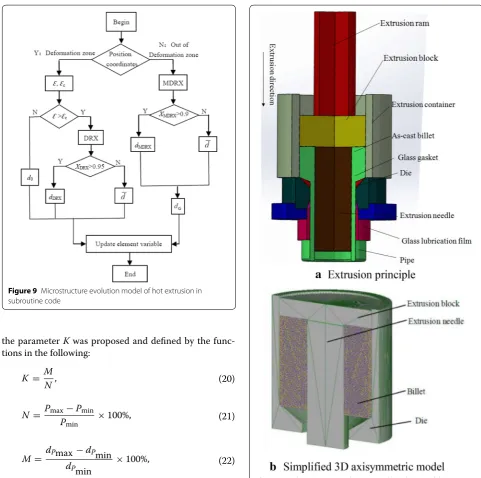
The models of as-cast P91 alloy steel (Eqs. (8)‒(19)) were encoded into subroutine code of DEFORM-3D platform by FORTRAN language. The microstructure evolution calcu-lation procedures of the hot extrusion process are shown in Figure 9.
4.3 Hot Extrusion Geometrical Models and Numerical Simulation Parameters
Figure 10(a) shows the working principle of the vertical extrusion machine on heavy caliber thick-wall pipe. Con-sidering the symmetric geometry of the billet, the die and the extrusion needle, 3D axisymmetric models are estab-lished in Figure 10(b). The required simulation conditions and parameters for the reliability simulation of hot extru-sion FE model are shown in Table 5. The material of the die, the extrusion needle and the extrusion block were H-13 die steel (4Cr5MoSiV1). The glass lubricant was used in hot extrusion process and the friction coefficient was 0.04 [12].
4.4 Simulation Results and Analysis
In order to estimate the influences of different extrusion parameters on the grain size of extruded thick-wall pipe, (11) εP =0.0162Z0.0863,
(12)
εc=0.867εP,
(13) XDRX=1−exp
−1.125
ε−εc ε0.5
4.005 ,
(14)
ε0.5=1.09ε˙0.173exp 101601 RT , (15) dDRX=3.65×10⁴Z−0.21,
(16)
dG2.68=d02.68+1.58×10⁸t10.31exp −79428 RT , (17)
XMDRX=1−exp
−0.693 t t0.5 0.753 , (18)
t0.5=1.33×10¹⁸ε˙−0.41exp
4876000 RT , (19)
dMDRX=9.37×10¹⁴d02.03ε˙−0.2exp −
487598.64 RT
.
the parameter K was proposed and defined by the func-tions in the following:
where N and M are the changing rates. Pmax, Pmin are the maximum and minimum values of a specific parameter, while P is related to the temperature, the extrusion ratio and the extrusion speed, respectively. dPmax, dPmin are the grain sizes under Pmax and Pmin, respectively. When K is calculated as positive value, the grain size increases with the increasing parameter, on the contrary, the value of K is negative and the grain will refined with the increase of parameter value.
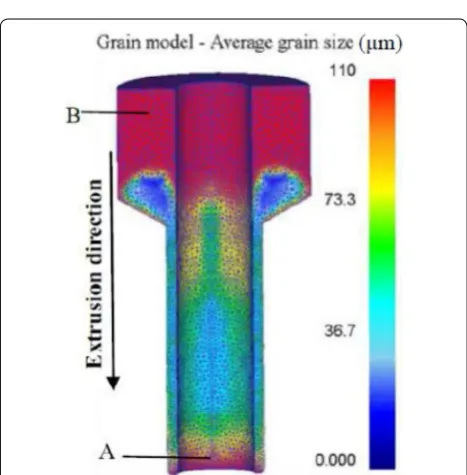
Figure 11 shows the grain size distribution of the simulated pipe during hot extrusion. Part A is the top of the pipe and part B is the end of the pipe. The grain sizes of part A are larger than other part because of the (20)
K = M
N,
(21)
N = Pmax−Pmin
Pmin
×100%,
(22)
M=
dPmax−dPmin
dPmin
×100%,
inhomogeneous deformation of the billet, and it is usu-ally removed in the industrial production. After hot extrusion, the microstructures of the end part are the finest and smallest in the pipe, while the length of this part is relatively short. Hence, the proper observation area of the pipe is the middle part shown in Figure 12
(pipe extruded in stable stage). The inner and outer sur-face will be finish cut in the future process, so points 1 and 5 are about 5 mm from the surface and the five points are equidistributed in the cross section. The
Figure 9 Microstructure evolution model of hot extrusion in subroutine code
effects of extrusion parameters on average grain size are analyzed in below.
4.4.1 Initial Extrusion Temperature
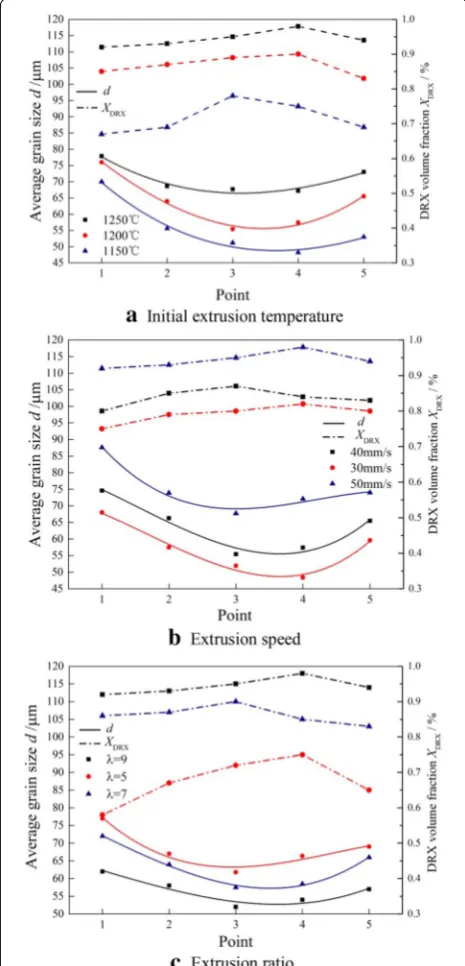
Figure 13(a) shows the effect of the initial extrusion tem-perature on the grain sizes and the DRX volume fractions of the pipe in extrusion stable stage, the extrusion ratio was 9 and the extrusion speed was 40 mm/s.
It is found that the DRX volume fractions of the five observation points are increasing as the temperature
increases. High deformation temperature offers enough energy for the nucleation and grain growth of DRX, and the atoms diffusion, grain boundary migrations are enhanced as well. Such phenomenon may owe to the fact that, during hot deformation, the boundary migration speed of the ridged-shape grains are fast and the migra-tions will grow into new recrystallization grains in a short time. In addition, due to the migrations and continuous deformation, the dislocation density behind the grain boundary is sharply decreased, which could not achieve to the balance state in a short time. Thus the decreasing dislocation density provides advantages for the nuclea-tion of new grains. When the deformanuclea-tion temperature is low (in Figure 13(a) of 1150 °C), the grain boundary migration does not have enough driving force, the growth of the potential crystal nucleus will stop and even disap-pear due to the surface energy. So under lower deforma-tion temperature, the DRX volume fracdeforma-tion is smaller. The DRX volume fractions under 1250 °C are more uni-form and the values can achieve to more than 95%.
The average grain size increases as temperature increase which is due to the exponential increase on grain growth under high temperature. Furthermore, the optimum extrusion temperature is 1250 °C, the param-eter K of initial extrusion temperature on average grain size is calculated as 3.17.
4.4.2 Extrusion Speed
The effect of the extrusion speed on the average grain sizes and DRX volume fractions of the pipe in extrusion stable stage can be found in Figure 13(b), when the extrusion temperature was 1200 °C and the extrusion ratio was 9.
The average grain size and DRX volume fraction increase with the increasing extrusion speed. As simu-lated in the hot extrusion process, the peak values of the strain rate under different extrusion speed (30 mm/s, Table 5 Hot extrusion parameters for the coupled hot
extrusion FE model
Parameter Content
Pipe size (mm) φ630 × φ500 × 9000
Initial billet temperature (°C) 1150, 1200, 1250 Initial die temperature (°C) 300
Initial grain size (μm) 123
Extrusion ratio 5, 7, 9
Extrusion speed (mm/s) 30, 40, 50
Die taper angle (°) 42
Coulomb friction coefficient 0.04
Thermal emissivity of blank 0.7
Environment temperature (°C) 20
Heat convection coefficient between billet and extrusion tools (N/mm/s/°C) 11 Heat convection coefficient between billet and air
(N/mm/s/°C) 0.02
Figure 11 Grain sizes of the extrude pipe during hot extrusion
40 mm/s and 50 mm/s) were 16.6 s−1, 19.6 s−1 and 24.3 s−1, respectively. It can be found in hot compres-sion tests [24], the grain size decreases with the increase of strain rate and the DRX volume fraction increases with the increasing strain rate. However, in Figure 13(b), the grain size changes in a totally opposite rule of the compression experiments. This phenomenon can be explained by the increased temperature. During the extrusion process, the deformation spaces consist of the
billet, the extrusion die and the extrusion needle. The spaces are nearly under an adiabatic condition, the heat transfer only occurs between the three parts, and higher extrusion speed brings large friction heat. The maximum temperatures during hot extrusion under extrusion speed of 30 mm/s, 40 mm/s and 50 mm/s were 1230 °C, 1250 °C and 1290 °C, respectively. When the extrusion speed is higher, the time of DRX nucleation and growth is get-ting shorter. Even though there have generated more heat which offer to the recrystallization nucleation, but the nucleation grains do not have adequate time to complete the grain boundary migration and dislocation energy accumulation. Thus, the increased fiction heat is used to the grain growth instead. So the grain size increases with the increase of extrusion speed, besides the microstruc-tural evolution of as-cast P91 alloy steel is more sensitive to the temperature than the strain rate.
For this reason, if the initial extrusion temperature is high, the extrusion speed should not fast. The parameter K of extrusion speed on average grain size is calculated as 0.41, and the optimum extrusion speed is 50 mm/s.
4.4.3 Extrusion Ratio
In the industrial production, the extrusion ratios are determined by the billet size and die mold. The effect of extrusion ratio on the average grain sizes and DRX vol-ume fractions of the pipe in extrusion stable stage is pre-sented in Figure 13(c), when the extrusion temperature was 1200 °C and the extrusion speed was 40 mm/s.
It can be obtained that, larger extrusion ratio induces higher DRX volume fractions and finer grain sizes because of the increased deformation degree. Under large extrusion ratio, the nucleation positions of the recrystal-lization grains and the driving force for the grain growth are increased during deformation. Thus the DRX volume fractions under extrusion ratios of 9 are nearly 100%, so the optimum extrusion ratio is 9.
The parameter K of extrusion ratio on average grain size is calculated as − 0.814. Under the capacity of the extrusion machine, it is better to use the large extrusion ratio and the slow extrusion speed.
4.4.4 Effects of Key Extrusion Parameters on Grain Size
As discussed above, the extrusion parameters of initial temperature, extrusion speed and extrusion ratio are mainly influence the grain sizes of the extruded pipe. Initial temperature and extrusion speed have positive influence on the grain sizes, while the extrusion ratio has negative influence. In contrast, the grain size is more sensitive to the temperature, and the extrusion ratio and speed have less effect on it. Thus, the design and opti-mization on CHE hot extrusion parameters must firstly determine the initial extrusion temperature, and then the
extrusion ratio. Under the invariability extrusion ratio, to obtain the heavy caliber thick-wall pipes with finer and smaller grains, the extrusion speed should not fast.
In the extrusion stable stage, the average grain sizes of the whole pipe are inhomogeneous. In the length direc-tion, part A are the biggest and part B are the smallest, in the cross section, the middle part are smaller than the two sides. The main reason is the nonuniform deforma-tions during the extrusion. In the length direction, the billet is under the constraint pressure and external fric-tion from the die, the outer surface is under the addi-tional shear deformation, therefore the materials flow out of the extrusion die in a nonuniform speed. Similarly, in the cross section of the pipe, the materials in outer and inner surface are under the shear deformation. Although the extrusion ram moves in a uniform velocity, but the flow speed of the materials during extrusion is nonuni-form. In addition, another nonuniform factor is the tem-perature gradient of the billet during hot extrusion, and it is higher in the middle and lower in the two sides due to the heat exchanges with die and extrusion needle.
To summarize, the optimum hot extrusion parameters of CHE process are including that, the initial temperature of 1250 °C, the extrusion ratio of 9 and extrusion speed of 50 mm/s.
5 Hot Extrusion Experiment on Heavy Caliber Thick‑Wall Pipe
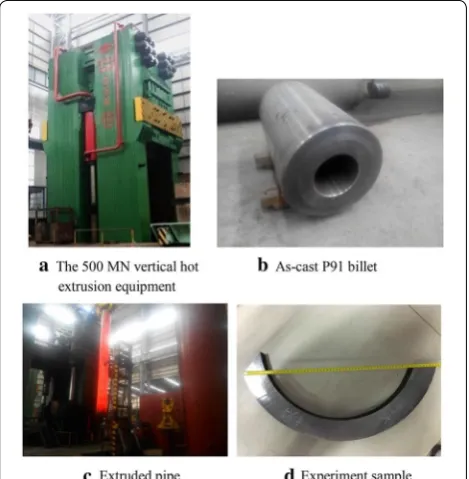
The hot extrusion experiment was carried out under the conditions of the proposed extrusion parameters in Hebei Hongrun Nuclear Equipment Technology Industry Co., Ltd. The 500 MN vertical hot extrusion equipment (Fig-ure 14(a)) was employed to investigate the hot extrusion process. The P91 as-cast billet and the extruded pipe are shown in Figure 14(b) and (c), respectively. The initial temperature of the billet was 1250 °C, the initial tempera-ture of the die and extrusion needle were 300 °C, and the taper angle of the extrusion die was 42°. The billet size was φ1253 mm × φ500 mm × 1000 mm and the production pipe size was φ630 mm × φ500 mm × 8500 mm. The glass lubri-cation gasket with 80 mm in height was placed between the billet and the extrusion block. The load–displacement curve of the extrusion ram was recorded during the extrusion pro-cess. The specimens (Figure 12) were cut from the middle part of the pipe which shown in Figure 14(d).
The comparisons between the measured and simu-lated load–displacement curves are illustrated in Fig-ure 15. The results show that, the maximum load value of the experiment is 430 MN, while the simulation load is 415 MN. The difference mainly due to the simplifica-tion of the hot extrusion FE model, and the actual extru-sion fraction conditions are more complicated than the
simulated. Thus the difference of the load value is in a reasonable deviation range. The computed results pre-sent a good estimate of the relationship between load and displacement during the hot extrusion process.
The metallographic structures of the five points are shown in Figure 16, the grain sizes are measured and compared with the simulated results as well. It can be found that the averaged grain sizes of the extruded pipe are about 60 μm, and the structures are fine and uniform. The experimental results are larger than the simulation ones due to the high temperature of the production envi-ronment. Whatever, the measured results and simulated data has good agreement, and the largest mean error is
Figure 14 Hot extrusion experiment on heavy caliber thick-wall pipe
20% which appears in point 4. Thus the proposed consti-tutive equations and microstructural evolution models present a good estimate of hot deformation behaviors of as-cast P91 alloy. Meanwhile, the hot extrusion FE model can be used in the simulation analysis, it offers guidance for the industrial production research of CHE process.
6 Conclusions
(1) According to the hot compression tests, the MDRX behaviors of as-cast P91 alloy are investigated. The MDRX kinetic models and grain size model are
proposed, which are consistent with the related experimental results.
(2) The thermal-mechanical and micro-macro coupled hot extrusion FE model are established to predict the microstructural evolution behaviours during hot extrusion of as-cast P91 alloy. The hot extrusion FE models are encoded into the DEFORM-3D plat-form by FORTRAN language.
(3) Effects of extrusion parameters on grain sizes of the extruded pipe are investigated by FE simulations. The grain size increases with the increase of initial temperature and extrusion speed, and it decreases with the increase of extrusion ratio. In contrast, the grain size is most sensitive to the temperature and then the extrusion ratio. In order to obtain the fine and uniform grain microstructures, the optimum hot extrusion parameters are including that, initial temperature of 1250 °C, the extrusion ratio of 9 and extrusion speed of 50 mm/s.
(4) The hot extrusion verification experiment is per-formed on 500 MN vertical hot extrusion equip-ment under the proposed extrusion parameters. The load-displacement curve during the extru-sion experiment and the grain sizes of the middle part extruded pipe present good consistent with the simulation results. The coupled hot extrusion FE model could give a good estimate of hot extru-sion behaviors of as-cast P91 alloy. It can be used to guide the industrial production research of CHE process.
Authors’ Contributions
YL was in charge of the whole trial; LJ wrote the manuscript; LJ, TH and YZ assisted with sampling and laboratory analyses. All authors read and approved the final manuscript.
Author Details
1 Department of Mechanical Engineering, Taiyuan Institute of Technology, Taiyuan 030008, China. 2 Shanxi Key Laboratory of Metallic Materials Form-ing Theory and Technology, Taiyuan University of Science and Technology, Taiyuan 030024, China. 3 School of Materials Science and Engineering, Taiyuan University of Science and Technology, Taiyuan 030024, China. 4 Hebei Hongrun Nuclear Equipment Technology Industry Co., Ltd, Cangzhou 061300, China.
Authors’ Information
Lu Jia, born in 1989, is currently a lecturer at Taiyuan Institute of Technology, China. She received her PhD degree from Taiyuan University of Science and Technology, China, in 2017. Her research interests including advanced manu-facturing technology and numeral simulating & emulating.
Yongtang Li, born in 1957, is currently a professor at Taiyuan University of Science and Technology, China. He received his PhD degree from Tsinghua Uni-versity, China, in 1994. His research interests include advanced manufacturing technology, forging equipment and theory and compact production process.
Tianjing Hui, born in 1991, is currently a master candidate at Taiyuan University of Science and Technology, China.
Yang Zhang, born in 1989, is currently an assistant engineer at Hebei Hongrun Nuclear Equipment Technology Industry Co., Ltd, China
Competing Interests
The authors declare that they have no competing interests.
Funding
Supported by National Natural Science Foundation of China (Grant Nos. 51675361, 51135007), Shanxi Scholarship Council of China (Grant Nos. 2015-086, 2016-096), and Shanxi Provincial Key Research and Development Program of China (Grant No. 03012015004).
Publisher’s Note
Springer Nature remains neutral with regard to jurisdictional claims in pub-lished maps and institutional affiliations.
Received: 29 March 2017 Accepted: 8 January 2019
References
[1] Y Li, W Q Huang, X H Chang, et al. A practical and selective method for the analysis of molybdenum in grad T91 tube and P91 pipe intended for power plants. Materials and Design, 2011, 284–286: 1510–1515. [2] Y R Guo, H Wu. Progress of research on production localization of P91
seamLess steel tube. Steel Pipe, 2008, 37(1): 22–27. (in Chinese) [3] R J Wang, Y G Xu, W Chen, et al. The property and application of P91
resistant steel for ultra- supercritical boilers. Modern Metallurgy, 2009, 37(3): 1–3. (in Chinese)
[4] Y T Li, L Jia, J H Fu. Thick-walled seamLess steel tube short tube short process casting and squeezing continuous formation method: China, ZL201310025737.4. [2015-08-19]. http://www.pss-syste m.gov.cn/sipop ublic searc h/paten tsear ch/showV iewLi st-jumpT oView .shtml . [5] F C Qin, Y T Li, H P Qi, et al. Method for producing heavy-caliber
thick-walled seamLess steel pipe by casting extrusion composite molding: China, CN201510172364.2. [2015-04-13]. http://www.pss-syste m.gov.cn/ sipop ublic searc h/paten tsear ch/showV iewLi st-jumpT oView .shtml . [6] G H Chelu, N Ghian. Technological parameters influence on the hot
extru-sion force of the pipes. Chemistry and Materials Science, 2002, 64(4): 47–56. [7] C Y Sun, B Liu, R Li, et al. The temperature rise and extrusion force of
IN690 superalloy during tube hot extrusion process. Material Science and Technology, 2011, 19(4): 52–58.
[8] J Chen, C G Bao, F L Chen. Evolutions of microstructure and mechanical properties for Mg-Al/AlN composites under hot extrusion. Materials Sci-ence and Engineering A, 2016, 667: 426–434.
[9] L Dang, H Yang, L G Huo, et al. DRX rules during extrusion process of large-scale thick-walled Inconel 625 pipe by FE method. Transactions of Nonferrous Metals Society of China, 2015, 25: 3037–3047.
[10] L L Chang, Y N Wang, X Zhao. Modeling of severe deformation and mechanical properties in Mg-3Al-1Zn alloy through asymmetric hot-extrusion. Transactions of Nonferrous Metals Society of China, 2008, 18: 257–262.
[11] H Jiang, J X Dong, M C Zhang, et al. Phenomenological model for the effect of strain rate on recrystallization and grain growth kinetics in the 617B alloy. Journal of Alloys and Compounds, 2018, 735: 1520–1535. [12] D Sathishkumar, P Sivakumar K S Sundaram, et al. Finite element analysis
and experimental study on the effect of extrusion ratio during hot extru-sion process of aluminium matrix composites. Defence Science Journal, 2017, 67(4): 428–436.
[13] T Tang, Y C Shao, D Y Li, et al. Extrusion simulation and texture study on Mg-Y alloy. Materials Science Forum, 2014, 817: 531–537.
[14] Sasaki, Terufumi, Kobayashi, et al. Production and properties of seamless modified 9Cr-1Mo steel boiler pipes. Kawasaki Steel Technical Report, 1991, 25: 78–87.
[15] C Pandey, A Giri, M M Mahapatra. Evolution of phases in P91 steel in vari-ous heat treatment conditions and their effect on microstructure stability and mechanical properties. Materials Science and Engineering: A, 2016, 664: 58–74.
[17] M F Moreno. Application of small punch testing on the mechanical and microstructural characterizations of P91 steel at room temperature. International Journal of Pressure Vessels and Piping, 2016, 142–143: 1–9. [18] L Jia, Y T Li, Y Zhang. A characterization for the deformation behavior of
as-cast P91 alloy steel and utilization in hot extrusion process. Advances in Materials Science and Engineering, 2017, 2017: 1–11.
[19] M H Maghsoudi, A Z Hanzaki, P Changizian, et al. Metadynamic recrystal-lization behavior of AZ 61 magnesium alloy. Materials and Design, 2014, 57: 478–493.
[20] Y C Lin, L T Li, Y C Xia. A new method to predict the metadynamic recrys-tallization behavior in 2124 aluminum alloy. Computational Materials Science, 2011, 50: 2038–2043.
[21] Y C Lin, M S Chen, J Zhong. Study of metadynamic recrystallization behaviors in a low alloy steel. Journal of Materials Processing Technology, 2009, 209: 2477–2482.
[22] Y C Lin, M S Chen. Study of microstructural evolution during metady-namic recrystallization in a low-alloy steel. Materials Science and Engineer-ing A, 2009, 501: 229–234.
[23] H Beladi, P Cizek, P D Hodgson. The mechanism of metadynamic softening in austenite after complete dynamic recrystallization. Scripta Materialia, 2010, 62: 191–194.
[24] Z X Li. The microstructure analysis and numerical simulation for hot extru-sion forming based on thick-wall pipe of as-cast P91 steel. Taiyuan: Taiyuan University of Science and Technology, 2016. (in Chinese)
[25] K Deng. Investigation of hot deformation behavior and structure property of as-cast P91 alloy based on thick walled pipe casting-extrusion composite forming. Taiyuan: Taiyuan University of Science and Technology, 2015. (in Chinese)
[26] Z X Li, B F Lei, J H Fu, et al. Modeling of dynamic recrystallization for as-cast heat-resistant alloy steel P91. Forging & Stamping Technology, 2016, 41(1): 121–126. (in Chinese)
[27] A Paggi, G Angella, R Donnini. Strain induced grain boundary migration effects on grain growth of an austenitic stainless steel during static and metadynamic recrystallization. Materials Characterization, 2015, 107: 174–181.
[28] P Uranga, A I Ferbabdez, B Lopez, et al. Transition between static and metadynamic recrystallization kinetics in coarse Nb microalloyed austen-ite. Materials Science and Engineering A, 2003, 345: 319–327.