ORIGINAL ARTICLE
Design Around Bundle Patent Portfolio
Based on Technological Evolution
Hui Li
1, Jiefeng Yuan
1, Runhua Tan
1*and Qingjin Peng
2Abstract
Product innovation can be achieved by analyzing leading products patents in the market. Different methods have been proposed for design around patent, commonly using the elimination or replacement of a single patent element. However, the existing research fails to restore the position and function of the design around object in the original patent portfolio of enterprises, which often leads to the phenomenon of evading one patent and violating another. This paper proposes a method for design around patent through using the fusion of technologies of the evolution theory and bundle-type patent portfolio analysis in the initial stage of product development. The object system is analyzed to select technical opportunities through the evolutionary path of technologies and functional trimming methods to achieve circumvent barriers of bundle-type patents. The bundle patent portfolio is analyzed for the prod-uct evolution with a radar map. The technological evolution path is combined with the TRIZ innovation method to identify and solve the design problem. Patentability of the new design is evaluated using the patent system rules for innovative scheme difference from the original patent portfolio. The method is verified in a case study for the design of a glass-wiping robot. The design solution has been patented.
Keywords: Design around patent, Bundle patent portfolio, TRIZ, Technological evolution, Inventive problem solving
© The Author(s) 2019. This article is distributed under the terms of the Creative Commons Attribution 4.0 International License (http://creat iveco mmons .org/licen ses/by/4.0/), which permits unrestricted use, distribution, and reproduction in any medium, provided you give appropriate credit to the original author(s) and the source, provide a link to the Creative Commons license, and indicate if changes were made.
1 Introduction
With the rapid development of technology and infor-mation sharing, patent inforinfor-mation analysis is getting more important for innovation [1]. The patent analysis has been used for the industry development evaluation [2–4], technology life cycle prediction [5, 6], research and development strategy formulation [7, 8], and patent value evaluation [9–13]. Enterprises have to build a clear intellectual property strategy to form a systematic patent barrier for a competitive advantage position of certain products in the market [14, 15]. The product’s techno-logical opportunities can be identified by studying pat-ent barriers of leading pat-enterprises or competitors in the market to analyze their patent layout of the current state of technologies [16, 17]. Different patterns of patent port-folio layouts can be applied to research and development plans [18, 19]. There are four types of patent portfolios
including umbrella, bundle, chain, and star types based on technical relations of patents, such as complementa-rity, competitiveness, supportability and extensibility. The umbrella type is a multi-problem patent portfolio scheme for a product system. The star type is for multi-system integration. The chain type is an industrial chain pat-ent portfolio for the product life cycle. The bundle-type is a patent portfolio for a single problem [20–22]. Using a bundle-type patent portfolio, different solutions of the same problem form a complete protection for the patent to overcome limitations of a single patented technology protection with a certain technical problem. Essence of a design around bundle-type patent portfolio is to find an existing valuable technical problem of a product by using the innovative method to solve the problem with new solutions, which can form a new patented technology that competes with the original target product.
Laws of the technical evolution are a series of princi-ples found by Altshuller of the existence, operation or change of a system [23]. He suggested that a same prob-lem appears repeatedly in different technical fields, and the same principle of a solution can be repeatedly applied
Open Access
*Correspondence: [email protected]
1 National Technical Innovation Method and Tool Engineering Technology
to different fields to solve similar problems. TRIZ’s tools for problem analysis and problem solving are enlightened by different ways to solve technical problems in the real world [24, 25].
This paper proposes the fusion of technologies of the evolution theory and bundle-type patent portfolio anal-ysis in the initial stage of product development. The object system is analyzed to select technical opportuni-ties through the evolutionary path of technologies and functional trimming methods to achieve circumvent bar-riers of bundle-type patents. Goals are searching alter-native solutions at a certain level of the product system through the technological evolutionary path, and solving the same problem based on different effect principles. It also uses the internal trimming replacement to achieve the deformed structure based on different product struc-tures. The final solution forms a new way to solve the same problem with different principles, structures or cir-cumvents based on the existing bundle patent portfolio.
2 State of the Art
2.1 Design Around Bundle‑Type Patent Portfolio
Research on design around patent commonly focuses on the elimination or replacement of a single patent element under using design around patent principles. Different methods have been proposed by researchers. TRIZ is used as a means of supporting product design-ers to obtain patented strategic data [26]. Three oppor-tunities are identified to guide inventors to find design around patent solutions through various recommended innovations and TRIZ tools [27]. Potential product opportunities are discussed beyond a given product area by processing large-scale technical patent data sets [28]. A trimming method is proposed based on TRIZ for the design around patent [29, 30]. A design around patent process is developed using both TRIZ and WOIS [31]. Integrated TRIZ conflict matrix and conceptual design is applied to process modeling of the product design around [32, 33]. An avoidance method is sug-gested using integrated TRIZ and existing patent tech-nologies [34]. However, the existing research on the single design around patent fails to restore the position and function of the design around object in the origi-nal patent portfolio of enterprises, which often leads to the phenomenon of evading one patent and violat-ing another. For the design around patent portfolio, a new framework is supported to extract patent portfolio strategic information [35]. IPC clustering analysis and maturity prediction are adopted to determine the pat-ent portfolio avoidance target [36]. In fact, these meth-ods only simplify a single patent to avoid the violation. They seldom consider differences and relations among internal patent portfolios. The design around purpose
and meaning of the patent portfolio are not clear. On the other hand, they also ignore scopes of the patent right, the recognition accuracy of the right map is low.
There are two bases for success of the design around patent, the scope of patent rights and non-infringe-ment of a new design. For scope of the patent right, it is required to understand patent technology problems based on the characteristics of the patent law docu-ment. Technical problems of a patent are determined by the difference of technical features of the existing proximal technology and actual effect of the problem solved by the patent [37].
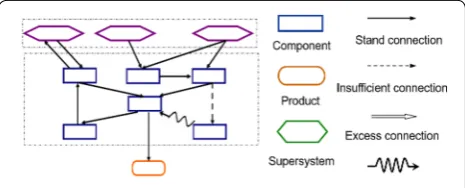
Solutions to a technical problem are extracted from the independent claim. According to legal character-istics of the patent document, a complete technical scheme with independent claims of the patent has the full protection. The technical information in a patent document is closely related to its functional expression. A functional model diagram is proposed for describing the independent claim of a patent, which is composed of the super system, components, relationships of com-ponents, and products. The document information is transformed into a patent right map as shown in Fig-ure 1 [38]. The super system is the environment that affects the system. The product is the output of the sys-tem to the environment. The component is the smallest element of the system. There are four types of connec-tions among components: excess, standard, insufficient and harmful as shown in Figure 1.
Design solutions cannot be contrary to the doctrine of equivalents and universal coverage principle. There are four principles to be followed in practical applica-tions: 1) deleting rule to remove technical features so as not to violate the principle of a full coverage, 2) Sub-stituting rule to replace technical features without vio-lating the principle of equivalence, 3) Changing rule of relationships to modify the connection and location of elements to not violate the universal coverage principle, and 4) Adding or combining rule to use the deletion and addition as a non-violation of the principle of the universal coverage and doctrine of equivalents [29, 30].
Patents in the bundle-type patent portfolio form a con-generic relation. Each patent has a competitive relation-ship with others. There are two types of the bundle-type patent portfolio as shown in Figure 2. Type A is com-posed of patents with different principles for the same problem. PA consists of structural modules A1 and A2. PB consists of structural modules B1 and B2. PA and PB constitute the type A patent portfolio. Type B is an inte-grated form of different structures to form a competitive bundle-type patent portfolio, PA’, PB’, and PC’ are three patents that solve the same problem with the same prin-ciple, but components of the problem solved are differ-ent, indicated by A’, B’ and C’, respectively. PA’, PB’, and PC’ form the type B patent portfolio. The more competi-tive patents formed by a self-circumvention, the more patent protections will have for core technologies of an enterprise. Competitive technologies circumvented from others may participate in the market competition to cul-tivate advantages of the enterprise [39].
2.2 Law of Technological Evolution
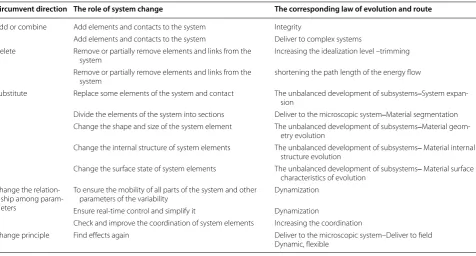
The law of technological evolution and its path in TRIZ are a kind of invention rules that prompt product development from the current principle to next stage [40, 41]. It is formed from a large number of invention patents in different fields. There are eight laws of tech-nological evolution including: 1) increasing the ideali-zation level; 2) unbalanced development of subsystems; 3) dynamization; 4) delivering to a complex system; 5) delivering to the microscopic system; 6) law of system integrity; 7) shortening the path length of the energy flow; and 8) increasing the coordination. Correspond-ing relationships of design around directions and laws of the evolution or some routes are summarized in Table 1 [42].
3 Proposed Method
3.1 A General Process of Design Around Patent
Figure 3 shows a design around process of bundle-type patent portfolios based on the law of technology evo-lution for a research object. The process includes four steps. The first step identifies barriers of a bundle-type patent portfolio; the second step searches a specific technological evolution route or makes function trim-ming in order to identify patent problems; the third step solves technical problems by technical conflict, material field analysis and effect theory; the fourth step verifies the validity of the patent portfolio.
A1
A2 B1
B2 A’ B’ C’
P P P
Type A Type B
Figure 2 Two types of the bundle-type patent portfolio
Table 1 Relations of design around directions and evolution routes
Circumvent direction The role of system change The corresponding law of evolution and route
Add or combine Add elements and contacts to the system Integrity
Add elements and contacts to the system Deliver to complex systems Delete Remove or partially remove elements and links from the
system Increasing the idealization level –trimming
Remove or partially remove elements and links from the
system shortening the path length of the energy flow
Substitute Replace some elements of the system and contact The unbalanced development of subsystems‒System expan-sion
Divide the elements of the system into sections Deliver to the microscopic system‒Material segmentation Change the shape and size of the system element The unbalanced development of subsystems‒Material
geom-etry evolution
Change the internal structure of system elements The unbalanced development of subsystems‒ Material internal structure evolution
Change the surface state of system elements The unbalanced development of subsystems‒ Material surface characteristics of evolution
Change the relation-ship among param-eters
To ensure the mobility of all parts of the system and other
parameters of the variability Dynamization Ensure real-time control and simplify it Dynamization
Check and improve the coordination of system elements Increasing the coordination
3.2 Design Around Target Definition
The object identification of the design around patent consists of three steps: 1) selecting the target enterprise’s product and searching patents to identify their bundle-type patent portfolio layouts; 2) analyzing the techno-logical evolution of the bundle patent portfolio for the state of technological development value; 3) building a patent-based technology evolution radar chart of the tar-get product, and selecting specific design around tartar-gets according to actual needs of the enterprise as follows.
Step 1: Selecting the target enterprise’s product and searching patents to identify their bundle-type patent portfolio layouts, such as a product composed of nents {A, B, C}. The development state value of compo-nents A, B and C can be identified as follows.
1) Searching patents of the target product in leading enterprises, screening and summarizing the patents, marking patents of each component to obtain a pat-ent group under differpat-ent componpat-ents. For example, the patent group of component A is {A} = {A1, A2,
…, An}.
2) Analyzing specific problems of the patent in each component to determine the problem module of
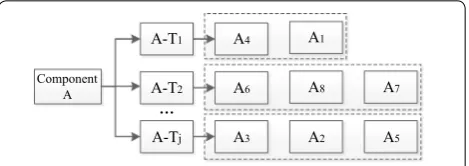
existing solutions to establish the correspondence between the problem module and patent solution. For example, component A for the technical prob-lem set is {TA} = {A − T1, A − T2,…, A − Tj},
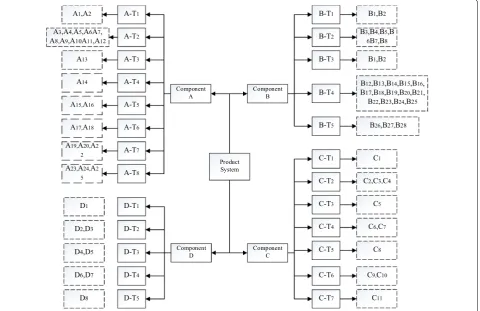
indicat-ing that the j discovered system problems are under component A. According to technical problems, the patent is classified to set up a bundle patent portfolio analysis chart as shown in Figure 4.
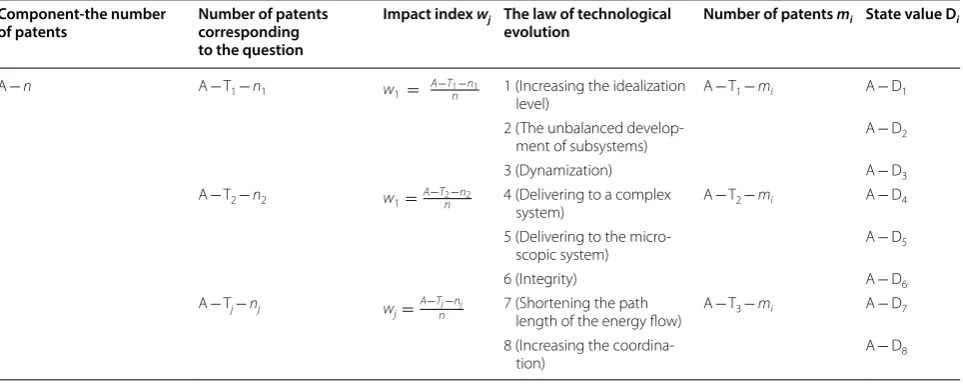
Step 2: Calculating the development state of each component under the law of technological evolution to determine the state of the art. The development state of each component of the product system under different evolution laws is shown in Table 2.
Choose leading companies or
competitors
Choose a product system
patents retrieving data cleaning
Establish product master dimension diagram of patents
Calculate the technological evolution
state value of each component
Draw radar chart of system technology evolution state Identify bundled
patented combinations
Confirm the evolution of technology
Confirm patent avoidance
strategy Step
1:identify avoid objects
Determine the
avoidance object Create a map of rights
Choose technology evolution route
Choose avoid path
Establish a specific route
search map
Predict future status
Function cutting
Form a variant
Step 2:Avoid problem identification
Technical Conflict
Invention Principle
Material Field Analysis
76 standard Solution
Resource Analysis
Effect Theory Step 3:Solve
technical problems
Produce solutions
Is it
infringement? patentable?Is it
Into the enterprise
knowledge base apply for patent
Step 4:Case evaluation yes
no
no yes
Figure 3 Design around process of bundle-type patent portfolio
A-T1
A-T2
A-Tj
A1
A8
A2
A4
A6
A3 A5
A7
Component A
Ă
We first search the total number of patents n and the number of patents nn for different problems of each
com-ponent of the product, and then determine the impact index wj of different problems, that is, wj= (A − Tj−nj)/n.
A − Tn−mi represents the number of patents for the
dif-ferent technological evolution laws under A − Tj, where i is the number corresponding to the law of evolutions 1 to 8. Using the impact index and number of patents, the value of the development state of component A under different technological evolution laws can be determined to confirm the technological evolution state of different components of the target. The development state is cal-culated as follows:
where mi is the number of patents under different laws of
technological evolution, wj represents the impact index
of different problems, and A-Di is the component A
development state value under No. i technological evolu-tion law. For example, component A solves three techni-cal problems, T1, T2 and T3. There are n patents in total. The number of patents for each technical problem is n1, n2 and n3, respectively. w1, w2 and w3 are (A − T1−n1)/n, (A − T2−n2)/n, (A − T1−n3)/n, respectively. The num-ber of patents for the application of technological evolu-tion law 1 is A − T1−m1, A − T2−m1, and A − T3−m1. The development state of component A under the law of technological evolution is A − D1=w1*(A − T1−m1) + w2 * (A − T2−m1) +w3 * (A − T3−m1).
Step 3: Drawing a radar chart of the product technol-ogy evolution state to select the circumvent direction.
(1)
A−Di=
j
j=1
wj
A−Tj−mi
,(i=1, 2, 3, 4, 5, 6, 7, 8)
Development state values of different components are calculated under the eight laws of technological evolu-tion using Eq. (1). A radar chart is formed as shown in Figure 5. Based on evolutionary states of technologies in the radar chart, we can clearly find the state and future of development space for the product system under dif-ferent laws of the technological evolution, which can be used to compare development state values of different components. Different products of the design around object can be selected for development strategies as follows.
1) Different avoidance components and laws are chosen according to actual needs of enterprises and resource allocations.
2) The design around direction can be decided based on components that are backward in all directions of evolution. A bundle-type patent portfolio is selected to solve a technical problem as the design around object. A technological evolution direction with less development can be identified for the development.
3.3 Design Around Problem Identification
The problem identification of design around patent involves two steps as follows.
1) Creating a patent right map. The map shows a set of patent solutions to a technical issue of the target problem as shown in Figure 1. The aim is to obtain protected technical schemes of the target object. 2) Identifying and analyzing problems in two types of
bundle-type patent portfolios.
Table 2 Product system components in different technological evolution laws under the state of development Component‑the number
of patents Number of patents corresponding to the question
Impact index wj The law of technological
evolution Number of patents mi State value Di
A −n A − T1−n1 w1 = A−T1n−n1 1 (Increasing the idealization
level) A − T1−mi A − D1 2 (The unbalanced
develop-ment of subsystems) A − D2
3 (Dynamization) A − D3
A − T2−n2 w1 = A−T2−n2
n 4 (Delivering to a complex
system) A − T2−
mi A − D4
5 (Delivering to the
micro-scopic system) A − D5
6 (Integrity) A − D6
A − Tj−nj wj =
A−Tj−nj
n 7 (Shortening the path length of the energy flow) A − T3−mi A − D7 8 (Increasing the
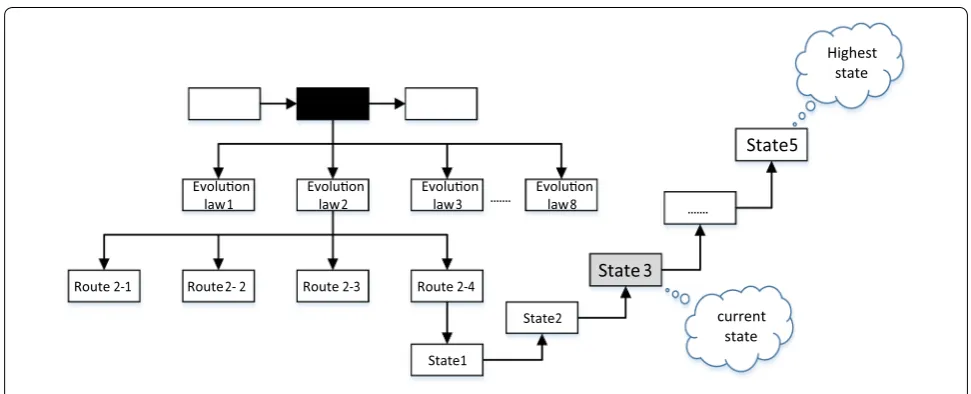
For type A portfolio: a search map of the technologi-cal evolution path is built as shown in Figure 6. The TRIZ theory reveals eight laws of the technological develop-ment and evolution. There are several specific routes
under each law of the technological evolution. The tech-nical principle of the same problem can be predicted in the selected route of technological evolution by deter-mining the current state of the product. For example, technological evolution paths 2‒4 can be selected under law 2 to evolve from states 1 to 5. Current state 3 is cor-rectly located to predict the development path and imple-mentation principles of state 4 or 5 in the next stage. The principles give designers ideas for the unification prob-lem to generate new concepts.
For type B portfolio: a design around path is chosen for function trimming to generate design variants. Accord-ing to the patent right map of the object, a specific clip-ping path can be selected in Table 3 for the function trimming to obtain variants, and transform the problem into a new design problem.
3.4 Problem Solving
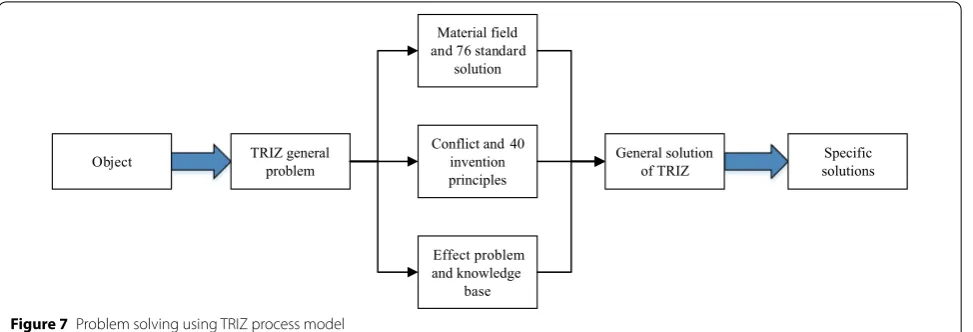
Two types of problem deformations can be obtained from Section 3.3. After the problem identification, these two types of problems are transformed into TRIZ stand-ard problems. Different problems can then be solved with the corresponding knowledge of TRIZ [43–46]. There are three types of standard problems and corresponding solutions. The first one is standard questions described by the material field, and 76 standard solutions; the sec-ond is conflict problems described by standard engineer-ing parameters and solutions of 40 invention principles; and the third is inspiration proposals from function searching and knowledge base. Conceptual solutions can be proposed based on the standard solution principle
E1
E2
E3
E4 E8
E7
E6
E5
E1:˄Increasing the idealization level˅
E2:˄The unbalanced development of subsystems˅
E3:˄Dynamization˅
E4:˄Deliver to complex system ˅
E5:˄Deliver to the microscopic system˅
E6:˄Integrity˅
E7:˄Shortening the path length of the energy flow˅
E8:˄Increasing coordination˅
Assembly A technology evolution status Assembly B technology evolution status Assembly C technology evolution status Assembly D technology evolution status Assembly E technology evolution status Assembly F technology evolution status 1
2
3 4
5 0
Figure 5 Product system technology evolution state radar chart
Evoluon
law 2 Evoluon law 3 Evoluon law 8
Route 2-3 Route2- 2
Route 2-1 Route 2-4
State 1
State 2
State 3
...
State 5
Evoluon
law 1 ...
current state
Highest state
[47]. A specific design can be developed for the final pro-posal of the design.
If there is no solution reached, the process will go back for redesign in Step 2 described in Section 3.3. Figure 7
shows the TRIZ process for the problem solving based on needs of different technological evolutionary laws and components selected.
3.5 Evaluation
Proposed solutions are evaluated for infringement. If there is any infringement, the solution will be denied. If
not, it is further checked for patentability from substan-tive conditions of its validity, creativity, and practical application. A final solution is obtained if it has patenta-bility. In order to obtain the technical protection, the final solution is applied to the patent portfolio. Otherwise, the final solution can be used as knowledge of the enterprise.
4 Case Study
4.1 Selected Product of the Design Around Patent
A glass-wiping robot is selected as an example for the case study from Patsnap patent database (http://www. Table 3 Design around patent path
Design around object Design around ways Illustration
Type B Delete At different levels to delete elements and contacts, the
function of self-realization by the system Executive
component componentObject
Substitute Replace elements and links at different levels, the function of which is replaced by elements within or outside the system
Executive
component componentObject
New executive component Change the
rela-tionship among parameters
Changes in different levels of contact among elements (including the relationship between the connection and location)
Executive component 1
Object component Executive
component 2 Add or combine At different levels to replace some of the elements of
the deletion and contact, add some elements in the overall system and contact
Executive
component 1 componentObject
New executive component Executive
component 2
Object TRIZ general problem
Material field and 76 standard
solution
Conflict and 40 invention principles
Effect problem and knowledge
base
General solution
of TRIZ solutionsSpecific
zhihu iya.com) for a product in a leading Chinese com-pany. 148 patents were found. 72 of them were finalized after removing the repetition. Bundle patent portfolios of the glass-wiping robot are obtained through analyzing actual technical problems solved by each patent. They are analyzed in following steps.
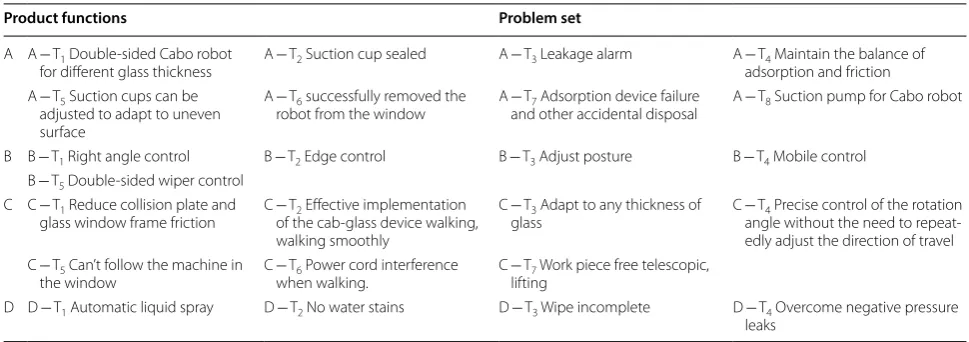
1) Patents are classified and marked based on product’s functional modules as shown in Figure 8.
2) Technical problems are analyzed for the solution of each patent to perform functions to form problem
sets as shown in Table 4. According to technical
problems, the patents are classified to form a bun-dle patent portfolio analysis chart of the glass-wiping robot. Component A has eight bundle patent portfo-lios. Component B has five, component C has seven and component D has four portfolios as shown in Figure 9.
Figure 8 Patent classification
Table 4 Problem sets of product functions
Product functions Problem set
A A − T1 Double-sided Cabo robot
for different glass thickness A − T2 Suction cup sealed A − T3 Leakage alarm A −adsorption and friction T4 Maintain the balance of A − T5 Suction cups can be
adjusted to adapt to uneven surface
A − T6 successfully removed the
robot from the window A −and other accidental disposal T7 Adsorption device failure A − T8 Suction pump for Cabo robot
B B − T1 Right angle control B − T2 Edge control B − T3 Adjust posture B − T4 Mobile control B − T5 Double-sided wiper control
C C − T1 Reduce collision plate and
glass window frame friction C −of the cab-glass device walking, T2 Effective implementation walking smoothly
C − T3 Adapt to any thickness of
glass C −angle without the need to repeat- T4 Precise control of the rotation edly adjust the direction of travel C − T5 Can’t follow the machine in
the window C −when walking. T6 Power cord interference C −lifting T7 Work piece free telescopic,
3) For the bundle-type patent portfolio module based on technical constraints, values of the development state of each component under the rule of techno-logical evolution are calculated for adsorption device A, control device B, walking device C and cleaning device D, respectively, as shown in Table 5. Values of development state under different technical evo-lution laws are calculated for components A and C shown from the left to right. Components B and D are shown from the right to left in Table 5.
4) A radar chart is formed for the state of product sys-tem technology evolution. Product evolutionary state values in Table 5 are shown in a radar chart of Fig-ure 10, the cleaning module represented by the green color shows a less development under laws of the technological evolution.
As shown in Table 4, the cleaning unit of the product solves four problems, namely the liquid spray automa-tion, no water stains, wipe incomplete and negative pres-sure leaks. In Figure 9, the number of patents for solving these problems is 3, 2, 2 and 1, respectively, forming four types of the beam patent portfolio. The jetting device in
the cleaning unit that has a relatively large number of ents is selected as the research object. Bundle-type pat-ent portfolios of the jetting device are CN201920651U, CN203244339U and CN203342551U in Figure 8.
4.2 Circumventing Problem Identification and Solution Search
4.2.1 Forming the Patent Right Map
Aiming at the bundle patent portfolio of the glass clean-ing robot’s sprayclean-ing device, the existclean-ing specific schemes of the spraying device of the object enterprise are ana-lyzed. There are manual and mechanical spraying mecha-nisms as shown in Figures 11 and 12. Among them, the manual injection mechanism requires human to operate the injection, its automation is low, while the mechanical injection mechanism is an automatic push and pressure mechanism composed of the motor, gear and push rod.
For function trimming to identify the problem and break through the technical constraints, a functional model of the mechanical injection mechanism of the object (the patent number CN201920651U) is built to determine the scope of the patent protection as shown in Figure 13.
Product System Component
A ComponentB
Component
D ComponentC
A-T1
A-T2
A-T3
A-T4
A-T5
A-T6
A-T7
A-T8
A1,A2
A3,A4,A5,A6A7, A8,A9,A10A11,A12
A13
A14
A15,A16
A17,A18
A19,A20,A2 2
A23,A24,A2 5
D-T1
D-T2
D-T3
D-T4
D-T5
D1
D2,D3
D4,D5
D6,D7
D8
B-T1
B-T2
B-T3
B-T4
B-T5
B1,B2
B3,B4,B5,B
6B7,B8
B1,B2
B12,B13,B14,B15,B16,
B17,B18,B19,B20,B21, B22,B23,B24,B25
B26,B27,B28
C-T1
C-T2
C-T3
C-T4
C-T5
C-T6
C-T7
C1
C2,C3,C4
C5
C6,C7
C8
C9,C10
C11
Table 5 C omp onen t de velopmen t sta
te based on the la
w of t echnolo gy e volution Componen t Pr oblem ‑the number of pa ten t Impac t inde x
Number of pa
ten t De velopmen t sta te v alue The la w of t echnolog ical ev olution De velopmen t sta te v alue
Number of pa
ten t Impac t inde x Pr oblem ‑the number of pa ten t Componen t A A − T1 − 2 A − T2 − 10 A − T3 − 1 A − T4 − 1 A − T5 − 2 A − T6 − 2 A − T7 − 3 A − T8 − 3
0.083 0.417 0.042 0.042 0.083 0.083 0.125 0.125
0 0 No . 1 1.214 4
0.071 0.250 0.071 0.500 0.107
B − T1 − 2 B − T2 − 7 B − T3 − 2 B − T4 − 14 B − T5 − 3 B 7 1.458 No . 2 0 0 0 0 No . 3 0 0 6 1.209 No . 4 1.857 6 8 1.834 No . 5 0 0 0 0 No . 6 1.892 6 0 0 No . 7 0 0 4 1.001 No . 8 4.392 12 C C − T1 − 1 C − T2 − 3 C − T3 − 1 C − T4 − 2 C − T5 − 1 C − T6 − 2 C − T7 − 1
0.091 0.273 0.091 0.182 0.091 0.182 0.091
0 0 No . 1 0.750 3
0.125 0.250 0.250 0.250 0.125
4.2.2 Problem Identification and Solutions
Scheme 1. According to the development state dia-gram, we select evolution laws and routes of existing technologies which are less applied to new solutions. The third law of technological evolution is dynamic, in which one route is to transfer the target to a fluid or field as follows: Rigid systems → Systems with one hinge → Systems with multiple hinges → Flexible sys-tems → Fluid based systems → Field based systems
[39]. This specific evolutionary route is selected for the technical prediction. Based on the existing product state of competing companies, a specific route search map of the product system is proposed in Figure 14. The current product state is calibrated to predict future product state as a fluid-based system or field-based system. The conceptual solutions for the prediction of future state are listed in Table 6.
From the preliminary search, it is found that concept 1 is invalid as it already exists. Concept 2 is selected for the detail design. Solutions are formed for the electromagnet
Figure 10 Radar chart of the robot product evolution
Figure 11 Manual liquid ejecting mechanism
Figure 12 Mechanical liquid ejecting mechanism
hinge joint Bole
Guiding mechanism
Push rod
Swing rod
Rotang
body Reducon gear
Pinion Output
sha Driving
motor
Contact
mesh Fixed
Corresponding sengs
Electromagnet spray mechanism
Micro-pump spray
Manual spray mechanism
Mechanical spray mechanism
Based on the field system
Fluid-based system
Hinge mechanism
Rigid structure
New state 2
New state 1
current state
Figure 14 Technology evolution route
Table 6 Conceptual solution based on the roadmap of technological evolution
Conceptual plan Working principle Illustration
Concept 1 Inflation bottles through the micro-pump, when the bottle pressure reaches a certain level, the liquid will be automatically sprayed. Meet the lightweight and miniaturization requirements
Concept 2 The use of push-pull electromagnet with automatic reset function can meet the requirements of lightweight, miniaturization and low noise of the wiping glass robot
liquid ejecting device as shown in Figure 15. Bottle (1) and electromagnet (7) are mated with the electromag-net through the movable iron core (2) and fixed shell (4). The movable iron core is sleeved with a spring (8) and the other end of the spring is contacted with the baffle cover (3) of the fixed shell. A coil (5) is mounted on the other end of the fixed shell, wherein the fixed iron core (6) is installed inside the coil. Its power-off state is shown in Figure 15(b).
A positive voltage is applied to the electromagnet. The push rod maintains the initial de-energized state and adheres to the fixed iron core. When the voltage is changed, a negative voltage is applied to the electromag-net. The push rod is pushed out of the squeezed bottle to form a liquid jet. Alternating positive and negative volt-age can achieve the continuous spray. If there is no need to spray, the electromagnet can be powered off. The push rod can maintain its position without the power con-sumption for energy-saving.
The electromagnet liquid ejecting device is small in size, simple in structure, and easy in control. Its func-tional model is shown in Figure 16. The bottle is sepa-rated from the robot main body for easy bottle cleaning and replacement. The frequency of positive and negative voltage conversions controls the speed of the liquid spray. When the power is off, it can keep the plunger adsorbed on the fixed iron core for the solenoid stable and high-precision working in a long service life.
Scheme 2. In the second method, the target patent is trimmed and deformed. By replacing the original execution component with the new component, the trimming variant is formed to enlighten the conceptual solution as shown in Figure 17. The problem is con-verted into the material field as shown in Figure 18. It provides a new solution for implementation of the push mobile function to form a new material field model for
the function design as shown in Figure 19. Using the trimming plan, formed mechanism S2 of the cam jet is composed of a motor, a cam, a push rod and a solution
Bole Movable core
Staonary
core Coil
Fixed shell Baffle cover Spring
Contact
Install Fixed Nesng
Corresponding sengs
Figure 16 Functional model of the electromagnet liquid ejecting
device
hinge joint Bole
Guiding mechanism
Push rod
Swing rod
Rotang
body Reducon gear Pinion Output
sha Driving motor
Contact
mesh Fixed
Corresponding sengs
Figure 17 Trimming variant of the jetting device
Figure 18 Trimming material field model
Figure 19 New material field model
bottle. The cam is driven by a motor. The push rod con-tacts with the cam for the push function. The push rod stroke can be changed by the shape change of the cam as shown in Figure 20. Compared to the original device, the new scheme has advantages of the simple struc-ture, easy manufacturing and convenient assembling. A functional model of the scheme is shown in Figure 21.
4.3 Solution Evaluation
(1) A checklist is established for the infringement
judgment in Table 7. It shows that the proposed
schemes are non-infringement.
(2) Evaluation of the solution patentability is conducted as shown in Table 8. It is concluded that the pro-posed schemes are creative and can be patented. (3) Patent application
As the design of the liquid ejecting device is a new scheme of the original bundle patent-type portfolio. It
has the patentability to have the protection value and form the technical solution that competes with the orig-inal patent solution. The structure of the cam jet liquid structure is simple and defensive. The proposed electro-magnetic automatic liquid ejecting device is creative for the patent application. At present, the proposed scheme has obtained the Chinese utility model patent number ZL201520752490.0 [48]. Its invention patent is under examination.
4.4 Discussion
The technology evolution law and trimming methods in TRIZ have been widely used in the design. This research uses the bundle patent portfolio analysis process based on the law of technology evolution to design a cleaning unit of the wiping glass robot. The design results are cre-ative in the following three areas.
1) The bundle patent portfolio analysis helps enterprises allocate resources of research and development. Compared to the traditional process of identify-ing needs and problems, the advantage of the pro-posed method can overcome the problem of waste of design resources through understanding of the complete development state of a product. Analyzing state values developed by different components of a product according to different technological evo-lutionary laws can provide design alternatives for enterprises. For example, from information in Fig-ure 10, the adsorption unit develops rapidly under E1 and E6, slowly on route E8; initial stages of the devel-Bottle
Cam Push rod Reduction
gear
Output shaft
Contact
Corresponding settings
Fixed
Figure 21 Functional model diagram of the new trimming program
Table 7 Infringement judgment checklist
Innovative program name Is it in line with the principle
of universal coverage? Is consistent with doctrine of equivalents Is it in line with the principle of forbidden regretted and the principle of donation?
Is it infringing?
Electromagnetic automatic
liquid spray device No No ‒ No
Cam jet mechanism No No ‒ No
Table 8 Evaluation for the solution patentability
Innovative program
name Solve the main technical problems Synonyms Boolean logic search Is there any novelty? Is it creative? The total function Sub‑function
Electromagnetic automatic liquid spray device
Control electromag-netic to achieve automatic spray
Electromagnet push rod device
Moveable iron core push rod, fixed iron core and coil, spring
(Electromagnet push device) or (moveable iron core push rod) and (fixed core and coil and spring) and (spray bottle or push bottle)
Yes Yes
Bottle Push bottle
Cam jet mechanism Using a cam
mecha-nism to achieve liquid ejection
Cam mechanism Cam, push rod (Cam and push rod) or cam
mechanism) and spray bottle
Yes Yes
opment are in E3, E4, E7 and E2; the control unit develops rapidly on E8 and E4, and slowly on E7 and E5. Compared to adsorption and control units, the evolution of walking and cleaning units lags behind, especially the cleaning unit. Therefore, the develop-ment state under each technology evolution law for the wiping glass robot product is in the initial stage. In this paper, only the cleaning unit is selected for the design. The designer can select different components and technological evolution routes to plan multi-ple paths, so that the design purpose is clear and the resource allocation is balanced.
2) The analysis of the bundled patent portfolio is more targeted and creative. The bundle patent port-folios formed by three patents CN201920651U, CN203244339U and CN203342551U solving the liquid ejecting problem in this example forms the research object. The right map of the target pat-ent based on the functional model makes the design result meet the scope of the vested rights protection and the design innovation.
3) The design solution that meets requirements of intel-lectual property rights can be protected by the patent system, as shown in the case example.
5 Conclusions
This paper proposed the design around method for a bundle-based patent portfolio based on the law of evo-lution of technology to obtain alternative soevo-lutions of a same problem, aiming at the patented layout of compet-ing firms’ products. The method consists of four pro-cesses: 1) A radar chart of technology evolutionary state is formed for the bundle-type patent portfolio to find cir-cumvention strategies; 2) Functional evolutionary routes and functional trimming are used to identify the route of problem solving; 3) The TRIZ method is used to search solutions to technical problems; and 4) The solution is evaluated to assess the effectiveness of the method.
Compared to the traditional design methods, the design around patent can make a full use of the patent information, reduce the blindness of innovation, and avoid the patent infringement. Comparing with other methods of design around patent, the proposed method uses a design around of the bundle-type patent portfo-lio to improve the matching accuracy and adaptability of TRIZ in the solution search based on the patent-based strategy.
Authors’ Contributions
RT was in charge of the whole trial; HL wrote the manuscript; JY assisted with sampling and laboratory analyses. QP improved the paper structure and writ-ing. All authors read and approved the final manuscript.
Authors’ Information
Hui Li, born in 1981, is a research fellow at School of Mechanical Engineering, Hebei University of Technology, and National Technological Innovation Method and Tool Engineering Research Center. Her research interest is in the theory and application of product innovation, Intellectual property and innovative management, especially in research of the patent circumvention and layout design. She has published 9 papers and 1 book, and completed 3 industrial projects. 11 inventive patents have been authorized.
Jiefeng Yuan, born in 1995, is currently a master candidate at School of Mechanical Engineering, Hebei University of Technology, and National Technologi-cal Innovation Method and Tool Engineering Research Center.
Runhua Tan, born in 1958, is a professor at School of Mechanical Engineer-ing, Hebei University of Technology, the Director of National Technological innovation Method and Tool Engineering Research Center, the Vice-President of the organization of Computer-Aided Innovation of International Federation for Information Processing in Asia, and Director of Professional Committee of Technological Innovation Method, Chairman of the Chinese Society of TRIZ. His research interests include theory of inventive problem solving (TRIZ), product innovation, conceptual design, and innovation management approaches. He has published more than 80 articles in Journals, such as Computers in Industry, Journal of Innovation and Entrepreneurship, Computers & Industrial Engineering, and Chinese Journal of Mechanical Engineering. He has published 5 books and completed 24 research projects.
Qingjin Peng is a professor at Department of Mechanical Engineering, Uni-versity of Manitoba, Canada. He received his bachelor and master degrees in Mechanical Engineering from Xian Jiaotong University, China, and PhD in Mechanical and Manufacturing Engineering from University of Birmingham, UK. His research interests include digital manufacturing, product design, and system modeling and simulation.
Funding
Supported by National Natural Science Foundation of China (Grant Nos. 51675159, 51605135), Central Guided Local Science and Technology Develop-ment Project (Grant No. 1824-1837G), and Ministry of Science and Technology (Grant No. 2017IM040100).
Competing Interests
The authors declare that they have no competing interests.
Author Details
1 National Technical Innovation Method and Tool Engineering Technology
Research Center, Hebei University of Technology, Tianjin 300401, China. 2 The
Department of Mechanical Engineering, University of Manitoba, Winnipeg, Canada.
Received: 20 December 2018 Revised: 26 June 2019 Accepted: 12 Octo-ber 2019
References
[1] U Lichtenthaler. Intellectual property and open innovation: an empirical analysis. International Journal of Technology Management, 2010, 52: 3-4, 372-391.
[2] B Philipp, N Bastian, S Gerhard. Paving the road to electric vehicles - A patent analysis of the automotive supply industry. Journal of Cleaner Production, 2017, 167: 75-87.
[3] Y S Chen. Using patent analysis to explore corporate growth. Scientomet-rics, 2011, 88(2): 433-448.
[4] M Kim, C Kim. On a patent analysis method for technological conver-gence. Procedia Social and Behavioral Sciences, 2012, 40: 657-663. [5] B Andersen. The hunt for S-shaped growth paths in technological
[7] Z Tekic, M Drazic, D Kukolj. From patent data to business intelligence - PSALM case studies. Procedia Engineering, 2014, 69: 296-303. [8] E Piacentini, E Drioli, L Giorno. Membrane emulsification technology:
Twenty-five years of inventions and research throughpatent survey. Journal of Membrane Science, 2014, 468: 410-422.
[9] B Wang, C H Hsieh. Measuring the value of patents with fuzzy multiple criteria decision making: insight into the practices of the Industrial Tech-nology Research Institute. Technological Forecasting & Social Change, 2015, 92: 263-275.
[10] J E Altwies, G F Nemet. Innovation in the US building sector: An assess-ment of patent citations in building energy control technology. Energy Policy, 2013, 52: 519-831.
[11] S Oh, Z Lei, W C Lee, et al. Patent evaluation based on technological trajectory revealed in relevant prior patents. Lecture Notes in Computer Science, 2014, 8443: 545-556.
[12] T Miyazawa, H Osada. Evaluation method for nature of basic invention by patent analysis. Portland International Center for Management of Engineer-ing and Technology, 2014: 1:1346-1353.
[13] L Leydesdorff, D Kushnir, I Rafols. Interactive overlay maps for US patent (USPTO) data based on International Patent Classification (IPC). Sciento-metrics, 2014, 98(3): 1583-1599.
[14] Y L Hsu, P E Hsu, Y C Hung, et al. Development and application of a patent-based design around process. Proceedings of the ASME Design Engineering Technical Conference, 2010, 1: 91-100.
[15] C Q Gao, L M Guo, F L Gao, et al. Innovation design of medical equipment based on TRIZ. Technology and Health Care, 2015, 23(2): S269-S276. [16] H Park, J Ree, K Kim. Identification of promising patents for technology
transfers using TRIZ evolution trends. Expert Systems with Applications, 2012, 40(2): 736-743.
[17] J L Luo, S Y Cheng, X R Yang, et al. The functional analysis and patent cir-cumvention based on Pro/Innovator. Modern Manufacturing Engineering, 2016, 2: 22-28. (in Chinese)
[18] G Kim, J Lee, D Jang, et al. Technology clusters exploration for patent portfolio through patent abstract analysis. Sustainability, 2016, 8(12): 1252.
[19] T Schubert. Assessing the value of patent portfolios: an international country comparison. Scientometrics, 2011, 88(3): 787-804.
[20] H Li. Patent design around research based on mechanical patent’s technol-ogy constraints and system constraints. Hebei University of Technology, 2016. (in Chinese)
[21] H Li, J T Huo, B Xu, et al. Research on patent portfolio design by using of TRIZ method. Science Technology and Engineering, 2014, 14(36): 197-203. (in Chinese)
[22] H Li, R H Tan, B Xu, et al. Patent design around method based on AFD for umbrella-type patent strategy. Journal of Mechanical Engineering, 2016, 52(5) 1-11. (in Chinese)
[23] G S Altshuller. The innovation algorithm. Worcester, MA: Technical Innova-tion Center, 2000.
[24] R Duran-Novoa, N Leon-Rovira, H Aguayo-Tellez. Inventive problem solving based on dialectical negation, using evolutionary algorithms and TRIZ heuristics. Computers in Industry, 2011, 62(4): 437-445.
[25] L Fiorineschi, F S Frillici, F Rotini. Enhancing functional decomposition and morphology with TRIZ: Literature review. Computers in Industry, 2018, 94: 1-15.
[26] T H J Vaneker, R G J Damgrave, J G Kuster. TRIZ as an enabler for intellec-tual property protection during product development. Procedia Engineer-ing, 2015, 131: 731-736.
[27] Z Van, F J Julian, W Veldhuijzen, et al. Patent circumvention strategy using TRIZ-based design-around approaches. Procedia Engineering, 2015, 131: 798-806.
[28] J Yoon, W Seo, B Y Coh, et al. Identifying product opportunities using col-laborative filtering-based patent analysis. Computers & Industrial Engineer-ing, 2016, 107: 376-387.
[29] M Li, X Ming, M Zheng, et al. A framework of product innovative design process based on TRIZ and Patent Circumvention. Journal of Engineering Design, 2013, 24(12): 830-848.
[30] M Li, X Ming, L He, et al. A TRIZ-based trimming method for Patent design around. Computer-Aided Design, 2015, 62: 20-30.
[31] T R Chang, C S Wang. Innovative theory and patent-design-around in wheelchair conceptual design. Journal of Gerontechnology and Service Management, 2012, 1(1): 49-62. (in Chinese)
[32] H T Chang, C Y Chang, W K Wu. Computerized innovation inspired by existing patents. Applied System Innovation for Modern Technology, 2017, ICASI: 1134-1137.
[33] H T Chang, Y C Hsieh, Y P Yang. Approaches to infringement risk evalu-ation of patent products for design-around. Design Engineering in the Context of Asia, Hong Kong, China, October 29‒30, 2015: 110-114. [34] Y C Hung, Y L Hus. An integrated process for designing around existing
patents through TRIZ. Proceedings of the I MECH E Part B Journal of Engi-neering Manufacture, 2007, 221(1): 109-122.
[35] M Grimaldi, L Cricelli, M D Giovanni. The patent portfolio value analysis: A new framework to leverage patent information for strategic technology planning. Technological Forecasting & Social Change, 2015, 94(1): 286-302. [36] P Jiang, C Wang, J G Sun, et al. Method and application of patented
design around by combination of IPC cluster analysis and TRIZ. Journal of Mechanical Engineering, 2017, 51(7): 144-154. (in Chinese)
[37] X X Xu. Research on patent infringement judgment. China University of Political Science and Law, 2011. (in Chinese)
[38] R H Tan. TRIZ and applications, the process and methods of technological innovation. Beijing: Higher Education Press, 2010. (in Chinese) [39] H Li, R H Tan, J T Huo, et al. Patent design around based on
mechani-cal patent’s technology constraints and system constraints. Computer Integrated Manufacturing System, 2015, 21(11): 2849-2860. (in Chinese) [40] R H Tan, Q H Zhang. The law and routes of system evolution in TRIZ and
the application. Industrial Engineering and Management, 2003, 8(1): 34-36. (in Chinese)
[41] D Cavallucci, C Lerch, E Schenk. Product lines innovation: On the use of technical laws of evolution. In: B H Thierry. The economics of creativity: Ideas, Firms and Markets, London: Routeledge, 2013: 41-57.
[42] H Li, R H Tan. Method of patent design around. Beijing: Higher Education Press, 2018. (in Chinese)
[43] D D Sheu, C T Hou. TRIZ-based trimming for process-machine improve-ments: Slit-valve innovative redesign. Computers & Industrial Engineering, 2013, 66(3): 555-566.
[44] D Russo, C Rizzi, G Montelisciani. Inventive guidelines for a TRIZ-based eco-design matrix. Journal of Cleaner Production, 2014, 76: 95-105. [45] J R Chou. An ideation method for generating new product ideas using
TRIZ, concept mapping, and fuzzy linguistic evaluation techniques. Advanced Engineering Informatics, 2014, 28(4): 441-454.
[46] Z Pei, E Amira, Z M Cecilia, et al. Experience capitalization to support deci-sion making in inventive problem solving. Computers in Industry, 2018, 101: 25-40.
[47] G S Altshuller. Creativity as an exact science: The theory of the solution of inventive problems. New York: Gordon and Breach, 1984.