Adv. Radio Sci., 8, 123–128, 2010 www.adv-radio-sci.net/8/123/2010/ doi:10.5194/ars-8-123-2010
© Author(s) 2010. CC Attribution 3.0 License.
Advances in
Radio Science
Low complexity Turbo synchronization without initial carrier
synchronization
U. Wasenm ¨uller, C. Gimmler, and N. Wehn
Microelectronic Systems Design Research Group, University of Kaiserslautern, Erwin-Schr¨odinger Str., 67663 Kaiserslautern, Germany
Abstract. Wireless data transmission results in frequency and phase offsets of the signal in the receiver. In addition the received symbols are corrupted by noise. Therefore syn-chronization and channel coding are vital parts of each re-ceiver in digital communication systems. By combining the phase and frequency synchronization with an advanced it-erative channel decoder (inner loop) like turbo codes in an iterative way (outer loop), the communications performance can be increased. This principal is referred to as turbo syn-chronization. For turbo synchronization an initial estimate of phase and frequency offset is required. In this paper we study the case, where the initial carrier synchronization is omitted and an approach with trial frequencies is chosen. We present novel techniques to minimize the number of trial frequen-cies to be processed. The communications performance and effort of our method is demonstrated. Furthermore the im-plementation complexity of the whole system is shown on a Xilinx FPGA.
1 Introduction
Synchronization and channel decoding are vital parts of ev-ery digital receiver for wireless communication. The trans-mission over a wireless channel results in timing, frequency and phase offsets. In addition, the received symbols are cor-rupted by noise. Task of the synchronization is to present data bits to the channel decoder, where the negative influ-ences of timing, frequency and phase offset are eliminated. A well known advanced scheme for channel coding is the use of turbo codes. The turbo encoder delivers a stream of systematic bits and two parity bit streams by a recursive sys-tematic convolutional encoding of the user data bits and an
Correspondence to: U. Wasenm¨uller
interleaved version of the user data bits. Turbo code decod-ing is done in an iterative algorithm based on the maximum a posteriori principle. Communication systems with Turbo codes can operate at very low signal-to-noise ratios (SNR).
Frequency offset synchronization and phase offset syn-chronization (carrier synsyn-chronization) is typically performed only once before channel decoding. The variance of the phase and frequency estimation depends on the SNR as well as on the number of symbols available for estimation of the phase and frequency offset. The mentioned variances influ-ence the decoder performance heavily; i.e. large variances lead to an unacceptable performance degradation of the used decoder.
In our paper we focus on carrier synchronization in con-junction with turbo code decoding. The method of joined iterative turbo code decoding and synchronization is called turbo synchronization. Turbo synchronization allows correct decoding also for larger variances of frequency and phase offset. This can be used to decrease the number of known symbols for synchronization purposes and thus increases the user data rate for a given bandwidth. However, also the advanced turbo synchronization technique needs an initial coarse carrier synchronization and can tolerate frequency off-set estimation errors up to a small limit.
In the situation of unacceptable estimation errors of the initial carrier synchronization tentative decoding with sev-eral trial frequency offsets must be performed. The effort of the receiver depends now on the number of investigated trial frequency offsets. We demonstrate novel techniques for minimizing the number of trial frequency offsets to be pro-cessed. To prove the feasibility of the system approach an implementation of the whole system is presented. The key facts of the hardware architecture for achieving low com-plexity for the principally expensive usage of trial frequen-cies are illustrated. Furthermore we analyze the additional effort for the turbo decoder caused by turbo synchronization and processing of trial frequency offsets and demonstrate the
124 U. Wasenm¨uller et al.: Low complexity Turbo synchronization without initial carrier synchronization 2 U. Wasenm¨uller et al.: Low Complexity Turbo Synchronization without initial Carrier Synchronization
system.
In Section 2 we summarize turbo encoding as well as the the principle of turbo code decoding. In the following Sec-tion 3 we explain the iterative synchronizaSec-tion and the inter-relation with the decoding algorithm. In Section 4 we give an short overview about the target communication system and explain the use of trial frequencies for frequency offset esti-mation. Our proposed method for minimizing the number of trials to be performed is presented. In Section 5 we analyze the communications performance of our proposed method. The hardware architecture is explained and hardware com-plexity of turbo synchronization without initial carrier syn-chronization is analyzed. Communications performance is determined by bit true models. Implementation complexities and results are given based on Xilinx devices. The paper is concluded in Section 6.
2 Turbo Codes
With the introduction of binary turbo codes by Berrou in 1993 (Berrou et al., 1993) near optimum error correction be-came possible. Due to these error correction capabilities, binary and duo-binary turbo codes allow for low frame er-ror rates (FER) at a low signal-to-noise ratio (SNR), outper-forming the widely used convolutional codes. Because of this advantage turbo codes are now part of a large number of communication standards.
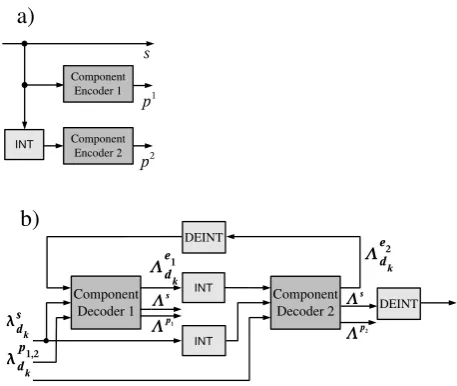
Turbo codes generally consist of a serial or parallel con-catenation of two codes, so called component codes, and an interleaver. While the first component code encodes the in-formation in the original order, the second one gets the infor-mation in a permuted order, see Figure 1a). In all standards convolutional codes are used as component codes.
Decoding of turbo codes is an iterative process where probabilistic information is exchanged between component decoders (Berrou, 2003). Iterative decoding implies a big challenge with respect to low latency and high throughput requirements.
A possible realization of a decoder for turbo codes is given in Figure 1b). The two component decoders that decode the two component codes are connected via interleaver and dein-terleaver. They uselog likelihood ratios (LLR)λs
dk,λ
p1 dkand λpd2
kof the systematic and parity information to compute the extrinsic informationΛe1
dk andΛ
e2
dk on the information bits. The iterative exchange ofΛe1
dk andΛ
e2
dk between these com-ponent decoders is referred to as turbo principle. One(full) iterationis done if Decoder 1 and Decoder 2 have run once. If only one decoder has calculated new information, we call this onehalf iteration.
Both component decoders optimize themaximum a pos-teriori probability(MAP) criterion. However, in hardware implementations the suboptimal Max-Log MAP algorithm withextrinsic scaling factor(ESF) is more suitable. In
com-Fig. 1.a) Turbo Encoder, b) Turbo Decoder
parison to the optimal algorithm the Max-Log MAP results in a performance loss of less than 0.2 dB (Robertson et al., 1995)(Robertson et al., 1997). Furthermore, the Max-Log MAP algorithm does not require knowledge of the SNR in contrast to the optimal Log MAP algorithm ((Worm et al., 2000)).
The Max-Log MAP algorithm consists of a forward and a backward recursion. It computes for each possible informa-tion or parity bitdk ana posteriori probability(APP) LLR
Λs,Λp1,Λp2.
3 Turbo Synchronization
The synchronization consists of the estimation of the un-known parameters of timing, frequency and phase offset, and the elimination of all possible negative influences intro-duced by these parameters. We focus on the frequency and phase synchronization of bursts with linear modulation (e.g. QPSK,16-QAM) in conjunction with turbo decoding. We as-sume, that the steps of gain control, timing synchronization and burst detection are properly carried out before. The re-ceived sample sequenceris given in the complex baseband according to Equation 1:
r(l) =s(l)·ej(2πfol+Φ)+n(l) l= 0,1,...,L−1 (1)
The sample sequencerwithLelements is based on modu-lation symbolss(l)with one sample per symbol and symbol durationT, and is disturbed by a noise sequencen. The un-known parameters of frequency offsetfo and phase offset
Φhave to be estimated for every received sample sequence. These parameters are considered fixed during an estimation interval; the sample sequence has to be corrected accordingly to the estimated frequency offsetf˜oand estimated phase
off-setΦ˜.
Fig. 1. (a) Turbo encoder, (b) Turbo decoder.
communications performance of the targeted communication system.
In Sect. 2 we summarize turbo encoding as well as the the principle of turbo code decoding. In the following Sect. 3 we explain the iterative synchronization and the interrelation with the decoding algorithm. In Sect. 4 we give an short overview about the target communication system and explain the use of trial frequencies for frequency offset estimation. Our proposed method for minimizing the number of trials to be performed is presented. In Sect. 5 we analyze the commu-nications performance of our proposed method. The hard-ware architecture is explained and hardhard-ware complexity of turbo synchronization without initial carrier synchronization is analyzed. Communications performance is determined by bit true models. Implementation complexities and results are given based on Xilinx devices. The paper is concluded in Sect. 6.
2 Turbo codes
With the introduction of binary turbo codes by Berrou in 1993 (Berrou et al., 1993) near optimum error correction be-came possible. Due to these error correction capabilities, binary and duo-binary turbo codes allow for low frame er-ror rates (FER) at a low signal-to-noise ratio (SNR), outper-forming the widely used convolutional codes. Because of this advantage turbo codes are now part of a large number of communication standards.
Turbo codes generally consist of a serial or parallel con-catenation of two codes, so called component codes, and an interleaver. While the first component code encodes the formation in the original order, the second one gets the in-formation in a permuted order, see Fig. 1a). In all standards convolutional codes are used as component codes.
Decoding of turbo codes is an iterative process where probabilistic information is exchanged between component decoders (Berrou, 2003). Iterative decoding implies a big challenge with respect to low latency and high throughput requirements.
A possible realization of a decoder for turbo codes is given in Fig. 1b). The two component decoders that decode the two component codes are connected via interleaver and deinter-leaver. They use log likelihood ratios (LLR)λsd
k,λ
p1 dk andλ
p2 dk
of the systematic and parity information to compute the ex-trinsic information3ed1
k and3
e2
dkon the information bits. The
iterative exchange of3ed1
k and3
e2
dkbetween these component
decoders is referred to as turbo principle. One (full) iteration is done if Decoder 1 and Decoder 2 have run once. If only one decoder has calculated new information, we call this one
half iteration.
Both component decoders optimize the maximum a
poste-riori probability (MAP) criterion. However, in hardware
im-plementations the suboptimal Max-Log MAP algorithm with
extrinsic scaling factor (ESF) is more suitable. In
compari-son to the optimal algorithm the Max-Log MAP results in a performance loss of less than 0.2 dB (Robertson et al., 1995, 1997). Furthermore, the Max-Log MAP algorithm does not require knowledge of the SNR in contrast to the optimal Log MAP algorithm (Worm et al., 2000).
The Max-Log MAP algorithm consists of a forward and a backward recursion. It computes for each possible informa-tion or parity bitdk an a posteriori probability (APP) LLR 3s,3p1,3p2.
3 Turbo synchronization
The synchronization consists of the estimation of the un-known parameters of timing, frequency and phase offset, and the elimination of all possible negative influences intro-duced by these parameters. We focus on the frequency and phase synchronization of bursts with linear modulation (e.g. QPSK,16-QAM) in conjunction with turbo decoding. We as-sume, that the steps of gain control, timing synchronization and burst detection are properly carried out before. The re-ceived sample sequenceris given in the complex baseband according to Eq. (1):
r(l)=s(l)·ej (2πfol+8)+n(l) l=0,1,...,L−1 (1) The sample sequencer withLelements is based on modu-lation symbolss(l)with one sample per symbol and symbol durationT, and is disturbed by a noise sequencen. The un-known parameters of frequency offsetfo and phase offset
8have to be estimated for every received sample sequence. These parameters are considered fixed during an estimation interval; the sample sequence has to be corrected accordingly to the estimated frequency offsetf˜oand estimated phase
off-set8˜ .
U. Wasenm¨uller et al.: Low complexity Turbo synchronization without initial carrier synchronization 125 The synchronization with turbo synchronization is done in
two main steps. Initially, a (coarse) carrier synchronization is performed. In case of larger variances of the estimation pa-rameters a degradation in the decoding performance will oc-cur. The principle of turbo synchronization is to improve the estimation parameters for synchronization (fine synchroniza-tion) with the additional use of tentative decoder decisions. The improved carrier synchronization is used to provide bet-ter input data for the decoding process. This process is done iteratively after each decoder iteration. We concentrate first on the step of fine synchronization, which will be used for turbo synchronization.
Frequency and phase offset can be optimally estimated on an unmodulated carrier. With the assumption, that the trans-mitted symbol sequencesof the burst is known the effect of the modulation by each transmitted symbols(l)can be re-moved by:
˜
r(l):=r(l)·s∗(l) l=0,1,...,L−1 (2) However, it must be considered, that usually the symbols of the burst are unknown or only some symbols, used for sup-porting the burst detection or supsup-porting the coarse synchro-nization are known. Thus we replace the transmitted symbol sequencesby an estimated symbol sequencese. The
estima-tion of the transmitted symbol sequence is provided by the turbo decoder.
The fine estimation of frequency and phase offset is based on the average phaseφ˜
0of the front part and on the average
phaseφ˜
1of the rear part of the burst with a modulation
re-moval by the estimated symbol sequencese. This is formally
given by
˜
φk:=
L/2−1+k·L/2
X
l=0+k·L/2
r(l)·se∗(l) k=0,1 (3)
With the two phase values of Eq. (3) the estimate of the fre-quency offset can be calculated with
˜
f0=
arg(φ˜0· ˜φ1 ∗
)
2π·L (4)
The estimate of the phase offset is calculated with the help of Eq. (4)
˜
φ=arg(φ˜0+ ˜φ1)−L· ˜f0·π (5)
The first decoder iteration is based on the LLR valuesλsd
k,
λpd1
k andλ
p2
dk calculated with the symbols of the coarse
syn-chronized received sequence. For the iterative fine syn-chronization an estimate of the transmitted symbols is used, which is produced by the turbo code decoder after each it-eration. The estimate of the transmitted symbols is gathered by the APP LLR of the decoder. A turbo code decoder com-putes APP LLR values3s of the systematic bits by default.
U. Wasenm¨uller et al.: Low Complexity Turbo Synchronization without initial Carrier Synchronization
3
The synchronization with turbo synchronization is done in
two main steps. Initially, a (coarse) carrier synchronization is
performed. In case of larger variances of the estimation
pa-rameters a degradation in the decoding performance will
oc-cur. The principle of turbo synchronization is to improve the
estimation parameters for synchronization (fine
synchroniza-tion) with the additional use of tentative decoder decisions.
The improved carrier synchronization is used to provide
bet-ter input data for the decoding process. This process is done
iteratively after each decoder iteration. We concentrate first
on the step of fine synchronization, which will be used for
turbo synchronization.
Frequency and phase offset can be optimally estimated on
an unmodulated carrier. With the assumption, that the
trans-mitted symbol sequence
s
of the burst is known the effect
of the modulation by each transmitted symbol s(l) can be
re-moved by:
˜
r
(
l
) :=
r
(
l
)
·
s
∗(
l
)
l
= 0
,
1
,...,L
−
1
(2)
However it must be considered, that usually the symbols
of the burst are unknown or only some symbols, used for
sup-porting the burst detection or supsup-porting the coarse
synchro-nization are known. Thus we replace the transmitted symbol
sequence
s
by an estimated symbol sequence
s
e. The
esti-mation of the transmitted symbol sequence is provided by
the turbo decoder.
The fine estimation of frequency and phase offset is based
on the average phase
ϕ
˜
0of the front part and on the average
phase
ϕ
˜
1of the rear part of the burst with a modulation
re-moval by the estimated symbol sequence
s
e. This is formally
given by
˜
ϕ
k:=
L/2−
∑
1+k·L/2l=0+k·L/2
r
(
l
)
·
s
∗e(
l
)
k
= 0
,
1
(3)
With the two phase values of Equation 3 the estimate of the
frequency offset can be calculated with
˜
f
0=
arg
( ˜
ϕ
0·
ϕ
˜
1∗
)
2
π
·
L
(4)
The estimate of the phase offset is calculated with the help
of Equation 4
˜
ϕ
=
arg
( ˜
ϕ
0+ ˜
ϕ
1)
−
L
·
f
˜
0·
π
(5)
The first decoder iteration is based on the LLR values
λ
s dk,
λ
p1
dk
and
λ
p2
dk
calculated with the symbols of the coarse
synchronized received sequence. For the iterative fine
syn-chronization an estimate of the transmitted symbols is used,
which is produced by the turbo code decoder after each
it-eration. The estimate of the transmitted symbols is gathered
by the APP LLR of the decoder. A turbo code decoder
com-Fig. 2.Considered burst structure
In turbo synchronization applications the decoder must
ad-ditionally calculate the APP LLR values
Λ
p1,2for the parity
bits.
To reduce the effect of using some erroneous reference
symbols in the fine synchronization, soft values are used for
the reference symbols. The values for the quadrature
com-ponents of the estimated symbols are calculated by a
tanh
operation on the APP LLR. Provided that the k-th
transmit-ted QPSK symbol
s
(
k
)
contains the bits
d
k(I)and
d
(kQ)of the
code word the estimated symbol
s
e(
k
)
is calculated as:
s
e(
k
) = tanh
Λ(
d
(kI))
2
+
j
tanh
Λ(
d
(kQ))
2
(6)
With the tentative soft values of systematic bits and
par-ity bits the sequence
s
eis generated and the described fine
synchronization process can be carried out.
The received sequence
r
is corrected with the new
esti-mates of frequency and phase offset. A new synchronized
received sequence
r
is calculated after each full decoder
it-eration. Turbo decoding and fine synchronization run in
par-allel in our architecture to avoid throughput degradation by
turbo synchronization. For the n-th iteration of the decoder
the LLR values
Λ
¯
s,
Λ
¯
p1, and
Λ
¯
p2of the transmitted bits are
calculated on base of the fine synchronized sequence, which
used the APP LLR values of the (n-2)-th iteration. A
dis-cussion of the effects of the schedule regarding the update of
LLR values can be found in (Alles et al., 2007).
4
Evaluation of a Grid of Trial Frequency Offsets
For using the principle of turbo synchronization an initial
coarse carrier synchronization with a sufficiently small
vari-ance of the estimation parameters is needed. The methods for
the carrier synchronization depend on the existing
communi-cations system. The burst structure of the targeted
commu-nication system is depicted in Figure 2. The burst consists
at the start and the end of a sequence of known symbols
-start unique word and end unique word respectively. The
un-known symbols in the mid of the burst correspond to the code
word of the turbo code encoded information sequence. A lot
of algorithms exist to estimate frequency and phase offset
with known symbols (data aided estimation) or with the
un-known data symbols (blind estimation) as described in (Meyr
et al., 1998; Mengali and D’Andrea, 1997). The variance
of the estimation parameters depends on the SNR, the
num-Fig. 2. Considered burst structure.
In turbo synchronization applications the decoder must addi-tionally calculate the APP LLR values3p1,2 for the parity bits.
To reduce the effect of using some erroneous reference symbols in the fine synchronization, soft values are used for the reference symbols. The values for the quadrature com-ponents of the estimated symbols are calculated by a tanh operation on the APP LLR. Provided that thek-th transmit-ted QPSK symbols(k)contains the bitsdk(I )anddk(Q)of the code word the estimated symbolse(k)is calculated as:
se(k)=tanh
3(dk(I ))
2 +jtanh
3(dk(Q))
2 (6)
With the tentative soft values of systematic bits and parity bits the sequenceseis generated and the described fine
syn-chronization process can be carried out.
The received sequence r is corrected with the new esti-mates of frequency and phase offset. A new synchronized received sequencer is calculated after each full decoder it-eration. Turbo decoding and fine synchronization run in par-allel in our architecture to avoid throughput degradation by turbo synchronization. For the n-th iteration of the decoder the LLR values3¯s,3¯p1, and3¯p2of the transmitted bits are
calculated on base of the fine synchronized sequence, which used the APP LLR values of the (n−2)-th iteration. A dis-cussion of the effects of the schedule regarding the update of LLR values can be found in Alles et al. (2007).
4 Evaluation of a grid of trial frequency offsets
For using the principle of turbo synchronization an initial coarse carrier synchronization with a sufficiently small vari-ance of the estimation parameters is needed. The methods for the carrier synchronization depend on the existing munications system. The burst structure of the targeted com-munication system is depicted in Fig. 2. The burst consists at the start and the end of a sequence of known symbols – start unique word and end unique word respectively. The un-known symbols in the mid of the burst correspond to the code word of the turbo code encoded information sequence. A lot of algorithms exist to estimate frequency and phase offset with known symbols (data aided estimation) or with the un-known data symbols (blind estimation) as described in Meyr et al. (1998); Mengali and D’Andrea (1997). The variance of the estimation parameters depends on the SNR, the num-ber of symbols and the use of known or unknown symbols.
126 U. Wasenm¨uller et al.: Low complexity Turbo synchronization without initial carrier synchronization In our targeted communication system the variance of
fre-quency offset estimation with data aided estimation methods as well as with blind estimation methods is not sufficiently small to perform afterwards a turbo synchronization with sat-isfying communications performance. This is caused by the targeted SNR range below zero dB and the low number of symbols (known and unknown).
Thus a grid of trial frequency offsets is tentatively used. These trial frequency offsets are evaluated by the decoding to decide on the best estimation. The effort is now determined by the number of trial frequencies to be processed.
To perform synchronization and decoding a set of trial fre-quency offsetsf˜iis used. For using this method it is required to estimate a corresponding phase offsetφ˜ for each trial fre-quency offset. Applying the trial frefre-quency offset to to the received sequenceris given by:
rf˜i=r(l)·e−j ( ˜
fi·l) l=0,1,···L−1 (7)
For maximum likelihood estimation of the phase offset the well known V&V algorithm (Viterbi and Viterbi, 1983) is used. A correlation of the modified received sequencerf˜i with the unique word at the start and end of the burst is per-formed, which is given by:
kf˜
i=
X
l∈U W rf˜
i(l)·u
∗
U W(l) (8)
The estimation of the phase offsetφ˜ for the trial frequency
offset is given by the argument of the phasorkf˜
iof Eq. (8): ˜
φfi=arg(kf˜i) (9)
As mentioned a criterion is required to decide on the best frequency offset. The received sequencer will be corrected with the trial frequencyf˜i and the belonging phase offsetφ˜. Based on this new sequence the LLR values for the turbo decoder can be calculated. The decoder performs the iter-ations as described in Sect. 2. For a decision on the best trial frequency offset an estimationseof the transmitted
bol sequence is used. The estimate of the transmitted sym-bol sequence is achieved as described in Sect. 3. For every trial frequency the correlation of received symbol sequence rand the estimated transmitted symbol sequenceseis used.
Correlation is a measurement of similarity and thus the trial frequency producing the greatest similarity between the two mentioned sequences is chosen. The correlation operation is given by
cf˜
i=
L−1
X
l=0
rf˜
i(l)·s
∗
e(l) (10)
The selection process is done with
˜
f= ˜fk with cf˜
k≥cf˜i for all i (11)
For the selection process off˜it is sufficient to use the
se-quence se in Eq. (11), which is achieved after one or two
turbo decoder iterations.
The computational effort for the evaluation of trial fre-quencies is dominated by the total number of turbo decoder iterations which must be performed. Thus it is desirable to minimize the number of trial frequency offsets to be evalu-ated by the decoder. The calculevalu-ated phasorkf˜ifor phase esti-mation in Eq. (8) can be used to exclude trial frequency off-sets from consideration before the decoding step. The mag-nitude of the correlation is a measure for similarity and thus only trial frequency offsetsfi with
|cf˜
i|≥CT r (12)
will be processed. It must be emphasized, that the best esti-mation of the frequency offset is not given by the maximum correlation value of Eq. (8).
5 Results
Our approach for synchronization and decoding without ini-tial carrier synchronization is validated per software simula-tions with bit true models in sense of communicasimula-tions per-formance. In addition the architecture of the system is pre-sented. The complexity of the components for implementa-tion on Xilinx FPGA is shown and briefly analyzed. 5.1 Communications performance
The communications performance of our system is demon-strated for a burst with QPSK modulation. The start unique word and end unique word contains 40 and 24 symbols, re-spectively. The code word uses 1248 symbols; it is based on turbo encoding with rate 1/3 and 16 states. A grid of 61 trial frequencies is used for this burst type. The trial frequencies are chosen to cover the maximum relative frequency offset of 6×10⁻³and to allow a fine synchronization by the principle of turbo synchronization.
The communications performance expressed as a frame er-ror rate (FER) is shown in Fig. 3 for different scenarios in an additive white gaussian noise channel. The graph with label “Blind” shows the FER for a blind carrier synchronization. Use of turbo synchronization produces no visible improve-ment in the figure. It is evident, that the carrier estimation parameters cause a unacceptable performance. The graph with label ”no threshold” and the graph with label “2800” coincide. In the targeted communication system a FER of 10−3is specified at SNR of−0.7 dB for ideal synchroniza-tion and optimal decoding. Hence the achieved communi-cations performance is comparable to a system with perfect knowledge of the synchronization parameters. The effort ad-vantage of the threshold criterion can be checked by Fig. 4. Using this threshold only approximately 60% of the trial fre-quencies have to be processed.
U. Wasenm¨uller et al.: Low complexity Turbo synchronization without initial carrier synchronization 127
U. Wasenm¨uller et al.: Low Complexity Turbo Synchronization without initial Carrier Synchronization
5
−1.4 −1.2 −1 −0.8 −0.6 −0.4 −0.2 0
10−4 10−3 10−2 10−1 100 Signal−to−noise−ratio E
S / N0
Frame Error Rate
Blind No Threshold 2800 3800 4800
Fig. 3. Communications performance
−1.4 −1.2 −1 −0.8 −0.6 −0.4 −0.2 0
35 40 45 50 55 60 65 Signal−to−noise−ratio E
S / N0
Complexity in % of accepted frequencies Threshold 2800 Threshold 3800 Threshold 4800
Fig. 4. Trial frequencies evaluated by decoder
With the threshold parameter a trade off between
commu-nications performance and implementation performance can
be regulated. The graphs with label ”3800” and ”4800”
re-spectively show the FER performance for different values
of the threshold. The computational effort for the
differ-ent threshold values is shown in Figure 4 as a percdiffer-entage
of the number of considered frequency offset values. For the
threshold label ”3800” approximately 50% of the trial
fre-quencies have to be evaluated. It is possible to choose the
threshold value for a defined SNR operation point. This is
demonstrated with the graphs with label ”3800”. For SNR
values above -0.2 dB the performance is identical to the
method without threshold. Depending on the exact value of
the threshold about 40% to 60% of the trial frequencies can
be excluded before the decoding step.
5.2
Architecture and Implementation
The architecture of the system is depicted in Figure 5.
Ob-jective of the architecture is to allow a hardware sharing of
functionalities of turbo synchronization and trial frequency
processing. Central part is the MAP component, which
per-Fig. 5. Architecture
forms a half iteration of turbo code decoding. Component
Pre includes the frequency and phase correction of the
re-ceived sequence
r
, which is used for the step of fine
synchro-nization in turbo synchrosynchro-nization as well as for processing of
trial frequencies. The phase estimation according to
Equa-tion 8 for the processing of trial frequencies is also included
in component Pre as well as the determination, whether the
actual trial frequency
f
iwill be excluded. The calculation of
LLR values including in the demapping and depuncturing is
used for providing the input data for the MAP component.
Unit Post carries out the central correlation operation
ac-cording to Equation 3 and Equation 10 respectively, which is
used for fine synchronization as well as trial frequency
pro-cessing. Both functionalities must use the transformation of
LLR-Out values to symbols as described for QPSK symbols
in Equation 6. The small part for frequency and phase
esti-mation according to Equation 4 and Equation 5 in component
Post is used only for fine synchronization. All shown RAM
blocks are double buffered to allow a parallel processing of
the main components. Therefore different trial frequencies
are processed in the components Pre, MAP and Post. The
step of fine synchronization is carried out in component Pre
and Post on the results of iteration n, while the MAP decoder
executes the iteration
n
+ 2
.
The architecture of the turbo decoder is a state-of-the-art
SMAP architecture with three recursion units which run in
parallel. The key parameter are summarized in Table 1. For
more details the reader is referred to May et al. (2007).
The resources for the components are presented in
Ta-ble 5.2 for an implementation in a Xilinx Virtex-5 FPGA.
Component Post is needed only for turbo synchronization
and trial frequency evaluation respectively. Approximately
half of the resources of component Pre are used for turbo
synchronization and trial frequency evaluation respectively.
Fig. 3. Communications performance.
U. Wasenm¨uller et al.: Low Complexity Turbo Synchronization without initial Carrier Synchronization
5
−1.4 −1.2 −1 −0.8 −0.6 −0.4 −0.2 0
10−4 10−3 10−2 10−1 100 Signal−to−noise−ratio E
S / N0
Frame Error Rate
Blind No Threshold 2800 3800 4800
Fig. 3.
Communications performance
−1.4 −1.2 −1 −0.8 −0.6 −0.4 −0.2 0
35 40 45 50 55 60 65 Signal−to−noise−ratio E
S / N0
Complexity in % of accepted frequencies Threshold 2800 Threshold 3800 Threshold 4800
Fig. 4.
Trial frequencies evaluated by decoder
With the threshold parameter a trade off between
commu-nications performance and implementation performance can
be regulated. The graphs with label ”3800” and ”4800”
re-spectively show the FER performance for different values
of the threshold. The computational effort for the
differ-ent threshold values is shown in Figure 4 as a percdiffer-entage
of the number of considered frequency offset values. For the
threshold label ”3800” approximately 50% of the trial
fre-quencies have to be evaluated. It is possible to choose the
threshold value for a defined SNR operation point. This is
demonstrated with the graphs with label ”3800”. For SNR
values above -0.2 dB the performance is identical to the
method without threshold. Depending on the exact value of
the threshold about 40% to 60% of the trial frequencies can
be excluded before the decoding step.
5.2
Architecture and Implementation
The architecture of the system is depicted in Figure 5.
Ob-jective of the architecture is to allow a hardware sharing of
functionalities of turbo synchronization and trial frequency
processing. Central part is the MAP component, which
per-Fig. 5.
Architecture
forms a half iteration of turbo code decoding. Component
Pre includes the frequency and phase correction of the
re-ceived sequence
r
, which is used for the step of fine
synchro-nization in turbo synchrosynchro-nization as well as for processing of
trial frequencies. The phase estimation according to
Equa-tion 8 for the processing of trial frequencies is also included
in component Pre as well as the determination, whether the
actual trial frequency
f
iwill be excluded. The calculation of
LLR values including in the demapping and depuncturing is
used for providing the input data for the MAP component.
Unit Post carries out the central correlation operation
ac-cording to Equation 3 and Equation 10 respectively, which is
used for fine synchronization as well as trial frequency
pro-cessing. Both functionalities must use the transformation of
LLR-Out values to symbols as described for QPSK symbols
in Equation 6. The small part for frequency and phase
esti-mation according to Equation 4 and Equation 5 in component
Post is used only for fine synchronization. All shown RAM
blocks are double buffered to allow a parallel processing of
the main components. Therefore different trial frequencies
are processed in the components Pre, MAP and Post. The
step of fine synchronization is carried out in component Pre
and Post on the results of iteration n, while the MAP decoder
executes the iteration
n
+ 2
.
The architecture of the turbo decoder is a state-of-the-art
SMAP architecture with three recursion units which run in
parallel. The key parameter are summarized in Table 1. For
more details the reader is referred to May et al. (2007).
The resources for the components are presented in
Ta-ble 5.2 for an implementation in a Xilinx Virtex-5 FPGA.
Component Post is needed only for turbo synchronization
and trial frequency evaluation respectively. Approximately
half of the resources of component Pre are used for turbo
synchronization and trial frequency evaluation respectively.
Fig. 4. Trial frequencies evaluated by decoder.
With the threshold parameter a trade off between commu-nications performance and implementation performance can be regulated. The graphs with label “3800” and “4800” re-spectively show the FER performance for different values of the threshold. The computational effort for the differ-ent threshold values is shown in Fig. 4 as a percdiffer-entage of the number of considered frequency offset values. For the threshold label “3800” approximately 50% of the trial fre-quencies have to be evaluated. It is possible to choose the threshold value for a defined SNR operation point. This is demonstrated with the graphs with label “3800”. For SNR values above −0.2 dB the performance is identical to the method without threshold. Depending on the exact value of the threshold about 40% to 60% of the trial frequencies can be excluded before the decoding step.
U. Wasenm¨uller et al.: Low Complexity Turbo Synchronization without initial Carrier Synchronization
5
−1.4 −1.2 −1 −0.8 −0.6 −0.4 −0.2 0 10−4
10−3 10−2 10−1 100
Signal−to−noise−ratio ES / N0
Frame Error Rate
Blind No Threshold 2800 3800 4800
Fig. 3.
Communications performance
−1.4 −1.2 −1 −0.8 −0.6 −0.4 −0.2 0 35 40 45 50 55 60 65
Signal−to−noise−ratio ES / N0
Complexity in % of accepted frequencies Threshold 2800 Threshold 3800 Threshold 4800
Fig. 4.
Trial frequencies evaluated by decoder
With the threshold parameter a trade off between
commu-nications performance and implementation performance can
be regulated. The graphs with label ”3800” and ”4800”
re-spectively show the FER performance for different values
of the threshold. The computational effort for the
differ-ent threshold values is shown in Figure 4 as a percdiffer-entage
of the number of considered frequency offset values. For the
threshold label ”3800” approximately 50% of the trial
fre-quencies have to be evaluated. It is possible to choose the
threshold value for a defined SNR operation point. This is
demonstrated with the graphs with label ”3800”. For SNR
values above -0.2 dB the performance is identical to the
method without threshold. Depending on the exact value of
the threshold about 40% to 60% of the trial frequencies can
be excluded before the decoding step.
5.2
Architecture and Implementation
The architecture of the system is depicted in Figure 5.
Ob-jective of the architecture is to allow a hardware sharing of
functionalities of turbo synchronization and trial frequency
Fig. 5.
Architecture
forms a half iteration of turbo code decoding. Component
Pre includes the frequency and phase correction of the
re-ceived sequence
r
, which is used for the step of fine
synchro-nization in turbo synchrosynchro-nization as well as for processing of
trial frequencies. The phase estimation according to
Equa-tion 8 for the processing of trial frequencies is also included
in component Pre as well as the determination, whether the
actual trial frequency
f
iwill be excluded. The calculation of
LLR values including in the demapping and depuncturing is
used for providing the input data for the MAP component.
Unit Post carries out the central correlation operation
ac-cording to Equation 3 and Equation 10 respectively, which is
used for fine synchronization as well as trial frequency
pro-cessing. Both functionalities must use the transformation of
LLR-Out values to symbols as described for QPSK symbols
in Equation 6. The small part for frequency and phase
esti-mation according to Equation 4 and Equation 5 in component
Post is used only for fine synchronization. All shown RAM
blocks are double buffered to allow a parallel processing of
the main components. Therefore different trial frequencies
are processed in the components Pre, MAP and Post. The
step of fine synchronization is carried out in component Pre
and Post on the results of iteration n, while the MAP decoder
executes the iteration
n
+ 2
.
The architecture of the turbo decoder is a state-of-the-art
SMAP architecture with three recursion units which run in
parallel. The key parameter are summarized in Table 1. For
more details the reader is referred to May et al. (2007).
The resources for the components are presented in
Ta-ble 5.2 for an implementation in a Xilinx Virtex-5 FPGA.
Component Post is needed only for turbo synchronization
and trial frequency evaluation respectively. Approximately
half of the resources of component Pre are used for turbo
Fig. 5. Architecture.
Table 1. Key parameter of the turbo decoder.
Binary Turbo decoder Architecture Serial MAP, 3 ACS units Trellis states 16
Infoword size 128–5124 bits Codeword size 128–15 372 bits Code rates 1/3...9/10
Parallelism 1 Input quantization 6 bit Algorithm MaxLog-MAP
ESF 0.75
Max. iterations 8 Technology FPGA Clock frequency 223 MHz Payload Thrpt. [Mbit/s] 4.67–14.02 Latency [µs] 10.36–414.7 Payload Bit/Cycle 0.02–0.06
5.2 Architecture and implementation
The architecture of the system is depicted in Fig. 5. Ob-jective of the architecture is to allow a hardware sharing of functionalities of turbo synchronization and trial frequency processing. Central part is the MAP component, which per-forms a half iteration of turbo code decoding. Component Pre includes the frequency and phase correction of the re-ceived sequencer, which is used for the step of fine synchro-nization in turbo synchrosynchro-nization as well as for processing of trial frequencies. The phase estimation according to Eq. (8) for the processing of trial frequencies is also included in com-ponent Pre as well as the determination, whether the actual trial frequencyfi will be excluded. The calculation of LLR values including in the demapping and depuncturing is used for providing the input data for the MAP component.
Unit Post carries out the central correlation operation ac-cording to Eqs. (3) and (10), respectively, which is used for fine synchronization as well as trial frequency processing. Both functionalities must use the transformation of LLR-Out
128 U. Wasenm¨uller et al.: Low complexity Turbo synchronization without initial carrier synchronization
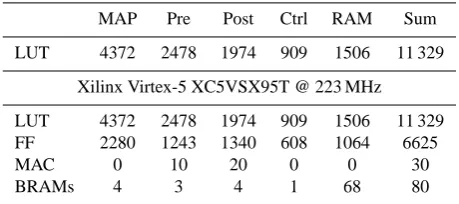
Table 2. Details of implementation complexity.
MAP Pre Post Ctrl RAM Sum LUT 4372 2478 1974 909 1506 11 329
Xilinx Virtex-5 XC5VSX95T @ 223 MHz LUT 4372 2478 1974 909 1506 11 329 FF 2280 1243 1340 608 1064 6625 MAC 0 10 20 0 0 30 BRAMs 4 3 4 1 68 80
values to symbols as described for QPSK symbols in Eq. (6). The small part for frequency and phase estimation accord-ing to Eqs. (4) and (5) in component Post is used only for fine synchronization. All shown RAM blocks are double buffered to allow a parallel processing of the main compo-nents. Therefore different trial frequencies are processed in the components Pre, MAP and Post. The step of fine syn-chronization is carried out in component Pre and Post on the results of iteration n, while the MAP decoder executes the iterationn+2.
The architecture of the turbo decoder is a state-of-the-art SMAP architecture with three recursion units which run in parallel. The key parameter are summarized in Table 1. For more details the reader is referred to May et al. (2007).
The resources for the components are presented in Table 2 for an implementation in a Xilinx Virtex-5 FPGA. Compo-nent Post is needed only for turbo synchronization and trial frequency evaluation respectively. Approximately half of the resources of component Pre are used for turbo synchroniza-tion and trial frequency evaluasynchroniza-tion, respectively.
6 Conclusions
In this paper we presented a novel method to reduce the com-plexity for turbo synchronization without initial carrier syn-chronization. To perform the decoding and synchronization steps without initial carrier synchronization a grid of trial fre-quencies is needed. The computational effort for process-ing of trial frequencies can be reduced by elimination of trial frequencies with a simple threshold comparison in the phase estimation step. Furthermore by applying turbo synchroniza-tion the grid of trial frequencies can be kept more coarse than with traditional decoding. The proposed hardware architec-ture allows a sharing of the components for evaluation of trial frequencies and for synchronization and decoding.
The components for trial frequency evaluation as well as for synchronization and turbo decoding can work concur-rently. The mentioned features result in a low complexity system. The achieved communications performance is com-parable to a system with perfect knowledge of the synchro-nization parameters.
References
Alles, M., Lehnigk-Emden, T., Wasenm¨uller, U., and Wehn, N.: Im-plementation Issues of Turbo Synchronization with Duo-Binary Turbo Decoding, in: Proc. 19th Annual IEEE International Sym-posium on Personal, Indoor and Mobile Radio Communications (PIMRC) 2007, Athens, Greece, 2007.
Berrou, C.: The Ten-Year-Old Turbo Codes are Entering into Ser-vice, IEEE Communications Magazine, 41, 110–116, 2003. Berrou, C., Glavieux, A., and Thitimajshima, P.: Near Shannon
Limit Error-Correcting Coding and Decoding: Turbo-Codes, in: Proc. 1993 International Conference on Communications (ICC ’93), pp. 1064–1070, Geneva, Switzerland, 1993.
May, M., Neeb, C., and Wehn, N.: Evaluation of High Throughput Turbo-Decoder Architectures, in: Proc. IEEE International Sym-posium on Circuits and Systems (ISCAS 2007), New Orleans, USA, 2007.
Mengali, U. and D’Andrea, A.: Synchronization Techniques for Digital Receivers, Plenum Publishing Corporation, New York, 1997.
Meyr, H., Moeneclaey, M., and Fechtel, S. A.: Digital Communica-tion Receivers, John Wiley & Sons Inc., 1998.
Robertson, P., Villebrun, E., and Hoeher, P.: A Comparison of Opti-mal and Sub-OptiOpti-mal MAP decoding Algorithms Operating in the Log-Domain, in: Proc. 1995 International Conference on Communications (ICC ’95), pp. 1009–1013, Seattle, Washing-ton, USA, 1995.
Robertson, P., Hoeher, P., and Villebrun, E.: Optimal and Sub-Optimal Maximum a Posteriori Algorithms Suitable for Turbo Decoding, European Transactions on Telecommunications (ETT), 8, 119–125, 1997.
Viterbi, A. J. and Viterbi, A. M.: Nonlinear Estimation of PSK Modulated Carrier Phase with Application to Burst Digital Transmission, IEEE Transactions on Information Theory, 32, 543–551, 1983.
Worm, A., Hoeher, P., and Wehn, N.: Turbo-Decoding without SNR Estimation, IEEE Communications Letters, 4, 193–195, 2000.