R E S E A R C H
Open Access
Cloud repository as a malicious service:
challenge, identification and implication
Xiaojing Liao
1,2*, Sumayah Alrwais
1, Kan Yuan
1, Luyi Xing
1, XiaoFeng Wang
1, Shuang Hao
1and Raheem Beyah
1Abstract
The popularity of cloud hosting services also brings in new security chal- lenges: it has been reported that these services are increasingly utilized by miscreants for their malicious online activities. Mitigating this emerging threat, posed by such “bad repositories”(simplyBar), is challenging due to the different hosting strategy to traditional hosting service, the lack of direct observations of the repositories by those outside the cloud, the reluctance of the cloud provider to scan its customers’ repositories without their consent, and the unique evasion strategies employed by the adversary. In this paper, we took the first step toward understanding and detecting this emerging threat. Using a small set of“seeds”(i.e., confirmed Bars), we identified a set of collective features from the websites they serve (e.g., attempts to hide Bars), which uniquely characterize the Bars. These features were utilized to build a scanner that detected over 600 Bars on leading cloud platforms like Amazon, Google, and 150 K sites, including popular ones likegroupon.com, using them. Highlights of our study include the pivotal roles played by these repositories on malicious infrastructures and other important discoveries include how the adversary exploited legitimate cloud repositories and why the adversary uses Bars in the first place that has never been reported. These findings bring such malicious services to the spotlight and contribute to a better understanding and ultimately eliminating this new threat.
Keywords: Cloud, Cybercrime, Malicious hosting service
Introduction
Cloud hosting service today is serving over a billion users world-wide, providing them stable, low-cost, reli-able, high-speed and globally available resource access. For ex- ample, Amazon Simple Storage Service (S3) is reported to store over 2 trillion objects for web and image hosting, system backup, etc. In addition to storing data, these ser- vices are moving toward a more active role in supporting their customers’computing missions, through sharing the repositories (a.k.a.bucketfor Google Cloud (Buckets n.d.)) hosting various dynamic content and programming tools. A prominent example is Goo-gle’s Hosted Libraries (Google. Google hosted libraries 2015), a content distribution network (CDN) for dissem-inating the most popular, open-source JavaScript re-sources, which web developers can easily incorporate into their websites through a simple code snippet. In
addition to benign users, the popularity of these services has also attracted cybercriminals. Compared with dedi-cated underground hosting services, repositories on le-gitimate commercial clouds are more reliable and harder to blacklist. They are also much cheaper: for example, it is reported that 15 GB on the dark net is sold at $15 per month (Servnet n.d.), which is actually offered for free by Google to every Google Driver user. Indeed, it has been reported (solutionary2015) that malware distribu-tors are increasingly using the commercial clouds to process and deploy malicious content.
Understanding bad cloud repositories: challenges
Although there have been indications of cloud hosting misuse, understanding how such services are abused is challenging. For the service providers, who are bound by their privacy commitments and ethical concerns, they tend to avoid inspecting the content of their customers’ repositories in the absence of proper consent. Even when the providers are willing to do so, determining whether a repository involves malicious content is by no means * Correspondence:[email protected]
1Indiana University, King Saud University, University of Texas at Dallas,
Georgia Institute of Technology, Atlanta, USA
2Department of Computer Science, Indiana University Bloomington,
Bloomington, USA
trivial: nuts and bolts for malicious activities could ap-pear perfectly innocent before they are assembled into an attack machine; examples include image files for Spam and Phishing as shown in Fig.1. Actually, even for the repository confirmed to serve malicious content like malware, today’s cloud providers tend to only remove that specific content, instead of terminating the whole account, to avoid collateral damage (e.g., compromised legitimate repositories). Exploring the issue becomes even more difficult for the third party, who does not have the ability to directly observe the repositories and can only access them through the websites or sources that utilize the storage services. Further adding to the complexity of finding such a repository is the diverse roles it may play in attack infrastructures (e.g., serving malware for one attack and serving Phishing content for another), due to the mixed content a single repository may host: e.g., malware together with Phishing images. As a result, existing techniques (e.g., those for detecting dedicated malicious services (Li et al. 2014; Nelms et al. 2015)) cannot be directly applied to capture the reposi-tory, simply because their original targets often contain more homogeneous content (e.g., just malware) and con-tribute to different campaigns in the same way. So far, little has been done to understand the scope and magni-tude of malicious or compromised repositories on legit-imate clouds (calledBad Repositoryor simplyBarin our research) and the technical details about their services to the adversary, not to mention any effort to mitigate the threat they pose.
Finding“bars”online
In this paper, we present the first systematic study on the abuses of cloud repositories on the legitimate cloud platforms as a malicious service, which was found to be highly pervasive, acting as a backbone for large-scale malicious web campaigns (Section “Measurement and Discoveries”). Our study was bootstrapped by a set of
“seeds”: 100 confirmed malicious or compromised buckets (Bucketsn.d.), each of which is a cloud resource repository with stored objects (often of different types) organized under a unique identification key. These buckets were collected from Spam messages or the mali-cious URLs cached by a popular malware scanner. Com-paring them with those known to be legitimate, we found that despite various roles each bucket plays in dif-ferent types of attacks (due to the diversity in the
content it serves), still the websites connecting to those buckets exhibit prominent common features (see Section
“Features of Bad Repositories”), particularly, the pres-ence of“gatekeeper”sites that cover the Bars (a valuable asset for the adversary) and remarkably homogeneous redirection behavior (i.e., fetching repository resources indirectly through other sites’references) and sometimes similar content organizations, due to the same attack payload the compromised sites upload from their back-end (i.e., the Bars), or the templates the bucket provides to the adversary for quick deployment of her attack sites. By comparison, a legitimate bucket (e.g., reputable jQu-ery repository) tends to bedirectlyaccessed by the web-sites with highly diverse content.
Based on this observation, we developed BarFinder, a scanner that automatically detects Bars through inspect-ing the topological relations between websites and the cloud bucket they use, in an attempt to capture Bars based on the external features of the websites they serve. More specifically, for all the sites connecting to a reposi-tory, our approach correlates the domains and URLs (particular those related to cloud repositories) across their redirection chains and content features across their DOM structures to identify the presence of gatekeepers and evading behavior, and also measure the diversity of their content organization. A set of new collective fea-turesgenerated in this way, includingbucket usage simi-larity, connection ratio, landing similarity and others (Section“Features of Bad Repositories”), are further uti-lized by a classifier to find out suspicious buckets. Run-ning the scanner over all the data collected by the Common Crawl (Crawl2015), which indexed five billion web pages, for those associated with all major cloud storage providers (including Amazon S3, Cloudfront, Google Drive, etc.), we found around 1 million sites util-izing 6885 repositories hosted on these clouds. Among them, BarFinder identified 694 malicious or compro-mised repositories, involving millions of files, with a pre-cision of 95% and a coverage of 90% against our ground-truth set.
Our discoveries
Looking into the Bars identified by our scanner, we are surprised by the scope and the magnitude of the threat. These buckets are hosted by the most reputable cloud service providers. For example, 13.7% of Amazon S3 re-positories and 5.5% of Google rere-positories that we
Fig. 1Example of deceptive images in Amazon S3 bucketcicloudf rontused for malvertising. The image was shown at the bottom of a webpage
inspected turned out to be either compromised or com-pletely malicious.1Among those compromised are popu-lar cloud repositories such as Groupon’s official bucket. Altogether, 472 such legitimate repositories were consid-ered to be contaminated, due to a misconfiguration flaw never reported before, which allows arbitrary content to be uploaded and existing data to be modified without proper authorization. The impact of these Bars is signifi-cant, infecting 1306 legitimate websites, including Alexa top 300 sites like groupon.com, Alexa top 5000 sites
likespace.com, etc. We reported our findings to
Ama-zon and leading organizations affected by the infections. Groupon has already confirmed the compromise we dis-covered and awarded us for our help.
When it comes to malicious buckets, our study brings to light new insights into this new wave of repository based cyber-attacks, including the importance of Bars to malicious web activities and the challenges in defending against this new threat. More specifically, we found that on average, one Bar serves 152 malicious or com- promised sites. In one of the large campaigns discovered in our re-search, the Barcloudfront_file.enjin.comhosts a malicious script that was injected into at least 1020 websites (Section“Prevalence and sharing”). These Bars sit right at the center of the attack infrastructure, supporting and co-ordinating other malicious actors’operations at dif- ferent stages of a campaign. Interestingly, we found that they could be strategically placed on different cloud platforms, making them hard to block (due to the popularity of their hosting clouds like Google) and detect (scattered across dif-ferent providers), and easy to share across multiple cam-paigns. As an example, the Potentially Unwanted Programs (PUP) campaign we found first loads a redirection script from a Bar on Akamaihd (the world’s largest CDN plat-form) to lead the victim to the attack web- site, then fetches Phishing pictures from an Amazon S3 Bar, and finally de-livers the malware stored on Cloudfront to the target sys-tems (Section “Case Studies”). In the presence of such meticulously planned attacks, the cloud service providers apparently are inade- quately prepared, possibly due to the privacy constraints in touching their customers’ repositor-ies. We found that manyBarssurvive a much longer life-time than that of the malicious content hosted on websites. Further complicating the mission of Bar identification are other evasion techniques the adversary employs, including code obfuscation and use of a redirection chain and cloak-ing techniques to avoid exposcloak-ing malicious payloads to a malware scanner.
Contributions
The contributions of the paper are as follows:
New understanding. We performed thefirstsystematic study on cloud repositories as a malicious service, an
emerging security threat. For the first time, our study reveals the scope and magnitude of the threat and its significant impact, particularly on the infrastructures of illicit web activities. These findings bring to the spotlight this important yet understudied problem and lead to a better understanding of the techniques the adversary employs and their weaknesses. This will contribute to better defense against and ultimate elimination of the threat.
New technique. Based on our understanding of bad cloud repositories, we take a first step toward automatically detecting them. The technique we developed relies on the topological relationship between a cloud repository and the websites it serves, which are difficult to change and effective at capturing malicious or compromised buckets. Our evaluation over a large number of popular websites demonstrates the potential of the technique, which could be utilized by both cloud providers and third parties to identify the threats posed byBars.
Background Cloud hosting
Cloud hosting is a type of infrastructure as a service (IaaS), which is rented by the cloud user to host her web assets (e.g., HTML, JavaScript, CSS, and image files). These web assets are organized into cloud repositories referred to as bucketswhich are identified by unique,2user-assigned keys, that are mapped as sub-domains. For example, the subdomain aws-publicdatasets.s3.amazonaws.comidentifies Amazon S3 as the cloud platform and aws-publicdatasets as the user’s cloud bucket and repository. Such name as-signment is labeled ass3.amazonaws.com_ aws-pub-licdatasetsthroughout this paper. Also, each bucket is protected by an access control list configured by the user to authorize requests for her resources.
In recent years, we have seen an increase in popularity of these services. A key feature of cloud hosting is built-in site publishing (Google. Publish website content 2015), where the web assets in the bucket can be served directly to users via file names in a relative path in the bucket (i.e., cloud URL). For instance, JavaScript files hosted in the cloud bucket can be directly run in the browser. Also, the pay-as-you-go hosting is well received as an economic and flexible computing solution. As an example, Google Drive today offers a free web hosting service with 15GB of storage, and an additional 100GB for $1.99/month, and GoDaddy’s web hosting starts at $1/month for 100GB.
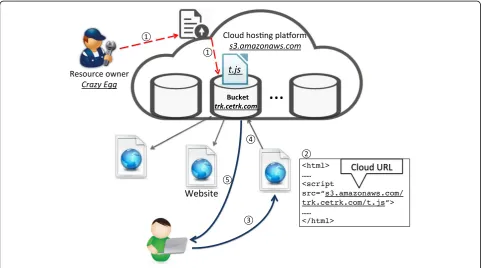
easily accessed by front-end applications (like the web-site) and shared across different parties. Figure 2 illus-trates an example, in which the resource owner creates a bucket on the cloud hosting platform and uploads a script there (CD); this resource (i.e., the script) is made public through a cloud URL, which can be embedded into any website (@); whenever the site is visited (®), re-quests will be generated for fetching the script (©) and delivering it to the visitor’s browser (®). The bucket in the example is typical of a service repository, whose re-sources can be fetched and updated through a cloud URL: for example, the visitor statistics of a website can be collected through a link (s3.amazonaws.com/
trk.cetrk.com/t.js), which downloads a tracking
script froms3.amazonaws.com_trk.cetrk.com, a bucket owned by the tracking website Crazy Egg. This is different from a “self- serving” bucket, whose resources can only be accessed by the bucket owner’s sites. Note that our study focuses on abuses of this type of cloud re-positories, regardless of the additional functionalities they may have (e.g., CDNs, DDoS protection, etc.), since these functionalities do not affect the way the repositor-ies are used by either legitimate or malicious partrepositor-ies.
Adversary model
In our research, we consider the adversary who tries to use cloud buckets on legitimate cloud platforms as service re-positories for illicit activities. For this purpose, the attacker could build her own malicious bucket or compromise
legiti- mate ones, and store various attack vectors there, including Spam, Phishing, malware, click-hijacking and others. These buckets are connected to front-end websites, which could be malicious, compromised or legitimate ones contaminated only by the Bar.
Finding bars online
In this section, we elaborate on our analysis of a set of known Bars (the seed set) and the features identified for differentiating benign repositories and Bars. These fea-tures are utilized in our research to build a simple web scanner, BarFinder, for detecting other malicious or compromised high-profile, previously-unknown reposi-tories and the malicious campaigns in which they serve.
Features of bad repositories
Our study is based on a small set of confirmed good and bad repositories and their related domains, which we an-alyzed to find out how Bars (bad repositories) differ from legitimate repositories. In the absence of direct ac-cess to these buckets, good or bad, all we can do is to infertheir legitimacy from who use them and how they are used (by different domains), that is, the features of the domains and their interactivities on the redirection paths leading to the cloud repository. Of particular inter-est here are a set of collectiveproperties identified from the resource fetching chains (a.k.a., redirection chains) for serving the content of Bars, which is hard to change by the adversary, compared with the content features of
individual Bars. Below, we elaborate on the way such data was collected and the salient features discovered in our research, which describe how the adversary attempts to hide Bars or use them to cover other attack assets, a redirection pattern never observed on legitimate repositories.
Data collection
To build the seed set, we collected a set of confirmed malicious or compromised buckets (called Badset) and legitimate buckets (called Goodset) as well as their re-lated domains, as illustrated in Table1.
Badset We utilized two feeds as the ground truth for gathering bad cloud buck- ets: the Spamtrap feed and theCleanMX feed (Clean-MX2015). The former comes from a Spam honeypot we constructed (A. authors n.d.) that receives around 10 K Spam emails per day, from which cloud URLs promoted by the emails were ex-tracted which may include spam resources such as HTML, images, and scripts. The latter includes the his-torical data of CleanMX, a popular domain scanning en-gine, from which cloud-related URLs were collected. For both feeds, we further validate them by VirusTotal (Vir-usTotal 2015) and manual inspections (e.g., looking for Phishing content) to ensure that they were indeed bad (to avoid contaminating the dataset with legitimate buckets used in malicious activities). Using the collected set of malicious cloud URLs from both feeds, we ex-tracted their repositories, which led to 100 confirmed Bars.
Goodset The good buckets were gathered from the Alexa top 3 K websites, which are considered to be mostly clean. To this end, we visited each website using a crawler (as a Firefox add-on) to record the HTTP traf-fic triggered by the visit, including network requests, re-sponses, browser events, etc. From the collected traffic, we extracted the HTTP cloud request URLs correspond-ing to 300 cloud buckets hosted on 20 leadcorrespond-ing cloud hosting services like Amazon S3, Google Drive, etc. (see Table 6 in Appendix for the complete list). Note that even though some of them provide CDN service or DDOS protection, they are all provided hosting service to act as cloud repository.
Bucket-served sites and their HTTP traffic We col-lected HTTP traffic using the crawler mentioned above
to visit a list of websites using buckets for feature extrac-tion. Rather than blindly crawling the web to find those sites, we adopted a more targeted strategy by crawling the sites found to contain links to the cloud in the past. We built the site list with the help of Common Crawl (Crawl2015), a public big data project that crawls about 5 billion webpages each month through a large-scale Hadoop-based crawler and maintains lists of the crawled websites and their embedded links. Searching the Com-mon Crawl (Crawl 2015) dataset, collected in February 2015, for the websites loading content from the 400 clean and malicious buckets identified above, we found 141,149 websites, were used by our crawler.
Topological features
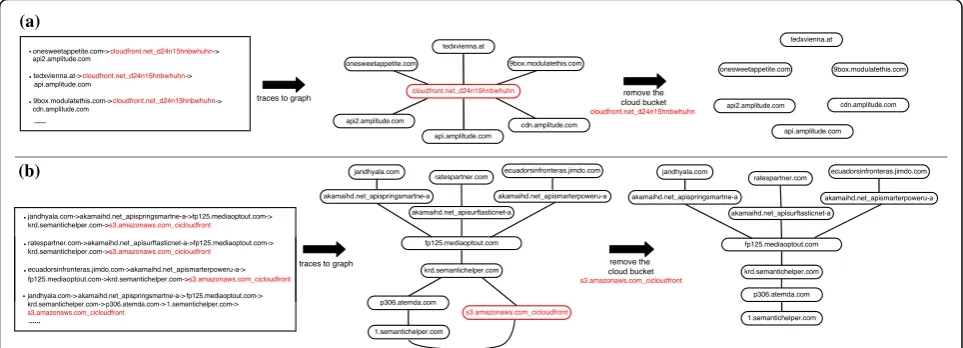
We first inspected the topology of the redirection infrastructure associated with a specific bucket. Such an infrastructure is a collection of redirection paths, with each node being a Fully Qualified Domain Name (FQDN). On each path, the bucket is either a node when it directly participates in a redirection (e.g., its cloud URL delivers a redirection script to the visitor’s browser) or simply a passive repository providing resources like pictures to other domains. Figure3 illustrates examples of redirection paths leading to two real-world repositor-ies, one for a legitimate bucket cloudfront.-net_d24n15hnbwhuhn and the other for a Bar s3.amazonaws. com_cicloudfront.
A key observation from our study is thatthe redirection infrastructure leading to a Bar tends to include the features for protecting the Bar from being detected by web scanners, presumably due to the fact that the repository is often con-sidered to be a valuable asset for the adversary. Specifically, we found that typically, there are a fewgatekeepernodes sit-ting in front of a Bar, serving as an intermediary to proxy the attempts to get resources from the Bar. Examples of the gatekeepers include fp125.mediaoptout.comand its downstream nodes in Fig.3b. On the topology of such an infrastructure, these gatekeepers are the hubs receiving a lot of resource- access connections from entry sites (the first node on a redirection path, see Fig.3). Also interest-ingly, our research shows that some gatekeepers can access the Bar through multiple paths. For example, in Fig. 3b,
krd.semantichelper.com can either go straight to
s3.amazonaws.com_cicloudfront or take a de-tour throughp306.atemada.com. This structure could be caused by the cloaking of the gatekeeper for hiding the Bar, or constructed to maintain access to the repository
Table 1Summary results of the seed dataset
# of buckets # of linked websites # of average linked website # of redirection paths
Badset 100 12,468 133 468,480
even when nodes (like 1.semantichelper.com) are down (detected, cleaned, etc.). Note that such a protection structure does not exist on the paths to a benign repository (Fig. 3a): normally, the resources hosted in a repository (e.g., jQuery) is directly fetched by the website using it, without going through any redirection; even in the presence of redirections, there will not be any gatekeeper, not to mention attempts to cloak or build a backup path.
To identify this unique“protection”structure, we utilize two collective features: bucket usage similarity(BUS) that captures the topology involving hubs (gatekeepers) and connection ratio (CR) that measures the interactivities across different redirection paths (which point to the ex-istence of cloaking behavior or the attempts to maintain back-up paths to the Bar). Specifically, consider a redirec-tion graph G= (V, E) (as illustrated in Fig.3), where Vis the set of nodes (the FQDNs involved in a redirection) andEis a set of edges from one node to the next one on individual paths:E={ei,j|node i precedes node j on a path}.
The BUS is measured by
1 i, where i is the number of immediate predecessor nodes to a repository (the domains connecting to the re-pository) and s is the total number of entries of the repository’s redirection graph. To find out the CR, we first remove the bucketband all the edges to which it is attached (if they exist) to get another graphGt=G Gb,
whereGb =(b, Eb) andEb =eb,j.Note that each graphGt
is associated with one bucket. Then, from Gt, we find out the number of connected components n and calcu-lateCR= 1n(see Fig.3for an example).
Both collective features were found to be discrimina-tive in our research. Figure4aand bcompare the cumu-lative distributions (CDF) of the ratios between Bad and Good sets. As we can see from the figures, Bars tend to have higher ratios than benign ones: the average BUS is 0.87 for the Bars and 0.79 for the legitimate repositories
and the CR is 0.85 for the bad repositories and 0.67 for the good one. As mentioned earlier, this is caused by the fact that a small set of gatekeepers nodes are often placed there for protecting the Bars while the redirection chains towards the good repositories are much more dir-ect and independent: different organizations typically do not go through an intermediary to indirectly access the public repository like jQuery, and even within the same organization, use of such a resource is often direct. Al-though there can be exceptions, our measurement study shows that in general, the structural differences between malicious and legitimate repositories are stark.
Also, we found that occasionally, a Bar itself may serve as a gatekeeper, running scripts to hide more valuable attack assets, such as the attack server or other malicious landing sites. When this happens, almost always the Bar leads to a small set of successors on redirection paths (e.g., attack servers, land sites). This is very different from the redirec-tion performed by the script from a benign repository, for example, cloudfront.net_d24n15hnbwhuhn. In such cases, the targets of redirections are often very diverse. Based on this observation, we further measure thelanding similarity,LS= 1l, wherelis the number of the unique last nodes on the redirection paths associated with a repository. Again, as illustrated in Fig.4c, our study shows that redirec-tion paths involving Bars share fewer end nodes than legit-imate ones, and therefore, the related redirection graphs (for Bars) have a higher landing similarity (0.94 vs 0.88).
Content and network features
In addition to their distinctive topological features, we found that the nodes on the redirection paths attached to a Bar often exhibit remarkable homogeneity in their content and network properties. Particularly, for the websites directly connecting to the repository, we found that they typically use a small set of templates (like
api2.amplitude.com cdn.amplitude.com api2.amplitude.com cdn.amplitude.com
jandhyala.com akamaihd.net_apispringsmartne-a fp125.mediaoptout.com krd.semantichelper.com p306.atemda.com 1.semantichelper.com
s3.amazonaws.com_cicloudfront
cloudfront.net_d24n15hnbwhuhn
api2.amplitude.com
cdn.amplitude.com (a)
(b)
Fig. 3Example of the redirection infrastructure leading to the le- gitimate bucketcloudfront.netd24n15hnbwhuhn(a) and the Bars3.amazonaws.com
WordPress) to build up their web pages, include lar DOM positions for script injection, carrying simi-lar IP addresses or even having the same content management system (CMS) vulnerabilities, etc. These properties turn out to be very diverse among those utilizing a legitimate cloud repository. For example, all websites linking to a Google Drive Bar have their malicious cloud URL (for injecting a script) placed at the bottom of the DOM of each website. In another example, we found that the front-end sites using a Cloudfront Bar actually all include a vulnerable JCE Joomla extension.
To better understand the diversity of such websites, we try to compare them according to a set of content and net-work properties. In our research, we utilized the properties extracted byWhatWeb (WhatWeb 2015), a popular web-page scanner. WhatWeb is designed to identify the web technologies deployed, including those related to web con-tent and communication: e.g., CMS, blogging platforms, statistic/analytics packages, JavaScript libraries, social media plugins, etc. For example, from the content
<link rel="search" type="application/ opensearchdescription+xml"
href="https://wordpress.com/open-search.xml" title="WordPress.com" />
we obtain the propertypas a key-value pairp= (k, v) = (wordpress, opensearch), which indicates the website using wordpress plugin opensearch.
From our seed dataset, the scanner automatically ex-tracted 372 keys of 1,596,379 properties, and then we clustered the keys into 15 classes such as Analytics and tracking, CMS and plugin, Meta-data information, etc., following the categories used by BuiltWith, a web tech-nology search engine (BuiltWith 2015). Some examples of these properties are presented in Table2. In addition to these properties extracted byWhatWeb, we added the following properties to characterize cloud URLs, includ-ing the position of the URL, the order in which different buckets appear in the web content and the number of cloud platforms used in a page.
Based on these properties, again we utilized a topo-logical metric to measure the overall similarity across sites. Specifically, the relations among all the sites (con-necting to the same bucket) in the same category (Ana-lytics and tracking, CMS and plugin, etc.) are modeled as a graph Gt= (Vt, Et, P), where V t is the set of the websites, which are characterized by a collection of propertiesP, andEtis the set of edges:
Et={ei,j|website i and j share p ∈P}, that is, both sites
having a common property. Over this graph, the site similarity is calculated as SiS¼1−jVn1j. Here n is the
number of connected components in the graph.
In our research, we computed SiS across all the cat-egories summarized from the seed dataset, and com-pared those with Bars against those with the legitimate buckets. Again, the sites using Bars are found to share many more properties and therefore achieve a much higher similarity value than those linking to a good bucket. This is likely caused by mass-production of mali-cious sites using the same resources (templates, pictures, etc.) provided by a Bar or utilization of the same exploit tool stored in a Bar for compromising the sites with the same vulnerabilities. Therefore, such similarity is inher-ent to the attack strategies and can be hard to change.
BarFinder
Design
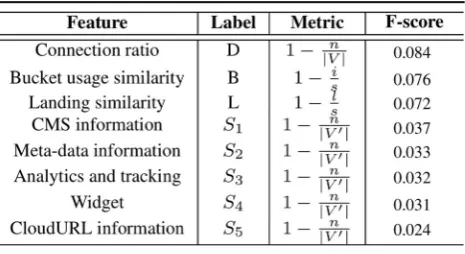
The design of BarFinder includes a web crawler, a fea-ture analyzer, and a detector. The crawler automatically scans the web for cloud buckets (embedded in web con-tent) and then clusters websites according to the buckets they use. From each cluster, the analyzer constructs a re-direction graph and a content graph as described earlier (Section“Features of Bad Repositories”), on which it fur-ther calculates the values for a set of collective features including disconnection ratio (D), bucket usage similar-ity (B), landing similarity (L) and a series of content property/network property similarities (S1 Sn) for n
web-technology categories (e.g., analytics and tracking,
(a) (b) (c)
Fig. 4Bars show smaller topological diversity.aCumulative distribution of bucket usage similarity per of connected ratio per cloud landing similarity
CMS and plugin, meta-data information, etc.). The out-put of this feature analysis is then passed to the detector, which maintains a model (trained on the seed dataset) to determine whether a bucket is malicious, based on its collective features.
Specifically, the crawler visits each website, inspecting its content, triggering events, recording the redirection paths it observes and parsing URLs encountered using the patterns of known cloud platforms to recognize cloud buckets. For ex- ample, the repository on Amazon S3 is accessed through the URL formatted as w + .s3 w + [?].amazonaws.com, and Amazon CloudFront pro-duces resource URLs in the form ofw+.cloudfront.net. In our research, 20 cloud platforms were examined to identify the buckets they host. At the feature-analysis stage, for each bucket, BarFinder inspects all its redirec-tion paths, converts every node into an FQDN to com-pute their topological features, and then connects different nodes according to their content and network properties to find out their site similarities, as described in Section“Features of Bad Repositories”.
Next, each cloud bucketi is uniquely characterized by a vector:Di, Bi, Li, Si,1Si,n, with each element a collective
feature. Individual features have different power in dif-ferentiating good and bad buckets, which we measured using the F-Score (Bishop 2006) (see Table3). Note that the feature with a large score can better classify these vectors than the one with a small value. Therefore, a binary classifier with a model for weighing the features and other parameters can be used to classify the vector set and determine whether individual buckets are legit-imate or not. Such a model is learned from the seed dataset. In our research, we utilized a Support Vector Machine (SVM) as the classifier, which showed the best performance among other classification algorithms (see Table 4). Its classification model is built upon the F-Scores for the collective features (D, B, etc.) and a
threshold set according to the false positive and negative discovery expected to achieve. For each bucket classified, the SVM can also report the confidence of the classification.
Implementation
This simple design was implemented in our study into a prototype system. The web crawler was built as a Firefox add-on. In total, 20 such crawlers were deployed. We further developed a tool in Python to recover cloud URLs from the web content gathered by Common Crawl. The feature analyzer includes around 500 lines of Python code for processing the data collected by the crawler and computing the collective features (Section
“Features of Bad Repositories”). Each feature in the vec-tor is normalized using the L1 norm before passed to the SVM classifier. In our system, we incorporated the SVM provided by the scikit-learn open-source machine learning library (Sklearn2015).
Evaluation
Here we report our evaluation of BarFinder on both the ground truth and the Unknown sets. All the experiments were conducted within an Amazon EC2 C4.8xlarge Table 2Examples of content and network features
Category Feature Example
Content CMS platform information and their plugin (wordpress, all in one SEO pack)
Meta-data information (metagenerator, drupal7)
CloudURL information (position, bottom)
Advertising (adsense, asynchronous)
Javascript library (JQuery, 1.9.1)
Analytics and tracking (Google-Analytics, UA-2410076-31)
Widget (addthis, welcome bar)
DocInfo technologies (open graph protocol, null)
Network Identity (IP, 216.58.216.78)
Cookie (Cookie, harbor.session)
Server framework version (Apache, 2.4.12)
Custom HTTP header (X-hacker, If youre..)
instance equipped with Intel Xeon E5–2666 36 vCPU and 60GiB of memory.
Evaluation on the seed set
We tested the effectiveness of BarFinder over our ground-truth dataset (i.e., the seed set) through the standard five-fold cross validation: that is, 4/5 of the data was used for training the SVM and the remaining 1/5 for evaluating the accuracy of Bar detection. Specifically, we randomly chose 80 Bars (out of 100) from the Badset and 240 (out of 300) legitimate buckets from the Goodset, together with the related websites (out of 141,149). These data were first processed by our prototype to adjust the weights and other parameters for its model. Then we tested the model on the remaining dataset (20 Bars, 60 legitimate buckets). The process is then repeated 5 times. BarFinder achieved both a low false discovery rate (FDR: 1- precision) and a high recall in detection: only 5.6% of reported Bars turned out to be legitimate (i.e., 1.6% of false positive rate), and over 89.3% of the Bars were detected. We further show the Area Under Curve (AUC) of the Receiver Operating Characteristics (ROC) graph, which comes very close to 1 (0.96), demonstrating the good balance we strike between the FD rate and the coverage. This preliminary analysis shows that the collective features of the sites connecting to cloud repositories are promising in detecting Bars.
Evaluation on the unknown set
We now use BarFinder to scan an unknown set. This un-known set contains HTTP traffic collected using a crawler as described in Section “Features of Bad Repositories”to visit a list of websites. This list of websites is also extracted from common crawl (Crawl 2015) by searching for web-sites that have loaded some content in the past from the cloud platforms listed in Table 6 inAppendix. As a result, the unknown data set contained HTTP traffic generated from dynamically visiting 1 M websites loading content from 20 cloud platforms and 6885 cloud buckets.
To validate our evaluation results, we employ a meth-odology that combines anti- virus (AV) scanning, black-list checking, and manual analysis. Specifically, for the Bars flagged by our system, we first scan their cloud URLs with VirusTotal for malware and check them against the list of suspicious cloud URLs collected from
our Spamtrap honeypot for Spam, Phishing, blackhat Search Engine Optimization (SEO), etc. In the case of VirusTotal, a URL is considered to be suspicious if at least two scanners raise the alarm. All such suspicious URLs (from either VirusTotal or the Spamtrap list) are cross-checked against the blacklist of CleanMX. Only those also found there are reported to be a true positive. Once a URL is confirmed malicious, its corresponding bucket is labeled as bad. Those unlabeled but flagged (by BarFinder) buckets are further validated manually.
In the experiment, BarFinder reported a total of 730 Bars, about 10.6% of the 6885 buckets. Among them, the AV scanning and blacklist verification confirmed that 502 buckets were indeed bad. The remaining 228 were manu-ally analyzed through, e.g., inspecting the resources in the buckets for phishing or scam content, running scripts in the VM to capture binary code download. This validation further confirmed 192 Bars. The FDR was found to be at most 5% (assuming those not confirmed to be legitimate), in line with the finding from the seed set.
Measurement and discoveries
Based on the discoveries made by BarFinder, we further conducted a measurement study to better understand the fundamental issues about Bar-based malicious ser-vices, particularly how the cloud repositories help facili-tate malicious activities, how the adversary exploited legitimate cloud bucketsandwhy the adversary uses Bars in the first place. Our research shows that on the infra-structure, Bars play a pivotal role, compared with the content kept on other malicious or compromised sites, possibly because they are hosted on popular cloud ser-vices, and therefore hard to blacklist and also easy to share across different campaigns. Also, in a malicious campaign, the adversary may take advantage of multiple Bars, at different attack stages, to construct a compli-cated infrastructure that supports her mission (Section
“Prevalence and sharing”). More importantly, we discov-ered that the adversary effectively exploited misconfigured legitimate buckets to infect a large number of their front-end web services (Section“Bucket Pollution”). Such observations, together with the challenge in blocking Bars, offer insights into the motivation for moving toward this new trend of repository-based attacks.
Prevalence and sharing
Landscape
As mentioned earlier, BarFinder reported 730 suspicious repositories from 6885 cloud buckets over 20 cloud plat-forms. Among them, we utilized 694 confirmed Bars (through AV/blacklist scanning or manual validation, see Section “BarFinder”) for the measurement study. These Bars were found to directly serve 156,608 domains (i.e., front-end websites), through which they are further Table 4Performance comparison under five-fold across
validation
Classifier Precision Recall
SVM 0.94 0.89
Decision Tree 0.9 0.83
Logistic Regression 0.91 0.87
Naive Bayes 0.9 0.79
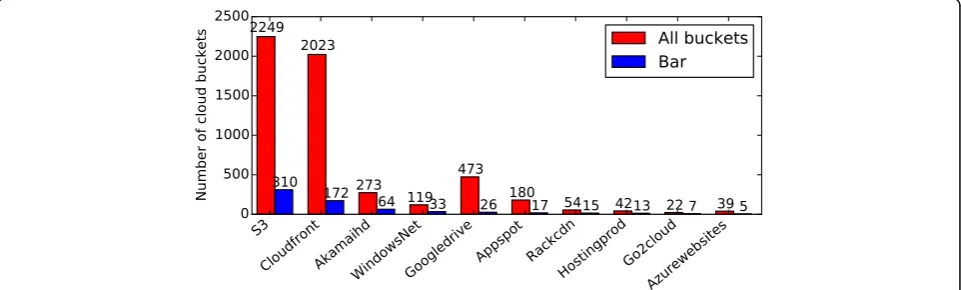
attached to 6,513,519 redirection paths involving 166,772 domains. Figure5illustrates the number of Bars we found on different cloud platforms. Among them, Amazon S3 is the most popular one in our dataset, host-ing the most Bars (45%), which is followed by Cloud-Front (Amazon’s CDN) 25.1% and Akamaihd 9.3%. Note that of these 20 clouds, seven of them provide free stor-age services (e.g., 15GB free space on Google Drive, 5GB for Amazon S3), and therefore easily become the ideal platforms for low-budget miscreants to distribute their illicit content. Also, eleven of them support HTTPS, on which malicious activities are difficult to catch by exist-ing signature-based intrusion detection systems like snort and Shadow (Snort 2015; Symantec 2015). Inter-estingly, on some of the most prominent platforms, the miscreants are found to take advantage of the cloud pro-viders’ reputations to make their Phishing campaigns look more credible: for example, we found that the ad-versary continuously spoofed Gmail’s login page on Goo-gle Drive, and the software download page for Amazon FireTV in an Amazon S3 bucket.
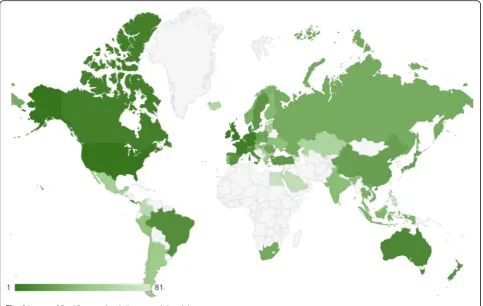
Figure6shows the distribution of Bars’frontend web-sites across 81 countries, as determined by the geoloca-tions of the sites. The number of Bars’frontend sites in each country is ranked and described with different levels of darkness in the figure. We observe that most of these frontends stay in United States (14%), followed by Germany (7%) and United Kingdom (5%).
Content sharing
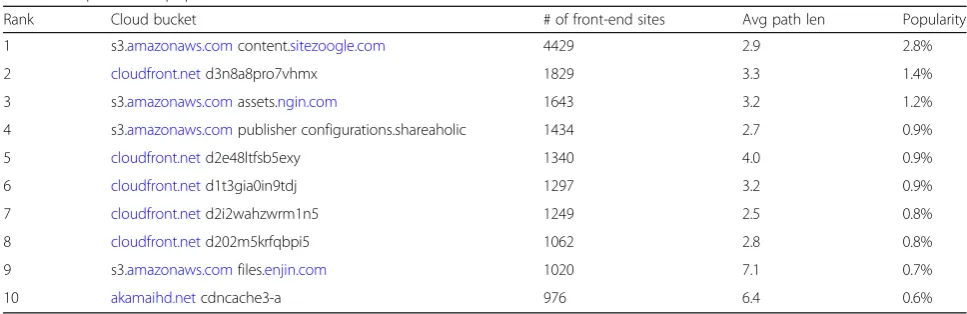
Our research reveals that Bars have been extensively shared among malicious or compromised websites, also across different positions on malicious redirection chains. Figure 7c illustrates the cumulative distribution of Bars’ in- degrees in their individual redirection graphs: that is, the number of the sites utiliz- ing these Bars. On average, each Bar shows up on 252 sites and 12% of them are used by more than 200 websites. Table 5 lists the 10 most popular Bars we found. Among them, eight, including
s3.amazonaws.com_content.sitezoogle. Com, s3.amazonaws.com_publisher_configura-tions.shareaholic, etc., host services for website generation, blackhat SEO or Spam. Particularly, aka-maihd. net_cdncache3-aturns out to be a distribu-tor of Adware, whose scripts are loaded into the victim’s browser to redirect it to other sites for downloading differ-ent Adware. Also, we found that another Bar s3.amazo-naws.com_files.enjin. Com hosts exploits utilized by 1020 bad sites. Finding Bars can help to effectively de-tect more sites with malicious contents.
Another interesting observation is that malicious con-tent is also extensively shared across different Bars. To understand such content reuse, we grouped the mali-cious programs retrieved from different Bars based on the similarity of their code in terms of edit distance. Spe-cifically, we removed the spaces within the pro- grams and ran the Python library scipy.cluster.hierarchy.linkage (Scipy 2015) to hierarchically cluster them (now in the form of strings) according to their Jaro scores (Cohen et al. 2003). In this way, we were able to discover three types of content sharing: intra-bucket sharing, cross-bucket sharing, and cross-platform sharing. Specif-ically, within the Amazon bucket akamaihd.ne-t_asrv-a, we found that many of its cloud URLs are in the form of http://asrv-a.akamaihd.net/
sd/[num]/[num].js. The JavaScript code turns out
to be all identical, except that each script redirects the visi-tor to a different website. The similar code also appears in another Amazon bucket akamaihd.net_cdncache-a. As another example, we discovered the same ma- licious JavaScript (JS.ExploitBlacole.zm) from the Bars on CloudFront and Qiniudn respectively, even under the same path (i.e., media/system/js/modal. js). Moreover, we found that attackers used sub-domain generation algo-rithm to automatically generate sub-domain for Bars, then further reused the same malicious contents for these Bars. Specifically, we found that 28 content sharing Bars on Aka-maihd have the same format in their names. Attackers
utilized a word bank based sub-domain generation algo-rithms (damballa2015), which concatenates fixed terms and a se- ries of domain names (remove dot), then truncates the string if its length is over 13, e.g.,apismarterpoweru-a (truncated fromsmarterpowerunite.com). The com-mon patterns of Bars indicate the potential of developing an accurate detection procedure.
Correlation
We further studied the relationships between different Bars, fetched by the same websites. From our dataset, 11,442 (3.5%) websites are found to access at least two
Bars. Among them, 8283 were served as front-end web-sites, and 3159 other sites on redirection chains. Also, 60.9% of these sites link to the repositories on the same cloud platforms and 39.1% use those on different plat-forms. In some cases, two buckets are often used to-gether. For example, we found that a click-hijacking program was separated into the code part and the con-figuration part: the former is kept on CloudFront while the latter is on Akamaihd; the two buckets always show up together on redirection chains. Such a separation seems to be done deliberately, in an attempt to evade detection. Also we saw that Bars carrying the same
Fig. 6Impact of Bars’front-end websites around the globe
(a) (b) (c)
Fig. 7Bars play critical roles in attack infrastructures.aCumulative distribution of degrees per sites.bPercentage of Bars in each position of
attack vectors are often used together, which are appar-ently deliberately put there to serve parties of the same interests: as another example, a compromised website was observed to access four different Bars on different cloud platforms, redirecting its visitors to different places for downloading Adware to the visitor’s system. Our findings show that Bars are widely deployed in at-tacks and serve in a complex infrastructure.
Bar-based malicious web infrastructure
Role in attack infrastructures
Actually, most nodes on a malicious infrastructure are the malicious websites with newly registered domains and those that are compromised. To better understand the crit-ical roles of Bars, we compared those nodes with the bad cloud buckets. Specifically, we first identified both types of nodes from the redirection paths and then analyzed the number of unique paths each member in either category is associated with and the position of the member on the path. Figure7apresents the cumulative distribution of the paths going through a Bar and that of a compromised or malicious site. As seen in the figure, compared with other nodes on the infrastructure, Bars clearly sit on much more paths (47.4 on average vs. 8.6), indicating their importance.
Further, Fig.7b shows the histogram of position distri-butions (again, Bars vs. bad sites). The observation is that more Bars (41%, 11%) show up at the beginnings and the ends of the paths than bad websites (22%, 5%), which demonstrates that they often act as first-hop redirectors or attack-payload repositories. For example, in our three-month-long monitoring of the campaign based on the Spyware distribution Bar akamaihd.net_rvar-a, we found that besides the Bar, 320 newly-registered web-sites participated in the attack; here the Bar acted very much like a dispatcher: providing JavaScript that identified the victim’s geolocation and then using an iframe to redir-ect her to a selredir-ected bad site.
Attack vectors and payloads
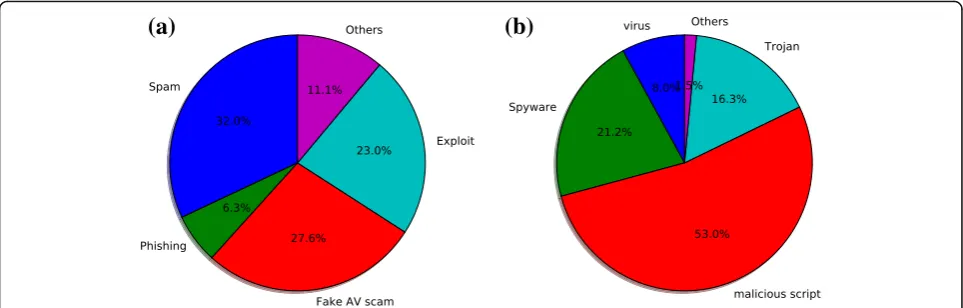
In a malicious infrastructure, the attackers run an attack vector to compromise the victim’s systems (browser, cli-ent, server, etc.), and then deliver an attack payload (e.g., malware). We found that Bars often serve the infrastruc-ture as repositories for such vectors and payloads. In our study, we ran AV/blacklist scanners and also checked fingerprints collected through manual analysis on the websites in our dataset (Section “BarFinder”). We iden-tify attack vectors using the labels generated by the AV/ blacklist scanners whenever available. Figure8aand b il-lustrate our findings, in which Spam, Phishing, Fake AV scams and vulnerability exploits are considered to be the attack vectors, and virus, Spyware, Trojan, malicious scripts and other malware-related content are treated as payloads. As we can see from the figure, both types of malicious content are extensively hosted by Bars. On the other hand, malicious or compromised websites typically only serve attack vectors (and retrieve the payload from dedicated servers or the cloud repositories) (Li et al. 2014; Li et al.2013). Interestingly, we found a malicious payload (CVE-2015-0029) on S3 Bar, which was uploaded in 2013 while the vulnerability is released in February, 2015. The malicious payload can stay active for a relatively long time in Bars.
Revenue estimate
We also investigated the revenues that could be received by the adversary leveraging malicious infrastructure. To this end, we utilized a model as proposed in the prior re-search (Alrwais et al. 2014; Moore et al. 2011): R(t) = Nv(t) Pa Ra where the total revenue R(t) during the
time periodt is calculated from the total number of ac-tions taken (i.e., click-through number, number of visi-tors Nv(t) weighed by the probability that the visitors
take action Pa) and the average revenue per action Ra.
Here, we assume the price model as pay per action: that is, the adversary gets paid only when a specified action Table 5Top 10 most popular Bars
Rank Cloud bucket # of front-end sites Avg path len Popularity
1 s3.amazonaws.comcontent.sitezoogle.com 4429 2.9 2.8%
2 cloudfront.netd3n8a8pro7vhmx 1829 3.3 1.4%
3 s3.amazonaws.comassets.ngin.com 1643 3.2 1.2%
4 s3.amazonaws.compublisher configurations.shareaholic 1434 2.7 0.9%
5 cloudfront.netd2e48ltfsb5exy 1340 4.0 0.9%
6 cloudfront.netd1t3gia0in9tdj 1297 3.2 0.9%
7 cloudfront.netd2i2wahzwrm1n5 1249 2.5 0.8%
8 cloudfront.netd202m5krfqbpi5 1062 2.8 0.8%
9 s3.amazonaws.comfiles.enjin.com 1020 7.1 0.7%
(e.g., software installation) is taken by the victims. Using a PassiveDNS dataset (DNSDB2015), which contains DNS lookups recorded by the Security Information Exchange, we estimated the daily number of visitors in February 2015 (data crawling time, i.e., attack time) Nv = 32 M.
Note that the probability of a visitor taking action Pa is
difficult to estimate due to the various malicious pages on different sites. According to the prior works (Alrwais et al. 2014), we setPa= 0.02 andRa= $1.25. These parameters
yield a daily revenue for attackers utilizing Bars of 32M 0.02 $1.25 = 0.8 million US dollars per day, which corre-sponds to a huge amount of illicit profit.
Bucket pollution
Polluted repositories
To find polluted buckets, we searched the Alexa top 20 K websites for the Bars in our dataset and 276 Bars were found. When a legitimate site links to a Bar, the reason might be either the website or the repository is hacked. Differentiating these two situations with cer-tainty is hard, and in some cases, it may not be possible. All we could do is to get an idea about the prevalence of such bucket pollution, based on the intuition that if a website is less vulnerable, then it is less likely to be com-promised. To this end, we ran WhatWeb, a powerful web vulnerability scanner, on these sites and found 134 Bar’s front-end websites contain various flaws, such as using CMS in vulnerable version (e.g. wordpress 3.9), vulnerable plugins (e.g., JCE Extension 2.0.10) and vul-nerable software (e.g., Apache 2.2). The remaining 142 Bar’s front-end websites look pretty solid in web protec-tion and therefore it is likely that the Bars they include were polluted. This set of potentially compromised buckets takes 19% of all the Bars flagged by BarFinder. These buckets, together with the additional 30 randomly sampled from the set, went through a manual analysis, which shows that indeed they were legitimate buckets contaminated with malicious content.
Misconfiguration and impact
It is even more challenging to determine how these buckets were compromised, which could be caused by exploiting ei-ther the cloud platform vulnerabilities or the bucket mis-configurations. Without an extensive test on the cloud platform and the repositories, which requires at least direct access to them, a comprehensive study on the issue is im-possible. Nevertheless, we were able to identify a misconfig-uration problem widely existing in popular buckets. This flaw has never been reported before but was likely known to the underground community and has already been utilized to exploit these repositories. We reported the flaws to the vendors and they confirmed our finding.
Specifically, on Amazon S3, one can configure the access policies for her bucket to defines which AWS ac-counts or groups are granted access and the type of access (i.e., list, upload/modify, delete and download): this can be done through specifying access control list on the AWS Management Console. Once this happens, the cloud veri-fies the content of theauthorizationfield within the client’s HTTP request header before the requested access is allowed to go through. However, we found that by de-fault, the policy is not in place, and in this case, the cloud only checkswhether the authorization key (i.e., access key and secret key) belongs to an S3 user, not the authorized party for this specific bucket: in other words, anyone, as long as she is a legitimate user of the S3, has the right to upload/modify, delete and list the resources in the bucket and download the content. Note that this does not mean that the bucket can be directly touched through the browser, since it does not put anything into the authorization field. However, the adversary can easily build his own HTTP header, filling in his own S3 key, as illustrated in Fig.10, to gain access to the misconfigured repository. In our research, we verified that all such opera-tions can be performed on any repositories with the con-figuration flaw, which suggests that site operators need to take more caution when setting the configuration rules.
(a)
(b)
To understand the impact of this problem, we devel-oped a simple web testing tool, which checked a bucket’s configuration using our own S3 key. By scanning all 6885 repositories (including both Bars and legitimate buckets), we discovered that 472 are vulnerable, which were associated with 1306 front-end websites. The Alexa global ranks and the bounce rates of their front-end websites are illustrated in Fig.9a and b. Sixty-three per-cent of them have bounce rates from 20% to 60%; 9 sites are ranked within Alexa top 5000 (e.g.,groupon.com,
space.com).
Focusing on the 104 bad buckets with the flaws, we further manually sampled 50 and confirmed that these buckets were indeed legitimate, including high-profile ones like s3.amazonaws.com_groupon. Further, looking into the these buckets’file uploading time (re-trieved from the buckets through the flaw), we found that in some cases, the attack has been there for six years. Particularly the Amazon bucket s3.amazo-naws.com_groupon, Groupon’s official bucket, was apparently com- promised five times between 2012 and 2015 (see Section “Case Studies” for details), according to the changes to the bucket we observed from the bucket historical dataset we collected from archive.org. We also estimated the volume of traffic to those Bar-related sites using a PassiveDNS dataset (DNSDB 2015), which contains DNS lookups recorded by the Security Informa-tion Exchange. Figure9cillustrates the traffic of the web-sites during the time period when their buckets were compromised, which was increased significantly compared with what those sites received before their compromise, indi- cating that they likely received a lot of visits. This provides evidence that the impact of such compromised buckets is indeed significant.
Case studies
In this section, we discuss two prominent examples.
PUP campaign
Our study reveals a malicious web campaign dubbed Potentially Unwanted Programs (PUP) distribution: the attack redirects the victim to an attack page, which shows her fake system diagnosis results or patch requirements through the images fetched from a Bar, in an attempt to cheat the victim into down-loading “unwanted programs” such as Spyware, Adware or a virus. This campaign was first discovered in our dataset. Altogether, at least 11 Bars from 3 dif-ferent cloud platforms and 772 websites (not hosted on the cloud) were involved in.
Through analyzing the redirection traces of the cam-paign, we found that two Aka- mai Bars, akamaid.-net_cdncache3-aandakamaihd_asrv-a, frequently inject scripts into compromised websites, which serve as first-hop redirectors to move a visitor down the redirection chain before hitting malicious landing pages (that serve ma-licious content). Interestingly, all the follow-up redirectors are compromised or malicious websites that are not hosted on the cloud. The scripts in the Bars were found to change over time, redirecting the visitor to different next-hop sites (also redirectors). On average, the life span of such sites is only 120 h, but the Bar was still alive when we submitted this paper. Such redirections end at at least 216 mali- cious landing sites, which all retrieve deceptive images from an Amazon S3 bucket s3.amazonaws.com_cicloud-front(a Bar never reported before and is still alive). An example is a system update warning, as shown in Fig. 1. From the reposi- tory, we collected 134 images, including those for free software installation, updates on all main-stream OSes, browsers and some popular applications. If she clicks and downloads the program promoted on the site, the code will be fetched from multiple Bars, such as s3.amazonaws.com_wbt_mediawhere the PUP puts a Bitcoin miner on the victim’s system, and cloud-front.net_d12mrm7igk59vq, whose program modi-fies Chrome’s security setting.
(a) (b) (c)
Fig. 9Alexa global rank, bounce rate and traffic increase rate of Bar’s front-end websites.aCumulative distribution of Alexa global ranks per Bar’s
Groupon Bar
We discovered that a misconfigured Amazon S3 bucket s3.amazonaws. com_groupon belongs to Groupon (Alexa global rank 265) (Fig. 10), a global e-commerce marketplace serving 48.1 million customers worldwide. The bucket was used as the resource repository for Groupon’s official website (i.e.,groupon.com) as well as its marketing sites (12 websites observed in our dataset). When tracking its historical content fromarchive.org, we were surprised to see that the Groupon S3 bucket has been compromised at least eight times in the past five years (e.g., 2015/08/06, 2014/12/18, 2014/06/25, 2014/01/ 27, 2014/02/26, 2013/06/23, 2011/11/08, 2010/09/28). These attacks caused different types of malicious pay-loads to be uploaded to their repository, including Adware, Trojan, virus and others. Even though the bucket owner changed the access control policy in 2012 to prevent the unauthorized party from directly listing the bucket content through browser, it remained accessible by our tool mentioned in Section
“Bucket Pollution”, which constructs anAuthorization field in HTTP header, and unauthorized listing, upload and even modification can still occur.
Discussion
Limitations of BarFinder
As mentioned earlier, Bar detection is hard, since cloud repositories cannot be directly accessed by the parties outside the cloud. Therefore, the goal of BarFinder is to leverage the sites served by Bars to find suspicious re-positories. For this purpose, we chose to utilize the col-lective features of these sites, such as their topological relations, content shared across sites, etc. This strategy could make the approach more robust, as the collective features are more difficult to evade compared with those from individual sites. On the other hand, it requires that the party running the system first makes efforts to gather the sites using cloud buckets, the more the better. Further, there are repositories that only serve a small set of front-end sites: e.g., we found that among the Alexa top 3 K sites, 67 sites are connecting to the cloud buckets only used by themselves. Those “self-serving” buckets are rather popular in reputable websites such as appspot.-com_android-site only used by android.com, s3.amazonaws.com_ttv-backgroundartonly used bytwitch.tv, etc. This fact makes the bad apples among them hard to catch by BarFinder simply because not
enough sites using them are out there to allow us to differ-entiate these two types of repositories. Detection techniques covering this type of Bars need to be developed in the follow-up research.
Other defenses against bars
Besides the detection effort made by the third party, as BarFinder does, more can be done to mitigate the threats posed by Bars, from the ends of the website owner, the bucket owner and the service provider. The website owner could perform integrity checks on the re-sources her website retrieves from the bucket, making sure that it is not compromised. The cloud bucket owner should carefully configure her cloud bucket to avoid the issue we found and other misconfiguration flaws. In this case, an automatic configuration checker could be helpful. Most im- portantly, the cloud provider does have the responsibility to move more aggressively on detecting and removal of Bars from their systems. This, however, is non-trivial, given the privacy concern and the fact that some Bars can only be considered to be malicious by looking at the malicious activities they are involved in, such as those hosting Phishing pictures. Fur-ther research is needed to better understand what the provider can do to address the issue.
Ethical issues
Most findings of the paper were made through analyzing the data crawled from the public domain. Regarding the study on the misconfiguration problem we found, our scanner was designed to minimize the privacy impacts on vulnerable repositories: specifically, it only tried out the functionality like file listing, uploading and down-loading. The impact of such operations are very much in line with those of running online web testing tools (e.g., Sucuri (Sucuri 2015)) on others’websites. Most import-antly, we did this with the full intention to protect such repositories from future exploits, and also carefully avoided changing any existing content there and deleted from our system all the files downloaded. Further, we have already contacted the major vendors such as Groupon and the cloud providers like Amazon about those security breaches, and will continue to notify others and help them fix the configuration problem. So far, Groupon has acknowledged the importance of our findings and expressed gratitude for our help.
Related work
Cybercrime hosting service
The cybercrime hosting infrastructure is a basic building block of the cyber-crime ecosystem. It provides servers and networking infrastructure for the cyber criminals, and it also persist in the face of takedown attempts and complaints of illicit activities. Alrwais et al. (Alrwais et al.
2014) investigated a trending and stealthy cybercrime host-ing service, that malicious activities were hosted on the sub-allocations of legitimate service provider Networks. Li et al. (Li et al. 2013) also found that Internet Service Provider (ISP) were used for abusive hosting. Compared with those prior studies, we shed light on the emerging and evasive cybercrime hosting platform: cloud service, which has never been studied before.
Bad site detection
Malicious web activities have been extensively studied (Invernizzi et al.2012; Invernizzi et al.2014; Moore et al. 2011; Nelms et al.2015). Most related to our work here is the use of HTML content and redirection paths to detect malicious or compromised websites. Examples for the content-based detection include a DOM-based clustering systems for monitoring Scam websites (Der et al. 2014), clas- sification of websites for predicting whether some of them will turn bad based on the features extracted from HTML sources, and a monitoring mechanism (Borgolte et al.2013) (called Delta) to keep track of the changes made to the content of a website for detecting script-injection campaigns. For those using malicious redirection paths, prominent prior approaches use short redirection se-quences to capture bad sites (Li et al.2014), unique prop-erties of malicious infrastructure (its density) for detecting drive-by downloads (Invernizzi et al.2014) or malware dis-tribution (Stringhini et al.2013) and a trace-back mechan-ism that goes through the redi- rection paths (Nelms et al. 2015) for labeling malware download sites. Compared with those prior studies, which all rely on the properties of the targets they try to capture, BarFinder utilizes the features found from the front-end websites using cloud buckets, as those repositories may not be directly accessible. Also, our approach leverages a set of unique collective features, based on the connected components of a graph, which, to our knowledge, has never been used before.
Cloud security
Previous studies on security and privacy issues in cloud storage primarily focus on the confidentiality of the data stored in the cloud or the attacks targeting the cloud computing infrastructure. Examples include the study on co- locating attack virtual machines (VM) with the target one on Amazon EC2 (Ristenpart et al. 2009), which enables a cache-based side-channel attack to infer sensitive user information from the target (Zhang et al. 2014), and the work on controlled-channel attacks on multi-user cloud hosting environment (Xu et al. 2015), which allows an untrusted VM to extract sensitive infor-mation from protected applications. More recently, at-tention has moved to abuse of cloud- based services for fraudulent activities. For example, prior research (Mulaz-zani et al. n.d.) analyzed Dropbox client software and
discovered that it can be exploited to hide files with un-limited storage capacity. Additionally, (Han et al. 2015) studied the use of the Amazon EC2 to host malicious domains acting as command and control centers, exploit servers by downloading malware samples and executing them in sandbox environments to analyze their interac-tions with the cloud. (Liao et al. 2016) studied the long-tail SEO spam on cloud platforms and measured its effectiveness. Our study differs from these works by pro-posing BarFinder to identify malicious cloud repositories and provide an in-depth analysis of the use of cloud re-positories in malicious campaigns and how they correl-ate with the websites they serve. In another study, researchers (Idziorek et al.2011) inspected the fraudulent traffic to cloud-hosted pages for the purpose of squander-ing the user’s resources and raising her cloud-usage cost. They also proposed detection methods based on the consistency of the requests. Unlike these works, our re-search investigated the abuse of cloud bucket as a mali-cious service, an emerging new cloud-based security threat that has never been studied before.
Conclusion
The emergence of using cloud repositories as a mali-cious service presents a new challenge to web security. This new threat, however, has not been extensively studied and little is known about its scope and magni-tude and the techniques the adversary employs. In this paper, we report the first systematic study on malicious and com- promised cloud repositories and the illicit on-line activities built around them. We collected a small set of seeding Bars and identified a set of collective features from the websites connecting to them. These features de-scribe the effort made by the adversary to protect Bars and utilize them to quickly build up a large campaign. Using these features, we developed a new scanner that de-tected over 600 Bars on top-of-the-line cloud platforms, including Google, Amazon, and others. Over these Bars, we per- formed a large-scale measurement study that led to surprising findings of such attacks. Examples include the central roles those buckets play at each stage of a web attack (redirection, displaying Phishing content, exploits, attack payload delivery, etc.), the strategy to separate mal-ware code and configuration files to avoid detection, and a configuration flaw never reported before that was likely exploited to compromise many cloud buckets. Our find-ings made an important step toward better understanding and effective mitigating of this new security threat.
Endnotes
1
We have manually examined and confirmed all those instances.
2
Acknowledgements
We thank our anonymous reviewers for their useful comments.
Funding
This work was supported in part by the National Science Foundation (grants CNS-1223477, 1223495, 1527141 and 1618493);
Availability of data and materials
All public dataset sources are as described in the paper.
Authors’contributions
XL: design and experiment; KY, LX: experiment; SA, XW, SH, RB: design. All authors read and approved the final manuscript.
Competing interests
The authors declare that they have no competing interests.
Publisher’s Note
Springer Nature remains neutral with regard to jurisdictional claims in published maps and institutional affiliations.
Received: 24 May 2018 Accepted: 10 September 2018
References
Hao, Shuang, et al. (2013) Understanding the domain registration behavior of spammers. Proceedings of the 2013 conference on Internet measurement conference. ACM
Alrwais S, Yuan K, Alowaisheq E, Li Z, Wang X (2014) Understanding the dark side of domain parking. In: Proceedings of the 23rd USENIX security symposium Bishop CM (2006) Pattern recognition and machine learning. springer
Borgolte K, Kruegel C, Vigna G (2013) Delta: automatic identification of unknown web-based infection campaigns. In: Proceedings of the 2013 ACM SIGSAC conference on Computer & communications security, ACM, pp 109–120 Buckets n.d..https://cloud.google.com/storage/docs/json_
api/v1/buckets. Accessed Aug 2018. [On- line]
BuiltWith. Builtwith.http://builtwith.com/, 2015. Accessed Aug 2018. [Online]
Clean-MX. Clean mx realtime database.http://support.clean-mx.de/ clean-mx/viruses.php, 2015. Accessed Aug 2018. [Online] Cohen W, Ravikumar P, Fienberg S (2003) A comparison of string metrics for
matching names and records. In: Proceedings of Kdd workshop on data cleaning and object consolidation
C. Crawl. Common crawl.https://commoncrawl.org/, 2015. Accessed Aug 2018. [Online]
damballa. Dgas in the hands of cyber-criminals:examining the state of the art in malware evasion techniques.https://www.damballa.com/ downloads/r_pubs/WP_DGAs-in-the-Hands-of-Cyber-Criminals.pdf; 2015. Accessed Aug 2018. [Online]
Der MF, Saul LK, Savage S, Voelker GM (2014) Knock it off: profiling the online storefronts of counterfeit merchandise. In: Proceedings of the 20th ACM SIGKDD international conference on Knowledge discovery and data mining. ACM, pp 1759–1768
DNSDB. Passivedns.https://www.dnsdb.info/, 2015. Accessed Aug 2018. [Online]
Google. Google hosted libraries.https://developers.google.com/ speed/libraries/?csw=1, 2015. Accessed Aug 2018. [Online] Google. Publish website content.https://developers.google.com/
drive/web/publish-site, 2015. Accessed Aug 2018. [Online] Han X, Kheir N, Balzarotti D (2015) The role of cloud services in malicious software:
trends and insights. In: DIMVA 2015, 12th Conference on Detection of Intrusions and Malware & Vulnerability Assessment, July 9–10, 2015, Milan, Italy, Milan Idziorek J, Tannian M, Jacobson D (2011) Detecting fraudulent use of cloud
resources. In: Proc. 3rd ACM workshop on cloud computing security workshop, Chicago
Invernizzi L, Comparetti PM, Benvenuti S, Kruegel C, Cova M, Vigna G (2012) Evilseed: A guided approach to finding malicious web pages. In: Security and Privacy (SP), 2012 IEEE Symposium on. IEEE, pp 428–442
Invernizzi L, Miskovic S, Torres R, Saha S, Lee S, Mellia M, Kruegel C, Vigna G (2014) Nazca: detecting malware distribution in large-scale networks. In: Proceedings of the Network and Distributed System Security Symposium (NDSS) Li Z, Alrwais S, Wang X, Alowaisheq E (2014) Hunting the red fox online:
Understanding and detection of mass redirect-script injections. In: Security and Privacy (SP), 2014 IEEE Symposium on. IEEE, pp 3–18
Li Z, Alrwais S, Xie Y, Yu F, Wang X (2013) Finding the linchpins of the dark web: a study on topologically dedicated hosts on malicious web infrastructures. In: Security and Privacy (SP), 2013 IEEE Symposium on. IEEE, pp 112–126 Liao X, Liu C, Mccoy D, Shi E, Beyah R (2016) Characterizing long-tail seo spam
on cloud web hosting services. In: Proceedings of the International World Wide Web Conference
Moore T, Leontiadis N, Christin N (2011) Fashion crimes: trending-term exploitation on the web. In: Proceedings of the 18th ACM conference on Computer and communications security. ACM, pp 455–466
Mulazzani M, Schrittwieser S, Leithner M, Huber M Dark Clouds on the Horizon: Using cloud storage as attack vector and online slack space. In: Proc. 20th USENIX security symposium, San Francisco, p 2011
Nelms T, Perdisci R, Antonakakis M, Ahamad M (2015) Webwitness: Investigating, categorizing, and mitigating malware download paths. In: 24th USENIX Security Symposium (USENIX Security 15). USENIX Association, Washington, D.C., pp 1025–1040
Ristenpart T, Tromer E, Shacham H, Savage S (2009) Hey, you, get off of my cloud: exploring information leakage in third-party compute clouds. In: Proceedings of the 16th ACM conference on Computer and communications security. ACM, pp 199–212
Scipy. scipy.cluster.hierarchy.linkage.http://docs.scipy.org/doc/ scipy/reference/generated/scipy.cluster.hierarchy. linkage.html, 2015. Accessed Aug 2018. [Online]
Servnet n.d..https://servnetshsztndci.onion. Accessed Aug 2018. [Online]
Sklearn. sklearn.svm.svc.http://scikit-learn.org/stable/ modules/generated/sklearn.svm.SVC.html, 2015. Accessed Aug 2018. [Online]
Appendix
Table 6A List of cloud hosting platforms
Cloud Platform Domain
heroku herokuapp.com
amazon S3 s3.amazonaws.com
cloudfront cloudfront.net
windowsnet windows.net
azure azurewebsites.net
google googledrive.com
appspot appspot.com
msecdn msecdn.net
bitbucket bitbucket.org
github github.io
sina sinaapp.com
olympe olympe.in
rackcdn rackcdn.com
baiduyun duapp.com
qiniu qiniucdn.com
akamaihd akamaihd.net
yahoo hostingprod.com
sogo sogoucdn.com
go2cloud go2cloud.org
Snort. Snort ssl and tls.http://manual.snort.org/node147.html, 2015. Accessed Aug 2018. [Online]
solutionary. Threat-intelligence.https://www.solutionary.com/_ assets/pdf/research/sert-q4-2013-threat-intelligence.pdf, 2015. Accessed Aug 2018. [Online]
Stringhini G, Kruegel C, Vigna G (2013) Shady paths: Leveraging surfing crowds to detect malicious web pages. In: Proceedings of the 2013 ACM SIGSAC conference on Computer & communications security. ACM, pp 133–144 Sucuri. Sucuri.https://sucuri.net/, 2015. Accessed Aug 2018. [Online] Symantec. The future of ids.http://www.symantec.com/connect/
articles/future-ids, 2015. Accessed Aug 2018. [Online] VirusTotal. Virustotal.https://www.virustotal.com/, 2015. Accessed
Aug 2018. [Online]
WhatWeb. Whatweb.http://www.morningstarsecurity.com/ research/whatweb, 2015. Accessed Aug 2018. [Online]
Xu Y, Cui W, Peinado M (2015) Controlled-channel attacks: deterministic side channels for untrusted operating systems. In: Proceedings of the 36th IEEE Symposium on Security and Privacy (Oakland). IEEE Institute of Electrical and Electronics Engineers