The Thirty-Third AAAI Conference on Artificial Intelligence (AAAI-19)
Fair and Efficient Memory Sharing: Confronting Free Riders
Eric J. Friedman
ICSI and UC BerkeleyVasilis Gkatzelis
Drexel UniversityChristos-Alexandros Psomas
Carnegie Mellon UniversityScott Shenker
ICSI and UC BerkeleyAbstract
A cache memory unit needs to be shared amongnstrategic agents. Each agent has different preferences over the files to be brought into memory. The goal is to design a mechanism that elicits these preferences in a truthful manner and outputs a fair and efficient memory allocation. A trivially truthful and fair solution would isolate each agent to a1/nfraction of the memory. However, this could be very inefficient if the agents have similar preferences and, thus, there is room for cooper-ation. On the other hand, if the agents are not isolated, unless the mechanism is carefully designed, they have incentives to misreport their preferences andfree rideon the files that oth-ers bring into memory. In this paper we explore the power and limitations of truthful mechanisms in this setting. We demon-strate that mechanismsblockingagents from accessing parts of the memory can achieve improved efficiency guarantees, despite the inherent inefficiencies of blocking.
1
Introduction
Resource allocation is the foundation of any computer sys-tem, and a particularly challenging problem in cloud envi-ronments. In shared computer systems, the users have access to the same (relatively small) cache memory unit, which they can use for high-speed access to data files. A naive memory management approach would be to partition this memory into as many blocks as the number of users and to isolate each user to her dedicated block. Traditional memory allo-cation policies, e.g., LRU (Least Recently Used) or MRU (Most Recently Used), could then be used to decide which files to keep in each block based on the frequency of the cor-responding user’s requests. This approach offers individual fairness guarantees to each user and users have no motive to misrepresent their preferences. However, this isolation can come at a great cost in terms of efficiency.
Although most of the files may be “private”, i.e., only a single user wants each file, there may also exist a “public” file, e.g., a massive dataset that multiple users wish to ac-cess. Depending on how frequently each user is expected to access the public file, a much more efficient utilization of the memory may be achieved through sharing. For instance, several user blocks could be used to store as much of the public file as possible, and the users could then access all of
Copyright c2019, Association for the Advancement of Artificial Intelligence (www.aaai.org). All rights reserved.
that memory without isolation. But, mechanisms that strive for non-trivial efficiency guarantees through memory shar-ing are susceptible to unfairness and user manipulation. Our goal in this paper is to design novel memory sharing mech-anisms that optimizeefficiencywhile guaranteeingfairness andtruthfulness(i.e., non-manipulability).
A fundamental notion of fairness, known as sharing in-centives in systems or proportionalityin AI, asks that ev-ery user should always be at least as happy as she would be if memory isolation was used instead. Many of to-day’s multi-tenant environments, including cache systems for cloud serving and big data storage (e.g., (Redis 2009; Memcached 2003)), optimize efficiency by sharing all of the memory and using LRU or MRU to decide which files to keep in it. But, these policies are based only on the fre-quency of the requests and not on the identity of the request-ing users, so they can inadvertently favor some users at the expense of others, and violate proportionality.
As fairness becomes more relevant in large computing systems (Verma et al. 2015; Ghodsi et al. 2013; 2011), users demand individual quality of service guarantees (QoS). A lot of recent work in AI focuses on building the foundations necessary to design new fair protocols for a variety of rele-vant settings (e.g., (Kurokawa, Procaccia, and Wang 2018; Fain, Munagala, and Shah 2018; Conitzer, Freeman, and Shah 2017; Kurokawa, Procaccia, and Wang 2016; Parkes, Procaccia, and Shah 2015; Goldman and Procaccia 2015; Dickerson et al. 2014; Friedman, Ghodsi, and Psomas 2014; Cole, Gkatzelis, and Goel 2013a; 2013b; Chen et al. 2013; Maya and Nisan 2012; Gutman and Nisan 2012)).
The fact that memory is a non-rival good permits a more effective utilization, but it can also lead tofree riding, a phe-nomenon which is well documented in the economics lit-erature (Groves and Ledyard 1977; Samuelson 1954). The main cause of free riding is the fact that users can often en-joy the benefits of non-rival goods without contributing to their value, knowing that other users will do so. In Section 2 we provide an example of how this may arise in our set-ting. Confronting the free riding motives without resorting to memory isolation requires a careful mechanism design pro-cess that yields the desired incentives. The long literature on mechanism design has supplied us with several widely ap-plicable tools, but the vast majority of these tools leverages monetary payments. Since the use of such payments would be unreasonable or infeasible in a memory allocation setting, we resort to the alternative approach ofmoney burning.
Broadly speaking, a money burning mechanism may in-tentionally underutilize some resource, effectively “penal-izing” some users, and simulating the impact of a mone-tary payment without the use of money. In our setting, we achieve this effect through the use of blocking. A mem-ory allocation mechanism controls not only which files are brought into memory, but also the access rights that each user has on each file. So, for example, a filejcan be brought into memory and the system can give some useri1full
ac-cess toj, completely prevent another useri2from accessing
it, while allowing partial access to some third useri3.
Recent work in systems has implemented memory shar-ing solutions attemptshar-ing to address fairness (Kunjir et al. 2017) or incentive concerns (Yu et al. 2018; Pu et al. 2016). However, (Yu et al. 2018) argue that the system of (Pu et al. 2016) actually fails to prevent free-riding and, as it happens, the system proposed by (Yu et al. 2018) is not truthful either. The authors make the unusual assumption that it is accept-able for a user to lie, as long as this does not hurt the other users. However, basic game-theoretic arguments show that the resulting equilibria of the induced game among the users can actually end up hurting some of them.
Our Results
We study the extent to which we can optimize theefficiency of memory sharing mechanisms that are guaranteed to be truthfulandfair. As a crucial tool in creating the right in-centives for the users, we consider two types of blocking, which we refer to asuniformandnon-uniform, with the lat-ter being more powerful than the former (see Section 2 for formal definitions).
For instances with two users we show that uniform-blocking mechanisms cannot provide non-trivial efficiency guarantees, but using nonuniform blocking can surpass this obstacle. Specifically, we provide a nonuniform-blocking mechanism that is83%-efficient, which is close to optimal.
For instances with multiple users we show that uniform-blocking mechanisms fail to achieve any constant approx-imation of efficiency. However, once again, we provide a nonuniform-blocking mechanism that performs much bet-ter; surprisingly, this mechanism can guarantee a1−1
e ≈
63%approximation of efficiency for all instances, even with an arbitrary number of users.
2
Model
A unit of cache memory is shared among a setNofnagents who need high-speed access to large data files. We virtu-ally partition this memory intonequal-sizedblocks, one for each agent. Each file is a sequence of bits and its total size is at least one block, allowing us to treat the files as divis-ible items. Each agent has a favorite “private” file that no other agent is interested in, and there is also a “public” file which corresponds to a massive dataset that multiple agents may wish to access. Our goal is to design a mechanism that elicits each agent’s interest in the public file relative to her private one and decide how much of the public file should be brought into the cache, which private files it should replace, and how much access to it should be granted to each agent.
We denote the public file as file0and usej ∈ {1, ...n} to index the favorite private file of agentj. A memory al-locationxxx = (x0, x1, . . . , xn)specifies, for each file j ∈
{0, ..., n}, the amount,xj, of this file that is in memory. For
notational convenience we measure these amounts in blocks, i.e., xj = 1means that the amount of file j in memory
is equal to one block (a1/n fraction of the memory) and
xj∈[0, n]for allj. Each agent attaches a value to each file,
which is proportional to the frequency with which the agent needs to access this file. Without loss of generality1, we nor-malize these values so that every agent’s value for a block of her favorite private file is1. We letvi ≥0denote agenti’s
value for each block of the public file. Ifvi<1, then agent ihas a higher value for her private file than she has for the public file. We usevi= max{1, vi}to denote the maximum
value of agentibetween the public file and her private file.
Free Riding Example. In a setting involving two agents, if each of them used her block of memory for her private file, then they both receive a total value of 1, since they get no value from the other agent’s private item. Now, as-sume that they both value the public item at0.75(less than their private item). If each agent used her half of the memory to store a distinct block of the public file instead, then they would each get a value of0.75from their own half, as well as an additional0.75from the other agent’s half, leading to a total value of1.5for both; a considerably more efficient outcome. However, if the first agent brings a block of the public file in her own half and the second agent brings her private file instead, then the second agent’s value becomes
1.75; she is effectively free-riding by taking advantage of the first agent’s contribution without reciprocating.
Blocking Mechanisms
A memory allocation mechanism asks each agentito report her value for the public file, it collects a bidbi(possibly
dif-ferent than the truevi), and it outputs an allocationxxxas well
as memory access rights for the agents. Using these access rights, the mechanism can choose to block agents from parts of the memory. We consider three types of mechanisms, de-pending on the extent to which they employ blocking. The
1
no-blockingmechanisms cannot block the agents from any part of the memory. Theuniform-blockingmechanisms can block the agents from accessing some parts of the memory but, if they choose to block-off something, then no agent can access it. This is equivalent to keeping some part of the memory empty, i.e.,P
j∈Mxj < n, whereM ={0, ..., n}.
Finally, thenonuniform-blockingmechanisms can block dif-ferent agents from difdif-ferent parts of the memory. That is, in-stead of being able to access all of thexj amount of filej
that is in memory, agentican access only anfi,j fraction,
i.e.,fi,j≤xj.
Without loss of generality, we can restrict our attention to mechanisms that never block the agents from accessing any of the private files in memory,2 i.e., f
i,j = xj for all j ∈ [n], so the only relevant information is fi,0, which
we denote by just fi for clarity. Therefore, given a
vec-tor of reported valuesbbb = (b1, . . . , bn)a mechanism
out-puts a vectorxxx(bbb) = (x0(bbb), x1(bbb). . . , xn(bbb)), along with
a vectorfff(bbb) = (f1(bbb), . . . , fn(bbb))of values
correspond-ing to the access to the public item allowed to each agent
i ∈ N. A mechanism isfeasible ifP
j∈Mxj(bbb) ≤ nand maxi∈N{fi(bbb)} ≤x0(bbb).
Preferences and Incentives
Each agent’s preferences over the possible outcomes of a mechanism are defined via a linear utility function that de-pends on the agent’s valuation. Formally, the utility of agent
ifor allocationxxx, given blockingfff, isui(x, fxx ff) =xi+fivi.
We also useui(bbb)to denote the utility of agentiin the out-come that will arise ifbbbis the set of bids reported. The lin-earity of the utility, which we discuss further in Section 6, is standard (Yu et al. 2018; Pu et al. 2016), and it corresponds to the delay that the agent avoids due to the blocks of the file that are already in memory.
A mechanism istruthfulif no agent ever has an incentive to lie, i.e., if for every agenti, every possible reported bid
bi ∈ R, everyb−i ∈ R(n−1) (every possible report of all
other agents), and every true valuationvi, the mechanism
satisfies ui(vi, b−i) ≥ ui(bi, b−i). In other words, every
agent’s utility in the outcome that will arise if she is truthful is never less than her utility after any possible lie. Since our mechanisms are truthful, we often replacebiwithvi.
Fairness and Efficiency
A mechanism isanonymousif its outcome does not depend on the “names” of the agents or the items and, hence, no permutation of these names would affect the outcome. A mechanism isproportionalif the utility of agentiin every outcome of the mechanism is at leastvi. These two
proper-ties ensure that each one of the participating agents receives individual QoS guarantees. That is, an agent cannot be dis-criminated against based on irrelevant information, and is guaranteed to receive her “fair-share” of the memory, i.e.,
2
This is because blocking agentifrom some other agent’s pri-vate item is pointless (ihas no value for it anyway) and blocking
ifrom her own private file means that we can instead replace that fraction of her item with a fraction of the public item and block everyone from accessing it, without affecting the outcome.
the utility that she would receive if we isolated each agent to a1/nfraction of the memory. We note that, although we use anonymity as an elementary notion of “symmetry” for our impossibility results, the mechanisms we provide in this paper actually satisfy much stronger symmetry properties.
A mechanism that yields a utility profileuuu= (ui)i∈N for
the agents is Pareto efficient if there exists no other feasible utility profile(u0i)i∈N such that,u0i≥uifor veryi∈Nand u0k> ukfor somek∈N. In order to measure the efficiency
of our mechanisms we use a common notion of approximate Pareto efficiency, initially defined in (Ruhe and Fruhwirth 1990). An outcome with utility profileuuuisρ-Pareto efficient if there is no feasible utility profile in which, compared touuu, every agent is more than1/ρtimes better off. We also prove a negative result for a much more demanding variant of this measure: we say that a mechanism with utility profileuuuisρ -stronglyPareto efficient if there is no feasible utility profile in which, compared touuu, no agent is worse off, and at least one agent is more than1/ρtimes better off.
An Example. Figure 1 displays a small2-agent instance, where the public file is valued atv1 = 5/6andv2 = 2/3.
Then,v1 = v2 = 1. There are six possible (integral)
allo-cations, which are represented as points in the utility profile space of the two agents (the points of the form (u1, u2)).
E.g., the point(2,0)corresponds to filling all the cache with agent 1’s private item, and(5/6,5/3)is from one block of the public item and one block of agent 2’s private item. Note that no-blocking mechanisms are restricted to generating utility profiles that are convex combinations of these points, whereas blocking mechanisms can output any utility pro-file within the Pareto frontier. The point(v1, v2)shows the
minimum utility requirement that the proportionality con-straint imposes. The dashed line in the figure defines the approximate Pareto region for an approximation factor of
ρ= 80%, i.e., all the feasible utility profiles that are at least
80%-Pareto efficient. Figure 1 also shows what the approxi-mate strong Pareto region looks like. The shaded blue region corresponds to all outcomes where the utility of agent1(the
x-axis agent) is a80%of the best it could be without hurting agent 2. Similarly, the shaded red region serves the analo-gous purpose for agent2, and the intersection of these two regions is the approximate strong Pareto region.
3
No-Cooperation Mechanism
Before delving into blocking mechanisms, and to get a sense of the performance guarantees that we can achieve with a very simple no-blocking mechanism, we first briefly define theNo-Cooperation(No-Coop) mechanism, which we can use as a benchmark for the subsequent results. This mecha-nism virtually partitions the memory intonblocks, and for each agentiit uses all of her block to store that agent’s fa-vorite item, i.e., either her private item ifvi <1or,
other-wise, the public one. As a result, ifkagents prefer the public item, thenx0 = k. Note that this mechanism does not use
v2
v1 (2,0)
(11/6,2/3) (10/6,4/3) (5/6,5/3)
Figure 1: The dashed line defines the 80% approximate Pareto region. The 80% approximate strong Pareto region is the intersection of the two shaded regions.
that could yield higher efficiency outcomes. The following lemma, whose simple proof can be found in the full version of this paper, shows that No-Coop gives an approximation of exactly1/n.
Lemma 3.1. The No-Coop mechanism is anonymous, pro-portional, truthful, and its approximation factor is exactly
1/nfor both the Pareto and strong Pareto measures.
4
Memory Sharing with Two Agents
In this section, we study two-agent instances. Due to space constraints, the proofs are deferred to the full version of this paper.
Uniform Blocking
We begin by restricting ourselves to uniform blocking mech-anisms, i.e., mechanisms that either block none of the agents from accessing some part of the memory or all of the agents. We first show that no such mechanism can outperform the No-Coop mechanism in terms of efficiency.
Theorem 4.1. There exists no anonymous, proportional, and truthful uniform blocking mechanism with a(0.5 +)
Pareto approximation for a constant >0.
Proof Sketch. LetI = (v1, v2)denote an instanceIwhere
the value of the two agents isv1 andv2 respectively, and
letδbe some constant such that 1−δδ < . Then consider the instancesI1= (1+δ,0),I2= (1+δ,1−δ),I3= (0,1+δ),
I4= (1−δ,1 +δ), andI5= (1−δ,1−δ).
Using proportionality we can conclude that the outcome ofI1needs to be(1,0,1); this outcome and the truthfulness
of agent 2 imply the outcome ofI2 is also(1,0,1). Using
a symmetric sequence of arguments, one can conclude that, facing problem instancesI3andI4, the mechanism would
need to choose the allocation(1,1,0).
Finally, using the truthfulness of agent 1 between in-stances I2 andI5 and the truthfulness of agent 2 between
instancesI4 andI5, we get a set of constraints in the
allo-cation ofI5 which contradict the (0.5 +)Pareto
approx-imation claim. See the full version of this paper for more details.
Nonuniform Blocking: Lower Bounds
Having observed the limitations of uniform blocking mech-anisms in (approximately) maximizing Pareto efficiency, we now turn to nonuniform blocking mechanisms. The main ad-vantage of these mechanisms is the ability to penalize one agent without necessarily also penalizing the other. How-ever, as we show in this section, despite the significant ad-ditional power that nonuniform-blocking mechanisms pos-sess, they too fail to combine proportionality with 100%
Pareto efficiency. In fact, no such mechanism can achieve more than a91%approximation of Pareto.
Note that enabling nonuniform blocking enriches the de-sign space for mechanisms and, as a result, proving the im-possibility of an approximation factor becomes harder. In particular, the combinatorial arguments that we used in the proof of Theorem 4.1 become significantly more compli-cated. To overcome this obstacle, rather than using combi-natorial arguments, we use duality theory.
Theorem 4.2. There exists no proportional and truthful mechanism that can achieve a91%Pareto approximation.
Proof Sketch. We first attempt to write a linear program whose solution corresponds to the mechanism with the op-timal approximation factor. After discretizing the valuation space of the agents and defining a variable for eachfivalue
of the mechanism, one can express (as a linear function) the utilityui(vi, bi, b−i)of an agentiwhen the other agent re-ports valuationb−i, agentireportsbi, and her true valuation
isvi. Given these variables,ui(vi, bi, b−i), we express
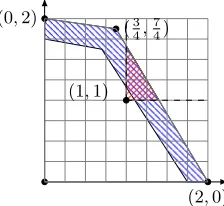
truth-fulness, proportionality, and feasibility as linear constraints. The objective is to maximize ρ, the Pareto approxima-tion factor, such that the outcome of the mechanism is guar-anteed to be within the ρ-approximate Pareto region. But, we run into the following issue:the intersection of the ρ -approximate Pareto region and the proportionality region in utility space is not always convex (see Figure 2). This means that, without a creative change of variables, this re-gion cannot be expressed using linear constraints. We there-fore identify a set of reported value profiles of the two agents for which this region is convex (e.g., see Figure 3), and we drop the Pareto constraints for all other value profiles. The resulting linear program solves a relaxed, discretized, ver-sion of the initial mechanism design problem. However, us-ing this formulation, we can now construct a dual program. A feasible solution to this dual program does, in fact, im-ply an impossibility result for nonuniform-blocking mech-anisms. Using this technique, we construct a feasible (and quite complicated) solution for the dual which yields the in-approximability bound of Theorem 4.2; the proof as well as the primal and dual formulations can be found in the full version of this paper.
Nonuniform-Blocking: Upper Bounds
(0,2)
(2,0) (5
4, 7 4)
(1,1)
Figure 2: The intersection of the approximate Pareto region and the proportionality region is not convex.
(0,2)
(2,0) (34,74)
(1,1)
Figure 3: The intersection of the approximate Pareto region and the proportionality region is convex.
in order to bring more of the public item in memory. The memory allocation mechanism can then be interpreted as an auction that defines the “price” that each agent needs to pay for accessing the public item. This mapping is very useful, as it enables us to use well-known results from mechanism design with payments in designing our mechanism.
Note that, ifv1=v2 = 0, i.e., both agents have no value
for the public item, then any proportional mechanism would have to output the allocation(0,1,1), i.e., one block of each private item and none of the public item, otherwise one of the agents would get a value less than 1. We interpret this outcome as both agents having a budget of1, which they are not willing to spend on the public item. Then, in instances where the value ofvi is higher, the mechanism may give
each agentithe opportunity to spend some of this budget in order to increasex0. Using this interpretation, when the two
agents’ reportedvivalues are high, i.e., when there is room
for cooperation among them, we wish to design a mecha-nism that provides them with the opportunity to “buy-into” the public item, at the appropriate price. As a result, a good mechanism needs to address the tension between efficiency, truthfulness, and proportionality, by carefully deciding the rate at which an agent can trade her private item blocks for a fraction of the public item.
The seminal work of Myerson (1981) dictates what the structure of a truthful mechanism needs to be in a setting with actual monetary payments. It restricts the allocation rule to being monotone and it also defines the form that the pricing rule should obey. Given the interpretation of the private item as a budget, we derive an analog of Myerson’s
characterization, which (1) restricts the functionx0(v1, v2)
implied by the mechanism to be (weakly) monotone, and (2) dictates the exact rate at which each agentican exchange her private item for the public item asvi changes, i.e., exactly
how fastxi needs to drop as a function of anx0increase.
This allows us to only worry about choosingx0(v1, v2).
Lemma 4.3. A mechanism is truthful for agentiif and only if for any fixed value ofv−ireported by the other agent, the
following two properties are satisfied:
1. x0(vi, v−i)is a monotone non-decreasing function ofvi.
2. For some functionci(.)that depends only onv−i,
xi(vi, v−i) =−vix0(vi, v−i) +vi
Z vi
0
x0(z, v−i)dz
+xi(0, v−i) +ci(v−i).
We use this characterization to design the following mechanism, whose presentation will be in two parts. We first address what the mechanism does when neither of the agents prefers the public item to her private item, i.e., whenv1≤1
andv2 ≤ 1. In this set of instances, our mechanism does
not take advantage of its nonuniform blocking power and, instead, uses only uniform blocking. We then move on to de-scribe the mechanism for the remaining instances, in which nonuniform blocking plays a crucial role.
Instances withv1 ≤1andv2 ≤1. The mechanism that
we propose, the Buy-Inmechanism, decides how much of the public item to bring into memory as a function of the productv1v2. If this product is at least1/4, then the amount
of the public item that is brought into memory grows log-arithmically as a function ofv1v2. It starts from a value of
x0 = 0whenv1v2 = 1/4and it goes up to 43ln 4 ≈1.84
when v1 = v2 = 1. The productv1v2captures, in a very
symmetric fashion, the extent to which there is room for co-operation. Our mechanism allows the agents to take advan-tage of that, as the product increases. On the other hand, if the product is less than1/4, the mechanism lets the agents keep their budgets unspent.
Given a function forx0(v1, v2), the form of thex1(v1, v2)
andx2(v1, v2)is implied, up to a constant transformation,
by Lemma 4.3, in order to ensure the truthfulness. Since
x0(v1, v2)grows logarithmically with v1, Lemma 4.3
im-plies thatx1(v1, v2)should decrease linearly. However, the
exact form ofx1(v1, v2)andx2(v1, v2)that we have chosen
below also ensures that the memory is never over-allocated, while providing good Pareto guarantees as well.
Algorithm 2:*
1 Buy-In mechanism forv1, v2≤1. ifv1v2≥1/4then 2 x0(v1, v2) = 43ln (4v1v2)
3 x1(v1, v2) = 3v2−4v1v2+1
3v2
4 x2(v1, v2) = 3v1−4v1v2+1
3v1
5 else
Instances withmax{v1, v2}>1. Since we have not used
nonuniform blocking so far, Theorem 4.1 implies that, to achieve more than50%approximation, wemustuse nonuni-form blocking in the remaining instances. A closer look at the proof of Theorem 4.1 reveals that a crucial truthfulness constraint relates to a deviation from an instance withv1>1
andv2 ≤ 1to one with bothv1 ≤1andv2 ≤ 1. In other
words, an agent who prefers the public item pretending to prefer her private one. For uniform-blocking mechanisms, this truthfulness constraint restricts the efficiency that can be guaranteed at the initial instance; nonuniform blocking alleviates these type of incentive issues. In particular, as the value ofviincreases, the moment it exceeds1, we exchange
all of agenti’s private item with an equal fraction of the pub-lic item,but block the other agent from accessing it. Further-more, in terms of the allocation of the other agent, whetheri
reportsvi = 1or anyvi>1makes no difference. In
Algo-rithm 3, note that the value ofx0(1, v2)whenv2≤1is
bor-rowed from the Buy-In mechanism for both values are less or equal to 1, i.e.,x0(1, v2) = 43ln (4v2), and similarly for
all other allocations of(1, v2)or(v1,1)whenv1orv2≤1.
Algorithm 3:Buy-In mechanism formax{v1, v2}>1.
1 if v1>1andv2≤1then
2 x0(v1, v2) =x0(1, v2) +x1(1, v2)
3 x1(v1, v2) = 0, andf1(v1, v2) =x0(v1, v2)
4 x2(v1, v2) =x2(1, v2), andf2(v1, v2) =x0(1, v2)
5 else if v2>1andv1≤1then
6 x0(v1, v2) =x0(v1,1) +x2(v1,1)
7 x1(v1, v2) =x1(v1,1), andf1(v1, v2) =x0(v1,1)
8 x2(v1, v2) = 0, andf2(v1, v2) =x0(v1, v2)
9 else ifv1>1andv2>1then
10 x1(v1, v2) =x2(v1, v2) = 0, and
f1(v1, v2) =f2(v1, v2) =x0(v1, v2) =43ln(4)
The non-trivial proof of the following result (see the full version of this paper) carefully analyzes the mechanism in terms of the tricky approximation measure based on Pareto efficiency.
Theorem 4.4. The Buy-In mechanism is anonymous, pro-portional, truthful, and it guarantees a83%approximation of Pareto.
5
Instances with Multiple Agents
This section studies the power and limitations of anony-mous, proportional and truthful memory sharing mecha-nisms for instances with multiple agents. Just like in two-agent instances, we show that uniform blocking mechanisms hit a significant road-block. The crucial information, which implies how much of the public item should be placed in memory, is how much the agents value the public item com-pared to their private item. If no agent values the public item then, clearly, none of it should be placed in memory. But, if enough agents have considerable value for this item, then they may benefit by sharing the public item using the mem-ory that their private items would otherwise occupy. In thissetting, even the task of figuring out the optimal outcome is not straightforward, let alone resolving the issue of agents misreporting their preferences.
We first prove that uniform blocking mechanisms fail to achieveanyconstant approximation of Pareto. We comple-ment this result by providing a nonuniform-blocking mech-anism that guarantees a 1− 1
e ≈ 63% approximation of
Pareto. The proofs missing from this section can be found in the full version of this paper.
Uniform Blocking
For the special case of two-agent instances where the agents prefer their private item, our Buy-In mechanism achieved a good approximation using only uniform blocking (Sec-tion 4). Surprisingly, we prove that all attempts to extend this result ton-agent instances are hopeless: even if all the agents prefer their private items, the ideas used by the Buy-In and, in fact, all uniform blocking mechanisms fail to achieve a constant approximation. Intuitively, when many agents are present, it becomes much more tempting to free-ride on the public item.
Theorem 5.1. There is no anonymous, proportional and truthful uniform blocking mechanism that can guarantee a constant approximation of Pareto for any number of agents.
Proof Sketch. Since private items have value1, if a sizeable group of agents report a value of1/√nfor the public item, any mechanism with good Pareto guarantees should bring in memory a lot of the public item. If a sequence of agents starts changing their valuation from1/√nto0, the propor-tionality property dictates that they should receive a block of their private file and Lemma 4.3 dictates that the devi-ating agents should “pay” something in exchange for any extra amount of this private file. The “payment” is the allo-cation of the public item. Since nonuniform blocking is not allowed, that payment has to affect all agents. This tension allows us to prove this very strong negative result.
To gain a better understanding of the effect that propor-tionality plays in the lower bound of Theorem 5.1, we also provide a lower bound that does not leverage this property. The following theorem shows that, even if we were will-ing to relax the proportionality constraint, no truthful and anonymous mechanism can combine anω(1/√n) approxi-mation of strong Pareto with a guarantee that every agenti
gets a value ofω(vi/
√
n). The proof uses similar ideas with the previous proof, but a longer sequence of deviations is required for the argument to go through.
Theorem 5.2. No truthful and anonymous uniform block-ing mechanism can simultaneously guarantee anω(1/√n)
approximation of strong Pareto and anω(1/√n) approxi-mation of proportionality.
Nonuniform Blocking
Our final result is theOpt-Outmechanism, an anonymous, proportional and truthful mechanism for instances with mul-tiple agents that uses nonuniform blocking and guarantees a
1 − 1
e ≈ 63% approximation of Pareto. This mechanism
item in memory. If there exists some agent iwhose value for a block of her private item is greater than her value for
nblocks of the public item, then a block of the public file is replaced by a block of filei, i.e.,xi←1andx0←x0−1.
This agentiis then blocked from accessing any remaining fractions of the public item (fi= 0). Among the remaining
agents, if there exists some other agent whose value for a block with her private itemiis greater than her value for the remainingn−1blocks of the public file, the same process is repeated, and this continues until either all agents switch to their private files or no other agent prefers that switch.
Algorithm 4:The Opt-Out mechanism.
1 Letx0=nandS={1,2, . . . n}.
2 while there exists an agentisuch thatvix0≤1do
3 RemoveifromS
4 Setxi←1andx0←x0−1
5 fi= 0for alli /∈S.
Theorem 5.3. The Opt-Out mechanism is anonymous, pro-portional and truthful, and achieves a1−1
e ≈63%
approx-imation of Pareto.
Proof Sketch. Proving that Opt-Out is anonymous, propor-tional, and truthful is relatively straightforward. On the other hand, the proof of the Pareto approximation is quite in-volved. We start by identifying the worst case instances for Opt-Out. Specifically, we show that among alln-agent in-stances, the instances where agenti reportsvi = 1/(n− i+ 1) (we call these “harmonic” instances) are the ones where the approximation factor of Opt-Out is minimized. Notice that in a harmonicn-agent instance, all agents choose their private file instead of participating in sharing the pub-lic file, which we refer to as having opted-out. In order to show that harmonic instances are the worst case instances, we show that given a worst case instance I whereq < n
agents opt-out, we can construct an instanceI0where an ad-ditional agent opts-out and the Pareto approximation inI0
is no better than the one inI. Therefore, we can focus on instances where all agents opt-out; among all such instances barely opting out is the worst case.
Having shown that harmonic instances are worst case in-stances for Opt-Out, in order to conclude the proof of The-orem 5.3 we need to also prove that the optimal allocation for ann-agent harmonic instance is not more thane−e1times better than Opt-Out. Our approach works as follows. First, we constrain the optimal solution such that exactlykout ofn
agents get a non-zero amount of their private item. Subject to this constraint, we can characterize the optimal solution and pinpoint the agent who improves the most by switching from the allocation of Opt-Out. Her improvement is a func-tionh(k, n)that we give a closed form for. We proceed to optimizeh(k, n). We show that the gap in performance be-tween Opt-Out and the optimal allocation is maximized for
ngoing to infinity, and somek∗∈Θ(n). The approximation ratio follows. More details are relegated to the full version of this paper.
6
Discussion
We conclude with a brief discussion on some central aspects of the memory allocation setting. We first briefly discuss why linear valuations are very-well justified in memory al-location. Then, we address how bidding and manipulation may actually take place in a real system where valuations are not necessarily reported by the users in the form of a bid. Finally, we also provide some additional context regarding the fairness constraint that we enforced.
Linearity of Valuations. First, this assumption is quite re-alistic in memory sharing: in a real system an agent’s utility is proportional to the time the agent saves due to the cache. Each agent requests access to a file and needs to retrieve all of its memory blocks; accessing a memory block from the main memory takes time t1, while accessing a block
from the cache takes much less timet2. Every time an agent
finds a requested block in cache impliest1−t2time saved.
Item valuations are proportional to their request frequency, hence, each item’s contribution to an agent’s utility is linear in the number of blocks of the item in cache and the valua-tion of the agent for the item. Equivalently, an agent’s utility is proportional to its expected cache hit-rate (also see (Yu et al. 2018; Pu et al. 2016), who make the same assumption). More importantly, the allocation outcome can be interpreted as time-sharing (the fractions correspond to how often a file is in memory) or a randomized choice of outcomes, in which case the linearity of expectation provides an alternative jus-tification.
Direct Revelation Mechanisms. For simplicity’s sake, we present our model as if the agents actually send a mes-sage to the mechanism, reporting their valuations. In re-ality, rather than eliciting bids, the system can just ob-serve the agents’ requests and regularly infer their valu-ations based on these requests. Due to locality of refer-ence, memory access patterns are good predictors of fu-ture requests so there is no need for the agents to actu-ally communicate their values. Analyzing direct revelation mechanisms, which are subsequently implemented as dy-namic systems is very common (e.g., (Ghodsi et al. 2011; 2013)).
Manipulation. Even if the mechanism observes theactual requests of the agents, the agents can still manipulate the valuations that the mechanism infers. Specifically, they can generate excessive spurious requests for an item that they do not really need, thus increasing its inferred valuation. At first glance it seems like an agent can hence only increase and not reduce a valuation, but this is not the case! Note that both proportionality and (approximate) Pareto efficiency are scale-independent measures (they are unaffected by scaling all of an agent’s valuations by some constant). Hence, an agent can decrease its (relative) valuation for an item by sim-ply generating excessive requests for all other items.
most fundamental and widely used measures in fair division, and it also known as “sharing incentives”, “stand-alone”, or “isolation guarantee” in systems. By default, memory is di-vided into equal pieces, isolating each agenti, but guarantee-ing them a value ofvi. Proportionality requires that
switch-ing from this naive solution to another outcome should be a Pareto improvement: no participant should be worse-off than this “outside option” that the isolation offers. This is an analog of what is known as “individual rationality” in mech-anism design: no agent should lose value for participating.
7
Acknowledgments
This work is supported by the National Science Foundation, under grants CCF-1755955, CCF-1216073, CNS-1161813, and CNS-1704941.
References
Chen, Y.; Lai, J. K.; Parkes, D. C.; and Procaccia, A. D. 2013. Truth, justice, and cake cutting.Games and Economic Behavior77(1):284–297.
Cole, R.; Gkatzelis, V.; and Goel, G. 2013a. Mechanism design for fair division: allocating divisible items without payments. In ACM Conference on Electronic Commerce, EC 2013, 251–268.
Cole, R.; Gkatzelis, V.; and Goel, G. 2013b. Positive re-sults for mechanism design without money. InInternational conference on Autonomous Agents and Multi-Agent Systems, AAMAS ’13, Saint Paul, MN, USA, May 6-10, 2013, 1165– 1166.
Conitzer, V.; Freeman, R.; and Shah, N. 2017. Fair public decision making. InProceedings of the 2017 ACM Confer-ence on Economics and Computation, EC ’17, Cambridge, MA, USA, June 26-30, 2017, 629–646.
Dickerson, J. P.; Goldman, J. R.; Karp, J.; Procaccia, A. D.; and Sandholm, T. 2014. The computational rise and fall of fairness. InAAAI, volume 14, 1405–1411.
Fain, B.; Munagala, K.; and Shah, N. 2018. Fair allocation of indivisible public goods. InProceedings of the 2018 ACM Conference on Economics and Computation, EC ’18, 575– 592.
Friedman, E.; Ghodsi, A.; and Psomas, C.-A. 2014. Strate-gyproof allocation of discrete jobs on multiple machines. In Proceedings of the fifteenth ACM conference on Economics and computation, 529–546. ACM.
Ghodsi, A.; Zaharia, M.; Hindman, B.; Konwinski, A.; Shenker, S.; and Stoica, I. 2011. Dominant resource fair-ness: Fair allocation of multiple resource types. InNSDI, volume 11, 24–24.
Ghodsi, A.; Zaharia, M.; Shenker, S.; and Stoica, I. 2013. Choosy: Max-min fair sharing for datacenter jobs with con-straints. InProceedings of the 8th ACM European Confer-ence on Computer Systems, 365–378. ACM.
Goldman, J., and Procaccia, A. D. 2015. Spliddit: Un-leashing fair division algorithms.ACM SIGecom Exchanges 13(2):41–46.
Groves, T., and Ledyard, J. 1977. Optimal allocation of pub-lic goods: A solution to the “free rider” problem. Economet-rica: Journal of the Econometric Society783–809.
Gutman, A., and Nisan, N. 2012. Fair allocation without trade. InProceedings of the 11th International Conference on Autonomous Agents and Multiagent Systems-Volume 2, 719–728. International Foundation for Autonomous Agents and Multiagent Systems.
Kunjir, M.; Fain, B.; Munagala, K.; and Babu, S. 2017. ROBUS: fair cache allocation for data-parallel workloads. InProceedings of the 2017 ACM International Conference on Management of Data, SIGMOD, 219–234.
Kurokawa, D.; Procaccia, A. D.; and Wang, J. 2016. When can the maximin share guarantee be guaranteed? InAAAI, volume 16, 523–529.
Kurokawa, D.; Procaccia, A. D.; and Wang, J. 2018. Fair enough: Guaranteeing approximate maximin shares. Jour-nal of the ACM (JACM)65(2):8.
Maya, A., and Nisan, N. 2012. Incentive compatible two player cake cutting. InInternational Workshop on Internet and Network Economics, 170–183. Springer.
Memcached. 2003. Memcached, a distributed memory ob-ject caching system. https://memcached.org/.
Myerson, R. B. 1981. Optimal auction design.Mathematics of operations research6(1):58–73.
Parkes, D. C.; Procaccia, A. D.; and Shah, N. 2015. Beyond dominant resource fairness: Extensions, limitations, and in-divisibilities.ACM Transactions on Economics and Compu-tation3(1):3.
Pu, Q.; Li, H.; Zaharia, M.; Ghodsi, A.; and Stoica, I. 2016. Fairride: Near-optimal, fair cache sharing. InProceedings of the 13th Usenix Conference on Networked Systems Design and Implementation, NSDI’16, 393–406. USENIX Associ-ation.
Redis. 2009. Redis. https://redis.io/.
Ruhe, G., and Fruhwirth, B. 1990. -optimality for bicri-teria programs and its application to minimum cost flows. Computing44(1):21–34.