Adv. Radio Sci., 9, 195–201, 2011 www.adv-radio-sci.net/9/195/2011/ doi:10.5194/ars-9-195-2011
© Author(s) 2011. CC Attribution 3.0 License.
Advances in
Radio Science
Performance of combined constellation shaping and bit interleaved
coded modulation with iterative decoding (BICM-ID)
T. Arafa, W. Sauer-Greff, and R. Urbansky
University of Kaiserslautern, Communications Engineering, Gottlieb-Daimler-Str., 67653 Kaiserslautern, Germany
Abstract. The increasing demand of achieving high data rates in modern communication systems requires highly ef-ficient bandwidth utilization. For this purpose, multilevel modulation schemes are used in association with forward er-ror correction (FEC) codes in order to approach the channel capacity. However, there is a gap between the capacity of a uniform signal constellation and the Shannon unconstrained capacity. This gap can be reduced by applying constella-tion shaping. The task of shaping is to modify a uniform distributed signal constellation towards a Gaussian like dis-tribution. In this paper, we investigate different approaches to combine the constellation shaping with a bit interleaved coded modulation with iterative decoding (BICM-ID) sys-tem. Simulation results show that this combination can offer a shaping gain up to 0.6 dB.
1 Introduction
Since the capacity of the additive white Gaussian noise (AWGN) channel was found by Shannon, most research in information theory is interested in designing a communi-cation system that operates close to Shannon’s limit. The channel capacity is the maximum mutual information be-tween channel input and output. The capacity of the AWGN channel for transmitted signals with Gaussian distribution is called as Shannon limit and it can be expressed with Shan-non’s formula (Shannon, 1948): C2−dim=log2(1+Es
No)
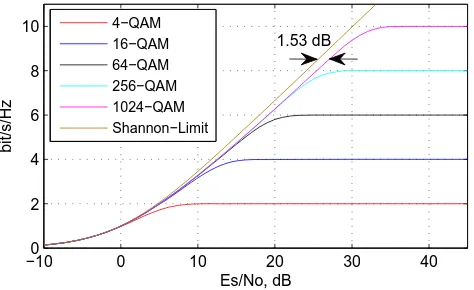
bit/s/Hz. Figure 1 shows the AWGN channel capacities with equiprobable M-QAM, for M=4,16,...,1024, compared with the Shannon limit. We observe from Fig. 1 that in the low SNR regime (<5 dB), the reduction in capacity due to using uniform signal constellation is negligible. Thus, in this case the binary coding techniques can approach the
capac-Correspondence to: T. Arafa
ity limit. On the other hand, high order modulation schemes likeM-QAM (M >4) have to be used for good channel con-ditions in order to increase the spectral efficiency. However, the use of equiprobable signal constellations leads to a loss ofπ e/6 (1.53 dB) due to using a uniform distribution rather than a Gaussian distribution over the signal set (Forney and Ungerboeck, 1998). Therefore, the use of powerful chan-nel coding with uniform constellation signal is not enough to achieve the capacity limit. The constellation shaping tech-nique that produces a Gaussian-like distribution over constel-lation points has also to be used to close the gap of 1.53 dB.
Higher level modulation schemes such asM-QAM can be used to achieve spectral efficient high data rate transmission over wireless, wireline, and optical links without increasing bandwidth. However, an increased density of the symbol constellation decreases its robustness against noise, which results in a high BER of the demapper. Therefore, the use of high order modulation schemes strongly requires channel coding to guarantee low BER at high bandwidth efficiency. Since an erroneous detected symbol may result in a burst of bit errors and channel codes are often sensitive to burst error, a permutation of the bit sequence has to be introduced be-tween coding and mapping, so-called interleaving. The con-catenation of channel coding, interleaving and modulation is denoted as a bit interleaved coded modulation (BICM). Iter-atively demapping and decoding BICM (BICM-ID) can im-prove the performance by exchanging the soft information between soft-demapper and channel decoder.
Constellation shaping is a method to shape an M-QAM signal constellation to follow the Gaussian distribution. Ac-tually, two techniques for constellation shaping have been mainly proposed in the literature. The first approach is to transmit the constellation points with unequal probability (Fischer, 2002; Khoo et al., 2006). The other is based on optimizing of the constellation points, i.e. using equiproba-ble signal constellations with unequal spacing (Sommer and Fettweis, 2000; Fischer, 2002; Djordjevic et al., 2010).
−100 0 10 20 30 40 2
4 6 8 10
Es/No, dB
bit/s/Hz
4−QAM 16−QAM 64−QAM 256−QAM 1024−QAM Shannon−Limit
1.53 dB
Fig. 1. The ideal AWGN channel capacities of equiprobableM -QAM signals compared with that of Gaussian signal.
The remainder of this paper is organized as follows. The concept of BICM-ID is briefly introduced in Sect. 2. In Sect. 3, the constellation shaping with different approaches including unequal probability and unequal spacing constella-tion points are presented. Since all BICM-ID systems suffer from an error floor, the inner precoding that can remove the error floor without adding extra redundancy bits is applied to the system in Sect. 4. Then, the chain of FEC coding, in-ner precoding and mapping will be optimized by means of extrinsic information transfer (EXIT) chart analysis. Simu-lation results and discussions are provided in Sect. 5. Finally, conclusions are drawn in Sect. 6.
2 BICM-ID concept
It is well accepted that the concatenation of code systems with iterative decoding can approach the channel capacity. The BICM-ID scheme is a special case of serial concatenated code systems where the turbo principle is applied between the inner decoder, i.e. the soft-demapper and the outer chan-nel decoder (ten Brink et al., 1998).
The block diagram of the BICM-ID scheme is depicted in Fig. 2. At the transmitter, the sequence ofkdata bits is firstly encoded into a codeword ofnbits by a recursive systematic convolutional (RSC) encoder where the code rate isR=k
n, which can be obtained, e.g., by puncturing. The encoded bits are randomly interleaved by a bit-wise interleaver. After interleaving, a group ofm coded bits is mapped onto one complex symbol ofM=2maccording to a mapping scheme. Therefore, the spectral efficiency of this system is given by
η=R·m bit/s/Hz. (1)
The originated complex symbols are corrupted by noise through the AWGN channel, so the received symbols are
r=y+n wheren is a complex circular symmetric Gaus-sian noise with zero mean and varianceNo/2 in each dimen-sion. At the receiver, and based on channel observationsr
−100 0 10 20 30 40
2 4 6 8 10
Es/No, dB
bit/s/Hz
4−QAM 16−QAM 64−QAM 256−QAM 1024−QAM Shannon−Limit
1.53 dB
Fig. 1.
The ideal AWGN channel capacities of equiprobable
M
-QAM signals compared with that of Gaussian signal.
The remainder of this paper is organized as follows. The
concept of BICM-ID is briefly introduced in Sect. 2. In
Sect. 3, the constellation shaping with different approaches
including unequal probability and unequal spacing
constella-tion points are presented. Since all BICM-ID systems suffer
from an error floor, the inner precoding that can remove the
error floor without adding extra redundancy bits is applied to
the system in Sect. 4. Then, the chain of FEC coding,
in-ner precoding and mapping will be optimized by means of
extrinsic information transfer (EXIT) chart analysis.
Simu-lation results and discussions are provided in Sect. 5. Finally,
conclusions are drawn in Sect. 6.
2
BICM-ID Concept
It is well accepted that the concatenation of code systems
with iterative decoding can approach the channel capacity.
The BICM-ID scheme is a special case of serial concatenated
code systems where the turbo principle is applied between
the inner decoder, i.e. the soft-demapper and the outer
chan-nel decoder (ten Brink et al., 1998).
The block diagram of the BICM-ID scheme is depicted in
Fig. 2. At the transmitter, the sequence of
k
data bits is firstly
encoded into a codeword of
n
bits by a recursive systematic
convolutional (RSC) encoder where the code rate is
R
=
kn,
which can be obtained, e.g., by puncturing. The encoded
bits are randomly interleaved by a bit-wise interleaver. After
interleaving, a group of
m
coded bits is mapped onto one
complex symbol of
M
= 2
maccording to a mapping scheme.
Therefore, the spectral efficiency of this system is given by
η
=
R
·
m
bit/sec/Hz.
(1)
The originated complex symbols are corrupted by noise
through the AWGN channel, so the received symbols are
r
=
y
+
n
where
n
is a complex circular symmetric
Gaus-sian noise with zero mean and variance
N
o/
2
in each
dimen-sion. At the receiver, and based on channel observations
r
and a-priori information of unmapped bits
L
Ma(at first
iter-ation
L
Ma= 0
), the soft-demapper calculates the a-posteriori
RSC
encoder
Mapperu
x
Soft-demapper
BCJR
decoder
1
n
y
r
M a
L
D a L
uˆ
D p
L
M p L
Fig. 2.
BICM-ID system model.
log-likelihood ratio (LLR) for each of the
m
coded bits per
symbol by using (ten Brink et al., 1998)
L
Mp(
x
k|
r
) =
L
Ma(
x
k)
+ln
P
y∈χ1 k
exp[
−
|r−y|2
No
+
m
P
j=1,j6=k
µ
−j1(
y
)
L
Ma(
x
j)]
P
y∈χ0 k
exp[
−
|r−Ny|2o
+
m
P
j=1,j6=k
µ
−j1(
y
)
L
M a(
x
j)]
,
(2)
where
µ
−j1(
y
)
gives the
j
-th bit of the symbol
y
while
χ
1k,χ
0kis the set of symbols having the
k
-th bit set to 1 and 0,
respec-tively. Then, the extrinsic information of the soft-demapper
L
Me=
L
Mp−
L
Mais deinterleaved to become the a-priori
in-put
L
Dato the outer soft-in/soft-out decoder, which gives the
a-posteriori value
L
Dpbased on the BCJR algorithm
(Hage-nauer, 1997). The extrinsic information of the outer decoder
L
De=
L
Dp−
L
Dais passed through the interleaver and fed
back as a-priori information
L
Mato the soft-demapper for the
next iteration.
As we have seen, only extrinsic information is exchanged
between inner soft-demapper and outer decoder at the
itera-tively decoded BICM system. Therefore, the performance of
this system can be analyzed and predicted by using the EXIT
chart (ten Brink, 1999). It is an efficient tool to visualize the
convergence behaviour and the BER floor of a concatenated
coding system. Moreover, it graphically shows the
relation-ship between the input mutual information against the
out-put mutual information from the soft-demapper and decoder
which help us to select the coding and mapping schemes that
match each other.
In this context, different EXIT characteristics of mapping
can be simply constructed by an irregular modulation
(modu-lation doping) that applies Gray as well as anti-Gray mapping
according to the doping ratio
α
=
N
anti−GrayN
anti−Gray+
N
Gray(3)
within the same transmitted block (Szczecinski et al., 2005).
3
Constellation Shaping
Constellation shaping is used to obtain a shaping gain over
uniform signaling. The ultimate shaping gain for high data
Fig. 2. BICM-ID system model.
and a-priori information of unmapped bitsLMa (at first iter-ationLMa =0), the soft-demapper calculates the a-posteriori log-likelihood ratio (LLR) for each of themcoded bits per symbol by using (ten Brink et al., 1998)
LMp(xk|r)=LMa (xk)
+ln P
y∈χk1
exp[−|r−y| 2
No +
m P
j=1,j6=k
µ−j1(y)LMa (xj)]
P
y∈χk0
exp[−|r−y| 2 No +
m P
j=1,j6=k
µ−j1(y)LM a (xj)]
, (2)
whereµ−j1(y)gives thej-th bit of the symbolywhileχk1,χk0
is the set of symbols having thek-th bit set to 1 and 0, respec-tively. Then, the extrinsic information of the soft-demapper
LMe =LMp −LMa is deinterleaved to become the a-priori in-putLDa to the outer soft-in/soft-out decoder, which gives the a-posteriori valueLDp based on the BCJR algorithm (Hage-nauer, 1997). The extrinsic information of the outer decoder
LDe =LDp −LDa is passed through the interleaver and fed back as a-priori informationLMa to the soft-demapper for the next iteration.
As we have seen, only extrinsic information is exchanged between inner soft-demapper and outer decoder at the itera-tively decoded BICM system. Therefore, the performance of this system can be analyzed and predicted by using the EXIT chart (ten Brink, 1999). It is an efficient tool to visualize the convergence behaviour and the BER floor of a concatenated coding system. Moreover, it graphically shows the relation-ship between the input mutual information against the out-put mutual information from the soft-demapper and decoder which help us to select the coding and mapping schemes that match each other.
In this context, different EXIT characteristics of mapping can be simply constructed by an irregular modulation (modu-lation doping) that applies Gray as well as anti-Gray mapping according to the doping ratio
α= Nanti−Gray
Nanti−Gray+NGray
(3)
within the same transmitted block (Szczecinski et al., 2005).
T. Arafa et al.: Performance of combined constellation shaping and BICM-ID 197 3 Constellation shaping
Constellation shaping is used to obtain a shaping gain over uniform signaling. The ultimate shaping gain for high data rates is 1.53 dB. Essentially, two approaches have been pro-posed for signal shaping. The first approach is to shape the signal constellation to have a non-uniform probability distri-bution. With the other approach, the signal constellation is non-uniformly spaced.
3.1 Shaping with non-uniform probability distribution over constellation points
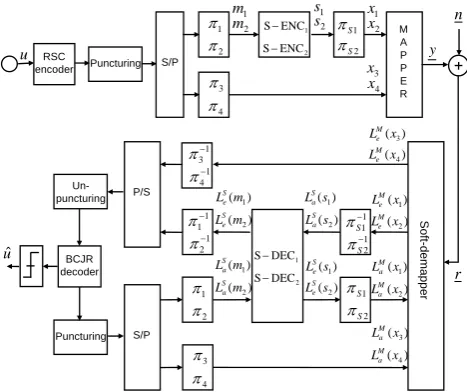
The basic idea of this approach is to transmit the symbols with unequal probability. In this case, the points with low energy, i.e. the points near the centre of the constellation are more frequently transmitted than the points with high en-ergy. For example, Khoo et al. (2006) proposed to divide the 16-QAM constellation into three sub-constellations with different power levels. The first sub-constellation contains four points with lowest energy, the eight points with medium energy forms the second sub-constellation and the third has four points with highest energy. Although every four bits are mapped onto one symbol, the first two bits can also be used to select one of these sub-constellations as follows: if we have 00 the first sub-constellation is chosen, 01 or 10 leads to the second and the third is selected for incoming bits 11. As we can see, we can obtain unequal probability over symbols if the first two bits fulfill this requirementPr(0) > Pr(1). This can be achieved by modifying the basic BICM-ID model as depicted in Fig. 3. The encoded sequence by a rate-RcRSC encoder is divided into four sequences by a serial-to-parallel (S/P) converter. Each sequence of the first and second com-posedKbits is interleaved tom1,2and then broken intoL successiveKs-bit blocks, whereK=L·Ks. TheseL suc-cessive blocks are serially fed to a rate-Rs shaping encoder (S-ENC) to generatesLsuccessiveNs-bit blocks, which re-sult inN-bit sequencess1,2, whereRs=KNss. The shaping encoder is designed so that the probability of a zero at the se-quencess1,2is maximized. Then, these twoN-bit sequences are interleaved tox1,2and passed to the mapper. Each of the third and fourth sequence already includesN bits and they are also interleaved tox3,4and passed to mapper. Thus, there are fourN-bit sequences at the input of the mapper to gen-erateN symbols, which fulfill the unequal probability dis-tribution. This transmission system is defined with spectral efficiency
η=2Rc(Rs+1) bit/s/Hz. (4)
At the receiver, the third and fourth sequences are directly processed between soft-demapper and channel decoder. A shaping decoder has to be used for the first and second se-quences. It accepts L blocks of a-priori information for info bits LSa(m1(k),m2(k)), k=1,...,Ks and for code bits
LSa(s1(n),s2(n)),n=1,...,Nswhich are generated from the
T. Arafa et al.: Performance of Combined Constellation Shaping and BICM-ID
3
rates is 1.53 dB. Essentially, two approaches have been
pro-posed for signal shaping. The first approach is to shape the
signal constellation to have a non-uniform probability
distri-bution. With the other approach, the signal constellation is
non-uniformly spaced.
3.1
Shaping with Non-uniform Probability Distribution
over Constellation Points
The basic idea of this approach is to transmit the symbols
with unequal probability. In this case, the points with low
energy, i.e. the points near the centre of the constellation
are more frequently transmitted than the points with high
en-ergy. For example, (Khoo et al., 2006) proposed to divide
the 16-QAM constellation into three sub-constellations with
different power levels. The first sub-constellation contains
four points with lowest energy, the eight points with medium
energy forms the second sub-constellation and the third has
four points with highest energy. Although every four bits are
mapped onto one symbol, the first two bits can also be used to
select one of these sub-constellations as follows: if we have
00 the first sub-constellation is chosen, 01 or 10 leads to the
second and the third is selected for incoming bits 11. As we
can see, we can obtain unequal probability over symbols if
the first two bits fulfill this requirement
P
r(0)
> P
r(1)
. This
can be achieved by modifying the basic BICM-ID model as
depicted in Fig. 3. The encoded sequence by a rate-
R
cRSC
encoder is divided into four sequences by a serial-to-parallel
(S/P) converter. Each sequence of the first and second
com-posed
K
bits is interleaved to
m
1,2and then broken into
L
successive
K
s-bit blocks, where
K
=
L
·
K
s. These
L
suc-cessive blocks are serially fed to a rate-
R
sshaping encoder
(S-ENC) to generates
L
successive
N
s-bit blocks, which
re-sult in
N
-bit sequences
s
1,2, where
R
s=
KNss. The shaping
encoder is designed so that the probability of a zero at the
se-quences
s
1,2is maximized. Then, these two
N
-bit sequences
are interleaved to
x
1,2and passed to the mapper. Each of the
third and fourth sequence already includes
N
bits and they
are also interleaved to
x
3,4and passed to mapper. Thus, there
are four
N
-bit sequences at the input of the mapper to
gen-erate
N
symbols, which fulfill the unequal probability
dis-tribution. This transmission system is defined with spectral
efficiency
η
= 2
R
c(
R
s+ 1)
bit/sec/Hz.
(4)
At the receiver, the third and fourth sequences are directly
processed between soft-demapper and channel decoder. A
shaping decoder has to be used for the first and second
se-quences.
It accepts
L
blocks of a-priori information for
info bits
L
Sa(
m
1(
k
)
,m
2(
k
))
,
k
= 1
,...,K
sand for code bits
L
Sa(
s
1(
n
)
,s
2(
n
))
,
n
= 1
,...,N
swhich are generated from
the RSC decoder and soft-demapper, respectively, and
cal-culates using these values the
L
blocks of extrinsic
infor-mation for info bits
L
Se(
m
1(
k
)
,m
2(
k
))
and for code bits
L
Se(
s
1(
n
)
,s
2(
n
))
which are passed to the RSC decoder and
RSC encoder S/P 1 2 3 4 1 ENC S 2 ENC S 1 m 2 m u 1 S 2 S 1 x 2 x 3 x 4 x M A P P E R BCJR decoder ) (x1 LM e Soft-demapp er 1 2 1 1 1 2 3 4 1 3 1 4 P/S S/P ˆ u ) (x2 LM
e ) (x3 LM
e ) (x4 LM
e
) (x2 LM
a ) (x1 LM
a
) (x3 LM
a ) (x4 LM a 2 s1 s ) (s1 LS
a ) (s2 LS
a
) (m1 LS
a ) (m2 LS
a
) (s1 LS
e ) (s2 LS
e ) (m1 LS
e ) (m2 LS e 1 1 S 1 2 S 1 S 2 S 1 DEC S 2 DEC S y n r Puncturing Un- puncturing Puncturing
Fig. 3.
BICM-ID system to shape 16-QAM with a shaping coding.
soft-demapper, respectively. Thus, the shaping decoder
cal-culates the extrinsic information of both info bits and code
bits based on the maximum a-posteriori algorithm (Khoo et
al., 2006)
L
Se(
m
(
k
)) = ln
P
M∈Ω1
k
exp(
A
)
P
M∈Ω0
k
exp(
A
)
,
(5)
where
A
=
Ks
X
l=1,l6=k
t
l·
L
Sa(
m
(
l
)) +
NsX
n=1
t
n·
(
L
Sa(
s
(
n
))
−
L
n)
,
(6)
Ω
1k,
Ω
0kis the set of all possible blocks
M
of info having the
k
-th bit set to 1 and 0, respectively,
t
lis the value of the
l
-th bit in -the block
M
under consideration,
t
nis the value of
the
n
-th bit in the codeword
S
associated to this particular
block,
L
n= ln
PPrr{{ss((nn)=1)=0}}is the a-priori knowledge of bit
s
(
n
)
before the first iteration starts. Analogously
L
Se(
s
(
n
)) = ln
P
S∈∆1
n
exp(
B
)
P
S∈∆0
n
exp(
B
)
,
(7)
where
B
=
Ks
X
k=1
t
k·
L
Sa(
m
(
k
)) +
NsX
l=1,l6=n
t
l·
(
L
Sa(
s
(
l
))
−
L
l)
,
(8)
∆
1n,
∆
0nis the set of all possible codewords
S
having the
n
-th
bit set to 1 and 0, respectively,
t
lis the value of the
l
-th bit
in the codeword
S
under consideration, and
t
kis the value
of the
k
-th bit in the block
M
associated to this particular
codeword.
3.2
Shaping with Non-uniform Spacing of Constellation
Points
It was proved in (Sommer and Fettweis, 2000; Fischer, 2002;
Djordjevic et al., 2010) that by using equally likely signal
Fig. 3. BICM-ID system to shape 16-QAM with a shaping coding.
RSC decoder and soft-demapper, respectively, and calculates using these values theLblocks of extrinsic information for info bitsLSe(m1(k),m2(k))and for code bitsLSe(s1(n),s2(n)) which are passed to the RSC decoder and soft-demapper, re-spectively. Thus, the shaping decoder calculates the extrinsic information of both info bits and code bits based on the max-imum a-posteriori algorithm (Khoo et al., 2006)
LSe(m(k))=ln P
M∈1k exp(A)
P
M∈0k
exp(A), (5)
where
A= Ks X
l=1,l6=k
tl·LSa(m(l))+ Ns X
n=1
tn·(LSa(s(n))−Ln), (6)
1k,0k is the set of all possible blocksMof info having the
k-th bit set to 1 and 0, respectively,tlis the value of thel-th bit in the blockMunder consideration,tnis the value of the
n-th bit in the codewordSassociated to this particular block,
Ln=lnPPrr{{s(n)s(n)==10}}is the a-priori knowledge of bits(n)before
the first iteration starts. Analogously
LSe(s(n))=ln P
S∈11
n
exp(B)
P
S∈10
n
exp(B), (7)
where
B= Ks X
k=1
tk·LSa(m(k))+ Ns
X
l=1,l6=n
tl·(LSa(s(l))−Ll), (8)
11n,10nis the set of all possible codewordsShaving then-th bit set to 1 and 0, respectively,tl is the value of thel-th bit
−1.5 −1 −0.5 0 0.5 1 1.5 −1.5
−1 −0.5 0 0.5 1 1.5
Imaginary Part
Real Part
64 NU−QAM
(a)
−2 −1 0 1 2 −2
−1 0 1 2
Imaginary Part
Real Part (b) 64−IPQ
Fig. 4. Signal constellations of (a) 64-NU-QAM and (b) 64-IPQ.
in the codewordS under consideration, andtk is the value of the k-th bit in the blockM associated to this particular codeword.
3.2 Shaping with non-uniform spacing of constellation points
It was proved in Sommer and Fettweis (2000), Fischer (2002), and Djordjevic et al. (2010) that by using equally likely signal points with unequal spacing the capacity limit can also be approached. In this method, the shaping gain can be obtained without any additional computational effort.
For optimizing the rectangular M-QAM constellation points, each dimension (i.e.N-ASK withN=
√
M) is op-timized as follows. The probability of eachN-ASK point is 1/N, but the coordinatesxi, i=1,2,...,N, of the points are chosen appropriately. Therefore, the Gaussian cumula-tive distribution function (CDF), which has value between zero and one, is partitioned intoN equal parts withN+1 boundaries Ni , i=0,1,...,N. The coordinatesxi of the sig-nal points are then given as the centroids of these parts
i N+i
−1
N
2 =
2i−1
2N , namely,
xi=CDF−1 2i−1
2N
=
√ 2 erf−1
2i−1−N
N
, (9) wherei=1,2,...,N. For example, Fig. 4a shows the non-uniform QAM signal constellation with 64 points (64-NU-QAM) while the channel capacity for this constellation is depicted in Fig. 5. We can see that the 64-NU-QAM constel-lation is close to the optimum and outperforms the classical 64-QAM if the capacity is less than 5 bit/s/Hz.
On the other hand, the two dimensions of the circular QAM constellation can be jointly optimized. The optimized complex symbols have to follow a complex Gaussian distri-bution. The amplitude and phase of a complex Gaussian ran-dom variable are independent and conform a Rayleigh and a uniform distribution, respectively. By using this idea, the optimal circular signal constellation is generated based on an iterative polar quantization IPQ procedure (Djordjevic et al., 2010). In IPQ, the constellation points are distributed over the circles of radius determined by the Rayleigh distribution. Therefore, the circular M-QAM constellation is optimized
−100 −5 0 5 10 15 20 25
1 2 3 4 5 6
Es/No, dB
bit/s/Hz
64−QAM 64−NU−QAM Shannon−Limit
Fig. 5. Channel capacity of 64-NU-QAM versus 64-QAM.
−100 −5 0 5 10 15 20 25
1 2 3 4 5 6
Es/No, dB
bit/s/Hz
64−QAM 64−IPQ Shannon−Limit
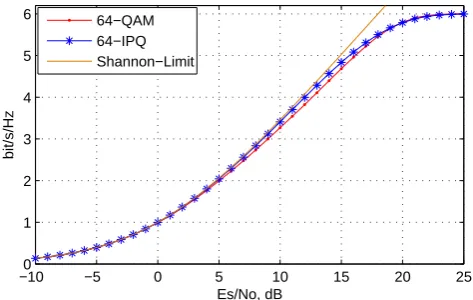
Fig. 6. Channel capacity of 64-IPQ versus 64-QAM.
to get anM-IPQ constellation based on the minimum mean square quantization error (Djordjevic et al., 2010). The op-timum number of pointsLi peri-th circle with radiusmi is determined by (Djordjevic et al., 2010)
Li= 3 q
m2iRri+1 ri p(r)dr
Lr
P
i=2 1 M 3
q
m2iRri+1 ri p(r)dr
, i=1,2,...,Lr, (10)
whereLr is the number of circles in the constellation and
p(r)is the Rayleigh distribution function. The radius of the
i-th circle is determined by
mi=
2sin(1θi/2) Rri+1
ri rp(r)dr
1θiRrri+1
i p(r)dr
, 1θi= 2π Li
. (11)
The limits of integration in Eqs. (10) and (11) are determined by
ri=
π(m2i−m2i−1)
2[miLisin(1θi/2)−mi−1Li−1sin(1θi−1/2)]
. (12)
T. Arafa et al.: Performance of combined constellation shaping and BICM-ID 199
T. Arafa et al.: Performance of Combined Constellation Shaping and BICM-ID 5
) (t x
0 modp t
0 modp t
Fig. 7.Additional inner rate-one RSC code with doping.
This problem can be solved if the tail of the soft-demapper curve (for IM
a >0.5) is bent up to reach point (1,1)
with-out lowering it forIaM<0.5. This can be achieved by using
a doping precoder (Pfletschinger and Sanzi, 2004). By this approach, a rate-1 RSC is inserted between interleaver and mapper as depicted in Fig. 7. The output of the inner encoder is doped where every p-th info bit is replaced by a coded bit and thus the rate is maintained. This scheme is defined with a doping periodp, which has to be chosen rather high to achieve the mentioned requirement as shown in Fig. 8.
0 0.2 0.4 0.6 0.8 1
0 0.1 0.2 0.3 0.4 0.5 0.6 0.7 0.8 0.9 1
I
A "a−priori information"
IE
"Extrinsic information"
doping period p=1 doping period p=10 doping period p=50 without precoding
RSC with R=0.5 and G=[23,35] RSC with R=0.5 and G=[07,05]
Fig. 8.EXIT chart of 64-IPQ mapping with different doping periods atEb/No= 5.25dB.
5 Simulation Results
Figure 9 shows the BER performance of the BICM-ID sys-tems applying an anti-Gray 16-QAM mapping scheme with-out and with a shaping encoder at spectral efficiencyη= 2 bit/sec/Hz. To ensure that both schemes operate at the same spectral efficiency, we used a rate 1/2 RSC code with genera-tor polynomials in octal form G=[23,35] for the original sys-tem and a rate 2/3 punctured RSC code with a rate 1/2 ing encoder for the system with shaping coding. The shap-ing encoder receives the info bits blockwise withKs= 7and
generates the corresponding codeword withNs= 14which
results in moderate complexity. As can be seen from Fig. 9, the system with a shaping encoder is 0.61 dB better than the original system at BER= 10−3. However, this scheme shows an error floor occurring at BER≈10−5due to the relatively poor error capabilities of a punctured rate 2/3 RSC code.
4 4.5 5 5.5 6
10−5
10−4 10−3
10−2 10−1
100
Eb/No, dB
Bit Error Rate
original system with shpaing encoder
Fig. 9.Performance of BICM-ID with and without shaping encoder after 10 iterations.
The performance of a BICM-ID system for both uniform (64-QAM) and non-uniform (64-UN-QAM) spacing of con-stellation points with different mapping schemes, Gray, anti-Gray and modulation doping (α= 0.5) is depicted in Fig. 10. The corresponding EXIT chart is shown in Fig. 11. The sim-ulation results show that the optimized rectangular constella-tion 64-NU-QAM offers an improvement of 0.33 dB for all mapping schemes. On the other hand, the modulation doping (α= 0.5) combines the benefits of both Gray and anti-Gray mapping and outperforms the both, where it reaches to the turbo cliff at low SNR but suffer then from error floor as explained in Sec. 4. These results match to the EXIT chart where the soft-demapper curve is slightly shifted towards the top by using 64-NU-QAM for Gray, anti-Gray and modula-tion doping which means an increase in the capacity.
4 5 6 7 8 9 10 11 12
10−6 10−5 10−4
10−3
10−2 10−1
100
Eb/No, dB
Bit Error Rate
Gray 64−QAM Gray 64−NU−QAM anti−Gray 64−QAM anti−Gray 64−NU−QAM
α=0.5 , 64−QAM
α=0.5 , 64−NU−QAM
0.33 dB
Fig. 10. BER of BICM-ID with different 64-QAM mapping schemes after 14 iterations.
Finally, the performance of BICM-ID systems with 16-IPQ and 64-16-IPQ mapping are evaluated. Since the construct-ing of Gray and anti-Gray mappconstruct-ing schemes for arbitraryM -IPQ constellations is not easy, we try to construct the map-ping schemes for 16-IPQ and 64-IPQ so that the proposed schemes match the outer RSC coding with a memory size of 4. The proposed mapping schemes for 16-IPQ and 64-IPQ are depicted in Fig. 12. The use of 16-IPQ and 64-IPQ of-fers an improvement of 0.32 dB and 0.12 dB at BER=10−3 compared with 16-NU-QAM and 64-NU-QAM with doping ratioα= 0.5, respectively.
Fig. 7. Additional inner rate-one RSC code with doping.
0 0.2 0.4 0.6 0.8 1
0 0.1 0.2 0.3 0.4 0.5 0.6 0.7 0.8 0.9 1
I
A "a−priori information"
I E
"Extrinsic information"
doping period p=1 doping period p=10 doping period p=50 without precoding
RSC with R=0.5 and G=[23,35] RSC with R=0.5 and G=[07,05]
Fig. 8. EXIT chart of 64-IPQ mapping with different doping periods
atEb/No=5.25 dB.
In Fig. 4b we depict the 64-IPQ constellation. The corre-sponding channel capacity is shown in Fig. 6. As we can ob-serve from this figure, the 64-IPQ constellation is very close to the Shannon limit and outperforms significantly the clas-sical 64-QAM for low and medium SNRs.
4 Error floor problem at BICM-ID systems
In general, all BICM-ID systems suffer highly from an error floor. The reason of this phenomenon can be explained using an EXIT chart. The EXIT-characteristic of soft-demappers mostly does not reach to the point (1,1), i.e. the intersection between the EXIT curves of soft-demapper and decoder is at
IeM<1 forIaM≈1. This means that even for ideal a-priori information, the obtained extrinsic information is not perfect and some bit errors remain.
This problem can be solved if the tail of the soft-demapper curve (for IaM>0.5) is bent up to reach point (1,1) with-out lowering it forIaM<0.5. This can be achieved by using a doping precoder (Pfletschinger and Sanzi, 2004). By this approach, a rate-1 RSC is inserted between interleaver and mapper as depicted in Fig. 7. The output of the inner encoder is doped where everyp-th info bit is replaced by a coded bit and thus the rate is maintained. This scheme is defined with a doping period p, which has to be chosen rather high to achieve the mentioned requirement as shown in Fig. 8.
4 4.5 5 5.5 6
10−5 10−4 10−3 10−2 10−1 100
Eb/No, dB
Bit Error Rate
original system with shpaing encoder
Fig. 9. Performance of BICM-ID with and without shaping encoder
after 10 iterations.
4 5 6 7 8 9 10 11 12
10−6 10−5 10−4 10−3 10−2 10−1 100
Eb/No, dB
Bit Error Rate
Gray 64−QAM Gray 64−NU−QAM anti−Gray 64−QAM anti−Gray 64−NU−QAM α=0.5 , 64−QAM α=0.5 , 64−NU−QAM
0.33 dB
Fig. 10. BER of BICM-ID with different 64-QAM mapping schemes after 14 iterations.
5 Simulation results
Figure 9 shows the BER performance of the BICM-ID sys-tems applying an anti-Gray 16-QAM mapping scheme with-out and with a shaping encoder at spectral efficiency η= 2 bit/s/Hz. To ensure that both schemes operate at the same spectral efficiency, we used a rate 1/2 RSC code with gener-ator polynomials in octal formG= [23,35]for the original system and a rate 2/3 punctured RSC code with a rate 1/2 shaping encoder for the system with shaping coding. The shaping encoder receives the info bits blockwise withKs=7 and generates the corresponding codeword with Ns=14 which results in moderate complexity. As can be seen from Fig. 9, the system with a shaping encoder is 0.61 dB bet-ter than the original system at BER=10−3. However, this scheme shows an error floor occurring at BER≈10−5due to the relatively poor error capabilities of a punctured rate 2/3 RSC code.
200 T. Arafa et al.: Performance of combined constellation shaping and BICM-ID
0 0.2 0.4 0.6 0.8 1
0 0.2 0.4 0.6 0.8 1 I a M , I e D Ie M , I
a D Gray 64−QAM Gray 64−NU−QAM anti−Gray 64−QAM anti−Gray 64−NU−QAM
α=0.5 , 64−QAM
α=0.5 , 64−NU−QAM
RSC with R=0.5 and G=[23,35]
Fig. 11. EXIT chart of different 64-QAM mapping schemes at
Eb/No=8 dB.
−1 0 1
−1.5 −1 −0.5 0 0.5 1 1.5 Imaginary Part Real Part 0 1 3 2 11 8 6 7 15 5 9 4 13 12 14 10 (a) 16−IPQ
−2 −1 0 1 2 −2 −1 0 1 2 Imaginary Part Real Part 0 2 4 6 8 10 12 14 16 18 20
2224 2628 30 32 34 36 38 40 42 44 46 48 50 52 5456
58 60 62 1 3 5 7 9 11 13 15 17 19 21 23 25 27
29 31 33 35 37 39 41 43 45 47 49 51 53 55 57 59 61 63 (b) 64−IPQ
Fig. 12. Proposed mapping schemes for constellations of (a)
16-IPQ; (b) 64-IPQ.
The performance of a BICM-ID system for both uniform (64-QAM) and non-uniform (64-UN-QAM) spacing of con-stellation points with different mapping schemes, Gray, anti-Gray and modulation doping (α=0.5) is depicted in Fig. 10. The corresponding EXIT chart is shown in Fig. 11. The sim-ulation results show that the optimized rectangular constella-tion 64-NU-QAM offers an improvement of 0.33 dB for all mapping schemes. On the other hand, the modulation doping (α=0.5) combines the benefits of both Gray and anti-Gray mapping and outperforms the both, where it reaches to the turbo cliff at low SNR but suffer then from error floor as ex-plained in Sect. 4. These results match to the EXIT chart where the soft-demapper curve is slightly shifted towards the top by using 64-NU-QAM for Gray, anti-Gray and modula-tion doping which means an increase in the capacity.
Finally, the performance of BICM-ID systems with 16-IPQ and 64-16-IPQ mapping are evaluated. Since construct-ing Gray and anti-Gray mappconstruct-ing schemes for arbitraryM -IPQ constellations is not easy, we try to construct the map-ping schemes for 16-IPQ and 64-IPQ so that the proposed schemes match the outer RSC coding with a memory size of 4. The proposed mapping schemes for 16-IPQ and 64-IPQ
0 0.2 0.4 0.6 0.8 1
0 0.2 0.4 0.6 0.8 1
IaM , IeD
Ie M , I
a D Gray 64−QAM Gray 64−NU−QAM anti−Gray 64−QAM anti−Gray 64−NU−QAM
α=0.5 , 64−QAM
α=0.5 , 64−NU−QAM
RSC with R=0.5 and G=[23,35]
Fig. 11.
EXIT chart of different 64-QAM mapping schemes at
E
b
/N
o
= 8
dB.
−1 0 1
−1.5 −1 −0.5 0 0.5 1 1.5 Imaginary Part Real Part 0 1 3 2 11 8 6 7 15 5 9 4 13 12 14 10 (a) 16−IPQ
−2 −1 0 1 2
−2 −1 0 1 2 Imaginary Part Real Part 0 2 4 6 8 10 12 14 16 18 20 22 24 26 28 30 32 34 36 38 40 42 44 46 48 50
52 54 56 58 60 62 1 3 5 7 9 11 13 15 17 19 21
23 25 27
29 31 33 35 37 39 41 43 45 47 49 51 53 55 57 59 61 63 (b) 64−IPQ
Fig. 12.
Proposed mapping schemes for constellations of (a) 16-IPQ
(b) 64-IPQ.
On the other hand, 16-IPQ and 64-IPQ mapping schemes,
as expected, suffer from an error floor. It can be removed by
using precoding with a doping period
p
= 50
. Moreover, by
using precoding with selecting a memory-2 RSC encoder for
matching the coding transfer curve to the new mapper curve
with precoding as shown in Fig. 8, the performance can be
improved as depicted in Fig. 13 and Fig. 14. The
perfor-mance is 1.09 dB and 1.27 dB away from the unconstrained
Shannon limit at BER
= 10
−3
for 2 and 3 bit/sec/Hz,
respec-tively, with moderate complexity.
6
Conclusions
In this contribution we presented the combined constellation
shaping and BICM-ID system. A shaping gain of 0.6 dB
can be obtained with unequal probability over constellation
points by adding a shaping encoder which results in high
complexity compared to the original system. On the other
hand, the optimized unequal spacing of points for both
rect-angular and circular constellations achieves approximately
the capacity and can be applied to a BICM-ID system
with-out any increase in complexity.
References
Djordjevic, I.B., Batshon, H.G., Xu, L., and Wang, T.: Coded
Polarization-Multiplexed Iterative Polar Modulation (PM-IPM)
1.5 2 2.5 3 3.5 4 4.5 5
10−6 10−4 10−2 100
Eb/No, dB
Bit Error Rate
16−NU−QAM, α=0.5 16−IPQ
16−IPQ with precoding
unconstrained Shannon limit
Fig. 13.
BER of BICM-ID without and with precoding for 16-IPQ
mapping after 25 iterations.
3.5 4 4.5 5 5.5 6 6.5
10−6 10−4 10−2 100
Eb/No, dB
Bit Error Rate
64−NU−QAM, α=0.5 64−IPQ
64−IPQ with precoding
unconstrained Shannon limit
Fig. 14.
BER of BICM-ID without and with precoding for 64-IPQ
mapping after 25 iterations.
for Beyond 400 Gb/s Serial Optical Transmission, Optical
Fiber Communication Conference (OFC), San Diego, California,
USA, 21-25 March 2010, OMK2, 2010.
Fischer, R. F.H.: Precoding and Signal Shaping for Digital
Trans-mission, John Wiley & Sons Inc., New York, USA, 2002.
Forney, G.D., Jr. and Ungerboeck, G.: Modulation and Coding for
Linear Gaussian Channels, IEEE Transactions Information
The-ory, 44, 2384-2415, 1998.
Hagenauer, J.: The Turbo Principle: Tutorial Introduction and State
of the Arts, Symposium on Turbo Codes, Brest, France,
Septem-ber 1997, 1-11, 1997.
Khoo, B.K., Le Goff, S.Y., Sharif, B.S. and Tsimenidis, C.C.:
Bit-Interleaved Coded Modulation with Iterative Decoding Using
Constellation Shaping, IEEE Transactions on Communications,
54, 1517-1520, 2006.
Pfletschinger, S. and Sanzi, F.: Iterative Demapping for OFDM with
Zero-Padding or Cyclic Prefix, IEEE International Conference
on Communications, Paris, France, 20-24 June 2004, 842-846,
2004.
Shannon, C.E.: A Mathematical Theory of Communication, Bell
System Technical Journal, 27, 379-423 and 623-656, 1948.
Sommer, D. and Fettweis, G.P.: Signal Shaping by Non-Uniform
QAM for AWGN Channels and Applications Using Turbo
ing, International ITG Conference on Source and Channel
Cod-ing, Munich, Germany, 17-19 January 2000, 81-86, 2000.
Szczecinski, L., Chafnaji, H., and Hermosilla, C.: Modulation
Dop-ing for Iterative DemappDop-ing of Bit-Interleaved Coded
Modula-tion, IEEE Communications Letters, 9, 1031-1033, 2005.
ten Brink, S., Speidel, J., and Yan, R.-H.: Iterative Demapping and
Decoding for Multilevel Modulation, IEEE International
Confer-ence on Global Communications (GLOBECOM), Sydney,
Aus-tralia, 8-12 November 1998, 579-584, 1998.
ten Brink, S.: Convergence of Iterative Decoding, IEEE Electronics
Letters, 35, 1117-1119, 1999.
Fig. 13. BER of BICM-ID without and with precoding for 16-IPQ
mapping after 25 iterations.
3.5 4 4.5 5 5.5 6 6.5
10−6 10−4 10−2 100
Eb/No, dB
Bit Error Rate
64−NU−QAM, α=0.5 64−IPQ
64−IPQ with precoding
unconstrained Shannon limit
Fig. 14. BER of BICM-ID without and with precoding for 64-IPQ
mapping after 25 iterations.
are depicted in Fig. 12. The use of 16-IPQ and 64-IPQ of-fers an improvement of 0.32 dB and 0.12 dB at BER=10−3 compared with 16-NU-QAM and 64-NU-QAM with doping ratioα=0.5, respectively.
On the other hand, 16-IPQ and 64-IPQ mapping schemes, as expected, suffer from an error floor. It can be removed by using precoding with a doping periodp=50. Moreover, by using precoding with selecting a memory-2 RSC encoder for matching the coding transfer curve to the new mapper curve with precoding as shown in Fig. 8, the performance can be improved as depicted in Fig. 13 and Fig. 14. The perfor-mance is 1.09 dB and 1.27 dB away from the unconstrained Shannon limit at BER=10−3for 2 and 3 bit/s/Hz, respec-tively, with moderate complexity.
6 Conclusions
In this contribution we presented the combined constellation shaping and BICM-ID system. A shaping gain of 0.6 dB can be obtained with unequal probability over constellation points by adding a shaping encoder which results in high complexity compared to the original system. On the other
T. Arafa et al.: Performance of combined constellation shaping and BICM-ID 201 hand, the optimized unequal spacing of points for both
rect-angular and circular constellations achieves approximately the capacity and can be applied to a BICM-ID system with-out any increase in complexity.
References
Djordjevic, I. B., Batshon, H. G., Xu, L., and Wang, T.: Coded Polarization-Multiplexed Iterative Polar Modulation (PM-IPM) for Beyond 400 Gb/s Serial Optical Transmission, Optical Fiber Communication Conference (OFC), San Diego, California, USA, 21–25 March 2010, OMK2, 2010.
Fischer, R. F. H.: Precoding and Signal Shaping for Digital Trans-mission, John Wiley & Sons Inc., New York, USA, 2002. Forney Jr., G. D. and Ungerboeck, G.: Modulation and Coding for
Linear Gaussian Channels, IEEE Transactions Information The-ory, 44, 2384–2415, 1998.
Hagenauer, J.: The Turbo Principle: Tutorial Introduction and State of the Arts, Symposium on Turbo Codes, Brest, France, Septem-ber 1997, 1–11, 1997.
Khoo, B. K., Le Goff, S. Y., Sharif, B. S., and Tsimenidis, C. C.: Bit-Interleaved Coded Modulation with Iterative Decoding Us-ing Constellation ShapUs-ing, IEEE Transactions on Communica-tions, 54, 1517–1520, 2006.
Pfletschinger, S. and Sanzi, F.: Iterative Demapping for OFDM with Zero-Padding or Cyclic Prefix, IEEE International Conference on Communications, Paris, France, 20–24 June 2004, 842–846, 2004.
Shannon, C. E.: A Mathematical Theory of Communication, Bell System Technical Journal, 27, 379–423 and 623–656, 1948. Sommer, D. and Fettweis, G. P.: Signal Shaping by Non-Uniform
QAM for AWGN Channels and Applications Using Turbo ing, International ITG Conference on Source and Channel Cod-ing, Munich, Germany, 17–19 January 2000, 81–86, 2000. Szczecinski, L., Chafnaji, H., and Hermosilla, C.: Modulation
Dop-ing for Iterative DemappDop-ing of Bit-Interleaved Coded Modula-tion, IEEE Communications Letters, 9, 1031–1033, 2005. ten Brink, S.: Convergence of Iterative Decoding, IEEE Electronics
Letters, 35, 1117–1119, 1999.
ten Brink, S., Speidel, J., and Yan, R.-H.: Iterative Demapping and Decoding for Multilevel Modulation, IEEE International Confer-ence on Global Communications (GLOBECOM), Sydney, Aus-tralia, 8–12 November 1998, 579–584, 1998.